Maintaining good relationships, managing horse welfare and risk, are all important concerns in equestrian communities. A new study, however, reports that a pervasive culture of ‘bravery’, which requires participants to prove themselves tough enough to belong, comes at a costly price.
In a compelling study, Rosalie Jones McVey from the Social Anthropology Department of the University of Cambridge, describes how the drive to demonstrate ‘grit’ and ‘commitment’ motivates riders and coaches to behave in ways that compromise horse welfare as well as their own health and safety. It suggests the pursuit of ‘bravery’ leads people to act against their moral values and reports that riders are being judged, ridiculed, excluded and belittled for being fearful.
This article, which is published in the open access journal Animals, is an important contribution to understanding the causes of welfare and safety problems across the horse sector. While it is focused on the British equestrian culture, the findings will prove useful in other countries that are witnessing declining participation as well as social licence to operate threats.
It helps explain at least one aspect of why horse people are more likely to ‘accept’ rather than ‘mitigate’ risks, a trend that has been described by other researchers, and a topic Horses and People has covered extensively. For example, you can read more on this here, here, and here.
It also sheds much needed light on the pervasiveness of bullying and exclusion among equestrian communities.
While much of the scientific literature has presumed that welfare improvements are made through better access to knowledge and education, other findings show the real problem is a lack of openness to receiving new knowledge and putting it into practice.
The field of Human Behaviour Change is shifting the focus to the barriers that prevent people from changing their practices as a means to drive equine welfare improvements. This is driving researchers, like McVey, to investigate other influences beyond education, such as whether people are capable, have the opportunity and the motivation to adapt their behaviour and practices in favour of improved safety and welfare outcomes. This research suggests that changing the culture to one that could also lead to improved self-confidence and better relationships – with our own horses and fellow enthusiasts.
McVey describes one aspect of the ‘motivations’ that drive horse enthusiasts to behave in ways that may be detrimental. To complete her research, she followed a cohort of 35 amateur riders and professionals who support them over 14 months, observing their day-to-day lives and recording their riding lessons, competitions and ‘yard chatter’ in field notes and by Dictaphone.
She collected and transcribed over 400 hours of recordings. Then, using a technique grounded on ‘narrative theory’, the stories and their structure were carefully analysed to show how riders’ eagerness to demonstrate their own bravery, often led them to describe their horse as defiant. The , instilling a ‘get tough and kick on’ attitude that has wide-ranging and detrimental consequences in terms of self-worth and horse welfare outcomes. She also reveals alternate narratives, including describing the horse as needy patient and the rider as care provider. Riders who sought veterinary diagnoses could also be judged negatively by others and seen as evidence of unresolved fearfulness, playing into the dynamics of exclusion and belittlement. Riders who were nervous when riding often felt embarrassed and ashamed, and were likely to ridicule themselves and be ridiculed by others.
McVey’s article is a must read for anyone who is concerned about the decline in participation and the prospect of losing a social licence to operate, which are partly driven by ongoing and unresolved issues in equine welfare and human safety. The writing, the stories and narratives she describes will resonate with most horse enthusiasts.
How do you recover when someone questions your self-worth? I think we have all experienced moments when someone has made us feel unworthy. This sometimes takes the form of bullying, but other times it is very quiet and dismissive.
Either way it hurts!
Let’s be honest and admit that this kind of stuff is going on a lot in the horsey world. It may not always be intended, but that’s how it is often received.
Riders often tell me they feel like they are being pushed into doing things they don’t really feel comfortable doing. This might be related to how they are training their horse, the way they look after him or her, the equipment they use or how they ride.
Most of us doubt ourselves. We feel we don’t know enough and, therefore, we should listen to someone with more experience. That in itself is a good thing, however, it can be a bad thing if we feel we are not being heard at all, or that our opinion doesn’t count.
Bullying
Some instructors can get loud, yell and get pushy. Often, they don’t realise they are doing it nor the effect it is having on their student, and it is more of an ‘in the moment’ response.
Dismissive behaviour
Dismissive behaviour is often much more subtle than bullying but just as damaging.
“You are not good enough and that’s why you were not invited.”
“You shouldn’t own a good horse because you will wreck it anyway.”
“It would be better if you would give up because you are never going to be good enough anyway.”
These negative sentences stick in people’s minds and haunt them forever.
The question to ask is, why this is the case, and what we can do about it.
In my personal life, I refuse to look through the ‘right’ versus ‘wrong’ lens.
This means that I don’t judge things as “this is right and that is wrong”, particularly when it comes to riding and horses.
There are many other ways to see the world many different ways to do things.
Different ways to train
Different ways to ride
Different ways to look after your horse
People will judge something as ‘right’ because it works for them and they judge something as ‘wrong’ when it doesn’t work for them. But just because it doesn’t work for them doesn’t mean it won’t work for someone else!
Every horse and every rider is an individual and every horse-rider combination is an individual combination.
As soon as we make judgements of ‘right’ and ‘wrong’, we create conflict and, when there is conflict, the ego jumps straight into its defense mode.
We defend ourselves by attacking, either out loud or quietly and calculated.
It is not about that individual horse and the rider anymore, it is simply the ego’s fight for survival, and the ego only survives when it is proven right.
And, if you don’t prove your ego right, it will do it itself by judging you wrong.
When things reach this point, there can’t be any winners only losers.
Can we protect ourselves when others use these tactics on us?
Remember that when it comes to riding and horse training, there is no ‘right’ way and no ‘wrong’ way, just many different ways of approaching training.
Ask questions and remain open to learning without giving away your power to make decisions.
Learn as much as you can by asking as many people as you can, but always choose the action that feels right for you.
You know what it is like to have a ‘gut feeling’. It’s when you say “I know it’s right for me.” Or you say, “I don’t know, it doesn’t feel right.”
Trust your instinct no matter how much or how little experience you have. If you trust your instinct you keep the power of deciding for yourself, if you don’t, you’ll keep running after others and end up on a roller coaster that will eventually hurt you. Not because the other person meant you harm but because you gave up on yourself.
If you need advice, seek someone you trust and ask. If you are given advice you did not ask for, simply reply:
“Thank you that’s interesting. Let me think about it.”
“Thank you for sharing but I am happy to keep doing what I am doing.”
“I am still learning and at the moment, I am happy with the way things are going. If I need some help or advice I will get back to you.”
Well, I am glad you ask! It is a very important question that directly affects your horse’s well-being, but finding the answer involves considering and balancing many aspects, from the horse’s history, individual anatomy, conformation and training, to the rider’s skill and how the rein aids are applied.
Fortunately, independent bit and bridle fitting services are growing, and horse owners are beginning to understand that professional advice in this area is an essential part of management.
In this article, Natascha van Eijk, the founder of the International College for Professional Bitfit Consultants (ICPBC) reveals the process followed during a Bitfit consultation, so you know what to expect from an independent and properly trained Bitfit consultant.
Why Bitfit?
A properly fitted bit can make a big difference to your horse’s comfort and also their ‘rideability’, and this is why Bitfit consultations are essential for any horse participating in any discipline, competitive or not.
There are numerous types and variations of horse bits available and choosing the right one is not always simple. This is because there are many factors that should be taken into consideration.
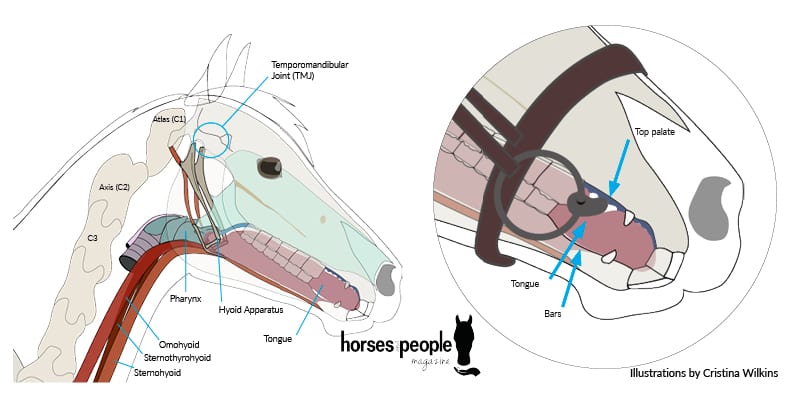
A good example is the tongue’s anatomy. Did you know that the shape, size and muscularity of the tongue differs greatly from horse to horse? This means that the position of the bit – where and how the mouthpiece lies on the horse’s tongue – will depend on the horse’s tongue itself (how your horse moves the tongue and how the tongue is anatomically shaped), but is also influenced by how the rider handles the reins. One affects the other and vice versa.
The horse’s anatomy has to be carefully considered when fitting a bit. Every horse is different and the same bit will sit and act differently between different horses and will even change depending on how the rider sits and/or uses the reins. Illustrations by Cristina Wilkins.
If there is too much pressure on the tongue, it may affect circulation, resulting in the horse pulling up the tongue or bringing it to one side or the other, which will affect the initial measurements and observations you made while having an initial look inside the mouth.
Bits that are poorly fitted will encourage the horse to move the tongue away from the bit’s peak pressure points, mostly resulting in damage to other structures like the bars that now lack protection from the tongue.
It is a misconception to think that bits place direct pressure on the bars. This should not be the case when the tongue is resting between the bars and the bit, but this does happen when too much pressure is applied, or the wrong shape of mouthpiece is used and the horse retracts the tongue in an effort to relieve the discomfort.
And it is not just the tongue that is important in the horse’s mouth.
It takes experience comparing a lot of horses to know if, for example, a palate is quite low or normal, and more importantly, whether a particular horse finds the palate an extremely sensitive area or not. Each horse is an individual, one size fits one.
Different bits and mouthpieces apply pressure differently on different areas and every horse has different sensitivities. If your horse is sensitive on the tongue and has a very low palate, the correct choice might be a thin bit that stays away from the palate as much as possible and doesn’t take up much space on the tongue and in the mouth.
The rider
However, a thin bit may not be a good choice if the rider is not a sensitive rider and uses strong rein tensions. Despite the original intention of making the horse more comfortable, the thin mouthpiece may not work in the wrong hands. When I come across such cases, I may choose a bit that has a wider bearing surface on the tongue but still isn’t too thick in height so as to avoid pressure on the palate.
A bit should be fitted to both, the horse and the rider!
This is why ICPBC Bitfit consultants are trained to assess not only the horses’ anatomy, but also the rider, and why a consultation is more complex than simply looking inside the mouth and trialling mouthpieces.
Even riders who prioritise self-carriage and use light rein pressures can have different riding styles that affect how the bit acts inside the horse’s mouth.
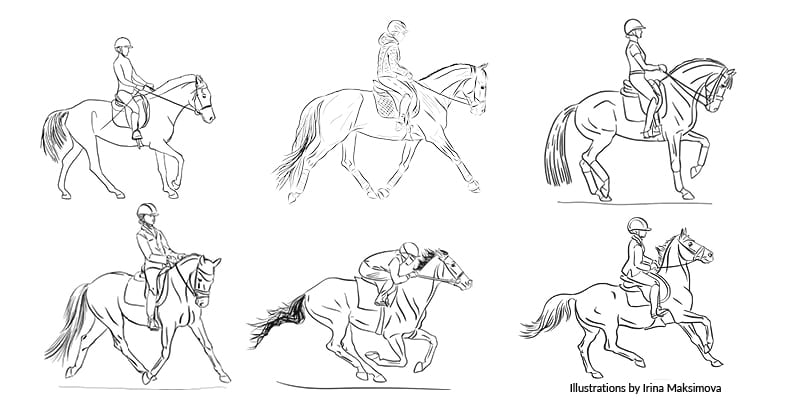
For example, some ride with their hands held higher up, others lower down. Some ask for greater degrees of lateral flexion of the horse’s neck, others don’t. Some ride their horses in a lower or rounder frame while others don’t.
The rider’s posture the way they hold their hands, the amount of contact and how they use the reins affects the action of the bit and this is why a Bitfit consultation always includes watching horse and rider in action. Illustrations by Irina Maksimova.
The way you apply rein aids (the direction of the force in relation to the horse’s mouth, and the amount of pressure you use), and the frame you ride your horse in are important for determining the right choice of bit because it affects the tongue’s position, the bit and therefore, the entire body.
The TMJ
Tension and discomfort in the mouth transfers directly to the temporomandibular joint TMJ (see previous article), as well as the muscles of the neck and shoulder, which will end up restricting the movement all the way to the hind legs – because muscle and fascia chains are interconnected and run along the entire body.
In the long term, horses who have poorly fitted tack and bits that hurt more than they should, will develop muscle spasms and other restrictions on the musculoskeletal system. And, importantly, these restrictions can only be assessed in movement. In a similar way, long-term muscle spasms and musculoskeletal restrictions will affect the rider’s ability to establish a sensitive contact with the horse’s mouth.
If your horse has trouble relaxing on the bit, everything needs to be taken in account.
This is what I call the whole-of-body approach and it is the reason the ICPBC only trains Bitfit Consultants with an already established professional background, such as veterinarians, qualified equine dentists, physiotherapists and osteopaths.
This requirement is great news for you and your horse.
If you suspect your contact issue is a result of poor dentistry in combination with the bit, it is a good idea to choose a Bitfit consultant who combines these two professions. On the other hand, if you have already eliminated and treated any dental issues, and you are already quite happy with the bit you use, you might be better choosing a Bitfit consultant with a background in physiotherapy or other body therapy.
Ultimately, the more thorough the assessment, the better chance of the result matching your expectations. Nevertheless, do remember that the bit is only one piece of the puzzle and it is likely that you will need to find some more pieces before your problem is completely resolved.
Horse riding and training skills, together with knowing how to influence the biomechanics of the horse are very important. This realisation has led the ICPBC to launch an online education course especially for coaches/instructors to become more specialised in bitting and contact issues.
We will offer a webinar with Horses and People about rein tension and how to improve contact issues. Some of the areas we will cover will help you become aware of what happens in the horse’s mouth when you give a certain rein aid, and we will relate it all back to Bitfit consulting.
The history
Just like a medical appointment, a Bitfit consultation starts with taking in a comprehensive history and learning the background information about horse and rider. I like to ask for the horse’s breeding as well, because most horses that share a bloodline also share certain temperament and physical characteristics, and this helps me narrow down the horse’s preferences.
The questions asked and the responses you give about your horse from the start will give the Bitfit Consultant and yourself a great deal of information. For example, a standard question when we talk about contact issues is: Since when has the horse been showing this behaviour? If the answer is ‘he has always done this’, I will ask the owner if anything changed around the time the behaviour started for the first time.
Often, owners will have an Aha! Moment. They may say; ‘Well, he did get his new saddle around that time’, or ‘well, he did have an incident on the trailer or the pasture’, ‘we did change to another bit/bridle’ or ‘we did change instructor’.
All these things and many others can have a huge influence on the contact. I once found a stitching needle that was left behind in the wool flocking of the saddle and it was thanks to me asking such questions that I had the idea to check the saddle panels. I found a hard item inside them which turned out to be a stitching needle and it was causing what looked like a ‘tongue problem’. In reality, the horse couldn’t loosen his back muscles and the tension was travelling through the rest of the body and showed up as a tongue issue.
When a horse contracts and holds a single muscle, slowly but surely, the rest of the musculoskeletal system will compensate and adjust – not always in a beneficial way. The detailed history (anamnesis), will provide some clear direction for the Bitfit consultant.
Check of the head and mouth
After the anamnesis the first check is an examination of the head and mouth. No two horses are the same and there are also many differences between breeds and countries. In the Netherlands especially, you will see that horses are bred with very fine and relatively small heads, but their tongues are not always as small. With a thick tongue that takes up most of the horse’s mouth, there isn’t much room left for the bit.
The Bitfit consultation starts with getting the history, then moves on to a thorough check of the horse’s body and anatomy.
The idea that a thicker bit is kinder just simply doesn’t work for these horses. They need mostly a thinner bit or a more curved mouthpiece to be comfortable, but you have to pay attention to the rider! If the rider is not sensitive, I still recommend a thicker bit with the right shaped mouthpiece.
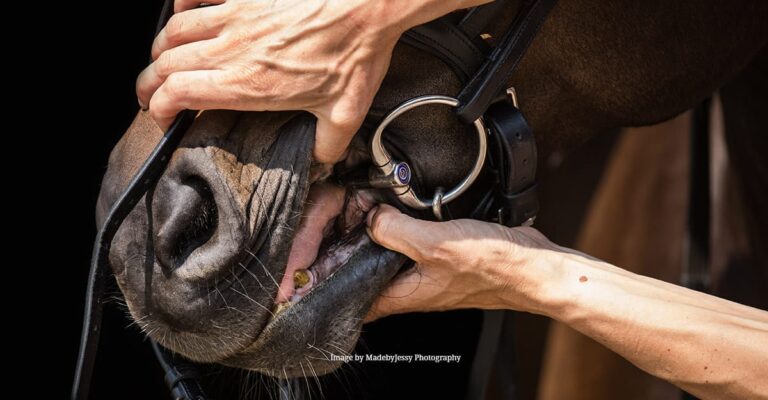
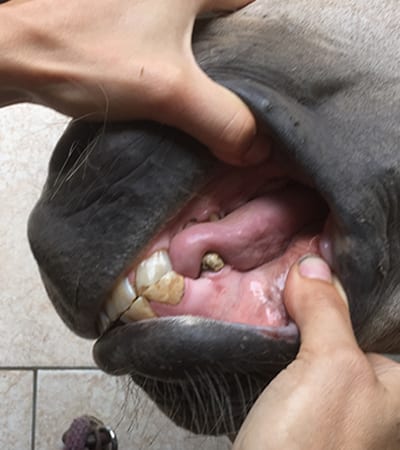
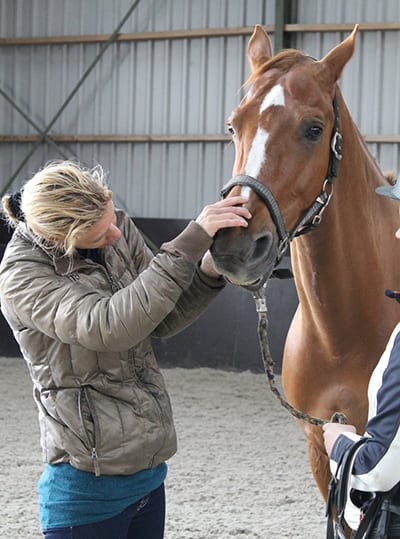
You can check if your horse has a thick tongue yourself. To do this, lift your horse’s lips when the jaws are closed. If the tongue is bulging out of the diastema (the space between the incisors and the molars), and there is no free space between the tongue and palate, you could say the horse has a thick tongue.
This is actually quite normal, so there’s no need to become distressed. I get many calls from horse owners alarmed because their horse has such a thick tongue that it fills up the whole dental cavity. Most of these horses will still be able to accommodate a bit and I have only ever seen a handful of extremes that could not. The question will be finding the right mouthpiece.
The palate
The roof of the horse’s mouth is what we call the palate. Some horses have low palates and almost no arch, while others have a fair arch. When it comes to bit-fitting, the more space the better!
The space that is left between the tongue and the palate determines how thick a mouthpiece can be accommodated comfortably. Of course, the ‘density’ (muscularity) of the tongue also plays a role in determining the space available. A tongue with quite a hard feel, a fleshy tongue, is different from a softer tongue.
A common mistake made when presented with a thick fleshy tongue is choosing a bit with a high port in an effort to ‘keep pressure off the tongue’. It’s all very good trying to relieve pressure from the tongue, but does the horse actually have the extra space between the tongue and the palate for a high port? Otherwise, the horse will start ‘stargazing’ as he tries to relieve himself of the bit pressing against the palate.
When I’m bit-fit consulting for a client, the sensitivity (and unfortunately sometimes bruising) of the palate usually tells me which bit the rider uses. Another major drawback with using unarticulated mouthpieces with high ports is that you can’t keep the port in the centre of the mouth when you pull on one rein. In such a case, the bit will always slide towards the side that is being pulled and will take the tongue along with it, leaving the bars on the opposite site without protection of the tongue and exposing them to being damaged.
The bars
The area on the lower jaw between the incisors and the molars is what we call the bars. This toothless (apart from canines) area is often injured or bruised as a result of choosing the wrong bit or by bad riding and training.
Check the bars by running your finger over them. I use my thumbs for this. If you want to try this yourself, keep your thumbs low, to avoid getting them caught between the first molars – that really hurts!
The bars should feel smooth and flat and should not be painful. The bars can be thick or thin, which may affect sensitivity. Bone spurs can be found on the bars and are almost always a result of poor bit use or riding with the wrong bit for quite a while.
The examination of the mouth includes teeth, first molars, gums, inside of the cheeks, structure, blind wolf teeth etc.
The head is checked for asymmetry in conformation and/or muscling, sensitivity of certain nerves on the head but also the skin. Often, you may find sensitivity of the nasal area or around the ears. In this case, the bridle and nosebands are often to blame. Poor fitted headpieces, small browbands and over-tight nosebands cause the headpiece to press against the ears and over the many nerves in this area. The nasal bone and lower jaw bones, of course, can be damaged by tight nosebands.
Checking the back
The anatomy of the head and mouth, particularly the asymmetry of muscles, can signpost to the stronger side of horse or rider and sometimes, even what kind of bit you use. In any case, to gather more information and get a complete picture, the whole body is checked as well.
Depending on the additional training of your ICPBC Bitfit consultant, the body check will be a longer or shorter examination, but all consultants will check the neck vertebrae for blockages and focus especially on the atlas and axis (which gives information about flexion (C0-C1) and rotation (C1-C2), as well as the junction between the cervical spine and the thoracic spine, including first rib.
The lower neck provides really accurate information on which side the horse leans on and is the start to making even more connections as one follows the fasciae lines and muscle chains. Just like people, horses compensate in patterns.
To fix a severe contact issue, you need to figure out which pattern your horse’s posture is in and what can be done to get him back to a more advantageous way of moving resolving the contact issue.
Personally, since my background is in a variety of bodywork therapies and riding instruction, I like to sometimes combine manipulations of the spine with changing the bit and adding some instruction.
The bit
If you have read to this point, you should now understand that the bit and bridle are links in a long chain.
Nevertheless, they are very important and I’m glad that interest in bit-fitting is growing around the world. I have witnessed amazing results with horses whereby neither the physiotherapist, the dentist, the trainer or the combination of all three could get good results, and all it took was changing the bit to a proper fit and immediately you could see the whole horse change.
When you relieve the tension in the mouth, the whole body has a chance to relax which immediately meant the rider was relying less on rein tension. This is why the riding style and practice should always be a part of the bit-fit consultation.
Once the Bitfit consultant has enough information from the history and assessment of the horse, they will offer a few options of bits that will fit the anatomy of the individual mouth.
From those options, the next thing is to test how the horse responds to the rider’s rein aids and find which of those options the horse prefers. The horse should be the one who decides. Yes, it is important that the rider is comfortable with a certain bit, but the horse should be leading the discussion.
A note about lightness…
Sometimes, a horse can feel really light in the rider’s hand, but this feeling is actually created by the horse moving away from discomfort and pulling the tongue up, exposing the bars. When another bit is tried and the tongue is more relaxed, the horse may feel a bit heavier for the rider but if the horse’s body improves in motion, it can be the sign that this is a better bit for this horse.
Your Bitfit consultant needs to watch the horse and rider and find a bit that will achieve the biggest improvement over the long-term. The ‘light in the hand’ bit mentioned in the example above might seem like a good solution to the rider, but if the lightness is the result of the shortening and tensing of muscles (which you can see when you know where to pay attention), this lightness will not last and after a couple of days your horse will deteriorate or feel just as bad as before.
Ultimately, Bitfit consultants assess and advise on the contact.
When dealing with an ICPBC consultant you will be able to purchase a bit, but sales should not be their main goal because you are paying for their advice. If your own bit is the correct fit, they will tell you. At least this is what the ICPBC is aiming for, shifting the paradigm from a sales-oriented consultation to a welfare-oriented one.
If you buy a bit from your ICPBC consultant and it turns out not to work as expected within a certain time frame, the consultant will help you find another alternative, either swap the bit or take it back, charging a small fee for polishing the bit again.
All these services combined should make it easier to find the correct bit. A consultation with an ICPBC consultant should provide many insights and ultimately will help you develop your communication and relationship with your horse. I have seen it work time and time again, and I know it can!
What do you picture when you think about ‘self-carriage’? Many of us picture a horse, perhaps in a dressage arena, travelling in a certain outline and maintaining gait and direction. In this article, however, I am going to discuss why self-carriage has a much wider definition and how important it is to all riders and horse handlers, regardless of their level of experience or discipline they choose to enjoy.
Although our first thought of self-carriage may invoke mental images of dressage horses, sadly, modern dressage is often a display of just the opposite.
The term self-carriage literally means the horse is maintaining itself without needing support from the rider, whereas in modern dressage, most horses are pushed and ridden with a strong contact (unrelenting pressure) on the bit and often, the same from the riders’ legs.
This unrelenting pressure is in direct violation of the International Society for Equitation Science’s (ISES) Training Principle #6: The correct use of operant conditioning, which explains that pressure must be released at the onset of the correct response.
Self-carriage is the focus of the tenth ISES Horse Training Principle:
10. Regard for Self-carriage
Aim for self-carriage in all methods and at all levels of training.
Train the horse to maintain:
gait
tempo
stride length
direction
head and neck carriage
body posture
Avoid forcing any posture.
Avoid nagging with legs, spurs or reins i.e., avoid trying to maintain responses with relentless signaling.
”Lack of self-carriage can promote hyper-reactive responses and compromise horse welfare.”
This definition is excellent for the ridden horse – of any discipline – but I think we can take the self-carriage concept even further than this to improve our training and handling of horses in all aspects of the horse-human relationship.
Self-carriage simply means maintaining precisely what the horse has been cued to do until you signal the horse to do something else.
Using a ridden example of riding a 20 metre circle at canter, the horse should maintain the canter, at the same speed, length of stride, in the same direction, with unchanging head and neck carriage and consistent body posture – all without the rider having to ‘hold’ or ‘force’ any of these elements.
If you have to constantly correct your horse to keep it on the circle, keep your inside leg on to maintain direction or both legs to maintain speed, if you need a ‘good, solid contact’ to hold your horse’s head and neck in position or to elevate the forehand and shoulders, then you are not in self-carriage.
In practice, however, this can seem a bit depressing because, how many of us have a horse that will maintain a 20m canter circle with all of the above without the need for some intervention?
Very few, I would estimate.
But remember, this is what we are aiming for, and, with the correct training, exactly what we can achieve.
Understanding the concept of self-carriage allows us to train with this as our aim and, along the way, we get a huge array of benefits:
We have to be clear in our mind about exactly what we want the horse to do and what we will use as motivation to encourage the horse to do that
Once we have decided on #1, we need to know exactly when we are going to release the pressure and reward the horse
Knowing this means we become very aware of when we have pressure and when we do not
It follows then that our use of combined reinforcement improves as we use the pressure-release-reward sequences repeatedly
In turn, the horse is able to relax as we are setting up easy-to-follow patterns of pressure-release-reward
The horse gains confidence, learns the sequence and begins to anticipate the predictable pattern
The horse is now in self-carriage, responding before pressure needs to be applied and continues until signalled to change something (such as speed or direction)
If we think about some of the common expressions we hear, such as ‘inside-leg-to-outside-rein’ or ‘keeping a good contact’, it begs the question of how these can coexist with self-carriage.
A horse that is in self-carriage at the mounting block will stand there until asked to move off. Image courtesy Kandoo Equine.
Of course, they cannot coexist! And this is a good reminder that we should always be training with the aim of reducing the pressure required to achieve the response. This is done by providing the horse with consistent pressure-release-reward sequences, always beginning with the lightest possible pressure cue.
The lightest pressure cue is often a verbal cue. While we don’t always think of our voice as a pressure cue, it is exactly that and, when used before a tactile signal, allows the horse the opportunity to respond before the heavier cue is applied.
Earlier, I mentioned that self-carriage deserves a wider definition and application than that which is currently common. I think it is important that we apply the principle of self-carriage – continuing to do what has been asked until signalled to do something else – to everything we do with the horse and that we start doing so as early as possible in the horse’s training.
By having self-carriage as our aim in all interactions with our horse it teaches the horse to be responsible for himself or herself in terms of their position and movement at all times.
Self-carriage is as relevant to trailer loading as it is to picking up feet, leading or riding that 20m circle. We always want the horse to do what we’ve asked until we ask them to do something else.
When we view all training and handling in this way, it helps us become aware of the signals and pressure cues we are giving the horse and thus, also be more aware of providing a timely release.
A horse that stands untied while being groomed is in self-carriage.
We’ve all ridden a horse that needs verbal encouragement, or even kicking, every stride to stay in trot, or a horse that lags behind on the lead and seems to need dragging along. But what if we could teach the horse self-carriage in these instances? Couldn’t we apply the self-carriage principles to picking up feet, standing at the mounting block or standing at the tie-rail?
I think that it is not only possible that we could, but also that we should do this for the benefit of the horse. What does that look like?
Examples of self-carriage
A horse that is in self-carriage at the mounting block will stand there until asked to move off.
A horse in self-carriage when with the farrier will hold up each foot until the farrier returns the foot to the floor.
Self-carriage for trailer loading looks like the horse that loads on to the trailer and waits quietly until he or she is signalled to back off.
Better relationships
By incorporating the concept of self-carriage into all of our training – from foundation training on the ground to advanced work under saddle – we can greatly improve our relationship with our horse. This is because teaching self-carriage requires us to be mindful of when and how we use combined reinforcement and makes us less likely to subject our horses to nagging or unrelenting pressure at any time.
With this in mind, how then do we go about incorporating self-carriage into our everyday handling and training?
The simple answer is to always have a ‘start’ and ‘end’ cue for any behaviour.
Let’s look at an example; with trailer loading, we teach getting on (just one foot at a time) and getting off at the same time. By doing this, the horse learns to wait for the signal to get off and learns not to back out before getting that signal.
A horse that loads on to the trailer and waits quietly until he or she is signalled to back off, is in self-carriage. Image courtesy Kandoo Equine.
The same is true for lifting and cleaning your horse’s feet; you have a signal, such as running your hand down the leg to lift the foot and when you have finished, you place the foot back on the ground and reward your horse.
If you simply drop the foot unannounced (without placing it gently down), you are un-training self-carriage – the response of keeping the foot up will become unpleasant because it becomes unpredictable for the horse (not to mention possibly jarring for his/her toe when it hits the ground).
Think about this next time you are teaching your horse something – anything – be it shoulder-in or to pick up the feet. You want a cue to go into the movement and a cue to come out of the movement.
Horses learn very well from predictable patterns and we all know they really don’t like surprises!
Training self-carriage in this way will make your horse’s life predictable and give your horse confidence.
When you begin to integrate small changes to your training and handling routines, such as focusing on self-carriage, it’s great to be able to measure your progress and see how it is helping your horse.
You can do this by completing an Equine Behaviour Assessment and Research Questionnaire (E-BARQ) on your horse every six months.
This will tell you how his or her trainability and rideability are improving and also how your horse’s confidence and compliance are improving. Your attention to self-carriage should improve each of these E-BARQ elements.
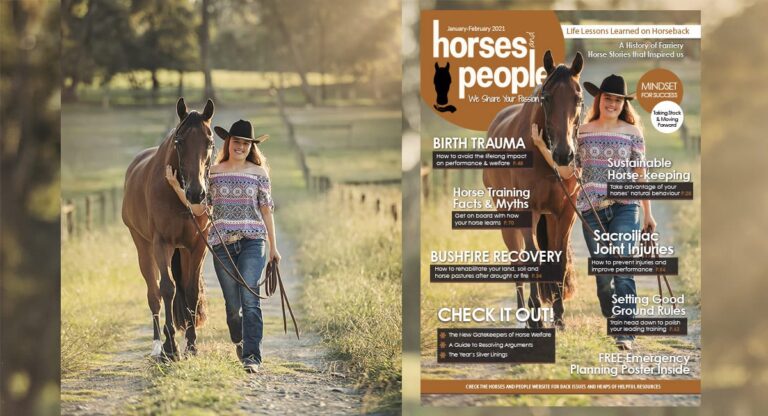
On our cover this issue we feature Hanna Rush and her Quarter Horse gelding Triandibo Roc n Lynx, also known as Doug or Dougie. The pair were photographed by Louise Sedgman as part of the Sweet Teen Project, an initiative to fundraise for Headspace Australia, an organisation working to support the mental health and wellbeing of our youth.
Hanna was one of the first teenagers to sign up at the start of the project. Her mum Emma, a professional photographer herself, was keen to support the cause and capture some memories because, as she says, “when photography is your day job, you tend not to pick up the camera with the kids.”
The photoshoot took place in March and soon after, in the blink of an eye, future plans came to a screaming halt as the COVID-19 pandemic placed the entire world in lockdown.
It’s nine months now and the Rush family, who live in the Yarra Valley near Melbourne, Victoria, have been in lockdown for so long, they are yet to visit Louise to see the photo collection. It has been a challenging year for all of us, but Victorians have endured the longest period of lockdown, including home schooling, in the entire world.
For Hanna who just finished Year 9, the routine of caring for and riding her horses has helped her deal with home schooling, being isolated from friends and unable to participate in horse-related events. “It’s really helped” she says. “You wanted to get schoolwork done really quickly so you could get outside!”
Her mum Emma is grateful that Hanna enjoys what has been her own life-long passion, especially because there was a time, about four years ago, when she expected Hanna to give up horses. “We were going to pony club and Hanna really didn’t like the jumping side” says Emma. “But we are very lucky to live near Trish Wettenhall and her Triandibo Quarter Horse Stud and Training Centre, and it sparked her interest in Western. Things have evolved from there” she adds.
Some years earlier, Hanna’s dad, David, had purchased himself a Quarter Horse mare and, after realising her good breeding, he decided to put her in foal to one of Trish’s stallions. This was the beginning of a family-wide pivot from the traditions of pony club to the world of Western and the love of the wonderful Quarter Horse breed.
“The AQHA [Australian Quarter Horse Association] and all the people at the shows are really welcoming and everyone is there to help each other out” says Hanna. “We fell in love with the breed as well. Quarter Horses have such wonderful temperaments” says Emma.
Emma adds that Trish’s passion for her industry, her encouragement and generous approach was instrumental in re-igniting Hanna’s enthusiasm. As Hanna progressed, Trish suggested she try one of her older schoolmasters, Doug. She continued having lessons on him at Triandibo Stud and as the partnership grew, Trish offered to lease the gelding to the Rush family so they could take him home.
It’s almost four years since they first met and everyone agrees the relationship is nothing but a great success. “Doug has thrown a lot of talents my way. He’s quite special. He’s taught me how to ride” says Hanna.
And the feeling is reflected in results, with the pair getting High Point Youth in Victoria in November 2019 and NSW in March 2020. Both Emma and Hanna are keen to get back into showing in 2021. Hanna’s favourite classes are Ranch and Showmanship, but she’s keen to try and master the flying changes and other training challenges of Western.
Hanna says she loves Doug’s quirky personality. “He’s a Super Lynx [progeny], and they are known to be a bit more special. He’s one of those horses that really picks up on how you are feeling” she says.
“He gets upset if I am nervous because he’s worried. When I started showing I used to get quite nervous and while I still do, I have a lot more trust and he has a lot more trust in me, so we’re a really good strong team now.”
And it seems that Doug has taught Hanna the most valuable of life lessons; “We have our good days and bad days, and it’s never going to be perfect all the time, but that’s what makes doing so well a lot more special – because it’s been a good day and you work hard for the good days” she says.
Louise Sedgman’s Sweet Teen Project is capturing the relationship and connection teenagers feel with their horse and gives them an opportunity to shine in front of the camera, while raising funds for Headspace Australia
To find out more about The Sweet Teen Project, pre-order the book or make a donation, visit Louise’s website: www.giddyupphoto.com or find her on Facebook.
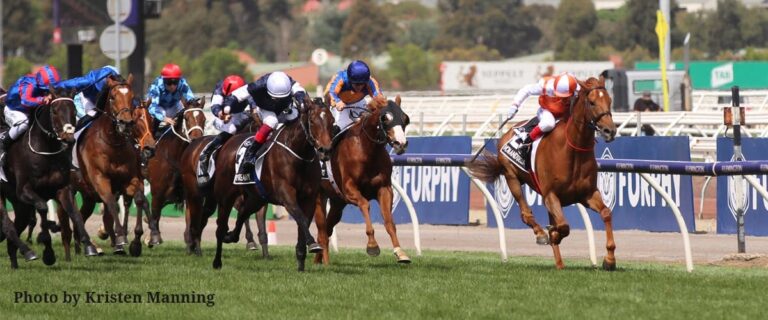
Racing Victoria (RV) has today confirmed that it will not be conducting any ‘whip for safety only’ race trials for the foreseeable future, including during the 2021 Festival of Racing.
RV does have plans for a new race series to feature during the 2021 Festival of Racing, the details of which will be announced under separate cover shortly.
RV outlined publicly in September 2020 its belief that the current national whip rules are no longer appropriate. RV believes that whip reform is essential if racing is to retain its existing audiences and, importantly, ensure that it is attractive for the fans and employees of tomorrow.
RV stated that it will always support the carrying of a whip by jockeys on safety grounds and that the industry’s immediate priority should be reducing its maximum permitted usage to between five and eight times per race in line with many other leading international jurisdictions.
RV formally tabled its position at last month’s Racing Australia (RA) Board meeting where it also reaffirmed that it is a willing and active participant in the review of the national whip rules being undertaken by RA’s Riding Advisory Protocols Panel.
It is RV’s hope and expectation that the RA review will be well advanced within the first quarter of next year and that meaningful progress can be realised.
In the meantime, RV will continue to engage with industry stakeholder groups and racing customers on the important subject of whip reform, which will include exploring ways to obtain insights into the potential impact of RV’s recommended reduction in whip use.
The current Australian Rules of Racing permit the use of the whip a maximum of five times in non-consecutive strides prior to the 100m mark and at the rider’s discretion in the final 100m of a race where its use in consecutive strides is permitted.
Britain (7 times per race), Ireland (8), Germany (5) and France (5) limit the number of permitted uses across the totality of the race, while in the USA, the states of California and Kentucky have announced recent reductions in their permitted totality (6).
Update from the Editor: Since March 28th 2021, all Thoroughbred races in the state of New Jersey, USA, are being run under ‘whip for safety only’ rules that prohibit the use of the whip for purposes other than to protect the safety of horses and jockeys.
My obsession with horses apparently began at a very early age. There was absolutely no family background for this obsession to occur. My mother and father had never even been close to a horse, other than those which featured in their lives as working animals. They were city folk.
I was born in Auckland, New Zealand, and we lived there, in safer times. The front door was always open if the weather was kind. One morning my mother couldn’t find me and ran out the front door to see me sitting cross-legged among the four great feathered hooves of the milkman’s delivery horse, goo-ing and giggling and stroking those feathers. I was about 18 months old, and my horse-obsessed journey has never faltered since.
I cannot now remember when I first read a horsey book, although I was apparently a precocious reader. Even if I cannot recall the precise moments of entering the world of fictional horses and riders, I know that my childhood was infused with the characters from this horsey world:
Black Beauty and Ginger (Black Beauty, Anna Sewell, 1877); Velvet and The Pie (National Velvet, Enid Bagnold, 1935); Alec and The Black (The Black Stallion, Walter Farley, 1941); Ken and Flicka (My Friend Flicka, Mary O’Hara, 1941); Ken and Flicka’s son, Thunderhead (Thunderhead, Mary O’Hara, 1943 – I still have a movie tie-in edition of Thunderhead, with great stills from the Roddy McDowell movie); Jill and her Black Boy (Jill’s Gymkhana, Ruby Ferguson, 1949), more recently politically corrected to Danny Boy; Darren and his Snow Cloud (Snow Cloud Stallion, Gerard Raftery, 1953).
I spent my childhood and early adulthood yearning for a horse of my own, finally achieving that goal only at the advanced age of 26. Until then, I had spent my life immersed in horsey books, elaborate fantasies, wishful thinking, and riding other peoples’ horses with varying degrees of success. Somehow it never felt the same as it did in the books.
My most elaborate – and most heart-breaking – fantasy came from a competition being run by the UK’s Daily Mail, when I was an 8-year-old child in England in 1958. Somehow or other, the prize was a pony.
I can only imagine the panic such a competition must have engendered in the parents of pony-mad children, no doubt involving hiding the paper from yearning eyes, and other clever strategies.
I saw the ad for the competition and entered. I was convinced that I was going to win this pony. He was already mine as soon as I entered the competition. I saw myself leading him into the garden of our tiny (rented) cottage in Berkshire, putting him to bed in his (non-existent) stable, riding him around the lanes, all tacked up in his (non-existent) gear, transporting him to Miss Smith’s riding school on the weekends in his (non-existent) float, drawn by my father’s real (and miniscule) Austin A35.
I lived deep within this fantasy for weeks, waiting for the announcement that the pony was being delivered to me. So real was this that 60 years later, I can still recall almost all its details; however, that reality is nowhere near as vivid as my heartbreak when the winner was announced, and it wasn’t me.
I demanded that my mother write to the editor and check that he hadn’t made a mistake. It may not be too long a reach to state that this disappointment and sense of loss underlay my lifelong yearnings to own my own horse, and may also be a link to another of my extended and elaborate fantasies as a child, one which I dangerously acted out.
Darren, the hero of Snow Cloud Stallion (1953) comes across a magnificent white stallion in the woods, which of course bolts off when sighted. Darren returns, riding his mare Goldilocks, with a halter and some pellets.
The stallion reappears, demonstrates that he was once at least tractable, so Darren slips off his mare (yes, mare), places the halter on Snow Cloud, and starts riding him bareback. I think Goldilocks obligingly takes herself home.
He eventually ‘tames’ the stallion, but of course, trouble is looming. Trouble always looms in horse books; in fact, it looms in all animal stories, I believe.
I can’t find my copy of Snow Cloud Stallion now and cannot remember the ending, but I do remember the cover illustration, of a superb white stallion, with flowing mane and tail, propping hard on the back legs, ears pinned.
Snow Cloud inspired a new fantasy for me: I would find a wild horse, tame it, and ride on to fame and glory.
We lived in the Berkshire countryside by this time and I was at boarding school, coming home only for the occasional weekend and the school holidays.
Both my parents worked in London and I usually spent the day time at home alone. This was perfectly acceptable then, I promise. While my parents were at work I would happily wander about our village, dressed in my jodhpurs and carrying my crop, in the hope that someone would magically offer me a ride on their pony. They never did.
I was a solitary child, with a vivid imagination. I drove a team of 8 black horses from a fork in the apple tree; I trained one of our cats to compete in Olympic show jumping over an obstacle course made in a trench in the snow; my best school friend and I rehearsed and perfected an elaborate system, complete with reins and bit, in which we would impersonate horse and rider, one behind the other, cantering about the schoolyard, one neighing and snorting, the other shouting ‘Hup!’ as we flew in perfect synchrony over quite large obstacles.
At the time, I was taking riding lessons with Miss Smith, one lesson each school holidays, at 5 guineas each, plus occasional extra lessons at mid-term weekends at home.
My father had foolishly promised me a riding lesson any time I came top of the class. With pride, may I say that this promise cost him a fortune? Miss Smith taught the Queen and her two older children to ride, and had a large plaque in the stable block, confirming her ‘By Royal Appointment’ status.
She was ruthless and unforgiving. In the entire time I had lessons with her, she never once let me off the leading rein. She towered above me on her hunter, clad in a tweed jacket and a bowler hat, armed with a short thick stick, with which she would whack Toby the pony on the head, should he make a grab at passing grass, shouting ‘Come up, sir!’.
Leading rein or not, we walked, trotted, cantered, galloped and jumped small fences, side by side, Toby going flat out to keep up with her giant hunter. Toby wore a double bridle for all these lessons, and I was taught from the outset the correct use of the snaffle and the curb bits, and the reins.
I would have the entire term at school to populate my horsey dreams with what I would do during these one-hour lessons: Miss Smith would be so impressed with my riding skills that she would let me off the leading rein, invite me to jump the course set up in the arena, and then, impressed with my ability, leg me up onto her hunter and send me forth to conquer the equestrian world.
Sadly, in the real world, we trotted along, with me occasionally being smacked on the head when she missed Toby’s. The most exciting things that ever happened were as follows: first, one of the grooms let me ride one of the school horses bareback in his loose box, so enormous in size that we could actually canter round it. The groom was fired.
Second, one day once mounted, we were all issued with pieces of tissue paper and told to keep them between our knees and the saddle, at risk of no longer being able to take part in the lesson should we drop one. I had an itchy ankle, leant down to scratch it and promptly lost my tissue paper. My father also lost his 5 guineas, as this happened before the lesson even started.
Third, Miss Smith invited me to join the riding school in going hunting with the local, very famous hunt club. I could ride Toby, we wouldn’t jump, just gallop with the hunt, still on the leading rein, all for the reasonable cost of 75 guineas. My father earned 5 guineas a week. Needless to say, I never went hunting, on Toby or any other horse.
But to return to my wild horse fantasy: on one of my solitary school holiday meanders, parents safely away at work, I came across a group of horses (probably ponies, really) in a series of connected fields. There were about 7 or 8 of them, good looking, friendly, and always happy to accept a carrot or an apple from me. One in particular I admired, a lovely bay horse with a long mane and a thick tail.
After a few visits, I grew bold and would go into the field with them all, running alongside them as they trotted and cantered about. I felt as though I was one of their herd. In my mind, my little bay friend transformed into Snow Cloud, a glowing smoky grey, huge, wild, both a threat and a challenge.
One day when I was visiting the horses, Snow Cloud was standing conveniently by the gate, so I just slid my leg over his back and grabbed a handful of mane. He walked off, followed by all the others, and then suddenly we were in a wild sideshow alley ride, belting down to a narrow gate into the next part of the field, swinging around the corner and cantering off to the next one. I have no idea how I stuck on, but in my mind Snow Cloud and I were galloping through the wintery pine forest, merging our futures into one superb dream of greatness.
I did this day after day, calling the bay horse over to the fence, slinging a leg and careering off around the fields, with the others in joyous pursuit. Until one evening someone knocked on our door, to tell my parents that their wild child had been riding his stallion in a mad scramble around his fields, upsetting his mares, and risking her life. Snow Cloud was real!
I had been riding an unbroken stallion, leading his mares in a wild gallop for minutes at a time – a girl who had never been off a leading rein before. Fantasy became reality for me on that day. How did a timid rider who even into her 30s was nervous about riding anywhere but an indoor school manage to subsume her fears into her fantasies? This remains one of the great questions in my horsey life.
While I may have waited nearly 30 years to achieve my own horse ownership goal, I have never stopped reading books about horses. I have read every word that Dick Francis wrote, all of his books being re-read multiple times.
His capacity to describe horses and the feelings associated with being around horses is unparalleled, in my opinion. (By the way, Dick Francis’ father worked for Miss Smith.)
As an adult I have read some seriously good horse books: Horse Heaven by Jane Smiley; The Horse Whisperer, by Nicholas Evans (the opening sequence is almost unequalled in its descriptive power, resonating kinaesthetically with anyone who has ever ridden a horse); Riders by Jilly Cooper, a horse rider’s secret guilty pleasure; and Airs Above the Ground by Mary Stewart, written by a supreme story teller who introduces the haunting beauty of the famous Lipizzaner horses into a romantic thriller.
At the moment, I am reading a series of young adult novels by Claire Svendsen, available on Amazon, about a young girl from a troubled and unhappy background who aspires to Olympic show jumping selection and who rides a splendid pony, Bluebird. I recommend these to anyone who yearns for old-fashioned horsey books. I have just finished number 45 in the series, and I am still as thrilled with them as I was at the beginning.
I must also confess that as a child I was an avid collector of ‘how to’ books. I bought them with my own saved pocket money or was given them as gifts by wised-up relatives. They formed the knowledge background to my dreams and fantasies, and introduced in tangible form the horse and rider heroes who peopled my horsey world. I still have these books.
Horses have populated my dreams, my aspirations, and my life. Did my youthful fantasies mould my adult life? Probably so. Was it just good luck that my dream job came up at exactly the right time in my life? Probably not.
As CEO of Equestrian Australia during the 1990s and early 2000s, my tenure included our home-based Sydney Olympic Games, surely every horse-lover’s dream. I had the opportunity to meet many current heroes, people and horses, and one or two childhood heroes as well. Showjumper David Broome, who featured in several of my childhood ‘how to’ books on his amazing horse Wildfire, signed his photo in one of my treasured books when I tracked him down at the Games. ‘What a memory!’, he wrote.
My horsey reading and my horsey experiences have never conspired to provide me with a gendered viewpoint about horses and their role in my life.
While my childhood horse and pony novels may have invented a world in which girls were more likely to be represented, my real-world experience reflected an almost equal representation of both male and female heroes, as well as male and female hero horses, and of course the one hero whose deeds I actually did try to emulate was male: Darren from Snow Cloud Stallion.
As an adult horse owner, I have only ever ‘owned’ geldings, but now as a 70-year-old rider, my current steed is a mare with a difficult temperament on the ground and a firm and abiding hatred of the horse she sees approaching her in the mirrors in the indoor school. The closer she approaches to her own image, the more she pins her ears and moves into attack mode. Sometimes it is interesting when the two actually meet.
On the other hand, she is the first horse I have ever ridden who can piaffe when asked, as against as an evasion from too much pressure. She has given me the best rides of my life, and I am now the best rider I have ever been.
They’re all horses, yes. But that doesn’t mean that little horses act like big horses when they’re in pain.
According to Dutch scientists, foals express pain differently from the way adult horses do. And because of that, they need their own pain-related facial expression scale that’s unique to baby horses.
A good understanding of pain levels that foals are experiencing can help people recognize problems, manage pain, and optimize drug dosing, said Thijs van Loon DVM, PhD, Dipl. ECVAA, assistant professor at Utrecht University, in the Netherlands.
So Van Loon and his fellow researchers took videos lasting up to 60 seconds of 20 foals, ranging from 1-2 days old up to six months of age in The Netherlands, Germany, and Ireland that had known painful conditions, like injuries, colic, or post-operative pain, before and after pain medication. They also filmed 39 healthy foals as controls. They then showed the videos to three observers who were unaware of which foals were healthy and which were not, or whether they had received pain medication or not. The observers were a senior anesthetist and his veterinary students who underwent a two-day training session on identifying different kinds of equine facial expressions.
They found that foals and adult horses share some of the same pain-related grimaces, like keeping the ears facing backwards and tightening the eyelids. However, they also found some major differences.
For example, foals don’t show the whites of their eyes more when they’re in acute pain, although adults do.
As Van Loon explained, that’s probably because foals just show the whites of their eyes all the time. “They’re constantly looking around, turning their heads and looking at different things around them almost continuously,” he said. “You see a lot of eye whites in these foals even when they’re playing or scanning the environment, so this was one of things that we wanted to take to into account and remove from the scale to avoid false positives.”
Foals also don’t show a Flehmen’s response in association with acute pain, unlike adult horses. In fact, healthy foals were actually more likely to make this characteristic upper lip curl than foals in pain were.
“This is also something we know from mature horses already, that the Flehmen response doesn’t necessarily mean that the horse is in pain because it’s a natural behavior,” he said. “But it is something that is especially associated with colic pain in mature horses, and there’s an obvious difference between healthy animals and animals in acute pain (with regard to adult horses). In the foal study, though, we saw a lot of healthy, pain-free foals showing a lot of Flehmen behavior, and this probably has to do with exploring the environment.” Foals exhibit Flehmen behavior from the first day of life and show it frequently enough that it can’t be used as a reliable indicator of pain, van Loon said.
The scientists also noticed that foals don’t often grind their teeth—even when they have them. “This is different from mature animals,” he said. “We didn’t see teeth grinding, either in the neonatal foals with no incisors or the older foals with teeth.”
One thing foals in pain did do that adults in pain didn’t, however, was smack their lips.
Lip-smacking might be one of the ways foals try to “work out the pain for themselves,” according to van Loon. “Maybe they’re trying to look for behaviors that help them, and maybe lip-smacking even leads to rushes of endorphins that help them cope with the pain, but at this point all this is a bit speculative. We just don’t know. ”
Despite the observers’ relative inexperience with recognizing equine behaviors, they all had similar findings when watching each video, Van Loon said. This strong inter-observer reliability indicates that with just some basic training, equine practitioners, breeders, and handlers could all easily assess pain in the foals under their care.
While this pilot study gave good oversight into specific pain-related behaviors in foals, more research is needed to confirm the results, according to Van Loon.
His team also hopes to fine-tune foal pain behaviors, to develop ethograms that are specific to different kinds of acute pain, like colic pain versus musculoskeletal pain. And further down the line, they also hope to create pain scales for chronic pain as well, he added.
Eventually, the results could lead to a foal-specific section on a future version of his research group’s “Equine Pain and Welfare App (EPWA)” mobile application, which owners can download for free.
The study is published in the open access journal Animals and is titled: Objective Assessment of Acute Pain in Foals Using a Facial Expression-Based Pain Scale by Johannes van Loon, Nicole Verhaar, Els van den Berg, Sarah Ross and Janny de Grauw. You can read the full text here.
Depending on their connection with horse racing, different people have different views about what’s “natural.” And that, according to one researcher, is having a major impact on the future of the sport.
While racing industry leaders might consider it “natural” for a horse to gape its mouth open under tight bit pressure or to act “eager” when he excitedly moves away from a handler who’s holding him by the bridle, and therefore see no reason for concern; animal advocates tend to disagree. For them, the horse’s behavior is a cause of unnatural conditions and an expression of stress or pain. And until the horse’s nature is taken into consideration, they believe horseracing lacks respect for who and what horses are, significantly threatening their welfare.
Such “dissonance” between the industry and animal advocates, as well as the general public, puts into question the industry’s legitimacy and its social licence to operate, according to Iris Bergmann, PhD researcher at the University of Sydney.
“We live in an era where the protection of the interests of animals has become the new social justice movement,” Bergmann said.
“Moreover, our knowledge of how horses experience their lifeworlds and what is being done to them is growing constantly. With animal welfare, we express how we see ourselves in relation to others—the horses in this case. And vice versa, we express how we see others—that is, the horses—in relation to ourselves.”
In her recent study, Bergmann spoke with nine racing industry professionals and seven representatives of animal advocacy groups in English-speaking countries about horseracing practices.
She selected four photos from a stock of nearly 1000 that represented common scenes on a race day. These included one unmounted horse avoiding contact from a handler holding his reins, a close-up of a ridden horse’s face with an open mouth while his rider keeps a tight rein, a mounted horse showing signs of stress while being surrounded by several people on the ground, and a facial close-up of a mounted horse opening his mouth and revealing his tongue attached with a tongue-tie.
Bergmann recorded, analysed, and compared the interview responses between the two groups of respondents. In particular, she viewed them within the “Layers of Engagement with Animal Protection” framework that she had developed in a previous study.
While there were exceptional outliers, racing industry leaders generally normalized what they saw in the photos, according to Bergmann. They either described the situation within the context of a Thoroughbred’s “natural” desire to race, or they qualified the scene as representing the nature of a horse that’s a product of specialised breeding for the industry and that doesn’t fully fit into the category of other horses and what ‘nature’ is, she said.
“They mostly did not regard the Thoroughbred as ‘nature’ anymore but as a product of human breeding, bred to race and wanting to race,” Bergmann said. “This reflects an instrumental view of the horse and allows racing people to rationalise the commonplace practices and interventions and not see the implications for what they are, from the perspective of the horse.”
Bergmann said she was surprised to not have “more subtleties” in the responses from the industry, she said. “The depicted practices were mostly defended and explained as normal and natural. They were trivialised and downplayed or ignored. So here were racing people active in key roles for reform mostly defending the status quo when it came to common racing practices. There were some exceptions (as discussed in the academic publication), but overall, a clear pattern emerged in the data.”
As for the animal advocacy leaders, on the other hand, they expressed concern that the horse’s nature was being violated in each photo and that these violations underscored inherent ethical issues with horseracing, said Bergmann.
As the public fights back against industry practices, calling into question specific techniques such as tongue ties and criticizing high injury and fatality rates, horseracing may find that it’s losing its social licence to operate, if it ever had one, Bergmann said.
“Racing horses as we know it with all that it entails is not consistent with the change required of us to transition toward a sustainable future,” she said. “The very purpose of horseracing is to have horses perform at and beyond their natural limits, which is facilitated with invasive legal and illegal means. This bears high risk of harm for horses, and, therefore, racing’s social licence will always be questioned.”
It’s always possible to make improvements, however, she added. Taking into consideration what’s driving public concern, industry leaders could make changes that that could gain approval in the public eye and reduce current levels of harm inherent in horseracing.
“The industry already knows what it needs to do when it comes to drugs and doping, break-downs, regulation, transparency, enforcement, retirement, and the lot,” she said.
“My research has shown that while the industry persists, there are two other broad areas that also need to be addressed: The culture within racing that facilitates abuse and resists reform, and common racing practices. Attention to common racing practices includes the need to recognise that the horse-human relationship also has profound welfare implications which needs to be addressed for effective change as long as racing exists.”
The notion of racing’s social licence has global relevance as horseracing spreads out into new territories, taking its practices—and reputation—along with it, said Bergmann. “We should also keep in mind that the thoroughbred industry is an industry with global reach,” she explained.
“The industry is investing into exporting breeding and racing into nations where these activities have not been part of the social and cultural fabric before. This globalisation of racing means it has an impact on and is intertwined with many nations, communities and economies.”
Overall, it’s a struggle that inherently involves both culture and an awareness of right and wrong, according to Bergmann.
“Racing is deeply entwined with and reliant on the common good,” she said. “It uses it and it needs the public and public institutions to support its enterprise. Therefore, there is a need to address the dissonances that have become increasingly evident and publicly discussed—that is, the dissonances between the industry’s pursuits and the horses’ interests, and the industry’s treatment of the horses and society’s values.
“We need to protect nature and animals, move away from instrumentalism, and adapt our values and attitudes accordingly,” Bergmann continued.
“We need to understand that we are not separate from nature but deeply intertwined with and dependent on nature. This needs to be reflected in all our activities and decisions impacting animals, and in our horse-human relationships.”
This open access study is published in Animals and titled: Naturalness and the Legitimacy of Thoroughbred Racing: A Photo-Elicitation Study with Industry and Animal Advocacy Informants by Iris M. Bergmann. You can read the full paper here.
Horses’ backs are not designed to carry riders, so it’s vital to do all that you can to reduce the impact of riding. You may already be alert to behavioural changes that can indicate back pain in your horse, but do you know how to prevent back pain from occurring?
Many performance problems stem from back pain1. Painful muscles are very common, but frequently not recognised1. There are many factors that can impact on the horse’s back, including hoof trim and saddle fit.
As well as educating yourself about these two important topics, here are five steps to prevent back pain in horses.
1. Be careful with any changes to terrain, footing or physical demands.
It’s easy to head off on a long trail ride with friends on a lovely day, and just travel without much thought to the ground under your horse’s feet or the physical requirements.
Riders often consider their horse’s cardiovascular condition when planning a return to work after a break, but the back also needs to be taken into account. An abrupt change to the level of work puts more pressure on the structures within the horse’s back, which can result in injuries and pain. Start slowly and only gradually increase your horse’s workload. Think about your intended purpose for your horse and the level of fitness that is appropriate for that purpose. Watch your horse for signs of discomfort.
Even if your horse is already fit, changes to terrain or footing can result in back strain. If you normally ride on firm footing and, once a month head off to an arena with deep sand for a workout, this can cause back pain.
Instead, you could go to the arena several times in preparation and do shorter, slower sessions to allow your horse time to adjust before asking more.
Cold muscles are much less elastic and, therefore, prone to injury. Make sure you do a slow and gentle warm up before asking your horse to increase speed or perform more demanding movements.
An effective warm up can be done at walk and will help the horse by increasing blood flow to the muscles, warming the muscles, and stretching muscles, ligaments and tendons.
By incorporating different-sized figures and lateral work, and thoughtfully transitioning to and from walk to halt and a slow back up, you can benefit the whole horse, physically and mentally.
Modify your warm down routine based on how strenuous the ride was. Consider your horse’s temperature and respiration rate. Concentrate on walking for your warm down.
Chinese medicine includes the premise that an individual’s physical constitution can predispose them to pain or injury in certain areas of the body.
For example, some types of horses are more prone to carrying excess tension in the muscles, increasing risk of injury. Other constitutional types have a predisposition to pain in the lumbar region. Thus, constitution can be a cause underlying the symptoms. A regular acupuncture treatment can help to correct imbalances, thus preventing back pain in your horse.
Acupuncture also eases tension or strain in muscles and ligaments, which helps the horse to move well and carry the rider without injury.
4. Increase your horse’s core strength
People sometimes talk about ‘building’ their horse’s topline by strengthening the muscles of the back. However, the muscles that provide the most support to the back and help build the strength to carry a rider without damage are found below the vertebral chain2.
Riding in a way that causes the horse to contract the muscles above the vertebral chain will cause harm, as these muscles need to be in a relative state of release for a ridden horse to move well2.
One thing that can cause contraction of the back muscles is mouth pain, as it tends to cause an elevated head and hollow back. Moving in this posture increases tension across the entire spinal column. Make sure your horse’s bit or teeth are not causing pain.
Some exercises that will help to strengthen the horse’s core muscles are:
Backing up one step at a time (ask gently for one step, then halt, another step, then halt). There is no need to do a lot of steps all at once. Start with just one step back and build up to a few. Make sure each step is done freely and loosely before asking for the next, and this will help to engage the core muscles.
If you’re just starting to build your horse’s core strength, be cautious when starting cavalettis. Begin by walking the horse over one pole laid on the ground, and gradually build to four poles at a walk with a few passes over the poles in each direction per session. If you support the horse to move consciously, rather than just rushing through, this is sufficient to work the core muscles; there is no need to increase the height or frequency for quite some time.
Incorporate hill work into your riding or groundwork, starting with slight inclines and declines, and only gradually increasing.
5. Calmness and softness
Horses in a state of hyper-excitement are likely to have spasm or excessive tension in their back muscles. This makes them more susceptible to injury.
Maintaining softness and calmness is, of course, key to good horsemanship, but its direct link to the horse’s back (and the rest of the body) is not always considered.
The horse’s back includes the spinal cord – an average of 24 vertebrae between the top of withers and tail head – muscles and ligaments holding the vertebrae in place, joints between the vertebrae and muscles that connect the vertebral column to the limbs.
With all those components needing to work together, and every movement of one part affecting other parts, protecting the back from injury is one of the most important things you can do to keep your horse sound in the long term.
Taking these five steps will also help to prevent behavioural and performance issues, giving both you and your horse a better ride.
References:
Harman JC. The Whole-Horse Approach to Acupuncture in Performance Horses. In: Veterinary Acupuncture – Ancient Art to Modern Medicine. Mosby, Inc. 2001, pp. 515-534.
Bennett D. Principles of Conformation Analysis. Equine Network, 2012.