fbpx
Home Blog Page 11

Oh But He’s Perfect! My ‘70s Horse-mad Girlhood

Wish for a Pony by Monica Edwards was first published in England in 1947 and has subsequently run to many reprints. It explores the feeling of being utterly and totally enchanted by horses, and it does so truthfully, and respectfully and in a way that also outlines the moral qualities needed to see through this passion to realization. I first read it when I was about seven and it has remained my favourite horse book.

Wish for a Pony tells the story of ten-year old Tamzin Grey, of ‘Westling’, (Rye Harbour) in East Sussex. Tamzin is growing up horse-mad in a good British middle class family with a kindly pipe-smoking vicar for a father, an affectionate mother and an adorable younger brother called Diccon. Tamzin and her equally horse-mad best friend Rissa (Clarissa) use wonderfully dated 1940s school-girl slang like ‘smashing’ and ‘goody’; they go to the village ‘for ices’ in their ‘guernseys’.  They are kind girls, well-brought up and polite – but there are no lengths they won’t go to be near, on, or around, horses.

The story begins at the start of the girls’ summer holidays. Rissa has spotted the arrival of horses from a smart Tonbridge Wells riding school, ‘Hillocks’. The girls are both thrilled, as they’ve spent their childhoods together doing almost anything to be near horses, taking the dairy ponies to the farrier, and begging rides off the local farmer on his draft mare ‘Tinkle’. But as they both sigh, they’ve only ever ridden ‘other people’s ponies’ as neither of their families can afford to buy them their own ponies.

They approach ‘Hillocks’ riding school owner Guy Randall and his assistant ‘Miss Wade’ and ask to work at the stables over the summer, in exchange for exercising the horses. Mr Randall politely dismisses them. Downcast at being rejected as stable hands the girls head down to Rye beach for a swim. All of sudden, one of the school horses, Carillon, comes careering towards them trailing behind him a loose hitching post tied to his halter that is banging against his perfect legs at every stride. The girls race to his rescue in unison, never thinking twice. “They had fifty yards to spare [before he jumped a five foot gate]… and ran on to meet the terrified horse, no room in their burdened minds for thought of personal and serious danger to themselves.” The girls stand right in front of Carillon, arms up, calling his name and he stops, and allows them to rescue him.

Guy Randall praises them for their bravery and in his gratitude offers them rides over the summer on the two school ponies, ‘Sea Pie’ and ‘Cobweb’, and the girls experience the delight of riding, and sea-swimming ‘well-schooled ponies’.  The girls spend a happy few weeks helping at Hillocks stable, mucking out, carrying water, feeding up, cleaning tack, and sweeping, in exchange for rides. The Hillocks ponies are a revelation to them, so perfectly schooled that they respond to a mere touch of the leg, even just a thought. They feel as if they could ‘suddenly fly’.

They swim the horses daily, and canter across the hard sands, the wind in their hair.  They accompany riding school students on beach rides, and in the process meet little Roy and his aunt Miss Polkinghorne, who rides school horse ‘Allegro’ side-saddle, in a style ‘so polished it seemed almost artificial’.

The girls think it ‘graceful, but not half as comfortable as cross saddle’, and they think her heavy blue serge wool habit ‘too confining’. The girls’ responses reflect the fact, that by the 1940s, it was quite acceptable for young girls to ride astride, their way being paved by the earlier generation of superb English horsewomen who rode astride by necessity while training hot, difficult remounts for armed services officers in World War One and proved themselves not only highly skilled and patriotic but quite ‘respectable’.

By the end of summer, the local Gymkhana looms, and Tamzin and Rissa practice their show jumping, bending around poles, show hacking, ‘Walk, Trot, Mount and Gallop’, the Wheelbarrow class, and Musical Chairs. The girls realise they need proper outfits (they’ve been riding in shorts up until now). At the Hastings jumble sale, against all odds, Tamzin pulls out from the pile of second-hand clothes ‘a pair of brown whipcord jodhpurs [just her size], and, a ‘neat little tailored riding coat in ginger Harris tweed’ to go with them. Tamzin somehow manages to fend off a fellow shopper, and then scrapes together the ‘four-and-six and five shillings’ they cost, and, topped off by ‘a dear little brown felt hat with an upturned brim’, her show outfit is complete. Rissa, being from a merchant’s family and a little better off, has hers tailor-made.

The magical quality of this scene, with its weaving in of chance and fate, it’s understanding of the importance of well-cut riding clothes, and its feel for fashion and tailoring, has never left me, and I can’t now pass a jumble sale without rummaging around for a pair of ‘brown whipcord jodhpurs – “just my size”. My collection of vintage and retro clothes always has a place for the old ‘elephant ear’ style jodhpurs. In my continuous efforts to duplicate Tamzin’s moment of luck I am drawn, zombie-like to jumble sales and Op-Shopping. I now volunteer regularly at the local church second-hand shop in a nearby village in the Adelaide Hills. On one memorable morning, on the ‘Fancy Dress’ rack, I did find a pair of jodhpurs, ‘just my size’ but they were a violent purple!

The climax of the story comes not at the Gymkhana, although both the girls do very well, bringing home ‘eight rosettes apiece’. Rather, it comes with the arrival of ‘Cascade’ at the Vicarage, a 14.2 hands high white Anglo-Arab. Like many of the formulaic pony stories from the era, Cascade is not only rescued by, but rescues Tamzin from her pony-less state.

Through happenstance, and through the social contacts of a convalescing sailor at their home, Tamzin hears about a pony in Yorkshire whose young child rider has been rendered paralyzed through an accident. The child put the pony at a jump under a low hanging tree upon which she hit her head and came off, suffering from spinal damage.

The father can’t bear the sight of the animal, and wants it shot. The daughter won’t hear of it, so Tamzin writes a letter begging to care for it on a kind of permanent loan basis. After her hopes are first dashed, then re-lit, the father (a red-faced Yorkshireman) accedes to the idea of passing the pony on rather than having it put down. The final pages of the novel are given over to the arrival of this perfect pony, and his settling in his new stable, with fresh straw and water. Tamzin is completely speechless with wonder at her dearest dream being realised.

The chauffeur lowered the horse-box door to form a ramp to the ground and climbed up it into the box. Cascade, in a brown head-collar, was led down the ramp and the rope put into Tamzin’s hand. She stared at him unbelievingly for a moment, then put out a hand to stroke his smooth neck. He pushed a soft muzzle against her side and she drew a small red apple from her pocket. He took it delicately and crunched it with quiet appreciation…”He’s more beautiful than anything I’ve ever seen in my life”, said Rissa slowly. Tamzin glanced at her and said “That goes for me too”.

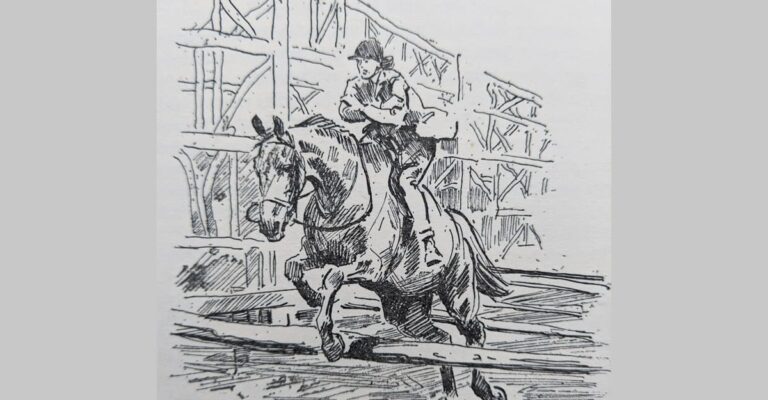
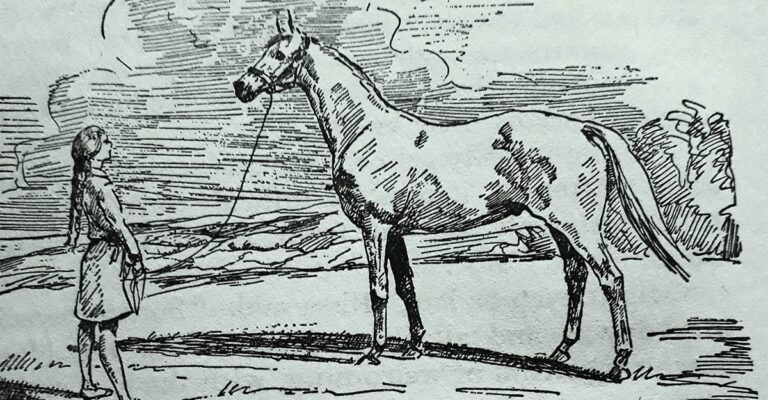
The lovely dry point etchings that illustrate the story were drawn by Anne Bullen. Bullen (1913-1963) was not only one of the world’s most respected writers and illustrators of children’s pony stories, but she also bred and trained children’s show ponies. She had six children, who between them have ridden in eight Olympic games, in eventing and dressage, with daughter Jennie (Loriston-Clarke) competing in four of these.

Here in Wish for a Pony Bullen depicts the ‘Hillocks Stables’ ponies that Tamsin and Rissa ride over the summer as not ponies but perfectly-formed small horses, with slender limbs, and charming fine heads. Two things about Bullen’s work here reveals her as a real horsewoman with a great eye; the anatomical precision of horses in movement and the sense of uphill balance (Bullen was an early adopter in England of German style dressage). Not least, these exquisite little creatures anticipate the show hacks she would eventually successfully breed at her stud ‘Catherstone’. I think as a child I also found the scale of the illustrations interesting; the girls, preposterously slender, look like tiny wind-blown paper dolls, but are nonetheless drawn perfectly to scale for their delicate ponies.

Wish for a Pony conforms in many ways to the formulaic tropes of the pony story. Tamzin’s world is conservative, loving and unchanging.   In a proto-feminist model however, it is evident that developing competence with horses does empower girls in pony stories like this one, yet few other signs of radicalism are permitted. The world of Wish for a pony is a gentle, predictable fairy tale world, ‘middle class, static, and irrelevant’ that conforms to the rigid formulae of the genre.

It was nonetheless a world that I clung to.  My family was middle-class, but unlike the fictional Grey family, we were by no means as tethered to place. By the time I was eleven we had spent several years in each of four different countries, Australia, Italy, Scotland and Canada. My father, a medical specialist, wanted an overseas post-graduation qualification, so he had a wider choice of jobs back home in Australia. My mother, expected in the 1960s to give up her career as a nurse upon marriage, (which she did), was simply passionately interested in other cultures, and in becoming a ‘cosmopolitan’, worldly person, with wide horizons and experience far beyond that of her 1950s rural and conservative Catholic girlhood. It was she rather than he who planned and coordinated our regular global journeys.

My sisters and I grew up with a lot of new languages and new schools, which meant that we sought safe worlds in books. I retreated to my bedroom, and read Wish for a Pony, over and over again, until I knew the phrases on almost every page, and I sketched and sketched and sketched horses until I could almost get them looking as lovely as ‘Cascade’.

In Grade 2 I even started selling my horse-drawings to schoolmates for twenty cents each, to save up for my pony – a scheme which saw me getting threatened with a smack of ‘the sandshoe’ from the Assistant Principal for running a business on school property.

My thoughts and dreams always centred on ‘horse-girl’ stories, featuring transformation, self-agency, courage, and knowledge.  I never stopped re-reading Wish for a Pony. Eventually, I did get my first pony, or rather, horse, at going-on sixteen, and it was a qualified disaster, as is quite often the case when your first horse is bought by non-horsey parents. I had no trainer, I had no horsey networks around me, a distinct disadvantage when the horse in question is a two year-old green broken Anglo-Arab – the same breed as Cascade, but mine was a chestnut. It’s a miracle we survived each other, and his first eighteen months were spent back in a paddock growing up. ‘Ozzie’ as I called him, ‘Sunwood Osmosis’, was trained by me, by reading a chapter of Tom Robert’s ‘Horse Control and the Young Horse’ each night before a schooling session and doing what Tom said in the book. Four years later, before starting University, I was able to sell him as a nice, ‘somewhat’ educated six year old gelding to a local horsey family.

Some thirty two years later, my second horse, my real ‘Cascade’ arrived on a truck after a four day journey from Queensland, and after he came down the ramp, the transport driver put the lead-rope in my hand, and I looked, speechless, at my very own, brand new (dust-covered) beautiful horse, and, in that moment I was Tamzin. I now have two, and am sometimes looking over my shoulder for a Tamzin or a Rissa to do some grooming and feeding!

On reflection, I do think that horse stories we read while young, encourage us to ‘rehearse’ staying calm and managing our emotions for the horse’s sake, and in this way while also being pleasurable they do help us prepare for that day – inevitable with horses –  when it all goes wrong. Diving into the world of horses is indeed transformative, and I do believe that Wish for a Pony prepared me, inspirationally and practically, for the good and the bad of horse-owning, and even forty-six years later I am still enchanted by the characters of the girls, their ponies and the world Monica Edwards created in this book.
Effective Horse Cooling – as Recommended by the FEI

5

Hot or hot and humid environmental conditions are a serious risk to health and performance unless properly managed. Research into the effects of heat and humidity on horses during competition has been ongoing since the Atlanta Olympic Games.

Here is some practical information on effective horse cooling, as recommended by the FEI.

Effective Cooling of the Horse

If horses have not experienced being aggressively cooled before then it is advisable to try and introduce this to them at home prior to competition. Make sure horses are used to fans, being sprayed with water from hoses and having people working on both sides.

BEST Cooling Techniques (in order of effectiveness)

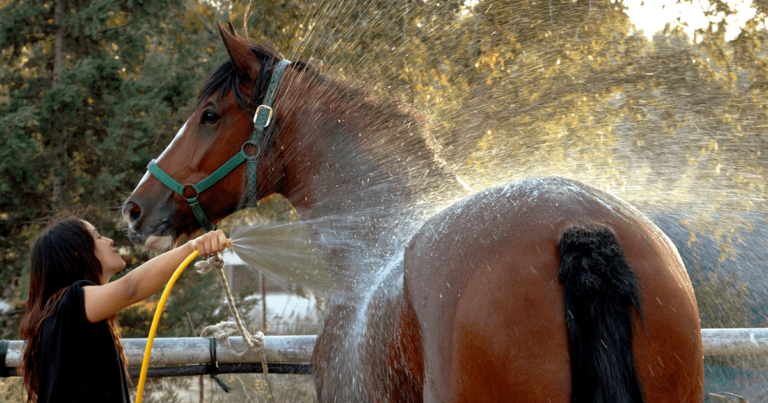
  1. Application of cold water- Applying large volumes of cold water all over the horses’ body is the most effective way of cooling a horse.
  2. There is no advantage to concentrating on applying cold water to specific areas such as large blood vessels on the neck or between the legs. Cold water, even applied over the large muscles, does not cause tying-up or muscle damage.
  3. Take advantage of fans or misting fans
  4. Move to shade

Aggressive cooling is the most important factor in reducing heat stroke in horses, and greatly reduces the risk of collapse and potential injury.

Things that DON’T work:

  • Ice packs – Placing ice packs over large blood vessels, such as those between the hind legs or over the jugular is not effective
  • Ice or cold water in the rectum- is invasive treatment, is not permitted, is dangerous, and also ineffective
  • Wet Towels – Placing wet towels over the horse actually slows down heat loss.

Practical Tips for Daily Management

Water should not be restricted at any time and can safely be allowed before and immediately after exercise

Recovery from transport: On arrival after long distance transport, horses are at an increased risk of colic and respiratory disease (“shipping-fever”).

They should be allowed to rest and recover for at least 3 days with regular hand walking (and grazing if available to encourage head lowering which helps clear the airways) before any significant training in the heat is undertaken.

Daily monitoring: Observing behaviour, feed intake, water intake, droppings (frequency and consistency) and basic clinical parameters (body weight, rectal temperature, heart rate and respiratory rate) are the best ways to identify and treat as early as possible any problems that might occur.

Signs a horse may be overheating

If you are at all concerned your horse may have severe heat stroke, then it’s important you seek vetetinary advice as soon as possible.

Signs your horse may be suffering from the heat include:

  • Lethargy and being unsteady, especially when pulling up after exercise (ataxia).
  • Blowing (deep and moderately fast breathing) excessively for a prolonged time after exercise.
  • Panting (faster shallow breathing)
  • Nostril flaring
  • Feeling very hot to touch
  • Increased rectal temperature
  • Very prominent blood vessels visible on the skin.
  • Decreased appetite and thirst
  • Dark urine
  • Reduced urination
  • Reduced performance
  • Dark mucous membranes
  • Muscle spasms
  • Thumps (synchronous diaphragmatic flutter)
  • Abnormal (irregular) heart rhythm
  • Slow recovery after exercise

This is often referred to as heat exhaustion but, if it’s not managed properly and quickly, it can progress to heat stroke. This may include ataxia and/or collapse.

Severe heat stroke or heat exhaustion can lead to renal failure, colic, myopathy (muscle damage), laminitis, liver failure and may be fatal if not treated promptly.

Read a more comprehensive article about caring for horses during hot conditions here.

This is an excerpt from the March 2018 FEI Sports Forum Supporting Document “Session 6 – Optimising Performance in a Challenging Climate: Management of Horses in Hot Weather”, by Dr David Marlin & Dr Martha Misheff.

Research into the Human-Horse Bond

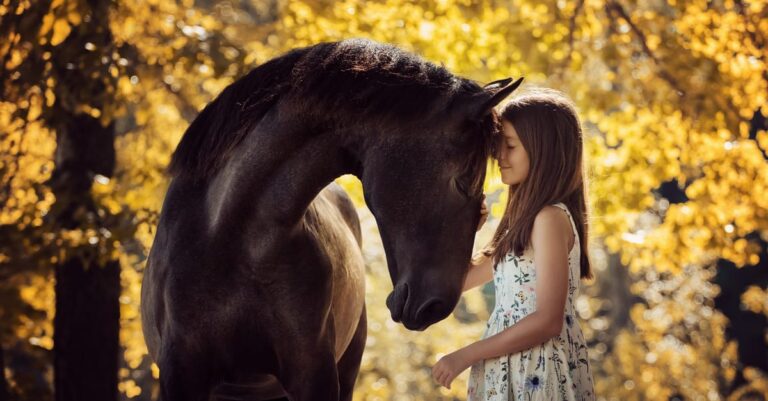
There’s a sense of peace that comes with standing in a pasture of grazing horses. There’s something that feels incredibly safe about surrounding ourselves with dozens of animals each weighing 10 times our own weight and seeing that they have no intention of hurting us. There’s something compelling about their beauty, gentleness, and unassuming curiosity that pulls us towards them and brings our hands out just to touch them. And there’s even something, almost impossible to explain, that makes us miss them when we’re apart.

And all that, scientists say, is exactly what bonding is all about.

According to a new study, humans create emotional bonds with horses that fit the scientific definitions of attachment theory. And they can do it really quickly—even within half an hour.

“People can create a bond with a horse at first glance, sort of like they can when they meet a new person sometimes and feel that they’d like to get to know that person better and form a deeper connection,” said Erna Törmälehto, PhD candidate at the Faculty of Social Sciences at Tampere University in Pori, Finland.

The four primary elements of attachment bond recognized by psychology researchers are staying physically close (proximity), feeling safe from danger (safe haven), having a sense of stability (secure base), and missing the relationship partner when separated (separation anxiety), according to Törmälehto and her colleague, Riikka Korkiamäki. PhD.

Nine teenagers having no significant history with horses evoked all these feelings after spending 30 minutes in a pasture with six calm, sociable horses, the two scientists said. The teens, aged 16 to 17, discovered the horses during a training program to become camp counselors. Törmälehto observed the three boys and six girls first watch the horses from behind a fence and then gradually go into the paddock to interact with the free-moving horses. Afterwards, she observed a one-hour discussion with the group that elicited feedback on how the experience made them feel.

They spoke of the horses being “beautiful,” “peaceful,” and “calm,” and that they felt “accepted” by the horses, the scientists said. They appreciated that the horses didn’t have prejudices against them and seemed to “approve” them. The teens expressed wanting to approach the horses and touch them, and that they liked feeling like the horses were willing for them to do it.

It’s horses’ nature as a prey animal and their highly developed sense of awareness of body language that makes humans bond to them this way, Törmälehto explained.

Although the teenagers were certainly affected by the peaceful environment of the quiet countryside in general, it was the connection with the horses that gave them a sense of emotional peace, said Törmälehto.

“People need social relationships,” she said. “A peaceful environment by itself doesn’t offer a live connection with others. A horse also provides a chance to a relationship with another being just by being present.”

And the horses stood out among the other animals at the farm as offering a very different kind of relationship with the humans, due in part to their “special sensitivity and cautious curiosity,” she added.

“There also were cats and dogs which were very sociable and kind to new people, but they were very active in making contact, and through that initiative they in a way demanded contact from people,” she said.

“The dogs come greet you swinging their tails and the cats start purring and cuddling, leaning and pushing while waiting to be petted. Through their actions they require activity from a person.

“Meanwhile, a horse approaches people differently, more reserved so that a youngster may take his or her own time and the horse demands no action. Horse can calmly stand farther away and just look at people by focusing their gaze and turning their ears towards a person; it can think for a moment and then come to meet a person or just stand there minding its business and maybe just keep eating.”

Critically, however, the success of the bond requires freedom to choose—for both partners, according to Törmälehto. “I think it is not possible to get a good relationship between horse and human when horses are forced to be with people,” she told Horses and People. “I think the bond is the best if the will of both the human and the horse has been taken account.”

Even so, it’s unlikely these horses felt bonded to the humans they just met in such a short amount of time, she added.

“I’d say that these horses were curious in meeting new people because they have had no previous negative experiences with people,” she said.

“We still know very little about the affection horses have towards people. Still, I don’t think a horse would become attached to a person as easily as a person would to a horse in such a short period of time.”

The study by Erna Törmälehto and Riikka Korkiamäki is published in the open access journal Animals and is titled: The Potential of Human–Horse Attachment in Creating Favorable Settings for Professional Care: A Study of Adolescents’ Visit to a Farm. You can read it here.

Race-2-Ride: Retraining and Welfare Off The Track

There has been much in the press over the last year about the welfare of horses leaving the racing industry, raising questions about the sustainability and ethics of the current situation. In this article, Kate Fenner explains how we can all help to protect the welfare of off-the-track horses by easing their transition from racing to sporting and leisure riding homes.

Having grown up surrounded by racing and racehorses, even taking one of my father’s ‘slow’ Thoroughbreds to school with me as a young teenager, retraining off-the-track horses was always an interest of mine. However, it is not always straight forward, and we need to be mindful of certain aspects of off-the-track horses’ training history to optimize the transition process.

What’s so great about racehorses?

Both Thoroughbreds and Standardbreds retiring from racing will have been extensively handled and often habituated to working with other horses, crowds, and travelling on a truck or float. Of course, not all these experiences will have been positive ones for the horse, and we need to keep that in mind when re-training.

Ask any Thoroughbred or Standardbred owner what they think is the best thing about the breed and eight or more out of ten of them will tell you: their versatility.

You will find both breeds in a wide range of disciplines from working on the farm, to dressage, show-jumping, hacking and trail riding, and I have even seen some having a go at reining!

There is no doubt that these beautiful horses can turn their hoof to anything but their success and happiness in their new post-racing lives does depend on how we re-educate them.

Here are 7 important things to remember:

1. Has the horse been started under saddle?

This may seem obvious but when we look at the Standardbred, the answer is clearly, no. This is actually a good thing because it gives us a place to start that horse.

The Thoroughbred is rather different, and it is easy to expect too much from these horses’ previous training.

Thoroughbreds are taught precisely what they need to know to race and often extraordinarily little else. Unfortunately, what they have been taught is rarely useful for their post-racing careers.

2. What exactly did they learn?

Unlike the pleasure industry, the racing industry is profit-based and results-focused, which doesn’t always allow sufficient time for training simple responses, such as ‘head down’ for bridling or ‘stand’ for mounting. And, while twisting the ear to get the bridle on achieves the desired result in that moment, it may also set the new owner up with a behavioural problem that requires addressing.

There are a host of problems that arise whenever we, as owners or riders, have an agenda that is seen as more important than the horse’s mental wellbeing.

3. Were they desensitised to pressure?

All off-the-track horses will have been desensitized to pressure cues, particularly bit pressure. Both Thoroughbred and Standardbreds learn to race with meaningless, often unrelenting rein tension, which again, is not a desirable response for the pleasure rider.

Physical force, such as pushing horses into barriers or yanking on leads in an attempt to stop movement, can have taken the place of sensitive, horse-centric training, the shortfalls of which will be evident when rehomed.

4. Fear based training

Racing is a high adrenaline sport. Horses repeatedly practice the flight response – it is this very fear-based response that trainers and jockeys are provoking.

We know that the flight response can be difficult to extinguish, as can any response learned using fear as a motivator, which is why, as new off-the-track owners, we need to be mindful of this during re-training.

5. How do they feel about learning?

While there are exceptions to every rule, many, or probably most, racehorses will have little or no understanding of combined reinforcement. Often, off-the-track horses simply haven’t been taught how to learn (mostly as a result of the considerations outlined in points 2 and 3 earlier).

6. How many homes?

Not all off-the-track horses move on to loving and caring pleasure homes. Due to their perceived zero value, these horses often pass through the hands of unscrupulous dealers, even being sold on with fictitious histories and breed details.

Alternatively, they can find themselves changing homes often and being classified as ‘project’ horses, neither of which situation is likely to improve their welfare or training.

7. What’s their experience of trainers?

Finally, off-the-track horses are often ridden and handled more by men than women during their racing careers. We don’t yet know if this impacts behaviour but the Equine Behavior Assessment and Research Questionnaire (E-BARQ) is currently looking at this possibility.

E-BARQ is examining whether horses ridden by men and boys differ in their behaviour and in certain personality traits to those ridden by women and girls.

This, as with all the E-BARQ research, promises to be remarkably interesting. If you haven’t yet assessed your horse’s behaviour using E-BARQ, then you can do so now by visiting this site: https://www.e-barq.org/

Here’s how we can help the racehorse transition to a good life:

1. Go back to basics

I would recommend taking your horse back to basics when it comes off the track and working through each of the foundation lessons, regardless of breed and experience.

Naturally, the Standardbreds, never having been under saddle, require this foundational work, but Thoroughbreds, while they have worn a saddle and carried a rider, the experience has been very different to leisure or sports riding.

By treating the horse as a blank canvas, you give it the benefit of calm, controlled, organized training and you are sure to create a safer and happier horse in the process.

2. Give them your time

Time is something we, as ex-racehorse owners, often have more of than their previous trainers/owners. Couple that with a desire to spend as much of it as possible with our gorgeous off-the-track companions, and you have a recipe for great things.

Never underestimate the benefits of simply spending time with your horse to both, get to know him or her and to teach those little responses, such as tying up or bridling with the head down, that may seem trivial but can make the difference between an ordinary start to the day and a relaxed and happy start.

Start with this simple ‘Head Down’ lesson, which you can find on the Horses and People website or by following this link: https://bit.ly/3aeG4mT

3. Re-sensitising pressure cues

As off-the-track horses have been desensitized to pressure cues, particularly bridle responses, it is necessary to be mindful of this and begin to engage the horse with learning.

Consider the simplest of cues, such as leading your horse. Always remember the sequence of pressure-release-reward and be sure not to be holding pressure if the horse is responding correctly.

This will help re-sensitize the horse to pressure cues, meaning you will need less pressure to elicit the same response over time, as the horse learns that you always release when he or she responds with the correct movement.

Give to the bit is an excellent place to start re-sensitising your horse to light pressure cues.

4. Keep it low key

It is important to only practice those responses that you want your horse to repeat, so be careful not to encourage the flight response by chasing the horse in the round pen or on a lunge line.

Because this response was reinforced during the horse’s racing career, we now need to establish alternative, safer responses for the horse. This is a great time to get to know your horse and really understand his or her emotional level – learning to recognize those signs of changes in the emotional level and begin to engage your horse with learning.

To learn more about how to get your horse engaged in learning read

5. Re-learning to learn

Learning how to learn is probably the biggest and most important obstacle to a successful post-racing career.

By taking the time to engage your horse with learning and teach him or her about combined reinforcement you breathe life into the horse and into your relationship with them. This is my favourite part of re-training off-the-track horses, watching them engage with learning and realizing how clever they are!

6. How experienced are you?

Off-the-track horses are not for everyone, despite being an inexpensive route to horse ownership.

They require an experienced, calm, and knowledgeable owner that is prepared to spend the time re-training the horse. If you’re that person – fabulous, because what a treat they are!

7. Where do I start?

If you get a horse straight from the racetrack, remember it will be full of high-quality feed and will need some time to ‘come down’ and get that out of their system. Change the diet gradually and carefully so that not everything changes at once for the horse.

Your new off-the-track horse may not be well socialised. This will depend on its history, but it is not uncommon for these horses to have been kept isolated since they started pre-training.

Introduce your horse carefully, to one new herd member at a time and always allowing them to ‘meet’ over a safe fence.

Some horses will have been stabled most of their lives and can panic if released into a large field. Again, break this down into easy steps for the horse, ensuring your enclosures are safe and secure.

Securing their future

Even when an off-the-track horse is fortunate enough to be placed with a reputable re-trainer and then rehomed, their training is unlikely to persist if the new owner does not know how the horse learned the responses.

Horses quickly revert to old behaviours when their riders are unclear or inconsistent with cues and rewards so, if you are taking on a horse off-the-track make sure their is ongoing training support available for horse and rider.

Kandoo Equine offers an OTT Training Passport for racehorses. The passport allows their new owners to access ethical, sustainable training, tailor-made for the off-the-track horse, together with a supportive community to help them through the journey.

Training Passports belong to the horse and, in the event the horse changes home, the new owner then benefits from access to the training and community.

Training Passports are now available with a 10% discount for Horses and People readers. Simply type H&P into the coupon code section on checkout.

Check out Dr Kate Fenner’s podcast for more step-by-step, ethical and sustainable horse training courses.

Helping Ranchers Identify Fatigue

Five million horses live in Brazil. Nearly three-quarters of them work as ranch horses on beef cattle farms, spending long days driving, cutting, and transporting, sometimes across difficult terrains and in extreme weather. Researchers are helping ranchers recognise the signs of physical tiredness to prevent exhaustion.

It can be a hard life. And at the end of the day, they wear their fatigue on their faces.

According to equine behaviour researchers, though, these facial expressions combined with the horses’ general body language can lead to useful, concrete indicators telling their handlers if they’re reaching the limits of physical exhaustion.

“We expect to see physical tiredness after any physical activity, but it’s important to know the degree of tiredness that the horses have suffered, as this directly affects their welfare,” said Pedro Henrique Esteves Trindade, PhD candidate at São Paulo State University, in Jaboticabal, Brazil.

Trindade and his fellow researchers observed Brazilian ranch horses before and after work over a seven-day period, making video recordings of their behaviour and noting more than 50 different behaviour variables. They also monitored their heart rate and took blood samples.

The 14 crossbred horses, ranging in age from 6 to 27, included 13 geldings and one mare. They lived and worked on two commercial beef farms in São Paulo State, known for its “gently sloping terrains.” By day, the animals worked in pairs or groups, and by night they rested and grazed in grass pastures in groups (with feed compliments). All the horses were fit with good body condition, and none wore shoes, he said.

Although the horses covered an average of nearly 19 km in a single day, very few of the body language parameters changed from before work to after work, Trindade said. That might be because, even though they worked as many as eight hours, the intensity was relatively low since they kept fairly low speeds.

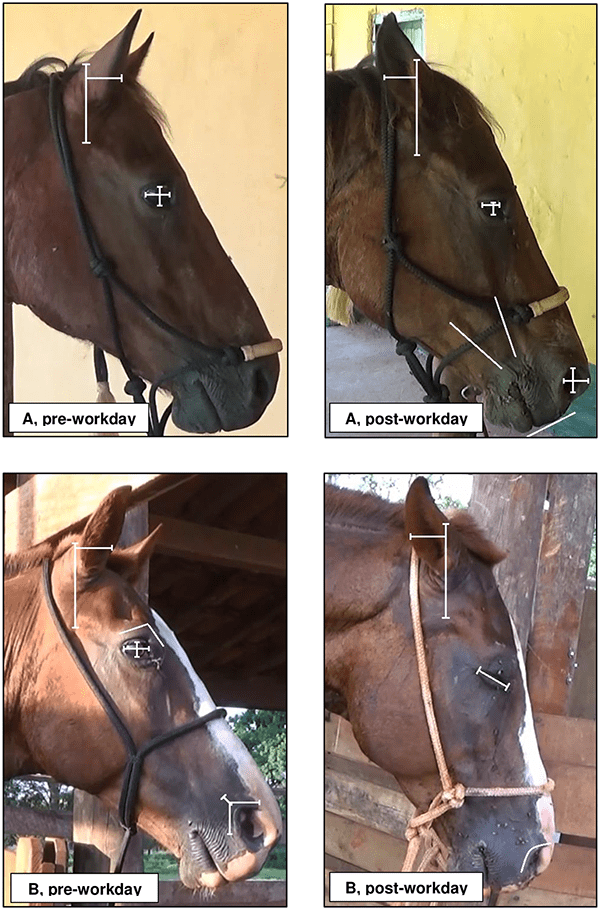
Still, they did note that, after work, the horses kept their eyes partially closed longer and more often, tightened their mouths more, shifted weight between the front legs more, and spent more time standing on three legs instead of four, he said. They also held their ears forward less often, showed the whites of their eyes less, spent less time turning their heads left or right, and generally made fewer movements in reaction to flies.

These behaviours suggest the horses were “tired,” but they could also be signs of pain, as scientists have noted similar body language in horses just after castration, Trindade said. The  creatinine kinase (CK) levels in the studied horses were also fairly elevated after a day’s work, pointing to possible soreness. Still, their heart rates dropped significantly shortly after work, meaning they were recovering from the exercise.

recognising fatigue in ranch horses
Still images from 30-s video clips of two ranch horses (A and B) pre- and post-workday.  The images show both ranch horses orienting their ears forward and backward before and after workday, respectively. Horse A has its eye partially closed (A, post-workday), while horse B has its eye fully closed and is showing contraction of the eyelid post-workday. Horse A showed contraction of the inner brow raiser before and after the workday, and showed tension of the muzzle and mimic muscles post-workday. Horse B showed nostril lift before workday. See Table 2 (in original paper) for descriptions of the categories of facial expressions. Image source: https://doi.org/10.1371/journal.pone.0228130.g001

But that doesn’t mean it didn’t leave them with pain somewhere, he added. In particular, they might have had pain in the mouth area (from the rider pulling at the bit) or in the musculoskeletal system, from the effort. “This increase in the CK activity and the facial tension post-workday could nevertheless be interpreted as low level pain induced by transitory changes in sarcolemma permeability, that did not produce lameness,” Trindade and his colleagues stated in their study.

“Now science needs to test these indicators and establish classifications of intensity of physical tiredness using dose-response studies,” Trindade said in an interview. “After these steps, the most powerful indicators can be used on farms to recognize physical tiredness before the animal reaches deleterious levels of fatigue or physical exhaustion. This will be important to determine the workload and also the rest period of the ranch horses.”

“Effect of work on body language of ranch horses in BrazilEffect of work on body language of ranch horses in Brazil, by Pedro Henrique Esteves Trindade,
Elke Hartmann, Linda J. Keeling, Pia Haubro Andersen, Guilherme de Camargo Ferraz, Mateus José Rodrigues Paranhos da Costa is published in Plos One. It is open access and can be found here.


Recruiting the help from those who know their horses best

You know your horse best andthat’s why researchers need you to help advance horse welfare

You read the articles about how scientists study horse behaviour, and you think, Why did they need to study that? I could have told them that.

Or maybe it’s the opposite. Maybe the scientists found that horses tend to behave in a way that’s totally the opposite of the way your horse behaves. And you think, Maybe they should know that.

Or, then again, maybe you’re fascinated by everything that these scientists are doing, and you find yourself asking, How does my horse’s behaviour and training compare to what other horses in the world are doing?

And then, you discovered E-BARQ.

Designed as a link between horse owners and horse researchers, the online Equine Behaviour Assessment and Research Questionnaire (E-BARQ) brings real-world data to scientists while giving owners a practical way to track their horses’ progress. This “citizen science” project benefits people in the laboratories and in the barns, as well as horses in general, as it hones in on factors that affect equine welfare, according to Kate Fenner, PhD candidate at the Sydney School of Veterinary Science at the University of Sydney, in Australia.

“It’s win-win for everyone,” Fenner said.

The E-BARQ platform, web-based or on a mobile app, allows horse owners to complete profiles of their horses and answer a series of questions about their horses’ training, management, and behaviour. Participants can update the profile every six months, revealing how the horse evolves over time. They can access graphs that show where their horse sits compared to other horses registered in the E-BARQ system, for individual criteria like trailer loading or social confidence, as well as graphs mapping their own horse’s unique progress. And meanwhile, researchers can take that data and apply it to their studies about horse behaviour and welfare, said Fenner.

“Looking at the individual graphs and then the profile as a whole, many owners are often pleasantly surprised to find that their horse is doing better than they thought,” she told Horses and People.

But filling out research surveys—even if it only takes 30 minutes once every six months—doesn’t seem to entice many people, despite the benefits to science. That’s why Fenner and her colleagues decided to test how attractive their E-BARQ platform was, and to find ways to make it more worthwhile to participants. “In order to have reliable data, we really need a strong base of participants,” she said. The “dog version” of E-BARQ, called C-BARQ (for “Canine”), has accumulated data on more than 85,000 dogs since its unveiling in 2005. That data has been used in more than 100 published scientific studies.

The research team asked nearly 800 academics, professionals, practitioners, and enthusiasts in the horse world to answer three simple questions about motivations and challenges related to data-driven research surveys. They realized that participants would be more likely to get engaged in E-BARQ if they could have incentives, like personalized feedback—hence the individual progress charts now included in the E-BARQ platform. The fact that users can click on these graphs and share them with their coach or within their chosen networks, provides an even greater incentive, Fenner said.

This investigative study also turned up an unexpected finding, Fenner added. Many respondents indicated (in the free-text section of the questionnaire) that they had a hard time getting reliable information about good behaviour and training science. Although many people read popular horse magazines and websites that give training and behaviour advice, readers don’t always have confidence in choosing the most reliable source since there’s so much conflicting information, she said. Furthermore, many coaches continue to train and advise based on outdated information without applying learning theory and other scientific knowledge, making it even more difficult for owners and riders to follow scientific recommendations.

Participation in E-BARQ could bridge that gap by connecting people at the grassroots of the horse industry with those accumulating and analysing the data in scientific laboratories, Fenner said.

“Data gathered from E-BARQ respondents—the people who know their horses better than anyone else—will help researchers identify and investigate those areas of horse training, management, and behaviour that are of greatest importance to owners,” she said. “This, together with ensuring that study results are accessible by those who need them, promises to benefit all stakeholders, particularly our most important one, the horse.”

This article is open access: The Development of a Novel Questionnaire Approach to the Investigation of Horse Training, Management, and Behaviour by Kate Fenner, Katherine Dashper, James Serpell, Andrew McLean, Cristina Wilkins, Mary Klinck, Bethany Wilson and Paul McGreevy and you can read it here.


‘The Horsemasters’ the book that inspired a way of life

I was lucky enough to be an only child in a family that had horses. My mother had met my father when she was employed as a groom from the same stable that he bought his best eventer!

Being with horses and riding was how I spent my childhood. When I wasn’t with them, and sometimes when I was, I would be reading a ‘horse’ book. These came in many forms, from talking horses to short stories about heroes on horses.

I didn’t like reading when I was first taught. I have to assume it was the subjects that came in ‘my first reader’ nearly half a century ago. From what I recall, I was capable, but disliked it and saw no point in making the effort.

My parents were avid readers, and thoroughly disappointed that their little girl wouldn’t do it. Until Mum had an idea. She bought a child’s book with lovely and expressive pictures, of a black pony and a chestnut horse with a young boy. And both of my parents categorically refused to read it to me.

The book was “Little Black, a pony” by Walter Farley (1961) who also wrote the “Black Stallion” series. I believe it was solely responsible for my capitulation to agree to read and, ultimately, my understanding that to read was to enter whole new worlds: of horses!

“The Horsemasters” by Don Stanford, published in 1958, had the most influence on my life with horses. The mere smell of its pages brings back so many memories of hours spent with my beloved ponies; or dreaming of a stable with steeds of all colours, adept at all disciplines and producing multiple blue ribbons!

The Horsemasters is a novel about a group of youngsters preparing for the “Horsemastership Certificate”, a British Horse Society examination that was a precursor to one that I took myself at age 15 (which made me the youngest from my area to attempt it). Our Chairman of Pony Club initially refused and only relented after my coach gave testimony of my standard.

There were six of us in our exams, I was the youngest by at least two years and was the only one to pass. I put that pass down partially to the learning I received from The Horsemasters.

I emulated my imaginary friends. I studied beforehand, just as the Horsemasters had in the book. In particular, just like the heroine Dinah, I studied a veterinary journal, but what I remembered most vividly, both in my exam and now, is the description of thrush, “characterised by an offensive smelling discharge and a ragged appearance of the frog”.

This was announced gleefully by one character to the heroine of the book when her horse was found to have it because “it is usually caused by dirty stabling”. This then resulted in a mock argument which taught the reader that this is not the only reason a horse would get the disease and caused the whole exchange to stick in my memory. This is fortunate because the Adelaide Hills are wet, and thrush starts easily here.

As I said, my Mother worked as a groom and I knew she had worked for a chap called “Frenchblake”. Whilst I would have identified with the main character anyway because she was female, I mostly identified with her because her situation had many similarities to Mum.

In my imagination, I went through this book with a young version of my Mother. It was Mum’s trials and tribulations and ultimate success and enjoyment that I was living. For me, the book’s horse characters were those in the black and white photos in Mum’s ‘horses’ album, with names as familiar to me as those of my own ponies.

The human characters too were from her time at “Frenchblake’s” yard, all carefully catalogued in her album. The main character is not the best rider or necessarily the most popular, but she is a worker and a fighter: that was what I looked up to and empathised with.

Dinah was not fond of early rising, with which I identified. However, she was responsible and not only would she get herself out to her morning horse duties, but she would ensure her friend was looked after in the process – the friend being worse than she was.

I think that these older books taught me that honour and helping others is the correct way to be. That responsibility is necessary around animals and that anything less than these is punished. Of course this was then reinforced by the behaviour of my real animals!

And it’s a book about Horsemanship. I read about how to keep a yard full of horses and that it’s very hard work if you do it properly.

I understood that there are standards to uphold and that I didn’t want to be sloppy. To a strong extent it was from this book I decided that whilst I wanted horses as a hobby, I did not want horses as a career and that this is actually ok.

I learnt that the love of horses surpasses race and gender. I noted that although there were youthful boys and girls of multiple nationalities all working alongside each other, there was no time or need for romance and no quarter was given for the ‘weaker’ sex.

Whilst there was some rivalry between the really good riders, this was based on that ability not on their gender. They all muck in together, form strong friendships, laugh at each other, tease each other and help each other out when it’s needed.

The horse sports are the only ones where men and women compete on a level playing field and I think this book started my education in understanding this.

Partway through the book, The Horsemasters are divided into two teams, each team working for the opportunity to go to a special event.

Now I learnt about team work and the importance of a catalyst and a common goal to promote team work. The teams are working for their goal, but they all have one common enemy which unites them and that is the Head Groom with the inapt name of Mercy. We learn to dislike Mercy, but when she has a fall, we are concerned. Then, at the end, when the twist comes, we understand that sometimes it’s a very lonely role to lead others to be their best.

Often, when I am hot, tired and thirsty having worked hard to get everything correct for my animals, I recall a late chapter passage. In it, the Horsemasters are released late on their exam day and realise that they have been so busy they have not looked after their horses. This had been their task every day for thirteen weeks. They race to the stables only to find that Mercy has single-handed completed the work that was usually done by the 14 Horsemasters!

Dinah is doing the certificate in order to realise her dream, not to ride horses, but to attend a particular college with her best friend. The college will take her on if she pays her way through working as assistant riding mistress. To be accepted, she must pass the certificate.

I went to a paid for school and whilst I didn’t have to work my way through, my parents gave me choices. I could either have horses or have all the pretty things my friends had, such as the latest in toys, shoes or whatever fad there was at the time. I never felt that I was left out though, I loved my life with the horses and to be fair, Mum made sure I was never completely without anything.

I had to work with my current pony to improve his schooling in order to better him for sale for when I outgrew him – so I could buy the next sized horse. From the  book, I got a sense of what in adulthood we all learn: that we must sacrifice in order to get what we think important. This value driven thread reinforced that bravery and doing what is morally right, is not just necessary but normal.

My father was a solicitor by profession and has published multiple second world war history books. As a child, I was taught that honesty and responsibility are essential to how I conduct myself. The real life heroes about whom Dad writes are often characters of outstanding bravery, with strong leadership skills, but they retain empathy for others. Luck also plays its part.

In The Horsemasters, the characters that stand out for me are those who display some of these traits. Dinah the main character of course, but also David, who was bucked off his horse and bravely remounted until he was able to get it right. Mercy I have already discussed, and the Polish Captain Pinski who was cheated in his riding ambitions by the war but has settled into his role of Instructor with a cheerful heart.

My personal beliefs include being fair; hard work can expect reward; and hope for the element of good luck. My career successes have been influenced by my values. As a successful leader I am told I am ‘firm but fair’, as an employee I am rewarded because I am honest and forthright, but will still toe the line.

I have remained with one company for 25 years, through three distinct career paths. I hope to remain with the company for as long as it has clear values which are in tune with my own. When I review this book I can see that much of the influence it had on me was as a reinforcement of what I hold to be important.

In this book I learnt about some of the basic horse husbandry requirements. The disease colic was discussed because the Horsemasters had lessons with Mr Ffolliott a retired vet. Colic is a horrid disease and quite common in horses, I have dealt with it myself since and having an introduction was very useful.

Often, when I make hay nets for my horses, I have a vivid picture of a passage in the book where two of the boys made a wisp out of hay. The girls watch the twisting of hay into a rope and the weaving of the wisp and then decide to have a go for themselves: without great success. I myself tried years ago to replicate this using baling twine, also without success, and these days I can’t remember the last time I saw, let alone used one.

In the book we meet all the different types of instructors that one meets in the course of a lifetime with horses. There’s the furious, then the calm and knowledgeable; the one that makes you feel like a disappointment and the one who makes you feel like you are gifted.

And we learn that each has something useful to impart, that we can take parts from each to make our own truth bound together by a single thread. That horses are “all such individuals” and we must ride in a way suitable to the individual we are on, and with empathy and kindness. I learnt some of the subtleties of riding with these imaginary instructors on the imaginary horses in the book. I learnt that my horse would listen to the instructor’s command rather than my own if I did not keep her engaged, and that my heel may lift in rising trot.

I learned that to fall is a part of riding and whilst preferably avoided, it is inevitable.

This book taught me about using a “grid” for inexperienced horses and/ or riders. I gather from a retired mounted policeman friend that he was put through a grid just as described in the book.

I myself have used a less intimidating version when training children on ponies, or my own young horses. With the former so they can feel the rhythm of the horse’s movement through a jump and with the latter to teach them to go forward and to ‘see the stride’ for themselves.

With the benefit of hindsight, possibly the most influential passages for my later life decisions were the two descriptions of Hunter Trials.

In the first, Dinah rides a fair sized course on the horse she has been responsible for grooming throughout her study. He’s an old and clumsy fellow and she has wondered aloud more than once why he is kept by such a prestigious school. When she takes him around the course she discovers why! He was born to hounds and cross country is what he loves and knows best.

Many years later when I re-read the book, my imagination swapped my own dear eventer into the frame of ‘Cornish Pasty’ and we were at Mt Gambier charging around the course there. Such memories are triggered by the vivid writing of each fence and the feelings of Dinah, which mirror real life.

Next we go to a big local event and watch the instructors ride the horses there with aplomb. We learn how to follow a class in such a way as to see as much as possible. Now I see my parents and I walking around Badminton in the United Kingdom or my husband and I walking around Adelaide International, the description is vivid and realistic.

Growing up I was only very rarely allowed to take on the fixed fences of cross country as Mum said she couldn’t bear to watch another family member take on the danger as Dad had. Instead, I competed in higher level affiliated show jumping. But my imagination was fired by the realistic descriptions in the book.

I had the knowledge, from the rare occasions I had been allowed to try, that the descriptions, whilst excellent, were still outstripped by the real thing. Had I not read the book (and read it repeatedly) would I have evented anyway? Given that was what my Dad did very successfully on horseback, maybe. But I lost interest in riding horses whilst still in the UK after a couple of serious accidents.

Several years later in Australia, when the opportunity arose to spend time with horses, the bug bit me again: ultimately leading me past my familiar show jumping discipline into the three phase competition because I desperately wanted to do the cross country!

Eventing is now my sport, it is why I get up early and work late, what I train my horses for and spend my money on. This is my raison d’etre and The Horsemasters inspired that passion in me which was nurtured through real life until it became my life. It wasn’t about gender or romance, it was about working hard for a goal, enjoying the journey, relishing the teamwork and the friendships that are forged within the sport and realising that living life with horses can make it as idyllic as a thoroughly splendid novel.

My Friend Floss

“High up on the long hill they called the Saddle Back, behind the ranch and the country road, the boy sat his horse, facing east, his eyes dazzled by the rising sun.”

So begins My Friend Flicka by Mary O’Hara, the story of a boy and his desire to have a horse of his own. The boy, Ken McLaughlin, lives on a ranch in Wyoming, USA, where his father breeds polo ponies. Ken has any number of horses he can ride when he is home from boarding school, but he longs for a horse of his own. His father resists giving him one because Ken is a daydreamer and doing badly at school.

My copy of My Friend Flicka came via a book order through a school book club in 1975. Once a term we would get the brochure and order form. Each term, Mum would let me select two books to buy and I would take the order form back to school in an envelope with the cash, then eagerly wait for the books to arrive.

The book club order forms were my major source of books as a child. There wasn’t a book shop in the small Western Australian wheatbelt town where I grew up. There was a small newsagency that occasionally had a few interesting books on the shelf in the corner and, in a larger town nearby, a larger newsagency with a bigger selection.

‘Interesting books’ to me were defined as those that were about horses. On monthly shopping trips to the ‘big town’ to get things we couldn’t get in our home town – school shoes, electrical appliances, and the like – I would scour the shelves for anything ‘interesting’, my saved pocket money at the ready and, just in case it wasn’t enough, promises in mind to make up the few extra coins that I may need to beg from my parents.

But the book club order forms remained by best source of books. The two books I ordered each term were inevitably horse books, although occasionally a book of dog stories or something about another kind of animal would sneak in – The Call of the Wild and White Fang by Jack London, My Dog Sunday, another about an orphaned calf and kid called Cinnamon and Nutmeg. But mostly it was horse stories – A Horse of Her Own, The Silver Brumby, Silver Brumby Returns, Phantom Horse, Come Home Phantom Horse, Misty of Chincoteague, Stormy – Misty’s Foal, King of the Wind, and a myriad of titles from the Pullen-Thompson sisters.

But it’s My Friend Flicka that sits on my book shelf to this day, tattered and dog-eared from countless readings, the opening lines committed to memory.

I envied Ken McLaughlin his life on a horse ranch, although not his domineering father. Like Ken, I was a country kid but I lived in town and wasn’t allowed a horse. In retrospect, I realise my parents had neither the time nor the money to indulge my pony passion, but as a child I saw only their resolute refusal.

Ken’s parents did, eventually, let him choose a yearling, although that didn’t initially turn out well, because he chose a wild but beautiful sorrel filly he called Flicka. As the tale goes, it almost ended in disaster, but the thing that gripped me was that in the end Ken had his horse and she loved him. A sorrel filly.

Sorrel wasn’t really a horse colour description much used in the other books that I read, and it took me a time to translate it as chestnut. When I did, I could understand Ken’s fascination; my dream pony was a chestnut, with some white on its face and some white on its feet, perhaps flaxen mane and tail, but I wasn’t so fussy about that.

I had an image in my head of the exact horse I wanted. I had a picture of it as well. My sister gave me a book for Christmas one year – The All Colour Book of Horses – long enough ago that it was important to put the ‘all colour’ description in the title. On the cover was a chestnut mare and her foal, walking across a lush green paddock.

The mare had a white blaze down her face and long white socks. The description inside the book told me that she was an Arab. She was, I thought, the most beautiful horse ever, and she became the epitome of my dream horse. I called her Bella, which I somehow knew was Italian for beautiful. She was the horse I wanted.

Decades before the internet, I scanned the livestock sections of the papers – The Sunday Times was the best for this, although sometimes The Countryman held promise. I cut out or circled the adds that appealed, conjuring their images in my mind, imagining ringing and finding out about them, going to see them, buying them, bringing them home. I walked and ran through the local bush tracks, or rode my bike, imagining always I was on my horse. But it was always childhood fantasies. There was never a pony of my own in my childhood.

There were horses – the local publican kept four or five trotters in a paddock on the edge of town. I saved some pocket money and bought a body brush, dandy brush and curry comb, and I would slip through the fence and groom the publican’s horses.

A few of the girls at school had horses, and I hung around with them, hoping for the chance of a ride. Occasionally I got one but I had no skills. All my knowledge was from the books that stood on my shelf or that I borrowed from the library and read and read and read.

I went to riding school for a week one school holidays, but I was so homesick that it was hard to enjoy being immersed in the horse world, and I felt embarrassed at my incompetence when there were so many kids there so much younger than me who were so much more capable.

In my teen years, one of my older brothers had a girlfriend who rode, and she took me riding whenever family trips took us to Perth. She tried hard to convince my parents that I should have a horse, at one stage even finding a little buckskin pony she thought was suitable. But it never eventuated and I remained ponyless except for the ones that so vividly filled my imagination.

In my early university days, I paid for riding lessons myself, scrimping and saving my meagre earnings to spend on two hours of bliss on Saturday mornings.

Later, I was distracted away from horses by study, work, travel, boys, and later by marriage and children. The years became crowded with other desires, with other things that were possible. Horses were too expensive. Too scary. Too much not of my world.

Yet my head turned to see horses in paddocks. My ears pricked at the sound of hooves. My heart lurched at the sight of pictures of little girls with their ponies. And envy rose on hearing of lives lived with horses. Somehow the idea that one day my life would have horses in it remained inside me.

It was my daughter who brought horses back into my life. Just before her third birthday she said she wanted a pony. My sister, remembering me asking for the same thing at the same age and knowing it was still an unfulfilled dream, asked me what I was going to do about that. “Get back on a horse,” I replied. I was determined that I was going to live my own dream; that I wasn’t going to get my daughter a pony and live vicariously through her.

I found a riding school near to where we lived in the city and started very traditional riding lessons. I loved being among horses and quickly the dream of my own horse, and of fulfilling my daughter’s dream of a childhood pony, came alive. It fed my desire for land – a place with room for a pony or two. By the time my daughter was approaching her seventh birthday, our little family had moved to a country property. I was approaching my forty-fifth birthday. Finally, the time had come for me to seriously look for a horse for myself and a pony for my daughter.

We found Timmy first. A little grey Welsh Mountain Pony, with dark eyes that looked as if they’d been outlined in kohl, the lashes painted with white mascara. The perfect child’s pony, although for twice as much money as I’d anticipated spending. We bought him anyway, me not really serious when I complained that my daughter was getting her pony before I had mine. Timmy came to live in our paddock and we ‘borrowed’ a little yearling filly from his previous owner to keep him company so he didn’t have to be alone in the big paddock. Then the hunt was really on for my pony.

Floss was one of the first horses I went to look at, with a semi-serious intent to buy. She was standing in the rain, a western style saddle on her back; just standing there, while all around her confusion crowded. A huge dog, a tiny dog, an overly-friendly deer (of all things!), half a dozen people, one of them a child with a brightly coloured golf umbrella. Floss’ owner wasn’t there, but had deputised these people – her mother, brother, cousins, to check out the prospective new owner and to show Floss to me.

Floss wasn’t officially for sale, but a friend of a friend had heard I was looking for a horse and had mentioned it to another friend of hers, and she was Floss’ owner. This woman had two other horses and Floss was hanging around in the paddock doing nothing; well, eating grass and being a horse, but not being used for any human-inspired purpose. She’d been doing that for two years and her owner was beginning to think that maybe she should move her on to a new home.

I looked at this horse and could hardly bare to touch her, more for fear that she would dissipate into thin air, than that she might hurt me in any way. I wasn’t thinking about my mythical Bella or Ken McLaughlin’s Flicka. I was looking instead at this real horse before me with the improbable name of Floss. I was trying to be sensible. To be realistic and logical. To be thinking and asking the right questions. To do this the right way.

All the time, my head pounding, my inner voice saying, no screaming, she is real, you could buy her, she’s not expensive, she comes highly recommended, look how quiet and calm she is. And yet, she hadn’t been ridden in years, she could be wild under saddle. Be sensible. Don’t judge a horse by its colour.

How could I not judge this horse by her colour? How could I not judge her by her stunning good looks? She was a little part-Arab (but mostly Quarter Horse) mare – chestnut, with lighter mane and tail, white blaze down her face, four white socks. I ran my hand down the warm reality of her neck, while my friend Judy picked up her feet and said, quietly, so only I could hear, “She has fantastic feet.”

“She’s a bit on the fat side,” I said to the owner’s deputies.

“Yes, she’s certainly a good doer.”

“Will someone ride her?” I asked.

The cousin got on. “I’ll only ride her a bit. She hasn’t been worked much in a while and she’s always been very forward.”

The cousin rode Floss around in a small paddock. She walked out briskly, moved into a speedy trot. Floss was definitely forward, probably too forward for me. But then, I could just call that willing, couldn’t I?

“I won’t canter her,” the cousin called. “She quite hot. She’ll calm down with more work.”

“Thanks, I’ll think about it and call you in a couple of days,” I said, sensibility to the fore, and we left.

“She’s a lovely animal,” Judy said as we drove away. “I’m tempted to buy her myself. But of course, she’s yours if you want her.”

“Are you going to buy her Mum?” my daughter asked from where she sat in the back of the car. “She’s so beautiful.”

At home, I pulled the All Colour Book of Horses from my shelf, the picture of ‘Bella’ there on the cover, looking just as she always had, in my mind and on the page. “Look at this,” I said, holding the book up to my daughter.

“Oh wow!” she exclaimed. “It’s Floss. That horse looks exactly like Floss.”

“Doesn’t she?” I said. “She was the horse I always dreamed of when I was your age.”

“Mum, you have to buy her.”

“I don’t think that you should buy a horse because it looks like one you dreamt of as a child. I don’t think that’s a good reason.”

“But she’s a good horse. She’s lovely.”

“Yes, she is.”

And so she became mine. My dream pony came to life, came to my life, 42 years after I first asked for a pony.

I borrowed Judy’s float and towed it behind my inadequately powered car to go and pick Floss up. Judy came with me. The idea was that I would take Floss on a two-week trial and buy her for a thousand dollars if I thought she was okay after that time. I planned to have a vet check done and to have a horse trainer I had been having some lessons with come and check her out. Floss was reluctant to get on the float and had worked up a nervous sweat by the time we got her home. We unloaded her down on the road. She was high headed and fiery. ‘I can send her back if she’s too much for me,’ I kept telling myself. Judy led her along the driveway as I was too nervous to lead her.

But I loved having the horses in the paddock. It was literally a dream come true. I watched them from the house when I should have been working. Timmy’s little friend Lacey went home and our two horses remained in the paddock; two horses grazing on the pasture beneath the towering karri trees. It was a scene of fantasy. I watched the interactions between them and learnt things books had never taught me.

I was on a steep learning curve with the horses. I worried about them getting sick. I worried about not being able to handle them properly. I enlisted an army of supporters from among my horsey friends and spent a small fortune on local horse professionals. Elissa came and gave Lauren weekly lessons. Judy and Lisa were just a phone call away. Justin came for two hours every Wednesday morning for two months and we worked Floss together. Justin is quiet and gentle, a hippy cowboy horse whisperer, with a scraggly tangly pony tail, and a bandana around his neck. He wears a cowboy hat with a feather tucked in the band. I liked him and learned from his every move. Sometimes I would watch Floss as she responded to him and was left wondering how he made her move like that. Then a friend gave me the tip to watch Justin as well as Floss, to see how he moved, to watch his body language. I did so and my horsemanship improved dramatically.

After five weeks Justin got on Floss for the first time. She tossed her head in protest but didn’t buck. She threatened to bolt and he calmly circled her. I was in awe of his skill; terrified that he would dismount and tell me it was my turn. He didn’t. I stayed on the ground, learning skills that somehow made me a better person as well as some sort of a horseman.

But the next week it was my turn. Justin had a short ride first then told me he thought it time I got on her. My knees were shaking as I lifted my foot to the stirrup. Justin stood by Floss’ head, steadying us both with his voice and his calm presence. I had reins but he kept the training lead on her as well. I walked and trotted circles around him, elated. I was riding my horse. I was riding MY HORSE. I couldn’t have been happier. I giggled like a little school girl and Justin smiled wryly. I wondered if he was laughing at me but didn’t really care and think his spirit is generous enough that he shared my joy. I talked incessantly, overflowing with enthusiasm.

Two weeks later I cantered Floss for the first time. Her body moved effortlessly beneath me. I swayed to the rhythm of it. Her mane flew before me. I could hear her hooves on the grassy paddock. It was so real. It was physical and emotional. Being with my horses brings me to myself in a way that I cannot properly describe.

At the end of My Friend Flicka, Ken, having recovered from a terrible illness, runs out to see Flicka. She has been waiting for his return and “…the neigh that (rings) out on the cold air was a sound the filly had never made before.” Floss isn’t Flicka and the best I can hope for when I turn up at her paddock is a head raised from the grass and a ‘have you brought carrots?’ look. I’m happy with that. I’m happy to step into the paddock, into horse time and just be in the moment. This deep contentment with the moment is an aspect of horsemanship that I hadn’t anticipated but which, over the years since Floss and Timmy first came to me, has become the essence of it for me.

The wait was worth it.

10 Reasons to Stop Whipping Racehorses

10 reasons to stop whipping racehorses, including new research revealing the likely pain it causes

Pressure is increasing on the global horse-racing industry to reconsider the use of whips in the sport.

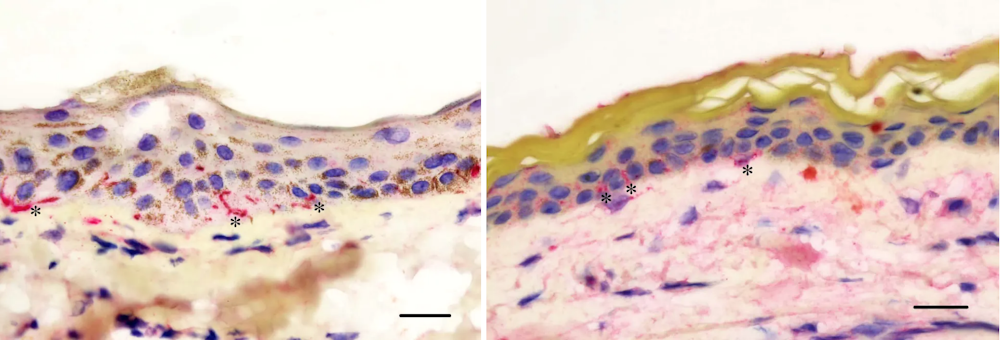
Our research, published in the journal Animals, shows horses’ skin is very similar to humans’ in both thickness and the arrangement of nerve endings.

This adds to existing evidence that whipping is ineffective and unethical. Here we outline ten reasons why it’s time to drop the crop.

1. Horses’ skin appears just as sensitive as humans’

At the core of the debate is the question of whether horses experience pain when being whipped. A Sydney-based research team (of which one of us, Paul McGreevy, was a member) examined skin from 10 human cadavers and 20 euthanased horses under a microscope to explore any differences in their skin structure and nerve supply.

The results revealed no significant difference between humans and horses in the concentration of nerve endings in the outer, surface layer of skin.

Cross-sections of horse and human skin.
Microscopic cross-sections (400x magnification) of horse (left) and human skin. Images show the epidermis (top) and superficial dermis. Selected nerve endings are shown in red and marked with asterisks. Scale bars represent 20 micrometres. Tong et al. 2020, Author provided

2. Horses’ skin is no thicker than humans’

The new study also found no significant difference between humans and horses in the average thickness of this outer layer.

Horses need skin that is both robust and sensitive to touch, particularly from other horses or flying insects. The inner, base layer of skin in humans is significantly thinner than in horses, but this is not where the nerve endings lie.

3. Whip-free and whipping-free racing already exists

Norway outlawed the whipping of racehorses in 1982. In the United Kingdom, “hands and heels” races for apprentice jockeys have been part of the racing calendar since 1999. These events, in which the least experienced (and presumably most vulnerable) jockeys race without using the whip, is at complete odds with the industry’s contention that whips are essential for steering and safety. There are no reports from Norway or the UK of problems in the conduct of these races.

4. There’s no evidence whips make racing safer…

Whip use has been claimed to be essential for the safety of horses and jockeys. However, the impact of whip use on steering and safety had not been examined until a recent study compared “whipping-free” races, in which whips are held but not used, with “whipping-permitted” races.

Races of these two types were meticulously matched for racecourse, distance, number of runners, and “going” (turf conditions on the day). A detailed examination of stewards’ post-race reports revealed no difference between the two race types in movement of horses across the track and interference with other runners, and therefore no evidence whipping improves safety. This adds to evidence from jumps racing that whip use is associated with catastrophic falls.

5. …or fairer…

The gambling industry has an interest in ensuring races are run with integrity, lest punters take their dollars elsewhere. Whip use is arguably the most visible sign that jockeys are indeed trying their hardest.

But the same study of stewards’ reports revealed no difference between “whipping-free” and conventional races in terms of the number of incidents related to jockey behaviour, such as careless riding or jockeys “dropping their hands” (indicative of not pushing the horse to run on).

The key to a fair race is not encouraging jockeys to use the whip, but rather ensuring all jockeys are subject to the same rules.

6. … or faster

The received wisdom is that whipping any horse makes it more likely to win. However, studies have shown increased whip use does not significantly affect speed at the finishing line, and the comparison study cited above found no difference in finishing times between whipping-free and conventional races.

What’s more, in “hands and heels” races, the jockey’s centre of mass is likely to remain directly above the horse’s centre of mass for more of the time, compared with when the jockeys are whipping the horses. So, the biomechanics of whip-free racing are arguably better for equine performance.

7. Whip rules are hard to police

The most prevalent breaches of the rules around whip use involve forehand strikes on more than five occasions before the 100-metre mark (44%), and the jockey’s arm being raised above shoulder height (24%). Studies of high-speed footage of 15 races revealed at least 28 rule breaches, involving nine horses, that were not recorded in stewards’ reports.

There are two reasons for this: the footage seen by racing stewards is filmed head-on, and is recorded at fewer frames per second than high-resolution video now provides. Head-on footage is preferred by stewards as it allows estimations of whip use on both sides of the horse, but it makes it harder to accurately police other aspects of whip use, such as the use of excessive force.

A separate study revealed more breaches are recorded at metropolitan than country or provincial racecourses, and by riders of horses that finished first, second, or third rather than in other positions. That said, horses that finished last were also worryingly vulnerable to whip-rule breaches.

What’s more, even legal whipping is likely to cause significant pain, given the similarity of human and horse skin.


Demonstration of the effect of a whip strike on human skin.

8. The public supports a ban on whipping

In a recent independent poll of more than 1,500 Australian adults, 75% thought horses should not be hit with a whip in the normal course of a race. The survey also found men were more than twice as likely as women to support whipping racehorses. Even among respondents who attended races or gambled on them at least once a week, 30% disagreed with whipping.

9. Whip-free racing still allows betting

While the ethics of promoting gambling is a different debate entirely, whip-free races in Norway and the UK still allow people to bet. It may even be more attractive to sponsors seeking assurance their brand is only associated with ethical activities.

10. Whipping tired animals in the name of sport is hard to justify

Horses have evolved to run away from painful pressure on their hindquarters, given the most likely natural cause of such stimulation is contact from a predator. Repeatedly whipping tired horses in the closing stages of a race is likely to be distressing and cause suffering. The horse’s loss of agency as it undergoes repeated treatment of this sort is thought to lead to the state of “learned helplessness”, in which animals learn they can do nothing to end their distress.

Racing must reckon with two key questions: does whipping actually work as intended, and is it an ethical way to treat a horse in the name of sport?

If the answer to both of those is “no”, a third question arises: why are jockeys still doing it?The Conversation

Paul McGreevy, Professor of Animal Behaviour and Animal Welfare Science, University of Sydney and Bidda Jones, Honorary Associate in Animal Welfare, University of Sydney

This article is republished from The Conversation under a Creative Commons license. Read the original article.

Identifying ‘fearfulness’ in foals could improve horse sports’ safety, say researchers

A fearful horse, in the wrong hands, is a dangerous horse.

That’s why Danish researchers have set out to determine clues to identify the foals that are likely to become fearful adults.

As a result, those horses could go to the right trainers with the skills necessary for dealing with fearful horses and reducing the risk of accidents.

And ideally, they could stay out of the breeding shed, according to Janne Winther Christensen, PhD, of Aarhus University, in Tjele, Denmark.

“A main cause of accidents is horses’ fear reactions,” Winther Christensen said, citing previous studies.

“As prey animals, there will always be situations where a horse can become frightened, but we can change the threshold for when this happens—through selection against fearfulness and appropriate habituation methods—and we can train them not to escape when the threshold is reached through appropriate knowledge and use of learning theory.

“Everyone involved in horse breeding, horse sports, and education of riders and horses has a shared responsibility to help reduce horse-human accidents,” she said. “Further, it is unethical to breed fearful animals due to well-studied, negative effects on animal welfare.”

But studying the development and consistency of fearfulness isn’t easy, according to Winther Christensen. It requires studying the same group of horses in exactly the same management situation for the first three to four years of life—which is rare in the horse world.

“If a group of foals are tested and then some are sold to leisure riders and kept in group housing, others are trained by professional riders and perhaps kept 23 h a day in a stable, it will be difficult to interpret adult test responses because they can be affected by individual experiences,” she said.

Determined to carry out such a longitudinal study—and motivated by the high rate of horse-human accidents related to the horse’s fear reactions, as exposed in this new Danish website tracking such accidents—Winther Christensen and her team followed 25 Warmblood stallions from ages five months (before weaning from the dam) to three and half years, in identical conditions.

All 25 stallions, belonging to the same stud farm, stayed together as a group (at first, with their dams) throughout the entire study period, with limited human handling.

They found that, as pre-weaned foals, the horses showed distinct differences among each other when faced with an object they’d never seen before—namely, plastic sheets spread out on the ground with colourful plastic boxes at each corner. (The foals didn’t have to actually walk over the plastic, but could go around it.)

The scientists observed how long it took for the foals to get back to their dams—who were waiting on the other side of the “scary object”—and what the foals did during that time.

The nervous ones showed alertness and “hurried” back to their mothers, whereas the less fearful ones approached and investigated the objects.

Heart rate monitors confirmed that the “nervous” foals had higher heart rates than the “calm” foals, Winther Christensen said.

As yearlings and as three-year-olds, the horses had to pass different scary objects, like a colourful plastic ball set on a colourful plastic waste basket, in order to get to a bucket of food.

The ones who were nervous as weanlings were also nervous as yearlings and adults, with higher heart rates and longer durations of alertness. The calmer ones continued to have lower heart rates compared to the nervous ones, and showed more object sniffing and touching.

Overall, the foals that showed more alertness towards objects were also the ones who later showed more pronounced fear reactions.

“Our study shows that fearfulness is consistent across age from foal to adult, and this knowledge is useful for selection purposes, as well as for ensuring appropriate training and handling of the most fearful individuals,” she explained.

“If breeders were willing to select for less fearful horses, only calm horses should be used for breeding,” she said.

“Selection experiments in other species have shown that after a few generations, the population will generally become less fearful.

“In horses, genetic selection would be further enhanced through maternal transmission of calm behaviour, due to the long period of close maternal contact.

“However, identifying the fearful horses at an early age would also be very beneficial for these horses as well as for human safety,” she continued.

“Fearful horses require skilled trainers, more training, and patience. They can still become good riding horses, but they can be dangerous in the hands of unskilled riders.”

Study highlights

  • Researchers investigated the development and consistency of fear responses in horses.
  • Twenty-five warmblood stallions were tested at 5 months, 1 year and at 3.5 years.
  • Some changes in fear-related behaviour were evident pre and post weaning.
  • Foals’ expression of alertness was the best predictor of their later behavior.
  • Responses were consistent between tests conducted at 1 and 3.5 years.

The study titled: Development and consistency of fearfulness in horses from foal to adult by Janne Winther-Christensen, Carina Beblein and JensMalmkvist is published in Applied Animal Behavior Science and the abstract found here.