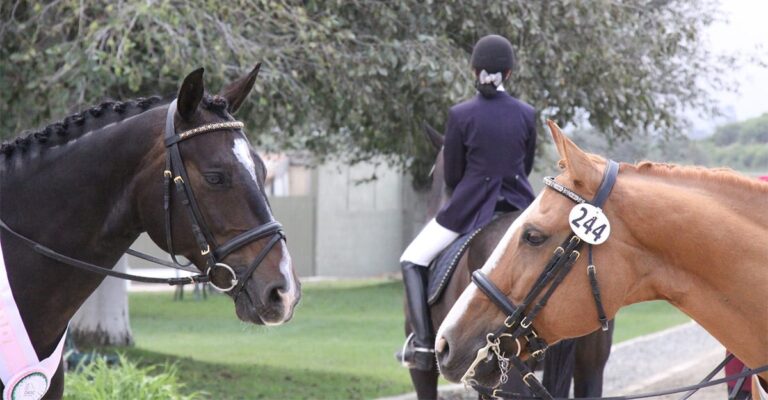
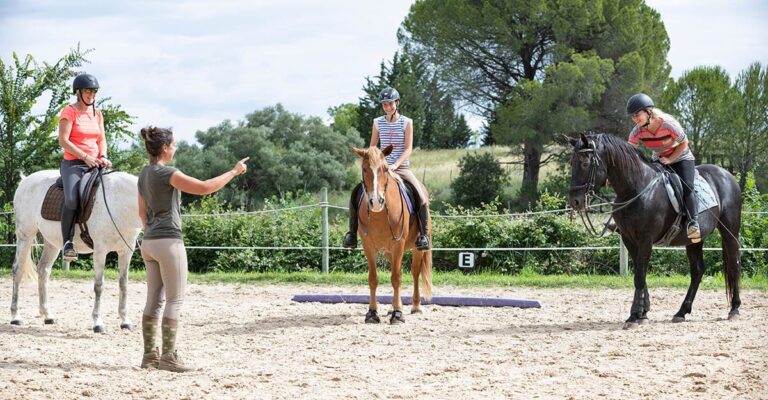
When human and equine athletes get separated for several weeks—such as during lockdown—physical and emotional strain can lead to anxiety, poor performance, and even reduced welfare, according to a new study.
Elite three-day eventing riders isolated from their horses for eight weeks during Italy’s Covid-19 movement restrictions did not ride as well in competitions after lockdown as they did before—despite six weeks of post-lockdown training, said Sabrina Demarie, PhD, of the Department of Movement, Human, and Health Sciences at the University of Rome “Foro Italico” in Rome, Italy.
A primary issue of coming out of lockdown? Anxiety.
“Even though eight weeks of confinement are definitely more than enough to compromise mental status and performance outcome, competitions were held six weeks after resuming training; therefore, higher anxiety was not automatically expected,” Demarie said.
“Indeed, previous studies have dealt with exercise restrictions due to injury without social isolation of either human or horses, and in those cases anxiety was not a big issue for returning to sport activity.”
Demarie and her fellow researchers—Christel Galvani of the Sacred Heart Catholic University in Milan and Veronique Louise Billat of the University of Evry-Val d’Essonne in Evry, France—followed 54 elite riders resuming riding activity after nearly two months of lockdown.
They recorded their performances at competitions four weeks before lockdown and at competitions 6 weeks after lockdown, and they surveyed them about their emotional and mental states, their lockdown self-training routines, and their evaluations of how much effort was required (how hard they were working) at any one time during post-lockdown training as well as during a competitive test.
The scientists noted that competitions post-lockdown were marked by poorer performance, according to Demarie.
Performance was most affected in the dressage test, probably because of heightened anxiety and greater difficulty concentrating due to a sort of mental overload, she explained.
Losing eight weeks of connection with their equine partner, the athletes still felt stressed about the competition even after having been reunited and working together for six weeks.
As dressage requires memorizing complex patterns and fine-tuned communication through subtle aids, and because the riders are aware that the test is scored entirely through judging (contrary to show jumping and cross-country), it’s logical that dressage performance was the most affected by lockdown, she said. And in fact, it was in dressage that riders reported feeling that they were exerting themselves the most, compared to before lockdown.
Even so, riders’ heart rates reached close to maximum levels already at the start of the jumping test, likely representative of anxiety there as well, Demarie added. But because event organizers created shorter versions of tests after lockdown—cutting 40% and 15% from cross country and show jumping, respectively—the athletes seemed to fare better in these tests than in dressage.
The reduced performance reflects not only reduced well-being for the rider but probably poorer welfare for the horse, as well, according to Demarie. Stressed riders convey their stress to their horses, she said. Notably, they might ride with incidentally stronger aids or stiffer bodies, and they might not align the release of aids to the horse’s response as well as they normally would.
As such, it’s important to keep human and equine athlete pairs together as much as possible even during lockdowns, Demarie said. “This will allow mental and physical wellbeing to be maintained for both horse and riders at a better level than during the spring lockdown when horses were managed by clubs staff only,” she told Horses and People. “It is intuitive that this is the lesson lawmakers have to ensure for animal wellbeing.”
And when competitions resume—especially if the pairs have had to be separated—training and tests should be modified to allow for a gradual progression back to pre-separation levels.
“The major findings of our study are that precautions have to be taken during and after training restrictions, in particular for the maintenance of positive mental status and physical wellness of the riders and the horses,” said Demarie.
“All stakeholders need to be aware that competitions should be planned at a lower level of difficulties and/or shorter course than before pandemic restrictions.”
The study is open access and published in the International Journal of Environmental Research and Public Health.
It is titled: Horse-Riding Competitions Pre and Post COVID-19: Effect of Anxiety, sRPE and HR on Performance in Eventing, by Sabrina Demarie, Christel Galvani and Veronique Louise Billat.
A new analysis of the Lehi horse, previously believed to be from the Ice Age, shows that the animal actually died sometime after the 17th century – and was raised, ridden and cared for by Native peoples. The study sheds light on the early relationships between horses and their guardians in the Americas and questions .
The findings, published today in the journal American Antiquity, are the latest in the saga of the “Lehi horse.”
In 2018, a Utah couple was doing landscaping in their backyard near the city of Provo when they unearthed something surprising: an almost complete skeleton of a horse about the size of a Shetland pony. Scientists and the media took note. Preliminary data suggested that the horse might be more than 10,000 years old.
“It was found in the ground in these geologic deposits from the Pleistocene — the last Ice Age,” said William Taylor, lead author of the new research and a curator of archaeology at the CU Museum of Natural History at the University of Colorado Boulder.
Based on a detailed study of the horse’s bones and DNA, however, Taylor and his colleagues concluded that it wasn’t an Ice Age mammal at all. Instead, the animal was a domesticated horse that had likely belonged to Ute or Shoshone communities before Europeans had a permanent presence in the region.
But Taylor is far from disappointed. He said the animal reveals valuable information about how Indigenous groups in the West looked after their horses.
“This study demonstrates a very sophisticated relationship between Indigenous peoples and horses,” said Taylor, also an assistant professor in the Department of Anthropology. “It also tells us that there might be a lot more important clues to the human-horse story contained in the horse bones that are out there in libraries and museum collections.”
Study highlights
The Lehi horse was unearthed in the city of Lehi, Utah by a surprised couple in 2018
Preliminary data suggested that the horse might be more than 10,000 years old
Researchers have now performed a more detailed study of its bones and DNA
It wasn’t an Ice Age mammal – it died sometime after the late 17th century
The Lehi horse is helping researchers understand how horses changed Native peoples culture
Written in bone
Taylor leads an effort funded by the U.S. National Science Foundation, called “Horses and Human Societies in the American West.” And he’s something akin to a forensic scientist — except he studies the remains of ancient animals, from horses to reindeer. He said that researchers can learn a lot by collecting the clues hidden in bones.
“The skeleton that you or I have is a chronicle of what we’ve done in our lives,” Taylor said. “If I were to keel over right now, and you looked at my skeleton, you’d see that I was right-handed or that I spend most of my hours at a computer.”
When Taylor first laid eyes on the Lehi horse in 2018, he was immediately skeptical that it was an Ice Age fossil. Ancient horses first evolved in North America and were common during the Pleistocene, he said, going extinct at about the same time as many other large mammals like mammoths. This horse, however, showed characteristic fractures in the vertebrae along its back.
“That was an eyebrow raiser,” Taylor said.
He explained that such fractures often occur when a human body bangs repeatedly into a horse’s spine during riding — they rarely show up in wild animals, and are often most pronounced in horses ridden without a frame saddle. So he and his colleagues decided to dig deeper.
DNA analyses by coauthors at the University of Toulouse in France revealed that the Lehi horse was a roughly 12-year-old female belonging to the species Equus caballus (today’s domestic horse). Radiocarbon dating showed that it had died sometime after the late 17th century. The horse also seemed to be suffering from arthritis in several of its limbs.
“The life of a domestic horse can be a hard one, and it leaves a lot of impacts on the skeleton,” Taylor said.
He added that scientists originally believed that the horse was so ancient in part because of its location deep in the sands along the edge of Utah Lake: Its caretakers appear to have dug a hole and intentionally buried the animal after it died, making it look initially as if it had come from Ice Age sediments.
And despite the animal’s injuries, which would have probably made the Lehi horse lame, people had continued to care for the mare — possibly because they were breeding her with stallions in their herd.
Hidden history
For Carlton Shield Chief Gover, a coauthor of the new study, the research is another example of the buried history of Indigenous groups and horses.
He explained that most researchers have tended to view this relationship through a European lens: Spaniards brought the animals to the Americas on boats, and white settlers shaped how Native peoples interacted with them.
But that view glosses over just how uniquely Indigenous the horse became in the Americas after those first introductions.
“There was a lot going on that Europeans didn’t see,” said Shield Chief Gover, a graduate student at CU Boulder and a tribal citizen of the Pawnee Nation. “There was a 200-year period where populations in the Great Plains and the West were adapting their cultures to the horse.”
For many Plains groups, horses quickly changed nearly every aspect of life.
“There was more raiding and fewer battles,” Shield Chief Gover said. “Horses became deeply integrated into Plains cultures, and changed the way people moved, traded hunted and more.”
He and Taylor hope that their research will, alongside Indigenous oral traditions, help to shed light on those stories. Taylor, for his part, suspects that the Lehi horse may not be the only set of remains mistakenly shelved with Ice Age animals in museum collections around the country.
“I think there are a lot more out there like this,” he said.
The study is published in Cambridge University Press in English and Spanish. It is titled: Interdisciplinary Analysis of the Lehi Horse: Implications for Early Historic Horse Cultures of the North American West, by William T. Treal Taylor, Isaac Hart, Emily Lena Jones, Joan Brenner-Coltrain, Jessica Thompson Jobe, Brooks B. Britt, H. Gregory McDonald, Yue Li, Chengrui Zhang, Petrus Le Roux, Carlton Quinn Shield Chief Gover, Stéphanie Schiavinato, Ludovic Orlando and Patrick Roberts.
Change is in the air in the equestrian world. It’s not a storm, yet, but there’s definitely enough breeze to fly a kite. Traditionalism, creaking and complaining, is starting to rustle in the wind as science begins to nudge it persistently.
It’s an exciting time, we are uncovering and shedding light on huge gaps in knowledge. Gaps, which to date, have been supported with sticks and stones, subjective experience, anecdotal evidence and a hefty dose of anthropomorphism.
Forward thinking equestrians are coming to terms with what our world looks and feels like for the sentient beings that are our horses. The person on the street (society) is starting to question our equine practices.
Equestrian sport regulators are engaging with low hanging fruit, penalising ‘excessive’ whip use in thoroughbred racing, introducing a ‘Blood Rule’ and banning whisker trimming. There is definite movement – the rocks are being pushed up the hill.
What interests me, as an amateur equestrian and equitation scientist, is how I can be involved in change – from the ground up.
Our world can, at times, be a very lonely place. Cultural belonging is key for equestrians and many of our unquestioned practices are firmly entrenched, some dating back to a military era.
Change can be challenging and hard – in some cases, it might mean admitting that we are wrong – a scary thing indeed for established professionals who have built their authority and a loyal following based on always ‘being right’.
Despite these challenges, I find commentary from change strategists comforting. Whilst change may be supported by regulators and law makers, it’s unlikely to originate there, explain Walker and Soule in the Harvard Business Review. They advise that culture change “can’t be achieved through a top-down mandate. It lives in the collective hearts and habits of people and their shared perception of ‘how things are done around here.’”
So, whilst creating cultural change is a slow, uphill process, it’s a process that rests with us. We create the habits. We get to say how ‘things are done around here’. And that’s what is so exciting.
I am currently riding at a new yard, in a foreign country, and I am submerged in a completely different culture to that in Australia. ‘Just do it’ is expected when instructors stamp and shout questions like: “You can sit a buck, can’t you?” That sneer was thrown at me after a school horse, usually ridden by many different children at a snail’s pace, was confused by my request for canter and, yes, I may be able to sit a buck, but should I want to?
Kids around here must show progression by jumping, competing and riding ‘anything’. It’s a rite of passage to ride the ‘crazy’ horse and ‘show it who’s boss’.
‘Naughty’ horses dump people all the time as they try and cope with a confusing and stressful environment before going back to spend the rest of the day isolated and confined to their stalls.
“They think I’m an idiot!” I complained to a friend last week, “No one takes me seriously!”
I used to ride with a group of instructors – they would all be cantering while I was still training my horse to ‘park’ at the mounting block. Grooms would rush over to ask if I wanted their help. Sometimes they openly laughed. I could feel myself trying to be small, trying to make excuses for my ‘lack of grit’.
It’s uncomfortable to be ‘the different one’ in a community, to be considered an outsider, to be a bit ‘strange’. I found myself taking to training when no-one else was around, or to hiding away in the high-walled round yard where no one could see me doing clicker training, or groundwork.
I stopped riding with the instructors because there was a sense of bemused belittlement when I had a productive training session but it was performed entirely in walk.
In a moment of reflection, I thought about my role as an equestrian advocate and realised that I was failing myself, and the horses I came into contact with.
I might not be jumping 1.10m courses and I may not have hundreds of hours of teaching under my belt, but I know a lot about what horses value, how they learn and how to train in an ethical way. Why was I hiding that away?
I can do hard things, I told myself, but that doesn’t have to mean changing everything and everyone all at once. It means changing the way that I think and operate.
To make meaning of my education, I simply need to show up. Perhaps then, a few lights will shine the path for the next ‘strange’ rider who comes along with knowledge of learning theory. Perhaps, at some stage in the future here, there will be a collective meeting of minds and habits that celebrates the privilege of developing a relationship with our horse, with absolute respect for what these amazing animals need to live an enriched life.
And today that small mindset change made a big difference.
Today I went to the yard to meet a new friend. He has a polo pony and, as a scientist himself, is interested in the work that I am doing. I didn’t hide. I stood out in the open with his horse and demonstrated what we had achieved in one session of clicker training the previous week.
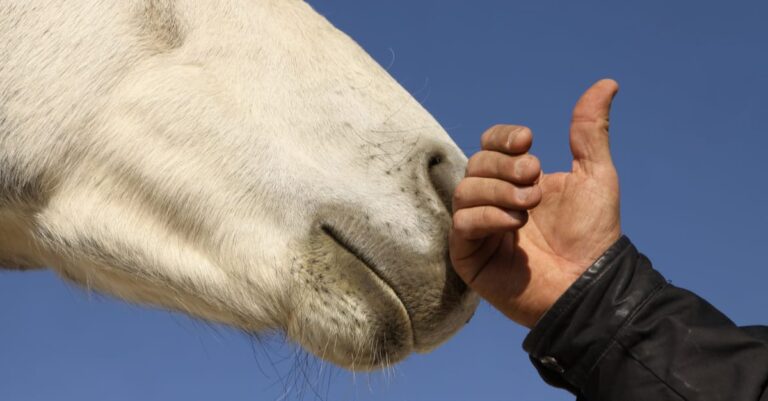
His little mare was fully engaged, alive, and present with us as she gave me ‘high fives’ (touching my hand with her muzzle) in exchange for a click, a piece of carrot and a scratch.
My friend tried it and she stretched and gently touched his hand. The warmth and satisfaction that simple act of communication brought to the air was palpable. “It feels like magic” I explained, “and that’s just the start.”
We put her away after our session, talking about what behaviours we could shape next, what it would be possible to achieve, quietly buzzing, when we were interrupted by one of the instructors, “can I ask what course you’re doing?” he enquired, “I’ve been thinking about doing some study myself…”
In a time of crisis there may be nobody to help you, no power, no communications, no emergency services, no veterinarian, no daylight… What is your plan?
Everyone’s situation differs according to the size and nature of their horse enterprise. That’s why each and every horse owner needs to develop an individual survival plan, coolly and calmly, before an emergency situation arises. Survival relies on forward planning and self-reliance.
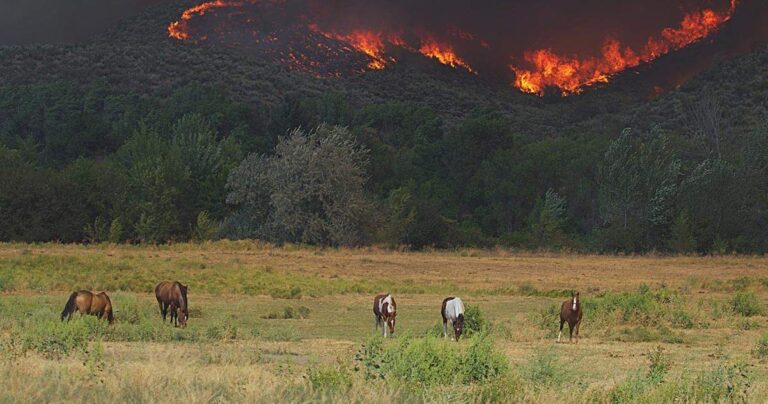
The first and most important thing to decide is whether you intend to stay on your property if there is a bushfire. Assess your risk, understand how safe your property would be if a fire occurred in the immediate area, and remain flexible.
If you decide you will leave, with or without your horses, you must do it early on a high-risk day and in advance of knowing there is fire in your area. The announcement of a Total Fire Ban should be the trigger for your decision. Late evacuation can be deadly.
Fitton HorseInsure: The insurance specialists for equestrians
Have a plan
Make arrangements ahead of the start of the fire season for a place to temporarily relocate your horses. Options may include showgrounds, sale yards, parks, racetracks, pony club grounds or placement with family and friends.
Identify several possible retreat routes from your property in case fires block your escape. Decide in advance which horses you will evacuate and make sure your vehicle is roadworthy and your horses are trained for transport.
Identify a “safe” area on the property where horses can be placed if evacuation is not possible or practical. This area should be as large as possible and may be a closely grazed paddock or be created from several paddocks by opening gates. Ideally, it should have a dam with clear access. An alternative “safe” area might be a large well fenced sand ménage provided there are no trees or buildings nearby that will burn readily.
Make sure your tack and other precious items are locked away – and insured, whether as home contents under a “sporting equipment” clause, or specifically on your horse insurance policy. You can insure other assets like fences, sheds, machinery and much more on a farm pack.
Prepare an Evacuation kit
Equip a lidded bin with the following:
wire cutters and a sharp knife
torch, portable radio and fresh batteries
water bucket
extra lead rope and head collar, woollen blanket and towels
equine first aid items
proof of ownership documents, including microchip numbers, brands, registration papers, insurance documents or bill of sale
whatever else you feel is essential for the first 24 hours.
Store the kit in an easily accessible location and ensure it is not used for anything but emergencies.
Identify your horses
Microchipped horses will be more speedily reunited with their owners if separation occurs during a disaster.
In an emergency, at the very least, be prepared to “paint” your name and phone number on the horse itself using livestock grease crayons like the ones used to number horses in endurance rides or clip similar details on its hair coat or paint its hooves. Neckbands, hip stickers and identification tags on leather head collars can also be useful.
Wear safe attire
In the event that a fire threatens you, whether you decide to evacuate or stay, the right clothes can help shield you from radiant heat, burning embers and flames. Cotton fabrics, sturdy leather gloves and boots, goggles and a damp cotton scarf to shield your face.
Fire-safe gear for horses
The same principles for fire safe clothing apply to your horse. Remove all rugs whenever there is a total fire ban.
Leather halters and cotton lead ropes will be safer even if they are not as strong. Synthetic halters or lead ropes, fly masks and tack may melt and cause serious burns to your horse and its handler.
When fire comes your way, your personal safety and that of the people working with you must be your first concern. A well-developed plan will help you remain calm and alert so you can think clearly and decisively.
Monitor weather forecasts and media broadcasts, especially ABC radio and local community radio stations for emergency information. Maintain good and clear communications with the people you are working with.
And above all, just do it! Good forward planning will protect the safety and well-being of you and your horses.
Your horse probably recognizes your face and knows your voice—maybe even the sound of your car driving up to the stables. And while he or she may develop some level of attachment to you, it might not be the same kind of bond that grows between parents and children or even humans and dogs, according to a new study.
And that doesn’t mean the relationship between horses and their humans isn’t special. It just means horses can—fortunately—turn to other humans for support and comfort in stressful situations, said Lina Roth, PhD, associate professor at Linköping University in Linköping, Sweden.
“We are not saying that there is not a special bond with the owner, but rather that even a stranger could give some support to a horse that has been stressed or separated from other individuals,” said Roth, who adds that she considers that she and her own horse have developed a “kind of bond.”
Roth and her fellow researchers, including colleague Paulina Lundberg, MSc, observed the behavior and monitored the cardiac activity of 26 privately owned horses living in boarding stables as they were led to an arena, walked, and then left alone for one minute before being reunited with their handler. The scientists tested the horses with their owners and with a handler they didn’t know in the same circumstances.
Interestingly, overall, there wasn’t any significant variation in the horse’s behavioural or cardiac reactions between being reunited with the owner versus being reunited with a stranger. In similar experiments with dogs and with young children, there’s a significant difference in reactions when it’s the dog owner or parent, compared to the stranger, she added.
“This might not be that surprising, when you think about the fact that most dogs live in our houses and are together with their owners from when they’re puppies,” said Roth. “But with horses, it is not as common that we keep the same individual throughout its life. In addition, the horse is a prey animal, and we might need to modify the research methodology in order to capture its complete behavioural response in this kind of studies.”
That doesn’t mean horses never develop special bonds with their owners, however, cautioned study co-author Elke Hartmann, PhD, of the Department of Animal Environment and Health at the Swedish University of Agricultural Sciences, in Uppsala. When and how they express attachment behaviour may depend entirely on previous interactions and the situation – where the horse lives, how much time the owner spends with the horse, what they do together, how long the owner has had the horse, etc. “It’s really important not to generalize research results,” said Hartmann.
This needs to be highlighted, because some media outlets reported on this study with misleading headlines.
“One study can’t give all the answers,” Roth added, “but this one is a really good start and has given us and the research field [investigating horse-human attachment], more interesting research questions to investigate.”
The study is open access and published in Applied Animal Behaviour Science. You can read it here.
The article is titled: Does training style affect the human-horse relationship? Asking the horse in a separation–reunion experiment with the owner and a stranger by Paulina Lundberg, Elke Hartmann and Lina S.V.Roth.
The term ‘agency’ is commonplace in human-animal studies and was featured in public debate via ‘The Equitation Welfare Workshop’. The event gave practitioners, equitation science researchers, vets and therapists from around the world a chance to openly discuss agency and the sport horse.
But what is agency and how does it relate to people and horses?
The following discussion is adapted from the book ‘(Un)Stable Relations: Horses, humans and social agency’ which I co-authored with Lynda Byrke.
In the social sciences and humanities research field that is concerned with ‘animal studies’, agency is used to convey how non-human animals have the capacity to make choices and impact other human and non-human animals.
In many ways, the concept of agency is an attempt to recognise animals as subjects, that is beings who are capable of having subjective experiences and relationships, and not deny them similar or the same capacity as humans.
The term is problematic for humans and non-human animals alike, in that it carries a sense of ‘free will’. But agency does not exist in a vacuum of unlimited capacity for voice and action. Rather, it exists in relation to structure.
There are social, physical and symbolic structures which enable and constrain the extent to which we (feel we) can act upon our agency depending on who we are and with whom we are relating (e.g., male/female, human/animal, young/old).
Some social structures are liberating but others can be coercive or exploitative. Some might have the appearance of free will but have been built on invisible systems of power, threat, fear and subordination.
For example, democracy might seem to provide people with more choice than, say, communism, but many people would point out that in many democratic societies, voters are largely constrained to a choice of only two parties.
Horses too are located in political systems. Some forms of horse ‘training’ may seem to prioritise choice, such as work at liberty, but the horses may not be ‘agents of free will’, especially if they interact with humans in enclosed spaces where the horse is less capable of removing him or herself from human-horse power relations. ‘Resistance’ is a sign of agency, but what are we going to do about it?
It is important to recognise that horses are agents or have agency but it is something else entirely to interact with them in ways which honours and enables their agency.
For example, sometimes when we ride, we make demands of our horses and even if we are ‘listening’, we may have already decided which responses are acceptable, unacceptable or correct. Or we put horses in positions which greatly limit the range of responses they can give. This is not always bad. It is important to set horses up for success, however, it is us who decides what success looks like
Sometimes, we ask horses questions instead, respecting their agency by allowing them to respond in many different ways and accepting their response without judging it as correct or incorrect. However, the conversation we had yesterday on the arena may not be based on the same terms today out on the trail when we are about to cross paths with a snake.
“If you are going to fully commit to allowing your horse to express their agency, you need to be prepared for them to say ‘no’, ‘not now’ or ‘no, not like that’.
This is why context is so important and why agency should always be seen as relational. That is, equines are agents but their agency is a product of the relations between a human and a horse at any given time, subject to the social, cultural and historical context of all parties, not to mention the emotional states of horse and/or human.
Projected worlds
Humans work for their living and have social obligations and cultural expectations to meet.
It is not uncommon to hear an equestrian state (for the apparent benefit of their horse), ‘you have the other 23 hours of the day to yourself’, usually when a horse appears ‘naughty’ or reluctant to ‘work’. I sadly admit to having said this myself until some years ago. But now I realise I was saying it for my own benefit – to override my feelings of coercion.
It is simply not enough to say that ‘everybody’ has a job to do. Just because most humans work as a trade-off for enjoying their non-working lives (often in a job they do not enjoy), does not mean horses must do so too. That is no more than a projection of our human world and social contract onto horses – and one which is akin to telling a horse to ‘toughen up’, ‘get over it’ or ‘get used to the real world’.
These are all examples of humans projecting onto horses the things we have heard or have had to face ourselves but have not had enough agency – or have had too much structure – to challenge.
In any case, when did horses give informed consent to this 1 hour contract in return for 23 hours to themselves? And what do they get to do in those other 23 hours? Are they 23 hours of a life worth living or are they spent standing in isolation in a bare yard waiting for two feeds which arrive around 10 hours apart within a 24 hour period?
Such a horse might technically be an agent. They can react and respond to their conditions during the 23 hours they have ‘for themselves’ or even resist during the 1 hour they are expected to defer their agency to humans, but can we call that agency?
Over to you…
Agency is, as social scientists describe it, an emergent property of human-animal relations. That means that whilst your domestic horse is considered an agent, their ability to exercise agency largely depends on you. You might relate with your horse in ways that narrow or expand their agency. They probably relate in ways which narrow or expand yours. Whatever the case, as the primary instigators of interactions with horses, it is our responsibility to create the conditions that facilitate the expression of equine agency. But this is not as easy as unclipping the leadrope and opening the fences.
If you are going to fully commit to allowing your horse to express their sense of agency, you need to be prepared for them to say ‘no’, ‘not now’, ‘not today’ or ‘not like that’. Beware – you might be surprised by how this makes you feel about yourself.
In addition to equine agency, other emergent properties of your new and improved social relations with horses may very well be feelings of being disrespected, ineffective, powerless, voiceless, incompetent or unloved. It is important not to buy into those feelings or interpret your horse’s behaviour in those ways (for example, crafty, disrespectful, bullying, powerful, loud, lazy or ungrateful).
By listening to horses and negotiating with them as social agents (who have a right to give and withdraw their consent to engage with us), we can critically reflect not only on human-horse relations, but how we relate with and to each other and ourselves.
There has never been a better time to challenge the world we have created for horses or the world we have created for humans. We all deserve to be seen, heard, acknowledged and allowed to express ourselves – and we would all benefit from applying less judgment to what emerges.
In a previous article I spoke about the importance of trusting your ‘gut feeling’ – the intuition you have of whether the advice is good for you – before you receive that advice. This time, I want to discuss what to do when you don’t have a gut feeling.
Learning often starts when we venture into new territory and taking advice from other people is crucial to our learning.
Some people become very defensive very quickly and they might miss out on some really good advice. Defensiveness often arises when someone has been getting too much advice to the point of being bombarded or overwhelmed.
In my own experience, when I have had people constantly telling me what to do and how to do it, I became defensive.
But becoming defensive only hurts yourself, not others.
So, my advice would be to listen to what people have to say and learn to say “thank you, but no thank you” anytime the advice doesn’t suit you, while staying open to advice that is valuable.
Our beliefs can also get in the way. If you believe that there is one particular way that things should be done, you are likely to block and stop yourself from trying something new.
The “my way or the highway” mentality never works, particularly with horses.
I remember when I first started teaching, I thought that because I had been a competitor and because I had some success, I knew how to train a horse.
In my lessons I was pretty set on certain things and I was not afraid to argue my point. This meant that I was often in a lesson where the riders did not get the results they were looking for, and I eventually had to learn that my way was not always the right way for them.
Having to admit to my students that my approach was not working and that I did not know what to do to resolve the issue was a humbling experience.
I learned that I had to go back and keep learning, that the best way of learning is to ask for help and to find people who know more than I did.
I attended clinics and just sat, watched and listened.
I learned to ask questions and more importantly, I learned to listen attentively to the answers.
I’ve spent many hours sitting in arenas watching other riders train and teach and I was prepared to pay for it or work for it.
Now that I have been riding for 40 years and coaching for over 20 years, I have come to know what I don’t know and I can be honest about it. In saying that, I also finally know what I do know and I have learned that the two aspects always go together.
What I mean by that is you have to acknowledge what you do know without being arrogant about it. When you know what it is you really know, you also gradually realise what you don’t know and that’s when the real learning begins.
It’s when we can put our ego aside and we stop defending ourselves that we can really start learning.
And you don’t always need to learn from people who are more experienced or higher in the sports hierarchy than you; you can learn something from everyone.
For example, I now find I learn most from my students, and often, from those with the least experience.
There is a famous saying; “if you can’t explain it to a six year old you don’t understand it yourself.”
Novice riders and novice horse people test my knowledge more than the advanced rider does. I constantly work on getting better at explaining and teaching the basics and that is how my own knowledge grows.
My point is that the greatest learnings often come when we least expect them. And the moral of the story is to stay open minded, listen to the advice others have to offer and don’t ever be too arrogant or too insecure to ask for help.
Even though it can be tough and sometimes overwhelming, there are a lot of kind-hearted people out there who genuinely want to help.
Therefore, even if you have been getting bad advice in the past, avoid the temptation to close your mind, become defensive or dismissive. Listen to what they have to say and then decide if you will take it on or if you don’t. Even if it doesn’t fit into what you need at this time, it might come in useful in the future or with another horse.
My wish is for us to support each other, that we offer help and advice but respecting the other person’s choice to take it or leave it.
My wish is that when we realise how much we still have to learn, we become inspired instead of beating ourselves up for not yet knowing everything.
My wish for you is that you will continue your learning journey for as long as you can and you take it you to your next lifetime so you can have a head start.
If there is one thing I know for sure, it’s that we cannot learn everything there is to learn in one lifetime, so the quest continues. Thinking this way gives me comfort and it relieves the pressure of time. Happy learning everyone!
When you look at a horse, are you evaluating the bone structure, leg alignment, musculature, balance and body proportions; that is, are you judging the horse’s conformation?
What if I told you that many of the so-called conformation faults are not inherited or fixed but actually compensation patterns?
Ever since horses were domesticated approximately 6,000 years ago, breeders have aimed to perfect their shape and structure to increase their ability to do the work they were bred for.
Many different breeds developed, and within each, extensive texts have been written listing conformation traits and teaching us to distinguish between the ‘ideal’ ones and those that are considered ‘faults’.
The problem, however, is that conformation tends to be judged and described as a set of fixed traits, rendering some horses more ‘valuable’ than others and, as I will explain in this article, many of the so-called conformation faults are not inherited or fixed but actually compensation patterns that develop as a result of pain and injury. This is both, good news and bad news…
The bad news of this perspective is that ‘ideal’ conformation can deteriorate as a result of dysfunction and pain caused by injuries, incorrect trimming/shoeing and/or bad management and training.
The good news is that when we uncover and treat the pain or dysfunction that is causing them, compensation patterns can be changed and so-called conformation faults and quality of life can be improved.
Birth trauma
A great example to kick-start this discussion is the foal. During foaling, the foal’s body is placed under a great deal of pressure as it’s pushed and squeezed through the birth canal. These pressures can cause damage which is now known as ‘birth trauma’.
Dr Ian Bidstrup, one of the most qualified veterinarians in chiropractic and acupuncture in Australia, has been highlighting the long-term effects of birth trauma for many years – from teeth wear to leg and hoof conformation, to unevenness and one-sidedness in gait, to behaviour and even stomach ulcers.
Research has confirmed the effect; for example, writing in the Equine Veterinary Journal in 1999, D. Jean and colleagues found broken ribs or a disruption between the junction of the ribs and the breastbone in over 20% of foals.
Soft tissue trauma to the foal’s shoulders and pelvis is even more common. From my own clinical observation, I estimate that 80% (or more) of foals born have some kind of birth trauma that causes compensation patterns of varying degree and severity.
The compensation can compromise the nervous system and show up as ‘windswept foals’ or ‘pigeon-toes’, ‘knocked-kneed’ or other forms of so-called conformation issues.
Other symptoms like the high heel-low heel syndrome or a club foot can can be compensation patterns from birth trauma that are often overlooked and classed as conformation faults.
The good news is that if you intervene early and help with the underlying problem, these issues can be corrected. Often, the correction, if intervened early, is easy and all it takes is maybe a chiropractic or acupuncture treatment from a certified practitioner.
However, if the problems are not recognized, they can lead to long term soundness problems throughout a horse’s life, as well as cause us to judge the horse as less valuable for having bad conformation, something that is especially sad when they are trying to compensate for a problem that could have been addressed early on.
If you are a breeder, find a chiropractic and/or acupuncture veterinarian who is experienced in diagnosing and treating foals, and have all new arrivals checked for birth trauma early.
Pain and conformation
From foal to adult, horses can develop all sorts of leg alignment issues like pigeon-toed, bow-legged or knock-kneed in the front legs, and cow-hocked, sickle-hocked in the hind legs and many more.
These horses can indeed have a conformation fault (a definite twist or deviation of the bones) or they can be compensating for some pain, either in their upper body or their feet, and it is muscle, rather than bone, that lead us to think we have a conformation fault.
In previous articles I have emphasised that horses are amazingly effective at hiding signs of pain.
Horses may have adapted to conceal any signs of weakness, but this does not mean they feel pain less, they just don’t show it as obviously. A wild horse that is obviously lame or shows other signs of being unwell catches the attention of predators and will become their target.
This means that by the time a horse shows an obvious lameness, it is often too late and the physical damage has been done. Catching issues early might make all the difference between a horse that just needs some treatment or a horse that is deemed unrideable due to physical damage.
The horse, when in pain, starts to “compensate’ i.e., changes posture, gait and behaviour in an attempt to protect the area from further physical damage while avoiding showing predators a weakness.
There are giveaway signs though, especially for those who are trained or know their horse well. There will be small and subtle changes somewhere in their body that (if you learn what to look for), can be identified as a pain-related compensation pattern.
The key is learning to distinguish between compensation and conformation, so let’s look at some examples.
Leg alignment
When looking at a pigeon-toed horse, most people assume that this is a classic conformation fault – i.e. it can’t be changed. This can be the case if the bone structure has grown in a way that turns the feet inwards.
However, there are many horses who are classified as pigeon-toed because one or both toes turn inwards but actually have quite a straight bone structure.
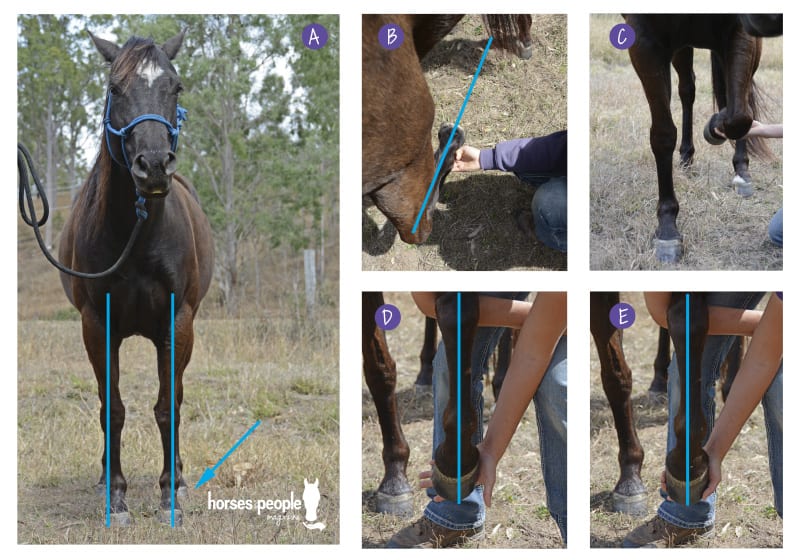
IMAGE A: Conformation or compensation? Standing square, this horse’s legs are not bearing weight evenly. The right front foot is closer to the midline and the left front appears pigeon-toed. IMAGES B & C: To check if it is a conformation fault or compensation pattern, start by checking the alignment as described in the text. IMAGES D & E: Since the pigeon-toed foot can be easily corrected, there’s a good chance it a compensation pattern. The next trick is to work out if the horse is compensating for a foot or upper body issue so it can be treated accordingly. Photos by Cristina Wilkins.
The horse may be turning the leg due to pain, either in the feet or the upper body. The way to distinguish between a conformation or a compensation issue is fairly easy.
Pick the leg up and hold it loosely by the cannon bone, letting it ‘hang’ where it wants to (Images C & D). If the muscles are relaxed and the horse is standing square, the foot will hang in alignment with the hind leg on the same side.
If there is some muscle tension due to a compensation , the leg might hang either outside the hind leg on the same side or point towards the space between the hind legs or even towards the diagonal hind leg.
Now take the leg forward, holding it behind the knee joint (carpal joint) and let it hang as shown in the photos. If you can easily adjust the ‘crooked’ joints and hoof capsule, it’s likely that the leg alignment can be changed.
If the bone structure itself has a bend or a twist it is likely a more permanent conformation issue.
The same test can be done when you look at knock-kneed horses or any other conformation fault in the front legs.
Inverted or u-neck
Although different breeds have been selected to carry themselves with a higher or lower head carriage (think of the difference between the high head posture of a Friesian horse and the lower carriage of a Quarter Horse for example), a u-neck refers to a degree of tension through the neck that is impacting their health, biomechanics and behaviour.
When we see a horse with an inverted or u-neck, it is generally due to the horse compensating for pain in the body. A horse that is sore in the front end and/or back will compensate and alter the head carriage holding the head higher. Commonly, you can also see a dip in front of the wither.
This posture creates a great deal of tension through the neck muscles, places pressure on the temporomandibular joint (TMJ) the hyoid and the poll, and even result in dental problems because a tight TMJ changes the way they chew. The horse may also become head shy, as he tries to stop you from touching a sore poll.
IMAGE A: Uneven shoulders caused by leg alignment issues. IMAGE B: A tell-tale sign of compensation patterns can be seen in the fascia lines. IMAGE C: Checking hind leg alignment to determine if it’s conformation or compensation. IMAGE D: An inverted or u-neck showing over-developed underline and under-developed top line. Image B by Cristina Wilkins. All other images courtesy Animal Biomechanical Solutions.
We often see horses develop a u-neck and their riders complain about that the horse not wanting to stretch out anymore or accept a contact with the bit. The high head carriage can limit the horse’s vision and since this posture is associated with flight and running, it will raise their arousal level and make them more reactive and spooky.
Changes in the head and neck posture and muscles can be caused by incorrect training and/or pain, and often, the pain will derive from the front end.
Problems with the front feet, legs, shoulders and/or neck can all cause the horse to change their head carriage.
U-necks are usually a sign of compensation, not conformation, and can often be greatly improved, first by addressing the underlying pain, and then with a training program that encourages the head and neck to function as it is meant to.
Shoulder angles
We talk about good horses having ‘good sloping shoulders’ and tend to criticise those who have shoulders that are too upright, but it pays to remember that the horse’s shoulders are only held to the body by muscle – they have no bony connection to the rest of the skeleton.
For this reason, when we look at shoulder angles, it can be tricky to know what the horse’s ‘true’ shoulder angle is and whether we are looking at a conformation issue or a compensation pattern.
A sign that we are dealing with a compensation pattern in this area is, for example, a high neck carriage or u-neck, which forces the shoulder blade into a more vertical position. Another sign is whether we can see fascia lines in the shoulder area, which are a sign of overloaded soft tissue.
We may see uneven shoulders – either one is higher than the other or the muscles on one side are more developed. Often, this is caused by a high heel – low heel syndrome. We talk about high heel – low heel syndrome when a horse has a more upright foot on one side and a flatter foot on the other side. This is caused by a change in loading through the legs due to either foot pain or pain somewhere else in the legs. The more upright foot is usually the sore one and the shoulder on the side will usually appear flatter. The flatter hoof being overloaded and the shoulder on that side will usually be the one that appears overdeveloped.
The only exception is a true club foot which is rare and will not cause uneven shoulders. But most upright feet are man-made club feet that are caused by an off loading off the higher foot and overloading of the flatter foot.
Another common reason for a high heel-low heel syndrome, are one-sidedness (a preference for one side when moving) as well as shoulder and neck issues. As discussed above, both can be related to birth trauma in foals or the trend to breed long-legged horses that can’t easily reach the ground as foals. This is because it leads to a change in grazing behaviour, stance and biomechanics that can lead to lifelong changes in the horse’s musculo-skeletal makeup.
Cow-hocked
When viewed from the back, a cow-hocked horse will stand with the hocks closer together than the feet. You can tell this posture is a compensation pattern when the horse presents with very tight adductor muscles (the muscles up high on the inside of the leg).
The tension causes the horse to turn the hocks in and the toes out, normally to compensate for pain either in the pelvis or the back, usually from having the hind end overloaded in relation to the front end. This overloading and resulting muscle tightness/soreness can cause horses to struggle lifting the hind leg up or to ‘play-up’ for the farrier.
Another hint that a horse is compensating can be detected when, as well as the cow-hocked stance, the hind feet have flares, bruising, long toes, underrun heels or a medial-lateral imbalance.
Fascia lines in the flank area are also a sign for an overloading of the hind end. The other test is to pick the leg up as shown in the photo and let it hang loosely. When you can see a straight bone structure with a twisted hoof capsule that can be adjusted using a slight pressure, we are likely dealing with a compensation pattern that can be changed.
Pelvis angle
A horse needs a functional pelvis to be able to develop propulsion, no matter it’s a dressage horse, a campdrafter a show jumper or a trail pony.
If sore, the horse can sometimes change its pelvis angle, either making it steeper or flatter depending on the way the horse is compensating. This leads to reduced mobility in the pelvis, which changes the way the horse can use itself and causes a lot of sacroiliac (SI) joint problems.
It is not always a problem in the hind-end that causes the horse to change the pelvis angle, more often than not it is actually coming from a pain issue in the front of the horse and the change in pelvis angle is the way of compensating. Another sign of a compensation issue in the pelvis area is a tucked tail. This often happens in combination with a change in pelvis angle and can be a sign your horse is sore.
Roached lumbar spine
If your horse gets very tight over the lumbar spine (the part between the last rib and the sacroiliac joint), or the spine has a convex shape (roach) in that area, it is likely that your horse is dealing with some pain issues.
Some people believe that a roached back is a structural fault but I haven’t seen a horse yet whose roached back was a true conformation fault.
The lumbar spine is a very common area for a compensation pattern to show up.
These horses don’t always show soreness in the back; sometimes they are so locked up that they don’t show any signs of pain when you push on their backs.
Importantly, the pain and underlying problem can be a long distance away from the site of compensation.
In summary…
These are a few examples from an endless list of compensation patterns that can be wrongly condemned as conformation faults.
The best way to look at the horse’s body is to see if you find pain or soreness anywhere and also if the horse is having trouble with some parts of its training.
Always remember that horses are masters at hiding pain so if in doubt, ask a certified practitioner in your area.
And, most importantly, if you think something is not right, it probably isn’t. You are your horse’s voice so make sure that everyone can hear it!
Floods are one of the most frequent natural disasters that horse owners have to deal with because many of the properties horses are kept in are floodplains. Despite this, it is easy to become complacent.
This helpful information has been compiled by Agriculture Victoria and applies to anyone keeping horses in a flood-prone area.
It covers the following aspects:
Mitigating floods in the area your horse lives
Preparing for floods
Evacuation
Horses caught in floods
Health hazards
Plan to cope with floods
Living in a 100-year flood plain means the chance of flooding is calculated as a 1% chance of flooding per year or a 30% chance in the lifetime of many mortgages.
Floods can be slow or fast rising. Slow-rising floods are typical as floodwaters move down a river or creek and can often be predicted to reach a certain height. Flash floods are usually the result of extremely heavy rain or melting snow and occur suddenly. They can also result from dam or levee bank failure.
Forward planning will greatly reduce the amount of animal and human suffering in any emergency situation including floods.
As a horse carer, when undertaking disaster planning for floods, you should make yourself familiar with the area in which your horses live. In particular, proximity to:
creeks
dams
waterways
drainage areas.
Councils have information on floodplains in your area. Proper land-use management and compliance with building regulations may reduce some of the costs due to losses from flooding.
The driveway to your property needs to be well constructed and maintained to protect you from being stranded during flooding, if you live in a risk area.
Avoid building in a floodplain. Sheds and stables should be located in high lying areas sufficiently large to be used as a holding area for horses in the event of a flood. If you graze horses on floodplains, be prepared to move them to higher ground before low-lying evacuation routes become flooded.
Construct separate buildings for storage of farm chemicals such as herbicides, pesticides and fuels so there is minimal chance of contaminating feed and water.
In broad, level flood plains where floodwaters are seldom deeper than one metre, you may need to establish areas of high ground on which horses can stay until floodwaters recede.
Regularly check the security of fencing and inspect buildings for sharp edges and soundness.
ensuring equipment and vehicles are in proper working condition.
Plan to be self-reliant for 72 hours. Secure supplies in case of evacuation and in case you need to care for horses without the day to day conveniences of:
electricity
readily available feed
a safe water source.
Horse evacuation plan
Make a family and animal evacuation plan. Ensure everybody who lives, works or agists at your property understands the plan. Discuss contingency plans with neighbours and friends.
If you are in a flash flood area:
try to identify safer areas
have several alternate routes to ensure rapid evacuation
if you have a large number of horses, anticipate the course floodwaters might take and establish which horses you will move first
start moving animals in advance of any danger (even if the evacuation turns out to be unnecessary, at least you will have practised an evacuation).
Emergency kit
A well-stocked emergency kit should be established and kept where it can be reached easily and quickly. Items that are valuable in a disaster situation include:
torches and a portable radio (with extra batteries)
food that requires little or no cooking or refrigeration
mobile phone charger
emergency cooking equipment
drinking water
a shovel and an axe
wire cutters
equine first aid items
leather gloves
extra head collars and lead ropes
extra clothing for both humans and horses.
Identification of horses
Prepare an information list about your horses to assist retrieval of horses from an emergency holding facility, or to help you find them should they get loose or lost during the flood.
Make sure your horse is identified with a microchip and that you have a record of the microchip number.
Include in your list:
a written description of each horse
information about any permanent identification features such as brands or microchip number
photographs of horses
proof of ownership.
Put all this information in a waterproof container and keep it with you.
Make identification tags that animals can wear on their head collars or around their necks while at a holding facility.
Transport and communication
Keep vehicles and horse floats in good working order and equipped with:
fuel
area maps
mobile phone
emergency numbers.
Food and water for horses
In case of emergency evacuation, keep in the float:
hay in nylon sacks
feed in plastic bags or containers with tight fitting lids
buckets and
an extra 20 litres of drinking water
Food is often initially unavailable or quickly depleted at holding facilities if the horses are evacuated.
Train your horses
Teach your horses to load into a float or horsebox. This will minimise stress and delay if flood strikes and in the event of an emergency evacuation.
Evacuation
Listen to radio announcements from emergency officials. If evacuation becomes necessary, remove horses to a safer area as soon as possible – before access roads become impassable. Only use routes recommended by local authorities. Turn off all utilities at the main switch before you leave. To assist emergency services, place waterproofed notes in the stables and house indicating if there are any animals left on the premises.
Do not attempt to drive over a flooded road. You could become trapped or stranded. Do not try to lead or ride horses through swift moving, deep water.
Horses caught in floods
Ensure your horses have an easy escape route if you have to leave them behind. Do not leave them stabled or in small yards. Many animals have died in floods when owners left them confined.
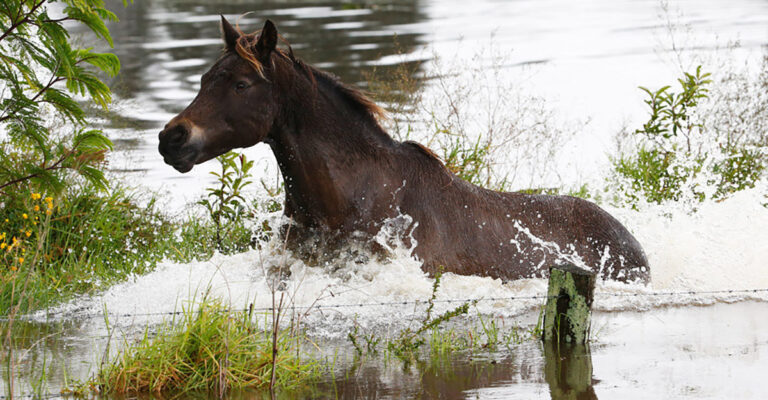
Horses can swim quite well and can handle water up to their bellies for lengthy periods. However, some limb swelling will occur with prolonged water contact. In general, most horses can handle their limbs submerged for 48 to 72 hours.
They need to be fed where they are and kept warm by eating hay.
Health hazards
In fast rising floods, horses can be swept into obstacles such as fences and corrugated iron. This can cause serious injuries.
Mud can pose a serious hazard for a stranded horse. If trapped and immobile, horses can fracture a limb or seriously injure themselves by struggling in deep, sticky mud.
Eye injuries are common when horses attempt to pull themselves free and hit their faces on stalls or fencing. Other hazards common to horses after floods include:
rainscald
mudfever
foot problems
pneumonia
wounds (especially to the legs)
waterborne illnesses such as leptospirosis
drinking contaminated water
eating mouldy food.
Contact your local veterinarian as soon as possible when your horse requires medical attention. If your horse is in need of euthanasia you can also contact your local council, the RSPCA, or your state’s animal health officers to humanely euthanase your horse in an emergency.
Before restocking flooded pastures, check to make sure the perimeter fences are intact. Remove dangerous debris, especially along fence lines and in corners. Water may have ruined the pasture causing a “green drought”. In these circumstances horses will need supplementary feeding. Lack of adequate forage could also force horses to eat poisonous plants.
Mosquitos and other insect pests may be abundant after a flood. As well as annoying animals, some species carry disease. To reduce mosquitoes around horses, purchase insect repellent from your local horse equipment store or veterinarian.
References
The ‘Animals in Disasters Independent Study Course‘ prepared by the Emergency Management Institute, the educational wing of the Federal Emergency Management Agency in the United States of America.
Herbert K and Heath S (1999) Disaster Planning. In The Horse published by The Blood-Horse Inc, Kentucky, June issue, pp 20 – 35.
Madigan J (1998) Recent weather phenomena highlight need for disaster planning World Equine Veterinary Review 3(1):43.
More information
More information on horse ownership and management can be obtained by contacting your local state’s emergency services (SES), horse council and the Dept. of Primary Industries. If you are unsure, ask your veterinarian for further advice.
In this article, Tanja Mitton comments on a recent article in Eurodressage by Adriane Alvord, “The Pain that Lives Behind the Barn Door” referring to the tragic death of Teresa Butta in the US.
We have lost three professional riders to suicide in the last three months and there are many more I know who were contemplating taking the same action. We can’t ignore this anymore and something needs to change.
There are so many people who struggle with life. Most struggle in silence and put on a mask that hides the way they feel. A beaming smile, a chatty conversation and a false assurance, “I am doing fine”, is all it takes to hide the way you feel. Not many people have the courage to ask for help and not many friends notice the subtle warning signs.
I am a mindset coach in the equestrian industry and, having worked with riders for over 15 years now, I know how many riders out there are suffering.
We often talk about the financial struggles and the pressure that riders are facing, but that is not all. I have met riders from wealthy backgrounds who have that special horse in their stable and still struggle with the pressure they put on themselves.
The constant striving to be better, living up to expectations (mainly their own), wanting to prove their worth and to earn the recognition of judges, trainers and colleagues often proves too much.
Our competition environment is a no-win situation. No matter what you do, it will never be good enough. There are always scores that need to improve, expectations from owners, coaches and parents that need to be met, and there is that constant drive to earn recognition – to gain the confidence that confirms, “I do belong.”
Every rider is only as good as the horses they have in their stable. A horse can be exceptional one day and create opportunities to be on ‘that team’, get selected into ‘that squad’ and reach ‘that dream’. It all seems just a grasp away and can disappear again in an instant, when the horse goes lame. Who can sustain that pressure over long periods of time?
To top it off, the general view is that riders are tough. There is an expectation that beautiful and skillful riders are confident and happy. After all, they are role models and others out there are looking up to them. So, riders just suck it up, put their heads down, work even harder and ignore the pain. They put the stress and worries aside and just keep on going, hoping that it will all turn out ok. Until one day it doesn’t and they break.
This has to stop and I am calling for a big review of how we can include more emotional support for all the participants in our equestrian sport.
We can’t just focus on our horse training we also have to focus on life training. It is possible to get mindset coaches involved in junior squads and pony clubs to help young riders develop life skills in how to deal with stress and pressure, but more importantly, creating a culture in our sport that allows them to reach out for help. With people around them they can trust and open up to. Let’s teach our young riders that asking for help shows strength and courage, not weakness.
For our older riders and professional trainers. Please hear me when I ask you to make time for yourself. We become so good at putting everyone else before ourselves – you are important, please make time in your day for you!
Get a coach who is there for your own wellbeing not only for your horses.
Speak openly about your problems and the pressures you encounter. Don’t bottle it up and hope it will disappear, it won’t! Instead, it will grow inside you and gradually consume you.
To the friends out there, take note. If someone doesn’t look like they are okay, that means they are not. Don’t let them shake you off. Keep an eye on each other and offer your support. That’s what friends are for. Picking up the phone when you feel like checking-in with someone can make a world of difference.
To the parents, encourage your kids. Teach them that achievements are measured from within not from the outside. Tell them that validating yourself is far more important than looking for validation from other people. Ask them what they want and make them understand that loving their pony and simply enjoying a ride is more important than winning ribbons.
To all the riders out there who ride for pleasure, take the pressure off! I see so many riders striving for this illusive goal of ‘success’ only to find that they keep shifting the goal post and whatever they do is never enough.
You are not wrecking your horse if you make a mistake!
Your horse is not better off with someone who takes it out competing and brings out the best in him/her. Your horse is better off with the one who loves and cares for him/her!
If you try to please others you will never reach happiness!
If you wait for someone else to tell you that you are good enough you will never be good enough!
Look inward rather than outward and find your joy, your love for riding, within you. That will make you better at what you do.
If you struggle, ask for help. Speak up and be open. It is time we made our equestrian sport a more supportive environment for everyone.
The Eurodressage article ‘The Pain that Lives Behind the Barn Door’ .