fbpx
Home Blog Page 8

It’s More than the Early Starts. Horseracing’s Staff Recruitment and Retention Problems

The problems surrounding the recruitment, training and retention of stable staff in horseracing extend beyond the early starts.

For at least half a century, the multi-billion-pound horseracing industry in the UK has had a hard time keeping staff on board. And that’s not because of the early morning hours or even the modest salaries.

According to a new study, issues like poor team management, long and unpredictable hours, an increasing number of horses, negative media portrayal, and a lack of praise for a job well done are contributing to high turnover rates in racing yards.

“Racing has experienced issues retaining staff for a number of years, anecdotally this has been linked to long working hours, which are often seven days a week,” said Jane Williams, PhD, professor in the Equine Department at Hartpury University, in the UK.

“But a strong, resilient team who are skilled, experienced, and feel appreciated in their roles will inevitably lead to them having greater job satisfaction and the business having less staff turn-over, a huge cost saving for any business,” she said.

Elizabeth Juckes, MSc supported by Williams, and Emma Davies in Hartpury University’s Equine Department led semi-structured focus group discussions with 30 trainers and staff, including senior staff, involved in the UK horseracing industry. They heard concerns about topics like skills gaps, work ethic differences, job conditions, and media portrayal that the staff members believed contribute to high job turnover.

Generally, they found that the staff had a passion for the horses and the sport, Williams and Juckes said. And that was the main thing that kept them holding on to a job which could otherwise be fraught with challenges and frustration.

“Predominantly, my motivation for carrying out the research was because I was working closely with racing staff through my role at the British Racing School and regularly having conversations where the issues were being identified,” said Juckes.

“The strong commitment shown by the staff was not surprising to me, but the feeling of not being appreciated and the lack of work-life balance were huge factors in their lack of job satisfaction and their risk of leaving the industry.”

Race yard employees generally start the day very early—often around 4:30 a.m.—but as long as they can establish a balance in their work and home life, the employees don’t really mind the early hours.

“Individuals working across racing and equestrian sport demonstrate a strong commitment and bond to the horses they care for, and while they may like a more positive work-life balance, they will go and above and beyond for the horses in their care, and I don’t think the early starts would put them off,” Williams said.

However, they do want to be appreciated for that devotion, she added. “I have observed the commitment of racing staff to their jobs, and this coming through (in our study) was not surprising,” she said.

“What was unexpected was how much staff valued recognition for the high standard of work they do, and that they don’t perceive this happening very often, even though that can make all the difference to how valued they feel.”

Generally, there seemed to be a concern among their study participants that senior staff knew how to manage horses, but were less skilled when it came to managing people, the researchers said.

The respondents also expressed disappointment about the number of hours they put in—including nights and weekends, often around 50 hours a week—without always being thanked for such effort.

Alongside this, those hours weren’t always even reliable, they said. They could change from week to week, with racing schedules varying and including more night racing for example, making it difficult for employees to make any personal plans or even program medical visits.

A significant increase in the number of racehorses—about 7% more than in 2014—without an increase in staff also created challenges for the workers. Whereas grooms used to ride two horses a morning, they were now riding three or sometimes four. And while they remained committed to the horses, there’s a risk that riding that many horses and accumulating that much fatigue could make them “disconnect” from the horses.

Some of the staff members evoked a lack of skills, especially among younger employees. But this probably reflects a greater problem of overwork and overly high expectations rather than poor education and training, according to Juckes.

“The UK has a robust education system for young starters to the industry through the British Racing School and Northern Horseracing College,” she said.

“I would say this ‘lack of skills’ issue is a consequence of the reactive, crisis management approach many yards feel they have to use ‘to get through the day,’ which in turn leaves little room to nurture less experienced staff, and it results in senior staff having higher expectations of younger and/or less experienced staff sooner.”

Meanwhile, media portrayal of the horseracing industry has been threatening racing’s social license to operate, and that’s led to employee frustration, especially in trying to manage the use of mobile phones on the yards. Shared images on social media don’t reflect the reality of the industry—for better or for worse—the staff told the researchers.

But where the media creates more issues for the staff is its portrayal of the life of people working in the industry, they said.

“The media may have had a history of framing racing as a hard, poorly paid job, but this is changing,” Juckes explained. “When you compare racing hours and pay, et cetera, to other areas of equestrianism, it compares very favourably.”

This probably stems from new initiatives by British racing authorities to ensuring human and horse welfare, moving forward, according to Williams. “There has been a lot of media coverage of this push, related in particular to the publication of the Horse Welfare Board’s “A Life Well Lived” strategy,” she said. “These initiatives will challenge some traditional practices, but I am confident will result in a more sustainable and positive industry.”

People considering jobs in the industry should seek reliable information directly from people working in the field, Williams said.

“Gain a good understanding of what working in it is like, chat with existing staff, and try and undertake some work experience as well,” she recommended. “I would also suggest that individuals upskill themselves as much as possible. There are some amazing degree programmes that have the flexibility to be completed alongside working on a part-time basis. This approach makes for a very employable individual with strong interpersonal, academic, and practical industry skills.”

The article is published by Wageningen Academic Publishers in the journal Comparative Exercise Physiology. It is titled: Racing to a staffing solution: an investigation into the current staffing crisis within the UK horseracing industry. By Elizabeth Juckes, Jane Williams, C. Challinor and Emma Davies.

The abstract can be found here: https://www.wageningenacademic.com/doi/epdf/10.3920/CEP200018


Equine Herpes Virus Outbreak: FEI World Cup Final Cancelled as Death Toll Rises

Equine herpesvirus outbreak spreads through Europe forcing cancellation of FEI World Cup Finals.

An Equine Herpesvirus outbreak in the Spanish city of Valencia has locked down the equestrian sector and forced the cancellation of the FEI World Cup Finals.

The first case was diagnosed in early March as the neurological form EHV-1. Twelve horses have already died and more than 100 are affected.

The outbreak happened at a venue hosting events for the annual Sunshine tour, when hundreds of performance horses travel across southern Europe to compete in FEI events.

Read more about Equine Herpes virus here.

The first horse to show symptoms was a Belgian mare who was well-enough to compete for two weeks before showing symptoms. Then it took some days for the test results to trigger a lockdown.  During that time, many horses entered and exited the competition venue unaware and have spread the disease to other countries. There are 1500 horses stabled at the venue.

Of the twelve deaths (as at 13th March), five have died at an equine hospital in Valencia, two at the event venue, two in Barcelona and two in Germany.

There are now eight countries with confirmed cases: Spain, Germany, Belgium, France, Sweden, Italy, Switzerland and Qatar.

As this is a particularly aggressive strain of Equine Herpesvirus, and to aid implement the lockdown, the FEI has blocked all of the original in-contact horses from the FEI Database until testing protocols are fulfilled. National authorities are urging horse owners returning from competitions to implement strict biosecurity protocols to prevent spread of this fatal disease.

FEI events have been cancelled in ten European Nations, Austria, Belgium, Estonia, France, Germany, Italy, Netherlands, Poland, Portugal and Sweden. However, the FEI strongly recommends that all National Federations in mainland Europe cancel their national events in order to minimise horse movements.

The Longines FEI Jumping World CupTM Final were scheduled to be held in Gothenburg, Sweden, from March 31 to April 4, 2021.

For up-to-date facts and figures from the FEI click here.

EHV is endemic in many countries, including Australia and New Zealand, but the focus now is on minimising the transmission of this particularly problematic strain. The severity of the outbreak and resulting lockdown is likely to trigger much needed research and review of biosecurity and horse movements.

FEI Secretary General Sabrina Ibañez said; “Nobody wants to see an outbreak like this ever again. There will be a comprehensive and fully transparent investigation into every aspect of this outbreak, the way it has been handled,  and the findings will be published so that, together with the community, we can all learn from this.”

Equine Herpesvirus causes respiratory and neurological disorders and abortions. There are nine different strains but EHV type 1 and 4 are the most significant as they produce the most virulent, easily communicable and most costly outbreaks across equine industries, all over the world.

Equine Herpes Virus can be transmitted directly from horse to horse, but similar to Covid-19, it can be transmitted by droplets in the air, which can travel long distances when a horse coughs. Exposure to virus particles in the environment on fences, gear, water troughs, clothing, shoes, etc., can also produce infection.

Once horses have been affected with Equine Herpesvirus, they can continue to be carriers for life, and can begin to spread the virus and infect susceptible horses around them during times of stress.

The evidence, so far, suggests EHV infection begins in the respiratory tract and, once the virus multiplies enough in susceptible horses, it gets into their blood stream where it produces a ‘viremia’. This just means virus in the blood. If there is a large enough amount of virus in the blood, it gets into the central nervous system where it can damage the brain and spinal cord, leaving horses unable to stand.

Images and footage of extremely sick horses in Valencia are circulating on social media and other platforms, who are pointing out the similarities of the consequences of this disease with COVID-19.

The FEI has been working to improve the treatment of horses at the venue and provided additional veterinary support and medical supplies, with a total of 21 veterinarians now onsite.

Over the weekend, they ordered extra stabling so that healthy/recovered horses can be better separated from sick animals on venue to prevent further transmission. A total of 44 temporary stables, which are being transported from the South of France, are due to arrive soon and 22 boxes will also be supplied to the Valencia Equine Hospital in order to free up emergency treatment permanent stables.

Additionally, the French National Federation and the FEI have coordinated a supply of inflatable support mats to assist recumbent horses to stand. Rescue nets and emergency slings are being sourced from Switzerland. The French and German National Federations are also supplying extra veterinarians.

While there are vaccinations for EHV, there is very little evidence they can prevent the neurological form of the disease. Although a few studies have found modified live vaccines can reduce the severity, many questions are still unanswered.

The FEI has announced it will be using data gathered from this outbreak to evaluate the effectiveness of the EHV- 1 vaccine, seeing which horses in the total group of 752 that participated in Valencia have been vaccinated, which had symptoms or were asymptomatic, and which horses have died.

It is important to note that once horses are affected with Equine Herpes Virus, they can continue to be carriers for life. At times of stress, they may begin to spread the virus around in their environment and infect susceptible horses around them. For a more detailed and referenced report on some of research in this area click here.

While the neurological form of EHV (Equine Herpes Myeloencephalopahy, or EHM) is fairly rare in Australia and New Zealand, there is some evidence the incidence is increasing.

Hendra Vaccine Class Action Commences as New Strain Identified

The Class Action against Zoetis, the pharmaceutical company responsible for manufacturing and marketing the Hendra vaccine, has commenced in the Federal Court of Australia as researchers announce they have identified a new strain was the cause of a previously unexplained horse death in September 2015.

The Class Action has been brought by horse owners who registered their details with the law firm LHD Lawyers against Zoetis who manufactures and markets the Hendra Equivac HeV vaccine.

Since its release in 2012, the Equivac HeV vaccine has been administered to more than half a million horses throughout Australia.

The focus will be on the marketing and promotional material Zoetis produce, with the applicant alleging the company “made representations including; There was a serious risk of horses contracting Hendra virus in all areas of Australia in which flying foxes were present; The vaccine had no serious side-effects; and all horses in Australia should be treated with the HeV vaccine.”

Class members  also allege that from 10 August 2012 to 20 March 2018 their horses suffered side effects from the HeV vaccine and as result, suffered loss or damage, including “diminution in the financial value of the horse, veterinary treatment expenses, loss of income generated by the horse, loss of opportunity to gain income from the horse and the replacement value of the horse.”

A sample class member, has also been identified in relation to a claim that the HeV vaccine was not of an “acceptable quality” within the meaning of section 54(2) of the Australian Consumer Law.

Zoetis denies any wrongdoing or liability.

Hendra virus (HeV) is a zoonotic disease (can pass from animals to humans) that is carried by flying foxes, passes on to horses and then to humans.

Whilst the likelihood of horses or humans contracting the disease remains very low, it can produce life-threatening illness, which has no cure or specific treatment. HeV is a notifiable disease and is found exclusively in Australia, although health authorities in other countries are keeping an eye on its close relation, the Nipah virus which has the ability to spread from person to person and is deadlier and more infectious than Ebola. Both Hendra and Nipah viruses were classified as potential bioterrorism agents after 9/11.

The incubation period for HeV, from infection to onset of symptoms may vary between 5 to 16 days, and onset is sudden, with rapid deterioration.

Signs vary from case to case, as the virus can affect different parts of the body, but includes fever, depression, lethargy, increased heart rate, laboured breathing, frothy nasal discharge, discomfort/weight-shifting between legs, sweating, muscle weakness, spasms or twitching, wobbly gait, balance difficulties, weakness, lethargy, circling, loss of coordination, head-pressing, convulsions and collapse, urinary incontinence and colic. Death usually occurs within 48 hours. HeV should be considered with the sudden death of an otherwise healthy horse.

The disease is only transmitted to people through very close contact with secretions or bodily fluids of infected horses. An infected horse can excrete HeV through nasal discharges for up to 72 hours before clinical signs appear, mortality is 70% and diagnosis is based on veterinary blood tests and swabs.

Vaccination of horses is considered crucial to break the cycle of HeV transmission from flying foxes to horses and then to people, as it prevents both the horse developing the disease and passing it on. It also protects horses from shedding the virus.

Hendra Virus was first identified in 1994 in the stable of Vic Rail a 49-year-old racehorse trainer. This first outbreak infected 20 horses, 13 of them died or were so sick they had to be euthanised. Rail himself became ill and died within a week of feeling unwell.

Since then, more than 100 horses are known to have been infected. 7 people have contracted Hendra Virus from attending to sick horses and four of them have died, the most recent in 2009. Evidence of exposure to Hendra Virus has been identified in asymptomatic dogs on two occasions.

Last week, researchers from the Australian led research project ‘Horses as Sentinels’ identified a new strain of Hendra Virus. The newly recognised variant has not been detected previously by routine biosecurity testing in horses and shares approx. 99% sequence identity with the 2015 horse case strain.

In addition, the new strain has been detected in grey-headed flying fox samples from Adelaide in 2013. Partial sequences of the variant have also been detected in flying foxes in other states. Grey-headed flying foxes migrate and their range includes parts of southern Australia, which previous advice classed as low risk – with some interpreting this to mean negligible risk of Hendra virus spillover.

Up until now, the original strain of Hendra virus has only been known to occur within the range of black flying foxes and spectacled flying foxes.

The ‘Horses as Sentinels’ research team has developed updated tests capable of identifying the new strain, and will be sharing them with relevant laboratories. They have also established that the current Hendra virus horse vaccine is expected to be equally effective against the new strain.

Make Hay, Not Straw Men! A Guide to Recognising and Avoiding False Arguments

I have previously written about biases and how they can skew our beliefs about what we consider right, correct and truthful. When it comes to how we defend those views, we might find ourselves using or being countered with a logical fallacy.

Read about biases by following this link

Logical fallacies function as unhelpful distractions from the issues at hand. The term ‘logical fallacy’ can be misleading. It doesn’t refer to an error being a logical one to make. Rather, it refers to an error in logic or reasoning.

Logical fallacies are good at ending arguments, but they often worsen conflict. They overlook common ground and shared values, and that makes it very difficult to people to work together to improve understanding or find solutions to problems.

For those reasons, logical fallacies are really bad news for horse welfare, which depends on humans getting along.

In this article, I describe some of the most common logical fallacies so that you can notice when they are being used – by you and by others. That way, you can discuss core issues with being distracted into other unhelpful and irrelevant debates.

You should also become more self-aware of the logical fallacies you might be using. They are a great indication that you are not being open-minded to the information in front of you and/or are clinging onto some beliefs that you aren’t ready to have challenged.

The false dilemma or false dichotomy fallacy

The false dilemma or false dichotomy fallacy turns a conversation into a polarised either/or debate.

The problem with a false dichotomy is that it forces people to double-down on their opinions instead of critiquing them and being open-minded to alternatives, to all the shades of grey and exceptions that always exist.

In Australia, the false dichotomy fallacy can be easily spotted on the first Tuesday in November each year, when people debate the ethics of horse racing.

This year, colleagues and I published the results of a study showing no statistically significant difference between whipping-permitted and whipping-free Thoroughbred horse races according to movement on course, interference on course or race times.

We concluded, therefore, that whip use does not improve steering, safety or speed, and suggested that whipping could be banned without compromising rider safety or racing’s integrity – i.e., the fairness for punters.

Yet, several people on social media accused us of being anti-racing. Their comments moved the discussion unnecessarily and unhelpfully away from a scientific report on what whips do and don’t do, to a polarised debate about racing in which one can be ‘for’ or ‘against’ everyone in the racing and nothing in between.

This achieves little except setting people at loggerheads and it distracts from the fact that it is possible to be concerned about the welfare of racehorses and be pro-racing.

Indeed, in the face of increasing public scrutiny of racing practices, banning the whipping of racehorses may increase the popularity of an industry that relies on a social license to operate.

Also around the time of the Melbourne Cup, some people point out that anti-racing people should invest their time protesting something more worthwhile, such as soring practices for Tennessee Walking horses.

American horse trainers might then tell Australian horse welfare advocates to first look at what’s happening in their own backyard. Then, all of a sudden, we find ourselves being pulled into a debate over which horse welfare cause is most worthy of our attention and why the horses in our own country are more important. At least, that is what will occur if we are influenced by the false dichotomy fallacy which tells us you can only defend this or that practice in this or that country .

If, however, we notice that we are being lured into a false dichotomy, we can thwart it by acknowledging that there is a range of equally worthy horse welfare issues around the world to which we can give as much or little attention as we wish. Better still, we can return to discussing whip use in horseracing instead of defending our  right to care.

The straw man fallacy

The straw man fallacy can be seen when someone re-words your argument or belief in a way which misrepresents your argument as something else which is easier to dismiss and makes you look like shortsighted one. You usually know when it’s being used because you will be thinking (or saying) ‘that’s not what I’m saying at all’ or you may feel that someone is twisting your words.

For example, I might say that I am pleased that the national horse traceability register is moving ahead, to which someone responds ‘so you want the Government to stop us having horses’, or ‘so you want to shut down all the small breeders because they can’t afford any more fees’.

In another example, I might say that I believe all riders should wear helmets, to which someone might invoke the straw man fallacy and say ‘so you’re saying that just because some people are too scared to ride without a helmet that we should have to wear one’. This has the effect of not only undermining my argument, but also undermining my character and suggesting that I am insulting riders who wear helmets.

The correlation/causation fallacy

Most of us know that correlation does not equal causation, but you might see this flawed logic appear in an argument.

For example, I might say that there is no scientific evidence to suggest that horses will copy windsucking behaviours. Someone who disagrees might say rhetorically “well then, why do all the horses at this property windsuck?”

Their use of the correlation fallacy means that they will be unlikely to consider the scientific literature to which I am referring. Equally, my appeal to authority by referring to scientific literature might result in me failing to consider why there is a concentration of horses on one property exhibiting a stereotypic behaviour (incidentally, there is an ‘appeal to authority fallacy’).

By putting aside our logical fallacies, we could have a conversation about the impact of horse management on the formation of stereotypies.

Another simple example comes again from whip use in horseracing.

It is easy to see a horse being whipped and assume that the reason why it ran fast enough to be first across the finish line was because it was whipped. However, this view shuts down consideration of what else was going on which may have contributed to (or even jeopardised) the win.

We might even see the causation fallacy in effect when people seek to undermine an argument by pointing out exceptions.

That is, when they deny a correlation. For example, after being told how important whiskers are as sensory apparatuses, someone might say, ‘well, my horse always has his whiskers trimmed and he has never injured himself’.

The tu quoque fallacy

The tu quoque fallacy takes its name from the Latin for ‘you also’. Effectively, this is when someone points out ‘you too’.

It’s kind of like a tit for tat and usually results from someone’s ego being bruised, their inability to accept criticism or a preoccupation with hypocrisy.

An example is if your friend tells you to stop kicking your horse when she has already responded to your leg aid, and you respond with ‘well you do it too’.

In this example, the tu quoque fallacy prevents the rider from receiving advice and improving their riding. It is based on the false assumption that someone has to be perfect to give advice. If that was the case, there would be very few people from which to learn!

If someone responds to you with a tu quoque fallacy, it is a sign that they don’t feel safe or confident enough to accept advice. If you find yourself using the tu quoque fallacy, you might want to do some self-exploration around why the person’s advice was such a trigger for you (such as feeling criticized in other areas of your life). Either way, be compassionate with them and kind to yourself.

The slippery slope fallacy

The slippery slope fallacy can be seen when someone takes a point to an extreme, and usually one which is unlikely, unintended and misrepresents the aim of the original discussion.

I often meet the slippery slope fallacy when I promote voluntary helmet use and someone inevitably says ‘well, let’s just ban horse riding altogether then because it’s simply too dangerous’.

In those instances, people are moving a conversation that was about risk management to an unreasonable conclusion. They are successful when you find yourself arguing why horse riding should not be banned instead of all the good reasons for wearing a helmet.

The case of whip use in racing provides yet another example. In response to suggesting that horses don’t like being whipped, someone might say ‘well let’s stop riding horses altogether then’.

In this sense, there is some overlap with the false dichotomy fallacy. One minute you think you’re talking about improving horse welfare and rider safety, and the next you find yourself in a debate about whether or not we should even ride horses at all!

How do you deal with a logical fallacy without being distracted?

There is no way to avoid someone trying to engage with you via a logical fallacy. It is important to remember that they work when you legitimate them by responding to them, but that means you need to notice when they are being used – by others as well as yourself.

Once you have developed some skills in the ‘spot the logical fallacy game’, you can practice not-responding to them.

First of all, this means taking a breath so you don’t react in a way that legitimates the logical fallacy. Then you need to weigh up whether or not calling someone out on their use of a logical fallacy will help or hinder your ability to continue to engage in a discussion, if indeed you still want to. If you do want to continue the discussion, try as much as possible to ignore the logical fallacy by returning to and reiterating the original discussion. You might simply say ‘for now, let’s get back to the topic of… (improving your riding, the impact of whips on horse speed, the known benefits of wearing a helmet, how the national traceability register will work, what we know about how horses learn, etc).

Disentangling yourself from logical fallacies is not easy, but it gets better with practice. Thankfully, social media in general and horse forums specifically, are not short of discussions with which you can hone your skills in recognising logical fallacies. Try it out!

There are several good articles online that list and explain other logical fallacies not mentioned in this article, such as the ad hominen, appeal to authority and bandwagon logical fallacies.

Further resources:

A website where you can copy links to 24 different logical fallacies and send one to someone you think should know that they just used one of them

Straw Man fallacy depicted by Fed up Fred

‘Is Whip Use Important to Thoroughbred Racing Integrity? What Stewards’ Reports Reveal about Fairness to Punters, Jockeys and Horses’


Facts and Myths in Horse Training

Have you ever trained your horse to do something completely by accident? Unfortunately, when we do teach something by mistake it is rarely a behaviour that we want. I’ve seen a number of horses that have been taught to rear by mistake, but few that have been taught flying changes by accident.

So, what is going on when the horse learns these unwanted behaviours? And why does it sometimes only take one or two repetitions for them to learn?

To answer these questions, we first need to understand operant conditioning.

Operant conditioning is the scientific term for a learning process that is really obvious – when a behaviour has good consequences, we learn to repeat it, whereas when a behaviour has bad consequences, we learn not to repeat it.  It’s quite simple really, and it applies to horses, kids and partners!

Our horses are sponges for information, they learn all the time we are with them, whether we realise it or not. Given this, the better we understand how horses learn and how the different forms of operant conditioning work, the more likely we are to train the behaviours we want and avoid those we don’t want.

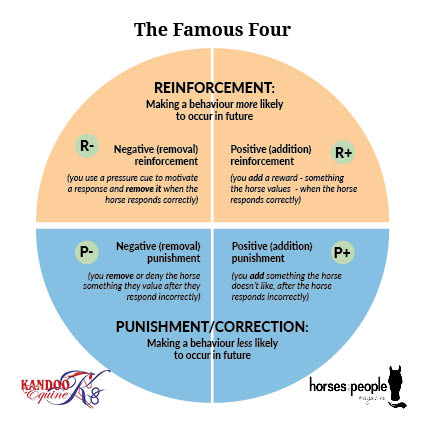
In order to define the process of learning to associate a behaviour with a consequence, psychologists defined four different ‘quadrants’.

The famous four

The first division of the operant conditioning quadrants differentiates reinforcement and punishment.

It is the user’s ‘intention’ that defines this, not, as is often thought, the severity of the action taken. This is a key point in understanding learning theory and how we train our horses.

Let’s look at those two different intentions:

1. Reinforcement is used when we want to make a behaviour MORE likely to occur in the future

2. Punishment is used when we want to make a behaviour LESS likely to occur in the future.

We use reinforcement a lot in horse training and it comes in many forms, from your voice, to tactile cues, comfort, rest and even food treats.

It is common to make the mistake of thinking punishment is only classed as ‘punishment’ if it is severe, but severity is irrelevant – it’s all about intention.

For example, if my horse kicks at me when I pick up a back foot, I could growl at him with my voice or I could hit him with a stick. While you may agree that growling is less severe than hitting with a stick, in reality, both are forms of punishment because I am trying to make the behaviour – kicking – less likely to occur in the future.

Those two main quadrants of reinforcement and punishment are then further divided into positive and negative forms of reinforcement and punishment.

These can also be thought of as addition (positive) and removal (negative) reinforcement and punishment. We can explain these as follows:

1. Positive reinforcement (addition reinforcement) is something you ADD to make a behaviour MORE LIKELY to occur in the future.

This is the REWARD segment. Good examples here are things you do after the desired behaviour has been performed: a scratch on the wither, a stroke on the neck, a rest, a soft word, or a treat.

2. Negative reinforcement (removal reinforcement) is something you TAKE AWAY or remove to make a behaviour MORE LIKELY to occur in the future.

This is the MOTIVATION segment. Good examples here are your voice (clucking to ask for trot), touch (asking to move away), and other pressure cues (legs, seat, reins and so on).

But remember, that negative reinforcement is the same as ‘pressure-release’, thus it must contain both the pressure and release segments. The release or removal of pressure, whether it’s a tactile cue or simply your voice, is what’s meant by ‘negative’ in this  equation.

Pressure that is not released, or not released in a timely fashion can become positive punishment and lead to habituation/desensitisation to your cues.

  1. Positive punishment (addition punishment) is something you ADD to make a behaviour LESS LIKELYto occur in the future.

Common examples include raising your voice at the horse or smacking it with the whip for performing an unwanted behaviour, such as biting or kicking.

  1. Negative punishment (removal punishment) is something you TAKE AWAY to make a behaviour LESS LIKELY to occur in the future.

This is not used very often in horse training but it can be seen when a horse is ‘tied to the tree of knowledge’ to contemplate a misdemeanour or deprived of friends or food as a result of displaying unwanted behaviour.

Famous Four Quadrants of Operant Conditioning
The consequence of a behaviour makes that behaviour more or less likely to be repeated in future.

You decide

Thus, as a rider, the choice is yours. You can use reinforcement and encourage those behaviours that you want to see, or you can use punishment and try to prevent your horse from continuing to display behaviours that you don’t want.

We know that horses (and people for that matter!) learn more readily from reinforcement than punishment and it’s worth discussing why this might be.

Punishment is necessarily very reactive. The horse must first do something wrong and then we correct that mistake.

This makes us, as riders or trainers, very reactive and it allows the horse to repeat unwanted behaviours, particularly when we are not very good at timing our corrections.

Punishment also relies on the horse knowing there is a correct answer or having to guess what they did wrong. It also encourages the rider or handler to assume that the horse knows this and is thus ‘misbehaving’.

This is a slippery slope. The moment we start making assumptions about what the horse is thinking, we head down that path of classifying the horse as ‘naughty’ ‘disrespectful’ or ‘stubborn’ or in some way ‘out to get us’, when the reality is more likely that we simply haven’t explained the lesson very well.

Punishment is unpredictable. If the horse does not know what they did wrong, does not yet understand the lesson, then the punishment arrives as a surprise, making training unpredictable and likely increasing anxiety as a result.

Myth buster

Let’s bust the biggest three myths around operant conditioning. These are:

Myth #1: Punishment and correction are different things

This is a common misconception probably because ‘punishment’ is a word that triggers strong emotions in us. However, once you understand that punishment/correction is anything done on your part that is intended to make a behaviour less likely to occur in the future, then severity is irrelevant in terms of the actual learning process.

Severity is also a very subjective measure meaning that it is perceived differently by each of us and also by individual horses.

When would the correction-punishment line be crossed, for example, when it came to tapping the horse with the whip or hitting it with a stick? Running towards it screaming like a banshee or hitting on the head? Regardless of severity, punishment is defined by the intention of the rider/handler to make a behaviour less likely to happen in future.

Myth #2: Negative reinforcement is bad

The word negative has given negative reinforcement a bad reputation so it’s best to think of it as subtraction or removal reinforcement, or pressure-release. Pressure comes in many forms, from your proximity or your voice to various levels of tactile cues.

However, the pressure is only half of the equation; the horse learns from the release/removal of pressure. When it is correctly timed, i.e., the pressure is released the moment the horse makes the desired response, the behaviour that the horse is more likely to repeat in the future is the one that earned the release.

Pressure-release is also the most common way of motivating a horse to perform a behaviour. For example, if we are lunging the horse at walk and we want it to trot, we might use the verbal cue of clucking (pressure). As soon as the horse trots, we stop clucking (release).

Myth #3 It is possible or practical to only use positive reinforcement

Something I hear a lot is; “I only use positive reinforcement”, often accompanied by a lovely photo of the person riding or leading their horse…

Positive reinforcement is excellent for shaping behaviour, but when used alone, the rider or handler has no way of motivating the horse to perform the desired behaviour, they must simply wait until the horse performs it and then add the reward (be it a scratch, a rest, a treat or some other item that the horse wants).

Depending on what you are trying to teach, the ‘waiting’ may take a very long time since the horse has many options.

A good example here is teaching the horse piaffe (a slow trot on the spot). I could stand with a piece of carrot in front of the horse for days before it decided to trot on the spot, but if I gave it some motivation to trot, perhaps clucking with my voice or gently tapping with the whip, then I could take that behaviour and shape it using rewards.

This is why combined reinforcement is almost always used when training horses. In combined reinforcement, pressure of some sort is used to motivate the horse, released when the correct behaviour is displayed and then a reward is added for greater effect.

Combined reinforcement = pressure–release–reward

It is also important not to confuse release and reward. The horse must get the release as it is part of the pressure-release sequence and the reward is extra and comes after the behaviour has been performed. The release is not a reward.

The most concerning thing about riders claiming to ‘only use positive reinforcement’ is that if they don’t realise they are using pressure, then they will not be releasing it – one can’t stop doing something unless they first know they are doing it!

Best of both worlds

As riders, handlers or horse caregivers, we are always presented with a choice of which operant conditioning quadrant to use. By choosing combined reinforcement we can remain proactive, guide the horse towards the correct answer, reinforce those desirable behaviours and set the horse up for success.

Next time, we will take a closer look at the difference between proactive and reactive riders and show you how you can provide your horse with a predictable, safe learning environment.

In the meantime, to learn more about the practical application of equitation science, visit: https://www.kandooequine.com/

From the All Blacks to the Stable… Ice N Easy Cold Therapy

Paid Content

Ice N Easy Equine is now providing cold therapy solutions specifically for the equine industry.

In the sporting industry, Ice N Easy is synonymous with quality. Their cold therapy products see teams such as the New Zealand All Blacks Rugby Union, Sunshine Coast Lightning Netball, Brisbane Bullets Basketball, Canterbury Bankstown Rugby League and the Australian Diving team, all choosing the Sunshine Coast based Ice N Easy to manage acute soft tissue injuries.

Ice N Easy have boldly transferred their 27 years of expert knowledge and dedication to their craft, to announce their sub-brand, Ice N Easy Equine, providing cold therapy solutions specifically for the equine industry.

“Ice N Easy have been working tirelessly to introduce a quality treatment solution that provides versatility, efficiency and effectiveness for owners, riders and the horse athlete.

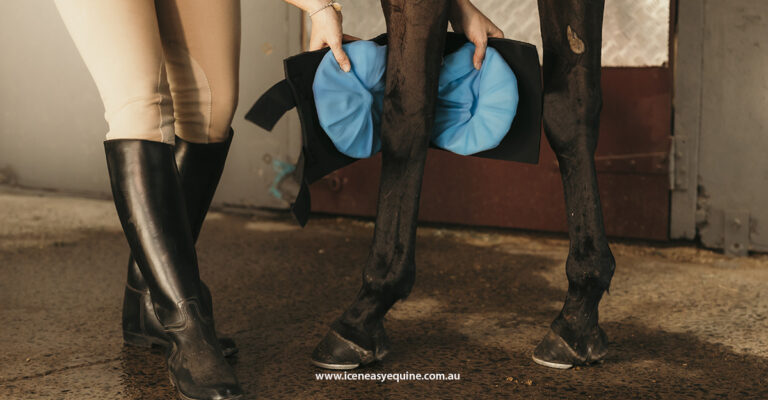
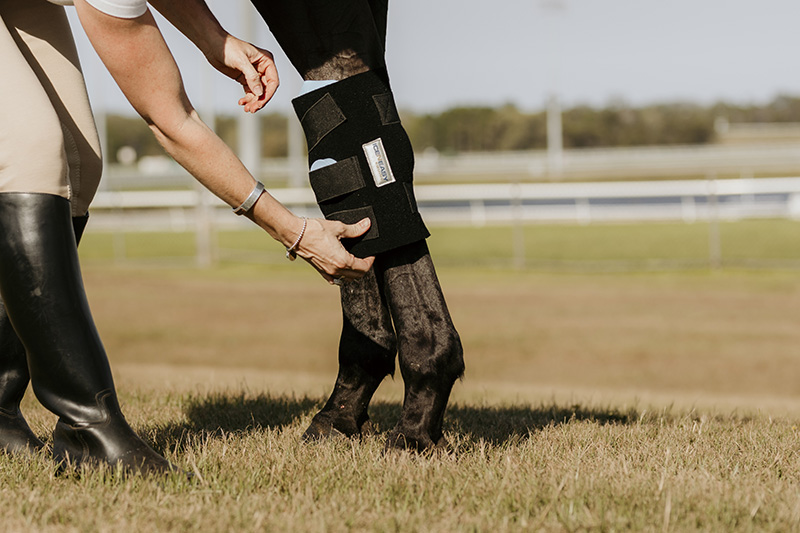
“We have combined our years of knowledge and expertise with the advice and collaboration of key Equine Physiotherapists and Veterinary Equine Surgeons to provide two great offerings in cold therapy for soft tissue injuries and surgery recovery for site specific treatment of the Navicular, Fetlock, Cannon, Knee and Hock”

Unique and backed by research

Ice N Easy Equine product offerings are very different to what is currently in the market. The Ice N Easy system revolve around the reusable ice bag in which Craig states; “Ice N Easy’s reusable bag is one aspect of the product where we demand perfection, in quality, the reduction rate of the ice melting and in the transfer of the cool temperatures to the injured site”.

Ice N Easy’s confidence in the quality and effectiveness of their reusable ice bag is justified when Craig adds; “unbeknown to us, a scientific study* by three orthopaedic surgeons determined our products cool the injured site quicker and sustain that temperature for a longer period of time”.

This study was published in BMJ Open Sport & Exercise Medicine journal.

Craig backs his confidence in the company with their 3-year warranty, a marquee of their trust in the ice bag technology.

It is difficult not to notice the influence of Ice N Easy’s history in the sporting arena in their development of this product, with its clear intention to be alongside competitors in the equestrian, eventing, dressage or campdraft arena, showcasing its efficient use, small storage and easy to clean features.

Ice N Easy Equine, providing cold therapy solutions specifically for the equine industry.

Recommended by experts

Olivia Lindley divulges on our suspicion, “I take my Ice N Easy everywhere, I love how versatile they are and easy to use. I just fill my Ice N Easy before I go to competition and keep it in the esky before the event and use it throughout. You just never know when or what you are going to have to ice and to have the Ice N Easy there with me really gives me confidence”.

When comparing the two products, the Equine Double has the look and feel of years of research and development with a clear aim of addressing high volumes of swelling in specific joints or muscle groups.

The Equine Double most definitely delivers in providing significant compression and complete coverage of all joints, especially the Hock.

“The fact the Equine Double covers the entire joint is great for post-surgery” explains Dr Stephen Raynor from Darling Down Vets, “the ability to use a single ice bag in the double strap to target focal injuries is advantageous.”

The Equine Double visibly concentrates on a specific injured site whilst being comfortable for the horse.

Ice N Easy’s step into the Equine industry is one to watch in the future as this versatile, effective and efficient product has the experts’ tick of approval and care for the horse at the apex of all decisions.

*Reference:

Saddle Fitting Guide

SAFETY REPORT

Sponsored by Fitton HorseInsure

Finding the correct fitting saddle is essential to ensure good welfare and maintain performance. Check the fit regularly and listen to your horse and your own comfort.

Teach yourself to evaluate saddle fitting and recognise problems to ensure good welfare and maintain performance with this handy guide.

Saddle fit dos and don’ts

Do use a qualified saddle fitter. The most widely recognised saddle-fit accreditation is from the United Kingdom’s Society of Master Saddlers, www.mastersaddlers.co.uk.

Do make sure the fitting includes ridden exercise because horses may change shape as they work. 

Do aim to fit a new saddle when your horse is in a shape and condition which they’re likely to maintain.

Do make sure you, as the rider, feel comfortable in the saddle and in balance with your horse.

Do assess the fit with the saddle pad or saddle cloth, not the saddle alone.

Do test the saddle under the conditions that you expect it will be used.

Don’t ever buy a saddle without trying it on your horse.

Fitton HorseInsure, the insurance specialists for equestrians

Poor saddle fit, early signs:

  • Muscle soreness under or behind the saddle. The horse may flinch when being groomed or behave abnormally when being tacked up.
  • Dry patches under the saddle surrounded by sweat following exercise.
  • Areas of swelling under the saddle following exercise.

Poor saddle fit, long term indicators

  • Depressions behind the scapulae (shoulder blades) or elsewhere under the saddle. These may reflect long-term saddle fit issues and pressure points.
  • White hairs appear when pressure has injured the hair follicles but note that they usually do not appear until the hair coat changes.
  • Dry patches under the front of the saddle surrounded by sweat following exercise.
  • Scabby skin lesions under the front or back of the saddle.

How to assess saddle fit yourself

You should always get a qualified saddle fitter to fit and check saddles, but here are some things you can check yourself between visits…

  • Check length: The tree of the saddle should not extend beyond the top of the last rib (T18). This can present challenges with ponies and short-backed horses.

(Note that jumping saddles are longer in the seat than dressage saddles to allow for a more horizontal thigh position.)

  • Check width: The saddle should not tip back or forward on your horse’s back.

The saddle should remain central on your horse’s back in walk, trot and canter, with the seat parallel to the ground. A little movement from side to side is normal, but the saddle should not slip or swing from side to side, or lift off the back. 

The rider must be able to sit centrally in the seat, not tipping forward or back. When your legs hang, they should not drift forward or backward. You should be able to stand in the stirrups and maintain your balance.

The gullet should not make contact with the spine when a rider is on the saddle. Check at least two fingers (3cm) can be inserted under the pommel when the rider is standing in the stirrups, both before and after exercise.

The front of the tree (the point of the saddle) should stay approximately 5cm behind the top of the back of your horse’s shoulder blade. Ruffling of the hair underneath the saddle could indicate undesirable movement.

The bearing area (panels) should be in contact all the way along the back.

The panels of the saddle must smoothly follow the curve of your horse’s back to fit well.

Saddle use dos and don’ts

  • Do remember that using layers and pads to correct a poorly fitting saddle can temporarily reduce signs of discomfort because the pad relocates the pressure points. But the improvement is usually transient, because new pressure points soon develop as a result.
  • Do be aware using the same saddle on more than one horse is not ideal and should be avoided, unless the horses have similar back shape.
  • Do recognise pain elicited by feeling or grooming the back may be an indicator that back shape changes have occurred and saddle-fit should be reassessed.
  • Do seek professional help if something doesn’t feel completely right regarding your saddle’s fit!

This article is a summary of a more detailed article by Drs Line Greve and Sue Dyson. You can read more detail here.

Fitton HorseInsure can include cover for your saddlery and tack at a competitive price. Saddles, bridles and other gear is not only expensive but also quite portable, and can be easily stolen. 

To ensure you are fully covered, specify your saddle on your existing horse insurance policy!

Horse Riders’ Attitudes to Managing Risk “Disturbing” Says Safety Researcher

So, horses are dangerous. Is that just the way things are? And does taking risks with horses make you look braver, more confident, or more of a leader?

According to one equestrian safety scientist, there are better ways to deal with horse-related risks. And there are better ways to reduce those risks. Perhaps more importantly, there are better ways to lead by example in the equestrian world.

“There seems to be a theme in life that we have to look, or perform like, the ones at the top-of-the-tree or in the spotlight to be seen as successful, acknowledged, or popular,” said Meredith Chapman, PhD, of The Appleton Institute at Central Queensland University in Wayville, South Australia, and Safety in Focus in Narrabri, New South Wales.

“In the horse world, I see this as very dangerous. And it often endorses the fast-track-approach to the top, no matter what, and taking short-cuts, and being a risk-taker. The idea that in order to be part of the in-group (popular), you need to be in the winners’ line up, can be fraught with some danger, is far from truth and often very unfulfilling.”

It’s also extremely hazardous to your health, according to Chapman.

Fatality statistics in horseback riding are highest for young women 20 and under involved in competitive sport—and despite the production and marketing of better safety equipment like vests and helmets, the numbers aren’t changing, year after year.

That’s particularly problematic considering that more advanced and professional riders tend to take the most safety risks with horses, Chapman said.

Her new survey revealed “disturbing” results—that higher-level and paid riders tend to have a more accepting attitude about the dangers of horseback riding, and that these are the riders who are more likely to do things that actually put them at greater risk, like riding without a helmet or skipping groundwork before getting on a horse. (Groundwork can help “connect” with the horse and give riders an idea about how the horse is feeling that day, she explained.)

If the industry wants to change the statistics, reducing the number of injuries and deaths related to horseback riding, it needs to encourage riders to do more than just buy expensive protective equipment, she said.

People need to change their attitudes about risks, and change their behaviour around horses.

They even need to change their goals—seeking a strong, mutually beneficial relationship with the horse more than that prized trophy.

And they need to be constantly aware of who’s watching them, and what kind of image they’re portraying to less experienced riders who might be looking up to them.

“Many of our inexperienced equestrians look for safety advice and directives, and if we are prepared to disregard basic safety principles for the sale of a horse or a blue ribbon, what are we teaching the younger generation?” Chapman said. “And what will the tally of incident, injuries, and fatalities be like in another 10 years’ time?”

Chapman and her fellow researchers collected data from the responses of nearly 1,300 equestrians in 25 countries surveyed about their views on risk and safety in connection with horses.

More than 10% believed there was nothing people could do to control risks around horses. But 12.5% said it was fine to drug a horse to make it safer to ride, Chapman said.

Alarmingly, 91% said that if an experienced rider didn’t use safety equipment, that could influence the way less experienced riders viewed safety precautions, she added.

Most of the respondents—81%—said they’d had at least one horse-related injury, and the average number of injuries per person surveyed was 3.3. Of those, 74% said they “now take more safety precautions around horses” because of that accident.

Even so, more than 25% of the respondents stated they were willing to put their horse’s safety above their own, Chapman said.

Ensuring a horse’s safety is important, of course, she added. But good precautions and management can help reduce the risk to both partners.

“Horses and humans need time to connect and learn as a duet,” said Chapman, who has been handling, riding, and breeding horses for more than 50 years.

“Being proud of what you achieve is where the mindset is most healthy, going forward with small steps. It’s about going out for an equestrian competition, for example, not to be measured by another’s place or someone else’s comments, but to explore if your hard work and training at home paid off in a different environment.”

That means taking things slowly, and taking time to train ourselves about how horses’ brains work, and how they learn.

“I feel we need to take a moment to stop and think about what we do with horses and the expectations we place on them,” Chapman said.

“We are the ones changing their world for our gain and pleasure. Take a little more time on the ground with them, and don’t be too quick to climb aboard and pursue your dreams. Give them time to adjust and learn, and be prepared to go back, and teach them again.

“Be kind, because they don’t speak our language. And remember that overconfidence can contribute to an unstable foundation, and this is when safety short-cuts are often taken, resulting in undesired outcomes.”

In addition to her five decades of horse experience, Chapman has worked in the health and safety industry for 20 years, and used to be a registered nurse in intensive care units, where she treated many equestrian patients recovering from—or succumbing to—horse-related injuries.

“My purpose in life now as a health and safety professional, and an academic, is to connect with the equestrian world and use some of my skills, experience, and research to help improve human-horse interventions in a safer and more respectful way,” she said.

The study is published in Animals and is open access. It is titled: ‘What People Really Think About Safety around Horses: The Relationship between Risk Perception, Values and Safety Behaviours’ by Meredith Chapman, Matthew Thomas and Kirrilly Thompson. You can read it here.


Predicting Catastrophic Racehorse Injuries a Step Closer

Predicting catastrophic racehorse injuries

After a string of deadly accidents on horserace tracks in recent years, science has aimed at finding ways to recognize which horses are most at risk of sustaining a fatal fracture. And the work is paying off. According to a team of U.S. researchers, a new blood test can detect certain copies of genes that could flag impending doom.

Racehorses that experience catastrophic injuries (fractures causing death or requiring immediate euthanasia) have a different profile of messenger RNA (mRNA), which can be detected through mRNA expression analysis from a blood test, said Allen Page, DVM, PhD, staff scientist and veterinarian at the University of Kentucky’s Gluck Equine Research Center, in Lexington.

By drawing blood in racehorses from time to time to see how their mRNA profile evolves, caregivers could pick up on clues that the horse is nearing the point of sustaining a catastrophic injury, and thereby choose to take necessary precautions, like changing the training program and seeking more in-depth veterinary examinations Page said.

“We believe that regular mRNA expression analysis in racehorses can help decrease fatal injuries, and we are really interested to see how this research and our findings are received by the racing industry,” he said.

Page and his fellow researchers acquired blood samples from 374 healthy Thoroughbreds just before a race, 205 healthy Thoroughbreds just after a race, and 107 Thoroughbreds within 30 minutes of sustaining a catastrophic injury (just before or just after euthanasia). They also had blood samples from both before and after a race for 37 healthy horses.

Scanning 21 mRNA pre-selected genes they thought might be good biomarkers for pending injury, they identified three which were distinctly different in horses that successfully finished a race and those that broke down with a life-ending fracture. The mRNA copies of Insulin-like growth factor 1 (IGF-1), Interleukin-1 receptor antagonist (IL1RN), and Matrix metalloproteinase-2 (MMP2) were expressed at different rates in the injured horses compared to the healthy horses.

All horses have these three genes in their DNA, so it’s not a genetic test checking for heritability of certain genes, according to Page. Rather, the test looks at what horses’ bodies do with the genes they have—or more specifically, how many mRNA copies the horses are producing.

DNA genes code for protein production, but it’s mRNA that serves as a bridge between DNA and protein production. To do so, the genes have to be transcribed—have copies made—into mRNA. The number of mRNA copies of a gene is linked to how much of the related protein gets produced. And that seems to depend on various circumstances, like the body’s reaction to internal and external events that are heading that horse towards a breakdown. Thus, it seems that horses’ gene transcription process changes upstream from the catastrophic injury. And ultimately, such changes could identify the horses that are about to have such a serious accident, Page said.

“We envision this being a test that is repeated with some regularity since mRNA expression will change over time as horses are conditioned and as a result of underlying injuries,” he explained.

“While that certainly adds cost, we see regular sampling as being a positive, in that we would be able to identify trends in mRNA expression changes within the individual horse,” said Page. “Rather than comparing them against other horses, like we did in this study, we could compare them to their previous samples, likely improving our ability to identify horses at risk for injury.”

Even so, the test can’t be considered all-compassing, Page added. “It probably won’t detect every horse at risk of catastrophic injury, but anything we can do to decrease the injury rate in racing is a step in the right direction,” he said.

The study is published in the Equine Veterinary Journal. It is titled ‘Expression of select mRNA in Thoroughbreds with catastrophic racing injuries’ by
Allen E. Page, Emma Adam Rick Arthur, Virginia Barker Forrest Franklin Ron Friedman, Timothy Grande Michael Hardy, Bruce Howard Emma Partridge, Matthew Rutledge Mary Scollay,John C. Stewart, Alina Vale and David W. Horohov.

The abstract can be found here.

The Saddle Fit Guide

Here is some advice for fitting, using and maintaining your saddle, compiled by the Animal Health Trust, in collaboration with World Horse Welfare.

Their research has highlighted some areas that should be carefully considered when fitting a new saddle, which will help to maintain and develop the horse’s topline, and reduce the likelihood of back pain. It is also important to remember to maintain your saddle properly, and to make sure it fits both yourself and your horse throughout the year.

Buying and fitting a new saddle

Do use a qualified saddle fitter. The most widely recognised saddle-fit accreditation is from the United Kingdom’s Society of Master Saddlers, www.mastersaddlers.co.uk.

Don’t buy a saddle without trying it on your horse.

Do make sure the fitting includes ridden exercise because horses may change shape as they work.

Do aim to fit a new saddle when your horse is in a shape and condition which they’re likely to maintain. There is no point buying a saddle when your horse is at their fittest if you do not have the time to keep them fit. Preliminary data indicate if a horse is not kept in a strict and consistent exercise and weight-maintaining programme, they will change shape over time.

Do make sure your horse moves well underneath the saddle.

Do make sure you, as the rider, feel comfortable in the saddle and in balance with your horse.

Do assess the combined fit if you intend to use your saddle with a pad or numhah, not the saddle alone.

Do test the saddle under the conditions that you expect it will be used, such as jumping, going up and down hills, galloping and riding long distance, etc.

What type of saddle to buy?

The style of saddle that you have depends on what type of riding you do and to what level you aspire to ride. For more advanced riding, a specialist saddle may help your position and effectiveness, but you may have to make a compromise depending on whether you can afford to buy more than one saddle. The position of the stirrup bars controls the position of the rider’s legs, which influences the shape of the saddle flaps.

A general purpose saddle is ideal for a pleasure rider that enjoys a variety of different types of riding. This type of saddle has a variably deep seat, but forward cut flaps without large knee rolls and can accommodate the rider for basic jumping, hacking, hunting and dressage.

A dressage saddle has straight flaps, and provides the rider with a closer leg contact essential for accurate and precise moves. It enables the rider to sit upright with a longer, straighter-legged position. There may be knee rolls and sometimes thigh rolls also to help to keep the legs well positioned.

A jumping saddle usually has a flatter seat and bigger, more forward cut flaps compared with dressage saddles to facilitate the two-point jumping position when going over fences. The shape of the seat varies and what is ideal for you depends somewhat on your jumping position. This is influenced by the length of stirrup which you prefer and, if riding cross country, how much you need to alter your position based on the type of fence that you are jumping.

Close contact saddles exist in all types of saddle and have been designed to put the rider closer to their horse. To obtain a close contact, the saddle has to have thin panels. Close contact saddles are potentially more difficult to fit properly. It is important to check frequently the panels are adequately thick to protect your horse’s back from the tree.

What to consider about the seat?

The top of the saddle consists of the sitting area, a narrower area in front under which the stirrup bars are located, the front (pommel) and the back (cantle).

The seat size should be based on both, the size of the rider’s buttocks and the length of their thighs.

The rider’s seat bones should point straight down, with the same amount of free space between the rider and the pommel, and between the rider and the cantle.

The horse’s shape determines the size and shape of the tree of the saddle, which also establishes the overall width of the saddle. If you have a narrow pelvis, it is best to avoid buying a very wide cob, which will need a wide tree, although a narrow seat can be built onto a wide tree, depending on the construction.

If the saddle is too wide for the rider it will be uncomfortable for the rider.

Be aware there are different designs of saddle to adapt to the different shapes of the rider’s pelvis. Therefore, a saddle that fits an adult male pelvis is unlikely to fit a female as well.

Manufacturers make saddle flaps for ‘average-sized legs’, and short- or long-legged people usually suffer. You should choose a saddle with an appropriate flap-length. Your knee should come approximately to the centre of the knee roll and the flap should be wide enough to enable your leg to move without leaving the flap if you shorten your stirrups. Saddle flaps can be changed to fit.

Saddle innovations

Treed saddles

Well-fitting treed saddles provide a stable seat for the rider and help distribute the rider’s weight over a large area of the horse’s back. However, ill-fitting treed saddles can cause pressure points, muscle atrophy and poor performance. A tree can be manufactured crookedly, or can break and cause back pain.

Treeless saddles

Some horses appear more comfortable in a treeless saddle compared with a treed saddle. Truly treeless saddles are completely flexible. However, they may have no gullet and, if a horse has a prominent spine, this may not be the best option. Weight fluctuation and the changing shape of the horse’s back are the most obvious reasons for choosing a treeless saddle. Many so-called ‘treeless’ saddles have some form of rigid structure to support the shape and stop it collapsing onto the back. There is often a rigid pommel arch which, although it gives the appearance of wither clearance, can leave the stirrup and girth attachments unsupported, causing peak pressure points over the back. Make sure a professional fitting service is available for the specific design that you select.

Air pockets

Some saddles have air pockets, which can be filled to mould to the horse’s back and, thus, adapt the saddle to asymmetries of the horse’s back. The amount of air can be adjusted to accommodate changes in back shape. Air is not subject to compression like conventional flocking and the risk of pressure points may be reduced. Air may leak over time, so regular checks are required.

Adjustable tree

Some saddles have an adjustable tree, so the angle at the front can be changed. This is a good option if your horse tends to change shape frequently under the front of the saddle, without changing shape further back beneath the saddle.

However, preliminary data indicate that, if a horse becomes narrower underneath the front of the saddle, this is often accompanied by a ‘wider’ shape at the level of the back of the saddle. Changing the width of the front of the tree will not necessarily allow the saddle to follow the shape of the horse’s entire back.

If only one part of the tree fits well, it is no better than having a saddle in which the whole tree doesn’t fit.

It is not easy to adjust the tree quickly and accurately.

Buying saddles with adjustable trees to fit many horses is not advisable.

Recognising saddle fitting problems

A lack of knowledge of how to recognise incorrect saddle fit can lead to pain, discomfort and, ultimately, poor performance.

Physical signs of poor saddle fit

The early warning signs…

  • Muscle soreness under or behind the saddle. The horse may flinch when being groomed or behave abnormally when being tacked up.
  • Dry patches under the front of the saddle surrounded by sweat following exercise.
  • Dry patches on the spine surrounded by sweat following exercise could indicate too many layers or too thick a layer beneath the saddle, filling up the gullet and pressing on the spine.
  • Areas of swelling under the saddle following exercise.

Long-term indicators…

  • Depressions behind the scapulae (shoulder blades) or elsewhere under the saddle. These may reflect a chronically poorly-fitted saddle and pressure points.
  • White hairs appear when pressure has injured the hair follicles. However, they usually do not appear until the hair coat changes.
  • Dry patches under the front of the saddle surrounded by sweat following exercise.
  • Scabby skin lesions under the front or back of the saddle.

How to assess saddle fit yourself

You should always get a qualified saddle fitter to fit and check saddles, but here are some things you can check yourself between visits…

The width and length of the tree of the saddle must be suitable for the shape of the horse’s back:

Check length: The tree of the saddle should not extend beyond the top of the last rib (T18).

Jumping saddles are longer in the seat than dressage saddles to allow for a more horizontal thigh position.

Some pony saddles are not adequately adapted to fit relatively large young people, without being too long for a pony’s back. The seat, knee rolls and flaps need to be designed to accommodate the rider’s growth.

Check width: The saddle should not tip back or forward on your horse’s back.

The saddle should remain central on your horse’s back in walk, trot and canter, with the seat parallel to the ground. A little movement from side to side is normal, but the saddle should not swing from side to side or lift off the back. The rider must be able to sit centrally in the seat, not tipping forward or back. When your legs hang, they should not drift forward or backward. You should be able to stand in the stirrups and maintain your balance.

The gullet is the central channel on the underside of the saddle, which fits over the top of the horse’s spine. It should not be in contact with the spine when a rider is on the saddle.

Check at least two fingers’ width aligned vertically (3cm) can be inserted under the pommel when the rider is standing in the stirrups, both before and after exercise.

Check you can see through the gullet of the saddle. The development of white hair on the top of your horse’s back can indicate lack of clearance.

The front of the tree (the point of the saddle) should stay approximately 5cm behind the top of the back of your horse’s scapulae.

Check the saddle stays behind the scapulae during exercise. Ruffling of the hair underneath the saddle could indicate undesirable movement.

The bearing area (panels) should be in contact all the way along the back.

Material used in panels differs, but this is not important provided the panels are soft and smooth against the back.

Feel under the saddle for any gaps. There should not be any areas where there is either reduced contact, or no contact between the panels and the horse’s back. This can also be checked by looking at the grease on the saddle, if using the saddle without a saddle blanket.

Alternatively, dust the bottom of the saddle with talcum powder and see how it is distributed on your horse’s back. You should not be able to run your hand under the front panel with a rider on the horse. Feel for excessive pressure, especially under the tree points. Look at the distribution of sweat on the saddle pad under the saddle, or look for the presence of dry spots on the back following exercise, which may indicate pressure points.

Fitting of the saddle relative to back shape

The panels of the saddle must smoothly follow the curve of your horse’s back to fit well.

Do recognise back shape can change within two months, the speed and direction of which are influenced by saddle fit, age of your horse, level and type of work and bodyweight. Frequent saddle fit checking is important, particularly when the grass starts to grow in the Spring. Saddles need to be adjusted to accommodate for these changes.

Horses having time off work are likely to change shape and saddle fit should be checked when regular work is resumed.

Should I use a saddle blanket, gel pad or riser pad?

A well-fitted saddle should not need anything underneath it.

A saddle pad can be used to keep the bottom of the saddle clean, to carry a sponsor’s logo or to change the appearance of the horse’s back.

A thick saddle pad can alter the fit of a saddle.

Saddle pads can change the balance of a saddle, and can narrow the space available between the gullet and your horse’s spine. Adding a thick pad can unbalance a saddle that is sitting level without a pad. If you do not want to change the balance of the saddle, you should only use a thin saddle pad. If you decide you want to use a thick pad, you need to be aware this could worsen the fit of one saddle and improve the fit of another saddle. You need to be aware of your horse and be aware that if you feel an initial improvement in performance when adding a pad, it can be due to a relocation of pressure points, rather than removing pressure points. Saddle fit needs to be changed.

A riser pad elevates the entire saddle – either uniformly or the front or the back of the saddle preferentially. For example, a riser pad, which raises the back of the saddle, may be used if the saddle slopes down toward the cantle during riding.

Alternatively, shims (wedge-shaped pads) can be used to selectively raise one part of the saddle. If the saddle slopes backward, shims can be placed under the back of the saddle. Usually, these saddles are too narrow and lifting the back of the saddle improves the balance. However, it may make the saddle tight under the tree points behind the shoulder; increasing pressure on the spine and creating a large ‘bridging’ area with reduced contact beneath the centre of the saddle.

If the saddle is too wide, you may add shims under the front until it can be re-flocked. You might need to change your shim configuration as often as every month if the horse is changing shape.

A gel pad will not improve the fit of a well-fitted saddle. It is claimed a gel pad acts as a shock absorber, but there is little scientific evidence to support this. It may limit movement of the saddle to some extent and, as a result, may result in over-heating of the back.

Always keep saddle pads off the wither. You should still be able to insert two fingers’ width (3cm) between the saddle pad and the spine with a rider on the horse. Select a well-cut saddle blanket or pad, with a ‘high wither cut’, especially for a horse with a prominent wither.

Never use a pad that is too small because it may create a ridge of pressure at the edge.

Saddle fit accessories

Girths are available in a number of materials, including with or without elastic inserts.

Worn elastic may result in the girth being over-tightened.

Elastic on only one end of the girth may result in the saddle being pulled to one side.

Leather girths may slip more than girths made of other materials.

A girth with curved contours in the elbow region may be more comfortable for the horse than a straight girth.

Saddle fit accessories, such as breast-plate, crupper or a foregirth, may be used to hold the saddle in position, but if you discover you need it every day to keep your saddle in position, the saddle may not fit your horse properly. However, the conformation of some horses makes perfect saddle fit impossible and additional accessories are required for correct fitting.

A breast-plate should not be used to lock the saddle in position. This may cause a continuous pressure on the chest and shoulder, and restrict the movement of the forelimbs. A breastplate must be fitted to the horse, so it does not interfere with the shoulder movement.

Saddle slip

Saddle slip is defined as the saddle consistently moving to one side while you are riding. Saddle slip may be due to an ill-fitting saddle, asymmetry in the horse’s back shape, a crooked rider or hindlimb lameness. We have demonstrated hindlimb lameness is, by far, the most common cause.

Detection of saddle slip provides owners, riders and trainers the opportunity to identify not only obvious lameness, but also low-grade and sub-clinical lameness. If your saddle starts to slip regularly, seek help from…

A qualified saddle fitter, a veterinarian experienced in lameness recognition and get someone to check you are sitting squarely. You must be observed in walk, trot and canter directly from behind. Help from a physiotherapist may be beneficial to teach you to sit more squarely.

Saddle use dos and don’ts

  • Do remember using layers to correct a poorly fitting saddle can temporarily reduce signs of discomfort because the pad relocates the pressure points. Improvement is usually transient, because new pressure points soon develop as a result.
  • Do be aware using the same saddle on more than one horse is not ideal and should be avoided, unless the horses have similar back shape.
  • Do recognise pain elicited by feeling or grooming the back may be an indicator that back shape changes have occurred and saddle-fit should be reassessed.
  • Don’t be afraid of seeking professional help if something doesn’t feel completely right regarding your saddle on your horse!

The best saddle to buy is one that fits both the horse and the rider. To ensure good welfare finding the correct fitting saddle is essential and may take some time. Teach yourself to evaluate saddle fit, so you know when something is not right. Check the fit regularly, and listen to your horse and your own comfort

More horse care advice can also be found by visiting World Horse Welfare’s Advice Library. To find out more, click here.