fbpx
Home Blog Page 42

Horse Training Course: Part 3 10 Easy Steps to Easy Trailer Loading

Training your horse to load

Trailer loading. If you ever thought there must be a better and easier way to train your horse, this new training series by Kate Fenner is designed for you! 

Kate’s gentle and no-fuss approach will provide you with the tools and confidence you need to educate your own horse.  

This series walks you through specific lessons and how to teach them. From stress-free trailer loading, to handling head-shy horses, to safe mounting. 

Last month, it was hips to the fence for safe mounting. This month, it’s…

Training your horse to load – easily!

Does the thought of trailer loading your horse keep you up at night? Do you plan to leave an hour earlier than necessary, just in case your horse won’t load? Would you go to more shows, clinics or trail rides with friends, if this wasn’t a problem with your horse?

If you answered a resounding YES to any of those questions then you are not alone, but if you follow these 10 simple steps, your loading nightmares can be a thing of the past.

Something I hear a lot is: “My horse is perfect, but he won’t load on the trailer”. So, let’s understand this – you were able to teach your horse flying changes, to slide to a stop, to canter through puddles and to jump a log, but not to walk onto the trailer?

When you think about it like that it doesn’t make much sense. So, where’s the disconnect?

I think the problem arises because we often neglect to teach trailer loading. By that I mean breaking it down to the simplest steps and building on each one progressively. Giving the horse time to gain confidence with each step.

We go through this progressive training process with other things. For example, with flying changes, we first get shoulder control and then independent hindquarter control, and only then do we ask for the next step. If we attempt to teach flying changes without independent hindquarter control, it will probably result in a disunited canter – a change in the front end, but not the back end of the horse.

So, how do we break down trailer loading for the horse? The horse is very big, and the trailer is small and dark! Just thinking about getting that whole big horse onto that tiny trailer can make your palms sweat, right?

Okay, so let’s start by making the trailer bigger – open it up by opening the front door and moving the central barrier across to the side. Now, how do we make the horse smaller?

If we only concentrate on ONE foot, the horse becomes smaller. We’re not going to try to get the whole horse on to the trailer, just the left front foot, okay?

I have found that if we can get the left front foot all the way to the front of the trailer, and slowly and carefully off again, the rest of the horse will follow – magic!

Step 1:

Teaching forwards and backwards.

The first thing to do is establish good cues for walk forwards and step backwards. Do this away from the trailer.

Stand on the left hand side of the horse and hold the lead rope about six inches from the bit. Face the back of the horse, standing near the head. The whip, in your right hand, can cue the horse forward from the hip.

In order to get and keep the horse in the Engagement Zone, we need to offer the horse the opportunity to respond to minimal amounts of pressure. Ultimately, we want the horse to lock-on to the trailer from the bottom of the ramp, self-load and stand quietly while you do the back up, but we don’t start there. Each horse is different in how much pressure they require at the start of the lesso,n but all will quickly begin to respond to less pressure as the lesson progresses as long as our release is well-timed and we have set up a good pattern.

Now is the time to install your clear cues. Your horse may respond to a verbal ‘cluck’ to walk forward, a raise of the whip or a tap of the whip, but remember this is your pattern – start with the ‘cluck’ or least amount of pressure, wait a second and then increase the pressure by raising the whip, and so on.

As soon as the horse walks forward, stop cueing and reward the horse with praise and a rub on the wither.

Next, install the step back cue. Again, it’s a good idea to have a verbal ‘back’ cue first. This can be followed by a touch on the chest, a tap on the chest with your hand and then, finally, some backwards pressure on the bit. Unlike with the forward movement, when teaching backing, reward after just one step.

Step 2:

Start where the horse is comfortable.

Trailer loading is simply asking your horse to go forwards and backwards, slowly and calmly – the trailer just happens to be there. Begin the lesson as far from the trailer as the horse is comfortable.

If you’re a long way from the trailer, then ask your horse for more forward steps and fewer backwards steps – perhaps five forward and two back. This will get you to the trailer more quickly, and reinforce both your forward and back cues.

Step 3:

Now at the base of the ramp, we simply continue the forwards and backwards steps. We are going to teach ‘one-foot-on, one-foot-off’. This way, we teach the horse to load and unload at the same time in training.

As soon as the horse puts one foot on the ramp, release the forward pressure (voice and whip) and praise the horse.

Try to cue the horse to back, just one step off before you think the horse is going to do it – this way, you can use your back-up cue and it looks like your idea!

Step 4:

Repeat Step 3, but now ask for two feet on the ramp. Just concentrate on the front feet, not worrying too much about the hind legs. Reward forward movement or a thought of forward movement. Try to lengthen the amount of time the horse stands and rests with two feet on the ramp, and be sure to cue the horse to back off so the horse learns to wait for that cue.

Step 5:

Once the horse is comfortable with two feet on the ramp and is backing off slowly when cued, it’s time to move to three-feet-on. You should be standing about halfway down the ramp and your main job is keeping the horse’s head in the centre of the ramp.

Step 6: 

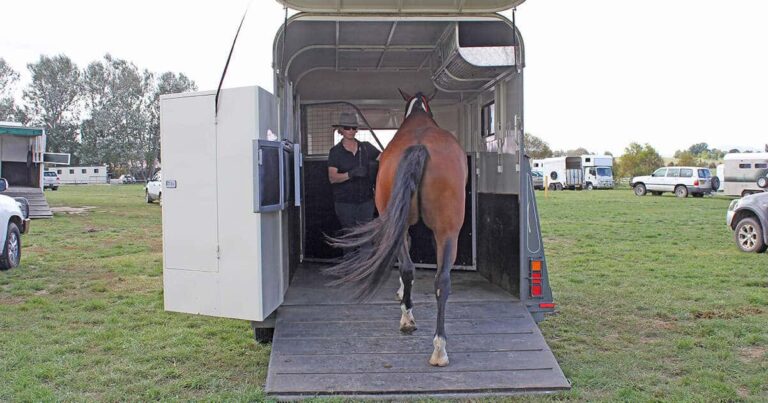
Now it’s time to cue all four feet on to the ramp. Your horse will start walking further into the trailer now and you can begin rewarding with a scratch further down the horse’s back. Try to think of it as your horse bringing their hindquarter to you so you can scratch it – the horse moves past you, stands and rests, while you scratch the hindquarters.

Some horses, like the one photographed here, will feel more comfortable if you walk in a little with them. Simply walk back to the hindquarters and reward the horse before moving to the front to ask for the back-up.

Step 7:

Each time your horse loads, they will move further up and into the trailer. Make the resting on the trailer periods longer, and soon your horse will be eager to get to the front of the trailer and receive a hindquarter scratch.

Step 8:

Once your horse is loading well, standing quietly and waiting for the cue to back off, it’s time to remove the bridle. The bridle was only needed to make it easier to keep the horse’s head in the middle of the trailer and now the horse has learned the pattern (walk up, rest, back off when cued), you no longer need it.

Step 9:

Be sure to move about as you scratch the horse on the hindquarter because you don’t want your moving to the front of the horse to back it up to become the cue itself. We never really know what the horse thinks the pattern is – for us, it might be walk on, stand, wait to be cued to back up, but the horse may take your movement as a sign you are about to ask for back-up and thoughtfully save you the trouble. This is another reason you want the back-up cue to be very clear.

Step 10:

It’s time to do the back-up now. Never tie your horse up before you have done the back-up and, of course, be sure the bridle has been removed by this stage.

Check out Dr Kate Fenner’s podcast for more step-by-step, ethical and sustainable horse training courses.

Horse Training Course: Part 2 Hips to the Fence for Safe Mounting

Safe mounting.

If you ever thought there must be a better and easier way to train your horse, this new training series by Kate Fenner of Kandoo Equine is designed for you! 

Kate’s gentle and no-fuss approach will provide you with the tools and confidence you need to educate your own horse.  

This series walks you through specific lessons and how to teach them. From stress-free trailer loading, to handling head-shy horses, to safe mounting. 

Last month, Kate launched the series explaining how to prepare your horse for learning. This month, it’s training hips to the fence for safe mounting.

Hips to the fence for mounting

Your horse’s behaviour while you mount can set the tone for the entire ride. A horse that has not yet been taught to stand quietly for mounting is, at best frustrating but, at worst, dangerous. It might be alright for the jockey to be thrown aboard while the Thoroughbred heads for the track, but most of us would prefer to get comfortably settled in the saddle and then ask our horse to move off when we are ready.

Training your horse to stand quietly and calmly by the mounting block is a simple and useful lesson that clearly illustrates the basic training principles. These principles that help us to simplify the lesson and break it down for the horse can be applied to any training situation.

The first step is to identify the following:

  1. The spot on the horse we want to move – here it is the left hind foot.
  2. The direction we want that to go – we want the left hind to step left.
  3. The motivator we are using – we will use a tap of the whip to motivate the horse to step left.
  4. The reward for the horse – verbal praise and stroking the horse (positive reinforcement), together with stopping the use of the whip (negative reinforcement).

Step 1

The left hind foot, like any part of the horse, can move in six directions – up, down, backwards, forwards, right and left.

By limiting the number of choices available, we can hugely simplify the lesson for the horse. We can do that in the following ways:

  1. If we stand close to the horse’s nose, we make moving forwards difficult.
  2. By holding the rein close to the bit, we make moving backwards less likely.
  3. If we line the horse up against the fence, stepping right is prevented.

This leaves three possible directions.

The horse may move ‘up’ by kicking at the whip or bucking. This would definitely tell us that our emotional level was too high and we should slow the tapping down, or perhaps just point the whip to the hip.

The other direction is ‘down’. Now, I must tell you, I’ve never come across this one, but it is possible the horse could sit down…

Of course, that leaves us with the easiest and, therefore, most likely direction that the horse will move – left!

Step 2

Once the horse is lined up on the fence, gently tap the hip with the whip.

Remember to position yourself so you’re slightly in front of the horse’s left front foot (but don’t get stepped on), as this will prevent forward movement.

Also hold the rein close to the bit, so the horse does not think you are cueing head movement (see Image A).

Step 3

Once you start to tap the hip, remain aware of your horse’s emotional level. Your horse will probably increase its emotional level a bit and possibly try moving all four feet a little.

If your horse is pushing past you, moving backwards or kicking at the whip, then you are applying too much pressure. Try relaxing a bit and calm the horse before asking again. This time, ask more gently. Often, after a couple of taps with the whip, the more sensitive horses will respond to the whip being pointed in the general direction of the hip.

Step 4

Now your most important job is to watch that left hind foot. As soon as it moves – even slightly to the left – cease all tapping and praise the horse.

Your horse won’t know what it has done the first couple of times to earn the reward, so your timing is terribly important as it will signal the behaviour – stepping left – that you are after.

The better your release of pressure (tapping or pointing the whip), the faster your horse learns.

Step 5

After your horse steps one or two steps left with the left hind foot, straighten the horse again by asking the shoulders to move further down the track. The hind feet will then go into the track and you can begin again (see Image B).

Step 6

Continue this process until the horse is stepping, so its now standing at 90o to the fence (see Image C).

When the horse is at this point, it’s best to walk around the back of the horse, simply leaving the reins over the neck, and lead the horse away from the fence using the right rein.

Then, take the horse back and begin again; each time walking around the back of the horse and leading it away from the fence with the right rein.

Step 7

Continue with the pattern until your horse is standing almost adjacent or parallel to the fence.

If you aren’t getting all the steps you’d like, try increasing the emotional level a bit by tapping a little faster. If you can get the horse to move a bit faster, it will usually also take bigger and faster steps, getting you to your goal quicker with is better for both you and your horse.

Step 8

Now is the time to decide if you are agile enough to climb up on the fence or whether you would prefer to mount from a block. Interestingly, most of my lovely ‘over 40s’ riders find the climbing on the fence the hardest part of this lesson so, if that describes you, practice a couple of times without your horse!

Step 9

It’s going to be slightly harder for the horse now as you’re changing position.

Climb up on to the fence or stand on the mounting block positioned by the fence. Holding the rein close to the bit, move the horse’s head away from you, while tapping the hip to cue the left hind to the left (see Image C).

Step 10

Some horses will need to be tapped with the whip and others will have the pattern well-established by this stage. Either way, release everything when the horse is at the fence and praise the horse.

The pattern now becomes you walk straight to the fence from the centre of the arena and climb up. The horse then begins the pattern at a 90o angle to the fence. You then cue the hip to move left, releasing only when the horse is parallel to the fence.

Now your job is to ‘dispense love’. We want the horse to know there is nothing else expected of it (see Image D).

The horse’s job becomes to stand quietly while you stroke and praise it – easy.

Step 11

Next, weight the saddle and stirrup, and rub your right leg over the horse’s rump, but do not mount (see Image E).

Repeat this process a few times, getting down off the fence before mounting, moving around the back of the horse and leading the horse away from the fence with the right rein.

Step 12

Finally, mount the horse. You should have no need to have a contact on the horse’s mouth, but can pick one up when you have settled in the saddle.

When you are ready, ask the horse to move off. Make this a clear and, preferably, an audible cue so the horse doesn’t work ‘moving off’ into the mounting cue (that is exactly what’s happened with a horse that doesn’t stand still for mounting).

Check out Dr Kate Fenner’s podcast for more step-by-step, ethical and sustainable horse training courses.

Biosecurity for Horse Owners

0

Why is a biosecurity plan important for your property?

Until 2007, Australia was one of a handful of countries that had never experienced an outbreak of Equine Influenza (EI), a highly contagious viral disease of the respiratory tract.

In animals that have been exposed to the virus previously and have, therefore, developed some degree of immunity, infection with the EI virus generally causes only mild disease.

However, in horses with no immunity to the virus, disease is often more severe. Australian horses are highly susceptible to EI because they have not been exposed to the causative virus and they are not vaccinated against it; Australian horses are, therefore, immunologically ‘naïve’ with regards to EI.

In August 2007, the virus causing EI escaped into this country’s horse population following a breakdown in quarantine procedures. Because Australian horses had no immunity to the virus, it was able to spread very rapidly across thousands of properties and infected over 76,000 horses in New South Wales and Queensland.

Once the outbreak had been recognised, a control and eradication scheme, based on movement restrictions and strategic vaccination, was implemented. This included a complete ban on all horse movements and cancellation of all equine events. While these measures were very effective in preventing further spread of the virus, it has been estimated control and eradication of EI from Australia cost over $1 billion.

The history of EI in Australia illustrates just how critical effective biosecurity protocols are in protecting both our horses’ health and the financial viability of equine-related businesses. However, it also provides some insight into the difficulties of implementing and maintaining effective biosecurity measures nation-wide.

Broadly speaking, the goals of a biosecurity protocol are to:

  1. Prevent entry of infectious diseases into a group or population of horses.
  2. Limit spread within a population should disease occur.

There are a large number of diseases that are ‘exotic’ to Australia (i.e. they do not occur normally in this country) and that have important implications for our livestock industries (such as Equine Influenza, Foot and Mouth Disease, etc.). Regulations to prevent the entry of these diseases into the country are developed at a state or federal level.

This aim of this article is to provide some advice on implementing effective biosecurity procedures to owners or managers of privately owned stables and farms. However, it is important to realise the first appearance of an exotic disease, such as EI, might occur at a private property (visit the Animal Health Australia website for more information).

In addition, some diseases that are present in Australia and occur commonly (such as Strangles) must be reported to the appropriate government body (to contact the Emergency Disease Watch Hotline, call 1800 675 888).

Preventing the entry of infectious diseases: managing new arrivals

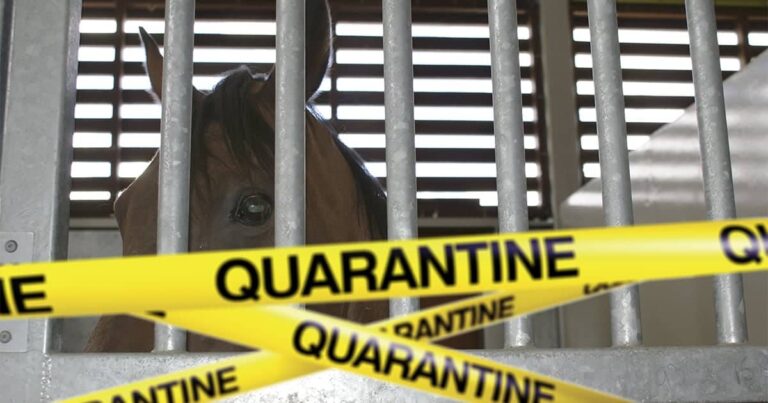
Preventing entry of an infectious disease into a population of horses requires the establishment of appropriate quarantine procedures. All horses arriving on a property for the first time should be quarantined separately from resident horses until you are confident the new arrival is not carrying an infectious, disease-causing organism.

Ideally, horses returning from events at which they had contact with horses from other properties should also be quarantined. However, this is often very difficult to achieve, particularly in busy stables with lots of horse movement. In these situations, returning horses (and their immediate neighbours) should be carefully monitored so if they did acquire an infection, they can be quickly isolated to limit the spread of disease.

When developing protocols to manage new arrivals, it is important to understand:

  • The specific diseases that we should be concerned with,
  • How those diseases are transmitted from one horse to another,
  • The incubation period for each of those diseases.

Diseases caused by the respiratory viruses (such as Herpes and Rhinitis) and Streptococcus equi (the bacteria that causes Strangles) are common, and have tremendous disruptive potential. Because they are common, these organisms are probably the most important to consider when developing biosecurity protocols.

However, other disease-causing organisms might be important under some circumstances. With the relatively frequent and rapid movement of horses from Queensland and New South Wales, we all need to be mindful of Hendra virus. Furthermore, with a very fluid flying fox population, there is always the risk of a case outside of the areas in which the disease is considered endemic.

Some of the bacteria that infect the intestinal tract (such as Salmonella) can cause severe, life-threatening disease. These bacteria are usually spread in faeces and are often extremely contagious.

Therefore, it is critical new arrivals are monitored very carefully for signs suggestive of gastrointestinal disease (i.e., fever, decreased appetite and a change in the consistency of manure).

Gastrointestinal parasites should also be considered in a comprehensive biosecurity plan as parasite resistance to many of the current anthelmintics (de-wormers) is a huge and increasing issue for horse owners and the equine industry.

Faecal egg counts and strategic de-worming protocols should be considered when new horses arrive at a property to prevent the introduction of resistant parasites. As you develop a plan for your property, you should consult with a veterinarian who is familiar with your particular operation.

The incubation period is the time from when an animal is first exposed to an infectious organism (e.g. a virus or bacteria) until it begins shows detectable signs of infection (e.g. a fever or a cough).

For most viruses and bacteria, the incubation period ranges from several days up to several weeks. Knowledge of the incubation period is important when determining the appropriate duration of quarantine. In most cases, a quarantine length of 3-4 weeks is sufficient.

It is important to recognise a horse infected with a particular organism might be able to infect other horses before showing any obvious signs (i.e. horses are infective to others within the incubation period of the disease).

Therefore, unless quarantined horses can be strictly isolated from one another, an ‘all-in, all-out’ policy – that is, all quarantined horses should arrive together and then leave together at the end of the quarantine period – is usually required to limit the chances of introducing a disease into the resident population.

Many of the diseases we are concerned about are transmitted on airborne particles when an infected horse coughs or sneezes. However, people and equipment are also important in the transmission of infectious organisms from one horse to another.

Quarantined horses must, therefore, be physically separated from resident horses and, ideally, attended by staff that have no or little contact with other horses on the farm. It is not known for certain how far particular matter carrying viruses or bacteria can travel, and remain infective when a horse sneezes or coughs, but 10 meters has been suggested.

If staff members must attend both resident and quarantined horses, horses in quarantine should be attended after resident horses. Staff members should wear separate clothes and boots when working with horses in quarantine and equipment (e.g. feeding, cleaning, grooming and tack) used in the quarantine area must not be used with resident horses. Hand washing between animals (even between apparently healthy animals) is essential as this is one of the most common means of transferring bacteria and viruses.

Quarantined horses should be examined at least twice daily for evidence of an infectious disease, such as decreased appetite, nasal discharge, swollen sub-mandibular lymph-nodes (the glands beneath the jaw), coughing, a change in demeanour or in the characteristics of the horse’s manure.

New arrivals should also have their temperature taken at least twice daily while they are in quarantine. A veterinarian should be consulted if there are any signs of disease or if a horse’s temperature is greater than 38.5°C on more than one occasion.

Limiting the spread of disease: managing sick horses in the barn or on the farm

Unfortunately, disease can occur in horses even on very well managed properties with robust quarantine and biosecurity procedures. In some cases, the disease-causing organisms are ubiquitous in the environment and are, therefore, difficult or impossible to eliminate completely. In other cases, they might be carried by wildlife.

Some infectious organisms can also cause ‘latent infections’; that is, the organism lies dormant within the horse, but can be reactivated under some circumstances. Reactivation of latent infections is particularly common with the Herpes viruses and is often associated with stressful events.

Additionally, some horses carry the bacteria causing Strangles and, although these ‘carrier’ animals are clinically normal, they are able to transmit the bacteria to other horses without signs of the disease.

In addition to a good quarantine routine, general recommendations for limiting disease spread through groups of horses include:

  • Separation of age groups (e.g. weanlings, yearlings and adults),
  • Limited mixing of horses from different groups (e.g. on breeding farms where mares might be managed in small bands),
  • Limiting access of wildlife to feed stores and water supplies,
  • Good, basic hygiene practices (e.g. regular hand washing, and routine disinfection of feeding and cleaning equipment, etc.).

Young animals are often more susceptible to disease than older animals and so separating age groups makes good sense. Separating age groups and avoiding mixing of animals from different groups also reduces social stress, which can increase susceptibility to disease.

Detection of latent infections can be very challenging, but if horses are maintained in strict groups with limited mixing, the spread of infection can be minimised should disease occur.

If disease does occur in a stable or on a farm, eliminating contact between infected and uninfected horses is the cornerstone of control and limiting spread of the disease. It is important to recognise there are three groups of horses to consider:

  • The clinically infected horse or horses.
  • Horses that have been exposed (i.e. those that have had contact with an infected horse) and might be habouring the disease-causing organism, but are not yet showing clinical signs.
  • Horses that have had absolutely no contact with the infected horse.

The clinically infected horse or horses must be completely quarantined from uninfected horses, but exposed horses must also be quarantined from unexposed horses. Exactly how those horses are quarantined will depend on the individual situation and will be influenced by a range of factors, including housing (e.g. horses kept at paddock as opposed to in a busy barn) and how the disease is transmitted.

Personnel access to both the sick and exposed horses must be strictly controlled. Feeding and cleaning equipment is easily contaminated, and must not be shared between the groups. Care should also be taken to ensure uninfected horses are not exposed to contaminated bedding. And, once again, hand-washing is essential!

The ‘in contact, but not yet sick’ horses need to be kept separate from both the sick horses and horses that have not had any contact with the sick horses. These ‘in contact, but not yet sick’ horses must be monitored extremely carefully for the signs of disease and cannot be considered disease-free until the maximum possible incubation period has elapsed without signs of disease.

Laboratory testing can sometimes be used to identify horses in this group that have been infected. Quarantined ‘in contact, but not yet sick’ animals should have their temperature taken frequently (at least twice daily) and should be carefully assessed for clinical signs of disease (e.g. lymph node swelling, nasal discharge, loss of appetite, change in faecal consistency, etc).

Cleaning up: cleaning and disinfecting stalls

Cleaning paddocks that have been contaminated by sick horses is obviously very difficult.

Exposure to the sun and elements will kill many, but not all bacteria and viruses – although sometimes that can take a very long time.

To prevent disease spread to other horses, the safest thing to do is to ‘close’ that paddock. The length of time that a contaminated paddock will need to be closed for will depend on the disease-causing organism involved and you should always consult with your veterinarian for more specific recommendations to limit exposure.

If a horse was in a stable when disease occurred, there are a number of critical steps to follow when cleaning that stall.

The first step is to thoroughly remove organic matter, such as manure and soiled bedding, since most disinfectants are inactivated by this material.

The walls and floors should be washed in a careful and systematic manner with a detergent (soap) and then rinsed with water to ensure all surfaces are clean.

The stall should then be allowed to dry before it is disinfected. A wide range of disinfectant are available, but phenolic- and quaternary ammonium-based products are often the most effective.

It is absolutely essential disinfectants are used according to label directions, particularly with regards to dilution and contact times. Many of these products are relatively toxic to people and so safety instructions must be adhered to.

If your farm or stable has an isolation stall, the same steps should be followed after every horse kept in that stall. Recognise that porous materials (wood, unpainted concrete blocks, unsealed concrete floors) can be extremely difficult or impossible to completely disinfect.

This is an important consideration if you are planning to build an isolation stall or building new stables. It can be virtually impossible to satisfactorily eliminate disease-causing organisms from dirt floors and a dirt floor would not be suitable for a permanent isolation stall.

Conclusions

If appropriately implemented, a quarantine protocol that includes strict isolation of new arrivals and frequent health checks will reduce the risk of introducing an infectious, disease-causing organism into a property.

Effective biosecurity processes require an understanding of the diseases that we should be concerned about, how those diseases are transmitted and what their incubation period is.

Unfortunately, despite the best efforts, infectious diseases will occasionally occur in a population of horses. The principles used to develop quarantine protocols can be also used to develop procedures that will limit the spread of disease. However, these are much more effective if developed ahead of time, rather than in the face of an outbreak.

Upper Respiratory Disease and Equine Herpes Virus

Upper respiratory infections are a significant problem across all equine industries and within the racing industry, in particular.

Studies have demonstrated considerable economic losses resulting from subclinical disease (when horses don’t look obviously sick, but are performing below expectations) – from acute infection (when horses have nasal discharge, a cough and obviously need rest or a reduction in training), and from the hypersensitivity and chronic inflammatory airway disease that develops in the lungs as a result1,2.

Most frequently, outbreaks coincide with yearling sales or a change in season, as this is the time of year in which racing stables introduce new horses to their yards, many of whom will bring ‘colds’ or upper respiratory infections with them. Horses get ‘colds’ just like people. They will have a fever, runny nose, sore throat and, occasionally, a cough. Many will also appear depressed and lose their appetite.

There are a number of pathogens that cause upper respiratory infections in horses, including Equine Herpes Virus, adenoviruses, rhinovirus, Equine Viral Arteritis (EVA), Streptococcus Equi Equi (Strangles), Streptococcus Equi Zooepidemicus and Equine Influenza (EI). Despite the Australian 2007 outbreak, both Australia and New Zealand are so far free of EI.

Equine Herpes Virus (EHV), identified over 60 years ago, remains the most common and economically significant cause of upper respiratory infections, worldwide3,4,5,6,7.

Equine Herpes Virus

There are actually nine different strains of Equine Herpes Virus, but only a few of them are clinically significant. The most important are EHV type 1 and EHV type 4 as they produce the most virulent, easily communicable and most costly outbreaks across equine industries, all over the world.

While EHV types 2 and 5 are ubiquitous (everywhere) and commonly cultured, the respiratory signs produced are generally mild, and they have not been demonstrated to produce serious outbreaks and economic loss.

A recent study done in New Zealand determined that 44% of individuals from a small group with nasal discharge had positive cultures for EHV type 2 and type 5 was identified in 50%. EHV types 1 and 4 were only identified in 6% and 27%, respectively, though the small sample size and specific population tested were cited as limiting factors.

Some heathy horses also cultured positive for EHV type 2 in the study and the author explained there were difficulties in positively identifying EHV type 48. All in all, the researcher found EHV was strongly associated with respiratory disease.

Previous studies done in New Zealand demonstrated evidence of recent EHV Types 1 or 4 infections in 72-100% of horses and foals9, 10.

Equine Herpes Virus can be transmitted directly from horse to horse, but it can also be transmitted by droplets in the air, which can travel the length of a football field when a horse coughs. Exposure to virus particles in the environment on fences, gear, water troughs, clothing, shoes, etc. can also produce infection.

Horses of all ages are susceptible, but animals under three years of age and those under stress are most frequently affected. This would include most weanlings, yearlings, racehorses and horses in training of any sort6.

Immunity from natural infection lasts for only two to six months, so the same individual can become infected more than once in a year or their lifetime. While horses older than 5 years of age seldom show signs of illness, they often harbour the virus and provide a source of infection for the younger, more susceptible horses in the population.

Young horses, with little immunity, will almost certainly become clinically ill when exposed. As they recover, over about 4-28 days, the virus, rather than being eradicated, enters the latent (silent) stage, sheltering in lymph nodes6. Once the horse is under stress, due to travel, training or co-mingling at sales, the virus becomes reactivated and is shed into the environment, infecting other susceptible individuals. Studies have shown that between 60 and 88% of horses may be silent carriers6.

Other clinical syndromes including abortion and neurological disease

Equine Herpes Virus can cause a few different types of disease syndromes, including respiratory disease, abortions and neurological problems. EHV type 4 is believed to cause the vast majority (up to 90%) of significant upper respiratory infections11 and has been identified in some abortion cases. While EHV type 1 causes the majority of abortion cases, some respiratory infections and most of the neurological cases6.

The evidence, so far, suggests EHV infection begins in the respiratory tract and, once the virus multiplies enough in susceptible horses, it gets into their blood stream where it produces a ‘viremia’. This just means virus in the blood. If there is a large enough amount of virus in the blood, it gets into the central nervous system where it can damage the brain and spinal cord.

It appears EHV-1 is the only type or at least the type most likely to produce neurological symptoms as it appears to be the only one that settles in central nervous tissue12.

The neurological form of EHV (Equine Herpes Myeloencephalopahy, or EHM) is fairly rare, especially in Australia and New Zealand, though there is some evidence the incidence is increasing13.

Clinical signs often develop eight to 12 days after a respiratory infection, and begin with weakness in the hind legs and incoordination. It can quickly progress, and within a day or two. Horses will go down and be unable to get up. In some cases, no signs of respiratory infection are obvious and the only early indication of a problem is a fever. Sudden weakness and death may be the first noticeable sign of EHM.

Alternatively, the viremia can allow the virus to get into the uterus. Once there, it causes the placenta to detach and the foal to be aborted. EHV-1 abortion was, up until the mid-1980’s, the most costly equine disease in North America, resulting in abortion storms that affected large percentages of mares on stud farms.

From the mid-1980’s, a widespread, aggressive vaccination program was instituted and the incidence of EHV-1 abortion was reduced by 75%. Fortunately, in New Zealand, the incidence of abortion has been lower than in other countries.

Vaccinations

Treatment of viral infections is difficult. There are no really effective, economical anti-viral drugs available. Antibiotics do not kill viruses and can only be used to treat animals with bacterial infections.

The best way to deal with EHV infection is to prevent it. Prevention requires a multi-faceted approach, including quarantine, hygiene and vaccination programs. Isolation of sick horses, and quarantine of exposed animals and premises are useful measures, but they are not always practical at racing stables and stud farms.

When horses attend sales or races, they are almost certain to be exposed to individuals who may not have been adequately isolated at their home stables and who may be shedding virus. Vaccination is the most practical way to reduce the rate and severity of infections in a racing stable where the horse population travels and changes regularly and in the racing industry as a whole.

Vaccinating a single horse will not reliably prevent that horse from getting sick if it is exposed to an overwhelming dose of virus14. Instead, to protect individual horses from viral infection, it is necessary to produce ‘herd immunity’. This epidemiological term can be explained like this.

If 100% of the horses on a farm are vaccinated, it is expected that 70% of those horses will become immune. If 70% of the individuals in a population have immunity, then virus will not have enough susceptible hosts in which to multiply. This will reduce the overall viral load in the environment and reduce the viral challenge to each individual; stopping the transmission of the virus within the herd14.

That is the long way of saying that ALL of the horses on a farm or in a population must be vaccinated to prevent respiratory infection from being transmitted from horse to horse and, therefore, to protect individual horses.

A vaccinated horse may still get sick if it is exposed to an overwhelming viral challenge at the races or during shipping. They may be exposed to a sick horse or placed in a stall where a sick horse has been. Vaccination, however, will ensure the horse will not get as sick and will recover faster than if not vaccinated15.

Vaccinate all young horses frequently and older horses regularly, particularly if there is an outbreak. Use a modified live vaccine containing EHV 1 and 4, if possible. If horses have never been vaccinated for EHV before, one to two booster shots are recommended at 4-6 week intervals after the first dose.

Foals should have their first dose at four months of age. Since immunity only lasts 12 weeks, one EHV 1+4 vaccine should be given every three months for optimal protection and, for young horses in higher risk environments (racehorses in training would fall into this group), though the minimum recommendation is every six months11,16,17.

Vaccinate pregnant brood mares at five, seven and nine months of gestation with an inactivated vaccine that contains only EHV-1, preferably at high antigenic levels. Pneumabort K, which is available in New Zealand, and Prodigy are two brands to consider for pregnant mares.

There is very little evidence that vaccination can specifically prevent the neurological form of the disease, but recent studies have found modified live vaccines can reduce the ‘viremia’ and this may reduce the likelihood the central nervous system of the horse will be affected by EHM18.

It has been noted EHV types 1 and 4 are fairly consistent and antigenically stable19, so unlike influenza viruses that mutate regularly, the same strains of EHV 1 and 4 remain basically unchanged over many years. The implication of this is that vaccines need not be adjusted annually or for each outbreak to be effective.

It is important to understand that once horses are affected with Equine Herpes Virus, they can continue to be carriers for life. At times of stress, they may begin to spread the virus around in their environment and infect susceptible horses around them.

As such, it’s worthwhile vaccinating young horses regularly to reduce the likelihood they will become infected and then become silent carriers, even if there are no reports of a serious outbreak.

References

  1. Viel, 2009. A New Understanding of Equine Inflammatory Airway Disease, OVMA Conference Proceedings, 2009.
  2. Bailey, 1988. Wastage in the Australian Thoroughbred Industry)
  3. Allen, GP, 2002. Epidemic Disease Caused by Equine Herpesvirus-1: Recommendations for Prevention and Control, Equine Veterinary Education, 2002.
  4. Bryans, JT & Allen, GP. Herpes Viral Diseases of the Horse, Herpesvirus Diseases of Cattle, Horses and Pigs, edited by Wittman, G.
  5. Crabb, BS. & Studdert, MJ, 1995. Equine 86 Herpesviruses 4 (Equine Rhinopneumonitis Virus and 1 Equine Abortion Virus,  Advances in Virus Research, 45, 153–190.
  6. Allen GP, JH Kydd, JD Slater and KC Smith. Equid Herpesvirus 1 and Equid herpesvirus 4 infections. Infectious Diseases of Livestock, (Ed.) JAW Coetzer and RC Tustin. Oxford Press (Cape Town), Chapter 76, pp 829-859, 2004.
  7. Ostlund, EN, 1993. The Equine hHerpesviruses. Veterinary Clinics of North America, Equine Practice, 9, 283–294.
  8. McBrearty, Thesis, 2011.
  9. Dunowska, M, Wilks, R, Studdert, MJ, and Meers J, 2002. Equine Respiratory Viruses in Foals in New Zealand, NZVJ, 50, 140-147.
  10. Dunowska, M, Wilks, R, Studdert, MJ, and Meers J, 2002. Viruses associated with outbreaks of equine respiratory disease in NZ, NZVJ, 50, 132-139.
  11. Townsend, H and Morley, P, 1992.  Western College of Veterinary Medicine, Department of Large Animal Internal Medicine, lecture notes.
  12. Allen GP, JH Kydd, JD Slater and KC Smith. Equid Herpesvirus 1 and Equid herpesvirus 4 infections. Infectious Diseases of Livestock, (Ed.) JAW Coetzer and RC Tustin. Oxford Press (Cape Town), Chapter 76, pp 829-859, 2004. 13.
  13. P. Lunn et al – EHV-1 Consensus Statement J Vet Intern Med 2009;23:450–461
  14. Iverson, J, 1992. Western College of Veterinary Medicine, Department of Veterinary Epidemiology, Lecture Notes.
  15. Patel, JR, Foldi J, Bateman H, Williams J, Didlick, S, Stark R.   Equid Herpesvirus (EHV1) Live Vaccine Strain C147:  Efficacy Against Respiratory Diseases Following EHV Types 1 and 4 Challenges.  Veterinary Microbiology vol 92, Issues 1-2, 20 March 2003, pg 1-17.
  16. Hines, M.  Department of Veterinary Clinical Services, Washington State University,  Recommended Vaccinations for Washington Horses, 2001.
  17. AAEP website, 2001.
  18. University of California Davis School of Veterinary Medicine,  EHV-1 Vaccination Fact Sheet.
  19. Allen, GP & Bryans, JT, 1986. Molecular Epizootiology, Pathogenesis, and Prophylaxis of Equine Herpesvirus-1 Infections. Progress in Veterinary Microbiology and Immunology, 2, 78–144.
  20. Perkins, NR, Reid, SW, And Morris, RS, 2004. Profiling The New Zealand Thoroughbred Racing Industry, NZ Veterinary Journal 53, 69-76.

The Cycle of Disaster Resilience

2

When it comes to extreme weather events or the possibility of an emergency animal disease outbreak, it’s not so much a matter of ‘if’ but ‘when’. Understanding the lifecycle of disaster resilience helps us to know what to expect and how to be prepared, respond safely, and recover quickly and effectively. Here are some resources to help you out.

It’s a lifecycle

Every year, somewhere in our region is impacted to some extent by a natural disaster – be it cyclones and floods, fires or earthquakes – and we all need to be prepared for the unexpected.

Our horse community is vulnerable to a variety of natural disasters and disease outbreaks. Being prepared is a critical aspect of minimising the effect of these emergencies, and leads to a faster and more effective response and recovery.

Being able to respond quickly and effectively to an emergency reduces the impact and stress of the event, and assists both us and our animals to recover more rapidly from the trauma.

Understanding the lifecycle of disaster resilience helps us to know what to expect and to be prepared, respond safely, and recover quickly and effectively.

At each stage there are different things to know, different actions we should take and different ways we connect with people. These stages can progress at varying rates and often overlap.

The four stages in the lifecycle of disaster resilience:

  1. Prevention activities reduce the impact of natural disasters and disease outbreaks through the identification and mitigation of risk. Such prevention measures can include maintaining appropriate vaccination schedules, good biosecurity practices on farm and at events, and property design. Eg, maintenance of drains and flood levies, and fire prevention activities.
  2. Preparedness is an ongoing set of activities in which people plan, prepare and train for emergency situations. This includes tasks such as establishing a ‘Stay or Go’ kit, making an evacuation plan, simulating disaster situations and training appropriate responses, and discussing emergency preparedness with our family, friends and neighbours.
  3. Response is the act of responding to the immediate needs of the emergency situation, whatever that may be. A well-rehearsed emergency plan developed during the preparedness stage enables more effective responses at all levels.
  4. Recovery involves activities and decision making necessary to restoring the affected area to its previous state or better. This includes not only the obvious rebuilding activities, but also undertaking a ‘lessons learned’ analysis to feed into the next stage…

It is a continuous cycle that revolves from one stage to the next without ever ending. The ‘recovery’ stage is the cue to begin future prevention.

So, what can we do right now?

If you have or haven’t been impacted by natural disasters recently, the following fact sheets and websites have a great deal of information to assist you in your response and recovery activities.

Some handy resources:

Fire:

  • Download the Queensland Horse Council fact sheet – Before the Fire [wpdm_package id=59859 template=”link-template-calltoaction3.php”]
  • Download the Queensland Horse Council fact sheet – During the Fire [wpdm_package id=59861 template=”link-template-calltoaction3.php”]
  • Download the Queensland Horse Council fact sheet – After the Fire [wpdm_package id=59864 template=”link-template-calltoaction3.php”]

Flood & mud:

  • Download the Queensland Horse Council fact sheet – Flood and your horse [wpdm_package id=59921 template=”link-template-calltoaction3.php”]
  • Download the Queensland Horse Council fact sheet – Flood and your horse property [wpdm_package id=59924 template=”link-template-calltoaction3.php”]
  • Download the Queensland Horse Council fact sheet – Mud management for horse operations [wpdm_package id=59927 template=”link-template-calltoaction3.php”]

Emergency planning:

  • Horse SA My Horse Disaster Plan
  • Download the Queensland Horse Council Emergency Planning Workbook to help you develop a plan to suit your particular circumstances [wpdm_package id=59933 template=”link-template-calltoaction3.php”]
  • Download the Queensland Horse Council fact sheet – An introduction to Large Animal Rescue [wpdm_package id=59930 template=”link-template-calltoaction3.php”]

Horse Health:

Disaster resilience doesn’t happen by accident, so what can you do in the good times to make sure you’re ready when disaster strikes?

At a personal level you can:

  • Sign up to your state/federal horse industry emergency contact database to ensure you receive timely and accurate horse industry related alerts.
  • Sign up to a severe weather warning service smartphone app.
  • Download a fire warning smartphone app.
  • Download the Queensland Horse Council horse owner emergency planning workbook plus relevant fact sheets to help you assess your risks and make appropriate preparations for your own circumstances.
  • Take a few moments to develop your own plan – it’s not a matter of ‘if’ but ‘when’ you will need it!

Horse Training Course: Part 1 The Engagement Zone

The engagement zone.

If you ever thought there must be a better and easier way to train your horse, this training series by Kate Fenner is designed for you! Get the tools and confidence you need to educate your own horse.  The articles will walk you through specific lessons and how to teach them.

Let’s start preparing your horse for learning. 

How your horse learns

Preparing your horse for learning is one of the most important things you can do. Think back to your school days and remember a favourite teacher you had. That’s the teacher that enters the classroom, quietly and politely asks the children to sit down, explains the day’s lesson and then goes on to break it down so the children understand it, find it interesting, want to learn more and can answer questions about the subject at the end of the lesson.

Do you remember that teacher and how confident that learning environment made you feel?

Notice that lesson didn’t start with the teacher shouting at the children to sit down, or chasing the children around and around the playground with a stick. Nor did the teacher come in and wander aimlessly about the classroom, ignoring the children.

Lessons with our horses shouldn’t begin like this either. A bored horse with an uninterested handler is not thinking about the lesson. A frightened or tired horse is not learning. A horse that practices running (and possibly bucking) on a lunge line or in a round pen is likely to repeat that (now learned) behaviour under saddle.

To optimise learning, we need to increase the horse’s arousal or emotional level a little. We are trying to ‘engage’ the brain – make the horse interested in the lesson, but not scare, frighten or tire the horse.

Assessing arousal 

The arousal or emotional level will control how successful (or not) your training is. In a scientific setting, arousal can be measured by checking heart rate and variability, cortisol levels and so on but, of course, in a daily training situation these wouldn’t be practical, so you need to get really good at assessing your own horse’s emotional level by simply watching them.

I like to use a scale of 1 to 100 – 1 being a really quiet horse; 100 being a very reactive horse. You don’t do this to ‘pigeon hole’ the horse and simply say “This horse is a 75” because their emotional level varies, depending on the situation they are in. A horse may be 50 in the paddock and, as soon as someone gets close, he may raise to a 75.

In a similar way, if you have three horses in the paddock at any one time, it is likely they will each have a slightly different arousal level from each other.

For training to be successful, we aim to manipulate or control that emotional level, never bringing it up too high where the horse is frightened, but not having it too low either, at a point where the horse is not engaged.

You can learn a lot more about how to find that Engagement Zone, the optimal arousal level for training, start with this free video series.

The lesson plan

Before you start to teach your horse anything, it’s best to have it very clear in your mind, so you can break it down for the horse.

Let’s take the example of trailer loading. Obviously, the goal here is to get the whole horse on to the trailer and standing quietly. However, this can be completely overwhelming to the owner of a 16.2hh ‘kite’ that likes to run backwards.

We can simplify this by breaking it down and working out exactly what we want the horse to do.

We need to find four things:

  1. The SPOT on the horse that we want to move. Here, if we look only at moving the left front foot, the lesson is simplified.
  2. The DIRECTION we want that spot to go. We want to move the left front foot forwards and backwards, so that we can teach loading and unloading at the same time.
  3. The MOTIVATOR or thing we use to encourage the horse to move. I always use pressure of some kind. A dressage whip tapping the hip is useful for ‘go forward’ and a touch on the chest will work well for ‘go backwards’. (See the text box on this page for more on different motivators and rewards).
  4. The REWARD we give the horse for making the correct movement. In addition to removing any pressure from the whip (go forwards), or the touch on the chest (go backwards), you praise and stroke the horse.

If we can get the left front foot to the front of the trailer ramp and off again, quietly, calmly and when cued, then we will have the whole horse on the trailer and waiting for us to fasten the back. Now we have a plan!

Patterns

Horses are great pattern learners.

Have you ever noticed how your horse will repeat certain behaviours in particular places or appear to anticipate your next cue? This is most likely because you have set up a good pattern.

Of course, it’s only a ‘good’ pattern if it encourages the horse to perform a behaviour that you want at the time that you want it!

A common example of a ‘bad’ pattern your horse has learned is when he breaks the walk in a dressage test.

Here the horse has learned the pattern:  We trot at C, and begins the trot, helpfully, earlier than C or even while crossing the diagonal.

So, could we turn this around to make it a ‘good’ pattern?

With this particular example, I suggest you practice the walk three times and you add a circle at C in the walk before returning to practicing the actual test.

This way, when the horse walks it is not just across the diagonal and then into trot, but the walk is repeated three times (leaving you going in the same direction), and a circle is added. This should be sufficient time for the new pattern – a long walk – to be learned.

There are a number of advantages to this solution:

  1. The pattern now becomes ‘walk for a long time’ and trot when cued.
  2. You get to practice the collected and extended walks.
  3. You can practice the transitions between the different walks.
  4. Because the horse has now learned to walk until cued to trot, you can ask for more activity in the walk.
  5. Once the walk is more active, you can add the cue to lower the head and stretch out while crossing the diagonal.

Wow, all of those things AND a much better score because you didn’t break the walk!

Check out other lessons in this series where Kate walks you through how to teach them. Or jump over to the Free Videos by clicking here.

Check out Dr Kate Fenner’s podcast for more step-by-step, ethical and sustainable horse training courses.

Developing a Healthy Topline

Developing a Healthy Topline

How to get your horse that perfect topline is what we are all after, but first we must understand what a topline is! 

The topline of the horse includes the withers, back loin (or coupling) and croup. Strength of topline and loin muscles also influences soundness and athletic ability. The topline will vary in length and in curvature, with some relationship between the two. The shape of the back can vary greatly from horse to horse.

Horses with toplines that are sunken in over their withers, concave along the back and loin, or dished in around their hip bones and hindquarters will have diminished strength in those areas.

There are several factors can contribute to a poor topline including:

  • Age,
  • Workload,
  • Pregnancy or lactation,
  • Lack of or incorrect exercise,
  • Poor saddle fit, and
  • Diet.

It has been a common practice for many years to feed additional calories from fat supplements or grains to try and improve a horse’s topline condition. This is not very successful as these calories are either used for energy and exercise, or they are stored as fat.

Typical fat storage areas in horses are behind the shoulders, over the ribs, neck and around the tail head, but not necessarily over the topline. A horse would have to be fed quite a lot of additional calories for fat to be laid down over the back.

If we think of humans, for example, you wouldn’t eat multiple cream buns with the end goal of developing muscles over your back and shoulders. This is one of the biggest misconceptions regarding a horse’s topline.

A horse’s topline is not made up of fat; it is actually mostly made out of muscle. Since the muscles along the withers, back, loin and croup make up the horse’s topline, losses in this area are actually atrophy of these muscles.

So, what can we feed that will help build the perfect topline?

Now that we have established the horse’s topline is primarily muscle, the question then becomes: What can we feed to develop more muscle in the horse?

Since muscle is made up of over 70% protein, building and maintaining muscle in the body requires the correct amount of dietary protein. Unfortunately, protein is mistakenly seen in a negative light nutritionally and often avoided.

When a horse has a poor topline, it is due to diminished muscle mass and potentially due to insufficient good quality protein in the diet. Proteins are made up of building blocks, called amino acids, and are an essential part of the horse’s diet.

Some of these amino acids include lysine, methionine, tryptophan and threonine. These and other essential amino acids are linked together in the body to form muscle. Not all protein, however, is created equal – just feeding a higher crude protein feed or hay may have limited results.

The quality of that crude protein or the amount of essential amino acids is what determines the effectiveness of that protein. Diets containing adequate levels of all the essential amino acids can drastically improve an imperfect topline.

Feeding a commercially prepared concentrate containing high-quality protein sources, such as legumes, including soybean and lucerne meal, along with additional individual amino acids, will promote muscle tone and a strong topline.

Products such as HYGAIN® GROTORQUE®, HYGAIN® BALANCED® and HYGAIN® SHOWTORQUE® provide quality levels of essential amino acids to assist muscle development and added vitamins for muscle repair. These high-quality protein sources provide essential amino acids in reasonable feeding levels to allow for proper muscle development.

Exercise

Exercise is also important when trying to develop or improve a horse’s topline. Exercise will condition and train existing muscles, and will help build a topline only if the nutritional building blocks of muscle are available in the diet.

Very often, horses in low to moderate work who are also easy keepers (e.g. lower level dressage horses or horses in semi-retirement) are fed a diet that is protein/amino acid deficient. These horses have plenty of rib cover and may even be overweight, but they have a poorly developed topline, especially over the loin, due to protein deficiency.

All HYGAIN® feeds utilise superior protein sources that contain high levels of essential amino acids. Using one of Hygains’ feeds, coupled with an appropriate exercise regime, will ensure your horse has a superior topline.

[wpdm_package id=60846 template=”link-template-calltoaction3.php”]

Equine Permaculture Design: Part 7 Make it happen

Equine Permaculture in action.

Following on from previous articles, in Part 7 of this exclusive Equine Permaculture Design Series, Mariette van den Berg explains how the permaculture design principles are put into action. First with observation, then planning and implementation – paying particular attention to the elements that are relevant in horse properties. 

The permaculture design approach aims to build systems that are easier to manage, more efficient and sustainable, whilst considering the health and wellbeing of all – people, horses, plants and the soil that sustains them.

Anyone who owns or wants to own land with the main purpose of keeping horses will have to consider the design and layout.

Some will have bought a property with an existing layout and facilities, while others may deal with a blank canvas. Even if you already decided and have your horse property laid out, you may still want to consider re-designing certain aspects to increase its efficiency and capacity, for aesthetic reasons or to promote better animal behaviour and health.

The aim of permaculture has always been to provide a design toolkit for human habitation. This toolkit helps the designer and landowner to model a final design based on an observation of how ecosystems, animals and humans interact, with the aim to create more efficiency and sustainability on any property.

A property design is composed of concepts, materials, techniques and strategies. As a design system, permaculture attempts to integrate fabricated, natural, spatial, temporal, social and ethical components to achieve a whole.

To do so, we need to not see these components as separate, but rather study the relationships between them and how they function to assist each other.

Every component of a design should function in many ways (so-called stacking functions). When every essential function is supported by many components, it also creates resilience. A simple example of this is placing a road or access way on-contour in a way in which the same structure could also be used for water harvesting by incorporating a swale alongside it.

In terms of efficiency, think also about a previous article on zoning a property (Part 3 of this series), whereby the things we use most often and the things we have to pay the most attention to are placed closest to the house in the design, such as the kitchen garden or chicken coop.

In this article, we will discuss the seven main action steps to consider when realising the layout and functionality of a horse property.

Equine Permaculture in action

Step 1: Observation

The key to permaculture is observation, but using all of your senses. Observation first allows you to see how the site functions within itself – to gain an understanding of its initial relationships.

Aim to record your observations systematically, using your property’s sector analysis (see Part 4 of this series, September 2016 issue) to illustrate all the elements (sun, wind, water, fire, etc.) that enter and flow through the property.

A camera and notebook (digital or conventional) are great aids to observation, allowing you to re-examine the information when necessary. They are also a great tool to show the before and after results! Nowadays, we can use drones to capture photos and videos to provide large and impressive views of the property and landscape.

Try to observe your property over the four seasons and in different weather, especially extreme weather – frost, heavy rain, very warm, etc.

  • What grass species or weeds grow in your pastures?
  • Where does it stay green, wet or boggy the longest?
  • Where do horses have the most impact on the pasture?
  • What is the wind like and where does it come from, including in the Winter and in the Summer?
  • Where does frost collect?
  • What is the soil like and does it vary within the site?
  • How much rainfall do you tend to get per season?
  • What wildlife is around?

The list of questions-observations will be as large as your interest is in improving your property!

During this observation period, you can bring in all factors into the design, such as lay of the land, natural flora and so forth. Some people recommend a year-long observation of a site before anything permanent is built or planted.

Step 2: Visioning

When we mention vision, most people typically think first about their personal goals for the property but, in the permaculture approach, we must give the land the highest priority.

We first need to address what the land and landscape need to be more productive and resilient. This will dictate where we may place components, such as pastures for our horses, laneways, vegetation, dams, swales, roads, arena, round yards, washing bays, sheds and even our house.

A systematic approach to the placement of these elements is well summarised in the Yeoman’s Relative Permanence Scale and Keyline Planning (see opposite page).

Following these guidelines will help you avoid mistakes, such as placing your horse shelter or central point first only to realise that you did it right in the spot where you could have collected water or where you could have grown fodder trees as a wind break!

The second part of visioning is listing your needs, your skills, time, money, boundaries, resources, likes and dislikes. This can be a very long list!

We all have our own personal goals and needs but, as horse owners, we also have some goals in common. Regardless if you just have horses for pleasure or you are running a horse business, we all aim to safeguard the wellbeing of our horses and, for that, we must create an environment where horses can express their natural behaviour.

We are all connected with the land and particularly so if we own and manage grazing animals. Thus, we need to incorporate the management of our animals and pastures into our goals, and provide a fairly detailed description of what that land must look like far into the future and how the fundamental processes (i.e. water, soil food web, nutrient cycle) work in any environment.

To make changes to our property, we need time, skills and/or money. This is why it makes sense to define a time and money budget for your property on a yearly basis. It is also important to clearly define what your boundaries are going to be – the actual boundaries of the land you want to work on and manage, which could be just a portion or all of your actual property. Working with smaller sections at a time can make the process more manageable.

Step 3: Resources

We already mentioned them in the previous step, which is part of your visioning, but it’s important that you focus on this section separately and you list the resources that are available to you. These are:

Financial resources: How much money is available to invest in the project? Is it available in a lump sum or small amounts over many months? Is funding available from outside bodies? Some Landcare and catchment organisations have access to grants for fencing and tree planting to protect riparian areas. Check with your local groups.

Skills and labour resources: What skills sets do you have and what skills are there around you that you can draw upon? It could be a neighbour or friend that may be able to assist you with your design; you may want to attend a property design workshop, or employ a consultant or designer. Later on, you may need a hand or two and, for example, you could organise a tree-planting session with friends and family, and follow it up with a nice meal!

Other resources: What plant, structures, machinery or other resources are available? What natural resources are there? You can, for example, capture the sun’s energy and use it to generate power or heat water. Of course, you may not need to own certain resources, such as farm or earthworks machinery.

Some of this can be hired to build a dam, make hay or spread compost, etc.

There are many resourses other than money… You have to be creative!

Step 4: Evaluation and maps

The next action step is to analyse what you have and how those elements interact in your property. In order to do this analysis, you will need to gather data (including our observations) and source good site maps. These could include satellite images, aerial photos, cadastral and topographical maps.

Maps are valuable to see clearly where to place many elements, such as water, access and structures. They also allow you to identify clearing zones, geology, soil type, fire danger, weather impact, etc. This is where you can implement the zone and sector analysis explained in previous articles.

Step 5: Development and design

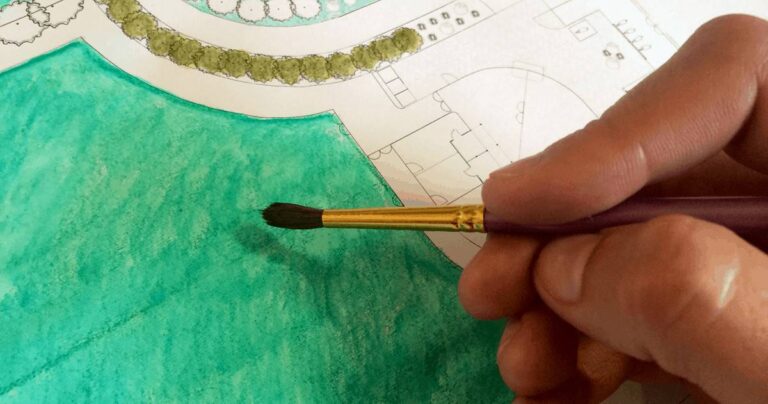
In this step, you get the chance to play with your colouring pencils!

A base map of what exists can be overlayed with tracing paper or transparencies, and you can start to look at how different aspects of the design might look.

There are many design techniques out there and most are relatively easy to use.

You can later expand to digital formats that use design software. Throughout this process, keep in mind property design is a dynamic process and you may want to make many changes before you create your final master plan. Remember also the components that you want to connect to each other (so-called stacking functions), these will need to be visualised as well.

Step 6: Implementation

Consider how your plan will be realised – the timing and phasing of the project. Create a plan of action and ensure everyone knows what the plan is. Hopefully, your people have been involved right from the start, because if it doesn’t reflect what they want to happen, it won’t!

In broad terms, the order of implementation is water, then access, then buildings and built infrastructure. The ground-breaking part of the process (literally!) is digging and shaping of the land. Take care of any major earthworks – clearing, levelling, digging ponds and swales, hardscaping, sheet mulching, trees, shrubs, plant covers, etc. before you think about fencing and structures.

Step 7: Maintenance

Part of the design process also involves estimating the maintenance that will be required to keep the site at a healthy optimum. There is no point creating a system that will require three days a week to maintain if you only have two days available.

Good design will preclude the need for any major adjustments in this area.

To summarise Equine Permaculture in action

The success of any design depends on how it is accepted and used by the people on the ground, and how the land, vegetation and animals respond to the layout of the infrastructure, pastures, paddocks, laneways and/or central point systems.

Permaculture design techniques may start with a thorough planning process that takes into consideration all known intervening factors – all those we have mentioned above and perhaps more. But, in the end, it comes down to our own management flexibility and ability to steer a path, based on the results of trial and error.

It is up to us to be willing to ‘learn as we go’ and act on new information, to continue to observe and remain open minded with the methods we use.

Happy designing!


To download this article about Equine Permaculture in action, complete with images and diagrams, click here.

[wpdm_package id=52402 template=”link-template-button.php”]

Equine Permaculture Design: Part 6 Manage runoff and erosion

Manage Runoff and Erosion.

Following on from last month’s look at how the shape of the land influences design and layout of a property,  in this Part 6 of this exclusive Equine Permaculture Design Series, Mariette van den Berg gives some practical solutions for managing water run-off and controlling erosion – one of the major problems on horse properties.  

When it comes to horse property layout, it pays to consider the permaculture design approach because it aims to build systems that are easier to manage, more efficient and sustainable, whilst considering the health and wellbeing of all – people, horses, plants and the soil that sustains them. 

When we design the layout of our horse properties, we cannot ignore the importance of the shape of the land. When we are dealing with uneven ground, slopes, hills and valleys, we must take into account further design considerations because the contour of the land has a pronounced effect on the flow of energy through the system.

If you are managing horses on a hilly property, you will no doubt have experienced the effect it has on water flow, soil condition and grass cover.

Erosion and runoff is one of the major problems on horse properties. While soil erosion may be more obvious on hillier or smaller properties with higher stocking density, flatter and larger properties are not exempted.

Soil erosion is a naturally occurring process that affects all landforms. In agriculture, soil erosion refers to the wearing away of a field’s topsoil by the natural physical forces of water and wind, or through forces associated with farming activities, such as tillage and animal grazing.

Whether it is by water, wind, tillage or animal grazing, erosion involves three distinct actions, including soil detachment, movement and deposition.

Topsoil, which is high in organic matter, fertility and soil life, will either be relocated elsewhere ‘on-site’, where it builds up over time, or it will be carried ‘off-site’, filling in creeks, rivers or drainage channels.

Soil erosion reduces cropland productivity and contributes to the pollution of adjacent watercourses, rivers, wetlands and lakes.

Soil erosion can be a slow process that continues relatively unnoticed or it can occur at an alarming rate, resulting in serious loss of topsoil.

Soil compaction, low organic matter, loss of soil structure, poor internal drainage, salinisation and soil acidity problems are other serious soil degradation conditions that can accelerate the soil erosion process.

In the case of horse properties that deal with large grazing animals, compaction is typically the main cause of soil erosion and soil degradation.

In the previous issue, we already briefly describe how the shape of the land (i.e. slope) affects natural the movement of energies, such as water, materials, heat, erosion control, fire control and aspect.

In this article, we would like to focus primarily on erosion control and how we can manage runoff, and specifically we will be discussing eight practical ways to prevent or manage erosion on horse properties.

1. Understanding the contours and shape of your land. 

If you want to work with natural patterns and prevent erosion, you must familiarise yourself with a contour map of your property.

A contour map is illustrated with contour lines, which shows valleys and hills, and the steepness of slopes. The contour interval of a contour map is the difference in elevation between successive contour lines. From these contours, a sense of the general terrain and slope can be determined. The steeper and longer the slope of a field, the higher the risk for erosion.

Soil erosion by water increases as the slope length increases, due to the greater accumulation of runoff. Consolidation of small fields into larger ones often results in longer slope lengths with increased erosion potential, due to increased velocity of water, which permits a greater degree of scouring (carrying capacity for sediment).

Therefore, it’s essential that if you are dealing with a hilly property and/or lot of water runoff, that you work as much as possible on contour lines and integrate methods, such as keyline design (ploughing), swale design and on contour vegetation planting/mulching, and fencing to prevent erosion.

2. Contour ploughing and keyline planning/ploughing

Contour ploughing or farming is the practice of ploughing and/or planting across a slope, following the contour lines.

The ripped contour lines create a water break, which reduces the formation of rills and gullies during times of heavy water runoff – a major cause of top soil loss and soil erosion.

The water break also gives the water more time to sink into the soil.

In contour ploughing, the ruts made by the plough run perpendicular to the angle of the slope, creating furrows that curve around the land and are level. This practice is also used for preventing tillage erosion. Tillage erosion is the soil movement and erosion caused by tilling a given plot of land.

A similar practice is contour bunding where stones are placed around the contours of slopes. Soil erosion prevention practices such as this can drastically decrease negative affects associated with soil erosion, such as reduced crop productivity, worsened water quality, lower effective reservoir water levels, flooding and habitat destruction.

Contour farming is considered an active form of sustainable agriculture.

Keyline planning/ploughing works slightly differently from contour ploughing.

The keyline design and plough concept was originally developed by P.A. Yeomans in the 1950’s to address issues of dwindling water supplies and soil erosion on Australian rangeland.

Yeomans developed a system of ‘amplified contour ripping’ that maximises productive use of rainfall and facilitates the uniform irrigation of land. The name, keyline, was given to the particular contour that runs through the keypoint, in all small headwater valleys where the slope change occurs. This contour is the primary contour in keyline planning.

The keypoint is found at the break of a slope where the land goes from convex to concave. Keypoints are often characterised by the beginning of a discernable channel, where subsurface flow from higher in the slope surfaces – in effect, like the end of a pipe – and can be captured and re-distributed. This is also the best place for farm dams.

The keypoint is the point of deposition (of soil) and this is where all clay forms (see the slope illustration last month’s article). Identifying the keypoint and keyline is the starting point for keyline design.

A keyline is the contour line that intersects with the keypoint.

As opposed to contour lines, which often vary in distance along their length, keylines fall off contour at the same elevation along the length of the line in such a way that keylines always run parallel to one other, making the creation of keyline cuts particularly amenable to mechanical management using a tractor and (P.A. Yeomans) plough.

The main idea behind keyline design is to capture water at the highest possible elevation and ‘comb’ it outward toward the (often drier) ridges using gravity, reversing the natural concentration of water in valleys.

The result of keyline cultivation is an overall drift of surface runoff water, which prevents runoff from concentrating in the gully and causing erosion. It increases the time of contact between the rain and the earth, and has the effect of turning storms into steady soaking rain.

Rain may have become less frequent in some parts of Australia, but its intensity and volume over a 24 hour period is growing overall.

Image C on Page 40 shows keyline ploughing on a hillside. Notice the plough lines fall towards the ridge and rise in the gulley. The water, which concentrates in the gulley, is slowly directed to the dry ridges. The ploughing shatters the compaction layers and the three life forces – air, light and water – are allowed to penetrate the ground and kickstart life back into the soil.

3. Swales and contour banks

Water flows the fastest straight down a slope and the effects of erosion will be most pronounced when water has the most direct path down a slope. Additionally, when water flows fast down a slope, very little of it is absorbed into the soil.

By digging trenches along contours of the slope (swales), the flow of water can be slowed down and diverted sideways on its downhill journey to allow it to soak into the soil.

Swales are not the same as contour banks. Contour banks actually re-direct the water slightly off contour, and drain to a central point to slow water and to stop erosion.

Swales are level banks that follow contour from start to finish. Swales as used in permaculture are designed to slow and capture runoff by spreading it horizontally across the landscape (along an elevation contour line), facilitating runoff infiltration into the soil. (See Image B)

A swale is created by digging a ditch on contour and piling the dirt on the downhill side of the ditch to create a berm. The soil that is excavated from the ground is placed, uncompacted, on the lower side of the excavation in a rounded mound shape.

Once the topsoil on the pasture is at 100% water-holding capacity, surface runoff flows into the swale. The water is absorbed, and taken deep underground to recharge the subsoil and replenish underground springs. This process slows water in the landscape and retains it in the ground for longer periods of time.

4. On contour fencing

Likewise, when constructing paths, tracks, laneways – for example, for paddock paradise set-ups – and fences, it is best to have these run along the contours of the site and not downhill as downhill running paths will create significant soil erosion, because there are no groundcover plants protecting the soil on a cleared path. Fences holding horses will become tracks as horses walk the fence-line day after day, so we also avoid running these straight downhill if at all possible.

5. Vegetation/planting 

The simplest and most natural way to prevent erosion is through planting vegetation. Plants establish root systems, which, in turn, stabilises soil and prevents soil erosion.

Having vegetation, such as shrubs and trees, will help control soil erosion and a forested steep slopes also warms the cool night air to create a thermal belt as described in our previous article. When water runs downhill, it will carve its own watercourses and gullies, washing away the soil in the process.

Trees, vegetation and groundcovers absorb the flow of the water and, by creating a buffer between the flowing water and the soil, they control the problem of soil erosion. That is why it’s also important to think in terms of ground/grasscover for your pasture areas. Healthy topsoil and good grasscover will act like a sponge, soaking up the water, and reducing direct and fast runoff.

6. Mulching (and slashing)

Mulches can be made of many materials and are are used to retain soil moisture, regulate soil temperature, build soil, suppress weed growth and to improve the aesthetics of an area.

Mulch is applied to the soil surface, around trees, paths, flowerbeds, to prevent soil erosion on slopes, and in production areas for flower, vegetable crops or pastures.

When applied correctly, mulches can dramatically improve soil productivity.

Mulch layers are normally two inches or more deep. A mulch is usually, but not exclusively, organic in nature. It may be permanent (e.g. plastic sheeting) or temporary (e.g. straw, bark chips). Together with manure or compost, mulch improves the activity of worms and other organisms, which are important for building soil and increasing plant nutrient availability.

Mulch is applied at various times of the year, depending on the purpose. Towards the beginning of the growing season, mulch serves initially to warm the soil by helping it retain heat, which is lost during the night.

On a horse property, you can add mulch to your pastures by slashing long-standing weeds and old bunch grasses. You can also use old or spoilt hay and, if you have bare ground areas in the horse paddocks, you can place a large round bales of hay, let the horses eat some and spread the rest over the area.

Adding grass or hay as mulch allows early seeding and transplanting of certain crops, and encourages faster growth. As the season progresses, mulch stabilises the soil temperature and moisture, and can also prevent weeds from growing.

In temperate climates, the effect of mulch depends on the time of year. When applied in Autumn and Winter, they are used to delay the growth of perennial plants in the Spring or prevent growth in Winter during warm spells, which limits freeze thaw damage.

7. Geotextile and geocells

Geotextiles are effective because they also stabilise soil. When used in conjunction with growing vegetation, they are even more effective.

Geotextiles are filter fabrics that are used to ‘lock’ loose soil into a position and increase its stability, protecting it from wind and water erosion.

Made from synthetic and natural fibres, geotextiles help in the filtering, separation and drainage of water from the soil. Geotextiles can be woven, non-woven or knitted. All these different fabric compositions are suitable and can be used in various applications.

Geotextiles are used extensively in civil engineering, agricultural and erosion control applications. They have a proven record stabilising steep banks, roads, railroads, canals, construction sites, coastal engineering and dams.

Another variant of the textile concept is known as ‘geocells’ or ‘matting’. This is a three-dimensional mat or tile made from polyethylene grids (cells or honey-combs). The structure retains a layer of top soil and anchors the growing grass roots, thus providing a stable surface highly resistant to the forces of rain drops and runoff.

Other materials, such as pea-rock and sand, can also be used to fill the cells. The cellular design allows for custom sizes, configuration and adaptability to a variety of terrains. The hydraulic properties are influenced by the type and compaction of the fill material.

Geocell/matting has many applications in horse properties! For example, slope protection, uncovered yards, horse sacrifice areas, tracks, roads, watering points, ditches, ponds and dam walls, etc.

8. Retaining walls (and terracing)

Retaining walls can be built around an area of erosion to prevent water runoff. Runoff water leads to further erosion and, if used with other methods, like terracing, for example, retaining walls can be very effective preventing soil erosion.

Retaining walls, such as rock gabions, can be very useful. Rock gabions are baskets made from flexible steel wire mesh and filled with granite or basalt rock. Rock gabions are constructed in various sizes and are commonly used for along creek banks, over soft ground, steep slopes and rock fall areas to trap sediment.

The purpose of rock gabions is to prevent undercutting and/or scouring at the base of steep slopes. Vegetation may be incorporated into the gabion by placing cuttings between the gabion layers. The cuttings will take root in the gabions and the soil behind the structure. The vegetation provides additional stability once the root structure has developed. (See illustration on Page 42)

To Summarise Managing Runoff and Erosion

These solutions to control water runoff can be used in combination to prevent and manage soil erosion in different areas on your horse property.

The structures and materials you choose to use will largely depend on the shape of your land, your budget and property design ideas.

The most important aspect of erosion control is understanding land contours, and the effect slope has on water and animal traffic, and learning to work with them to reduce damage to your land.

For example, if you are planning on fencing areas for your horses’ pastures or planting trees/shrubs, use contours for placement. This small adaption won’t cost you necessarily more (maybe you have to run a few extra meters), but in the long run, it will avoid damage and loss of soil and, consequently, grasscover, which will always cost much more in labour and money to restore!

[wpdm_package id=52398 template=”link-template-calltoaction3.php”]

Equine Permaculture Design: Part 5 Slope and Aspect

Slope and Aspect

Following on from last month’s concept of energy flow, in this Part 5 of this exclusive Equine Permaculture Design Series, Mariette van den Berg explains the design tool that permaculture design consultants use when deciding the best placement and layout of a property. This time focusing on the shape of the land and how we can find ways to use it to our advantage. 

When it comes to horse property layout, it pays to consider the permaculture design approach because it aims to build systems that are easier to manage, more efficient and sustainable, whilst considering the health and wellbeing of all – people, horses, plants and the soil that sustains them. 

When we design the layout of our horse properties, we cannot ignore the importance of the shape of the land. When we are dealing with uneven ground, such as slopes, hills and valleys, further design considerations need to be taken into account because the contour of the land has a pronounced effect on the flow of energy in our overall system.

If you are managing horses on a hilly property, you will have experienced the effect of the slopes on water flow, soil condition and grass cover.

With any slope, gravity will move things from the highest point to the lowest and we can take advantage of the work performed by gravitational forces to make our system more energy efficient.

The main emphasis of designing with slope is efficient energy flow. In this article, we will describe how the shape of the land affects natural energies, such as water, materials, heat, erosion control, fire control and aspect.

Water capture and flow

Put simply, water is the world’s most valuable life-sustaining commodity!

Without water, we don’t get very far on a property. We need water for plants, animals and ourselves. Therefore, water and how it flows over your land is one of the first energies you have to identify, so you can design in terms of maximising harvesting.

Since water flows from the highest point to the lowest, any slope can be used to move water downhill.

We can exploit gravity by situating water storage, such as tanks or dams, uphill on the higher points of a site, as this allows natural forces alone to supply a flow of water without needing additional energy to power a pump.

In addition, we can place our dams on the ‘key point’, which is not only the highest ideal placement for water catchment in a valley, but is also a likely place to find both a spring and good clay as it is the initial point of deposition in the landscape.

The keypoint referred to in the diagram on Page 36 is the area or plateau that lies between the convex slope above it and the concave slope below it.

Important to note is the keypoint is not actually on the inflection point, but a little further downhill from the actual inflection point, still along this central path of the valley, where the force of water movement changes from erosive to deposition. This where you can place your so-called keypoint dams. Here you can capture more efficiently water and prevent erosion.

Another way to capture more water on a slope is by the use of swales. Swales are on-contour, level banks that store water and soak it to deeper underground reservoirs.

A swale is not a drain! The words on-contour and level are very important because this helps with slowing down the movement of the water and preventing erosion.

Swales have a special width and depth, and on the lower end a little mound is made. This area is typically vegetated with a cover crop and, later on, shrubs and trees can be planted to stabilise the banks – and, at the same time, you can use it to grow fodder! In a future issue, we will discuss this in more detail.

Another way to capture water or redirect water flow is by using gravel pits with reeds growing in them, which can serve as a wastewater (grey water) treatment system. The idea is to build these grey water reed beds downhill from the house or horse stables, so waste or soiled water can flow by gravity into the reed beds, where it is cleaned and then directed into a pond or swale situated further down the slope.

As an alternative to using a reed bed wastewater treatment system, the greywater from the kitchen, bathroom and laundry can be directed to an orchard that is located downhill from the house.

Structures that have a large roof areas for rainwater harvesting, such as horse shelters, sheds, workshops and other such buildings that people don’t live in, can be located uphill from the house, to capture rainwater, which is collected in water tanks located next to these structures, and fed via gravity to the house and/or stables.

Materials

Like water, the movement of resources and materials from the high areas to the lower ones uses less energy than moving them across level ground, and considerably less energy than moving materials uphill.

By locating access roads uphill of the house, less energy is expended distributing any materials throughout.

Similarly, growing timber for firewood or plants for mulch uphill from the house makes it easier to bring the material back to where it will be used because the load is carried downhill.

How heat moves

Another very important aspect to consider when designing is how the slope affects the air temperature.

Heat behaves in an opposite manner to water, as heat rises upwards, as does warm air. Conversely, cold air, being more dense, sinks and flows downward.

Dams and bodies of water situated downslope can reflect heat, as well as act as a thermal mass, heating up during the day and releasing the heat at night. Since heat rises, the heat emanated will rise upwards and warm the upslope area.

Similarly, we can place plantings of tall trees on a slope to retain heat, to warm the incoming cold night air that flows down the slope.

When the warm air moves through the forested area, it will have warmed up as much as it can and, on reaching a plateau at the end of the forest, all the warm air will begin to rise, creating a thermal belt, which will be warmer than the surrounding area.

If we place a house in this thermal belt, it will be warmed naturally (see next page), which shows a thermal belt at the keypoint on the property design.

We can also take advantage of the fact that hot air and hot water rise to set up the collection point downhill, which allows us to use the energy above the collection point. For example, if we set up a solar water heater on a lower level, the hot water will naturally rise upwards by convection, it can then be stored and accesses from an elevated tank.

A solar hot water heater is basically a thermosiphon, a passive heat exchanger that works by convection to circulate water without a pump. The water starts to move when the water inside the collector is heated by the sun. It expands, becomes less dense and, therefore, lighter, and rises to float above the cooler, denser, heavier cold water. As the convection moves the hot water upwards, out of the collector, cold water flows by gravity into the collector where it, in turn, is warmed up and continues the cycle.

Erosion control

Most horse owners will be aware of the importance of erosion control, especially on hilly properties. Having vegetation, such as shrubs and trees, will help control soil erosion and a forested steep slopes also warm the cool night air to create a thermal belt as described previously.

When water runs downhill, it will carve its own watercourses and gullies, washing away the soil in the process. Trees, vegetation and ground covers absorb the flow of the water and, by creating a buffer between the flowing water and the soil, they control erosion.

This is why it’s also important to maintain  good grass cover in your pasture areas. Healthy topsoil and good grass cover will act like a sponge, soaking up the water, and reducing direct and fast run-off.

Water flows fastest straight down a slope and the effects of erosion will be most pronounced when water has the most direct path down a slope. Additionally, when water flows fast down a slope, very little of it is absorbed into the soil.

As mentioned earlier, by digging trenches along the contours of the slope (swales), the flow of water can be slowed down and diverted sideways on its downhill journey, slowing it down and allowing it to soak into the soil.

Likewise, when constructing paths, tracks, laneways – for example, for paddock paradise set-ups – and fences, it is best to have these run along the contours of the site, rather than down the hill. Downhill running paths will create significant soil erosion, because there are no ground cover plants protecting the soil on a cleared path.

Fences holding horses will become tracks as horses walk the fence-line day after day, so its best to avoid running any fences straight downhill, if possible.

Fire control

If you are located in a bush fire prone area, it is very important to include a fire sector in your design.

In addition, you should also have a fire management and evacuation plan in place for your property, in case a bushfire strikes you! Your state government and horse industry websites offer emergency plan advice, and have information about how to best manage horses in bushfire-prone areas.

If your house is located on a slope, the greatest danger is from fires running from the downhill area up the slope. These are called upslope fires. The steeper the slope, the higher the risk. The speed and intensity of the fires doubles for every 10 degree increase in the slope angle. This is happens for two reasons:

The angle of the slope allows the fire to dry the material uphill, making it more flammable when the fire reaches it, and

The updraught effect – when a fire strikes, hot air rises fast and the fire pulls in more oxygen-rich air from lower down the hill to feed it. The more air that feeds in, the hotter it gets and the fiercer it burns.

As a consequence, the worst places to site a house is on sharp rigdetops or hilltops. Such a house is exposed from all sides to the threat of fire and fire will race quickly up the slope.

Another risky spot is the lee side of a hill, that is, the side of the hill sheltered from the wind. As the wind blows over the crest or top of the hill, it creates a low pressure area on the lee side, which creates a lot of air movement. During a fire, this powerful air movement can drive a fire cyclone, which will be burning directly over the house!

To reduce the risk of fire, houses and horse stables need to be sited:

  • Away from the tops of hills or ridges,
  • Preferably on downslope plateaus (level areas),
  • If the house is located on a slope of a hillside, excavate a shelf, a flat area and locate the building on the shelf, well back from the edge to protect it from radiant heat coming from the downhill area, and
  • If excavating a shelf, build a pond as a firebreak or an earthbank to protect the building from radiant heat.

Aspect of a slope

The aspect of a slope is simply the direction it faces. A sun-facing slope is facing north in the southern hemisphere and facing south in the northern hemisphere.

Good orientation can increase the energy efficiency of your home, making it more comfortable to live in and cheaper to run.

Ideally, choose a site or home with good orientation for your climatic and regional conditions, and build or renovate to increase the site’s potential for passive heating and passive cooling; adjusting the focus on each to suit the climate.

For those sites that are not ideally orientated, there are strategies for overcoming some of the challenges.

In hot, humid climates and hot, dry climates with no Winter heating requirements, aim to exclude direct sun by using trees and adjoining buildings that give shade year round, while capturing and channelling cool breezes.

In all other climates, a combination of passive solar heating and passive cooling is desirable. The optimum balance between capturing sunlight (solar access), and capturing cooling breezes is determined by heating and cooling needs.

A northern aspect is generally desirable in climates requiring Winter heating, because the position of the sun in the sky allows you to easily shade northern parts and the ground near them in Summer with simple horizontal devices, such as eaves, while allowing full sun infiltration in Winter.

Similarly, the aspect of the slope or orientation should also be considered in your design when placing horse buildings and facilities.

When building stables, shelters, loafing areas, arenas and even when planting vegetation, you should take the aspect of the slope into consideration.

You want to have your horse shelters positioned in such a way they offer protection against the severe (gust) winds/rains. During Summer, you want to have enough shade to protect your horses from the midday sunlight, while still allowing sunlight during Winter.

All this can be achieved by using a combination of natural and man-made structures which offer these features.

Summary

Permaculture places an enormous emphasis on sustainable design concepts for our homes and properties, with the aim to capture energy that facilitates the growth of our living systems and to set in place cycles, which eventually lead to greater energy and chore efficiency.

To accomplish this, we need to have a close look at the layout of our horse properties and, in our design process, we need to:

Determine the zones within the site to optimise the distances where elements are located (see Part 3 in the July issue of Horses and People),

Analyse our sectors carefully to account for all the ‘wild energies’ moving through our site, and locate design elements to harness or reduce them as necessary (see Part 4 in the August issue), and

Assess the sun angle and slope to gain maximum benefit from them.

After this analysis, we will have a fairly sound and potentially successful design in terms of making the most efficient use of energy for our site.

It is a fairly simple and straightforward exercise to systematically step through each of the areas covered under Zone, Sector and Slope, and attend to each part of the design as a separate task.

Breaking up even the largest site into smaller sections makes it much easier to design. Dividing up the site into zones does this for us. Sector planning involves observation of nature to see where the elements come into our site design and slope is a really a creative exercise where we see how much free energy you can use from what nature offers!

[wpdm_package id=52394 template=”link-template-button.php”]