fbpx
Home Blog Page 41

Horse Training Course: Part 8 Long-Reining Part 2

If you ever thought there must be a better and easier way to train your horse, this training series by Kate Fenner is designed for you! Each article walks you through specific lessons and how to teach them. From stress-free trailer loading, to handling head-shy horses, to safe mounting. Kate’s gentle and no-fuss approach will provide you with the tools and confidence you need to educate your own horse.  

In this two-part series, she suggests…

Use long-reining as an alternative to lungeing your horse.

If you missed Part One, you can read it here.

Last month, we looked at how to prepare your horse for long-reining. These steps are vital, even if you think your horse ‘will be fine’ with it so, don’t be afraid to recap on that lesson.

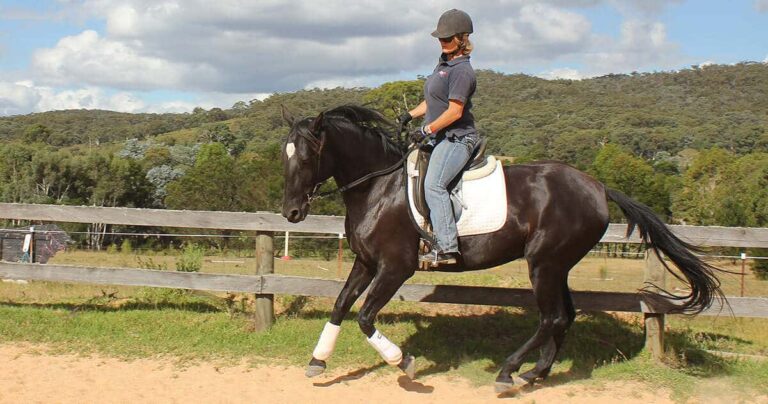
Long-reining is one of the most useful exercises you can have in your toolbox. It is an educational tool, where the horse is learning about relaxation, softness in the bridle and self-carriage, and is building those important topline muscles that your horse needs to carry you. After teaching ‘Give to the Bit’, I use long-reining on almost all horses.

One of the main advantages, for educationally-young horses, is the horse can learn the movements, self-carriage, shoulder elevation, transitions and so on, without the added difficulty, distraction or perhaps confusion of carrying a rider, and the leg and seat cues involved.

In fact, long-reining enables us to break things down and teach the horse one thing at a time – just as is recommended by the International Society for Equitation Science (ISES) in their First Principles of Horses Training.

Another time long-reining will come in useful is when your horse is changing discipline. Let’s say you have a dressage horse that has only ever been ridden in an arena and you want to start trail riding. You can use long-reining to habituate your horse to the bigger – and potentially scarier – environment outside the arena by long-reining the trail.

Start long-reining your horse in the arena, with the gate open, and drive him in and out the gate – gradually working your way further from the safety of the confines of the arena. This is also a brilliant exercise for the ‘barn sour’ horse. You don’t want to be riding a confused, frustrated or conflicted horse, and this exercise will make learning to work on his own a much easier lesson for your horse.

Again, it’s about breaking it down.

Personally, as a trainer, I have to ride a large number of different horses – some of whose educational level is unknown even to their owners. If I teach ‘Give to the Bit’ and then long-reining, I can quickly assess the horse.

I stand safely in the middle, cue walk, trot and canter, check for relaxation, soundness and obedience and then ask myself “Can I and do I want to ride this horse?” If the answer is no, then I know where the work is needed. Either way, I have kept myself safe by checking this before mounting.

If your horse has been out of work for a while, teach long-reining before you get back on board. I honestly don’t think it makes any difference to the horse whether you are riding or not as far as learning habits is concerned. The habits we want to instill are relaxation, travelling in a soft frame and responsiveness to cues. By far, it’s best to do that safely from the ground.

So, let’s get started!

If you are fortunate enough to have access to a round pen, I advise you to use that to teach long-reining. By almost eliminating the need for directional control to begin the lesson, the round pen makes it easier for the horse. If you don’t have a round pen, just remember the larger the area, the more directional control you will need and the more choices you are giving your horse.

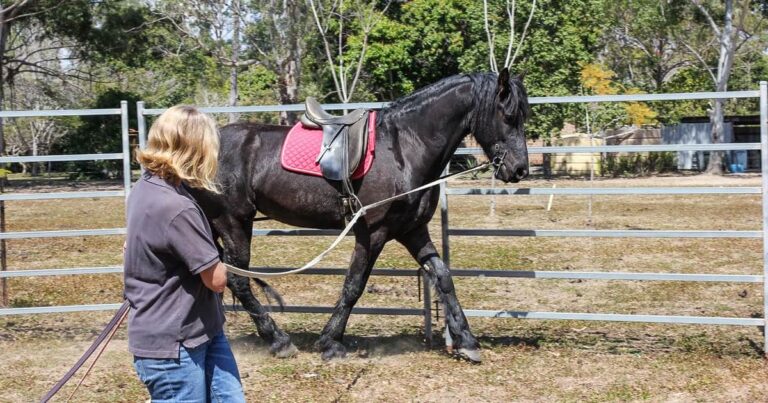
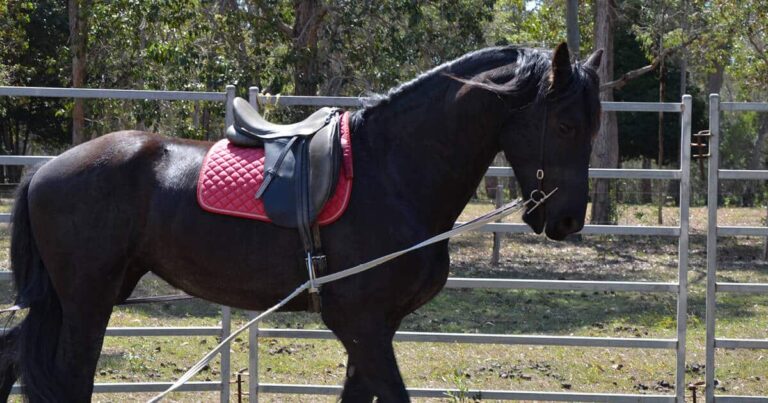
I’m going to use the example of long-reining in a saddle, with the stirrups tied together (see Part One) as I find it the safest option when teaching the horse this lesson, especially to those horses that have been lunged, and have learned to turn and face you.

Step 1: 

Tack your horse up, with stirrups snuggly tied together under the girth, a snaffle bridle, lunge lines attached through the stirrups to each side of the bit and bring your lunge whip.

I know, it’s a lot of stuff!

Slide the outside rein over the rump so you are standing about two metres away from your horse’s flank – outside the kicking range and ready to cue forward movement to begin the session.

Step 2: 

To make it easier for the horse, you are going to stay close and make your circles small to start with. Having you in a driving position, slightly behind the horse, may be new and take some getting used to. In order to habituate your horse to this and feeling the lines on either side of him, we are going to commence with changes of direction.

This is a good starting point because the horse slows during a change of direction and it helps to keep you behind the movement. It’s important you stay behind the midpoint of the horse’s barrel; otherwise, if you get too far forward, your horse will try to turn and face you.

While you are changing direction, make a conscious effort to watch the horse’s tail – this keeps you behind the horse. Keep watching the tail until the horse is moving in the new direction and then move your focus to mid-barrel.

TIP: Move the whip across first, before asking for the change of direction.

Step 3: 

If you’re anything like most people, you are now feeling like the least coordinated person alive and wanting to ditch the whip! Don’t do that. Without the whip, you only have your legs (as in chasing the horse), your voice (as in shouting at the horse) or the lines (as in swinging the lines at the horse and possibly jabbing him in the mouth), to encourage the desired forward movement.

Remember, we are building a relaxed and responsive horse. Raising the whip should be enough to create forward movement and, if your horse has not yet learned that cue, use more whip movement until the pattern is learned.

Step 4: 

Your horse is watching you, probably very closely. You’ll know if you move too far forward because your horse will try to turn and face you.

Use that vigilance to your advantage by setting up really good patterns.

By moving the whip from one hand to the other before changing direction, you prepare your horse to change direction.

Pass the whip over the top of the lines and hold it in what will be the new outside hand – only then asking for the change in direction with the reins (and, of course, watching the tail).

Doing this not only gives the horse a warning the change of direction is coming, it also sets you up by getting the whip in the correct hand and it reminds you to take a step to the side to position yourself to watch the tail (and remain behind the movement).

Step 5: 

Once both you and your horse are comfortable with changing direction in walk, set up a good side circle, 18 to 20 metres in diameter, to begin trot work.

Many horses have been lunged or round penned for extended periods of time, and we want to make sure that long-reining remains educational and engaging, and doesn’t become tiring or tedious.

By focusing on transitions, we make this exercise completely different from mindless circling.

Begin by asking for a few strides of trot and then back to walk, change direction and do the same thing on the other side.

Long-reining is about engaging your horse’s brain and getting him inside your ‘bubble of communication’ so the more changes of speed, gait and direction you do, the better.

Of course, the less you do in terms of circling around, the better too. A tired horse isn’t learning anything.

TIP: Long-reining is a great place to work on perfecting your transitions.

Step 6: 

Once your horse is working well in walk and trot, and remaining relaxed, soft in the bridle and in an elevated frame, it’s time to ask for canter.

If your horse is tense, rushing or has a high head, then stay with walk and trot, and practice ‘Give to the Bit’ while you are doing so.

If, at this stage, you feel your horse really hasn’t got the foundation of relaxation and softness, then go back to give to the bit without the long-reins and establish that before continuing.

TIP: Decide on the verbal cue you would like to use under saddle and teach that on the lines.

To establish a good canter transition, you will want to give your horse a series of cues. I use a verbal ‘kiss’ sound (as I’ve used a single cluck for walk and a double cluck for trot) for canter and would like my horse to respond to that without having to use any pressure cues.

Of course, until the pattern is established, the pressure cues (lunge-whip) will be required. Once we are riding the horse, we can use the leg, but obviously we can’t do that here.

For long-reining, I want three cues:

  • Verbal ‘kiss’ sound,
  • Raise the whip, and
  • Increasing whip movement.

Once on board, these might change to:

  • Verbal ‘kiss’ sound,
  • Touch with leg, and
  • Squeeze with leg (or touch the horse’s hip with the whip).

I understand a lot of people don’t like to use verbal cues because they “can’t talk in a dressage test”. However, we need to keep a few things in mind.

Firstly, the dressage judge is most unlikely to be able to hear a quiet cluck or kiss. Secondly, you need to consider the time your horse spends, in its lifetime, actually doing a test. Even for the madly keen dressage enthusiast, it’s not a long time. Finally, we are always aiming to work off less pressure so, if we can train the horse to respond to a verbal cue, we negate the need for physical pressure.

Step 7: 

Often with these things, the hardest part is getting started and stopping. It’s important your horse is relaxed and will stand quietly at the end of the lesson while you untack them.

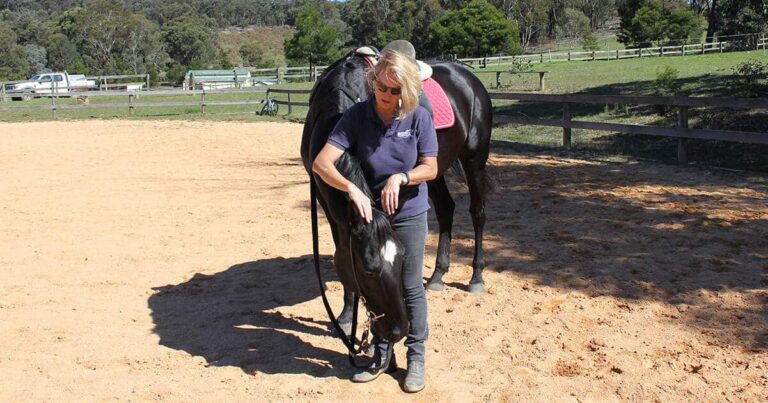
Always stop your horse out on the circle and go up to the horse, rather than getting the horse to come to you, or allowing it to turn and face you. Then, approach your horse. The first thing to do is unfasten both of the lines. This way, if your horse does get a fright and attempts to leave, you can simply pull the lines away (not as easy when using a surcingle and you must take the lines out carefully in that case).

Step 8: 

You now have all of the elements in place to make great changes in your horse’s way of going using long-reining.

Until you feel proficient and you are sure your horse is relaxed, always go back to walk to change direction. Later, when you are superstars at this, it’s a great place to teach flying changes, but that can be a bit ugly without a strong foundation!

Try to make it interesting, and fun for the horse by adding transitions and changes of speed within gait, along with lots of verbal praise for their efforts. But, remember, it is hard work, especially for those horses not used to travelling in frame or don’t have a lot of topline development, so don’t overdo it.

For a full training course on long-reining, visit the Kandoo Equine Online Training – https://www.kandooequine.com/
Check out Dr Kate Fenner’s podcast for more step-by-step, ethical and sustainable horse training courses.

Horse Training Course: Part 7 Long-Reining Part 1

If you ever thought there must be a better and easier way to train your horse, this training series by Kate Fenner is designed for you! Each article walks you through specific lessons and how to teach them. From stress-free trailer loading, to handling head-shy horses, to safe mounting. Kate’s gentle and no-fuss approach will provide you with the tools and confidence you need to educate your own horse.  Last time, Kate explained the ‘give to the bit’ lesson and, this month, she returns with a two-part series about learning to long-rein your horse.

Long-reining your horse.

Most of us do something to prepare our horses for riding, for example, some in-hand work, lungeing, circles on a long line or perhaps some round pen work.

Given we all live such busy lives and our time with our horses is almost always limited, are we really making the most of this preparation time?

The questions to ask yourself are:

  • Why am I doing this?
  • What am I hoping to achieve from the five or more minutes I spend before my ride?

The first few minutes often set the scene for the rest of the ride or session, so it’s important they are useful, positive and designed to engage the horse.

If your answer to why you are doing this and what you are hoping to achieve by the pre-ride work is to ‘get the edge off’ or tire the horse a little so they are less fresh, then keep this in mind… You are, at the very best, making your horse fitter and, a fit, uneducated horse is certainly no more desirable than an unfit, uneducated horse.

Learning patterns

During your preparation time, you will also be teaching your horse habits. We all know what great pattern learner’s horses are! If you are lungeing, round penning or running your horse on a long line, he may also be travelling with a high head, hollow back and, possibly, even bucking.

If your horse is not keen to move, you may have to resort to chasing – something we never want to do.

All of these things set up habits and, when you want to change your routine – let’s say you don’t have time for a pre-ride exercise – then your horse is likely to repeat the behaviour, despite you being aboard. Naughty horse? No… Your horse is just a good learner.

It doesn’t matter to the horse whether you are riding or working on the ground, you are teaching behaviours. If bucking or running away (the flight instinct that is evoked by chasing on the lunge or in the round pen) is acceptable when you’re on the ground, then you should also expect these learned behaviours under saddle.

This corresponds with Equitation Science’s Training Principle #9: avoid and dissociate flight responses.

If instead, we make the aim of our pre-ride time to be to engage the horse, get the horse to relax and come into our ‘bubble’ of communication, then we not only utilise the time well, but we educate the horse in the process.

Long-reining is the perfect tool for this. It is a rather forgotten art, probably because people mistakenly think it’s difficult or time-consuming but, once you have taught your horse to long-rein, you will not look back.

Before you start

While your horse does not have to be started under saddle to teach them to long-rein, it’s essential they have learned ‘give to the bit’ (see the July and August 2017 issues of Horses and People for a step-by-step guide or check out the Kandoo website).

If you are starting a young horse, long-reining is the ideal place to judge whether or not your horse has the established foundation training necessary to progress to riding.

Has your horse been off work for a period? Teach them to long-rein and get them back into the swing of learning in the Engagement Zone; build up those top-line muscles they need to carry you, and generally make that transition back to work easier for you and your horse.

Okay, enough about why, let’s move on to how!

I’ve broken this down into two stages for you and, this month, we cover the most important stage: preparing your horse. The habituation work here is not only useful for long-reining, but all of your horse’s training. We will also cover the equipment you need and how to set your tack up in the safest possible way.

Getting started

Because so many horses have been taught to lunge (and, sadly, many of them have been chased on the lunge or sent around in mindless circles for extended periods), we want to make this a completely different experience for them – an engaged and relaxing exercise.

This aspect corresponds with Equitation Science’s Training Principle #10: demonstrate minimum levels of arousal sufficient for training (You can learn more on this at: http://equitationscience.com/equitation/principles-of-learning-thoery-in-equitation).

One of the problems with lunging is that it is easy for the horse to turn and face you. Once taught (i.e. the horse has been successful more than once at stopping work when turning and facing), this can be hard to un-train.

For this reason, we are going to begin our long-reining sessions with the outside line behind the horse, making it considerably more difficult for the horse to turn and face us, even when, as handlers, we’re not as fast at correcting things as we will be later, with a bit of practice behind us.

Step 1:

The first thing we need to do is to habituate the horse to having the rope behind him. Remember, the line will have some pressure on it from time to time when the horse is working on the lines, so it is important to be sure he accepts this before attaching the line to the horse.

Hold the lunge line clip in your hand, so that it doesn’t accidentally hit the horse.

Rub the horse with the line around the rump. Ideally, the horse should stand completely still and remain relaxed while you do this. If that is not the case, make the rope ‘smaller’ by bunching it up more and gently ‘groom’ the horse with it.

Once the horse is relaxed and still, open the rope up slowly, but continue with your grooming motions. Soon, the horse will be relaxed and enjoying the grooming. Work your way up to being able to throw the rope over the horse’s rump and allowing it to slide off.

If at any stage the horse moves off or appears tense, simply go back a stage and repeat until the horse relaxes again.

This step may take a little time with some horses, especially those that may have been chased with ropes in the past. It is worth spending the time, because teaching your horse to relax when introduced to new things is a vital element of foundation training.

Step 2:

Now that your horse is relaxed with the rope around his hindquarters and back legs, it’s time to let him feel some pressure on the rope. To do this, simply make a big loop with the rope in your hand and loop it around the hindquarter.

The most important thing here is to be able to drop the rope quickly, should the horse rush forward or begin kicking.

Horses that have been ‘pulled’ onto trailer using a butt-rope or been forced, rather that taught, to do other things using a rope behind them, are quite likely to kick at the rope. In order to long-rein the horse with the rope behind him, we need the horse to be 100% comfortable with this feeling.

If your horse has had a particularly bad experience, which will be obvious by lots of kicking and tucking his hindquarters underneath him to escape the rope, then you may decide that, for now, it is best just to go to the more advanced stage of having the reins both at the wither and not behind the horse.

I do, however, feel it is a good lesson for these horses to learn and habituate to the rope, as harboring a fear of that magnitude indicates a huge hole in your foundation training. Personally, I only come across about two in every 100 horses that I decide to leave this particular part of the lesson for later.

Steps 1 and 2 are there to ensure your horse is not at all afraid of the rope. Don’t move on until you are sure your horse is completely relaxed with the ropes. I know, it sounds like I’m being pedantic about this.

We are now going to attach the rope to the horse and, if the horse is not completely relaxed with and accustomed to the ropes, he is likely to panic and will not only move off at speed, but will be ‘chased’ by the ropes when he does so. Yes, very ugly, very fast!

Step 3:

It’s up to you whether you would prefer to use a surcingle or a saddle to long-rein. I personally use the saddle for several reasons:

  1. The reins fit easily through the stirrups so, should something go wrong after I have unclipped the reins from the bit, I can simply pull them away from the horse. With the surcingle, the clip at the end of the line will get caught in the rings and the reins will ‘chase’ the horse.
  2. The stirrups hold the reins lower. This is important with the taller horses because, even when set low on the surcingle, it is still quite easy to get a rein jammed under the tail when the horse turns – not a nice experience for the horse.
  3. If I am thinking I might ride the horse after long-reining, I am much more likely to jump on as the horse is tacked up and ready to go – perhaps I’m just lazy, but I wouldn’t always go back to the stables, untack and re-tack, just for a five-minute ride (shame, it might have been brilliant!).

With the surcingle, I suggest using the lower rings to start with. Again, this is so the line can go behind the horse, making it more difficult for him to turn and face you. Do be aware when the horse changes direction, especially those tall horses, the rein is still quite high and can get caught under the tail if you are not careful to monitor that.

The reins go from the back to the bit. Put the clip through the ring on the surcingle and clip it on to the bit. Gently lay the rest of the rein on the horse’s back and clip on the other side.

If you are using a saddle, you will need to attach the stirrups together under the saddle. I use a short bungie cord, but a piece of baling twine also works well.

Remember to tie it quite snuggly, because if there is too much movement, the twine may rub the horse’s elbow. Tie the stirrups so they make guides for the lines. Position them by moving the part nearest the front of the horse to the outside in the same position the stirrups would be if you were riding. Then, simply put the line through from the back and clip it on to the bit.

Check in next month…

Next month, we’ll get the horse moving on the lines but, in the meantime, take your time and enjoy the habituation part. Plus, any work you can do on the ground (and under saddle) with ‘give to the bit’ will pay dividends next month!

Check out Dr Kate Fenner’s podcast for more step-by-step, ethical and sustainable horse training courses.

Yvette Frahn: In Pursuit of Perfection

Equine Artist Yvette Frahn

“I challenge you to do a painting a day.”

Yvette Frahn had been working part-time as an equine artist for some time when her friend set the challenge to her – to create one new work a day.

Yvette was momentarily at a loss – where would she get the inspiration to create such a long stream of new pieces?

Then she was struck by a realisation. She had the source material out in the back paddock – her mare, Tooky, and on her desk, a towering stack of photographs she had already taken of her.

Over the next few months, Yvette created over 60 artistic works in ink depicting Tooky. She was astonished when the pieces began selling across Australia and overseas.

“I couldn’t believe this funny horse, doing her thing out in the paddock on the farm, would be loved by so many people,” Yvette tells me.

“This is when I discovered you can live in absolute isolation on a farm and you can connect to the whole world.”

A rural upbringing led to the simultaneous development of a love of horses and a love of art. Yvette points to a moment she remembers vividly, spotting “a grubby little pony” when she was four years old and feeling an instant connection to the creature.

“That’s actually where it started. You know how people talk about having a calling? Something they just can’t not do? That’s how it was for me.”

Yvette’s mother drew horses for her at her daughter’s behest, until one day, Yvette was no longer satisfied with her depictions and took the pencil for herself.

Growing up, she was perceived as slightly odd by her peers and classmates for this unusual combination of interests. “When you’re horsey and you’re a creative, you automatically don’t fit in a box [especially] in a rural district.”

Nevertheless, she persisted. Despite initially enrolling in a horse husbandry course at an agricultural college, Yvette found equine studies didn’t quite suit her. After a period of travel and uncertainty, she returned with “the absolute clarity that what I needed to do was study art, because that’s what drove me.”

The horse husbandry course did, however, offer one unexpected benefit. “The beautiful part of it was we got to do dissections,” Yvette says.

“I learned an awful lot about anatomy. I think that’s partly what governs my artwork: my need to be faithful to what I know underlies the skin and the muscles, the skeletal structure…

I get wildly excited about colour, and a lot of my artwork has extreme colour in it, but if you look underneath that, I am anatomically obsessive.”

Yvette studied her undergraduate degree at Ballarat University, where supportive lecturers allowed her to focus on her interest in equine art in her final year. She was encouraged to undertake further artistic study afterwards, but her interests called her elsewhere.

“I kept thinking about what it felt like when I was a kid, when being creative was a weird thing, and I thought actually I’d rather study education,” she says.

After gaining her secondary education qualification, Yvette decided rather than following the school curriculum, she would develop her own art education program and teach privately.

Underlying her educational work is the need “to connect back to those kids that were like me when I was little, and for that matter adults, and anyone else in society…

I could create that beautiful atmosphere where you are in the moment as a creative person, and you are constantly experimenting and trying things out…

I wanted people to just make art for art’s sake and celebrate being inventive.”

It has illuminated another aspect to her sense of self as an artist. “I find there’s half of me that loves being introverted, stuck in the studio and making art. And the other half of me loves getting out there and sharing it with everyone, and inspiring people to have a go themselves.”

Ultimately, it is the horses that fuel her creatively. I ask why she decided to focus so particularly on the equine. “I didn’t choose it; it chose me,” she answers.

“They are infinitely fascinating and infinitely complicated. They never ever get boring, and I never get to the point where I think I know so much that I don’t need to do more of it.”

There are two horses that stand out as models she has returned to again and again in her practice.

The first, Blue Jasper, was her first serious competition horse. He and Yvette competed all over the Adelaide Hills and enjoyed great success in the show jumping ring.

“That’s a sport that teaches you about leg obsession!” says Yvette. “Obviously it’s pretty hard work on their legs, and you get kind of fascinated by what’s going on with the joints and ligaments, and stuff like that.”

“I did a lot of artwork of [Blue Jasper], and carted him all over the country and, in fact, he’s buried on the farm here,” Yvette tells me.

These days, her work is dominated by the aforementioned Tooky – a mare with attitude. “She’s a bit lethal. And that’s one of the reasons why she’s going to spend the rest of her life with me,” she says.

Yvette found Tooky, an ex-racehorse, through a friend when she was in search of a riding horse. After being confronted with the mare’s front and back hooves in close proximity, despite her better judgement, she found herself saying “I’ll take her.”

Yvette has never been able to change Tooky’s nature, but it’s clear they’ve struck a kind of accord. Perhaps it is Tooky’s vivid personality that gives her such life on the canvas.

“My ultimate focus with all the art that I do of horses relates to that magical moment as a four year old where I connected with this living being,” says Yvette. “I paint to connect, I suppose… It’s in the pursuit of that ultimate visual perfection that brings the life of that horse into your world.”

Yvette has the pleasure of working from her home farm, in a barn studio that she and her husband converted together. “I married the neighbour,” she laughs.

As a young girl she always had the support of her parents, and as Yvette grew older, her husband, Gary, became her greatest champion.

“He committed to supporting my art even before we married and it is with his never faltering faith in what I can do that we have done so many things, and nearly all of it together… I don’t know that I could do this without him. He is my rock.”

While her skill and commitment is key to her artistic achievement, clear communication underlies Yvette’s success as a businesswoman.

The process of commission involves detailed discussions of the planned work and, if it is a larger piece – requiring a proportionally larger time commitment and investment – Yvette will produce sketches of the design.

“In all that conversation you have before a commitment of that size is made, you get an understanding for what matters to them as a horse owner,” Yvette explains.

If the owner is committing to a big piece and the horse isn’t too far away, sometimes Yvette will round up her photographer friend, Kerri-Ann Afford, and hit the road to meet her subject in the flesh.

“Every time I meet a horse and do something special with that horse as an artist, it seems to lead to a body of extraordinary work that I do because I’m somehow connected to them,” says Yvette. “It drives my inspiration.”

While a standard A3 piece may be completed in a matter of hours, the larger works may take a number of months. “I value myself for being able to create a really high standard and be efficient at the same time,” Yvette explains.

She’s the kind that works well under pressure. She strives to never disappoint a client, frequently delivering more than was expected. “There’s so much faith and trust in what I can do for them, and I think that comes out of really great communication,” she says. “But a photograph is never as good as the real thing when they unwrap it when it arrives at their place.”

Her art has created connections all over the country, and now across continents. In 2016, Yvette had her first art exhibition in America, organised by the biggest equestrian organisation in the States – the Quarter Horse Association.

She sold every piece at the exhibition, and now hopes to return to the country every couple of years to spend a few months painting and selling her work. A colouring book she also created during the trip is now stocked at the prestigious Manhattan Saddlery in New York.

“One of my big ambitions is to get a solid foothold in America,” Yvette tells me; she’s also had interest from multiple parties in China and sees potential to expand there.

Ultimately, she aims “to be one of the best equine artists in the world.” It’s no small dream, but her work speaks for itself, and Yvette has confidence in her ability and dedication.

On a smaller scale, she tells me, “I’d also like to see if I can produce another good horse over jumps, so I can keep riding!”

It all comes down to the horses, after all; they’re Yvette’s inspiration, and from the number of commissions she receives from around the world, it’s clear they inspire their owners everywhere.

“There seems to be nothing more fabulous about being a horse person than to have original artwork on your walls,” Yvette says. “That’s been one of the fascinating things; how do we measure our love and our dedication and our passion for [our] horses?

One is having those horses and committing our lives to them. But I’m finding the artwork seems to be, for many people now, the other side of that dedication and that ultimate love.”

“That’s why I do it with my own horses. In doing it, it feels like they will be part of my world forever.”

[wpdm_package id=63989 template=”link-template-button.php”]

You can visit equine artist, Yvette Frahn’s Spirit of Equine website by clicking here.


Horse Training Course: Part 6 Learning to Give Part 2

Give to the bit. If you ever thought there must be a better and easier way to train your horse, this training series by Kate Fenner is designed for you! 

Each article walks you through specific lessons and how to teach them. From stress-free trailer loading, to handling head-shy horses, to safe mounting. Kate’s gentle and no-fuss approach will provide you with the tools and confidence you need to educate your own horse.  

Last month, Kate explained the ‘give to the bit’ lesson on the ground. This month, she continues from the saddle, riding give to the bit.

Last month, we looked at how to teach your horse to give to pressure – ‘give to the bit’ – from the ground. This lesson is often the first one I teach a horse because it’s an uncomplicated way for the horse to learn about negative reinforcement; that is, the pressure goes away when he finds the correct movement. In this case, it’s giving to bit pressure specifically.

When we come to riding give to the bit, there will be some re-learning for the horse as the angle of the rein will be slightly different, and we have added our weight and any leg cues we use.

To make this easier for the horse, we can go through the same steps as we did on the ground – breaking the lesson down.

Step 1: At a stand still.

Of course, you have read and taught your horse ‘Hips to the Fence for Safe Mounting’ because that was in the March issue of Horses and People. In case you missed it, you can read it here. So, now it’s time to mount your horse and begin the ‘Give to the Bit’ lesson from the saddle.

This is not the easiest part of the lesson as one might expect. The reason is it’s hard to raise the horse’s emotional level without moving their feet. Therefore, asking the horse to give to the bit a couple of times while standing still is all you will need to do.

Once you are mounted and your horse is waiting patiently at the mounting block or fence, simply pick up the right rein and ask the horse to give to pressure. As soon as he does, release the rein and praise the horse (verbal praise and a nice scratch on the wither works well).

Step 2: Get walking.

Move your horse away from the mounting block or fence, so you have enough space to walk left and right.

Now that you have started moving around the arena, you will have two reins. The outside rein will be there to stop the horse from moving his head too far to the side.

Remember, you really never want the horse moving his or her nose outside the point of the shoulder, but it’s fine while the horse is learning to exaggerate this a bit – just not so much the horse is straining his neck by moving his nose close to your knee!

Step 3: It’s all about the release.

The two most important things to remember when teaching this lesson are:

  1. We are releasing on relaxation and,
  2. The horse learns from the release, not the pressure.

If you have a horse that has been habituated to a great deal of pressure (an off-the-track Thoroughbred, a beginner’s horse or even a dressage schoolmaster), then you might need a lot of pressure to begin the exercise.

Pressure is your motivator – you need enough to motivate the horse to change. A horse that has been desensitised to pressure will require just a little more than the level to which it has become accustomed – or desensitised.

This does not mean you will always require more pressure. Quite the contrary – I usually find once such horses realise there is a way to make the pressure go away completely, they learn very fast indeed! These are the horses that, when they realise they are being involved in the learning process and have control over the application of pressure, learn the pattern quickly and soon respond even before the pressure is applied.

Step 4: Repetition.

When you begin riding this exercise, you may find your horse raises his head during the change of direction. That’s because it is easier for the horse to give when there is some lateral movement involved and during the change of direction you are moving in a straight line.

Horses that have been taught to travel in a stiff and hollow frame, or those that have been habituated to a lot of bit pressure, have often also learned to lean on the bit. By offsetting your horse’s head a little, this is made more difficult and it prevents the horse from pulling against you with his entire skeletal system.

Straightness comes as you spend longer and longer riding the strides between your circles.

Aim for a pattern of serpentines – perhaps ten metre half circles. At the beginning, you will simply change direction from left to right, and your horse may raise its head during that change. Once they realise this is not necessary, and simply changes bend and not head elevation, it’s time to increase the number of steps you take on two reins – with the head and neck straight.

If your release is consistent, your horse will soon learn to maintain his head elevation during the change of direction.

Step 5: Putting it all together.

This exercise, like much of our training, is most difficult to ride in walk. I think it’s hard to keep the horse in the Engagement Zone in walk and the added motivation of moving the feet a little faster in trot is a big advantage.

When walking, the horse has a lot of time to think about other things – be it something scary outside the arena or where his friends are – but, by increasing the level of motivation a little by increasing speed, it seems to help the horse focus on the lesson.

Trot, even a slow trot or jog, is a great training pace at which to establish patterns, such as give to the bit. Don’t be afraid to use it. I often hear that ‘I can’t ride a dressage test in jog’, but you are training not riding a dressage test. Allowing the horse to jog while learning a new movement will not ‘ruin’ your trot.

I find that ‘starting with your goal’ leads to a lot of riders simply giving up, assuming they aren’t good enough or that their horse is not able to learn the lesson. This is especially true for young horses that are learning new things, such as give to the bit and to travel in frame because, as young potential dressage horses, they are thought to have to travel around in a ‘good working trot’.

The give to the bit lesson is simply a stepping stone, a foundation lesson, which establishes relaxation first, then frame and self-carriage are the result of this with engagement.

Trot or jog is your ‘learning pace’. The pace the horse can maintain relaxation and engagement, but be motivated enough to look for a release. Work your serpentine pattern, with lots of changes of direction, for as long as you feel your horse is physically and mentally able.

Remember, a tired horse isn’t learning and hurting the horse, even unintentionally by over-using the neck and back muscles, isn’t productive.

It’s our job to make these important foundation lessons fun for the horse – the sort of lesson that makes the horse eager to come back and learn something new tomorrow. How do we do that? Easy – focus on what the horse gets right and on your release. Be present and engaged in the lesson yourself – this means making a big fuss and rewarding your horse when he finds the right answer.

Once you have established a soft, round and relaxed frame in walk and trot, it’s time to move up to canter. Of course, serpentines will not be possible (unless you’re hiding some fabulous flying changes), so aim for a good circle, not too big or the horse may be too straight, and not too small as the horse is unlikely to have the balance for that. Your circle should be about 20 metres in diameter – the width of an average arena.

The 20m circle is a new pattern for the horse that has recently been doing serpentines, so establish your circle in trot and then signal the horse to canter. Exactly the same principles apply. Your outside rein is there to stop the horse from bending their head too far to the inside of the circle, but you are asking for the give on the inside rein and releasing when the horse gives to the pressure and relaxes.

For a full video course of ‘Give to the Bit’, go along to the Kandoo Equine Online Training site: http://www.kandooequine.com.

Check out Dr Kate Fenner’s podcast for more step-by-step, ethical and sustainable horse training courses.

Horse Training Course: Part 5 Learning to Give Part 1

If you ever thought there must be a better and easier way to train your horse, this training series by Kate Fenner is designed for you! 

Each article walks you through specific lessons and how to teach them. From stress-free trailer loading, to handling head-shy horses, to safe mounting. Kate’s gentle and no-fuss approach will provide you with the tools and confidence you need to educate your own horse.  

Last month, it was training your horse to lower his head on cue, both on the ground and under saddle. This month, Kate talks about teaching your horse to…

‘Give to the bit’ pressure

People often look at the results of teaching ‘give to the bit’ – a soft round frame and a horse in self-carriage – and tell me they don’t need that because they ‘only want to go trail riding’, ‘don’t do dressage’ or ‘aren’t at that level yet’.

While a horse that is soft in the bridle, travels in frame and maintains self-carriage may look ready to compete at a show, the truth is all of these things are about safety – first and foremost.

‘Give to the bit’ teaches your horse about negative reinforcement – that pressure is released when the horse finds the correct movement. The horse learns it controls the pressure and that pressure, from the bit, legs and seat, will not be unrelenting.

Horses habituate, and even desensitise, to pressure cues very quickly. When pressure is unrelenting, the horse simply learns to tolerate it.

Let’s imagine you ride your horse with a good contact (whatever that might mean) and that it equates to 3-out-of-10 (3/10), with 0 being no rein tension and 10 being the most you can hold…

Once your horse has habituated to a contact level of 3/10, you will need to increase this to get the same result – let’s say to 4/10.

You know where this is going, right?

Yes, it’s leading you to that dressage horse, in a double bridle with the rider leaning back and waterskiing, simply to ask the horse to collect back from an extended trot.

As you can imagine, all that bit and leg pressure causes tension in the horse. Just think about that – having pressure from the bit and riders’ legs wrapped around you, as such, relaxation is not going to be easy to achieve.

‘Give to the bit’, on the other hand, is all about relaxation. The release comes when the horse relaxes!

We always need to reward relaxation and start each lesson with a relaxed horse in the Engagement Zone – our bubble of communication (See Part One of this series in the February issue of Horses and People or online here).

‘Give to the bit’ is a great exercise to get your horse there and ready to learn.

From the ground

Step 1:

Define what we want to move and how we are going to move it.

  • Spot: The spot on the horse we are going to move – the nose.
  • Direction: The direction is in towards the chest so the nasal plane is just in front of the vertical.
  • Motivator: Bit pressure from the rein.
  • Reward: Release of pressure and praise – verbal and in the form of a wither scratch.

Step 2:

Decide on the equipment to use.

  1. A full cheek snaffle bit is useful because the horse feels pressure on the side of the face, producing a clearer signal. The full cheek also has the advantage of not being able to pull through the mouth if the horse decides to open their mouth.
  2. A dressage whip so the horse can be cued to move forward from the hip, with a tap of the whip. Often, simply lifting the whip will motivate most horses sufficiently. It is important the horse is cued to move forward from behind and not pulled forward with the bridle.

Step 3:

Design the pattern we want to use

  1. Stand on the left hand side of the horse and hold the left rein in your left hand, no more than 6-12 inches from the bit. The right rein should remain over the horse’s neck and does not need to be held at all, but do make sure it isn’t too long, and risking the horse stepping in or on it.
  2. Try to hold your rein at the same angle it will be when you are riding. In other words, don’t pull your horse’s head down. Imagine you are sitting in the saddle, sitting up like the queen and carrying your two cups of tea – where would the rein be to give that angle? Hold it there.
  3. Your right hand, holding the dressage whip, can rest around the wither – in readiness for that scratch that horses find so rewarding, when your horse finds the correct answer to your pressure question.
  4. Pick up a small amount of constant pressure on the left rein and hold it until the horse ‘gives’ to that pressure. If the horse does not give, then increase the pressure by small increments until they do. Do not release the pressure until the horse moves into it – i.e. gives to the bit.
  5. Remember the horse has to make the movement, you are not pulling the horse’s head around. This exercise requires animation – the horse has to engage their mind and work out which direction to make the movement. As always, the horse can move in at least six directions and they must learn which one earns the release and praise.
  6. Try to keep your hand as close as possible to the riding position, about two inches from the neck. You don’t want to move the rein a long way from the neck, nor do you want to touch the neck with the rein as both of these cues will be used later when we teach shoulder control (ISES Training Principle 3: http://equitationscience.com/equitation/principles-of-learning-theory-in-equitation).
  7. If, however, your horse is having trouble with the ‘give’ at the beginning, then it is sometimes easier to start with a more lateral movement – more left turn of the head. Once the horse has established the reward is in the ‘give’, you can reward for less head turn. Well done, now you’ve established the pattern – you pick up some pressure, the horse gives (moving their head down, in towards the chest and in front of the vertical), and you release the pressure and reward the horse.

Step 4:

Both sides of the horse.

Go around to the right-hand side of the horse and repeat the process at stand still. If the horse wants to move, then ask for forward movement. You have the dressage whip for that.

Some horses might understand the cue as a back-up signal and you do not want the horse to back up. Gently tap the horse on the hip with the whip to get forward movement or simply allow the horse to stand at this stage.

Remember to hold the right rein in your right hand and leave the left rein over the neck. Most of us are so accustomed to handling horses on the left when on the ground, we feel somewhat uncoordinated when we go to the right. Be patient with yourself! You’ll get there.

Step 5:

Getting moving.

Once you have established the pattern of giving to pressure, you are going to ask the horse to walk circles while giving to the bit.

Once the horse has given to the bit, give your usual verbal cue to walk forward and follow that up with a light tap on the hips with the dressage whip if the horse doesn’t respond.

Don’t worry too much about where your horse walks at the moment, just that they are walking forwards. Try to walk with the horse, with your hand across your chest, so you are both walking forwards and you are not pivoting around on the spot as you’ll get terribly dizzy! We will teach the horse about direction in the shoulder control lessons. Remember… One thing at a time!

Step 6:

Repetition.

Give to the bit quickly becomes an automatic response because the horse learns they can get a release from pressure. The thing to remember is you want the horse to respond from less and less initial pressure.

If you have set up a good pattern and you never surprise your horse with a quick application of pressure, they will soon learn the pattern and begin to respond before too much pressure is applied. Eventually, the horse will respond even before pressure is applied if the pattern has been well executed.

This is a good example of the horse anticipating the pressure to come and responding before it does. This is great when you have established a good pattern and sometimes terrible when you have not!

Step 7:

Putting it all together.

It’s a good idea to change sides often when teaching this lesson as this will help prevent those often little used neck muscles from getting sore. If your horse has not been in work, just do short lessons, about 5 to 10 minutes in length.

As you are going to be changing sides often, it’s a good idea to teach ‘stop’ at the same time. You can find a full video course on teaching ‘stop’ on the website – www.kandooequine.com – together with this video lesson and many more.

Remember, this lesson is all about ‘giving’ – both your horse and you are learning to give. It is teaching you both about negative reinforcement or pressure-release, so it is a great opportunity to teach yourself to release pressure and to release it with the correct timing.

Next time, we continue this lesson by progressing to achieving ‘give to the bit’ under saddle.

Check out Dr Kate Fenner’s podcast for more step-by-step, ethical and sustainable horse training courses.

How to Compost Horse Manure

If you manage a property and horses, you would most likely have encountered pasture and land problems. While issues such as overgrazing, erosion, compaction, no grass growth, weeds and waterlogging are likely to be seen on smaller properties with high stocking rates, larger acreage properties are not exempted! 

The severity of the problems will also depend on your geographical location, climate, shape of the land (flat vs hilly), as well as current and previous  management. No matter what the land problem or its severity, it all comes back to taking care of our soil! 

Permaculture is concerned with the restoration of soil as a priority, because healthy soil produces healthy plants and grasses — which result in healthy horses!  

Within an ecosystem, a number of fundamental processes play a role in the recycling of nutrients: the water cycle, the mineral/nutrient cycle, the community dynamics (i.e. the relationship between the organisms in the ecosystem), and the energy flow. 

In a natural system, many species of plants and animals play a role in these processes. However, on horse properties, the manager (yes, that means you!) is responsible for overseeing the animals and returning waste, in the way of compost or mulch, to the soil and plants. Actively creating soil in pastures becomes the property owner’s role, whereas in nature many other processes and species carry out that function. 

Maintaining healthy and productive soils requires a holistic approach to land management. It requires an understanding of how a soil environment can be created, where the physical, chemical and biological components work together to sustain plant growth with minimal impact on the surrounding environment. Factors which contribute to healthy and productive soils, include the levels of soil organic carbon (e.g. plant and animal materials in the soil at various stages of decay), nutrient availability, water cycle, soil dwelling organisms, grazing and pasture management. 

While most horse and land owners are quite aware of their soil’s nutrient component and typically add minerals and/or fertilizer to aid pasture growth (sometimes based on soil tests), not many are aware of the importance of soil carbon, as without a good medium –organic matter – nothing will grow (or not to its full potential). 

What if there was a way to take everything that a property or equestrian centre could provide naturally and turn it into a potent fertiliser that can build organic matter, add nutrients and promote soil dwelling organisms at the same time? 

Not only is this possible, but it can also be implemented in a short period of time, and can drastically reduce costs by bypassing expensive soil improvement products that may not safeguard or promote soil biology.  It’s called compost!

What is compost?

Compost is made using the waste products of our animals’ manure, stable bedding, weeds from paddocks, lawn clippings, and other household waste such as food scraps and paper. Anything that was once living can be composted. 

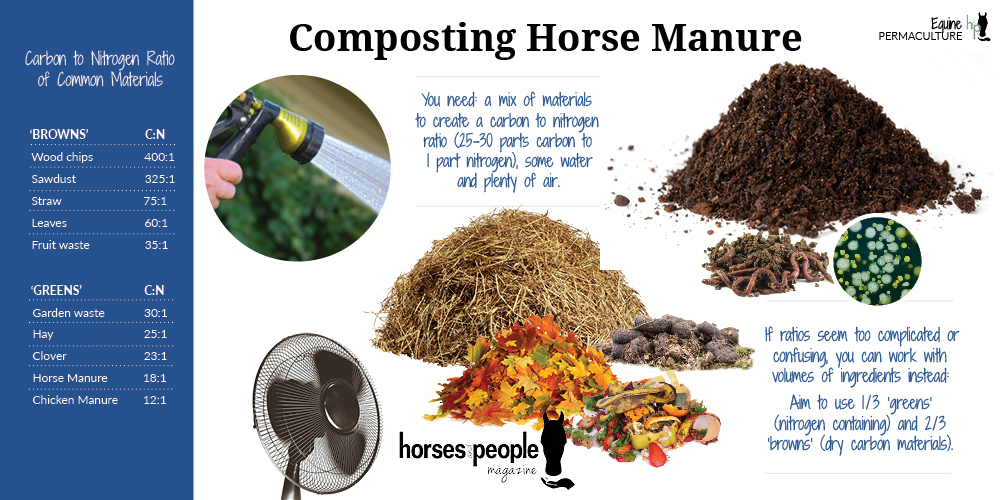
Making compost requires a balance of waste materials and other inputs. Some of our waste can be categorised as ‘browns’ the carbon (C) part, which are typically woody type of materials, straw and dead leaves. The other waste is categorised as ‘greens’ the nitrogen (N) part, which can be grass clippings, manure and food scraps. 

To get good quality compost we need a larger volume of carbon than nitrogen – typically 25 or 30 parts carbon to 1 part nitrogen – the so-called C:N ratio. 

If the C:N ratio is too high (excess carbon), decomposition slows down. If the C:N ratio is too low (excess nitrogen) you will end up ‘burning’ the pile (and creating a sticky pile). 

Brown + Green = Black 

When you put browns and greens in the correct ratio you get your end product compost! But it’s the organisms such as worms, insects, fungi and bacteria that do all the work. 

Those organisms use carbon for energy and nitrogen for protein but, for them to thrive in your compost heap they require water and oxygen. This means that if you want good quality compost that is healthy, the ingredients need to be properly managed. 

Composting without aeration and too much water will create an anaerobic situation which can result in the proliferation of pathogenic microbes. 

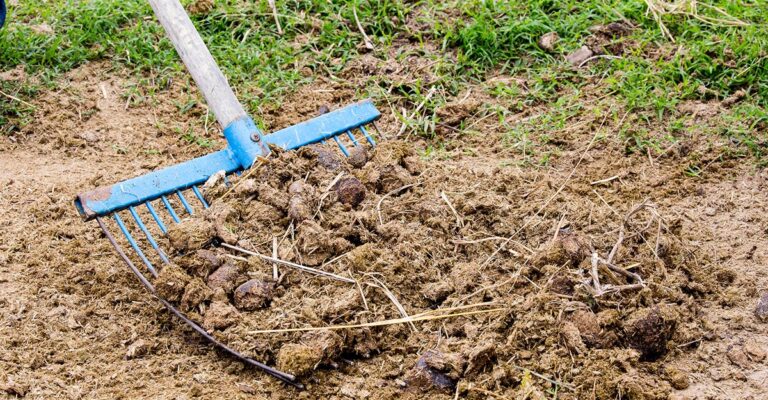
Many horse owners tell me, “I just leave my manure pile in a certain area of the property or pasture… isn’t that compositing?” My answer is yes and no at the same time. Left alone, horse manure will decompose over a long period of time, but true composting is about managing the decomposition process. 

On its own, horse manure typically is about 18:1 ratio of C:N. While this is not very far of the desired 25:1, if the fresh manure pile is not aerated and moisture is not controlled, it will become an anaerobic environment. You will be able to smell this! The smell of ammonia is an indicator that nitrogen is in excess, and carbon/energy is limited. 

Ammonia losses are common when composting high nitrogen materials such as fresh grass clippings and/or manure, and are often accompanied by other nitrogen losses that either run off or infiltrate the soil. 

At large horse facilities these nitrogen losses could threaten surface (creeks, dams) or groundwater quality. The excess nitrogen will also cause the pile to ‘burn’ (reduce in volume). 

Composting techniques

A number of methods are available for composting organic waste, such as passive composting and hot (turning) composting. Both systems have advantages and disadvantages. 

Passive composting

Passive composting involves stacking the materials into piles and leaving them to decompose over a long period of time with little disturbance and management. 

For the reasons explained earlier, if you are going to rely on passive composting, you need to prevent creating an anaerobic situation. 

You can do this by adding some old straw or dry hay to your fresh manure pile to improve the C:N ratio. It will also help maintain its volume. Particularly if you want to spread the compost on your pastures, you want to stay as close to the ideal 25:1 ratio as possible, because it creates a bacteria dominated environment. If you will be using your compost for tree planting, you want an even higher carbon component (a fungi dominated environment) that is closer to the 30:1 ratio.

See the box on the opposite page, which explains how you obtain this ratio without too many calculations. 

Passive composting can certainly work for small horse properties (from one to five horses) that, either don’t have a front-end loader to turn the piles, or where you are not able to manually turn the pile on a regular basis, but they only work provided you add enough carbon material in between the layers of fresh manure (straw, sawdust, dry leaves and/or old hay). 

Work with small piles measuring between 1.5 and 2 m at the base and to a height of about 1 m. Each time you tip your manure on the pile, add a thin layer of carbon (like layering a cake), until you reach the height. Once completed, leave it mostly undisturbed until the matter has decomposed into a stabilised product. 

The small piles can take some advantage of natural air movement but there are different techniques that promote aerobic composting through passive aeration. For example, you can place punctured PVC tubes in the middle of the pile so that air can move through to the centre. Some people even connect a small air pump (such as those used in septic systems) to force air into the plastic tubes. 

Hot (turning) composting

Good quality compost that is free of pathogens is more likely to result from hot and turning (aerobic) composting techniques, because they use temperature measurements to monitor the process. 

Hot composting also fast-tracks the breaking down of organic matter. For example, the Berkeley Method of hot composting (developed at the University of Berkeley in the United States), can work in as little as 18 days! 

It is based on turning the compost pile regularly to encourage aerobic processes and heating the pile with a mixture of high nitrogen items (such as lawn clippings or manures), balanced with carbon (straw or paper).

  • The requirements for hot composting using the Berkley method are as follows:
  • Compost temperature is maintained between 55-65 degrees Celsius. 
  • The C:N (carbon:nitrogen) balance in the composting materials is approximately 25-30:1. 
  • The compost heap needs to be roughly 1 to 1.5m at base and 1 to 1.5m high. 
  • If composting material is high in carbon, such as tree branches, they need to be chipped (with a mulcher). 
  • Compost is turned from outside to inside and vice versa to mix it thoroughly.

With the 18-day Berkley method, the procedure is quite straightforward:

  1. Build compost heap 
  2. Four days – no turning 
  3. Then turn every second day for the next 14 days 

To get the dimensions of the pile and easily add layers of browns and greenS, you can use plastic garden or chicken/ goat mesh fencing to create a cylinder type structure (typically these are 1-1.25 m in height) so you can add layers inside and, once finished, remove the wires. The piles are made like a cake. 

You can also choose a 50:50 ratio to make richer compost and to make the most of your manure! It will work. Just pile alternating thin layers of browns and greens until you end up with a compost heap that is 1 metre square and a bit taller than that. 

There’s no real need to get caught up in the mathematics of precise C:N ratios. It’s more a matter of trying it out – you can always improve it the next time around! 

Start watering your compost heap while alternating the layers. Once finished you will need to cover it with a tarp to control the temperature and moisture, and to protect it from the rain.  

The biology present heats up the pile, then eats and breaks down organic matter, bringing the temperature to an ideal range of 55 to 65 degrees Celsius. This temperature kills any detrimental pathogens contained in the animal manures and also weed seeds. 

Temperature can be measured using a compost, soil or cake thermometer probe (prices online vary between $30 and $50). 

Temperature and moisture are critical in this process. By regularly watering and turning the pile when it reaches 65 degrees Celsius, it is possible to generate highly fertile soil-building compost that is rich and abundant with every element required by the plants to grow, replete with soil microbes and fungi – in fewer than 20 days.

Composting and storage locations

Before you start, it’s important to consider the location for your manure, bedding and compost storage. 

A location that is close to the stables and/or paddocks is ideal, so you can easily manage and collect it for spreading. 

You must avoid any run-off seeping into creeks and dams, so think about the surface, slope and distance to your waterways. 

Make sure that you have enough space around the pile to work around it when you turn it. Alternatively, if you choose for passive composting, make sure the bays are not too large. Smaller heaps will break down quicker. 

A cover is needed for hot composting to manage the temperature and moisture, but it is also a good idea for passive compost to avoid runoff after rain. 

Some areas have specific legislation or policies directing how you should store animal manure and the minimum distances away from waterways. For example in the Netherlands, if you have five or more horses or a commercial equestrian facility, you are require to build concrete bays which contain drains that redirect the moisture. In the United States they have similar requirements but these vary from state to state. 

In Australia this may also differ per council and state. For example, in Queensland, under the Environmental Protection Act 1994, it is an offence to allow contaminants (e.g. waste, sawdust and manure) to enter stormwater drains, roadside gutters and waterways. 

Don’t forget your neighbours! They may not really appreciate the views of your steaming manure pile. Plan ahead to get the location right.

Composting horse manure ratios
Composting is about managing the natural process of decomposition of materials.

Some important points:

  • Locate your compost heap in an area protected from too much sun or heavy rain, to prevent the compost from drying out or becoming waterlogged which slows down the composting process.
  • Space required for your heap should be about 2 x 2 metres, with enough space around it to work when turning the compost.
  • Water each layer until it is moist as you build the heap. After three or four days, give the compost some air by mixing and turning it over, then turn every three days until the compost is ready – usually between 14 and 21 days. Remember, frequent turning and aeration is the secret to successful composting.
  • Turn the compost using a garden fork, or even better, a long-handled pitchfork. In cold or wet weather, you can cover the compost heap with a tarp or plastic sheet to prevent the rain cooling it down – rainwater will penetrate into the core of the compost pile.
  • In cold temperatures the air will cool the surface but not the core of the compost heap. By covering it you prevent some heat loss from the surface to cooler outside air and retain the heat within the compost heap better.

Summary

Composting is nature’s way of recycling and building healthy soils. Horse manure is relatively easy to compost but involves more than piling the waste! 

To manage a compost pile you just need to consider the following factors: 

  • carbon to nitrogen ratio,
  • oxygen, 
  • moisture and, 
  • temperature.
  • Correct composting can virtually eliminate odour, flies, weed seeds and internal parasites found in horse manure, and creates a valuable soil amendment for resale or for pasture application. Compost microorganisms can produce antibiotics, which suppress plant diseases and can also degrade toxic chemicals.

Hot (turning) compost schedule:

Day 1 

Mix together ingredients by laying then in alternating thin layers of “browns” and “greens”. Wet the compost heap down very well so it is dripping water out of the bottom and is saturated.

TIP: You can place an ‘activator’ in the middle of your compost heap to kick-start the composting process. Activators include comfrey, nettles, yarrow, animal and fish-derived products, urine (!) or old compost. 

Day 5 

Turn the compost heap over – outside to inside and inside to outside. This means that, when turning the compost, you move the outside of the pile to a spot next to it and keep moving material from the outside to the new pile. When you’re done, all the material that was inside will be outside and vice-versa.

Ensure the moisture stays consistent. With gloves on,  squeeze a handful of the compost materials. They should only release one drop of water or just drip a drop.

TIP: If the compost is too wet, spread it out or open a hole about one metre wide with the handle of the pitchfork, or place some sticks as a base before turning the pile on to them, to aid with drainage. 

Day 7 & day 9 

The compost heap should reach its maximum temperature on these days. As a simple guideline. if you can put your arm into the compost up to your elbow it is not at 50 degrees Celsius! And is, therefore, not hot enough. Probably best to use a compost or cake thermometer! 

You need an optimum temperature of 55-65 degrees Celsius. At temperatures over 65 degrees Celsius, a white ‘mould’ spreads through the compost. This is actually some kind of anaerobic thermophilic composting bacteria often incorrectly referred to as ‘fire blight’. It appears when the compost gets too hot – over 65 degrees Celsius – and short of oxygen. It disappears when the temperature drops and aerobic composting bacteria take over. 

Temperature peaks at 6-8 days and gradually cools down by day 18.

Turn the compost heap over every second day (on day 6 and again on day 8).

  • If the compost pile starts reducing in size quickly, there is too much nitrogen in the compost. 
  • To heat the compost up faster, you can add some fresh manure with your pitchfork when turning it. 
  • If it gets too hot and smelly and goes down in size, it has too much nitrogen. You need to slow it down, throw in a handful of sawdust per pitchfork when turning. 

Day 11 to day 17 

Continue to turn the compost every second day. 

Day 18 

Just warm, dark brown, smells good.

When earthworms move into the compost, you know it is finished and ready, because it has now cooled down and is full of nutrients! 

What is the Best Joint Health Product for my Horse?

What is the Best Joint Health Product for my Horse?

There are two primary reasons for this question:

  1. Treat an issue they have noticed in their horse, and
  2. Provide to their horse as a possible preventative.

As easy as this question is, it is often one that veterinarians don’t like answering because there are just so many options available. Veterinarians often have not had the chance to truly evaluate the actual data behind the different products, particularly in the area of nutraceuticals. There are many options available to veterinarians for the treatment of joint-related issues, including NSAIDS, injectables and nutraceuticals.

The biggest criticism within the veterinary profession of joint-related products has been:

  • Lack of scientific validation behind products and their claims
  • Issues associated with product administration (site reactions, withholding periods, etc.)
  • Costs per dose of administration

These factors make it extremely difficult to recommend specific products.

Often the key criteria identified by veterinarians and their clients on the best joint products to utilise is:

  • Technical virtues
  • Ease of application
  • Cost per dose
  • Possible side effects from administration
  • Safe long-term usage

Interpath is a research and development company that has been working in this area for the past 12 years. They have been listening to the ongoing comments and feedback provided by veterinarians, surgeons and end users, and believes it has now developed a product that is capable of meeting the needs of the Australian equine industry.

4CY TE™ Epiitalis® Forte is a new feed additive that includes the key active ingredient Epiitalis®. Epiitalis® is an oil extract, which has been patented for its ability to proliferate chondrocytes in an inflamed environment and for its ability to suppress prostaglandin E2, a central inflammatory mediator.

4CYTE™ has become a brand synonymous with quality research programs supporting revolutionary product development. Having undergone in-vivo, in-vitro and clinical studies, giving veterinarians and end users the confidence of a scientifically developed and backed product.

Clinical Trial (unpublished)

A recent clinical trial completed at the Equine Medical Centre Ocala on horses showing signs of arthritis and joint inflammation by Dr Fred Benker showed a consistent positive response. Some of the key results from this study included:

Lameness

  • 7 of the 10 horses had a consistent lameness at Day 0
  • 8 of the 10 horses at Day 14 had an absent or difficult to observe lameness
  • Only 1 horse had a subtle limp after 42 days

Range of Movement

  • 8 of the 10 horses had a significant reduction in range of movement/mobility at Day 0
  • At Day 14, 8 horses were showing full range or a slight reduction in range of movement/mobility
  • At Day 42, 9 of the 10 horses had full range of movement/mobility
  • Some of the veterinary comments made on individual cases at the conclusion of the clinical trial:
  • Much sounder, no longer requiring other medication to trail ride
  • Went from retirement back to being able to compete in barrel racing
  • Terrific results working better than the previous IA treatment protocol
  • Miracle for this horse – running, bucking, playing like a foal for the first time in several years
  • Helped this horse significantly

For further information on this new product, please contact your Provet Account Manager or visit the 4CYTE.

[wpdm_package id=60925 template=”link-template-calltoaction3.php”]

The Horse’s Advocate: Ang Lea

Equine therapy.

It had been nine weeks since Cienna had dislocated her shoulder, but when Ang Lea of Horse Fix was called in, the mare was still hobbling on three legs. On top of that, the adjustment in how she was carrying herself was causing secondary problems in her hind end. Cienna’s vet had fixed the dislocation, but referred the owners to Ang for ongoing care. 

An accredited Equine Bowen Therapist, one of the first things Ang does at a horse’s first appointment is film their movement. As Cienna’s was such an extreme case, she took a video at every session. “It was life or death,” says Ang. Over the course of the next few months, regular appointments with Ang saw the shoulder and rear end issues resolved, and Cienna’s progress was documented on film. “She could hardly walk. And now she’s trotting and cantering around like the frisky Arab she is.”

Ang was already in her forties when she made the decision to leave her city job and pursue a career with horses. As a young athlete competing in running, she had received regular massage treatments and had developed a feel for it herself, until she was being sought after for massage. She was also a lifelong horse lover, working at a local institution growing up – Rinaldi’s of Ballarat – and owning her own horses in her thirties.

“Eventually, I got to that stage where I said ‘I should be doing this’. I’m good at massage … I’m obsessed with horses – no brainer.” But, Ang is nothing if not thorough when it comes to research and she wasn’t going to sign up for the first course she could find. Good content and national accreditations were essential factors, which led to Ang signing up to study Equine Bowen Therapy with Smart Bowen International Training College.

“I got so much out of it,” Ang says of the course. “I had to do over 100 case studies. It was not lightweight.” The extensive coursework meant that Ang finished the course with a solid understanding of the theory and plenty of practical experience. Her past life in the city also set her in good stead to get “hit the ground running” with her new equine business.

With a qualification like that under their belt, some might be tempted to start practising and never look back. But, as Ang says, “the best horse owners always want to learn; they don’t get shut down into one particular approach.” The same can be said of practitioners and Ang is a model when it comes to professional development. She’s studied equine biomechanics, craniosacral therapy, anatomy, soundness and gait assessment, to name but a few of the courses she has participated in. All have contributed to Ang’s holistic approach to her equine therapy, but she doesn’t guard the knowledge closely: “I don’t think I should have that in my back pocket and it should be just for me; I think that’s something I should share and give to the world.”

Interestingly, it is in her dressage lessons that Ang has felt much of her development as a horse person and practitioner occurring. For the last two years she’s been having weekly lessons with Leanne Williams of Avoca Park, who is currently Australia’s only licensed Ecole de Légèreté instructor. “She taught me feel and that’s been an important part of my bodywork,” says Ang. “Now, that is incredible – anyone who can teach content that is virtually unteachable.”

Reading the horse from a different viewpoint – from the saddle – has lent another dimension to Ang’s approach to her treatment. “Understanding as a rider what to do has been very important, in terms of understanding what’s going on in the horse’s muscles, ligaments and tendons – where I have the influence with my hands, body and breath.”

“At the start of every first consultation, I always do a postural check on the rider and I feel their shoulders so I can see how much tension they’re carrying. Because that’s going to undo the work with my hands… With your contact, if you’re incrementally tighter in one hand, you’ll put incrementally more pressure on the bit; and then you’ll affect the hyoid apparatus in the jaw, and then you’ll affect the whole body.”

For this reason, Ang is currently studying towards her Equestrian Australia Introductory Coaching Certificate, with Leanne. “I’m aiming to be the personal trainer and the massage therapist,” she explains. “So that I can actually help the riders improve the outcomes, as well as what my hands can do.”

Encouraging horse owners to look first to themselves before their “problem” horse is a big part of Ang’s approach. “Make sure it’s not about you, your body and your goals,” she advises. “The horse will tell you very clearly. The horse is not being piggy. The horse is not being a bitch. Sometimes horses just need a better rider and/or a rest.”

“Something I advocate for owners is to look at themselves as being the athlete first,” she says. “I think it’s only fair once you’re in working order to start thinking about what you expect of your horse.” Ang has stringent goals for her own strength and fitness, and believes all riders should have the same attitude; it’s informed by her history as a runner. Her father, Richard Lea, was her athletics coach, and Ang counts him as a major influence for teaching her about discipline and fitness conditioning.

The fitness values Ang espouses are exemplified in one of her sponsored riders. Vicky Henschke, whose horse, Akupheli Supernova (Naalah) featured in this article, has a history in gymnastics; one of the reasons Ang decided to sponsor her. “She’s an owner who really values bodywork,” says Ang. “She’s been an elite junior athlete herself, so she really understands the importance of it – she gets massage herself.”

Recently, Ang was gratified when Vicky took her advice not to compete at a particular event when Naalah wasn’t physically ready for the challenge. In listening to her therapist, Vicky put the welfare of the horse above her own ambitions. “I tell people things they don’t want to hear,” Ang admits. “I’m an advocate of the horse – I’m not there to mollycoddle owners.”

“That said, I’m the first person to step back if I realise that I’m wrong,” she goes on. Having worked with Ang on my own horse, this is something I know to be true; Ang has a habit of ringing her clients to update them on the latest findings that relate to their horses’ care.

“Getting good information and making sure what I’m spouting is correct is really important to me,” she says. “I wouldn’t say I’m a great writer, but I’m good at researching.” As much is evident on her Facebook page, where Ang shares comprehensive pieces she has personally compiled on subjects like stringhalt.

“When I was an owner, looking back on it, I wish I’d had people that helped me with my horses that were more willing to share and talk me through things,” Ang reflects. “My modus operandi as a therapist is to talk.” It’s one of the reasons she films her clients’ horses – so she can show the owner what she’s seeing and talk them through it.

“Be your horse’s own specialist,” Ang advises. “Anyone can put their hands on a horse, get a feel for their horse.” When your instincts tell you that your horse needs to see a professional, make sure they know what they’re doing. “There are reasons why people are professionally accredited… Check that your professional is insured, because if something goes wrong, you need to have that fallback.”

“Keep exploring; stop if it doesn’t feel right; trust your instincts.”

Like many people, Ang finds that spending time with horses feeds her creative energy as well. “I’ve painted horses compulsively forever,” she tells me. “For me, horses are about connecting with myself too. You learn so much about yourself through horses… Representing them visually is an important part of that process [for me].”

“You know how beautiful horses are and how present they are. I think that’s probably one of the most important things for me; they keep me very present in terms of my own personal journey.”

Driving out across the state at sunrise on a clear morning, it’s clear Ang loves what she does. “I’m outside, I’m in the country, I’m around horse people who love their horses. Find me a better job!”

To learn more about Ang Lea, click here.  You can also watch Cienna’s story on YouTube.


Horse Training Course: Part 4 The ‘Head Down’ Lesson Made Easy

The Head Down Lesson. Have you ever had your horse do the perfect imitation of a kite on a lead, or have you had to try to bridle that convincing giraffe impersonation? If so, stick around because in this step-by-step guide, you can learn how to train your horse to lower his/her head – from the ground and under saddle – as well as train him/her to accept the bridle.

As is often the case, the obvious reasons for teaching the horse to lower its head, are just that – obvious.

We need to be able to put the bridle on, administer worming paste, brush around their ears and check our horse’s teeth. However, the hidden benefits to this lesson are probably even greater…

Most handling begins with the head – be it approaching, catching, bridling or grooming. This is our chance to make a good first impression and it is the thing the horse will remember the next time we approach.

It also sets the stage for the remainder of the session – it can be a gentle teaching session where the horse has found answers in movement or a struggle that has left you both a little too emotional.

At its most basic, this lesson teaches the horse (and the handler) to understand pressure-release (negative reinforcement).

We hear the term pressure-release a lot, but sometimes, we forget the aim is to reduce the pressure required. The way to do that is to time the release perfectly. This simple lesson will help you clarify those two important elements.

The overriding benefits of this lesson are about attention, focus, safety, communication and control. It’s about getting your horse into the engagement zone – where your horse is relaxed and in your bubble of communication.

‘HEAD DOWN’ FROM THE GROUND

Step 1:

Define what we want to move and how we are going to move it –

  • Spot: The spot on the horse we are going to move – the tip of the left ear.
  • Direction: The direction is down.
  • Motivator: Pressure from the lead rope or hand on the poll.
  • Reward: Release of pressure and praise.

Step 2: 

Design the pattern we want to use –

  1. Place hand on the poll (or use the lead rope if your horse raises his head very high).
  2. Apply small amount of downwards pressure.
  3. Watch the tip of ear for any downward movement.
  4. Release and praise when ear moves downward.
  5. Repeat.

Step 3: 

Getting started –
Place your hand on your horse’s poll.

Simply holding your hand there may be enough to encourage movement, so don’t apply any pressure to start with.

The horse has six directions to move – left, right, back, forward, up and down. Allow the horse to experiment with each direction, watching the tip of the ear and releasing immediately when you see the tip of the ear move downwards – even if it is just a small amount.

If your horse has a very high head to start with and you are unable to reach the poll comfortably, simply apply a small amount of pressure to the lead rope attached to the halter, wait for the ear to lower and then release.

Step 4:

Repetition –
How much pressure do you need?

You need enough to motivate the horse to lower their head. Now is the time to pay particular attention to the amount of pressure you are using. Your aim is to reduce that with each repetition.

In Step 2, we set up a good pattern. If you allow your horse time to respond before you apply any pressure, you will find quite quickly your horse will lower its head even before your hand reaches the poll.

BRIDLING

In order to bridle the horse, we need three things – the horse must put its head down, open its mouth and be able to have its ears handled. Before you start with the bridle, this can all be accomplished in the head collar with a soft lead rope.

Step 1: 

Lowering the head –
Repeat your pattern for head lowering until your horse is in a comfortable position for you to begin the bridling lesson.

Step 2: 

Opening the mouth –
Place the palm of your left hand below the horse’s chin and gently insert your thumb between the lips. Do not scratch the horse or put pressure on the bars of the mouth.

Your horse will probably open its mouth when they feel your thumb between their lips but, if not, simply tickle the tongue a bit with your thumb. This will encourage the horse to move the tongue and open their mouth.

Remember, you are setting up another pattern, and your horse will begin to anticipate the tongue tickle and respond by moving the tongue, and opening their mouth even before your thumb enters their mouth. Great! This is what you want.

Step 3: 

Ear handling –
Begin with ensuring that you can stroke your hand over the ears and then, with your right hand between the ears, hold the lead rope and move over the ears as if it was the head piece of the bridle.

Step 4: 

Bitting –
Instead of starting with the bit, we are going to use the soft lead rope. Cradle the lead rope in your left hand, holding the long end in your right hand between the horse’s ears. Open the mouth with your thumb and allow the horse to pick up the rope.

Step 5: 

Putting it all together –
Using the lead rope as a bridle, go through your pattern of bridling the horse.

Step 6: 

Bridling –
Now that you have established a good pattern and the horse is relaxed, put the bridle on the horse.

Step 7: 

Unbridling –
With your right had between the ears, ask the horse to lower their head. Slip the right ear out first and, again, ask the horse to lower their head, if necessary. Wait until the horse is relaxed before moving the head piece over the left ear.

Keep your forearm between the ears and gently lower the bridle, allowing the horse to drop the bit. This should simply be the opposite movement of the bridle going on – with the weight of the bit being the only force moving it out of the horse’s mouth.

Remember –
It is even more important to make sure the horse remains relaxed with a lowered head during unbridling because if the head goes up, the bit is likely to hit the incisors, encouraging the horse to throw its head higher and possibly run backwards – potentially ending in injury.

‘HEAD DOWN’ UNDER SADDLE:

Having a head down cue when riding is very useful. In the arena, after a period of work, ask your horse to walk and cool off with their head down; thereby, stretching out all of those topline muscles.

On the trail, when you want the horse relaxed, but remaining engaged and in your bubble of communication, train the horse to walk with the poll below their withers on a long rein.

Do you want top marks for your walk in a dressage test? Teach this cue, practice transitions within walk, and make the judge smile as your horse marches across the diagonal in a long and relaxed stretch.

Step 1:

Decide on the new cue –
Now that we are under saddle, we’ll need a new cue. It doesn’t really matter what your cue is – mine is raising my right hand and applying a little pressure to the bit – as long as you release as soon as you see the ear drop, even a small amount.

Step 2: 

Teach the new cue –
Simply walking around the arena, not worrying too much about direction, the first thing to do is teach the horse the new cue. Lift your right hand and apply some pressure to the bit. The horse has six directions to move (back, forward, left, right, up and down) and might try the other five first. Don’t worry, simply watch that ear tip and release as soon as it lowers.

Step 3: 

Repetition –
Repeat this enough times sothe horse is anticipating the pressure and responding before it. I know, we hate it when the horse anticipates, but it simply means they have learned the pattern really well – if you have a good pattern in place then you’ll learn to love this!

Step 4: 

Set up a new pattern –
Now it’s time to set up another pattern for the horse. I use the dressage pattern of walking the short side of the arena in a soft frame and walking the diagonal in a long, relaxed marching stretch.

Each time you come around the corner, establish your line on the diagonal, and ask the horse to lower their head and stretch out.

This is a great exercise for your dressage horse. Not only does it teach great free walks across the diagonal and transitions, but it also stops your horse from breaking the walk by anticipating the trot or canter.

Of course, you have to remember you are teaching patterns and your horse is a master pattern learner. If you practice the dressage test, even just a few times, your horse may well learn you trot at C and helpfully trot well before that. If, on the other hand, you never ask for trot at C (until you are actually in front of a judge) and instead circle in walk at C and ask for trot somewhere on that circle, then you will not have established a pattern and should get a winning transition when you ask for one.

The benefits of teaching the ‘head down’ cue, both on the ground and under saddle, are far reaching. From the trail to the dressage arena, bridling and ear handling, the ‘head down’ cue will be useful on a practical level, as well as helping you to keep your horse in the engagement zone.

Find more training resources at www.kandooequine.com.

If you ever thought there must be a better and easier way to train your horse,  Kate Fenner’s Kandoo Equine Training is designed for you!

Kate walks you through specific lessons and how to teach them. From stress-free trailer loading, to handling head-shy horses, to safe mounting. Kate’s gentle and no-fuss approach will provide you with the tools and confidence you need to educate your own horse. 

Check out Dr Kate Fenner’s podcast for more step-by-step, ethical and sustainable horse training courses.

Responsible Horse Breeding

Breeders large and small should be the first to assume the long-term responsibility for every foal produced. The first question to seriously consider is: Why do you want to breed a foal? This 12-point list helps to check if you are breeding responsibly.

1 Market:

The first and most important thing to consider is the market. Is your ‘product’ actually in demand? What is your competition? Are mare and stallion from sought-after lines? Is there something else about them that will make the offspring saleable? Temperament should be as important as conformation and bloodlines. It is especially easy for irresponsible breeders to ignore inherent behavioural defects that result in horses with invisible yet defective genes.

2 Costs:

Your plan needs to involve cost planning for feed and labour, e.g. do you know how many man hours it takes to put one or say, five foals on the ground each year and to keep them up to selling age? Your check list could have boxes for calculations up to riding age, when most are sold. It’s no excuse to say they will be sold beforehand, because they mostly do not. Your plan also needs to include extras that tend to come with the territory, such as retirees, horses who cannot be sold, and ones you keep to promote your stud and breed with later.

3 Sales, Checks and Guarantees:

Plan for how you will prepare and present horses for sale, with appropriate advertising and service, to give each horse a good chance. Essentials such as a good website, decent photos, and responding properly to enquiries should be expected of any reputable breeder. It is also irresponsible not to agree to take back a horse that you have bred, with no fuss, if it falls into hard times. Breeders should assess the potential purchaser for suitability just as thoroughly as the buyer should check out the breeder.

4 Value:

Breeders need to realise that the value of their breed and breeding programme is the value they can sell geldings for. It is easier to think only of the horses that you dream about producing, and to forget that in the process you will inevitably breed horses that do not fulfil anyone’s dreams!

Plan what to do with the horses that do not make the grade to be breeding stock or saleable produce; i.e. the horses that are the ‘wrong’ colour/size or with temperament/soundness/conformation defects. Some may lack the ‘looks’ but have a future as a good riding horse if they have a good temperament and legs, but they will need training to show they are going well under saddle to prove their worth.

Above all, avoid the delusion that if any of your stock do not make the grade then they can always be a companion horse/lawnmower/paddock ornament. There are already huge numbers of horses that fulfil the criteria of ‘unwanted’ or ‘wastage’.

5 Selection criteria:

Think very carefully about what you are planning to breed, and what selection criteria you will apply when formulating matings. Are you pandering to fashion? The problem with fashion is that it comes and goes. The trouble with horses is that they live for a very long time and definitely outlive fashions. You could be breeding horses who will no longer be in demand in a few years.

If you are breeding for a certain colour or size (or both) you need to plan what to do with the ones who do not have the right attributes.  The much more important attributes of temperament, soundness and functionality can be overlooked when selecting breeding stock for colour/size because a horse can win in the show ring with a poor temperament or unsoundness.

Temperament and trainability should be top of the selection criteria list (followed closely by conformation and soundness) to give all offspring the best chance to enjoy good quality of life even if they do not make the grade in terms of colour, size, and other cosmetic criteria.

Some breeders think that because a breed is ‘rare’ everyone else will want it (and then exhaust themselves and their family promoting it). Others come up with elaborate cross breeds and complicate it further by aiming for a specific colour or size, producing horses destined to add to the already overpopulated pet market. The more cosmetic criteria (colour, size, etc) you aim for, the more ‘wastage’ there is likely to be.

6 Genetics:

You need a good knowledge of genetics and a good knowledge of the background of your chosen breed and the performances of horses in the pedigrees. Do you know what genetic diseases are prevalent in your chosen breed? Are you committed to helping eradicate them? Do you understand conformation and its influence? You need to be able to read a pedigree properly and to be able to design suitable matings that have the maximum chance of the foal being an improvement on the parents and a worthy representative of the breed.

7 Controlling breeding:

Gelding colts is essential (especially when starting out) and it does cost money, which must be budgeted for. Gelding is a necessary means to promoting yourself as a quality breeder. Having ‘accidents’ and sub-standard colts on your property does nothing to encourage buyers or enhance your reputation. It is the first sign of a hoarder.

8 Breed registers:

Breeders who breed horses for which there is no register are at risk of condemning their horses to a very small and oversupplied market. At the same time, many breeders do not spend time involving themselves with their breed society by helping, learning and networking. They cut corners with registrations because they see that as ‘losing money’.

On the other hand, breed societies could do a lot more to help with the problem of over breeding. They could put together checklists to help people thinking of getting into the breed. They could start to encourage temperament tests at shows so that breeders are rewarded for producing safe and trainable animals rather than just pretty ones. They could educate people about the facts and costs of  breeding horses. Associations could take more responsibility for regulating out genetic diseases within their breed. They could offer gelding incentives and performance incentives for geldings. They could work with genetics consultants and classify breeding stock (particularly stallions) and studs as meeting certain criteria. Quality studs would then be recognised by the breed association itself for adhering to responsible breeding practices.

9 Support network:

Your plan needs to include your family and take into account their involvement. For example if you are relying heavily on your husband to do the manual work and your children to ride the produce of your stud what will happen if your husband decides he has had enough (as many do) and when your children grow up and leave home?

10 Horse Training:

A stud needs a rider (or riders) because it is a delusion to think that you will be able to sell your stock unbroken for good money. A stud must have the manpower to take this into consideration, or the money to employ someone. If not, you are indeed operating under a delusion.

11 Do you need a stallion?

There are too many breeders standing more than one stallion at once with insufficient promotion and business skills. It is not a good idea to start a breeding program by having a stallion first, then getting some mares for him. A stud does not need a stallion unless they regularly breed more than five foals per year – until then, it is best to use AI or send the mares out and gain the experience whilst you pick the brains of other reputable breeders. Learn which stallions are putting out the best foals and which sell readily. Not every named stallion is actually improving on the mares he is bred to and is relying on the calibre of his mares to make a name for the stud.

12  Stallion owner’s responsibilities:

Too many breeders with a stallion accept mares that are not suitable. Once you own a stallion it is too tempting to accept mares to justify having him and to make him ‘earn his keep’. Too many breeders are breeding from mares that have never been broken in and/or are of unsuitable temperament, mistaking ‘cute and cuddly’ for a ‘good temperament’. How can you know the soundness, trainability and temperament of your animal if it has not been performed under saddle?

Ultimately, horse breeding is self-regulating and breeders themselves have to take the initiative and become responsible custodians of their industry. If they don’t, someone, somewhere will eventually start to ask difficult questions about where this surplus of unwanted, often sub-standard horses are coming from, which will lead to regulation from outside the industry.

It is easy to start to think responsibly about breeding and you have a moral obligation to try.

Find more responsible horse ownership resources by Jane and Stuart Myers for responsible horse ownership on their website www.equiculture.net