fbpx
Home Blog Page 43

Equine Permaculture Design: Part 4 Energy Flow

Energy Flow

When it comes to horse property layout, it pays to consider the permaculture design approach because it aims to build systems that are easier to manage, more efficient and sustainable, whilst considering the health and wellbeing of all – people, horses, plants and the soil that sustains them. 

In this Part 4 of our Equine Permaculture Design Series, Mariette van den Berg explains another design tool that permaculture design consultants use when deciding where to place all the elements needed. This time, the aim being to capture energy to increase growth of your system. 

Key to permaculture is the wise husbandry of natural resources, in particular in terms of energy. In nature, where energy is cycled, living systems grow. This is why permaculture places an enormous emphasis on enhancing soil fertility through composting, thereby minimising the loss of energy in the system.

Likewise, the perennial edible landscape associated with permaculture, that includes food trees, fodder trees, pastures, herbs, etc. decrease the energy input required for food production for our horses, other grazing animals and ourselves.

This can be translated in the design concepts of our houses and properties with the aim to capture energy to increase the growth of our living systems, and set in place cycles, which eventually leads to greater energy and chores efficiency.

To accomplish this, we need to have a close look at the layouts of our horse properties. Permaculture uses zone and sector planning to help us identify what the best placement of elements is for our site. These design tools helps us select the location of the different elements, so that activities can be performed efficiently and sustainably.

In the previous article, we discussed zone planning, which is a system where the location of an element in a design is determined by:

  • How often we need to use the element.
  • How often we need to service the element.

Zones are abstract, conceptual boundaries around the home, which help us to work with distance to plan efficient energy use and are divided up into zones numbered 0 to 5, based their accessibility and frequency of use in relation to the location of the house.

The lowest number denotes the most frequently accessed areas, while the highest number indicates the areas least accessed.

(See the previous article in this series: Part 3 – Property Layout, which appeared in the August issue of Horses and People).

Sector analysis 

A site does not exist in isolation; it exists as part of a larger environment, where external energies, the elements of nature (e.g. wind, sun, etc.), which come from outside our system, also act on it. To plan for these energy systems in permaculture, we use a system of energy planning known as sector planning.

Sectors are a way of considering the external energies that move through a system and how we might best take steps to either utilise or counter such factors.

These external energies might be:

  • Prevailing wind direction,
  • Site orientation and aspect (north, south, east, west),
  • Winter/Summer sun paths,
  • Underlying geological make up (bed rock, clay or sandy soil types, etc.),
  • Frost pockets, and
  • Fire danger areas and so on.

Since these natural energies come into our system from outside, we can place elements in our design strategically to manage or take advantage of these incoming energies.

By placing plants, trees or structures in the appropriate areas, we can:

  • Block the incoming energy flow (e.g. a windbreak),
  • Channel the incoming energy for a specific use (e.g. redirecting water to a dam for later use), and
  • Open up areas to allow the energy to enter and/or flow more freely  (e.g. removing trees to let in more sunlight).

Blocking incoming energy flow

While we generally encourage external energies to enter our system, at times they can be destructive. In these cases, we aim to block the energy flow as much as possible to prevent any severe damage to our system.

Wind:

Take, for example, the element wind! If you have a reasonably open block of land, you will have experienced the negative effects of wind (and horses also don’t seem to like it much as well). In particular, hot Summer winds, cold Winter winds, salty seaside breezes and damaging dusty winds all need to be restricted as much as possible in a design through the use of windbreaks. Windbreaks can be constructed using specifically resilient plants and trees, or by building protective man-made structures.

Sun:

Another important element that we need to take in consideration in our design is the sun.

We will need to identify where the Summer sun and Winter sun shines as this is important for managing the harsh midday and afternoon Summer sun (north and west sun in southern hemisphere; south and west sun in northern hemisphere).

Planting trees and shrubs is a great way to help with shading, but the species you use will largely depend on your geographical location and climate. For example, deciduous trees can be planted around the house to block the sun in Summer, keeping the house cool.

In Winter, when the leaves fall, the low Winter sun can warm the house naturally. However, if you live in more tropical environment, you will use more evergreen trees.

Man-made structures can also be built around the house which take advantage of the sun’s low Winter angle and high Summer angle providing Summer shade and Winter sun.

Fire:

Bushfires in Australia are frequent events during the hotter months of the year, due to Australia’s mostly hot, dry climate. However, bush fires are not only limited to Australia, they are also very common in North America and Canada. Fires impact extensive areas each year.

Where fire danger exists, the areas most prone to incoming fire should be identified and firebreaks should be placed in these areas in our designs. The aim is that we use elements and/or materials in our design that do not burn, such as roads, cleared areas, stony ground, concreted areas, stone walls, dams, marshes and waterways. These areas can also be planted with fire-resistant tree species and vegetation to create a shelter belt. Trees suitable for this purpose are evergreen (legumes) trees/shrubs and typically European deciduous trees, such as deciduous fruit and shade trees.

View:

Another application of ‘blocking incoming energy’ is the screening of unwanted views. Trees, plants and structures can be built to provide additional privacy and block out unwanted views, while providing a more aesthetically pleasing alternative.

Channelling incoming energy flow

We should, of course, use energies that come in to our systems for our own benefit.

Water:

Water flowing into our horse properties, either from directly above as rain, from run-off coming from neighbouring properties, or collecting in an area, such as a flood prone area, can be redirected into lakes, dams, ponds, irrigation channels, swales and other water management systems, such as rain tanks for human and animal consumption.

Water can be captured at an elevated point on the site, and being elevated, it is a store of what they call ‘potential energy’ in physics. The water can then flow under gravity to perform work, such as irrigation or water supply.

Water flowing across a stream or river can be used to drive a hydroelectric generator to provide electricity or can have some of the flow diverted for irrigation purposes.

Wind:

Wind can be captured to drive wind turbines or windmills, providing a source of free energy to the property, which we can utilise for our purposes. Cooling summer breezes can also help.

Sun:

Sunlight can be harnessed in the generation of solar power, solar water heating, drying foodstuffs, and so on.

Opening areas to promote incoming energies

In some situations, we may have to intervene and purposely clear or open up an area on our property to allow natural energies to enter the system more easily.

Sun: 

If you are based in a colder climate, you may want to allow more sunlight into your area, especially during the Winter time.

If you have structures or trees blocking the light reaching your Zone 1, home/kitchen garden, for example, rather than relocate the garden, you can clear the area to allow more sunlight in. Where places are too shaded, you can thin out trees or branches to increase productivity from the available space.

View: 

Equally, we can clear an area to create a view of a pleasant outside area. If we have potentially stunning views of mountains, lakes and forests, or you may like to see your riding and horse facilities from your home, we will want to clear objects obstructing the view to take advantage of such a positive features in our site design.

Mapping the sectors

The key is observation!

In most cases, these natural energies will not be fully valued on a single visit to your property. A full year or more of information will be needed, as well as delving into longer time frame data and the memory of neighbours who are long-term residents of the area.

The best way towards gathering and collating information from your property information is to draw a circle and divide it into sectors and zones, placing the house at the centre. The sectors are the compass directions and the impacts of natural forces within these sectors, i.e. Summer and Winter sun, wind, fire hazards, such as bush, and wildlife (see diagram on opposite page).

Each sector indicates one of the external energies discussed above and is usually represented as a wedge shape, like a slice of a pie, radiating our from the centre of activity – the home. But, the focus can be moved to any other structure of place as necessary, such as your horse stables, shelters, arena or loafing areas.

Sector planning in our design allows us to manage the incoming wild energies moving through our property. By the strategic placement of elements in our design, we can block, channel or open up access to these natural energies to optimise the use of energy in our site.

Together, zone planning and sector planning cover the management of energy inside the site and external energies flowing through the property respectively.

Next month

Once we have completed our property zone and sector analysis, we can then consider one more factor in efficient energy planning, which is the concept of slope.

The contour of the land has a considerable impact on the design of the property, so this topic will be discussed next month in Part Five.

Download this article “Equine Permaculture Design: Part 4 Energy Flow” by clicking here [wpdm_package id=52392 template=”link-template-button.php”]
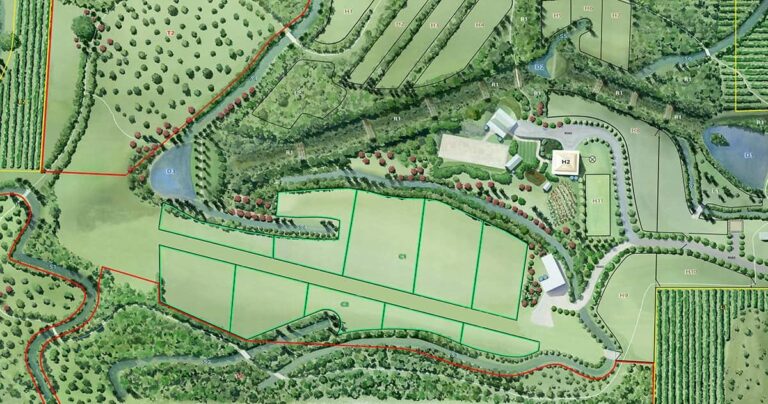
Equine Permaculture Design: Part 3 Property Layout

When it comes to horse property layout, it pays to consider following the permaculture design approach because it aims to build systems that are easier to manage, more efficient and sustainable, whilst considering the health and wellbeing of all – people, horses, plants and the soil that sustains them. 

In this Part Three of our Equine Permaculture Design Series, Mariette van den Berg explains the first two techinques that permaculture desing consultants use when deciding where to place all the elements needed, why they do it this way, and how the same principles can be applied to designing a horse property – either from scratch or to identify any changes that could be made to an existing property layout to make it more efficient. 

Permaculture is a creative design process, based on whole-systems thinking, informed by ethics and design principles – some of which we have introduced in Parts One and Two of this series.

The permaculture approach guides us to mimic the patterns and relationships we can find in nature, and can be applied to all aspects of human living, from agriculture to ecological building, from technology to education and even economics.

While there are many principles that are important, the key to permaculture is the wise management of natural resources, in particular in terms of energy.

In nature, when energy is cycled, living systems grow. Therefore, permaculture farming places an enormous emphasis on enhancing soil fertility through mulching and composting, thereby minimising the loss of energy from the system.

Likewise, permaculture is associated with creating perennial edible landscapes, including food trees, fodder trees, pastures, herbs, etc. because they decrease the energy input required for food production for both our grazing animals and ourselves.

Property Layout – A design concept

The same principles can even be translated into design concepts for our houses and properties with the aim to capture energy, to increase the growth of our living systems and set in place cycles; a process which eventually leads to greater energy and chore efficiency.

To accomplish this, we need to have a close look at our property layout  and permaculture uses zone and sector planning to help us identify what the best placement of elements is for our site.

In particular, zone and sector analysis is a tool to determine the best locations for the activities you wish to integrate into the system, so they can be performed efficiently and sustainably.

Zone and sector analysis techniques are regularly covered in permaculture texts and permaculture design courses, and can be easily applied to horse properties.

Permaculture zones

The design principle of zones and sectors is concerned with efficient energy planning, that is, planning the placement of elements in the design, such as trees and plants, animals, structures and buildings, to make to most efficient use of energy.

Zone planning is a system where the location of an element in a design is determined by:

  1. How often we need to use the element.
  2. How often we need to service the element.

The use and service of the elements are quantified using 0 to 5, and can be thought of as a series of concentric rings moving out from a centre point, where human activity and need for attention is most concentrated, to where there is no need for intervention at all.

This is a basic logical principle, whereby the things you use most often, and the things you have to pay the most attention to, are placed closest to the house in the design. Subsequently, the things that are used the least often, or that require little or no attention, are placed furthest away in the design, and things that fall somewhere in between are placed accordingly.

By situating the most often used or serviced elements in a design closest to the home, it makes it easier to access them. This means less energy is expended to access them, making for a more energy- and chore-efficient design.

As an everyday example, a kitchen garden where you grow your own vegetables and herbs would ideally be located near the kitchen itself, so you can look after it and because it’s only a quick step outside the back door of the house to get the required cooking ingredients. It would be highly inefficient and a great waste of energy if you had to walk across your whole property to some remote back corner to get what you need to prepare a meal.

In horse properties, it is also important to have your horse yards or stables reasonably close to the house site (zone 2) because we visit them daily.

Keeping this in mind, we also have to remember animals gathering close to the house (for example in a sacrifice area, central point or holding yard) can increase the soil and pasture problems in ways that are neither healthy for horses nor do they support the aesthetics of the property.

This is why property layouts, which are based on a central point system, such as Equicentral, always recommend the area where horses will spend time in (called loafing), has a suitable surface or footing. This helps prevent soil degradation (erosion, compaction, mud/dust and weeds, etc.), and keeps the environment healthier for horses and people.

Whether you are designing a central point system or not, when looking at your property’s zoning you also have to consider the connection between the stables and yards closer to the house, and the grazing areas (zone 3). Laneways systems are one option, the other is that all the paddocks are fenced in a way that allows them to connect directly with the central area that is closer to the house (zone 2).

It’s important to understand that: 

  • Zones are not separated by hard boundaries; they do not need to be defined with fences or other hard structures.
  • Zones can blend into each other. This is most often the case in real life designs.
  • Zones are not circular, they can be any shape and become defined by how accessible they are from the house.

Practical property layout zone diagrams

Now that we have discussed some of the guidelines of what we place in each zone, let’s revisit the basic zone diagram with a more practical focus on a horse property (See downloadable PDF).

The reason zones are rarely circular is because ground is rarely flat and even apparently flat ground will have a measurable slope. Furthermore, areas of land can be irregularly shaped, so real world zone diagrams can appear very different from the conceptual zone diagram in the previous page.

On the opposite page is an example of a zone diagram which is closer to a real-life example, where each zone is shown in a different colour for illustrative purposes. Here, you can see the zones can be irregularly shaped, they can overlap, rather than form concentric circles, and a particular zone can appear more than once. This highlights the flexibility we have in mapping zones in zone diagrams and how far from the circular conceptual diagram real-life examples can be.

Zone size

The size of a zone is driven by two factors:

  1. The distances that are practical to cover on a human scale.
  2. The amount of space required to yield produce to support a given number of people or animals.

With these factors in mind, here are some practical design guidelines for the ideal amount of area allocated to each zone.

  • Zone 1: Is ideally around 1,000 sqm (1/4 acre) in size for a family of four) as this size is manageable as an intensive food production system.
  • Zone 2: Is ideally 4,000 sqm (1 acre) in size for a family.
  • Zone 3: Can range from 4 to 20 acres for a family or slightly more for a horse property, bearing in mind these grazing areas will be more managed than those in zone 4, i.e. may be used for growing hay.
  • Zones 4 and 5: Can be any size.

Of course the size is variable and depends largely on your family, your lifestyle, the number and type of animals you manage, and the acreage available!

The most important aspect is that zoning is all about saving energy and making management (chores) more efficient.

Making it flow

Zones are concerned with the flow and use of energy inside our site, optimising it by using distance and the strategic placement of elements, according to the frequency of use and the attention they require.

Zone planning, however, does not account for all the systems of energy interacting with the site we are designing. A site does not exist in isolation; it exists as part of a larger environment, where external energies, the elements of nature (e.g. wind, sunlight, water, etc.), which come from outside our system, also act on it.

To plan for these energy systems, in permaculture, we use a system of energy planning known as sector planning. The importance of sectors (and slope) on our property will be discussed in the next article.

To download this article “Equine Permaculture Design: Part 3 Property Layout” click here [wpdm_package id=52392 template=”link-template-button.php”]

Equine Permaculture Design: Part 2 Managing Resources

Managing resources.

If we want to live and manage properties more sustainably – preserving natural systems and creating better environments for our horses and ourselves – we have to get smart with our resources. 

In this Part Two, Mariette van den Berg explains the functional design principles and tools that permaculture provides, and which allow us to obtain sustainable yields in our horse properties. (Read Part 1 here).

The permaculture approach to earth, social and resource management is interdisciplinary. The aim of permaculture is to design sustainable human settlements that preserve and extend natural systems, may that be in an urban, rural, lifestyle or a productive farming context.

Understanding the fundamental principles that govern natural systems is the key to becoming more sustainable and is the start of applying permaculture.

Last month, we began the equine permaculture design series looking at natural systems. We discussed the permaculture philosophy of:

  • Working with, rather than against nature;
  • Using protracted and thoughtful observations, rather than protracted and thoughtless action;
  • Looking at the multiple functions that exist in natural systems, rather than obtaining only one function/yield from them, and
  • Allowing systems to demonstrate their own natural development.

Energy recycling

When working with natural systems, it is essential that we think in terms of energy. Everything around us (organisms, populations or ecosystems) contains energy.

This energy may be stored or may leave the system; it can be transferred from one form to another, but it cannot disappear or be destroyed, nor can it be created (first law of thermodynamics).

In order to support more sustainable farming and lifestyle options, we should capture this energy before it leaves our property and think in terms of recycling.

Managing natural resources and surplus 

The energies that come into our system and exist without the action of humankind are what we call natural resources. They also include all natural characteristics, such as magnetic, gravitational, and electrical properties and forces.

On earth, natural resources are sunlight, atmosphere, water, land (includes all minerals), along with all vegetation and animal life that naturally lives upon or within the identified characteristics and substances.

Natural resources are typically divided into biotic and abiotic resources.

Biotic resources are obtained form living and organic material (the biosphere), such as animals, grasslands and forests, and the materials that can be obtained form them (e.g. manure, hay and wood). Fossil fuels, such as coal and petroleum, are included in this category because they were formed from decayed organic matter.

Abiotic resources are those that come from non-living, non-organic material, such as land, water, air and heavy metals (gold, silver, iron, copper, etc).

While we can utilise these natural resources, we should take in consideration that other living components need to use some of these resources to keep themselves alive. The aim is to try and use the surplus – that which is over and above the needs of the natural system – this is what we can call our ‘yield’.

Obtaining yield

The way to obtain yield involves  managing our resources conservatively because energy, like money, is much easier saved than generated.

Resource saving examples are recycing waste, composting, insulating against heat loss, etc. After that, we can work out ways to use these saved resources.

Managing resources by design

One of the main objectives of permaculture is to create functional designs that obtain this yield and provide a surplus of resources. Let’s look at what resources we may find and what categories they fall into, so we can plan ahead some strategies for use.

Natural resources

In the context of sustainability we typically categorise our resources in terms of renewable and non-renewable.

We know that renewable resources can be replenished naturally and are continuously available. Some of these (i.e. sunlight and water) are not noticeably affected by human consumption, but others take longer to recover and are, therefore, more susceptible to depletion and over-use.

Pastures are a good example of a renewable energy that is susceptible to over-use. They provide energy for our horses, but if we over-use them and don’t allow the plants and soil to recover, the energy won’t return in the same volume.

From the human use perspective, a resource is classified as renewable only if the rate of replenishment/recovery exceeds that of the rate of consumption.

Non-renewable resources are either slow to form or do not naturally form in the environment. In human terms, resources are non-renewable when their rate of consumption exceeds the rate of replenishment/recovery; a good example are fossil fuels.

Permaculture narrows down the resources into five categories, according to their ‘use-and-result’:

  1. Resources that increase by modest use: An example are fodder browse (trees or shrubs), which benefit from moderate browsing (pruning) by herbivores because the leaves/twigs that regrow are less woody and more nutritious. Left ungrazed, the browse becomes woody, unpalatable or grows too high.
  2. Resources unaffected by use: In theory, a well-managed ecosystem can be unaffected by use. In resource management, an example would be diverting a river for water irrigation because the water returns into the system at large.
  3. Resources that disappear or degrade if they are not used: Examples are unharvested hay crops or pasture. If you do not graze pastures or turn them into hay, the plants will lose their nutritional value.
  4. Resources reduced by use: Common examples of this are overfishing, harvesting old growth forests, and mining coal and oil. In an equine property context, an example would be losing your pastures and soil due to overstocking.
  5. Resources which pollute or destroy other resources if used: This typically refers to residual poisons in an ecosystem and run off. An example would be the contamination of water (i.e. dams, creeks) with excess fertiliser or killing dung beetles through the use of certain wormers.

Categories 1 and 3 are those most commonly produced in natural systems and rural living situations, and are the only sustainable basis of society.

Categories 4 and 5 result from urban and industrial development and, if not used to produce permanent beneficial changes to the ecosystem, become pollutants.

Therefore, we should aim to use categories 1 to 4 wisely, avoid as much as possible category 5 and regulate all uses to produce sustainable yield.

This is known and managing resources and, while it is commonly used by conservation bodies to manage fish and animal populations, there is no reason why we should not to apply the same principles in our own lives and our own properties.

Using the surplus (yield)

In permaculture, we want to make use of any surplus our natural systems provide.

A basic understanding of what is available and how we can best go about managing our resources on our properties will support better ecosystems and is key to becoming more sustainable at large.

Yield can happen naturally (intrinsic yield) or it can be created by the design. It is measured in different ways:

  1. Product yield: The sum of primary and derived products available from or surplus to the system. This can be our crops or pastures and, through some active management, composted manure.
  2. Energy yield: The sum of conserved, stored and generated energy surplus of the system. This relates to all forms of energies, such as capturing sunlight for powering an electric fence or harvesting hay (which is an energy reserve for the animals).

How successful we are in producing a surplus on our property really depends on our creativity and the inventions we devise to capture these resources.

We should also consider the costs of our yields in terms of energy and health. Product yield may create problems of pollution or soil loss and cost more than it can replace. A good example is when overgrazing or overstocking leads to compacted soils, and results in lower and lower yields each season.

As property managers, our role in managing resources is to store, direct, conserve and convert the resources that pass through the site into useful forms of energies that we can exist on.

The system yield of our design is the total sum of our strategies in terms of surplus energy usefully stored.

Strategies to obtain yield

There are many permaculture strategies that can create yields without costly inputs and they can be grouped in broad categories. Here are some examples:

Physical-Environmental:

  1. Restoring and creating soils.
  2. Diverting and recycling water that runs through the property.

Biological:

  • Selecting low-maintenance pasture plants.
  • Supplying key nutrients through mulching and composting.

Spatial and Configurational:

  • Using zone, sector and slope characteristics in design (this will be discussed next month in detail).
  • Identifying and using patterns (e.g. land contours) to support irrigation and stacking functions.

Temporal:

  • Increasing cycling frequency. For example, establishing an advanced rotational grazing plan (See the March issue of Horses and People Magazine).

Technical:

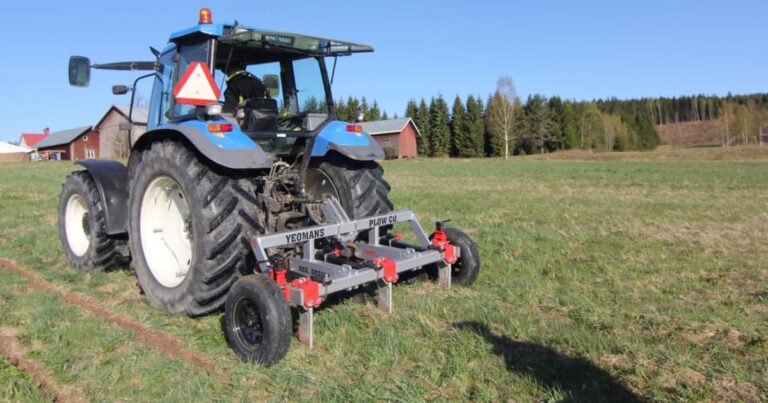
  • Using technology to rehabilitate the system (e.g. keyline plow to decrease compaction).

Conservation:

  1. Routing resources to next best use.
  2. Storing run-off water in tanks and dams.
  3. No-till or low-till cropping.

Design:

  • Making harmonious connections between components and sub-systems
  • Making choices as to where we place things or how we live.

Cycling and re-cycling

Cycles happen all around us and are any recurring event or phenomena. Nature does it on a continuous basis. Cycles are opportunities in time, and can be used to speed up recovery and support new yield.

Just think of your pastures. They grow and die off at the end of the growing season. They turn into mulch that decomposes and is consumed by soil organisms, which then turn it into humus-like material high in nutrients that feeds the next season’s plants with the help of symbiotic fungi and bacteria.

Another example of cycling is when your horse eats grass which turns into manure that is dropped on the ground, breaks down and returns to the soil to feed the next season’s plants.

To capture energy and produce more yields, we need to think in terms of ‘re’-cycling.

If we want to have year-round food (pasture and vegetation) for our horses, we need to help the system by supporting this cycling process.

We can accomplish this by returning waste (manure or, better still, composted manure) to the pastures to support soil development and nutrient cycling.

To maintain the production of our pastures, we need to manage our horses and time graze them using rotational cell grazing systems that allow you to move horses around and avoid overgrazing.

Niches

Besides thinking of cycles, we also should be aware of niches in our environment, as these are important components that can create various types of yield for us.

In the permaculture context, a niche refers to the way in which an organism fits into an ecological community or ecosystem.

Niche is a place to be, to fit in, find food, shelter and room to operate.

Thinking of our own lives and our horse properties in this way, we will see there are many niches within niches that you can benefit from.

For example, a tree is a universe in itself. A tree offers many specialty forage niches to birds, mammals and invertebrate species. These species are dynamic and appear or disappear during different seasons. A tree can offer shelter and shade to our horses or can serve as a windbreak. Trees could even be utilised as fodder for horses or provide food for your people!

When you start identifying and listing these niches, you enable better utilisation and greater diversity, hence more yield!

Summary

To live and manage our horse properties more sustainably, and create better environments for our horses and ourselves, we have to get smart with our resources. Permaculture provides us with tools and functional design principles that obtain yields using our resources conservatively.

While working with natural systems is the basis of permaculture, the profound difference between permaculture design and nature is that, in permaculture, we actively intervene to supply missing elements and to guide how the system develops.

The functions and yields we can create in a systems is theoretically unlimited, because we may not know all the ways to conserve and store energy, and any system we build can be improved. There is always room for another plant, another cycle, another arrangement or technique; our own creativity and efforts are an integral part of permaculture.

To download this article “Equine Permaculture Design: Part 2 Managing Resources” click here [wpdm_package id=52388 template=”link-template-button.php”]
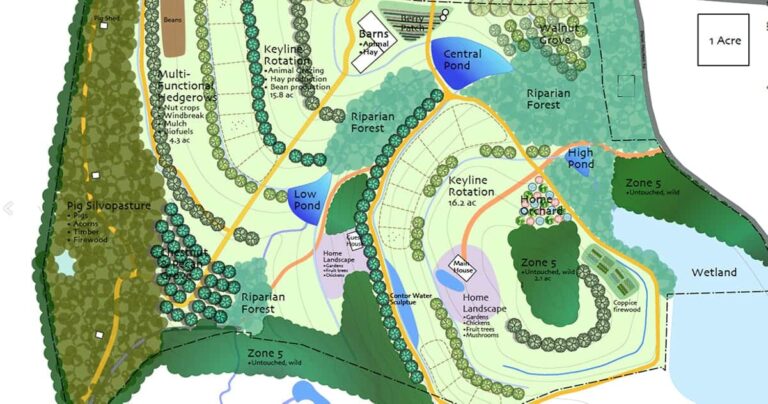
It Starts with Knowledge

Jane and Stuart Myers

“Responsible, sustainable and ethical horse ownership starts with knowledge,” proclaims the official website of Equiculture – a term that encapsulates so much. 

Jane and Stuart Myers’ business covers everything from land management to horse welfare and rider biomechanics. Before even meeting the couple, it’s clear from their range of books, workshops, talks and articles that knowledge and education are incredibly important to them both. 

I spoke to Jane and Stuart Myers from their caravan home in Queensland, in which they spend half of every year, teaching and touring, when they aren’t doing the same on the other side of the globe.

Both grew up in the United Kingdom and now, they return on an annual basis, developing the business they run together. They are the rare kind of couple who can not only work together every day, but support, encourage and bring out the best in one another.

Jane fell in love with horses early. She got her first horse at 11 after many years of lessons and began teaching riding at the age of only 14. In her words, it was “ridiculous because I didn’t know anything – but I thought I did.”

Having suffered from hearing loss all her life, Jane left school with no qualifications, at a time when the only aid to her hearing was being seated near the front of the class. “I opted out,” she explains. “I attended in body, but I certainly wasn’t there in spirit. I wrote my name at the top of the exam papers and didn’t even attempt to write on them.”

However, as soon as she could read, Jane discovered she could teach herself. “I found that researching via reading was my best way of learning. I’m still very much like that now – I love to read and research [on my own].”

Stuart, on the other hand, had minimal experience with horses when he met Jane. He’d had a good education and became qualified as a youth worker, and it was he who encouraged Jane to go back to school and then to university.

“I actually jokingly call Jane my Eliza Doolittle,” he laughs. She certainly took the task in hand. Returning to education at 23, Jane had completed her A Levels (VCE equivalent), Bachelor’s Degree and a Masters Degree in Equine Science by the age of 30.

“Jane’s hearing really held her back,” Stuart explains. “She had to put a Dictaphone on the desk at the front of the lecture theatre and every night she had to transcribe it. She worked really hard.”

Stuart’s pride in his wife is apparent. His rather different background gave him a unique perspective on their equestrian life together. “He won’t admit it, but he is an exceptionally bright person,” says Jane. Stuart Myers was a youth worker for more than 20 years before taking on full-time responsibilities with Equiculture.

“Looking at how people can achieve things they don’t think they can – that’s where my passion lies,” he says. “Not sure why, but I often see things from a different perspective to most people and I use this insight to offer alternatives which help to create change in people mainly, but recently in horses.”

However, not being a horse person gave Stuart a fresh take on the equestrian world. “I’m not a horse person. I haven’t got that ‘horse gene’, but I do understand them. I’ve got a background in human behaviour, so I looked at the culture of the horse world and I’ve always asked questions about it.”

When the pair emigrated to Australia to set up their own horse property, Stuart’s questioning attitude changed the way they managed their land. As Jane recalls, “Stuart was constantly saying ‘Why are we pushing the wheelbarrow through the wind and the rain and the mud to horses standing right out at the other end of the property? Why on earth can’t they come to us?’”

“I said ‘Because that’s just the way it is, Stuart, that’s just what we do!” Eventually, they developed The Equicentral System: a method of horse management which has minimal impact on the land, and saves time and effort on the part of horse owners. Using this method, horses are kept in herds, which return to a central area to be fed, watered and loaf on a surface that protects the soil beneath.

“It revolutionised our lives,” says Jane. “The amount of time it saves; the horses are calmer; there are massive land management benefits – you don’t have any mud issues if it’s wet; you don’t have any dust issues if it’s dry.” As it was their first property, they were forced to be creative. “We only had limited resources and a lot of things to do,” says Stuart. “We’re always looking at ways we can improve things.”

“I’ve always maintained that when you don’t have much money and you have to think your way through problems, you’re much more inventive. You have to be much more of a problem solver. So, that’s been our ethos,” says Jane Myers.

While living in Victoria, Jane taught in the Equine Science program at Melbourne University but, when the couple relocated to Queensland and replicated their successful system, they began to think of ways to share it.

Jane wrote a book for CSIRO entitled ‘Managing Horses on Small Properties’ and, not long after, they were asked to give a talk on the topic. A local council resource manager attended and realised she had found the solution to an ongoing problem in Australia.

Jane and Stuart were horse people teaching land management. It was a unique combination that would allow them to effectively communicate land management practices to other horse people – they spoke the same language. In the 10 years since, Jane and Stuart have delivered their talks on behalf of local councils, Landcare groups and Water Catchment Authorities around the states of Australia.

In 2012, Jane was the recipient of a Winston Churchill Fellowship, a program which enables Australians to travel overseas in the pursuit of knowledge in their chosen field. Together, Jane and Stuart travelled to the United States for eight weeks to investigate sustainable horsekeeping practices and deliver a few talks while they were there.

“Some really interesting things are happening in the States,” Jane recalls. “But, we found that Australia is actually quite advanced in this subject. In the States, it’s quite similar to the United Kingdom in that the government doesn’t really see the need to educate horse owners about land management, whereas Australia does.”

It was during their travels in America that Jane developed a sore throat and a small lump in her neck. On their return to the United Kingdom, she was diagnosed with throat cancer – a great shock to a woman who had never smoked and always ate healthily. She was told that she risked losing her tongue. “They grounded Jane in the United Kingdom for almost a year, undergoing intensive treatment,” says Stuart.

“What we believe is that there’s always a silver lining to every cloud,” says Jane. “By the time I was at the end of the treatment I was in a wheelchair, couldn’t speak and was being fed through a stomach tube. But, once I’d recovered from that, initially it was easier to write than anything else, so I wrote my two ‘Horse Rider’s Mechanic’ books and now, three years later, we’ve just finished re-writing all our other books, plus another new one.”

Stuart took over delivering the talks, continuing even when Jane was fully recovered. “We found that Stuart’s really good at the talks,” Jane explains. “He really enjoys it and people really enjoy him also.”

The subsequent change in routine allowed Jane to pursue her interest in rider biomechanics, which she explores in her ‘Horse Rider’s Mechanic’ books and clinics. Her interest in the topic stemmed from reading Sally Swift’s ‘Centred Riding’ at a young age. As she reflects, “That book really was a – what’s the word?”

“Revelation,” Stuart supplies.

“Yeah, a revelation. That really was the first of its kind.” Jane continued to explore similar books as they were published, but her own take on the subject is rooted in her experience as a riding instructor. “I decided to market myself to mature women – not just women but, as you know in the horse industry, it tends to be women – who are either learning to ride for the first time, or are returning to riding. That’s a huge group of people. Rightly or wrongly, a lot of coaches actually avoid those people. They prefer to teach people who are highly competitive.”

Jane focused on what her students were feeling at all times and developed her methods around that, but her approach is always adaptive. “I’m always reading more things, watching other people, always thinking of other ideas.”

They cover innumerable horsekeeping topics in their body of work, but Jane and Stuart Myers’ passion and focus clearly lies in passing on the knowledge and understanding of the horse world that they have gained.

“This sounds cliché, but we believe that we’re making a huge difference to people’s lives, and the lives of horses too,” says Stuart. “We can see that change when we get feedback from people about how their lives have changed, and how their horses and properties have come on… We’ve seen a real change in the way people are thinking about horsekeeping in the last 5-10 years and we’ve certainly been part of that. It’s quite significant when you feel like you’ve made a difference to people.”

Jane chips in – “And horses!”

[wpdm_package id=63962 template=”link-template-calltoaction3.php”]

Equine Permaculture Design: Part 1 Natural Systems

Natural Systems

Permaculture, or permanent agriculture, is a design system for sustainable living devised in Australia by Bill Mollison and David Holmgren in the 1970’s. It is one of the movements that can help us use the land in a cleaner and less costly manner, making it more resilient and resistant to extreme conditions. 

Equine permaculture integrates the principles of permaculture design with other sustainable farming practices that can be implemented on horse properties, however large or small. 

In this and the next article, Mariette van den Berg will lay out some of the founding design principles in Permaculture, and provide examples of how they apply in an equine setting and can benefit horses, people and the land.

Natural systems

Understanding the fundamental principles that govern natural systems is the key to becoming more sustainable and is the start of applying Permaculture. While some may be acquainted with Permaculture, its concepts and principles, others may be wondering what it all means and how it can be applied to their horse property!

In fact, Permaculture is common sense design that can help create a better environment and lifestyle. Permaculture is an approach and philosophy for managing the earth’s and our social resources that aims to design sustainable human settlements that preserve and extend the systems found in nature.

Permaculture can be applied in an urban, rural or productive farming context at any scale, and can certainly be applied to horse properties, whether large or small.

Understanding the principles that govern Permaculture design and applying them will help create better environments for horses, and this is especially critical if we are going to manage more and more horses in small suburban acreages.

The Law of Return

We are consumers and horse graziers that take a lot from the land, but often fail to support its need for energy return, so that it can replenish itself.

Natural systems will always attempt to restore equilibrium (balance) and, if we mistreat, overload or deflect such life systems and processes, we get a reaction that may have long-lasting consequences. Good examples of this are topsoil loss, erosion, weeds, compaction, reduced pasture availability, water pollution… The list goes on.

Our typical reaction has been to treat these problems with what’s known as ‘prescription farming’ (targetted herbicides, chemical fertilizers, etc.) and additionally, by importing larger quantities of feed to sustain the needs of our horses. This is neither good for the environment nor our pocket! The gloomiest part about this loop of import is that is is so widely  accepted in the horse industry.

Is it because we see our horses more as pets, rather then ‘grazing livestock’ and we have been somewhat indoctrinated into buying feed from the shelves?

Have we placed our endeavour to become grass farmers and manage the land in the ‘too hard basket’?

Most likely it’s a combination of many factors, including education on how to best manage pastures. The subject can be confusing because agricultural services typically educate on the basis of reductionism science. Most ‘agricultural solutions’ that are based on scientific (green revolution) evidence seem to tackle only one element at a time.

As an example, science has shown that plant growth can be supported by the addition of nitrogen, phosphorus and potassium (so called NPK), but what about the rest of the minerals? By only spreading these NPK fertilisers, we are reducing the associations the soil and plants make with other minerals and nutrients. This will make plants and soils less nutritious and resilient, which will lead to the following problem: Weeds.

The next solution is to develope (through science) a herbicide product that kills anything that isn’t the pasture or crop of your choice! By looking at our pasture problems one element at a time, we end up in a continual loop of buying in more items. Such an approach does not seem to work long-term, and could even be very unhealthy for you and your horses.

Complex, adaptive systems

In nature, living organisms do not lend themselves to strict scientific definitions because they are complex, adaptive systems that are always in a process of change.

Living organisms are typically part of a whole within a bigger whole – within a system. Therefore, we need to view the parts (w)holistically and be aware there are connections everywhere.

An example of a (w)holistic approach is that we don’t directly feed pasture plants, we feed them through a process of breaking down organic matter with the help of many soil-organisms – the bacteria and fungi in the soil that have a symbiotic relationship with plants and exchange many nutrients – and even water – with them.

This doesn’t mean that we cannot apply science and study the individual parts, but we clearly need to regularly step back to also study the system as its whole – and in its even bigger whole whenever possible!

Integrative and interdisciplinary science can be difficult to comprehend, and some researchers may be of the opinion that it is almost unmanageable because having many factors could influence an outcome. Still, by studying both – the parts and the whole systems – we will advance our understanding and could apply management tools much more efficiently than is currently being done.

Permaculture provides tools that are based on an integrative approach and emphasises self-reliance, responsibility and the functions of living things.

Using energy

One of the founding principles we need to be aware of when working with natural systems is that we need to think in terms of energy. Everything around us contains energy; organisms, populations and ecosystems. This energy may be stored or transferred from one form to another, but it cannot disappear or be destroyed, nor created (this is known as the first law of thermodynamics).

The energy can be the rain that is collected in the mountain rivers that run all the way to the sea. It is the food (pasture) that keeps your horse warm, alive and mobile.

What we consider ambient and useful energy storages are degraded into forms that are less useful to us until they no longer serve our system (entropy or gradual decline).

By understanding this cycle, we can then ask ourselves:

How can I best use energy before it passes and leaves my property or system?

Our strategy should be to store as much as we can, ‘from source to sink’.  To capture as much water in our hills to drought-proof our farms, and increase vegetative growth (capturing the sun’s energy) for food and soil building.

Life systems constantly organise and create complex energy storages from diffuse energy and materials, accumulating, decomposing, building and transforming them for further use. We can find ways to use this in our property management and design processes.

Take manure, for example. Horses are fibre processing machines, turning grass and hay into nutrient-rich manure 24/7.

One approach is to leave horse manure on the paddocks, and harrow it to help it break down and return nutrients to the soil. While this may be a productive use, it only achieves one function and is not a very good practice unless you can also remove the horses for a period of time to prevent them being exposed to parasites.

On the other hand, composting the manure can create humus-like material that you can spread on both your pasture and gardens.

If you do it the correct way (aerobic hot turning), you can turn the compost into compost tea and spray it directly on the pasture. The compost tea acts as a gentle tonic for the plants, encourages microbial activity in the soil, helps to break down organic matter and releases nutrients for plants.

A paradigm shift in perspective

In summary, when we review pasture management and property design using a permaculture perspective, we should really think in terms of how the resources and energy consumed can be best used to conserve and regenerate renewable energy in living systems.

This style of thinking is what led to the establishment of the design principles described in the following pages.

The Permaculture Design Principles:

As an approach or philosophy, Permaculture is based on a set of principles that can be applied in any context, including on your own horse property.

Understanding the principles that govern Permaculture design and applying them will help create better environments for your horses, your family, your land and the wider community.

1. Work with nature, rather than against it. 

This principle highlights the importance of learning to recognise natural systems and patterns, because they will help us to become more efficient, saving us time and money.

When looking at the design of a horse property, we need to look for the natural patterns, such as water flow, wind and sun angle. These patterns dictate the best and most energy efficient location for a dam, house site, access road or horse shelter.

When applied to weed management, for example, we can go against nature and use herbicides on a long-term basis, but this is linked to degraded soils and plants developing resistance to the chemicals used (which, in turn, leads us to reinvent new chemicals to deal with the resistance problem). On the other hand, we can work with nature; view weeds as pioneer species that grow in soils that no other (grass) plant can occupy, and use them as organic matter that can help build soil by slashing and mulching. Once slashed, the weed roots die off and the mulched plant returns organic matter high in minerals that can restore balance in the soil.

2. The problem is the solution. 

If weeds are the problem, use them to create the solution – healthier soils! The difference between something being advantageous or not is only in our perception – how we see it. Therefore, if you have something on your property that is a problem, look at in a different way and turn it into the solution.

For example, if you have a rocky area in your pasture that refuses to grow grass, could you turn it into a track paddock or the central point for your horses, which will help with keeping their feet dry, and may aid hoof wear and hoof health?

3. Make the least change of the greatest possible effect. 

A good example on a horse property is choosing a dam site by selecting the area where you get the most water for the least of amount of earth moved.

Another example is to use portable, rather than permanent fencing to set up laneways, paddocks or a central point system (such as Equicentral) to move horses and keep them off the pasture – reducing over-trampling and overgrazing, and aiding recovery of the soil.

4. The yield of a system is theoretically unlimited. 

The only limit on the number of uses of a resource possible within a system is in the limit of the information and creativity of the designer. This means there is always an opportunity to find more uses for parts of your system or to add to any system.

For example, when planting trees and shrubs to create a shelter belt, why not plant specific edible fodder trees for your horses and/or nut or fruit trees for your own consumption? While many horse owners will instantly focus on meeting the needs of their horses, they may  forget the property could also be used to produce food for both the horses and their own family!

5. Everything gardens. 

Everything has an effect on its environment. What this means is that nothing in nature works on its own, including us. Even when we can’t see it, there are many connections. Instead of trying to control everything in our gardens or pastures, we can get better results if we sit back and let other organisms do some of the work for us.

Taking the example of weeds and soil building again. If you know this, you can ensure that your effect is a positive one. For example, by pasture planning (cell grazing) or rotational grazing management of your horses you are gardening – allowing recovery and plants to regrow.

Encourage a questioning approach

Permaculture is best skilled using what’s known as the Socratic questioning technique because most people already know what Permaculture is but, initially, they don’t always realise it.

Socratic questioning and teaching is the oldest and still most powerful teaching tactic for fostering independent, critical thinking, because it focuses on giving students questions, not answers. It models an inquiring, probing mind by continually probing into the subject with questions.

Permaculture is common sense. It’s a lot of intuition and a goodly portion of counter intuition. Permaculture appeals because deep down, people know that permaculture is our duty, our destiny, the basis of all wealth and human survival. It is also the way forward for the horse industry to create better environments for horses and people, especially if we are going to manage horses more and more on smaller acreages around the cities.

In addition to being fun to apply, Permaculture is the embodiment of progress in the context of any flailing civilization and, when we think of the upcoming struggles of our future generations, Permaculture is an act of thoughtfulness.

In the next article, we will describe in more detail the concept of resource management and how we can obtain yields in a more sustainable way.

To download this article titled “Equine Permaculture Design: Part 1 Natural Systems” click here [wpdm_package id=52384 template=”link-template-button.php”]
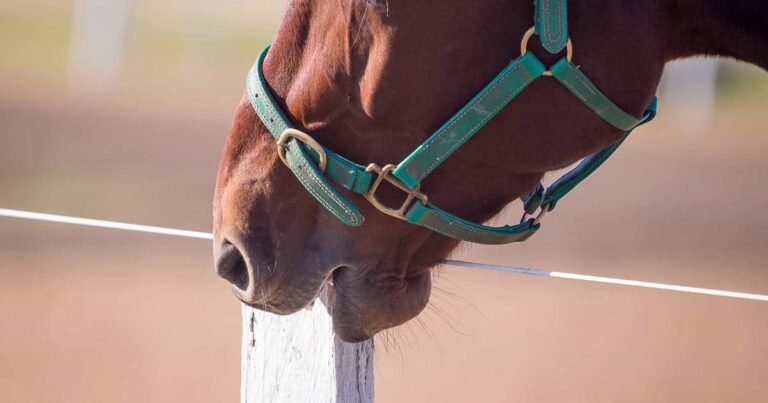
Stereotypies

In this article, Dr Rachel O’Higgins examines the current understanding of stereotypies – a group of behaviours which are commonly referred to as ‘stable vices’.  As Dr O’Higgins explains, horse owners must change the way they think about stereotypies; instead of being offensive, they need to be recognised as a horse’s coping mechanism induced by frustration and brain dysfunction. 

Instead of attempting to stop horses from displaying these stereotypic behaviours, we must recognise the management practices that cause the horse stress and leads to their development, so we can be sure to avoid them.

The term ‘vice’ should not be used to describe these behaviours as it implies there is something morally wrong with the horse. Stereotypic behaviours include weaving, crib biting, windsucking and box walking, amongst others, and are defined as a repeated movement with no obvious function, either induced by frustration or brain dysfunction. These repetitive behaviours can be seen commonly in zoo animals, which pace up and down the fence, or caged birds, which pluck out their own feathers.

What are they?

Stereotypies are abnormal behaviours and rarely occur in animals living in their natural environment. Lack of companions, unnatural feeding, and inability to make normal movements and exercise all increase the likelihood that stereotypies will be shown.

Stereotypies must, therefore, be considered as behavioural problems, which are a result of trying to cope with a problem that is causing the animal frustration. One study found that around 15% of Thoroughbred racehorses have stereotypies. In another study of 1,750 horses, stereotypies were more common in dressage and eventing horses, and were also more common in horses that spent more time stabled.

Wind-sucking – or ‘aero-phagia’ – involves the horse opening its mouth, contracting the pharyngeal musculature (muscles of the throat), flexing the neck muscles and sucking air into the proximal oesophagus, usually with a characteristic ‘grunting’ sound. When a horse is crib-biting, this action is accompanied by gripping with, or resting, the upper incisor teeth on a solid object, such as a stable door or fence post. Once acquired, the behaviour is extremely persistent and can occur in environments very different to where it first arose (e.g. a horse that started wind-sucking in the stable may also start to do it in the paddock).

Do they affect the horse’s health?

All stereotypies have an energy cost, which may be high enough to result in weight loss in some circumstances. Some horses may choose to spend a reduced amount of time eating in order to crib-bite or wind-suck, and this can also result in weight loss.

Reports suggest a link between wind-sucking and spasmodic colic. This hasn’t been proven, although an association has been made with a type of colic where the small intestine becomes trapped in a space in the abdomen called the epiploic foramen. The majority of the time, however, there are no perceived adverse effects of stereotypic behaviours.

Contrary to popular belief, crib-biting and wind-sucking horses don’t actually swallow much air. Radiography of horses as they were crib-biting showed there was no movement of the tongue as one would expect in true swallowing. Instead, each horse showed an explosive distension of the proximal esophagus that prompted no peristalsis (the wave-like muscular contractions that go with swallowing). Much of the air exited the proximal esophagus between crib-bites by returning through the cranial esophageal sphincter into the pharynx (the air exited out of the open mouth). This may explain why tympanitic colic (abdominal pain associated with wind or flatulence) is not seen in all cases of crib-biting horses.

A man-made problem

Evidence suggests horses have been crib-biting and wind-sucking since their domestication 15-30,000 years ago and the first written record of stereotypies appeared in a French text in 1609.

Stereotypies are, therefore, thought to be a result of domestication and changes in the way the horse is kept. The horse is designed to spend over 50% of its day grazing and, in the wild, will live in large, open spaces in stable social groups.

The consequences of stabling brings about a lack of social contact, restriction from normal movement and ‘idleness’ because of the use of cereal-based concentrates instead of forage, thereby reducing the horse’s natural feeding time and feeding behaviour.

Studies have shown each of these factors bring about an increase in the likelihood of a horse performing a stereotypy. If animals that show stereotypies are put into improved conditions, they usually show a reduction in occurrence of the stereotypic behaviour.

Studies have also identified weaning as a critical point in the development of oral stereotypies. Two thirds of wind-suckers and crib-biters start within one month of weaning; at the same time as diet and environment are substantially altered.

Causes and motivation

Owners of horses that are established wind-suckers or crib-biters often notice the behaviour is displayed immediately after eating. Palatable, high-cereal feeds can cause an increase in the acidity of the stomach and, it has been speculated, that increased acidity and abdominal discomfort are a trigger for crib-biting and wind-sucking behaviours. Production of alkaline saliva when wind-sucking may help the horse to neutralise stomach acid and, therefore, reduce discomfort.

In addition, some studies have found antacids, as well as acting to decrease gastrointestinal inflammation and ulceration, reduce the wind-sucking behaviour in some horses.

An alternative explanation for stereotypic behaviour in horses relates to stress-induced alterations in central nervous system (brain) dopamine physiology. Dopamine is a neurotransmitter; a type of chemical released during stereotypic behaviour that helps control the pleasure and reward centres in the brain.

Horses that wind-suck have been found to have significantly higher numbers of dopamine receptors in the area of the brain that controls goal-directed behaviours associated with attaining rewards and avoiding negative stimulus.

If the horse’s environment doesn’t allow it to attain goals (movement, socialising, feeding, etc.), the animal is maintained in a heightened state of goal-attainment. It is this ‘appetite phase’ of goal attainment that is the basis for stereotypy development in some horses.

As with other species (in particular humans), some forms of brain damage could potentially be a cause of stereotypies in the horse. However, this is rarely, if ever, the cause of the stereotypies that we commonly see.

Stereotypies are not ‘contagious’

Owners often regard wind-sucking as ‘contagious’, believing other horses will copy the behaviour. As such, these horses are often confined away from other animals on the property because their monetary value is usually less than a similar animal free of any stereotypies.

There is no evidence to support that stereotypies are contagious. Development of stereotypies does not normally occur at pasture and it is unlikely that wind-sucking behaviour would be copied in these circumstances. When stabled horses show stereotypies, they must have frustrations over their environment, whether or not they have initiated that behaviour by copying others. Equally, the idea there is a genetic component to stereotypies is unproven. It is likely this idea stems from related horses being kept in similar housing and management conditions.

Can horses be cured?

Various methods to prevent wind-sucking and crib-biting have been tested and, so far, a cure remains elusive.

A crib-strap or cribbing collar consisting of a strap around the ears and neck, with either protruding leather or two pieces of jointed steel hinged together at the throat.

The collar works by tightening around the pharynx as the horse attempts to arch its neck. These collars don’t work for every horse and, in one study, horses prevented from crib-biting with a collar for 24 hours resumed the behaviour at a higher rate than before, when the collars were removed.

The horses also seem to adapt to the collars, which then require continued tightening, and can result in skin trauma and potentially serious injury.

Aversion therapy has also been attempted with electric shock collars. Despite promising early reports, only nine horses out of 60 were ‘cured’ and three of these required reinforcement therapy after just nine months.

Surgical interventions

Three surgical methods to prevent wind-sucking have been described.

The first is a neurectomy, which involves removal of the surrounding nerve tissue of the sternomandibularis muscle of the neck. The second is a myectomy, which involves the removal of omohyoid and sternohyoideus neck muscles.

These surgeries work by preventing sufficient arching of the neck, but are not always successful and can cause severe frustration to the horse as they are then unable to carry out certain movements.

The last surgery is a buccostomy and involves making a hole through the horses cheek into its mouth. The idea is that the horse requires a ‘seal’ to suck in air. This surgery often doesn’t work, causes disfigurement and regularly heals over anyway.

Both surgery and collars, in an attempt to reduce the occurrence of wind-sucking and crib-biting, result directly in poorer horse welfare and do not lead to permanent improvement, even if welfare is ignored, so they should be discouraged.

Enrichment

Hanging stable-toys, balls and licks to reduce ‘boredom’ in the horse are often sold to owners to reduce stereotypies. However, there is very little evidence to suggest they reduce ‘boredom’ and the stereotypic behaviour that supposedly results from it.

However, devices that stimulate natural foraging behaviours, like the ones that release small amounts of food as the animal spends time pushing them around the stable, can help to reduce the time spent performing stereotypic behaviours.

Drug treatments

Transient elimination of crib-biting has been reported in subjects treated with certain drugs also used to treat alcohol and drug addictions in humans. These work in the brain to reduce the heightened state of ‘goal-attainment’ discussed earlier. The study used nalmefene in a continuous infusion for one week and, for that week, no cribbing was observed. However, daily injections would be expensive and are not practical, and the behaviour returns when the drug is stopped.

It is the causes (motivation) of wind-sucking/crib-biting, rather than the action, that should be treated.

1. Let them do it

Remember that stereotypies are a coping mechanism, so unless the horse is injuring himself or is at high risk of colic, he is unlikely to benefit from attempts to block the stereotypy. Both, the horse’s physical and psychological welfare should be the primary considerations.

If you have a crib-biter, provide him with a non-abrasive surface they can bite (e.g. cover a rail with rubber) and discourage him from biting other surfaces (e.g. with electric tape or a taste deterrent).

2. Improved housing

Long-term, the goal should be to improve housing and management. Housing should provide opportunity for movement and a variety of stimulation. The horse should have adequate space to exercise, ideally in the area they are kept or in an area they can access daily for intervals.

3. Social contact

Full contact with other horses should be maximised, preferably by being kept in groups or with a companion, and being able to touch and see other horses when they are required to be stabled.

4. Constant access to forage

Nutrition should be adequate, and quality forage that takes a long time to collect and eat should be provided. Restrictor haynets (slow-feeding haynets) are a great way to extend foraging time. However, having to work harder for food may frustrate some individuals, and become an additional and counter-productive stressor.

5. Other strategies

Other strategies for reducing the behaviour involve altering dopamine transmission. This can be achieved with drugs, like nalmefene, or without drugs through ad libitum feeding, increasing periods of turn-out and socialisation, and also with acupuncture. Interestingly, acupuncture, which reduces dopaminergic activity in the brain, has been shown to reduce crib-biting and wind-sucking in some horses.

Take home message

So far, a cure for stereotypic behaviours remains elusive. Instead of concentrating on prevention, we should be working to avoid the development of stereotypies by improving the welfare, housing and management of our horses from weaning to retirement.

This case study is reprinted with permission from ‘Equine Behaviour, A Guide for Veterinarians and Equine Scientists’ by Prof. Paul McGreevy.

The case

A four-month-old Warmblood colt was spotted repeatedly grasping at the top of a gatepost and occasionally licking it while the rest of the group, including its dam, idled in the same corner of the paddock. On closer scrutiny, the owners found no evidence of wood-chewing and did not detect a grunting sound with the behaviour. The foal was not receiving creep feed, but the mare, the highest-ranking adult in the group, was receiving concentrated feed every evening. None of the four adult horses in the paddock showed similar behaviours.

Alarm bells

Video surveillance was used for this case. Because of its repetitive nature, the invariantly-arched neck posture and the appetitive licking associated with it, the behavior was diagnosed as an early form of stereotypic crib-biting. The grasping behaviour was regarded with concern, because of the likelihood of its becoming stylised into crib-biting after weaning, so the following measures were taken to reduce management factors associated with its appearance.

The action plan

All gateposts in the paddock were coated very generously with a taste deterrent. The fence line was protected with a single line of electrified wire. The pasture in the paddock was short, so hay was fed to the group on a daily basis.

The hay was delivered to the centre of the enclosure, rather than being placed near the gateway where concentrates had previously been offered. This was intended to break down any association between eating and reaching for the gatepost. The hay was placed on the ground in the short-term to avoid there being any uprights in close proximity to the feeding horses and to normalise their posture.

Hay from three farms was sourced and samples of each were offered in seven separate piles, which allowed the five horses a pile each and two forage sources to choose from. Alternating the source of the hay in adjacent piles meant the mare and foal had a choice of forages. When the pair were brought in for supervised supplementary feeding of the dam, it became clear she was dropping a considerable amount of grain while chewing. Great care was taken to ensure that no dropped grain was left lying around for the foal to consume. Meanwhile, the mare received dental treatment that resolved the quidding.

The weaning

Before weaning was attempted, a mare-and-filly-foal dyad was located by means of an advertisement in a local newspaper and brought to the paddock. The foals bonded extremely well and, one month later, the visiting mare was removed. Two weeks later, the resident mare was removed and the colt was observed carefully for signs of the grasping response. None were seen. The pair of weanlings were kept at pasture throughout the Winter.

Ad libitum hay feeding was maintained and small amounts of concentrated food with a dietary antacid supplement were introduced very gradually. Although the amount fed to the youngsters was small, it was nonetheless divided into three feeds to reduce its effect on gastric pH. Four years later, the colt’s behaviour remains normal. The owners have not challenged him with traditional feeding regimens and intend to keep the time he spends in the stable to a minimum. None of the dam’s subsequent foals have shown signs of similar behaviours.

[wpdm_package id=49075 template=”link-template-button”]

Home, Family, Healing Horses

Most readers of Horses and People will be familiar with the Barefoot Blacksmith, Andrew Bowe, whose stories from the Mayfield Rehabilitation Centre can often be found in this magazine’s pages. 

What some may not realise is that Andrew is just one half of the husband-and-wife team who have built the business from the ground up and one quarter of the family of four who collectively keep their property running. 

Read the magazine version of this article

Set on a beautiful piece of land nestled in the hills just outside of Yarck, Mayfield, is a rehabilitation centre, school of equine podiotherapy, working farm and family home. We are met at the entrance to the garden by Nicky Bowe: horsewoman, businesswoman, mother, veterinary nurse, accountant – the list goes on. Like the property itself, everyone in the Bowe family has many facets.

Andrew pops in to say hello, but it’s a room full of women who sit down together to talk about the family and their property. Eldest daughter, 15-year-old Sophie, has made us Melting Moments. “Sophie helps out by doing a lot of the meals,” Nicky tells us. “She’s the serious one. ‘Come on, Mum, we’ve got to do this, let’s cook dinner.’ They all have their roles.”

“Emma is my little entertainer,” Nicky goes on, nodding her head at her youngest daughter. “She keeps things light around here. She reminds us to play – swimming in the pool, running around with the dogs, nagging me to take her for a ride.”

The Barefoot Blacksmith business has grown exponentially during the lifetime of Nicky’s two daughters, and I’m curious about how she and Andrew balanced raising their children with expanding their business. “We made the children part of it all,” she says simply. “They’re my little helpers.”

The property has been the Bowes’ home for many years now. Before that, it belonged to Nicky’s parents. “I grew up as a little girl on this property and I was always outside with Dad,” she explains. It’s where she became mesmerised by horses as a child and was eventually thrown in at the deep end when a neighbour gave her an old mare. Working with horses was a passion that only grew as she matured. “To pay my way through college, I used to buy horses from the saleyards, work them and sell them. I’d buy them off the track, off trainers, anyone’s rejects,” she recalls.

It was at college that Nicky met her future husband, Andrew. “I finished school very young, so I didn’t have my licence. I used to get a lift back home from college with him. I used to have to sit in the back seat though, because there was another girl who got a lift back home and she was there before me,” she laughs. Though she and Andrew had grown up in neighbouring towns, their paths hadn’t crossed before.

Nicky needed to save farrier costs on her project horses, so she and Andrew enrolled themselves in a weekend farriery course offered by their college. It was the beginning of a long career for Andrew. Meanwhile, Nicky had finished her science degree and found that her employment prospects weren’t as good as she’d hoped. “We wanted to renovate this property, so we bought it off Mum and Dad,” she says. “We were paying that off and doing all sorts of jobs. I was waitressing, nannying, cleaning fish…”

While working on a cattle stud, Nicky met a vet who asked her to come and work for him. Nicky spent the next decade working as a veterinary nurse, only stepping down when she became pregnant with their first child, Sophie. Never able to sit still, Nicky studied accounting during her pregnancy. “And all of those things that I studied – science, hospitality, veterinary nursing, accounting – all help me in my business. They’ve all sort of come together.”

Their rehab work, which has now become such an integral part of what they do, came about organically one day when Andrew brought home a horse. “He was working every day as a farrier, and there were horses the vets told people were hopeless and needed to be put down. Andrew couldn’t fix them with shoes, so that’s when he started down the barefoot track,” Nicky explains. “Some of them were surrendered to us in the beginning – given to us because they were going to be put down and we said ‘Well, can we take them home?’ And then, there are people that just cry out for us to help them.”

“I understand that in the veterinary industry, they have a duty of care,” she says. “But, if you think about it, if a human’s in pain, we don’t decide to put them down, do we? People can live with pain. And, I suppose, that’s where Andrew and I sort of took off. We’ve looked at herbal pain relief and it’s working. So, I suppose it all happened out of necessity.” The Bowes now work successfully alongside veterinarians; many of whom have read their book, ‘The Pony That Did Not Die’.

Nicky and Andrew published their first book together in 2013; the culmination of many years of rehabilitation work and two years of compiling, writing and editing. ‘The Pony That Did Not Die: Healing Laminitis with Barefoot Rehab’ is yet another way in which the duo are attempting to share the details of their work with the wider world, with the good of the horse always prioritised. The book is self-published – there isn’t much this couple can’t do themselves!

Everyone in the family has a role to play in the rehabilitation aspect of their work. Horses in dire need are often surrendered to the Bowes, who find new homes for them once they have recovered. “I ride the little ones that no one else can ride,” 12-year-old Emma explains. One of her two current ponies is a former rehab case, now treasured by the family. “He has all the experience and the ability I wanted, so he’s going to teach me how to go to higher levels.”

“He’s a keeper!” Nicky says. “He’s a real champion.” Those that don’t stay with the family go to caring, permanent homes, but the Bowes aren’t the kind of people to hand over their horses and never hear of them again. Many of their rehab centre graduates are leased out, so the family can keep an eye on what happens to them.

Older sister Sophie plays her part with the horses, but the cattle and sheep are her real passion. “I’m in between horses,” she explains. “I’m not competitive. I’d much rather just gallop around the farm on a horse. I like helping with sick sheep, doing all the gross farm stuff.” She doesn’t, however, see herself taking on the family business. “I’d rather start fresh on a new farm. Sheep and cows; probably more cattle because they’re more profitable and they don’t die as easy.”

Sophie’s understanding of farm life is clearly a realistic and well-informed one. “I think that life experience of getting out there, seeing how people run businesses and watching their parents teach has only helped them,” says Nicky. Their busy home life certainly doesn’t seem to hold them back; both Sophie and Emma were recently Dux of their years.

Since education is such a key aspect of Nicky and Andrew’s approach to their business, it’s not surprising their daughters are so well-rounded. “We felt there was a need to spread the word,” says Nicky. “We thought the way to do it was to educate people and try to basically clone ourselves – tell them all our secrets and send them off back into their regions of Australia and New Zealand.

“We’ve had a few international students as well.” In the beginning, they hired teaching venues to instruct their pupils, but it soon became clear a facility based at their home would be ideal. The Australian School of Equine Podiotherapy, based at Mayfield, is the result of that mission. “Our aim, our ultimate goal, is to have people out there like us, doing what we do, to take the pressure off us,” says Nicky.

Not only that, they hope to improve knowledge of horse management across the board, so there are fewer cases in need of rehabilitation. “We’d love for people not to have to bring their horses here,” Nicky laughs. Their education programme has recently received a great boost, becoming nationally accredited. “It’s a big milestone,” she explains. “There’s a lot more paperwork, but essentially it’ll be the same and it will allow our students to get funding to come in.”

We take a drive around the property, Sophie zooming ahead on a dirt bike, with three dogs yapping behind the wheels, and Emma following on horseback. As parents and daughters introduce their many animals and point out their native grasses, the overwhelming impression is this is a family that is deeply tied to their land. This couldn’t be clearer when I ask Nicky what the challenges are to running a business from home. “Challenges? I think there’s a lot of advantages! You’re here and it’s your home. I think it’s the way to go, really.”

Read the magazine version of this article

[wpdm_package id=64004 template=”link-template-button.php”]
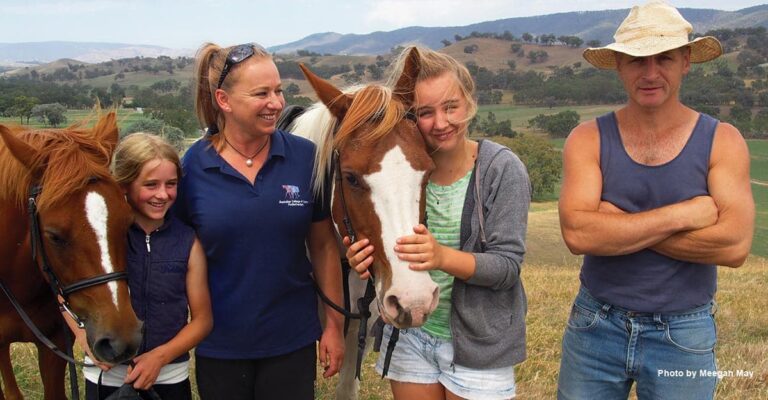
Renovating Damaged Pastures and Soils

Renovating damaged pastures and soils – soil compaction

The key problem on horse properties is compaction and, in this article, I’ll explain what compaction is and how to recognise it. I’ll provide some practical and integrative solutions for renovating damaged pastures and soils, de-compacting by means of biological and mechanical management, as well as explain how property design and pasture planning can help reduce these problems in the future. 

Horses compact the ground and they especially love to do so in the corners of paddocks. When soils are compacted by hoofed animals, rainwater is unable to infiltrate the ground to the compaction layer and grass roots cannot open up the soil. This leads to the next symptoms: you can’t get grass to grow, you grow weeds, you start erosion and water-logging…

In addition, soils that are severely compacted have significantly less oxygen availability (they become anaerobic) and most of the soil organisms, such as dung beetles, worms, and beneficial bacteria and fungi will disappear. This can lead to the growth of bad (anaerobic) bacteria, which can be harmful to you and your horses. Therefore, the number one priority to solve is, typically, compaction and after that, the rest will follow with some help!

Soil Compaction

Soil compaction occurs when a force compresses the soil, and pushes air and water out of it, so that it becomes denser. Compaction is exacerbated when the soil is wet and less able to withstand compression.

The most common causes of compaction on properties are vehicles, heavy machinery and animals (traffic). The degree of compaction depends on the force compressing the soil, the strength of the soil, the soil type and contact area.

For example, heavy machinery will compact the soil more deeply, whereas lighter vehicles and animal hooves compact the soil directly underneath and around the contact area.

While horses and cattle are both large grazing herbivores, it appears that horses have a larger impact on soil, due to the morphology of their hooves and for being more active.

Nevertheless, any hooved animal can cause soil compaction because it is not only the weight and hoof shape, but also the time the soil is exposed to them that determines the severity of the compaction in the soil.

How do I tell if my soil is compacted?

Compaction is typically visible where animals congregate. However, at times, you may not see it in the middle of the pasture as it often occurs in a layer below the soil surface.

The simplest way to check if you have compaction problem is to push a steel rod or large screwdriver into the ground. Driving your pig tail posts into the ground will already give you a fair indication! If you can’t push the rod in very far, your soil may be compacted or very dry. Another way is to use a shovel and try to dig a 25-30cm deep hole. As you dig, it will become obvious if it’s easy or difficult to penetrate the soil layers.

Compacted soil shows up as a hard, solid layer with large, deformed aggregates. The soil above it is usually looser and separates quite easily to expose the smooth surface of the compacted section. The compacted soil is often arranged into horizontal layers, giving a platy structure. You may see plant roots growing horizontally along the top of the compacted layer because they cannot grow through it.

In addition, most of the time you will see colour differences. The compacted layers will have no organic matter, will have a paler colour or even appear orange. The top layer may still be brown, but will also show reduced organic matter. Typically, severely compacted soils also lack topsoil, due to erosion and reduced plant growth.

De-compacting your soil

Working with weeds

Extremely compacted grounds are impossible to de-compact naturally unless we use weeds to do the hard work for us. Weeds are non-native, or immigrant, species – and hardworking ones at that!

Permaculture designers understand that, once a native landscape has been pushed past the point where it cannot repair itself (such as today’s landscape), hardworking immigrants (weeds) are required to fill the niche.

Building soil by encouraging the breakdown of organic material, including weeds high in accumulated minerals, is a natural means of restoring horse pasture health. Many weeds with deep, thick tap-roots can only grow in hard, compacted soils and, the good news is that, instead of fighting them, we can use them to fast-track our pasture management and build soil.

If paddocks are slashed before the weeds seed, the weeds and their roots, which are deep in the ground, will die and break down, allowing air and moisture to penetrate deeply and adding organic matter high in minerals to the soil. This process can be repeated several times.

Many weeds adapt themselves to growing in poor soil and they accumulate the very minerals that the soil is lacking – an important advantage of instigating a system using weeds. Once topsoil has been restored, rich in soil micro-organisms and minerals, weeds will be out-competed by grasses and legumes.

Keyline plowing

A fast way to de-compact and regenerate horse pastures and paddocks is by using Keyline Design and Mechanical Methods, such as the Yeomans Keyline Plow® or a Wallace Plow to deep-rip (not cultivate) the pasture. These plows have a chisel plough shank that slices, lifts the soil, and closes it after the pass of the plow.

The Yeomans Keyline Plow® utilises a special deep-ripping technique to infiltrate water into the soil efficiently and hold it on the land as long as possible. It’s almost as though the ground is able to take a deep breath; allowing moisture and oxygen in.

The first shallow rip with the Keyline Plow allows roots to break through the first compaction layer. In the second season, the pass goes deeper again and the roots follow. The final pass is to a depth of approximately 24 inches (600mm). Grasses can now start to work with soil bacteria and fungi to access deep minerals, which are essential for grazing animals.

You can even add a liquid compost (tea) or biofertilser and grass/legume seeds to the rip lines to speed up your pasture restoration following the Keyline process.

Over three to four passes with the Yeomans Keyline Plow®, and using Keyline Design, we can de-compact soil, increase soil carbon, build soil, increase water-holding capacity, increase soil life in the soil food web and even drought-proof our land.

Mulching and fertilising

We already mentioned the slashing of weeds, which creates mulch, builds soil and adds minerals. Mulching weeds and old grass will also help with covering bare soil and retaining moisture (in effect, reducing evaporation).

Using mulch can be particularly beneficial in the bare/compacted patches of your pastures. You can use old hay and/or straw as mulch or slashed grass, and add compost or manure to restore these areas in your pasture.

This works well for smaller compacted areas, such as corners and boundary tracks, but can also be done for larger areas of pastures, around water points or on slopes.

Add a thin layer of mulch first, which is your carbon part, followed by a thin layer of compost or manure (fertiliser) and then top it with another layer of hay/straw.

It’s important that you wet it down, which is needed for the decay process to begin and will also avoid the top layer from being blown away with the wind (clearly try to avoid extreme windy days to do this job!).

You may have to repeat the watering for a couple of days until it’s set in (and depending on rain). You can even add some pasture/legume seeds to speed up the growth and restoration.

The best time for recovery is during the growing seasons but, even in Winter, your bare soils will benefit from this mulching process, as you will avoid further erosion and build organic matter before Spring starts.

Reducing compaction in pastures

To aid soil and pasture recovery, it is important that you remove horses from the paddock or fence the area off that you’re working on. Once the pasture has been restored and you have enough pasture available for grazing, you can return the horses.

In order to reduce further compaction on your property, it’s essential you review your property design and pasture planning (pasture rotation). In the previous issue of Horses and People, we already mentioned the importance of subdividing pastures and advanced paddock grazing to support plant recovery and avoid overgrazing. This will also help with reducing compaction.

Understandably, we will never fully avoid compaction along boundaries, water and feeding points but, by timely grazing and moving animals frequently, the compaction is less severe and can be easily restored using mulching techniques or just recovery time if you have healthy soils to start with.

Another solution is to use tracks and sacrifice/central point systems that can take some of the regular congregating of animals. As the word is suggesting, this is an area that you sacrifice for pasture/plant growth and clearly allow compaction. Typically, these systems are used to provide a central space for water, feeding or to move horses off pasture for plant recovery or reducing pasture intake.

The design of your sacrifice or central point will largely depend on the number of horses, the space available and your budget. While you allow compaction to happen in these areas, it is important that you pay close attention to the drainage and footing, so you avoid mud build up, which can be very dangerous for you and your horses.

You will need to look at the shape of the land and consider the need to level and prepare this area in such away that it allows water to slowly be drained without causing quick run-off (and erosion).

The sacrifice area will need to be fenced off and requires a border around the footing to avoid run-off. You can even build a (rock) rain garden that can take some of the extra run-off water (kind of like a mini swale!).

There are many types of materials that can be used as footing. Your choice will largely depend on your preferences, availability and budget. River sand, pea rock gravel and wood chips are regularly used for their comfort and/or price, and can be applied to different areas. You can even decide to use ground stabilising products, such as plastic pavers with a cell-like structure (honeycomb or diamond-shaped are best).

Typically, sand or pea rock can be used to fill the grid spaces, and this will allow water to pass through, without turning it into a muddy area. This system can be very useful for high impact areas, such as gateways, tracks and water points. However, it still needs to be managed and manure should be taken away regularly to avoid build-up that can turn into a slurry.

Summary

This article sheds some light on the most common pasture problems – weeds, erosion and water-logging – which we now know are just symptoms, the key problem is compaction!

If you tackle compaction, you will at the same time eliminate most of the other issues on your property. By using biological and mechanical tools, you can restore soil health and manage pastures.

You can set up specific areas that can support the impact of animal trampling, either by using a footing around water and feeding points, or building a track and central point system where you allow animals to congregate. In a future issue, I’ll discuss in more detail the set up and design of these areas. So, stay tuned!

To download this article titled “Renovating Damaged Pastures and Soils” about soil compaction click here [wpdm_package id=48995 template=”link-template-button”]


Further Reading:

All About Soils Series starting with All About Soil. Part 1, Facts about soil

Why the long face: just how risky is horse riding?

Eventing is a sport enjoyed by many Australians, but what are the risks? How risky is horse riding?
Eventing is a sport enjoyed by many Australians, but what are the risks? alan feebery/Flickr, CC BY-NC-ND

Kirrilly Thompson, CQUniversity Australia

The death of 17-year-old horse rider Olivia Inglis in March 2016 rocked the global equestrian world. The hashtag #rideforolivia went viral.

Not two months later, 19-year-old Caitlyn Fischer died in a similar event.

Both girls were experienced riders who specialised in eventing, which is an Olympic equestrian event in which Australian horses and riders excel internationally. It comprises three phases of competition: dressage, cross country and showjumping.

Both girls died on the cross-country course, from rotational falls. The cross-country phase is considered particularly dangerous as it involves galloping over solid obstacles on mixed terrain. Falls in this phase typically occur from height and at speed.

Where a horse clips a solid fence and falls rotationally, there is a risk of it falling on – and killing – the rider.

Wayne Roycroft, from the International Equestrian Federation, called them “freak occurrences”.

The tragedy of their deaths is undisputable. But just how risky is eventing, and horse riding in general?

A rider clearing a jump in a local eventing event. How risky is horse riding?
A rider clearing a jump in a local eventing event. Denzil O’Brien, Author provided

Risks

One researcher documented rider deaths in all levels of eventing across the globe. She identified 59 confirmed rider deaths between 1993 and 2015. That is an estimated global average of 2.68 deaths per year from eventing.

A highly cited article, published in 1999, by Australian trauma specialist Dr Bruce Paix claimed that eventing was more dangerous than motorcycle or car racing. Paix found eventing 70 times more dangerous than horse riding in general and 180 times at the highest levels.

But can eventing be compared to other forms of horse riding, let alone motorcycle racing?

Paix’ calculations were made in relation to injury rates per time spent in the saddle. A recent critique suggests that risk is not evenly distributed across an eventing competition, hence the public popularity of the water jump.

Another way might be to look at injury rates per starter on the field. However, this data does not discriminate between falls on the flat and falls made at obstacles.

A recent critique by Denzil O’Brien suggests that a more accurate way to measure injury is to determine injury rates per jump attempt, as it is at jumps that horse and rider are at greatest risk of a rotational fall.

So eventing might not be more dangerous than motorcycle or car racing after all, but are event rider deaths “freak occurrences”?

A single misstep can be very costly when eventing. How risky is horse riding?
A single misstep can be very costly when eventing. Kat Netzler/Flickr, CC BY-ND

Freak factor

In Australia alone, there are an estimated 20 deaths from horse-related injury every year. Compare this with an average of 1.7 deaths from shark attack. Every time a rider mounts a horse, there is a possibility they may fall off.

Every time a beachgoer swims in shark-infested waters, there is a risk that they are exposed to sharks. How “freak” then are these events?

This is not semantic quibbling over terminology. Freak events are usually considered the ones that could not have been prevented. Perhaps they could not even have been predicted.

The concern is that describing a horse-related death as a freak accident will lead to apathetic attitudes towards safety among those most at risk.

While the freak factor has been applied to motorcycle riders, base jumpers and rockclimbers, it is even more relevant for anyone sitting astride – or even handling – a half-tonne animal capable of running 50km/h and which has its own mind, teeth and hooves, and isn’t afraid to use them.

The risk of safety apathy among equestrians is further compounded by the widespread acceptance that horses are dangerous because they are inherently unpredictable herd animals, whose flight instinct is ever ready to kick in as their riders get kicked off.

Seeing horses as unpredictable is a risk factor for horse-related injury in itself. That is, if it activates complacency.

While no sentient being is fully predictable (humans included), a number of technical controls can be introduced to reduce the likelihood and consequence of an accident, injury or fatality.

But are we missing the point? Instead of talking about how unpredictable horses may or may not be, what if we spoke about how well humans can “read” and interpret horses? Can we improve human ability to predict horse behaviour?

Horse Grimace Scale behaviours.
Costa et al. (2014)

There is a fine line between confident-aggressive, shy-afraid or quiet-sick, as any recipient of a dog bite or horse kick might know.

Animal scientists have developed some useful tools to help us talk to the animals. For example, researchers developed the Horse Grimace Scale to enable scoring of the equine pain face. It directs the assessor to pay detailed consideration to the horse’s ears, eyes, chewing muscles, chin and facial profile.

The chart has been adapted for popular circulation to help horse owners interpret their own horses. While interpreting the horse’s facial expression is far from a panacea for horse-related human fatality, it makes sense to accept that an unhappy or unwell horse is also a more unpredictable and less safe horse to be around.

Many an experienced rider or trainer who is particularly observant and attuned to horses will frequently claim “they could see something coming from a mile away”.

The question, though, should not be whether or not horses are unpredictable, but how we can better understand, interpret and pre-empt horse behaviour. In so doing, talking to the animals might actually be less of a freak occurrence than being injured by them.The Conversation

Kirrilly Thompson, Associate professor, CQUniversity Australia

This article is republished from The Conversation under a Creative Commons license. Read the original article.


Recommended reading:

Transparency and Research for the Future of Horse Sports

20 (More) Reasons to Wear a Helmet

Equine Permaculture: Part 3 We Are Grass Farmers

We are grass farmers!

When we own horses, we sign up to become the caretakers of large herbivorous animals that have adapted to eating a plant-based diet primarily made up of grasses. This is why we, as horse owners, should think of ourselves as ‘grass and forage’ farmers for our horses, even on the smallest of properties. 

The more you learn about how plants in general and grasses in particular work, the better equipped you will be to make informed decisions about the diet and, therefore, long-term health of your horses. 

Why are we grass farmers?

As horse owners, we create as best as we can husbandry and pastoral systems that can cater for the needs of our horses. However, we soon find out that managing horses in these systems is not without effort; it needs continuous understanding and action.

To make your pasture systems really work, it helps to have some basic knowledge on how grasses and legumes develop and grow, the effect of grazing pressure, what leaf area should remain after grazing, and how all this effects the recovery of your plants and, accordingly, your grazing planning and paddock rotation. In short, you need to think of yourself as grass farmers! (See the previous article in the March 2016 issue of Horses and People).

Even if you agist your horse and don’t have direct control over grazing and pasture management, it is never too late to get involved, become grass farmers and get to know your horses better!

If we manage horses on pastoral systems, it is important you get to know the plants your horses may consume. However, there are thousands of grass species out there and it won’t be possible to provide you a complete list in this magazine that gives you all the in’s and out’s of your pasture. The aim for this article is to discuss the differences between grass species, and what are the most common species we encounter in temperate and (sub) tropical environments here in Australia.

A large family

The grass family, known scientifically as the Poaceae or Gramineae, is one of the four largest families of flowering plants, with approximately 600-700 genera and 10,000 species.

Grasses are included with lilies, orchids, pineapples and palms in the group known as the monocotyledons, which includes all flowering plants with a single seed leaf.

Until recently, fossil findings indicated that grasses evolved around 55 million years ago. Recent findings of grass-like phytoliths in Cretaceous dinosaur fossilised faeces have pushed this date back to 65 million years ago.

Grasses range from tiny inconspicuous herbs less than an inch high to the giant bamboos that grow to 130 feet tall. The family is undoubtedly the most important flowering plant family to animals and humans, directly or indirectly providing more than three quarters of our food.

Grasses are also a major producer of our oxygen and provide a large component of the earth’s environmental filtering processes, due to their enormous geographic range, spatial coverage and biomass. Grasslands are estimated to compose 20% of the vegetation cover of the Earth. Poaceae live in many other habitats, including wetlands, forests and tundra.

The economic importance of grasses can hardly be overstated. Grasses are the greatest single source of wealth in the world. They provide much of the starch (rice, cornmeal, bread, cereal, pasta, and so on) and much of the protein in most human diets.

Although a few grasses can significantly accumulate heavy metals and other harmful substances from the soil, and a few others have potentially poisonous cyanogenic compounds in their shoots and leaves, the overwhelming majority are not poisonous.

Grasses sweeten what you drink and eat with cane sugar, molasses and high fructose corn syrup. Corn by-products also provide the raw material for many chemicals used in industry.

Grasses provide the raw material for most alcohol products (sake from rice, rum from sugar cane, beer from barley, bourbon from corn, and whiskeys and other spirits from wheat and rye). Besides food and fuel, they also provide building materials, such as bamboo and thatch.

What are C3 and C4 grasses?

Grasses can be classified as either C3 or C4 plants, sometimes referred to as cool season and warm season plants.

The terms C3 and C4 refer to the different pathways that plants use to capture carbon dioxide CO2 during photosynthesis. The names are simply derived from the number of carbon atoms in the first product of photosynthesis (C3 = 3 carbon compound and C4 = 4 carbon compound). C3 and C4 grasses have different growth requirements.

Cool season, warm season

Cool season, C3 plants are adapted to cool season areas and grow in either wet or dry environments. C3 plants are more efficient than C4 plants under cool, moist conditions and at lower light intensities. ‘Temperate’ pasture species are all C3 plants and they grow actively in Winter when the C4 plants are dormant or only able to grow slowly.

Warm season, C4 plants are more adapted to warm or hot seasonal conditions under moist or dry environments. The C4 plants have some important advantages over C3 plants in hot, dry conditions. They are more water and nitrogen efficient, but require more energy (light) as there is an additional step in the photosynthetic pathway.

The C4 plants only need to keep their stomata (the tiny openings that allow gasses and water to enter the plant) open for short periods, so they lose much less water (transpiration) for the same amount of CO2 fixed by photosynthesis. This is a significant advantage under hot, high light intensity and moisture-limiting conditions.

Carbohydrate storage

Both grass types have internal structure to support the different types of metabolism. C4 grasses form starch and C3 grasses generally form fructan as they store carbohydrate, but there are some C3 grasses that evolved and store starch instead of fructan. There a number of Australian native grasses, such as Weeping grass and Wallaby grass, that are of the C3 type, but produce starch and no fructan.

Both C3 and C4 grasses can accumulate significant amounts of soluble sugars, non-structural carbohydrates (NSC) or starch during active growth periods, which can put some horses at risk of developing metabolic disorders, such as laminitis. However, between C3 and C4 species there is no difference in how much NSC they tend to accumulate in optimal growth conditions.

C3 grasses and legumes, such as ryegrasses, cocksfoot, Yorkshire fog and clover, and C4 grasses, such as, paspalum, kikuyu, couch grass, early growth Rhodes grass and panic grass, have a high potential to accumulate NSC.

Many Australian native grasses are lower in sugar and fructan but, because of this, they are also more sensitive to overgrazing. These include Red grass, Windmill grass, Weeping grass, Speargrass, Kangaroo grass and Wallaby grass.

Oxalate content in grasses

Oxalate content of grasses is especially relevant to those who keep horses in tropical and sub-tropical climates because the oxalates upset the uptake of calcium in the body and are associated with conditions, such as ‘big head’.

Various tropical grass species, including Kikuyu grass (Pennisetum clandestinum), Seteria (Setaria sphacelata), Panic grass (Panicum maximum), buffel grass (Cenchrus ciliaris) and pangola grass (Digitaria decumbens) contain significant levels of soluble oxalates that react with Ca to form insoluble Ca oxalates, reducing the Ca absorption in the digestive tract of grazing animals. This leads to a disturbance in the absorbed calcium:phosphorus ratio, resulting in mobilisation of bone mineral to alleviate the hypocalcaemia.

Prolonged mobilisation of bone mineral in horses consuming these tropical grasses results in nutritional secondary hyperparathyroidism (NSH) or osteodystrophy fibrosa (‘big head’). Cattle and sheep are less affected, but not unaffected, because they can degrade oxalates in the rumen.

Grasses with more than 0.5% oxalate or calcium:oxalate ratios of less than 0.5 result in a negative calcium balance and are capable of inducing hypocalcaemia in horses. Levels of 2% or more soluble oxalate can lead to acute toxicosis in ruminants.

It is important to note the levels of oxalate in the plant depend on the species, cultivar, time of the day, season, and soil conditions (nutrient availability). Nevertheless, when horses graze on pastures where grasses known to have high levels of oxalates predominate, it is important to balance their rations with a dietary calcium and phosphorus (mineral) supplement.

What grass species should I have in my pastures? 

The presence of both C3 and C4 species can be desirable in a pasture as they can occupy different niches. For example, C3 species are often more abundant under the shade of trees and on southerly aspects, while C4 species often dominate full-sun conditions and northerly aspects. This results in providing greater grass cover across a range of conditions that exist within a same area.

It is very common to find both C3 and C4 species in one paddock, and this has the additional advantage of providing a broader spread of production throughout the year (Winter and Summer) for both our domestic grazing stock and the animals native to the area.

Download and read this article “Equine Permaculture: Part 3 We Are Grass Farmers” here [wpdm_package id=52380 template=”link-template-button.php”]