fbpx
Home Blog Page 40

All about Soil. Part 3, DIY soil tests

DIY Soil Tests.

In this Equine Permaculture series, we ‘dig deeper into soils’ and, to date, we have explored what soils are, how soil is formed, the different types of soil and how they sustain life through the soil-food-web.

If you missed those articles, you can find them by clicking on Part 1 and Part 2

In the following parts, we focus on the importance of soil tests – in the lab and DIY – interpreting these soil test results, and, finally, in our last part, we will explain how these tests can help your property’s soil and pasture management. 

In Parts 1 and 2, we learned soils are complex mixtures of minerals, water, air, organic matter, and numerous micro and macro-organisms that are the decaying remains of once-living things.

Soil forms at the surface of land – it is the ‘skin of the Earth’, it supports plant life and is vital to life on Earth. Although we know taking care of our soils will help us grow healthy pastures to feed our horses, soil continues to be overlooked, underrated and taken for granted.

How much do you spend, as a horse and property owner, getting to know your soils – reading up on soil facts – compared to the time you spend planning and managing your pastures?

The importance of soil testing

Soil testing or analysis is a valuable tool for your farm. It determines the current condition of your soils, and the inputs that may be required to improve soil health and fertility.

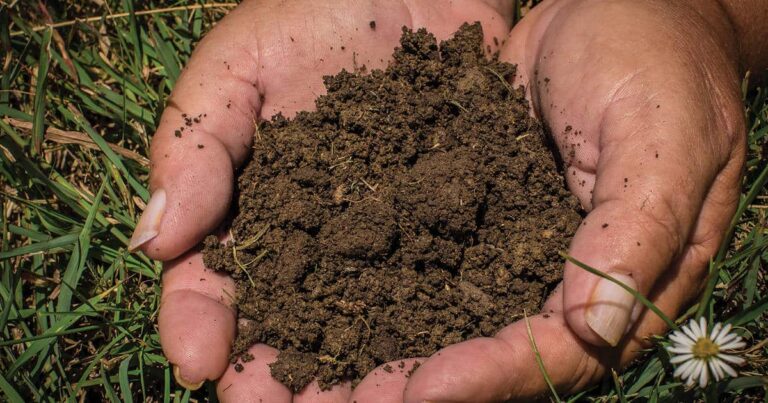
Soil fertility is determined by the soil’s chemical, physical and biological properties. Some properties, such as soil texture, colour and structure are visible to the eye. However, the chemical composition of soil needs to be measured. This is why soil sampling and testing is essential.

Soil tests are used to determine the soil’s nutrient content, organic carbon content, pH level and even microbiology. Armed with this information, you can define the exact type and quantity of fertiliser that will improve your soil. This is important because healthy, fertile soils grow healthy, fertile pastures.

Soil testing can also be used to check pastures are not over-fertilised. Many nutrients tend to be over-applied – resulting in imbalances in the soil and harmful effects on the environment.

For example, an excess of nitrogen can cause leaching and groundwater contamination, or contamination of waterways from run-off. We see the effect of the latter with algal blooms in dams and waterways.

In addition, over-fertilising can cause problems with excessive growth of high-producing pasture species that are not always ideal for managing ‘good doers’, or horses in maintenance or light work.

Over-fertilised pastures have also been linked to an increase in plant and fungi toxins, which can cause health problems in horses. To learn more, read the ‘Your Pasture Pharmacy’, available on the Horses and People website.

While it is best to get to know your soils with a comprehensive laboratory analysis and soil report, you can also do some of the basic tests yourself! Keep reading…

Taking soil samples

Soil conditions vary from paddock to paddock and region to region. Each paddock should be considered on a case-by-case basis when making soil and pasture management decisions.

For a soil test to provide a reliable guide to the condition of your soil, the sample tested must truly reflect the soil in the area sampled.

If the soil type varies within the area to be tested, sample the predominant soil type only.

Choosing an area to sample

Areas with major soil type variations, or that differ in appearance, pasture growth or past treatment should be sampled separately – provided the area can be treated separately. A pasture/soil map or satellite image can be helpful in distinguishing areas, and in recording where the samples were taken.

Once you’ve selected the area to be sampled, use one of the following patterns to take between five and 10 cores at regular intervals: network (a), Z-scheme (b), diagonal (c) and in rows (d).

The minimum recommended is five to 10 cores per sample. The more cores, the more representative the sample will be – and more accurate the results.

Choosing the core sites

Although you may be following a set pattern, the cores should be taken from sites of average pasture growth.

You should avoid sampling areas of bare ground (unless they are predominant) and where there is very good growth (the ‘roughs’, which have an excess of urine and manure).

Stay 10 metres away from contaminated or deceptive parts, such as the area around gateways, farm or animal tracks, loafing areas, sheds, fence lines, troughs, trees, fertiliser and lime dumps.

Avoid the bottom of gullies and water holding depressions, areas where timber windrows have been burnt and extremely wet soils.

Taking the cores

There are several different tools you can use, such as an auger and sampling tube, but a clean spade works just as well. It is important you use a clean, plastic bucket to collect your core samples, because a metal one can contaminate the sample for trace element analysis.

At each sampling site, remove all surface material, such as pasture or weed growth, and surface litter, to expose the bare soil and take a uniform slice of soil about 20mm thick to the required depth.

Core depths of 100 mm (3-4”) are recommended for pastures. Subsoil (deeper cores) sampling can also be beneficial to determine deeper storage of nutrients (for deeper, tap-rooted plants) and in areas where salinity, acidity or heavy metal contaminations are suspected in the soil.

Repeat at each core site until you have at least five to 10 core samples in your plastic bucket.

Break up clods and mix thoroughly, then spread the total sample from the bucket evenly onto a clean surface. A plastic tarp works well (make sure you pin it down on windy days or find a sheltered area!).

By this time, you will probably have more soil than you need for analysis (the typical requirement is between 200-300g). Although, if your budget allows, you should duplicate the samples for better accuracy.

To reduce the sample size, but maintain a good representative sample, divide the total mix into quarters, discard the two diagonal quarters and remix the remains, then continue this reduction process until you achieve the amount required for the soil.

Remember also, as well as bagging and sending a sample to a laboratory for a comprehensive report, you can DIY soil tests at home, so keep some soil separately for that purpose. Keep reading to learn how to do this…

Place the sample into the bag, label it with all relevant details, and number or code it, so you can keep track of your sample bags. Include details such as name, address, date of sampling, site of sampling, depth of sampling and, if applicable, any fertiliser details. Some soil labs offer sample kits and soil bags, but ziplock or plastic bags work just as well.

For a laboratory analysis, you will have to fill out a form with all relevant details and you will have to select your analysis package. These packages are tailored to specific soil types or are based on the number of tests conducted to provide you with either standard or more comprehensive details. We will discuss lab soil testing in the next issue.

Now you have collected your samples, let’s use some for our at-home, DIY soil tests!

DIY soil tests

If you search online, you can find many soil or garden websites that offer you DIY soil testing kits and even online testing tools. These can be very useful, but the quality and costs of testing kits may vary. Alternatively, there are low-cost solutions for doing basic tests yourself using limited tools.

1.  Squeeze test – composition

One of the most basic characteristics of soil is its composition. In general, soils are classified as clay soils, sandy soils or loamy soils (check Part 1 of this series).

Clay is nutrient-rich, but slow draining. Sand is quick draining, but has trouble retaining nutrients and moisture. Loam is generally considered to be ideal soil, because it retains moisture and nutrients, but doesn’t stay soggy.

To determine your soil type, take a handful of moist (but not wet) soil and give it a firm squeeze. Then, open your hand. One of three things will happen:

  • It will hold its shape and, when you give it a light poke, it crumbles. Lucky you… This means you have loam!
  • It will hold its shape, and, when poked, sits stubbornly in your hand. This means you have clay soil.
  • It will fall apart as soon as you open your hand. This means you have sandy soil.

Now you know what type of soil you have, you can work on improving it.

2. The compaction test

Plunge a wire flag vertically into the soil at different locations. Mark the depth at which the wire bends. The sooner it bends, the more compacted the soil. A foot or more of easily penetrable soil is ideal for healthy pastures.

Compacted soil inhibits root growth, water availability, and keeps earthworms and other vital soil fauna from circulating freely. It is, therefore, important you work on de-compacting your soils before even attempting more soil tests! See our previous article on how to de-compact horse pastures at: Renovating Damaged Pastures and Soils

3. The percolation test

It is also important to determine whether you have drainage problems or not. This one is often related to compaction problems. Good infiltration gets water to plants where they need it (at their roots), prevents run-off and erosion, and let’s air move more efficiently into soil pores. Water-logged soils/pastures can cause problems with building up of weeds and anaerobic bacteria.

To test your soil’s drainage:

  1. Dig a hole about six inches wide and one foot deep.
  2. Fill the hole with water and let it drain completely.
  3. Fill it with water again.
  4. Keep track of how long it takes for the water to drain.

If the water takes more than four hours to drain, you have poor drainage and this could be an indication of compaction.

4. The pH test

Knowing the pH of your soil will help your pasture plants grow by absorbing nutrients better from the soil. Their ability to do this depends on the nature of the soil and its combination of sand, silt, clay and organic matter.

The makeup of soil (soil texture) and its acidity (pH), as well as the abundance of micro-organisms, determine the extent to which nutrients are available to plants.

pH is tested on a scale of zero to 14, with zero being very acidic and 14 being very alkaline. Most plants grow best in soil with a fairly neutral pH, between 6-7.

When the pH level is lower than five or higher than eight, plants just won’t grow as well as they should. pH testing can be done with soil pH kits or pH probes. These kits are fairly accurate, but you must make sure you follow the testing instructions precisely.

Alternatively, there are two other ways you can test the pH yourself without kits or probes! Keep reading…

Option 1: Vinegar and baking soda pH DIY soil tests

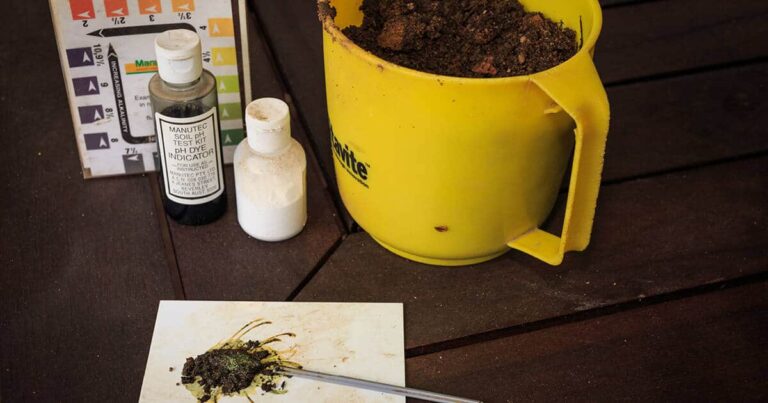
Collect one cup of soil from different parts of your pasture (use soil you collected for sampling) and place two teaspoons of soil into two separate containers. Add 1/2 cup of vinegar to the soil. If it fizzes, you have alkaline soil with a pH between 7-8.

If it doesn’t fizz after doing the vinegar test, then add distilled water to the other container until the two teaspoons of soil are muddy. Add 1/2 cup baking soda. If it fizzes you have acidic soil, most likely with a pH between 5-6.

If your soil doesn’t react at all, it is neutral with an ideal pH of seven and you are very lucky!

This test is fun to do. After you added vinegar and you do not observe a reaction in your bowl, don’t think your experiment didn’t work! You can do a check by adding distilled water to another bowl of soil and pour on just a sprinkling of baking soda. You get instant fizz! It just means you have acidic soil.

Once you know whether your soil pH is a problem or not, you can begin working to correct the problem.

Option 2: Cabbage water pH DIY soil tests

Measure two cups of distilled water into a saucepan. Cut up and add one cup of red cabbage. Simmer for five minutes. Remove from heat and allow it to sit for up to 30 minutes.

Strain off the liquid, which will be purple/blue. This will have a neutral pH of seven.

To test, add two teaspoons of pasture or garden soil to a jar and a few inches of cabbage water. Stir and wait for 30 minutes. Check the colour. If it turns pink, your soil is acidic. If it is blue/green, your soil is alkaline.

These tests give you some indication if you are dealing with problem soils, which may be one of the reasons why you won’t be able to grow certain pasture species or why you have weed problems.

In the last part of this series, we will discuss in more detail how you can restore your soil’s (pH).

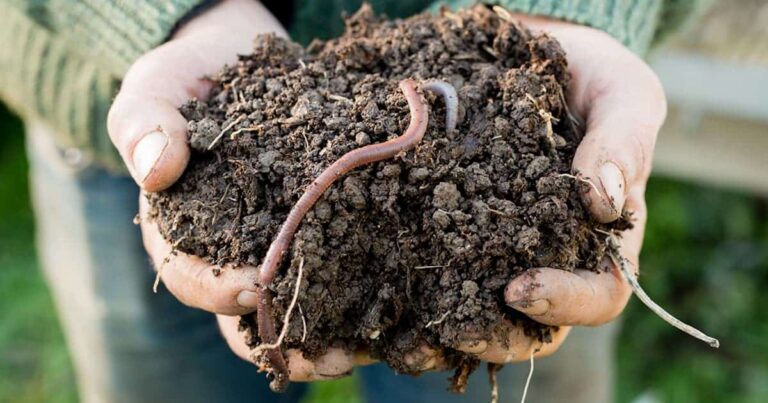
5. The worm test

Worms are great indicators of the overall health of your soil, especially in terms of biological activity. If you have earthworms, chances are you also have all of the beneficial microbes and bacteria that make for healthy soil.

To do worm DIY soil tests:

  1. Be sure the soil has warmed to at least 13 degrees and it is at least somewhat moist, but not soaking wet.
  2. Dig a hole one foot across and one foot deep. Place the soil on a tarp or piece of cardboard.
  3. Sift through the soil with your hands as you place it back into the hole, counting the earthworms as you go.

If you find at least 10 worms, your soil is in pretty good shape. Less than that indicates there may not be enough organic matter in your soil to support a healthy worm population, or that your soil is too acidic or alkaline.

6. Soil organisms

Measure the animal life in your soil by digging down at least 15cms and peering intently into the hole for a few minutes. Tick off the number and species of each organism observed, such as centipedes, ground beetles and spiders.

Because most soil organisms spurn daylight, gently probe the soil to unearth the shy residents. If you count less than 10, your soil does not have enough active players in the food chain.

A thriving population of diverse fungi, bacteria, insects and invertebrates is one of the most visible signs of soil quality. The more that creeps and crawls under your pasture or garden, the less opportunity there is for pests and disease.

Each level of soil life does its part to break down plant residue and make more nutrients available for plant growth. See our previous article on soil-food-web interactions at: All About Soil. Part 2, The soil food web to learn more.

7. Plant residue

If you have good grass cover, dig down 15cms into the soil and look for plant matter at that depth. The range of organic material is important to notice here. The presence of recognisable plant parts, as well as plant fibres and darkly-coloured humus indicates an ideal rate of plant decomposition.

The single most important component of healthy soil is organic matter. But, plants and other organic materials decompose only when soil organisms are there to do the work. Any sign of this process is a good sign, but the speed of decomposition is important too. Fast decomposition is another indicator of soil quality. In poorly-aerated soil, plants break down slowly – a condition that gives off a faintly sour scent.

8. Plant vigour

Start this test during the active growing season, and look for healthy plant colour and size that’s relatively uniform. Overall health and development must be judged based on what’s considered normal for your region, but will also depend on local weather conditions.

Plant vigour indicates soil with good structure and tilt, a well-regulated water supply and a diverse population of organisms. It’s, by far, the best sign of effective soil management you’ll have above ground.

9. Root development

Use a shovel or hand trowel to dig gently around a selected plant; if you choose a weed, you won’t miss. Once you’ve reached root depth, pull an annual plant up and check the extent of root development, searching for fine strands with a white, healthy appearance. Brown, mushy roots indicate serious drainage problems. Stunted roots might also indicate disease or the presence of root-gnawing pests. When you look at the roots, you can really see what’s going on.

Roots have the most immediate connection with and reliance on soil quality. Without air, water, biological activity and crumbly soil to grow in, roots can’t do their job.

Summary

Learning as much as you can about your soil will help you decide what needs to be done to make it ideal for the pasture plants you want to grow (and outcompete weeds!). The above-mentioned DIY soil tests are easy and fun to do, and are a good start to gain some information about your current soil condition and what you may have to improve.

Of course, if you want a more comprehensive analysis of your soils, you will have to send your samples to a certified soil laboratory.

Search online for soil services in your region or state, although many offer national services. They will provide information about collection of soil samples and sending it into their laboratory for analysis.

Based on the package chosen, they will return a report that will alert you to any nutrient deficiencies in your soil. The pricing of soil tests will depend on the package chosen. Basic soil tests will be relatively cheap around $50. However, a microbiology tests can be as high as $250-300 per sample. Often, the labs also provide additional consulting services and advise steps to correct the issues observed.

Alternatively, you can also work with an agronomist or soil scientist who do all the work for you and produce a recommendation report. There are many options, depending on your time and budget!

We will discuss some of the soil parameters and lab results in the next part of this series.

[wpdm_package id=49052 template=”link-template-button”]


This article about DIY soil tests was published in Horses and People April 2018 magazine.
How to Avoid Kissing Spines: Lessons from the Old Masters

Kissing spines.

Adams’ ‘Lameness in Horses’ (1987)1 describes kissing spines as a condition of the vertebral column in horses caused by overlapping and/or impingement of the dorsal spinous processes (DSP) in the thoracic and/or lumbar vertebrae. 

Kissing spines lead to pain in the back with the associated avoidance behaviour, such as reluctance to be saddled, and inability to perform in the intended sport of equitation or racing. The etiology (origin of the condition) in this edition of Adams’ is mainly observed to be due to injury in the back, with some ambiguity as to other causes. As yet, it does not mention training as one of the potential causative factors. 

More recently, this condition has been established as one of the underlying osseous changes of the vertebrae, causing primary back pain in horses, together with spondylosis (fusion of vertebral bones), degenerative joint disease (DJD) and intervertebral disc disease, and is more frequently seen in show jumping and dressage horses.

The location is frequently observed between T13 to L2, and riders report the feeling of loss of power from the hindquarters ‘not coming through the back’, lack of clarity in the flying changes, especially tempi changes, in downward transitions and during quick changes of direction, or simply the horse not accepting the rider on their back.

On palpation, horses suffering from impinged DSP (kissing spines) will exhibit pain over the area of the processes, as well as over the para-spinal muscles, which are typically very sensitive to touch.

Radiographs at times are inconclusive, because some clinically normal horses can show diminished spaces between the dorsal spinous processes without the horse showing any symptoms.

A large field study on a population of 805 horses failed to establish a clear causative correlation between back pain and lameness, and between lameness and back pain2.

However, kissing spines or DSP impingement is clearly seen more frequently in performance horses, and should be considered in all cases where back pain is leading to changes in ‘rideability’ and the horse’s general performance.

Questions need to be asked as to the increased occurrence of this type of pain and skeletal change, particularly today, when the quality of performance horses specifically bred fit-for-purpose has increased significantly.

Anatomical considerations

The skeleton of the horse shows clearly the horse was not made to carry a rider on their back.

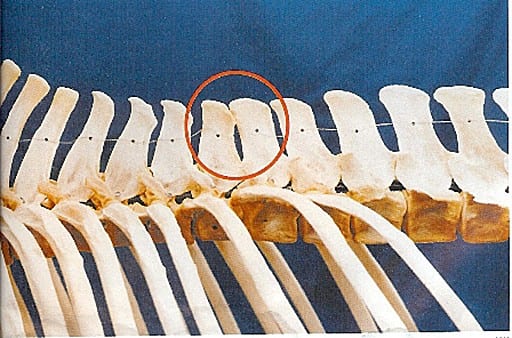
The construction of the vertebral column, supported by front and hind legs, is that of a bridge with sufficient stability (mainly passively via the nuchal ligament and superspinous ligament dorsally, and the white line ventrally) to support weight suspended underneath (GIT tract, foetus) and the horse during straight forward movement (see Image A).

This passive stability is supported by the direction of the dorsal spinous processes along thoracic and lumbar sections of the vertebral column. The first 14 DSP of the thoracic spine are directed toward the back, effectively functioning as a lever for this area, when the neck is lowered during grazing.

The 15th thoracic vertebrae is the area of a directional change (anticlinal vertebrae), after which the DSP are directed upwards and slightly forwards, before changing again in the sacral area. The latter arrangement, again, aiding in the ‘lifting of the back’ from behind, when the haunches/hind legs step under the body (see Image B).

When placing weight upon this structure from above, on an untrained horse, the horse automatically will brace the top line of their body, resulting in a contraction of the musculature, followed by a sinking of the back.

Due to the above described anatomical make-up of this area, this contraction will result in a narrowing of the intervertebral spaces, bringing the DSP closer together, tilting the pelvic area upwards and forwards, setting the hind legs further backwards and away from the body mass. In the front, the thorax (chest) will sink relative to the shoulders and the neck will come up, contracting the area at the base of the neck, in front of the horse’s shoulder blade.

In the training of the riding horse, it is important this passive mechanism is supported and strengthened to counteract the downward forces of the organs suspended within the abdominal cavity and the weight of the rider.

In order to achieve this, the horse has to learn to activate two major muscle chains. The ventral muscle chain is made up of the abdominal musculature, including the psoas group, and the flexor muscles running along the underside of the neck (omohyoid and sternohyoid muscles), and their associated subcutaneous fascia on the shoulder and the tensor facia latae around in the stifle area. This muscle chain has to be activated.

The dorsal muscle chain is formed by the neck and back extensors, including the multifidi muscles and the brachiocephalic muscle on the underside of the neck. Interestingly, the functional and anatomical connection of these two muscle chains is in the area of the hyoid bone (forming part of the base of the horse’s tongue).

This is important to understand because only with a relaxed and ‘chewing’ tongue base (i.e. hyoid) is the horse able to relax their jaw and poll, in turn coordinating supportive tension and relaxation along the ventral and dorsal muscle chains.

Achieving and maintaining this reaction to the bit is one of the cornerstones in classically correct equitation.

Images C, D and E (scroll down to download the illustrated version of this article), show the interplay of the dorsal and ventral muscle chains in three situations. Image C depicts a horse at rest in a neutral position. In this position, both muscle chains are relaxed and utilising a minimal amount of energy. The back is relaxed, and the horse is resting and not carrying a rider.

Image D shows a horse with a head and neck position that allows for the hind legs to step under, due to an engaged ventral muscle chain which, in turn, causes the dorsal muscle chain to function with the rhythmical ‘relaxed’ activity, which will show a swinging, oscillating back of a well engaged and ‘through’ horse – the aim of early dressage training.

Note, the neck is relatively long, the underline of the neck and jaw are open, the nose is just in front of the vertical, but with the nose at a level of the point of the shoulder. The engagement of the ventral muscle chain, and its connection via the abdominal musculature and facia, allows for a backward tiling of the pelvis and a stepping under of the hind legs.

Due to the connection of the long back muscles to the dorsal aspects of the last cervical vertebrae, the ‘telescoping’ forward of the base of the neck from in between the shoulder blades is vitally important to the correct positive tension of the dorsal muscle chain, allowing for a lifting of the back.

Image E shows the reaction of an untrained horse having to carry a rider or that of a badly trained horse, with neither muscle chain working correctly, the back legs camped out behind, tensed muscles and a sunken back.

Horses travelling like this will show lack of rhythm and short steps. In this position, the DSP will be forced closer together, laying the foundation for potential impingement and pain.In addition, when looking at the skeletal development of the horse, one can see whilst some of the long bones supporting front and hind legs are maturing from six months to four years, the fact is the vertebrae of the back do not mature fully until the horse reaches seven years of age or older in some individuals3.

Not taking any other factors into account other than skeletal maturity, it becomes obvious that adding a rider’s weight on the back of a young horse puts un-physiological strain onto as yet insufficiently mature bone tissue, and further sets the horse up for premature health issues.

Furthermore, bone growth in the long bones of the limbs is directed upwards, with the bony precursor cells that later develop into solid bone being aligned along the area of greatest stress, i.e. directed more vertically. So, whilst adding a rider’s weight is still not ideal, at least the stress is directed in line with the developing bone. This is not the case with the vertebral column, where bone growth is directed more horizontally and any weight added from the top will act as a force that is perpendicular to the direction of growth.

Most performance horses are backed at the age of two, three or four years old, possibly due to the pressures of their planned performance careers, which forces the riders, trainers and owners into a set time frame to achieve each competitive performance milestone4.

In order to ensure the proper development of a riding horse, it becomes apparent horses have to be trained and conditioned, both physically and mentally, in a knowledgeable, careful and patient manner, in order to avoid musculoskeletal issues; resulting in a horse which is capable to excel in equitation for many years, without taking undue damage to their body or mind.

It is to this end, the understanding of the principles of dressage training, as described by the Old Masters, becomes vitally important. Even prior to the advent of scientific study in equitation, and with possibly a limited knowledge of functional anatomy, but based on decades, and possibly centuries, of observational experience, a training system and philosophy was developed, which takes into account the above-mentioned challenges of the horse’s skeletal maturation and the need for complete re-training of its natural way of going, having to carry a rider without taking damage.

Gustav Steinbrecht said in his book ‘The Gymnasium of the Horse’: “The training of the horse is based on gymnastic exercises according to the laws of nature, through which the [horse’s] whole muscular system is being conditioned and put into a direction, which will be useful to the rider.” If you exchange the term ‘laws of nature’ with ‘functional anatomy’, it becomes apparent any horse needs to be trained with sufficient knowledge of functional anatomy and biomechanics.

To train a horse to be ridden without suffering damage, according to the Old Masters, a period of basic training of up to two years consisting of lungeing, in-hand work and ridden work is scheduled.

This training will teach the horse gradually to adopt and maintain a posture of ‘artificial equilibrium’, or balance, which results in its ability to carry a rider with ease. To achieve such balance, the trainer uses a system of varying amounts of pressure and pressure-release signals with legs, hands and the rider’s weight – collectively called ‘the aids’.

Once the horse has understood and is able to maintain this new balance, they are able to shift their centre of balance further toward their haunches and can take more weight onto their hind legs by learning to flex the large joints (the coxofemoral joint and the stifle joint), which is needed for collection. In addition, they can travel relatively straight (i.e. their hind legs follow the track of their front legs on straight lines, as well as on a circle, and take evenly-sized steps and push with similar force), and they are able to work in self-carriage, whilst carrying a rider through various exercises in all three basic gaits5.

The Old Masters understood this process cannot be rushed, it is different for each horse, and the training schedule has to be individualised according to the conformational and temperamental challenges given by each horse, and should not be submitted to the constraints of competition schedules.

As Heuschmann writes: “The back [of the horse] has been regarded as the critical centre of movement in the horse since 1896” and “The whole trunk musculature in a correctly ridden horse is designed for movement – his back was not built for direct weight-bearing”.

A recent study at UC Davis using radiographic imaging of the equine vertebral column compared the position of the DSP of a horse with their back in a neutral position with that of a horse mimicking an ‘engaged’ core (using their dorsal and ventral muscle chain). The x-rays clearly add visual and quantifiable evidence the spaces between the DSP are enlarging significantly along the thoracic and lumbar vertebrae, and especially at mid thoracic level.

Knowing the horse will not be able to protect their body naturally when carrying a rider, correct basic training following the above outlined principles becomes the responsibility of each trainer and rider for any horse destined for a long and healthy ridden life.

[wpdm_package id=66520 template=”link-template-button.php”]

List of references:

  1. Stashak T.S. Adams’ Lameness in Horses. 4th edition. (1987) Lea & Febiger
  2. Landman M.A.A.M. et al. Field Study of the Prvalence of lameness in horses with back problems. (2004) Veterinary Record. 155, 165-168.
  3. Bennett D. Timing and Rate of Skeletal Maturation in Horses. With Comments on starting young horses and the state of the industry. (2008).
  4. Dyson S. Lameness and Poor Performance in the Sports Horse: Dressage, Show Jumping and Horse Trials (Eventing) (2000). Proceedings of the Annual Convention of the AAEP. 308 – 315.
  5. Zich A. & Ohms D. Calme, En Avant, Droit. Ruhig Vorwaerts, Gerade (2007). WuWei Verlag.

Further reading about kissing spines:

  • Heuschmann G. Balancing Act. The horse in Sport – An Irreconcilable Conflict? (2011). Trafalgar Square.
  • Lin Y. Lumbar disease and Lameness in the Horse. (2010) In: Yang Z, Xie H. ed. Traditional Chinese Veterinary Medicine. Reddick FL Jing Tang. 253-262.
  • Henson F. Equine Back Pathology. (2009) Oxford, UK Wiley Blackwell
  • Developing your horse’s back. The biomechanics of engagement. Equitopia.
  • Racinet Jean-Claude. Falling for Fallacies. Misleading Commonplace Notions of Dressage Riding. (2009). Cadmos.
  • Stodulka R. et al. Medizinische Sattellehre. (2013) Olms.

This article about how to avoid kissing spines was published in Horses and People March 2018 magazine.


All About Soil. Part 2, The soil food web

In this Equine Permaculture series, we ‘dig deeper into soils’ and explore what soils are, how soil is formed, the different types of soil and how they sustain life through the soil-food-web. 

We will also discuss the importance of soil tests – in the lab and DIY – and how to interpret soil test results, as we build up the story of how all this knowledge can assist your pasture management decisions and the health of your horses. 

Last month, we began the series by brushing up on some facts about soil. If you missed that article you can read it here. Now, let’s dig deeper to meet the organisms that live in the soil and sustain all life.

Soils are complex mixtures of minerals, water, air, organic matter, and numerous micro and macro-organisms that are the decaying remains of once-living things. Soil forms on the surface of land – it is the ‘skin of the Earth’. Soil supports plant life and is vital to life on Earth, yet it is the most overlooked, underrated and taken-for-granted partner in our attempt to grow plants.

If we want to grow healthy pastures, we must take care of our soils, but how much time have you spent – as a horse and property owner – getting to know your soils, compared to the time you spend planning and managing your pastures?

Soil biology

The variety of organisms that contribute to the soil-food-web is astonishing. They range in size from the smallest single cell bacteria, algae, fungi and protozoa, to the more complex nematodes and micro-arthropods, to the recognisable earthworms, insects, small vertebrates and plants.

As these organisms eat, grow, move through, die-off and decay in the soil, they create humus (the organic material in soil) and they contribute to clean water, moderated water flow, clean air and, very importantly, to growing healthy plants that can feed our horses.

The exchanges between these organisms form a ‘web of life’ in exactly the same way as the interactions between flora and fauna that biologists study above ground. What most people forget to realise is the above ground interactions would not survive without the below ground systems functioning.

Soil biology is understudied when compared to biology above ground, yet it is vital for the health of our pastures, gardens, shrub lands and forests. If pasture soil is healthy, there will be high numbers of beneficial bacteria and bacterial-feeding organisms.

If the soil has received heavy treatments of herbicides, chemical fertilizers, soil fungicides or fumigants that kill these organisms, many of these tiny critters die, and the balance between pathogens and beneficial organisms is upset, allowing opportunistic, disease-causing organisms to become problems; not to mention negatively affecting the growth and quality of your pasture.

There are many reasons why the soil-food-web is an integral part of landscape processes, for example:

  • Soil organisms decompose organic compounds (including manure, plant residue and pesticides), preventing them from entering water and becoming pollutants.
  • They sequester nitrogen and other nutrients that might otherwise enter groundwater, and they ‘fix’ nitrogen from the atmosphere, making it available to plants.
  • Many organisms improve soil aggregation and porosity, thus increasing infiltration, and reducing runoff and soil erosion.
  • Soil organisms prey on crop pests and are food for above- and below-ground animals.

The soil-food-web

The soil-food-web refers to the community of organisms that live the entire or part of their lives in the soil. A food web diagram shows a series of exchanges (represented by arrows) of energy and nutrients as one organism eats another (see Image A).

The ‘fuels’ of the food web are the primary producers; these are photsynthesizers – the first trophic level (first position in the food chain), such as plants, lichens, moss, photosynthetic bacteria and algae, that use the sun’s energy to convert carbon dioxide from the atmosphere into the carbohydrates that allow them to sustain themselves and grow.

Most of the soil organisms get their energy and carbon by consuming plants, other organisms and waste by-products (second to fifth trophic, or food chain levels). A few bacteria, called chemoautotrophs, get energy from nitrogen, sulphur or iron compounds, rather than carbon compounds or the sun.

As organisms decompose complex materials or consume other organisms, nutrients are converted from one form to another, and are made available to plants and to other soil organisms. This means all plants – grass, trees, shrubs, agricultural crops and so on – depend on the food web for their nutrition, and this is why I often highlight we do not feed pasture plants directly, we feed them through the soil organisms that make up the soil-food-web.

The role of soil organisms

Growing and reproducing are the primary activities of all living organisms. As individual plants and soil organisms work to survive, they make exchanges with each other.

By-products from growing roots and plant-residue feed soil organisms. In turn, soil organisms support plant health as they decompose organic matter, cycle nutrients, improve soil structure and control the populations of soil organisms, including crop and pasture pests.

Let’s have a closer look at some of the soil organisms that make up the soil-food-web and their functions.

Bacteria

Our native soils are full of bacteria, both beneficial and pathogenic. A spoonful of ordinary backyard soil may contain billions of bacteria of thousands of different kinds, many of them specific to a region. In general, bacteria help water move through the soil more easily, they recycle organic matter and they help ward-off soil diseases.

There are many types of bacteria, but one of the most important groups you may have heard of is the nitrogen-fixing bacteria. These bacteria are especially found on the roots of leguminous plants and shrubs (for example clover, lucerne and acacias).

Nitrogen-fixing bacteria are capable of transforming atmospheric nitrogen into fixed nitrogen (inorganic compounds usable by plants). They dine on particles of humus (organic matter), creating a waste product called ‘bacteria manure’ that adds new forms of organic content to the soil.

Many plants absorb nutrients most efficiently through this bacterial waste product, so the more nitrogen-fixing bacteria in the soil, the better. This is why we often want to plant legumes in our pastures. Lucerne, for example, is one of those plants we like to have in pastures because, in symbiosis with Rhizobium bacteria, it can make athmospheric nitrogen more available to the plants and because it offers great feeding value to grazing animals.

Bacteria and bacteria’s waste products are also eaten by fellow soil dwellers of many kinds, so they feed other organisms in the soil, in addition to feeding our plants. Our pastures and gardens soils are typically dominated by beneficial bacteria.

Protozoa

Protozoa (single-cell organisms), comprised of three groups; (1) flagellates, (2) amoebae (both naked and testate), and (3) ciliated are important in maintaining plant-available nitrogen and mineralisation processes and, as bacterial-feeders, are important in controlling bacterial numbers and community structure in the soil.

The presence or absence of certain protozoa species is indicative of the presence of certain hazardous wastes and, therefore, can be a very useful indicator of certain types of environmental impacts.

Fungi

Many horse owners assume fungi must be bad for the soil, but this is far from the truth. When most people think of fungi, they think of mushrooms. They also tend to think of fungi as plants.

A characteristic of plants is they inhale carbon dioxide (CO2) and exhale oxygen (O2). Fungi actually breathe in O2 and exhale CO2, just like humans. Interestingly, fungi have survived two mass extinctions over 65 million years and the only plants that also survived those extinctions are the ones that formed associations with fungi. This should highlight the health implications of not managing soil and all the life it contains correctly.

Fungi are vitally important to soil health and beneficial forms are found in virtually every kind of soil on earth. Like bacteria, fungi break down organic matter by digesting and excreting humus, followed by recycling nutrients through the soil-food-web.

Mycorrhizae are among the best known soil fungi. They attach themselves to the roots of plants and create a mesh of fine feeder ‘rootlets’ that act like pumps, pulling nutrients and water into the host plant’s root system. They have a symbiotic relationship because, in return, the plants exchange carbohydrates with the mycorrhizae fungi.

In effect, the fungi networks – chains of microscopic strands (mycelium) that have been recorded at lengths and depths of approximately 10 kilometres – increase the surface area of the roots and, thus, the plant’s ability to absorb nutrients.

For example, plants will send out chemical signals to fungi telling them they require magnesium – an element essential for plant growth. The fungi networks can search the surrounding areas and deliver the required magnesium to the plant in exchange for the food the fungi need: carbohydrates.

Healthy woodland soils are dominated by fungi, meaning there are more fungal creatures than bacteria in the soil. Whereas pasture soils tend to be dominated by bacteria.

Nematodes

Nematodes (non-segmented worms, such as parasitic worms), like fungi, are usually assumed to be pathogens, but beneficial nematodes abound in the soil. Nematodes are one of the most ecologically diverse groups of animals on Earth, existing in nearly every habitat.

Nematodes eat bacteria, fungi, algae, yeasts and microalgae (diatoms), and may feed on several small invertebrate animals, including other nematodes. In addition, they can be parasites of invertebrates, vertebrates (including horses and humans) and plants. Nematodes range in length from the tiniest marine nematode measuring just 82 μm (micrometres or 0.00082 of a centimetre) to the massive nine metre whale parasite, but most of the species found in soil are between 0.25mm and 5.5mm long.

Nematodes are recognised as a major consumer group in soils, generally grouped into four to five trophic categories based on their food preferences, the structure of the stoma (mouth) and oesophagus, and method of feeding.

Plant-feeding nematodes possess stylets (spear-like structures in the mouth) with a wide diversity of sizes and structure. They are the most extensively studied group of soil nematodes because of their ability to cause plant disease and reduce crop yield.

Fungal-feeding nematodes have slender stylets, but are often difficult to categorise and have been included with plant-feeders in many ecological studies.

Bacterial feeding nematodes are a diverse group, and usually have a simple stoma in the form of a cylindrical or triangular tube, terminating in a teeth valve-like apparatus.

Predatory nematodes are usually large species with equally large ‘mouths’ and powerful ‘teeth’.

Omnivores (ones that eat other organisms and plants) are sometimes considered as a fifth category in the food chain of soil nematodes. They can fit into one of the categories listed above, but also ingest other food sources.

As an example, some bacterial feeders may also eat protozoa and/or algae, and some stylet-bearing nematodes may pierce and suck algae, as well as fungi and/or higher plants. Stages of animal parasitic nematodes, such as hookworms, may also be found in soils, but generally are not common in most soil samples.

Nematodes and protozoa function as regulators of mineralisation processes in soil. For example, bacterial- and fungal-feeding nematodes release a large percentage of nitrogen when feeding on their prey groups and are, thus, responsible for much of the plant-available nitrogen in the majority of soils.

Nematode-feeding also favours certain species of bacteria, fungi and nematodes and, thereby, influences soil structure, carbon utilisation rates and the types of substrates present in soil.

Arthropods

These critters are recyclers that feed on bacteria, fungi and earthworms, as well as plant particles. They include micro-arthropods – very small organisms, like mites – and larger organisms, like sow bugs, springtails, spiders and centipedes.

The micro-arthropods stay put in the soil, consuming debris, and making nitrogen and other nutrients more readily available to plants and other soil biota. Arthropods also control the population levels of other organisms in the soil, keeping things balanced naturally.

Earthworms

Of all the members of the soil-food-web, earthworms need the least introduction. Most people become familiar with these soft, slimy invertebrates at a young age.

Earthworms are hermaphrodites, meaning they exhibit both male and female characteristics. They are major decomposers of dead and decomposing organic matter, and derive their nutrition from the bacteria and fungi that grow upon these materials. They fragment organic matter and make major contributions to recycling the nutrients contained within.

Earthworms occur in most temperate soils and many tropical soils. They are divided into 23 families, more than 700 genera and more than 7,000 species. They range from an inch to two yards in length and are found seasonally at all depths in the soil.

The fuel of the food web

Organic matter is comprised of different types of compounds – some more useful to organisms than others. In general, soil organic matter is made of roughly equal parts humus and active organic matter.

  • Active organic matter is the portion available to soil organisms.
  • Bacteria tend to use simpler organic compounds, such as root exudates or fresh plant residue.
  • Fungi tend to use more complex compounds, such as fibrous plant residues, wood and soil humus.

As mentioned before, bacteria dominated soils are typically pastures, whereas fungi dominated soils are usually woodlands and forests.

Intensive cultivation of soil triggers spurts of activity among bacteria and other organisms that consume organic matter (convert it to CO2), depleting the active fraction first. Practices that build soil organic matter (reduced tillage and regular additions of organic material – by spreading mulch and compost) will raise the proportion of active organic matter long before increases in total organic matter can be measured.

As soil organic matter levels rise, soil organisms play a role in its conversion to humus – a relatively stable form of carbon that remains sequestered in soils for decades or even centuries.

Soil organic matter is the depot for the energy and nutrients used by plants and other organisms. Bacteria, fungi and other soil dwellers transform and release nutrients from organic matter. These micro-shredders, immature oribatid mites, skeletonise plant leaves. This starts the nutrient cycling of carbon, nitrogen and other elements, such as minerals, ultimately feeding our pasture plants!

Habitat of soil organisms

The organisms of the food web are not evenly distributed through the soil. Each species and group exists where they can find appropriate space, nutrients and moisture. They occur wherever organic matter occurs – mostly in the top few inches of soil, although microbes have been found as deep as 16km in oil wells. Soil organisms are concentrated in several areas, including:

  • On the surface of soil aggregates. Biological activity, in particular that of aerobic (requiring oxygen) bacteria and fungi, is greater near the surfaces of soil aggregates than within aggregates (lacking oxygen). Within large aggregates, processes that do not require oxygen, such as denitrification, can occur. Many aggregates are actually the faecal pellets of earthworms and other invertebrates.
  • In litter. Fungi are common decomposers of plant litter because litter has large amounts of complex, hard-to-decompose carbon, such as lignin. Fungal hyphae (fine filaments) can ‘channel’ nitrogen from the underlying soil to the litter layer. Bacteria cannot transport nitrogen over distances, giving fungi an advantage in litter decomposition, particularly when litter is not mixed into the soil profile.

However, bacteria are abundant in the green litter of younger plants, which is higher in nitrogen and simpler carbon compounds than the litter of older plants. Bacteria and fungi are able to access a larger surface area of plant residue after shredder organisms’, such as earthworms, leaf-eating insects, millipedes and other arthropods, turn litter into smaller chunks.

Interestingly, by adding different type of green (nitrogen) litter versus older (carbon) litter to your compost or manure pile, you can create more bacterial- or fungi-dominated compost. Bacterial-dominated compost is preferred for pastures as mentioned earlier.

  • Around roots. The rhizosphere is the narrow region of soil directly around roots. It is swarming with bacteria that feed on discarded plant cells, and the proteins and sugars released by roots. The protozoa and nematodes that graze on bacteria are also concentrated near roots. Thus, much of the nutrient cycling and disease suppression needed by plants occurs immediately near roots.
  • On humus. Fungi are common here. Much of the organic matter in the soil has already been decomposed many times by bacteria and fungi, and/or passed through the guts of earthworms or arthropods. The resulting humic compounds are complex and have little available nitrogen. Only fungi make some of the enzymes needed to degrade the complex compounds in humus.
  • In spaces between soil aggregates. Those arthropods and nematodes that cannot burrow through soil instead move in the pores between soil aggregates. Organisms that are sensitive to dehydration, such as protozoa and many nematodes, live in water-filled pores.

When are soil organisms active?

The activity of soil organisms follows seasonal patterns, as well as daily patterns. In temperate systems, the greatest activity occurs in late Spring when temperature and moisture conditions are optimal for growth.

In tropical systems, this is more during the Summer months (wet-season). However, certain species are most active in the Winter, others during dry periods and still others in flooded conditions.

Not all organisms are active at a particular time. Even during periods of high activity, only a fraction of the organisms are busily eating, breathing and altering their environment. The remaining portion is barely active or even dormant within the soil.

Many different organisms are active at different times and interact with one another, in addition to interacting with plants and the soil. The combined result is a number of beneficial functions, including nutrient cycling, moderated water flow and pest control.

So… How does the soil-food-web impact my pasture?

The living component of soil, the food web, is complex and has different compositions in different ecosystems. Management of our pastures benefits from and affects the soil-food-web.

When practising pasture management, it is not the vegetation that is replenished, but the soil. The best means to achieve this is to replicate naturally-occurring nutrient cycles: we need to feed the soil through a process of breaking down organic matter with soil microorganisms, bacteria and fungi.

In a natural system, many species of plants and animals play a role in these processes. However, on farming land, it is the owner or manager’s responsibility to oversee the animals and return waste (via compost or mulch) to the soil and plants.

Permaculture is concerned with the restoration and development of soil as a priority, because healthy soil produces healthy plants and grasses – which help produce healthy horses!

One of the most difficult aspects of teaching people about working with natural systems and improving pasture health is that permaculture is a way of thinking. It is not a product, it is not something that can be bought off the shelf from the local rural supplier, spread, sprayed or watered.

The difference is, once natural health has been allowed to return through interaction in the soil-food-web, natural balance can be restored. Natural systems are the only science recognised by nature. All over the world, when natural systems are disregarded, the land suffers and, in the long-term, attracts high input costs, such as herbicides, chemical fertilisers, and so on.

However, this not to say we can use certain human tools, and agricultural and biological manufactured products, but we need to be aware there is no one solution or fix to our soil, weed or pasture problems, but rather, we need to adopt an integrated whole-system approach to our management.

One of such tools is conducting soil tests, which offers us a reference (current status of our soil) and allows us to monitor our outcomes of our farming practices. These soil tests should not only provide us with a nutrient/mineral profile, but also with an indication of our soil carbon and soil biology, often-overlooked aspects!

Thus, in the next part of this series, we will discuss the importance of soil tests – in the lab and DIY – and how to interpret these soil test results.

Further reading:

  1. Soil Biology Primer – Natural Resources Conservation Services (United States Department of Agriculture) – www.nrcs.usda.gov
  2. Soil Health, Soil Biology, Soil borne Diseases and Sustainable Agriculture. A Guide. By G. Stirling et al. 2016. CSIRO Publication, QLD, Australia.

[wpdm_package id=49043 template=”link-template-button”]

Starting Romeo: Part 1 Haltering and Tying Up

In this brand new, exclusive training series, Kate Fenner from Kandoo Equine will take you deep into starting a horse under saddle. Join us for the whole of 2018 and watch the un-started, five-year-old Friesian gelding, Romeo, gradually work through each of the foundation lessons and, why not follow along with your own horse? Part 1 starts with haltering and tying up and picking up your horse’s feet.

All of the lessons will be suitable for any horse and are designed to build a solid foundation from which to train. Plus, you will have free access to accompanying video of each lesson!

So, whether your horse is already going under saddle, but you feel there are some areas that need a little work, or your horse’s foundation training has a few ‘holes’ and resembles Swiss cheese, you’re in the right place!

Work your own horse through each of the foundation training lessons with Romeo and you’ll be amazed at the results you achieve.

Meet Romeo

Meet Romeo, our case-study horse for the next several training articles. Romeo is a five-year-old Friesian gelding who has been, up until now, enjoying life in the paddock with his herd.

Romeo was gelded as a four-year-old, and had sufficient handling required for veterinary and farrier visits, as well as trailer loading lessons (as discovered when he moved state six months ago).

In this, the first of the series, we’ll take Romeo through the basic handling, including haltering and grooming, tying up and picking up feet.

Haltering

Before we do anything, we need to catch the horse! Romeo is 16hh, and I haven’t yet taught him to put his head down for bridling or haltering.

Many of us halter a horse by flicking the head piece over the poll and then buckle it up but there are a couple of problems with this popular method. It’s often very difficult to do with a tall horse and we risk slapping the horse on the cheek when passing the head piece over.

I have an alternative haltering method that I developed when working with Australian Brumbies.

For those tall or nervous horses, there are three steps to easier haltering:

  1. Hold the long end of the head-piece with your right hand and have the halter on the righthand side of the horse’s neck. (Download the pdf version of the article to see Image B).
  2. Hold the nose-piece with your left hand and maneuver the halter, so the head-piece is close to the poll. (Download the pdf version of the article to see Images B, C and D).
  3. Pull the head piece tight and, at the same time, slip the muzzle into the nose-piece. (Download the pdf version of the article to see Image E).
  4. Lastly, fasten the halter.

Watch the free video of this lesson here.

Grooming

Of course, when it comes to grooming, we all know what to do, but you can also use this time as a test of your horse’s emotional level and decide whether or not they are ready to continue with a new lesson.

I like to do as much work as I can with these educationally young horses with the horse free, rather than tied up, because I think we get more information from the horse this way.

I keep the long, soft lead rope on and pop it over his neck if I feel he might move off. If he does move off, he’s telling me something – he’s not ready for whatever it is I’m doing.

Romeo is quite an emotional horse, he’s very vigilant when in the paddock and very aware of everything going on in his immediate vicinity. This makes him a delight to train, because it’s so easy to see when he’s not 100% confident with the lesson I’m teaching.

You’ll notice in the photos his ears are always on me and, as each short lesson progresses, his head elevation lowers albeit ever so slightly.

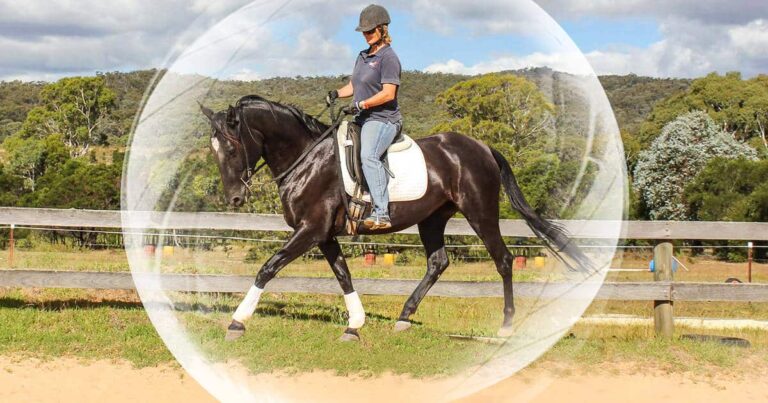
So, while it looks like I’m grooming Romeo to make him pretty for the camera, I’m actually building our bubble of communication – I’m getting Romeo into the Engagement Zone, focused and ready to learn.

I do this by being very aware of his head elevation and ear positioning. I want him to be slightly more emotional than he would be in the paddock, but not emotional enough to want to leave.

As his emotional level increases, so does his head elevation (this will happen before his feet move). I like to see his ears relaxed, but on me so, when his attention leaves and he looks at something in the distance, I know I need to bring it back on to me.

This pre-ride or pre-lesson time is precious and informative. This forms a good deal of what your horse will take away from the day’s activities. We’ve all done it – been in a hurry and impatient, or late to ride and rushed through this fundamental preparation work. It only needs to take five minutes. We’ve all got five minutes, right?

Watch the free video of this lesson here.

Tying up – the Idolo advantage

The are many different schools of thought on tying a horse. As a trainer, I see a lot of horses that have learned to pull back when tied and require re-training. For this reason, I now teach all horses to tie using a idolo tie (or similar). This simple plastic device prevents the horse from getting hurt, should they pull back. (See images E, G & H on the next page.

You’ll notice when horses do pull back, they usually only go back a metre or so, just until the tie breaks (if your horse runs off it probably indicates something other than a tying up issue).

As great pattern learners, horses learn this pattern particularly fast, because pulling back hurts and pain is an effective motivator (but not one we ever want to use, of course).

The pattern becomes: tie up, pull back, resulting in pressure and pain, the tie or head collar breaks, and release of pressure (negative reinforcement) follows.

As with all well-learned patterns, this pattern usually takes less and less time to complete, and soon you have a horse that is pulling back as soon as they are tied.

The idolo tie breaks that cycle, because it allows the rope to pull through the device, and the horse doesn’t get hurt or loose. Once you remove pain from the situation, the horse quickly learns pulling back is unnecessary.

Of course, there are various other recommendations, such as tying to a piece of string. This is certainly better than tying an untrained horse hard to a rail, but pulling back will still cause a significant amount of pain, especially in a thin rope halter. Have you ever tried to break a piece of bailing twine?

The advantage of webbing or leather halters is they will break in these situations. So, while I wouldn’t normally recommend a piece of equipment on the basis that it was more likely to break, in this case I certainly would. Thin rope halters can do untold damage when horses pull back.

Picking up feet

Romeo came to me as an unhandled yearling and I used the following method to teach him to pick up his feet. This is also a great method to use for youngsters or horses that find this difficult.

As with the grooming, it’s a good indication whether your horse is confident with the handling, if they can be loose when you are doing the exercise.

If you don’t have a small, safe area, then tying the horse may be your only option.

Beginning with the front legs, start by grooming all the way down the leg and then use a stiff rope, such as a lariat, to rub the leg. Once the horse is comfortable with that, it’s time to lift the foot off the ground.

Picking up the feet is like any other lesson and has the following components:

  1. A SPOT on the horse you want to move – here it’s the left front foot.
  2. A DIRECTION you want that to go – in this case, we want upwards.
  3. A MOTIVATOR to get the horse to move – ours will be simply holding up the fetlock.
  4. A REWARD for performing the behaviour – by placing the foot down and praising the horse.

Simply holding the fetlock joint should be motivating enough for the horse to lift their foot. The aim is for you to be able to lift the foot and then place the foot back on the ground – hopefully, before the horse takes it away.

I know you often see people sticking thumbs into the tendons to get the foot up and then chasing the horse around the paddock, while holding on to the foot, but this isn’t a good introduction to, what should be, a simple lesson.

The more you can break the lesson down for the horse, the quicker they will pick it up. At first, the horse may just take the weight off the leg and you can reward that – this will shape the behaviour.

For the inexperienced or unknown horse, it’s best to be cautious when approaching the hind legs. I use a lariat because it’s stiff and I can get the horse to step into it, but you can use a long lead rope if you don’t have a lariat.

Loop the lariat around the horse’s left hind fetlock (see Image B) and lift the leg slightly off the ground (Download the pdf version of the article to see Image C).

The next step is to work your hand down the leg to accustom the horse to that feeling. Use the lariat to lift the foot a few more times, while you continue to handle the leg and, finally, you should be able to easily take the foot in your hand and place it back on the ground. (Download the pdf version of the article to see Image C, D & E).

There are three reasons it’s important you place the foot back on the ground and not drop the foot. These are:

  1. You’re teaching the horse a pattern so they need to have a clear start (cue to lift foot), middle (stand while foot is held) and end (foot is replaced on ground and horse is praised). Without this ‘end’ step, the horse may think the pattern ends with them taking the foot away.
  2. You don’t want to surprise the horse, as such, your pattern needs to be clear and consistent.
  3. When you drop a foot, it often lands on the toe and this can be very uncomfortable for the horse. As always, we want this lesson to be a pleasant experience.

Don’t forget to watch the free video of this lesson here!

Next…

In the next article, Romeo starts bridling and ‘give to the bit’ work. We’ll take a close look at how to introduce the bridle and take this use of negative reinforcement that we worked on today to a whole new level by starting to build our bubble of communication and get Romeo into the Engagement Zone.

Much fun, see you then!

Check out Dr Kate Fenner’s podcast for more step-by-step, ethical and sustainable horse training courses.

This article was published in Horses and People March 2018 magazine or buy the whole series as an e-book.

The Confident Horse

The confident horse. We talk a lot about confident riders, about losing our own confidence with horses and about strategies to re-gain confidence, but what about the horse’s confidence? Surely that’s just as important. After all, our horse is the other half of the partnership.

The Confident Horse

What is confidence?

For riders, confidence is about knowing what might happen next. We talked about this in more detail in the previous article ‘Skyrocket your Confidence’.

Does our horse understand and obey our cues? If something unexpected happens, will our horse spook or bolt?

Of course, we can never be 100% sure of what our horse will do, but if we have trained them ourselves, then we will have a much clearer idea of the possibilities and outcomes.

For horses, I believe, it’s much the same. The horse wants to know whenever they find the correct answer to our requests, the pressure will be released, because their rider is predictable and consistent, and the patterns that have been established will continue to provide reward and release of pressure.

So, why do horses lose confidence and become anxious? 

I think the biggest reason is a lack of consistency, when:

  • The horse gets surprised by cues,
  • Isn’t working in the Engagement Zone (their attention is elsewhere),
  • Has poor, but well-established, patterns of behaviour set up,
  • Has been subjected to positive punishment (either intentionally or unintentionally, as the result of poorly timed negative reinforcement),
  • Has been chased (again intentionally or unintentionally in the round yard or at liberty), or
  • Has been successful in obtaining a release of pressure by offering a flight response.

Knowing this, how can we tell if a horse is indeed confident or lacking confidence?

A confident horse lacks anxiety, is relaxed and calm, appears keen to come in to work and makes it easy for you to feel all of these things.

Consistency 

Taking responsibility for your horse’s welfare encompasses their training. By training your horse yourself, you will automatically build their confidence.

Of course, you need to be consistent with your training. By this, I don’t mean you need to train your horse every day or even every week. I find horses have excellent memories for well-learned lessons and a recent study I conducted suggested working a horse regularly did not improve learning efficiency. This means horses in regular work are not necessarily learning any faster than those rarely worked.

That’s worth remembering, because people often think they have to ‘start at the beginning’ when a horse has been out of work for an extended period and I don’t think anything could be further from the truth.

Rather than approaching it as starting from the beginning, think about it as giving the horse a quick refresher course – perhaps your first lesson or two, and then continuing on from where you left off. Obviously remain mindful of your horse’s physical fitness level and ability to concentrate after a lengthy spell.

Probably the most important aspect of training is to have the horse relaxed and engaged with you. I call this working in The Engagement Zone.

To recap on The Engagement Zone article, see the March 2017 issue of Horses and People.

The Engagement Zone relates to your horse’s arousal level – the physiological parameters, such as heart rate, that reflect your horse’s emotional state – and this needs to be higher than it would be when resting, but not so high as to cause anxiety or stress in the horse. I’ve found this (while training with a heart rate monitor on the horse) to be only about 15% above resting, so not hugely high.

If you’d like to learn even more about The Engagement Zone and some of the first scientific attempts to test it, you can download the following article: http://journals.plos.org/plosone/article?id=10.1371/journal.pone.0174313.

Timing 

We talk about pressure-release, but when do you release? The quicker your release, the faster your horse will learn.

With trailer loading, for example, as soon as you see the foot begin to move forward, stop tapping and reward the horse. Sometimes, and especially in the first attempts, you can even release on the ‘thought of forward movement’, when you see the horse moving their weight forward when asked.

This is called ‘shaping’. It involves rewarding an approximation of the behaviour. In the trailer loading example, moving the weight forward, but not the feet, in order to make the request really clear for the horse.

Once the horse learns where the release comes from, you can begin working on increasing the level of the response.

Have a look back at the trailer loading article we printed in the May 2017 issue of Horses and People to see how that behaviour was shaped. You can also find it online here.

I think one of the best lessons for you to teach when you want to improve and practice your timing is ‘Give to the Bit’.

The two-part series we titled ‘Learning to Give’ appeared in the July and August 2017 issues of Horses and People.

This lesson starts on the ground and, because you’re only asking for a small movement to begin with, the horse gets many of releases and a lot of praise, making it fun, plus you get tons of opportunities to practice your timing!

Pressure 

One of the most common questions I get asked is: “How much pressure should I use [to reward my horse]?”

There’s no single answer to this, because it will depend on your horse, their history, whether or not they’ve been habituated to pressure, whether they’re relaxed or anxious, and many other factors, including their education and previous experience with the application of negative reinforcement.

However, you horse will tell you! Pressure is your motivator, which means you will require as much pressure as it takes to motivate your horse to make the movement you are requesting.

Let’s take the example of ‘Hips to the Fence’ for mounting, which we published in the April 2017 issue of Horses and People.

With some horses, all you will need to do is raise the whip in the direction of the hindquarter, and the horse will start moving and looking for answers. If, with this horse, you then went on to tap the hip, their emotional level would likely increase well above The Engagement Zone (the optimum learning state) – and that would be too much pressure.

Another horse may be desensitised to the whip and require tapping on the hip and, if that didn’t produce a response, perhaps tapping a little faster will.

Remaining mindful of the horse’s emotional level the first few times you apply pressure will tell you the baseline amount required to motivate your horse.

The thing to remember is the horse is learning a pattern, so the pressure itself is not nearly as important as the timing of the release, which must be immediately the behaviour is performed.

With each request, as the pattern establishes in your horse’s mind, you should require less and less pressure to get the same result.

Have a look at the ‘Hips to the Fence’ video on my free training page and see how the horse, after just a few minutes and getting the emotional level correct, responds by moving his hips to the fence with just a click of the fingers and no whip at all. Check it out at: https://www.kandooequine.com/products/free-training-tips/categories/229716/posts/697015!

Breaking it down 

Breaking it down means knowing what you’re going to teach, each individual step and having a lesson plan.

Remember when that teacher at school told you that you were good at something? Perhaps you were, but perhaps you weren’t and they just wanted to encourage you. You can do the same thing for your horse.

If your horse starts to get anxious, take them back to something they know and reward that behaviour. Make a big fuss, with lots of scratches and telling them how clever they are.

Often, when we’re concentrating on getting something right, be it a flying change or just riding a 20 metre circle, we hold our breath, tense up and completely forget to praise the horse.

That’s why I particularly like the scratch on the wither as a reward. I teach it early on, when a lot of people might be using a food treat, because I know when I’m working on my flying changes later, I can reach down and scratch my horse, but I can’t pop a carrot in his mouth.

When I do reach down, I am still holding the rein but, because I’ve moved my hand, the horse gets an automatic release of pressure. The movement also relaxes me, as I remember it is the horse that is learning and I want him to be relaxed too.

If you’re working on creating a confident horse and you want to practice breaking a lesson down, then I suggest you have a go with ‘Long-Reining’.

The two-part series on long-reining appeared in the October and November 2017 issues of Horses and People.

As part of breaking the lesson down for your horse, you’ll need to start with ‘Give to the Bit’, and then get to work on the habituation to the lines before your horse is ready to long-rein.

If you’re interested in doing more habituation work with your horse and learning more about breaking lessons down into manageable chunks, there’s a free video on the subject on my website. You’ll find it at: https://www.kandooequine.com/p/premier-free-stuff.

Relaxation

Relaxation is paramount. It is essential the horse is relaxed before, during and after the lesson to optimise training.

A nervous or anxious horse is unlikely to be learning the things you are teaching. A further problem with the anxious horse is one possible response to anxiety is flight. If the horse successfully manages to release pressure by escaping with flight, they then learn an incorrect response.

It can be difficult to un-train that flight response as fear is such a powerful motivator. To check for relaxation, go back and have a look at The Engagement Zone article and then apply this when teaching one of the other lessons, such as trailer loading.

If you’re right at the beginning of your training journey or you have a new horse, pop along to the ‘Head Down’ article and teach this simple lesson to your horse.

Not only will it help you learn about how much pressure your horse requires and show you when to release that pressure, but you’ll also be setting your horse up for a great bridling session.

This article was published in Horses and People February 2018 magazine.

All About Soil. Part 1, Facts about soil

Facts about Soil. In this Equine Permaculture series, All About Soils, we ‘dig deeper into soils’ and explore what soils are, how soil is formed, the different types of soil and how they sustain life through the soil-food-web. 

Furthermore, we discuss the importance of soil tests, in the lab and DIY, interpreting these soil test results, and how they may assist our soil and pasture management on the property. 

But, before we start digging up the dirt, let’s brush up on some facts about soil. 

Soils are complex mixtures of minerals, water, air, organic matter, and numerous micro and macro-organisms that are the decaying remains of once-living things. It forms at the surface of land – think of it as the “skin of the earth.”

Soil is capable of supporting plant life and is vital to life on earth. In other Equine Permaculture articles, we have focused on the importance of taking care of our soils, so we can grow healthy pastures to feed our horses.

The soil is perhaps the most overlooked, underrated, taken for granted, but major partner in growing plants. When managing pastures, how many horse and property owners have passed over getting to know their soil – reading up on facts about soil – in favour of pasture planning and management?

What is soil?

Like many common words, the word ‘soil’ has several meanings. The word is also known as ‘dirt’, ‘waste’ or ‘earth’. In its traditional meaning, soil is the natural medium for the growth of plants.

Soil has also been defined by the FAO (Food and Agriculture Organization of the United Nations) as a natural body, consisting of layers (soil horizons) that are composed of solids (minerals and organic matter), liquid and gases, that occurs on the land surface, occupies space, and is characterised by one or both of the following: horizons, or layers, that are distinguishable from the initial material as a result of additions, losses, transfers and transformations of energy and matter, or the ability to support rooted plants in a natural environment.

Lengthy definition, that. But, reading closely, soil has many things in it: nutrients, minerals, dead, decayed stuff, water and other liquids, and air and other gases. And, surprise, soil has horizons, just like the atmosphere, and each is easily identifiable from the other. We will explain these in a bit more detail further in this article.

Soil is the end product of the combined influence of climate, topography and organisms (flora, fauna and human) on parent materials (original rocks and minerals) over time. As a result, soil differs from its parent material in texture, structure, consistency, colour, chemical, biological and physical characteristics.

Soil is an essential component of  ‘Land’ and ‘Eco-systems’. Both are broader concepts encompassing vegetation, water and climate – in the case of land. And, in addition to those three aspects, also social and economic considerations in the case of eco-systems.

Soil composition

Soil is a mishmash of many things from all over the place – small pieces of broken rock, fallen leaves, dead critters, decomposed tree branches and, of course, decayed plants, to name a few. Additionally, soil acts like a sponge storing 0.01% of the total water on Earth within its pores. To be exact, a typical healthy soil sample contains the following:

  • 45% minerals
  • 25% water
  • 25% air
  • 5% organic matter

Soil also holds many living organisms. An acre of soil can hold about 5-10 tonnes of living beings. If you conduct a microbiology soil test, you may find one gram of soil holds as much as 5,000-7,000 bacteria species.

Soil formation

Soil formation typically happens over many years. Natural processes, like weathering, erosions, rains, floods, hurricanes, thunderstorms, tornadoes and the like, all contribute to soil formation. Lichen and plant roots also help break down rocks into little pieces to become part of the new soil.

Because of the different materials and processes that affect its formation, soil comes in different colours and textures. Soil could have such lively colours, such as red, yellow and white but, most of the time, soil is black, brown or grey. Due to the sand, silt, clay and other mineral particles in it, soil may be smooth, creamy, rough, crumbly and sticky to the touch.

Parent materials

Soil minerals form the basis of soil. They are produced from rocks (parent material) through the processes of weathering and natural erosion. Water, wind, temperature change, gravity, chemical interaction, living organisms and pressure differences all help break down this parent material.

The types of parent materials and the conditions under which they break down will influence the properties of the soil formed. For example, soils formed from granite are often sandy and infertile. On the other hand, basalt under moist conditions breaks down to form fertile, clay soils.

There are five main interacting factors that affect the formation of soil:

1. Organisms

Soil formation is influenced by organisms (e.g. plants), micro-organisms (e.g. bacteria or fungi), burrowing insects, animals and humans. As soil forms, plants begin to grow in it; they mature, die and regrow. Their leaves and roots are added to the soil.

Animals eat plants; their wastes and, eventually, their bodies are added to the soil. This begins to change the soil. Bacteria, fungi, worms and other burrowers break down plant litter, and animal wastes and remains to eventually become organic matter. This may take the form of peat, humus or charcoal.

2. Climate

Climate (rainfall, temperature and wind) influences the rate of weathering and affects plant growth. Temperature also affects the rate of weathering and organic decomposition. With a colder and drier climate, these processes can be slow, but with heat and moisture, they are relatively rapid.

Rainfall dissolves some of the soil materials and holds others in suspension. The water carries these materials down through the soil. This is known as leaching. Over time, this process can change the soil, making it less fertile.

3. Topography

The shape, length and grade of slope affects drainage. Aspect determines the type of vegetation on a slope and the amount of rainfall received. These factors cause variation in soil formation.

4. Time

The length of time that soil materials have been weathered influences soil properties. Minerals weathered from rocks are further weathered to form materials such as clays, and oxides of iron and aluminium.

5. Natural erosion

Soil materials are progressively moved within the natural landscape by the action of water, gravity and wind. For example, heavy rains erode soils from the hills and deposit them in lower areas, forming deep soils. The soils left on steep hills are usually shallower. Transported soils include alluvial (water transported), colluvial (gravity transported) and aeolian (wind transported) soils.

Soil horizon (soil layers)

There are different types of soil, each with its own set of characteristics. Dig down deep into any soil and you’ll see that it is made of layers, or horizons (O, A, E, B, C, R – see Image C).

Put the horizons together and they form a soil profile. Like a biography, each profile tells a story about the life of a soil. Most soils have three major horizons (A, B, C) and some have organic horizon (O), eluviated horizon (E) and/or bedrock horizon (R).

Horizon O (humus or organic) is the topsoil that we walk on. It’s one-inch thick and made up of decayed, organic stuff that feeds the soil and keeps it healthy. Horizon O is the most fertile, productive layer because it contains humus and lots of microorganisms that make nutrients available to plants.

Horizon A (topsoil) is the layer after Horizon O. It’s also part of the topsoil, composed of roots and beneficial micro-organisms, like mycorrhizae and fungi, that feed on the waste materials shed off by roots. Of course, this horizon is also home to those hard-working critters, such earthworms, centipedes and dung beetles, that benefit soil health.

Horizon E (eluviated) is the layer after Horizon A that some soil types may have, such as older soils and forest soils. This layer is leached of clay, minerals and organic matter, leaving a concentration of sand and silt particles of quartz or other resistant materials.

Horizon B (subsoil), the layer that follows, is a very tough layer. Rich in minerals that leached (moved down) from the A or E horizons, and accumulated here. The soil is so hard that no root or critter can penetrate this barrier.

Immediately after that is Horizon C (parent material). These are rocks and old soil that form all the horizons above it. This layer contains primary bedrock, secondary materials from other places, old soil formations and the like.

Horizon R (bedrock) is the last layer and consists of a mass of rock, such as granite, basalt, quartzite, limestone or sandstone that forms the parent material for some soils – if the bedrock is close enough to the surface to weather. This is not soil and is located under the C horizon.

Soil types

Soil can come in many different soil types and identifying the type of soil you have will help to identify the types of plants that you can grow in your pastures. Soil can be categorised into sand, clay, silt, peat, chalk and loam types of soil, based on the dominating size of the particles within a soil.

Sandy soils are light, warm, dry, and tend to be acidic and low in nutrients. Sandy soils are often known as light soils, due to their high proportion of sand and little clay (clay weighs more than sand). These soils have quick water drainage and are easy to work with.

They are quicker to warm up in Spring than clay soils, but tend to dry out in Summer and suffer from low nutrients that are washed away by rain. The addition of organic matter can help give plants an additional boost of nutrients by improving the nutrient- and water-holding capacity of the soil.

Clay soils are heavy soils that benefit from high nutrients. Clay soils remain wet and cold in Winter, and dry out in Summer. These soils are made of over 25% clay and, because of the spaces found between clay particles, clay soils hold a high amount of water. Because these soils drain slowly and take longer to warm up in Summer, combined with drying out and cracking in Summer, they can often test gardeners.

Silt soils are light and moisture-retentive soils with a high fertility rating. As silt soils compromise of medium-sized particles, they are well drained and hold moisture well. As the particles are fine, they can be easily compacted and are prone to washing away with rain. By adding organic matter, the silt particles can be bound into more stable clumps.

Peat soils are high in organic matter and retain a large amount of moisture. This type of soil is very rarely found naturally occuring in a garden and often imported into a garden to provide an optimum soil base for planting.

Chalk soils can be either light or heavy, but always highly alkaline, due to the calcium carbonate or lime within its structure. As these soils are alkaline, they will not support the growth of ericaceous plants that require acidic soils to grow. If a chalky soil shows signs of visible white lumps, then they can’t be acidified and gardeners should be resigned to only choosing plants that prefer alkaline soils.

Loam soils are a mixture of sand, silt and clay that are combined to avoid the negative effects of each type. These soils are fertile, easy to work with and provide good drainage. Depending on their predominant composition, they can be either sandy or clay loam. As the soils are a perfect balance of soil particles, they are considered to be great for pastures and gardens.

An important feature of soil is that it changes with depth.

Soil texture

Soil texture (e.g. loam, sandy loam or clay) refers to the proportion of sand, silt and clay-sized particles that make up the mineral fraction of the soil. For example, light soil refers to a soil high in sand relative to clay, and heavy soils are made up largely of clay.

Texture is important because it influences the amount of water the soil can hold, the rate of water movement through the soil, as well as its workability and fertility. For example, sand is well aerated, but does not hold much water and is low in nutrients. Clay soils generally hold more water and are better at supplying nutrients to plants.

Texture often changes with depth, so roots have to cope with different conditions as they penetrate the soil. A soil can be classified according to the manner in which the texture changes with depth. The three profile types are:

  • Uniform – same texture throughout the profile,
  • Texture-contrast – abrupt texture change between surface and sub-soil,
  • Gradational texture – changes gradually from light to heavy down the profile.

Soil structure

Soil structure refers to the way soil particles group together to form aggregates. These aggregates vary in size and shape – from small crumbs through to large blocks.

Very sandy soils are structureless because sand grains do not cling together. Some soils resemble a large solid, featureless mass – referred to as massive, and have little or no structure. Good soils fit in between the two extremes. A well-structured soil breaks up easily into aggregates or peds, with a definite shape (e.g. granular) and size (1-60 mm).

Organic matter helps give a soil good structure by binding soil particles together. Good structure is important, as it allows water to soak into the soil and excess water to drain away. It also allows air movement through the soil. Soil, air and water are vital for healthy plant growth and continued nutrient supply.

Soil colour

Soil colour is strongly influenced by humic (organic) materials, which are brown or black, iron oxides (red or yellow) and features of the parent material. Poorly drained soils may contain blue, grey and green colours.

Soil pH level

Soil pH is the measure of the acidity or alkalinity level of the soil. It affects plant growth, as it determines the availability of plant nutrients in the soil.

Soil pH is measured on a scale from 0-14, with 7 being neutral. A highly acidic soil can have as low as pH 3, while a highly alkaline soil can be close to pH 10. Most soils have a pH 6-8 range and plant growth is usually best in a soil of pH 6-7.

Soil nutrients

For plants to be healthy, they need a steady supply of nutrients from the soil. Nitrogen (N), phosphorus (P), potassium (K), sulfur (S), calcium (Ca) and magnesium (Mg) are required in relatively large quantities (macro-nutrients).

Others are required in small quantities (micro-nutrients or trace elements), such as copper (Cu), zinc (Zn) and manganese (Mn). A shortage or absence of any one of these essential nutrients can severely retard plant growth.

Too many nutrients can be as bad as too few. The availability of nutrients is affected by the pH level of the soil. For example, in very acidic soils, manganese and aluminum may be present in toxic concentrations. The nutrient status of a soil can be determined by a laboratory analysis of the soil or the plants that grow in it.

Soil dispersibility

This is a characteristic of some clay-rich soils that have a high concentration of sodium or magnesium in the clay fraction. A ‘sodic’ soil has a high sodium ion concentration. When these soils come into contact with water, they may become unstable and disperse.

Dispersion in the surface soil leads to crusting and surface sealing. Also problematic, dispersion in the subsoil accelerates erosion, and may lead to the formation of gullies and tunnels.

Soil permeability and porosity

Permeability is a measure of how easily water moves through the soil. At the surface, it affects the rate at which water can enter a soil, called the infiltration rate. It is affected by soil structure and texture.

Porosity is the amount of space around mineral grains that can be filled by water or air, which contribute to a soil’s permeability. Particularly large pores that are visible are called macropores.

Soil organic matter and carbon sequestration

Soil organic matter is the component of soil derived from all biological sources – whether living or non-living. Soil organic matter is a vital indicator of soil health, because of its impact on a variety of soil functions and properties.

It provides the energy source for micro-organisms in the soil, is a reservoir of nutrients and improves the structural stability, water-holding capacity and pH buffering capacity of the soil.

Soil organic matter content is difficult to measure directly, but can be visually inspected. Laboratory tests actually measure soil organic carbon (SOC), which makes up about 58% of total soil organic matter. Soil organic matter is made up of several pools that vary in their contribution to soil functions and their longevity in soil systems.

Organic residue deposited in or on the soil is the most active pool, but may be rapidly lost (has low stability). Humus (made up of resistant compounds derived from decayed organic residues) is a slow, more stable pool. Charcoal is very stable, but is not biologically active and, therefore, is an inert or passive pool.

Soil cultivation and soil degradation result in losses of organic carbon, which is released as CO2 into the atmosphere. Land clearing and over-grazing also contribute to the loss of soil carbon.

Improved soil management strategies, such as crop stubble retention, or leaf area management (for pasture) on the soil surface and reduced grazing pressure, have the potential to increase the store of soil carbon, thereby acting as sinks for atmospheric carbon.

Understanding facts about soil for better pasture management

The soil sustains most living organisms, being the ultimate source of their mineral nutrients. Soil management is an integral part of land management, and may focus on differences in soil types and soil characteristics to define specific interventions that are aimed to enhance the soil quality for your pastures.

For example, many horse properties are established on over-grazed farmland that exposes subsoil. Many horse owners are not aware this is not the correct soil layer we need to work with to build pastures. We need to build a healthy top layer (top soil) before we can sustain healthy plants. Specific soil management practices are needed to protect and conserve our soil resources, as well as build more soil!

Soils are neither ‘good’ nor ‘bad’, because the distinction is often based on their intended use. However, many soils have characteristics that make specific management interventions desirable to avoid problems for grazing purposes.

Good management of soils assures mineral elements do not become deficient or toxic to plants, and that appropriate mineral elements enter the food chain (soil–food–web).

In the next issue, we will discuss in more detail the soil-food-web interaction and how this supports healthy pastures for our horses.

[wpdm_package id=49033 template=”link-template-button”]


This article on facts about soil, was published in February 2018 issue of Horses and People magazine.

Managing Pastures for Soil Health – Part 2

Managing pastures for soil health, Keyline design. As horse owners, we care for large herbivores and, in order to support them with the food they are designed to eat, we must take care of our land. Making the right land management decisions – ones that will create healthy pastures, and adequate food resources for our horses and for ourselves – is often easier said than done and certainly not something you can buy off the shelf. By understanding the ecosystem as a whole and its natural functions, you will be able to make management decisions that support the natural patterns. 

Read Part 1 here.

Horses compact the ground and they especially love to do so in the corners of paddocks. But, when soils are compacted by hoofed animals, rainwater is unable to penetrate the ground and grass roots cannot open up the soil, resulting in poor grass growth.

Additionally, severely compacted soils will also reduce the amount of active soil workers, such as dung beetles. Dung beetles help break down horse manure and transport it underground, which helps with soil de-compaction and fixing nitrogen levels. But, when your pastures are severely compacted, even dung beetles cannot do the work for you. If the soil is too hard, they will die as the spikes on their legs get eroded and, without them, they cannot bury themselves into the ground.

In the first part of this new series (see November 2017 issue of Horses and People), we highlighted the importance of soil development to support the water cycle, mineral cycle, solar energy flow and community dynamics – the patterns of change and development within communities of living organisms, such as our soil food web.

What you may not know is by combining our property’s design with equine permaculture, and Keyline principles and strategies, you can actively hydrate the land, build soil, increase beneficial soil organisms and regenerate horse pastures.

De-compacting soil

Extremely compacted grounds are impossible to de-compact naturally, unless we use weeds to do the hard work for us. Weeds with deep, thick tap-roots, such as thistles, can only grow in hard, compacted soils, and we can use these to fast-track our pasture management and build soil.

If paddocks are slashed before the weeds set seed, the weeds will die. The roots in the ground also die and break down, allowing air and moisture to penetrate deeply, and adding organic matter high in minerals to the soil. This process can be repeated several times over the seasons.

Many weeds adapt themselves to growing in poor soil and accumulate the very minerals the soil is lacking. Therefore, using weeds wisely can be very beneficial. Once the soil biology and minerals are restored, weeds will be ‘out-competed’ by grasses, because those weeds cannot grow in nutrient-dense soil.

A faster way to de-compact and regenerate horse pastures and paddocks is by using Keyline design and mechanical methods, such as Yeomans Keyline Plow or a Wallace Plow to deep-rip – not cultivate – the pasture using a chisel plough shank that slices, lifts the soil and closes it back up after the pass (see Image A).

The Yeomans Keyline Plow is a special cultivation technique that allows water to infiltrate into the soil efficiently and holds it on the land as long as possible. It’s almost as though the ground is able to take a deep breath, allowing moisture and oxygen in.

What is Keyline® design?

The Keyline design and plowing concept was originally developed by P.A. Yeomans in the 1950’s to address issues of dwindling water supplies and soil erosion on Australian rangeland. Yeoman developed a system of ‘amplified contour ripping’ that maximises productive use of rainfall and facilitates the uniform irrigation of land.

Keyline is a philosophy and technique that regenerates rural and urban landscapes, supports the protection of wildlife and fish habitats, and with carbon sequestering techniques, helps to address aspects of global warming and climate change.

Keyline principles and techniques are based on a holistic approach that works with natural patterns to restore and increase the depth and fertility of the soil, while increasing its water-holding capabilities for improved soil health.

The concept of deep-ripping is depicted in Image A. The first shallow rip with the Yeomans Keyline Plow allows roots to break through the first compaction layer. Second season, the pass goes deeper again and the roots follow.

The final pass is to a depth of approximately 24 inches (600mm). Grasses can now start to work with soil bacteria and fungi to access deep minerals, which are essential for grazing animals, such as horses.

Over three to four passes with the Yeomans Keyline Plow, and using Keyline Design, we can de-compact soil, increase soil carbon, build soil, increase water-holding capacity, increase soil life in the soil food web and even drought-proof our land.

The term Keyline comes from the reference to a ‘keypoint’ on the watershed, which is the interface between collection and distribution of water on the landscape – where ridge meets the valley (see Image B).

Keyline planning is based on the natural topography of the land. It uses the form and shape of the land to determine the layout and position of farm dams, irrigation areas, roads, fences, farm buildings and tree lines.

Keyline layouts of farm and grazing lands also incorporate design of the storage of run-off water within the farm. A good design efficiently spreads the often-irregular rainfall patterns – so common to Australia – and enhances rural production, even on the smallest of horse properties.

Keyline concepts are the opposite of conventional practices of farm design. Conventional horse property design creates an artificial and dangerous practice of concentrating run-off water into manufactured disposal drains designed to remove, as rapidly as possible, run-off water from a rural landscape, i.e. a rapid evacuation of rainwater to the nearest creek or lake that ends up in the ocean.

In Australia – the driest of the world’s continents – this is counterintuitive. This practice can, and often does, create more erosion than it was ever intended to prevent. On these horse properties, paddocks frequently turn into mud-pits, following long periods of mismanagement season to season.

Compaction of the soil caused by horses stops water from penetrating the ground, and prevents grass roots from opening up the soil and de-compacting naturally. In addition, removing trees from the pasture eliminates the natural cycling and storage of water by the trees, which we describe in more detail in following articles.

Re-patterning and Keyline concepts, in contrast, can help property managers halt erosion and improve pasture hydration. Keyline design has a wide range of applications – from the smallest acreage through to larger farms.

A keypoint is the point on a slope cross-section where the slope transitions from convex to concave – the convex ridge, characterised by high erosion, gives way to the depositional concave slope.

Keypoints are also often characterised by the beginning of a discernable channel, where subsurface flow from higher in the slope surfaces – in effect, like the end of a pipe – and can be captured and re-distributed. A keyline is the contour line that intersects with the keypoint.

As opposed to contour lines, which often vary in distance along their length, keylines fall off contour at the same elevation along the length of the line; such that keylines always run parallel to one other, making the creation of keyline cuts particularly amenable to mechanical management using a tractor and plough. Contour intervals are drawn in from the 130-foot line to the 260-foot line.

Improving soil carbon

As a result of our farming and land management practices, global soil carbon levels have significantly dropped. Conversion of natural to agricultural ecosystems causes depletion of the soil organic carbon pool by as much as 60% in soils of temperate regions, and 75% or more in cultivated soils of the tropics. Depletion is exacerbated when the output of soil carbon exceeds the input and when soil degradation is severe.

Soil carbon is important because it acts like a sponge – holding water and nutrients – and supporting life for organisms above and below the surface. So much of human settlement is built on compacted run-off land, whether it be roads, over-grazed farm land, or the suburbs or cities we call home.

Still, water has to go somewhere. If it is not into soil carbon for storage and hydration, then it is out to sea. Rather than washing away the topsoil of a compacted landscape, Keyline design slows the effects of changing weather patterns and better allows the landscape to absorb changes as they arise.

Keyline systems positively contribute to erosion control by building soil and soil carbon. Through the process of deep-ripping land, and moving water from gullies to ridges to hydrate the landscape,

Keyline systems help to drought-proof farms by encouraging deep penetration of plant and grass roots. Proponents of Keyline design do not believe soil creation must be a slow process or soil, once lost, is lost forever. Keyline practices effectively eliminate soil erosion; in fact, soil fertility, and even soil itself, can often be created faster than it can be eroded.

Water harvesting

The main idea behind Keyline design is to capture water at the highest possible elevation and comb it outward toward the ridges using gravitational forces, reversing the natural concentration of water in valleys.

Maximising the flow of water to the drier ridges and using precise plough lines that fall slightly off contour slows the movement of water, and spreads it more uniformly, infiltrating it across the broadest possible area (see Image C).

By effectively capturing and distributing rainwater and enhancing soils, Keyline design allows us to delay irrigation from off-farm sources until later in the season and can result in fewer applications being required in the dry season.

This system captures significant quantities of water that would otherwise run off and stores it in the soil. It also builds soil fertility, which further improves moisture-holding capacity.

The addition of organic matter increases the number of micropores and macropores in the soil – either by ‘gluing’ soil particles together or by creating favourable living conditions for soil organisms. Certain types of soil organic matter can hold up to 20 times their weight in water.

The result of Keyline cultivation is an overall drift of surface run-off water, which prevents run-off concentration and the resultant gully erosion. It increases the time of contact between the rain and the earth, and has the effect of turning storms into steady, soaking rain. Rain may have become less frequent in some parts of Australia, but its intensity and volume over a 24-hour period is growing.

By capturing and retaining water, Keyline systems also help to control flooding. The net effect of a Keyline system is to flatten hydrograph peaks, which both reduces flooding during storm events by storing more water in the soil and dams, and allows stored water to seep back into waterways over a much longer period.

Keyline design can lengthen the run of seasonal creeks, augmenting supply in drier Summer months and improving the quality of water that is returned from farms to waterways. Keyline design can also contribute to groundwater recharge, improving the health of wells and, in particular, increasing water security in alluvial valleys.

Soil development and management

Soil life responds dramatically to ideal air, moisture, food and temperature conditions. These conditions are simple to create with grazing, sub-soiling, and dependable rainfall or irrigation.

Life begets life. Plants, their roots and attendant exudates are the solar harvesters and the raw food for soil life. Grazing animals are ‘biological accelerators’ in they are the most effective tools to be used to speed mineral cycling.

Grazing animals can build topsoil surprisingly quickly; however, merely keeping a number of horses in a paddock and not managing the space properly only makes soils worse. We must take time and care to actively manage animals in order to restore degraded pastures.

This will entail removing horses from the paddock, or fence-off the area that needs to be rested or worked on. Once the pasture has been restored and you have enough pasture availability for grazing, you can return your horses.

To reduce further compaction on your property, it’s essential you review your property design and pasture planning. In many cases, design systems, such as a designated central loafing area, can be highly beneficial to reduce the overall pressure on smaller acreage.

In a previous issue (see March 2016 issue of Horses and People), we mentioned the importance of advanced paddock grazing, and subdividing pastures to support plant recovery and avoid over-grazing. This will also help with reducing compaction.

Understandably, we will never fully avoid compaction along boundaries, water and feeding points, but with timely grazing and moving animals frequently, this compaction becomes less severe, and can be easily restored using Keyline and mulching techniques, or just by relying on recovery time – if you have healthy soils to start with.

[wpdm_package id=49025 template=”link-template-button”]


Step-By-Step Guide to Skyrocket Your Confidence

The Cambridge Dictionary defines confidence as: “The quality of being certain of your abilities or of having trust in people, plans or the future”. This applies directly to our riding – confidence is being certain of our riding and training abilities, having trust in our horse, in what we’re doing with our horse at the time and what we plan to do with our horse in the future. 

Riding confidence

Is all about knowing what might happen next. When we lack riding confidence, it really means we don’t know what might happen at any time during our ride. The horse might spook or shy, spin around, not slow when cued, refuse a jump, not load onto the trailer or any other myriad of possibilities.

What you might not have considered is the confident rider’s horse could also do any of these things, so what’s the difference between them and you?

It’s easy to assume that one rider is simply better or more experienced than the other. Perhaps he or she is better at riding ‘through’ problems, is younger or hasn’t suffered a bad fall/nasty accident… You can insert any of your own reasons here. But, is that really the case? I don’t think so.

I believe confidence is something that must be learned and earned through working with your horse. It’s something you give each other when you train your own horse.

Through the training process, you develop a confident rider and a confident horse. You can’t develop confidence reading a book, or watching someone else either ride or train your horse. You can’t develop confidence by sending your horse out to a trainer or (unfortunately) by increasing your alcohol intake!

In this article, I’m going to discuss why such things don’t lead to lasting improvements in your riding confidence and then talk about how you can skyrocket your confidence in a simple, step-by-step way.

Why do we lose riding confidence?

There often seems to be a trigger or event that leads to a loss of confidence. It might be a bad fall, a frightening ride or an untrained horse, but is it really the event that robbed us of our confidence?

Might it be more to do with the way we think about our horse, riding and training? If that’s the case, this is actually something we can change – good news if you want to re-gain your confidence.

Deciding you lost your confidence because of an event, such as a bad fall or a bolting horse, immediately places you in a victim role – this terrible thing happened to you, there was nothing you could have done about it and now you’re stuck with it.

Really, when you look at it like that, it’s not terribly helpful, is it?

The same applies when we blame other circumstances, rather than events. These might include your age or the fact you are now a parent – neither of which you can change – so you are left to try to re-gain your confidence, even though the reason you lost it in the first place is never going away…. Umm, this isn’t sounding like it will work, right?

Often, to add insult to injury, the very forums that are supposed to help riders build confidence have a habit of achieving just the opposite by focusing on the unchangeable – be it circumstances or history.

I recall, a few years ago, sitting in on a Riding Confidence Clinic where the first two hours were spent with attendees telling the group why the lost their confidence. There was every circumstance – from broken backs in falls to rearing horses on the lead. Honestly, by the end of the session you wouldn’t have got me near a horse, let alone on one. Having begun the day brimming with riding confidence, by lunch time I was questioning my sanity for being around horses at all.

Sadly, this is an all-to-common approach to teaching riding confidence and usually has the opposite effect.

What needs to change?

The first thing that needs to change to re-gain your riding confidence is your understanding of how you can anticipate and change your horse’s behaviour.

We know confidence is all about trusting our horse and knowing what our horse might do next but, if you don’t know how to change your horse’s behaviour, then you can’t possibly feel this trust.

Imagine the riding school situation. Here the rider has no knowledge of the horse, so it’s impossible to guess how the horse might react to anything (other than trusting the school’s proprietor only to supply quiet horses). In this situation, the rider isn’t in a position to ‘train’ the horse, because they don’t have the necessary skill or knowledge to do so.

Many riding school horses are very quiet (many are probably also in learned helplessness, but that’s a different article). However, it’s still not a good place to re-gain riding confidence, because you aren’t in a position to trust (know) or educate the horse you are riding.

Riding schools are, of course, great places for other things, such as practicing riding, learning new cues, developing an independent seat and so on – they are just not places for improving your riding confidence in a way that will be transferrable to other situations.

Step-by-step: the road to confidence

Step 1: 

The first thing to do is to take responsibility for your horse’s behaviour.

I don’t mean beat yourself up if your horse is less than perfect, just understand your horse is learning all the time, with each and every interaction, and these patterns you set up by repeating certain things over time result in today’s behaviour – be it good, bad or indifferent.

Step 2: 

Make the decision to become a proactive rider/trainer and not be a reactive victim any longer. This means you are going to go out and actively teach your horse all the useful, safe and fun things that you want them to know, rather than hoping for the best each time you ride.

Step 3: 

Learn how to break a lesson down and teach your horse anything you want them to know. It’s not difficult, and you can look back over this series for a few simple and very useful examples.

Step 4: 

Remember, your horse is a pattern learning machine! If you want exemplary behaviour, set up great patterns.

Here’s an example of how to do this: https://www.kandooequine.com/blog/day-38-breaking-it-down (check out days 38-42).

Step 5: 

Raise your expectations. We rarely get more than we expect, so if you expect your horse to take ten minutes to load onto the trailer, they probably will. If, on the other hand, you expect him to walk straight on and he doesn’t, you know something is wrong and you also know how to address that problem (see the May 2017 issue of Horses and People).

Having low expectations or not even considering how your horse is going to behave before asking them to do something is akin to setting off on holiday without a destination in mind. It might be fun, but you’ll never know what the full potential might have been had you done some research and made a detailed plan.

Step 6: 

Never do something under saddle that you aren’t completely comfortable with from the ground and you don’t feel desperate to try.

I teach people how to start their own horses under saddle and this is my top rule. If you’ve ever had a riding or handling accident when you thought “I knew that would happen”, then you’re not alone. Accidents happen when we skip training steps or go too far too fast for the horse. I always tell people to wait until they are desperate to do the thing – whether it’s canter, jump or simply get on the horse for the first time – before they actually give it a go. That feeling is confidence itself.

We can never fully predict what might happen, we can never know every possibility but, if you are at all worried about doing something, I suggest you stay with the preparation work until you are desperate to do it. I have found this to be the best indicator both you and your horse are ready.

How do I stop myself from losing my confidence again?

Many factors can influence your confidence. It may take a dive if you’ve had a break from riding, got a new horse, received a mountain of unsolicited advice or even attended one of those clinics I described above. The best thing to do is to follow the steps outlined above to get you back on track.

Perhaps your horse has been out of work for a while. Horses that have been out of work because of injury or because our lives have been too busy to ride, need safe and simple exercises to introduce them back into work.

They also often require exercises that will build their topline muscles and general fitness. Groundwork exercises are wonderful for this and your riding confidence. I’d start with Give to the Bit (see July and August 2017 issues of Horses and People) where you can get your horse working in a nice, soft outline and in the Engagement Zone (see March 2017 issue of Horses and People).

Then, you can move on to Long-Reining (see October and November 2017 issues of Horses and People). This is a great exercise for building fitness, as well as practicing transitions and improving your riding confidence – well before you actually get on the horse.

I use long-reining to ‘check’ whether the horse is ready to ride. If the horse is relaxed, attentive, travelling in a soft frame and obedient to voice cues, then I feel confident they will behave in the same way when I ride as they do on the long reins – giving me the riding confidence I need to jump on.

If you’d like to get inspired and increase your riding confidence, sign up for Kandoo Equine’s 100 Days email series – it’s 100% free!

[wpdm_package id=4115 template=”link-template-button.php”]

Tarcoola’s Legacy: Sharon May-Davis’ promise to improve horses’ lives

Sharon May-Davis, equine anatomy.

The professional development room at Avoca Park is filled with equine industry professionals and interested horse owners. Everyone sits in plastic chairs as the presenters finish their preparations for the next three days’ work. Wheel the Lead – or Wheely – lies on the table, mostly shrouded in shade cloth and towels, a bunch of flowers resting on his ribcage. He is a 16-year-old Thoroughbred ex-racehorse and yesterday he passed away. 

Read the magazine version of this article

Today, this roomful of people will have the opportunity to learn from Wheely, even after his death. Under the guidance of renowned equine anatomist Sharon May-Davis, assisted by spinal veterinarian Dr Christine Gee, we will learn what was truly going on beneath his skin.

Sharon May-Davis is a household name among horse owners in Australia, and indeed in many countries. Even within the pages of Horses and People Magazine, it has been abundantly clear she has been a tremendous inspiration – having been counted among the influencers and mentors of many of our previous interviewees.

Sharon’s work in equine therapy, anatomical research and lecturing has taken her around the world, and her discoveries have shaken the foundations of the equine industry. Yet, this indomitable scientist is “still that person who’ll sit down and have a drink with you,” and as she puts it, “silly as a cut snake round the table.”

The event we are all here at Avoca Park to attend is a three-day equine dissection, performed and facilitated by Sharon May-Davis. These dissections, which she conducts in locations around the country, are open to anyone, from professionals and therapists, to hobby riders – anybody who wants to know more about the animal they’re working with.

The subjects of study are always horses whose owners have made the decision to put them down, but whose death is given purpose and significance in enabling a roomful of students to learn how they can improve the lives of more horses. “Wheely is here to help teach us,” Sharon tells us, laying a hand gently on the figure on the table.

Sharon’s first impression of horses is of “giants in the mist,” a memory she had almost convinced herself was a dream, until she learned her father had kept trotters until she was four years old. Her love of horses only strengthened as she grew up, while her interest in science and anatomy developed in tandem. As a teenager, she began shooting and dissecting rabbits and, by the age of 17, she had already articulated a complete rabbit skeleton.

At the same time, Sharon’s obsession with horses got her into all sorts of trouble. At 13, she was caught riding a spelling racehorse in the field and was swiftly reprimanded. It didn’t set her back though. Coming from “a highly competitive family,” Sharon found her own sporting outlet in horse riding and competed successfully for many years.

At the age of 20, Sharon met Tarcoola – the horse that would change her life.

“For the two years that I had that horse in my life, the love was just consistently great,” she says. “I don’t want to anthropomorphise, it was just – he was just special.” Here was a horse who would whinny when he saw her approaching, leave his girls to come and play with Sharon, and mutually groom with her. “I was really lucky because some people never get that in their entire life. … Who needs boyfriends when you’ve got that?”

This unique relationship was cut tragically short by Tarcoola’s death only two years later. Sharon couldn’t shake the feeling that something was wrong, but by the time the problem was diagnosed, there was nothing to be done. “Three vets got it wrong; the fourth one got it right. But, it was too late to save his life.”

“My biggest regret with him was that I didn’t make the decision early enough to put him down. I couldn’t let him go.” She tried to move on quickly with a new horse, but found her heart just wasn’t in it. “I didn’t care and that’s where I had to stop,” Sharon says. “I wasn’t for him. And he wasn’t for me. And I never had [that same connection] again.”

However, the impact Tarcoola had already made on Sharon was not easily shaken. “The greatest gift he gave me was to help all these other horses,” she says. “Had he not left, I wouldn’t be who I am and what I am today.” So, she made a promise to Tarcoola she would dedicate herself to improving the lives of horses.

She has certainly lived up to her promise. Under her belt already is a Bachelor of Applied Science (Equine), a Master’s degree (with four equine theses) and six equine therapy qualifications. She has a Certificate of Honour from Midway College, Kentucky, a level three index in research (the equivalent of Associate Professor or Professor) and will soon have further honours, which are yet to be announced publicly.

She has performed hundreds of dissections and articulated more than 30 equine skeletons. Informally, her achievements have earned her the memorable nicknames: ‘The Bone Lady’ and ‘Equine CSI’.

Among her most significant achievements are her 15 years of research into the congenital malformation of the cervical vertebrae C6 and C7, which was finally published by the Journal of Equine Veterinary Science in 2014.

In the same year, her discovery of the misrepresentation of the nuchal lamellae in equine anatomical drawings proved modern domesticated horses had previously unrecognised anatomical variations. Horses and People Magazine has reported on this research and the article is available in our archives; both studies are available to read online.

The latter study prompted Sharon to investigate primitive breeds, which she believed may hold the key to the “mystery of the missing lamellae”. “I always had a view that going primitive was going to be useful for domesticated horses, but I had no proof until I started dissecting primitive horses,” Sharon explains. She saw what she describes as “perfection on the table.”

“There was one thing that consistently happened throughout what I was looking at: the symmetry left and right was nearly 100% perfect. I’d never encountered that before.” The wild horses’ lifestyles were creating well-developed, symmetrical muscles, the likes of which she had never seen in domesticated horse dissections.

Supplementing her dissections with observations in the wild, Sharon developed a theory of horse management which emphasises browsing – eating from heights above the knee, as well as grazing. This method has revolutionised horse-keeping as a means of improving strength, fitness and symmetry.

“At this point in time I’m working to preserve the Konik,” Sharon tells me, referring to the primitive breed she primarily works with. Culling is currently necessary to manage the horses’ numbers in their environment in the Netherlands, which is what gave Sharon the opportunity to dissect them. However, now she has seen what exceptional animals they are beneath the skin, she’s working to prevent further culls in the region.

It’s not just horses whose lives have been changed by Sharon’s work: owners and riders all over the world have been deeply affected by what they have learnt under her guidance. During the day, I have the opportunity to speak with Leanne Williams, who owns and runs Avoca Park with her husband, John. Leanne attended her first dissection years ago, before offering her venue to Sharon to expand her work into Melbourne and the wider Victorian region.

“The moment we stop learning, we stop developing,” says Leanne. It’s the reason she’s so committed to hosting continuing education events at Avoca Park. “Sharon will be the first one to say that every horse she dissects, she learns something else. Every horse we train, we learn something else.

“Every horse we breed, we learn something else. Every horse we break in, we learn something else. Every rider I teach, I learn something else – a) about humans and b) about horses.”

As a horse trainer and competitor, Leanne confesses she sometimes finds it hard to enter the dissection room. “Maybe it’s a bit confronting, because I do work horses and – let me remove the word ‘maybe’ – it is confronting to go in there and realise I am also doing it to my horses.”

“It’s not their choice to be on that arena. It’s our choice, it’s our leisure activity, it’s not theirs. So, if we can make that as enjoyable for them as possible and then give them longevity within our sport – not theirs – then that’s fantastic… That’s why I do what I can do. The more people that understand that, the easier the horse’s life is.”

The beautiful paddocks and facilities at Avoca Park are the result of decades of work by John and Leanne, who built it up themselves from scratch. The strength of that partnership is mirrored in Sharon’s relationship with her husband, Lindsay.

“He supports me,” Sharon says simply. “He said ‘there would be a lynch mob if I tried to pull you away [from your work], and that would change you, and I love you the way you are.” As a retired engineer, Lindsay can offer a fresh take on Sharon’s work. “He looks at it in water flow… From an engineer’s perspective.”

He knows much more now about the equine cervical vertebrae than he ever expected to, of course. “He said in all honesty it’s not his cup of tea, but he’s there to support,” Sharon laughs.

Ultimately, behind the impressive and intimidating wall of qualifications, research and international reputation, it’s clear Sharon has touched the lives of so many people who care about horses in the same way she does. As she strokes Wheely and thanks him for helping us to learn, her humbleness is truly surprising. “The horses change me, and they’re always teaching me,” she says. “I’m always the student.”

When I mention how often she has been named as a mentor or inspiration by others in the equine industry, Sharon’s mind goes immediately to Tarcoola and she smiles. “I didn’t realise he’d made such a big impression.”

The dissection is a bittersweet experience, with the confronting sadness of Wheely’s death, mingled with feelings of hope and excitement springing from the possibilities – what may be learned from him that can help other horses.

“It’s not the ones that are there on the table, it’s the ones I’ve saved – pure and simple,” says Sharon. “Every time one of these babies is on the table, I know of at least 10 that we’ve learnt from that we can save. If I can give them longevity and quality of life, then my job has been well done and I’ve honoured my horse.”

Read the magazine version of this article

[wpdm_package id=63991 template=”link-template-calltoaction3.php”]

Managing Pastures for Soil Health – Part 1

As horse owners, we care for large herbivors and, in order to support them with the food they are designed to eat, we must take care of our land. Managing pastures for soil health by making the right land management decisions – ones that will create healthy pastures, and adequate food resources for our horses and for ourselves – is often easier said than done and certainly not something you can buy off the shelf. 

By understanding the ecosystem as a whole and its natural functions, you will be able to make management decisions that support the natural patterns. 

In a previous Equine Permaculture article, we focused on the element water – a crucial ingredient for growing plants. But, without nutrients present in soil, pasture plants won’t survive either. Soil stores nutrients and serves as a medium for growth. It is an anchor for roots and also holds water. Soil contains the air, water and food that provides a suitable place for plants to grow. But, let’s not forget the living organisms in soil – they also play an important role in providing nutrients and water to our plants!

Nature’s inherent complexity can be understood better by describing the four fundamental processes that operate in any ecosystem. These are:

  • Water cycle,
  • Mineral cycle,
  • Solar energy flow, and
  • Community dynamics (the patterns of change and development within communities of living organisms, such as our soil food web).

If you consciously modify any one of these processes, you automatically change all of them in some way because, in reality, they are only different aspects of the same thing.

It helps if you think of them as four different windows through which you can observe the same room – our ecosystem – as it functions.

In this article, we will focus on the ‘room’ that is our pasture and soil.

Window 1: water supply

One of the first fundamental processes we need to be aware of is the water cycle on our pastures.

Without water in our soils, organisms cannot survive and plants won’t grow. This becomes very obvious if you are dealing with compacted soils, which are not uncommon on horse properties!

Have a look at the image on Page 35 (download the pdf version of this article) – The water cycle. It depicts two situations:

  1. On the lefthand side, you see a typical pasture with compaction problems, which causes run-off – the water runs over the top and is not stored in the soil (nor does it seep into underground reservoirs).
  2. On the righthand side with good groundcover, good topsoil and a thriving underground community of organisms, any rainwater that falls is able to penetrate to the deeper soil layers and is slowly filtered to underground reservoirs.

The most important reason to manage our soil is to improve water infiltration. In a previous article (8 Ways to Manage Run-Off and Control Erosion on Horse Properties, which you can read at: http://bit.ly/2gondy5), we discussed how we can improve the water cycle and decompact soils on our horse property.

Window 2: minerals and nutrients

The second fundamental process that we need to consider to improve our soil and pasture health is known as the mineral or nutrient cycle.

There are at least 16 essential chemical elements for plant growth. Carbon, hydrogen and oxygen are obtained in large amounts from air and water, and make up the bulk of plant dry matter in the products of photosynthesis, but usually are not included as ‘nutrient’ elements. Nitrogen, phosphorus, potassium, calcium, magnesium, sulfur, iron, manganese, zinc, copper, boron, molybdenum and chlorine are obtained from the soil and required by all plants.

Sodium, silicon and nickel are essential elements for some plant species and, although not required, have positive or beneficial effects on the growth of other species. Cobalt is essential for nitrogen fixation by legumes.

Additional elements, such as selenium and iodine, are not required by plants, but can be important in plant nutrition, because they are essential nutrients for our horses, other animals and ourselves – all of whom consume plants.

Sources of plant nutrients in soil

Plants obtain mineral nutrients through root uptake from the soil solution (or via soil organisms). Sources of these soluble nutrients in soil include:

  • Decomposition of plant residues, animal remains and soil microorganisms,
  • Weathering of soil minerals,
  • Fertiliser applications,
  • Manures, composts, biosolids (sewage sludge), kelp (seaweed) and other organic amendments, such as food processing byproducts,
  • Nitrogen-fixation by legumes,
  • Ground rock products, including lime, rock phosphate and greensand,
  • Inorganic industrial byproducts, such as wood ash or coal ash,
  • Atmospheric deposition, such as nitrogen and sulfate from acid rain, or nitrogen-fixation by lightning discharges, and
  • Deposition of nutrient-rich sediment from erosion and flooding.

Losses of plant nutrients from soil

Mineral nutrients also can be lost from the soil system and become unavailable for plant uptake.

Nutrient losses are not just costly and wasteful, they can be a source of environmental contamination when they reach lakes, rivers and groundwater.

Nutrient losses occur through:

  • Runoff: Loss of dissolved nutrients in water moving across the soil surface.
  • Erosion: Loss of nutrients in or attached to soil particles that are removed from fields by wind or water movement.
  • Leaching: Loss of dissolved nutrients in water that moves down through the soil to groundwater or out of the field through drain lines.
  • Gaseous losses to the atmosphere: Primarily losses of different nitrogen forms through volatilisation and denitrification, which is the conversion of plant-available nitrate-N to N-gases that are unavailable to plants and easily lost from soil.
  • Crop/pasture removal: Plant uptake and removal of nutrients from the field in harvested products.

Therefore, an effective mineral cycle also requires a vegetation-covered and biologically-active soil.

If we look now at the image on the next two pages that is illustrating two soil conditions, we can see when the mineral cycle is effective (right side), many nutrients cycle between living plants and living soil continually.

In contrast, when soil is bare or exposed, and has a low biological activity (left side), nutrients become trapped at various points in the cycle, or are lost to wind and water erosion.

Nutrient cycling is never 100% efficient. There are always some losses or ‘leaks’ from the cycles, even natural ecosystems.

In farming systems, we typically buy minerals (and nutrients) in to get our output, which is either pasture, or is sold as a crop or hay.

In commercial farms, the balance between nutrient inputs and outputs is easily shifted in one direction or the other. Farms typically quantify the balance between inputs and outputs, and set up a nutrient budget.

Nutrient budgets can be determined at different scales – from single fields to whole farms, to landscapes and even broader regional areas. While this all seems very complicated, in short it means we just have to maintain soil fertility – to maximise nutrient cycling and nutrient-use efficiency.

The primary challenges we face in sustaining soil fertility are:

  • Reducing nutrient losses,
  • Maintaining or increasing nutrient storage capacity,
  • Promoting recycling of plant nutrients,
  • Applying additional nutrients in appropriate amounts, and
  • Supporting the development of healthy, vigorous root systems,
  • So, how do we accomplish this? There are many cultural practices that can be used to reach these goals, including:
  • Proper grazing management (rotational systems),
  • Growing cover crops (and crop rotations), such as Winter legume,
  • Handling manure as a valuable nutrient source,
  • Composting and using all available wastes or by-products,
  • Liming to maintain soil pH,
  • Applying supplemental fertilisers (organic, inorganic or chemical based), along with
  • Routine soil testing.

As Permaculture supports the use of organic farming practices, I will continue using this as an example for fertilisation.

Fertilising

Organic agriculture’s approach to fertilising is to feed the soil and let the soil feed the plant. Manure, compost, kelp and other organic fertilisers that supply multiple nutrients are emphasised, but inorganic materials are also important in this process.

Inorganic fertilisers for organic crop production must be from natural rock deposits and cannot be chemically processed.

These can also be used for pastures. They are relatively insoluble, with slow release of plant nutrients (whereas chemically processed inorganics are designed to be more soluble for plants and soils).

Ground minerals, like rock phosphate, especially colloidal or soft rock phosphate, greensand (K, P), gypsum (Ca, S), and limestone (Ca, Mg, pH) are commonly applied. Even less soluble products, like basalt and granite dust (K, Mg, Ca, trace-metal micronutrients) are also used.

Nutrient release from minerals with low solubility depends upon accelerated weathering reactions, which are stimulated by an active population of soil microbes, such as bacteria and fungi.

Living microorganisms themselves are also a major nutrient storage pool, so organic cultural practices to maintain soil fertility are designed to enhance soil biological activity.

Ideally, this microbial population functions both as a ‘sponge’ that soaks up excess nutrients and a nutrient source that releases nutrients when the population turns over, in addition to its role in promoting release of nutrients from minerals and decomposing organic matter. The phrase “feed the soil” refers to the importance of meeting the nutrient needs of these soil organisms and their subsequent roles in meeting the nutrient needs of plants. This brings us to the third window!

Window 3: living organisms – our soil food web

You never feed plants! You feed the soil through a process of breaking down of organic matter with soil organisms, such as earthworms and dung beetles, as well as microbes, bacteria and fungi.

The plant produces food (simple sugars) that is made available at the end of the root tip and in their leaves through the process of photosynthesis.

Plants form associations with soil biology, like bacteria and mycorrhizal fungi, to trade foods. The sugars are the food soil organisms need and will be made available to them in exchange for all essential nutrients, minerals and even water that is delivered through fungi.

Fungi

Let’s look at fungi as an example. When most people think of fungi, they think of mushrooms – and they also think they are plants. A characteristic of plants is they inhale carbon dioxide (CO2) and exhale oxygen (O2). Fungi actually breathe in oxygen (O2) and exhale Co2 like humans.

Fungi survived two mass extinctions – the last of which was 65 million years ago – and the only plants that survived that were the ones that formed association with fungi.

Plants send out chemical signals to fungi that’s says, for example, “I need magnesium” – an element essential to plant growth.

Fungi networks – chains of microscopic mycelium (fungi) strands that have been recorded up to 1–10km long and deep – can search out the required nutrient and deliver it to the plant in exchange for food (namely carbohydrates, such as glucose and sucrose) the fungi needs to survive and thrive.

Bacteria

Nitrogen-fixing bacteria are microorganisms capable of transforming atmospheric nitrogen into fixed nitrogen (inorganic compounds usable by plants).

More than 90% of all nitrogen fixation is effected by these organisms, which thus play an important role in the nitrogen cycle. In soils, we are interested in the symbiotic species, such as the Rhizobium, which is associated with leguminous plants (various members of the pea family and lucerne).

There are other species that are associated with certain types of dicotyledonous plants (flowering plants) or cereal grasses.

The symbiotic nitrogen-fixing bacteria invade the root hairs of host plants, where they multiply and stimulate formation of root nodules, enlargements of plant cells and bacteria in intimate association. Within the nodules, the bacteria convert free nitrogen to ammonia, which the host plant utilises for its development.

To ensure sufficient nodule formation and optimum growth of legumes, such as lucerne, beans, clovers, peas, soybeans, and seeds are usually inoculated with commercial cultures of appropriate Rhizobium species, especially in soils poor or lacking in the required bacterium.

Earthworms

Earthworms can substantially improve the quality and quantity of pasture production. Feeding and burrowing activities increase the cycling of soil nutrients and organic matter, and are beneficial to soil structure.

Earthworms are counted in spadeful’s of soil taken from the top 10cm of a 25cm2 block. Samples should only be collected when soil moisture is high (generally in late Winter or early Spring) as worms will retreat to greater depths when surface drying has commenced. Separate soil carefully to avoid splitting the worms and always count the worms twice to confirm the number.

Less than 10 earthworms per block is considered low, 15 moderate and more than 20 represents an abundant population. When soil is moist, most worms will be found near the surface in the root zone of the pasture.

Dung beetles

Dung beetles also play an important part in our pastures. Not only do they clean up horse poo, they do a great job of nutrient cycling!

Dung beetles feed on manure, use it to provide housing and feed for their young, and improve soil structure and forage growth in the pasture areas.

Adult dung beetles are drawn to manure by odour. Many are species-specific in that they prefer a certain type of animal manure. They will fly up to 16 km in search of just the right dung and can attack dung pats within seconds after they drop.

Some species will even hitch a ride near the tails of animals in anticipation of a deposit. Once drawn by the odour, the adults use the liquid contents of the manure (‘dung slurpie’) for their nourishment. Majority of dung beetles will even bring manure underground in burrows to lay eggs, which means aeration and fertilisation without even doing any work yourself!

They are important enough in manure and nutrient recycling, making them well deserving of the pasture manager’s attention. Thus, in our next article, we will look at farming strategies to support more living organisms in our soils.

Read our article on the amazing dung beetle here

Community dynamics

Bacteria, fungi, earthworms and dung beetles are just a selection of organisms we like to see in our pastures, there will be many other insects and organisms playing a critical role in creating soil, and cycling nutrients and water. We probably haven’t studied them all yet!

It is important to have variety of these organisms in your soils. With a few exceptions, natural communities strive to develop towards ever-greater complexity, and thus, stability.

When we humans start to develop pastures and crops that are monocultures, we reduce the complexity and defy principles of nature, so they only can be maintained by unnatural means – and then only temporarily.

In a low successional community, there are comparatively fewer species present. Amongst those present, it is usual for their populations to fluctuate widely and often very rapidly, due to weed and insect outbreaks for instance. These communities of organisms are usually very unstable and out of balance, as depicted to the left of Image A on the previous page.

On the other hand, in high successional conditions there are many species and, whilst number of individuals within each species tends to be lower, their relationships with each other lead to very stable populations. There is balance, as shown on the righthand side of Image A.

Within nature, succession is generally advance. You can see it as a coiled spring. When compressed, succession is retarded, but when the compressive force is released, the spring rapidly moves upwards towards a higher level.

It is likely you will see rapid changes in succession when you deliberately manage for them. This involves improving soil condition and water cycle, so you create the right environment for organisms to live in and do their job – breaking down organic mater to make more soil and feed plants! This brings us to window four!

Window 4: Energy flow

Blue (water) before green (plants) before black (soil).

We cannot create good soil without organic matter (plants), which needs to be broken down to humus-like material. But in order to grow plants, we need water.

In addition, the organisms that break down these plants require water as well. This means everything in our soil and pasture is dynamic, and energy is transferred from one to the other (never truly lost as we explained in our first part of the Equine Permaculture series). This is referred to as energy flow as shown in Image B on the left page.

Almost all life requires the energy that flows daily from the sun. The basic conversion of this solar energy to a usable form takes place through plant material on land and in water. That is why plants form the base of the energy pyramid depicted in this article.

As the energy passes from plants to whatever eats them and, in turn, eats the eaters of the plants, some energy is lost as heat, but eventually we end up with decay, which is returned to the soil and feeds the plants.

Most people understand this principle, but only a few see how this works to our advantage when we start thinking about pasture health. We need to capture as much solar energy, so we can create more or better soil – this even means utilising plant species that we may label as ‘weeds’.

If you want to improve your soil, you need to use weeds, let them capture this energy and slash the plants to return it to the soil. Once you are building soil, it will be easier to allow for succession with more preferred pasture species.

Summary

The hardest realisation of learning about working with natural systems and improving pasture health is that it’s not something you can buy off the shelf from the local rural supplies, spread it, spray it or water it in.

Soil health will be achieved when we restore the natural balance that allows the interaction of the soil food web as illustrated throughout this article.

Natural systems are a way of thinking – they are the only science recognised by nature. All we have to do is study it and support its natural patterns with the tools and practices available to us, such as:

  • Proper grazing management (rotational systems) to maintain grass cover,
  • De-compacting pastures using deep ripping equipment,
  • Handling manure as a valuable nutrient source, composting and mulching.

All of these techniques will enhance one or more of the fundamental processes discussed and, ultimately, will lead to better pastures and, therefore, better health for your horses!

Read the next part of this two-part series.


[wpdm_package id=49020 template=”link-template-button”]