fbpx
Home Blog Page 37

Equitation Scientists Challenge ‘Misinformation’ Presented at WHW Conference

World Horse Welfare. In an open letter, the International Society for Equitation Science (ISES) asked World Horse Welfare (WHW) to publicly rectify “a number of incorrect claims and insinuations” made by Olympian and WHW trustee Richard Davison regarding noseband research at their recent conference.

Roly Owers, MRCVS, WHW chief executive responded and praised Richard Davison for sharing his personal opinions and encouraging debate on issues affecting sport horse welfare. Hon. President of ISES was asked by WHW to publish the response and it can be downloaded here.

The ISES, whose aim is to facilitate research into the training of horses to enhance horse welfare and improve the horse–rider relationship, says it is important to prevent misinterpretation [of the scientific research] as it may damage the welfare of sport-horses.

The ISES open letter can be downloaded here.

WHW is an international horse charity that claims to be driven by a desire to stop unnecessary suffering, using a practical approach and scientific evidence to deliver lasting change across the full spectrum of the horse world. The theme of this year’s conference, which took place in Central London on 31st October, was “Enhancing value, being evidence-led and campaigning, highlighted as key factors in improving welfare through Changing Times”.


The day began with a well-intentioned talk by Chief Executive Roly Owers who spoke of the challenges faced today and the need for horse sports to maintain a social licence to operate. Mr Owers suggested there is an opportunity for using the fast-paced change and emerging technologies for good – provided everyone takes responsibility and time to improve equine welfare.

The presentation by Mr Davison that the ISES is challenging started at 10.25am. Mr Davison was introduced as a trustee of World Horse Welfare and four time Olympian, and had been invited to speak about “Equestrian sport: the good, the bad and the ugly – and, where to next?”

During his talk, Mr Davison rejected the need for further regulation as a means to protect welfare and, instead, called out social media activists and ‘the media’ in general for failing to support the sport’s regulators – the FEI – in their ongoing quest to maintain their values which state on numerous occasions that the welfare of the horse is paramount.

“There is endless protection from regulations” said Mr Davison. “We don’t need more regulations; we just need them to be clear, unambiguous and relevant to modern times and current knowledge. And if you do seek rule amendments, then do it through the correct process by lobbying your national federation.”

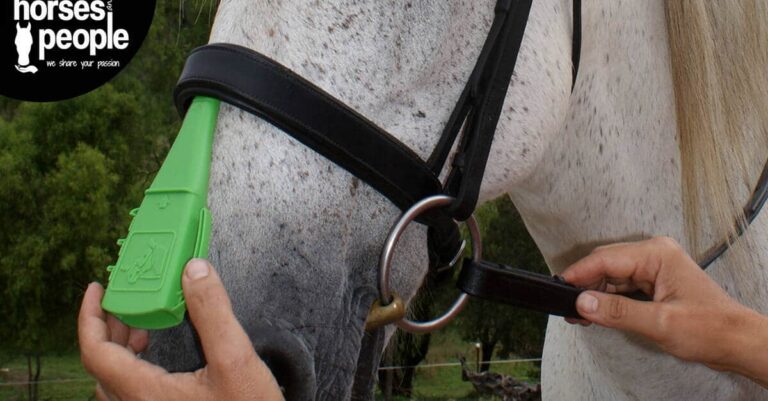
While Mr Davison ended his talk by recommending sport horse welfare could be improved by, for example, giving horses more opportunities to graze and leave their stables as well as improving education in learning theory, the highlight of the talk was nosebands. He questioned where and how tightness should be measured and the potential dangers faced when performing tightness checks at competitions.

The ISES open letter details and counters the instances when Mr Davison maked insinuations they consider misleading and/or inaccurate, and points out the failure to consider some of the most compelling evidence that tight nosebands are both, very common and a serious welfare concern.

In particular, it is worrying to hear Mr Davison claim that the nasal bones may not be the most relevant place to check noseband tightness, something which defies the laws of physics when you take into account the anatomy of the horse’s head (read more about that here).

This lack of understanding and failure to stay up-to-date with the latest research, not just by Mr Davison but by most national governing bodies and the FEI, may explain why their steward guidelines are still recommending noseband checks be performed on the side of the horse’s face. It has been shown time and time again that a noseband can be very tight and still allow a whole hand to fit between the strap and the side of the face.

So far and despite the compelling evidence of the threat of tight nosebands to both, horse welfare and horse sports’ social licence to operate, only two national federations – New Zealand and Denmark – have recognised the need to test noseband tightness at the nasal bones and have stipulated a minimum spacing must be achieved.

As insinuated in this unfortunate presentation, it seems that in others, the sporting interests and potential liability issues resulting from the use of a standardised gauge are overriding the welfare concerns raised by peer reviewed scientific research.

The FEI and the national federations write the rules that stewards enforce. As long as they continue to measure tightness on the side of the face, riders will continue to compete with very tight nosebands. If the FEI were to accept the nasal bone as the place to measure and demand a minimum spacing can be achieved, many riders would have to loosen nosebands.

By denying or ignoring the scientific evidence the FEI is, ultimately, protecting riders from having to loosen nosebands and is failing to meet its aim to protect horse welfare. This is their perogative but, perhaps, they should state the fact and their reasons behind their decision to keep nosebands tight in competition – without shooting the (scientific) messenger.

The WHW 2018 conference presentations are free to view on YouTube. Mr Davison’s presentation starts approx 45 mins in.

Download the ISES open letter to WHW here.  The response by WHW can be downloaded here.

How Much Salt? Brought to you by Hygain

0

Providing your horse with adequate salt each day can go a long way in maintaining hydration which not only safe guards health but supports optimal performance as well. But, how much is enough and, are there risks in giving too much salt? In this article, Claire Thunes, PhD, a consultant nutritionist for Hygain Feeds, answers all these questions and explains why salt is an essential daily supplement for all horses year-round.

Average daily requirements

An average 500kg horse has a daily requirement of 10 grams of sodium and 40 grams of chloride on a cool day doing no work (NRC, 2007). Bump the work level up to moderate and those requirements increase to 17.8 grams and 53.3 grams respectively and this does NOT account for hot weather. These two electrolytes are critical to the function of numerous cellular processes within your horse’s body and for that matter, yours as well!

Salt’s role in the horse’s body

Sodium plays a vital role in the functioning of the central nervous system and the transport of glucose across cell membranes. It is also the major electrolyte involved in determining the relative acidity of cell fluids and the levels of fluids inside and outside of cells.

Chloride is also a major component of the fluid surrounding cells (extracellular fluid) involved in acid base balance and fluid regulation. Additionally, chloride is an essential component of bile as well as hydrochloric acid a major secretion in the stomach necessary for digestion.

Sodium is the major positively charged ion in the fluid surrounding cells and potassium is the main positively charged ion within cells. The difference in the concentrations of potassium and sodium creates a concentration gradient across the cell membrane.

When nerves are triggered, channels in the nerve cell membranes open and the sodium ions move into the cell. This changes the internal electronic charge of the cell from negative to positive. Gradually potassium channels open and the process is reversed.

Tightly controlling the concentration gradient across cell membranes is vital for nerve cell function and therefore electrolyte levels are vital to nerve conduction and muscle contraction. A horse with inadequate sodium status may therefore have compromised muscular skeletal performance.

There are sensors in the brain that monitor blood sodium concentration. If circulating sodium levels become too concentrated a thirst response is triggered that motivates consumption of water. Water makes up just over 60 percent of a horse’s body weight and is vital for numerous bodily functions.

Maintaining an adequate sodium level is not only important for neuromuscular function but for overall hydration status as well.

What happens if your horse is not getting enough sodium or chloride?

Where sodium goes water tends to follow. Therefore, if circulating sodium levels drop, blood volume decreases which impacts blood pressure.

With sodium being the major electrolyte in extracellular fluid and its important role in maintaining the circulatory system as well as the neuromuscular systems, there are a number of mechanisms for controlling sodium concentrations.

For example, the circulatory system has baroreceptors that register blood pressure and in response to changes in pressure they send feedback to the nervous and endocrine (hormone) systems. In turn, the kidneys can either hold on to or excrete more sodium depending on what feedback they receive. When circulating sodium levels are inadequate less sodium is excreted in urine. Instead the kidneys will excrete more potassium.

Because water follows sodium, urine with lower sodium content will contain less water and be more concentrated.

Ironically, lower circulating sodium means less thirst stimulus so while water is conserved by reducing excretion, consumption of more water is not stimulated. The result is dehydration.

Despite the horse’s ability to adapt well to reduced sodium intakes thanks to the various regulatory mechanisms, horses that are not consuming adequate sodium will have a low level dehydration which may become an issue should greater demands be placed on them.

Horses consuming inadequate amounts of sodium are more likely to suffer from heat stress, and electrolyte imbalances than those consuming the correct daily intake of sodium and chloride.

They may also have an increased risk of impaction colic due to reduced fluid consumption and flow through the gastrointestinal tract.

Other symptoms associated with inadequate sodium and chloride intake include:

  • Decreased feed intake
  • Weight loss
  • Muscle Weakness
  • Decreased milk production
  • Constipation
  • Decreased skin turgor (skin stays tented when pinched)
  • Licking objects
  • Uncoordinated muscle contractions

How do you best insure adequate daily intakes of sodium and chloride?

Sodium and chloride levels in forages vary and without a forage analysis it should not be assumed that they are adequate to meet daily requirements. While sodium and chloride are both added to commercial feeds to help meet requirements and aid in palatability the amounts may not be enough to meet daily needs especially in working horses.

Therefore, the best practice is to ensure a supplemental source.

How much salt?

Luckily an easy source of supplemental sodium and chloride exists in salt. Regular table salt or sodium chloride is approximately 61 percent chloride and 39 percent sodium. Feeding 30 grams of salt a day will provide 11.7 grams of sodium enough to meet the maintenance needs of a 500 kg horse.

What about ad lib salt licks?

Many people rely on block salt as their horse’s supplemental source of sodium chloride. While horses do have a craving for sodium which will cause them to seek it out, few horses lick a block adequately enough to consume their daily requirement.

A 500 kg horse needs to consume about a one kilo block of salt a month to be consuming its daily sodium requirement. Some horses consume more salt off a block if it is broken in to chunks or if loose salt is made available in a pan.

Horses should absolutely have free choice salt available to them but if your horse is not consuming adequate amounts of salt from a block to meet daily maintenance requirements consider adding about 15 grams per 250 kg of body weight to their ration everyday.

What type of salt?

Be sure to use sodium chloride not lite salt as the latter is potassium chloride and will not help maintain sodium levels. Some horses appear to prefer sea salt or Himalayan salt over regular table salt. There is no added nutritional benefit of these more gourmet forms of salt however if these are what are preferred by your horse they can be a good choice.

Can I feed too much salt?

As for whether you can give too much salt the National Research Council (NRC) advises that as long as adequate water is available excess sodium will be excreted in urine and gives the maximum tolerable concentration in the ration of six percent of total feed intake.

Research suggests that large intakes of salt may lead to gastric ulceration, however, the levels of salt administered in the studies were significantly greater than would reasonably be given by most people.

Keep in mind that the purpose of giving salt is to provide adequate sodium to meet daily maintenance requirements not to replace sweat losses. Horses can lose large quantities of sodium and chloride in sweat and for these replacement purposes a good electrolyte supplement such as HYGAIN REGAIN should be used in addition to salt.

Providing your horse with adequate salt each day can go a long way in maintaining hydration which not only safe guards health but supports optimal performance as well.

Feeding for Weight Gain

Feeding for weight gain: Some horses do not maintain their bodyweight easily and it can prove a real challenge to keep them at an ideal weight. Ultimately, your horse’s ribs should not be visible, but they should be easily felt if you run your hand along your horse’s side. 

A common complaint from horse owners is their horse hasn’t got enough topline. This is achieved through the horse working in a manner that strengthens the muscles in their back and the correct diet of quality protein, which helps to build muscle. 

Regularly monitoring your horse’s weight with a weight tape or livestock scale will allow you to identify any changes to their weight early, thereby enabling you to make corrective actions quickly. But first, we must understand why the horse is underweight.

What causes weight loss?

Weight loss can be credited to a number of factors, only some of which are feed-related. The first factor that should be checked when assessing causes for weight loss is the condition of the teeth. Proper dental care is essential to a horse because of the nature of their diet.

Horses evolved eating coarse roughage and plant materials that require thorough grinding by the molars to break down the particle size of the food.

Poor worming regimes can also cause weight loss, regardless of what and how much you are feeding. Parasites may compete directly for the nutrients inside the digestive tract. They may also cause damage to the intestinal lining, making it difficult to absorb nutrients. Damage to the intestinal lining can diminish the production of enzymes needed to prepare food particles for absorption.

Stress can also contribute to weight loss. If your horse is a chronic stall walker, weaver or fence runner, they are burning calories needlessly all day long. Simple management changes, such as daily turnout or the addition of a stall buddy, can alleviate these behaviours. High grain, low roughage diets can also cause stress, as a result of gastric ulcers that are painful to the horse and may discourage them from eating.

Disease or illness can also interfere with weight gain – either by decreasing the horse’s appetite or by directly affecting nutrient absorption within the digestive tract. An example of this would be chronic liver disease due to the decreased ability to handle protein and fat properly. If all these can be eliminated and your horse is still not putting on weight, the next step is to evaluate your horse’s diet.

What should I feed?

Fibre: Of the three major energy sources (fibre, carbohydrates and fat), fibre is the most important. Fibre is the major component of pasture and hay. Some horses can maintain their weight on fibre sources alone. For the poor doer, however, fibre alone will not maintain weight, but there are fibre sources with higher energy content and digestibility than others. When comparing the energy content of lucerne and grass hays, lucerne hay can provide a horse with more energy than grass hay of similar quality. However, low-quality lucerne hay, which has more stem than leaf, is not a rich source of energy.

When quality pasture or hay is not available, or if the horse does not readily eat hay or have access to pasture, there are alternative fibre sources that can be added to the diet, such as HYGAIN® FIBRESSENTIAL®, the nutritionally enhanced chaff nuggets. The most common are ‘super fibres’, such as beet pulp and legume hulls (soy or lupin hulls).

HYGAIN MICRBEET® is a beet pulp-based alternative fibre source. The fibre in beet pulp is about 80% digestible (as compared to 50% for average hay). Soy and lupin hulls are the skin of the bean (not the husk or pod) that is knocked off before oil is extracted from the bean. The energy content of legume hulls is close to that of oats. Certain additives, such as yeast, may help with fibre digestion if the horse has a problem with the balance of microbes in the large intestine. Yeast has been researched and found to improve fibre digestibility. Many feeds from the HYGAIN® range contain probiotics – live yeast-based additive that assists with fibre, calcium and phosphorous absorption. Maximising forage quality should be the first dietary adjustment when trying to achieve weight gain.

Carbohydrates: Carbohydrates, specifically sugar and starch, in the form of grains have been the most traditional method of increasing the energy density of the diet. Obtaining energy from sugar and starch is very efficient due to their simple enzymatic processes. While grain is a concentrated source of energy for the horse, there are some complications with feeding large quantities. The small intestine can easily become overloaded with sugar and starch, resulting in an overflow into the large intestine. This can lead to gas colic, colonic ulcers and even laminitis. When trying to get a thin horse to gain weight, it is often tempting to keep increasing the amount of grain being fed. Unfortunately, if too much grain is fed and the delicate microbial population in the large intestine gets disturbed, most horses will lose their appetite and the situation worsens. Care should be taken not to feed any more than 2kg of grain in a single meal. When large amounts of grain are fed, it should be divided equally over three or more meals throughout the day. Make sure the horse is always getting at least 1.5-2% of their bodyweight in the form of fibre, and a good rule of thumb is to try and stick to a roughage to grain ratio of around 70:30.

Fats: Fats and oils are commonly used in horse feeds to increase the calorie content of the feed or to replace the calories supplied by grains. Fat supplementation has many benefits, including providing calories for weight gain, and providing essential fatty acids to improve skin and coat condition. Feeding fat has also been reported to decrease excitability in nervous horses. Both animal fats and vegetable oils have been fed to horses, although the use of vegetable oils, such as soy, rice bran or canola oil, is more prevalent due to superior palatability.

Fat sources, such as HYGAIN® RBO®, rice bran oil or soybean oil contain 2.5- 3 times more energy than grains on an equal weight basis. Increasing the fat level of the diet is the easiest and safest way to increase the energy density of the diet. Higher energy levels can be obtained by feeding a lesser amount of a high-fat concentrate mix, compared to a concentrate mix containing lower-energy grains. Research has indicated adding 5-10% fat to the total diet has maintained the bodyweight of horses with a 21-25% decrease in concentrate intake. HYGAIN® SHOWTORQUE® is a high fat, no cereal grain textured concentrate, ideal for safe weight gain. Adding fat to a horse’s diet permits safe weight gain, while reducing the chance of colic or founder. Digestion of fat also yields less internal body heat, when compared to other diets. Thin horses will gain weight and do so without having to eat as much grain if the diet is fortified with additional fat.

How long will weight gain take?

Gaining weight on your horse will not happen overnight and horse owners should have reasonable expectations as to how long it will take to avoid disappointment. The 2007 National Requirements for Horses suggested it takes 16-20kg of gain to change a horses body condition score by 1 unit (based on a 500kg horse; 1 to 9 scale). Therefore, a horse with a body condition score of 2 would need to gain around 60kg to increase their condition score to a 5. This would take around six months to achieve and would require a very energy-dense feeding protocol. It is safe to assume a horse can gain one condition score per 60 days, when provided with adequate additional dietary energy and no underlying disease is apparent.

Take home message

Whether your horse is underweight, overweight or just right, it’s important to evaluate their condition through advancing age, environmental changes and performance demands regularly. Addressing unwanted fluctuations before they become potential health risks is the key to maintaining optimal bodyweight. After addressing all possible causes for the horse’s weight loss, increasing the amount and quality of fibre the horse is receiving should be the first dietary change made, followed by increasing the energy density of the concentrate portion of the ration.

To find out more about HYGAIN visit: www.hygain.com.au

[wpdm_package id=2920 template=”link-template-button.php”]

Starting Romeo Part 9: Mounting and Turning Out

Mounting and Turning Out. In this, the last part of this exclusive training series, Kate Fenner from Kandoo Equine has taken Romeo through the essential foundation lessons that work for any horse. Whether you have a horse that hasn’t been started yet or your horse has been under saddle for years, there will be areas of the foundation training that may need a little work.

You can recap on all the articles on the Horses and People website and watch video of each lesson at the Kandoo Equine website.

Mounting and Turning Away

Romeo has proven to be a wonderful horse for this series because of his naturally high emotional level. Even in the paddock, Romeo is vigilant, standing tall and watching out for danger. When training such horses, it’s especially important to break lessons down and always be checking that you are building on a strong foundation.

If you are not aware of how to judge your horse’s emotional level, then horses such as Romeo, because they are unlikely to show obvious signs of anxiety involving moving their feet, can pose a challenge.

Throughout this series, we’ve seen Romeo display his rising emotional level with an increase in head elevation and a tensing of the muscles (this, of course, is easier for me to see/feel than to show in photographs).

Therefore, it has been particularly important for Romeo to remain unrestrained during the lessons. If he decides to leave, then I know that I have gone too-far-too-fast and need to return to something he is confident with.

This early foundation work is all about building confidence in your horse and, as a result, in yourself.
We talk a lot about wanting more riding confidence but rarely take the time to define what that really means or how we could go about gaining it.

For me, confidence comes from knowing what might happen next. Of course, we’ll never know exactly what will happen, but if we’ve trained our own horse and worked through all the foundation lessons demonstrated by Romeo in this series, then we have a fairly good idea of how the horse is likely to react.
Whenever we mount a horse that we don’t know or someone else has trained, we are doing so with fingers crossed, hoping for the best. It’s not a great place to start.

Horses are individuals and each will react slightly differently to any given lesson. Therefore, it is so important to be flexible in your training and break lessons down appropriately for each horse.
I have broken this lesson down to make it suitable for most horses.

As this is the final lesson in the series, I will assume that you have completed the previous steps and now all we need to do is mount.

To prepare for the mounting lesson, spend a few minutes working on the following lessons:

Give to the bit (See Part 2 and Part 3), shoulder control (See Part 4) and, five to ten minutes long-reining (See Part 6).

This will get your horse into the engagement zone, that bubble of communication that holds his/her attention and confirms that you have their focus before you start the mounting process.

Step 1: Lean over the saddle

Once your horse is relaxed at the mounting block (see Image C),  you can begin putting weight over the saddle.

Start by lying over the saddle and leaving most of your weight on your feet, still on the top of the mounting block as shown in Image D.

While you are there, use your hands and arms to habituate your horse to movement and slight pressure around the saddle area. Be sure to touch the shoulders and neck areas as well as behind the girth. While you have your weight on the mounting block, take one leg and gently rub your horses barrel with it, this is useful habituation for the ridden leg position.

If your horse remains relaxed, put all your weight over the saddle and continue the habituation process with your hands and arms on the horse’s right side.

However, if you feel your horse is getting tense, go back to having your weight on the mounting block again and only progress when he/she is relaxed.

Step 2: Weight in stirrup

Place your foot in the stirrup (see Image E) and gently rise to a standing position in that stirrup on the left side of the saddle (see Image F).

In this position, you are above the horse and he/she can feel all your weight in the saddle. Try to lean over the saddle slightly so that your weight is more evenly distributed.

Now is a good time to check your horse’s relaxation level. Notice that Romeo’s head elevation remains the same between the two positions in Images E and Image F.  The reason we don’t immediately sit astride the horse is that we can easily slide off from this position if we misjudged the situation and the horse’s level of relaxation.

Step 3: Take up reins

With your weight across the saddle, take up the right rein and ask for a ‘give’ as shown in Image G. Your horse should flex to the right and relax. Release the rein and praise the horse.
This is the start of ‘movement’. For now, it is only movement of the head and neck but a soft ‘give’ from the horse assures us that he/she is relaxed and listening.

Step 4: Take a few steps with weight over saddle

With your weight over the saddle, pick up the right rein and ask for some bend to the right (see Images G and H).  Encourage your horse to take a step or two using your go forward verbal cue – mine is a cluck.
A few steps away from the mounting block is enough for the first time. Slide off your horse, praise him/her and return to the mounting block (see Image I).

Step 5: Getting astride

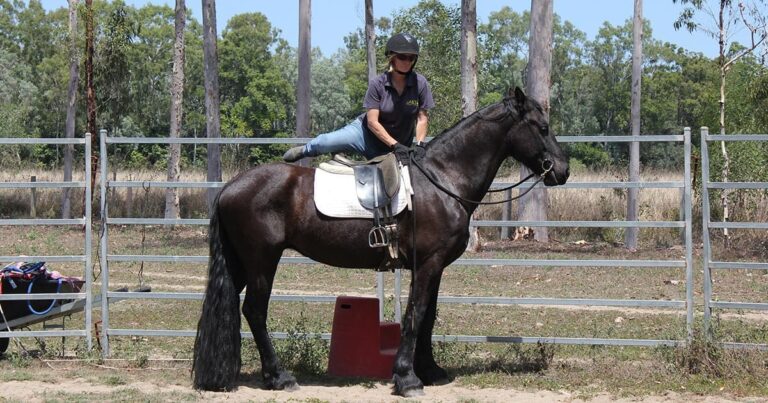
It’s important to habituate your horse to having your leg and foot over his/her rump – we don’t always mount beautifully or tidily! Gently brush your horse with your leg and foot on the rump as you move your right leg over the saddle as in Image A.

Lower your weight gently into the saddle (Image B) without placing your right foot in the stirrup (Image C).
Dismount again and repeat this mounting and dismounting until your horse is relaxed and comfortable.

Step 6: Take a few steps standing tall in saddle

Before sitting astride and taking any steps, we’re going to take a few steps standing tall in the left stirrup because we can easily slide off from this position if necessary (Images D & E).

Step 7: Leg over and get stirrup

The final step is to mount again and take up your stirrup (see Image F).

Check for relaxation before you ask for a few steps to the right and away from the mounting block, following the same pattern we’ve established over the previous six steps. Your horse’s head elevation should be the same and you should not need to be holding tight on the reins to prevent forward movement.

Bend your horse to the right as you did in Step 4, using your voice and praise your horse when you get movement.

Watch this lesson! This month’s video is available here: https://www.kandooequine.com/blog/romeo-mounting

Time for a break

Horses vary as to how much they can learn in any single lesson and how much training, in a block of time, is suitable for them. I like to get my horse to this stage and then turn them out for anything up to six months, depending on the age, breed and general maturity of the horse.

It’s imperative that these early lessons are as calm and quiet as you’ve seen here with Romeo because it leaves the horse with a very positive experience of training. We haven’t tired Romeo, or caused him and distress or discomfort. After a break in the paddock with his herd, Romeo should come back to work for a quick refresher and then make good progress because of this relaxed and calm foundation.

I know we are all a little impatient and so much of our lives today involves instant gratification, but we owe it to our horses to do the best possible by them and giving them a solid foundation, with time, patience, understanding and empathy, is doing just that.

Don’t be in a hurry – your horse is an individual and by giving him/her the time they need; your effort will be returned a million-fold over the years to come.

Kandoo Equine Online Training – Do It for Your Horse!

Kandoo Equine has some free training coming up shortly and some exciting news to share with you next month. Don’t miss out, sign up for email notifications here: https://www.kandooequine.com/blog

Check out Dr Kate Fenner’s podcast for more step-by-step, ethical and sustainable horse training courses.

This article was published in Horses and People November-December 2018 magazine or buy the whole series as an e-book.

Your Spooky Horse Explained: The Limbic Motor System

Spooky horse? Improving your understanding of the inbuilt instinct for survival in the horse – how it is triggered and what it looks like – will improve your training methods, reduce the instances of injury to both, you and other people around the fearful horse and the horse himself.

A question of survival 

Horses evolved from small mammals whose survival depended on their ability to flee from predators. They are prey animals that must be constantly aware of potential dangers which have developed excellent abilities to recognise a perceived threat that can trigger the flight or fight reaction, and horses have a fast fear response.

The horse’s anatomical and athletic physique allows the advantage of flight and speed when potentiating a perceived danger.

The emotion of fear is an important trigger of self-defence and studies indicate that the fear response can be extremely diverse in quality and intensity.

This evolutionary developed reaction will result in either freezing, avoidance, aggression or fleeing from the perceived threatening stimulus (the freeze, fight or flight response).

These are natural ‘built-in’ unconditioned fears such as shying at the sound of a rustle in a bush, loud noises and flashes of light. This innate evolutionary developed response mechanism is genetically programmed for survival and is still present in domesticated horses.

Once the flight response is engaged, the escape path of a horse can offer unpredictable responses!
Horses commonly accelerate to full gallop within one or two strides and run without regard for their own safety and not notice or process how to navigate obstacles such as fences leading to both human and equine injuries.

Movement can occur by a conscious decision, for example moving to another paddock because the horse has realised that the gate to the next paddock has been opened.

This is a conscious decision because the special senses have sent messages calmly relayed to the prefrontal cortex (the reasoning portion of the brain). The horse may have visualised the opening of the gate or heard the sound of the gate fastener opening and maybe it is the time of day when he expects to venture to the feed area etc.

Movement may also occur when a horse is startled and believes he may be in danger. In this case, the relaxed horse catches scent, hears and sees a perceived predator such as a stray dog.

These thoughts, sensations and emotions use a much faster neurological pathway to alert the horse to move out of the way quickly without first analysing the extent of the danger.

This process explains why horses’ reactions and behaviours to what we might see as trivial objects, such as a tree stump, wheelie bin or benign sound, trigger a panic state in your horse.

The fear response arises out of the emotional system which impacts directly on the motor system.

The limbic system

The limbic motor system translates thought, sensation and emotion into movement.

In research, the ‘limbic motor system’ refers to the limbic system impacting on the motor system – that is, when the body translates thought, sensation and emotion into movement.

Fear is a neurophysiological reaction to a perceived threat. The horse’s survival relies on his own ability to sense and flee from a predator in a fraction of a second as a way to gain some advantage over the planned attack from that predator.

The limbic system is the part of the brain involved in emotional and behavioural responses, especially when it comes to behaviours for survival, feeding, caring for young, and fight and flight responses.

The limbic system is made up of several structures including the amygdala, thalamus, hippocampus, hypothalamus and cingulate cortex. (See Image A when you download the pdf version of this article).

Meet the amygdala

The amygdala is the emotion centre of the brain, while the hippocampus plays an essential role in the formation of new memories about past experiences.  The emotional area coupled with the recall of an incident can lead to a jumpy horse.

The amygdala is associated with emotional processing and is the fear generation centre in an animal’s emotions.

Although the prefrontal cortex (the planning and rational decision-making portion of the brain) is smaller in the horse than a human, the amygdala (the emotional and fear centre within the brain) is proportionally larger when anatomically compared with other brain structures and other species.

This would also seem an evolutionary anatomical variant to suit survival in the horse. Table 1 on the opposite page refers to a study by Takeuchi et al. (2007) that compared the size of the amygdala between horse, cow and pig.

The amygdala has two pathways that link to the portion of the brain called the nucleus accumbens that is part of the basal ganglia that is involved in instigating movement.

The pathway from the amygdala is a fraction of a second faster than the route through the prefrontal cortex that first decides about the course of action.

The special senses including vision, auditory, olfaction and the sense of touch all have a short cut and faster neural pathway which by passes the prefrontal cortex and is “hard wired” to the emotional system that is also “hard wired” to the muscles that move the limbs.

It would be feasible to assume that because these special senses are fast and hard-wired to the emotional system and transmitted to the leg muscles, the horse could spook when aroused by unknown scary stimulus coming from the rider.

This may be in the form of somato-sensory input (sense of touch) as the rider tenses and applies pressure to the horse (which can be interpreted as potential danger), or when the rider focuses on an object that has presented problems in the past, such as a fenceline where dogs have previously ran-to barking aggressively and spooking the horse and rider.

What you need to know about spooky horses…

  • The shorter fear response route is faster to react than the longer, rational thinking route.
  • Horses are a large flight animal with an anatomically large amygdala that has shortcut circuits from the special senses that alert the emotional system of any imminent or perceived threat of an attack by a predator.
  • The limbic system can engage the motor system before the prefrontal cortex has evaluated the threat.

Many studies have been carried out on the amygdala and its role in the limbic system of emotions but little has been carried out on the horse amygdala and its connection to the motor system.

Improving our understanding of the neuroanatomical and neurophysiological differences in the amygdala between species and their impact on the limbic motor system would help provide safer handling of horses in all situations.

[wpdm_package id=66471 template=”link-template-button.php”]

This article appeared in Horses and People October 2018 magazine.

The Riding House

This month we explore the history of the indoor arena or ‘riding house’ to use its original name. Some might consider that indoor arenas are not necessary in Australia because of our climate, but this would be to overlook the Northern hemisphere influences on equestrianism, including equine architecture. It is also true that those of us in the southern regions benefit from having access to an indoor during our long, cold and wet winters, and those further north benefit from the sun shelter they provide.

There is, however, another loftier reason why we ride in dedicated, properly surfaced and roofed-in spaces. If we situate equitation as both an art form and a sport across the various disciplines, then we need to train in conditions where we can focus and concentrate on each other, and not on the weather or distracting sights and sounds.

Richard Berenger, ‘Gentleman of the Horse’ to George III put it well in 1771 when he wrote that riding houses were needed to ‘awe, guide, and confine the horse’; in other words, [and reading into the richly characterful language of the period], they helped the horse to settle and concentrate.1

Image B on the next pages, a pen and wash drawing in the Paul Mellon collection at Yale Centre for British Art, once thought to be by George Stubbs, but now unattributed, shows a young horse concentrating on being long-lined and learning shoulder-in at Tattersalls Training School, around the middle of the eighteenth century.

Note the gentle morning light coming in through the high set ‘Diocletian’ window, the angled wooden boards along the walls and the tanbark surface.

Historically, dressage has the earliest associations with an indoor ‘hall’ or dedicated indoor space for horse exercise. The ‘cavaliers’ or circle of expert riders around King Charles I of England were the first to build riding houses.

This small group of wealthy aristocrats grew obsessed with high school or ‘haute école’ after learning about it on their ‘Grand Tours’ of France and Naples as young men, but they realised that to continue the dressing (or training) of the ‘great’ or educated horse in freezing England they needed a special interior place; a ‘riding house’.

The cavaliers’ construction of functional yet beautiful riding houses made possible the transmission of Continental dressage theory into England.2 Many cavaliers also employed foreign riding masters to run their establishments. Foremost among the cavaliers was William Cavendish, 1st Duke of Newcastle, courtier and riding instructor to King Charles II.

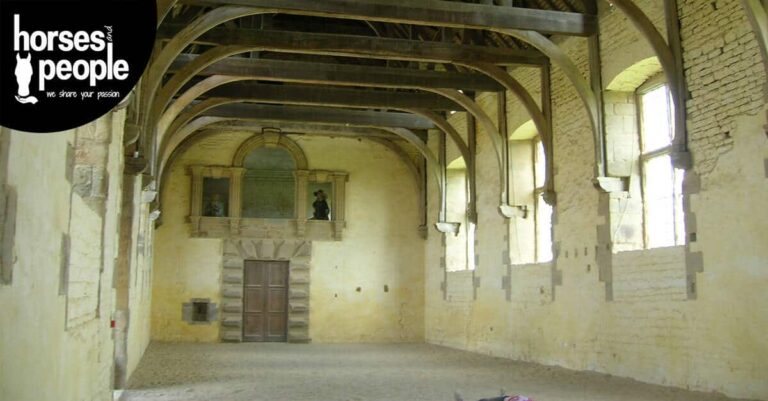
Cavendish’s own Riding House, at Bolsover Castle (see Image A on the next page) was completed in 1630 and is one of the finest examples of the indoor arena in the Stuart period.

Designed by Huntingdon Smythson, the Bolsover Riding House was created to be perfectly in-keeping architecturally with the castle, the stables and the grounds, thus creating a seamless unity of appearance.
Built entirely of stone, Bolsover Riding House featured ‘a series of gabled dormer and casement windows, with Classical architraves (the moulded frames, or lintels over doorways or windows), and massive rusticated door frames’. In this, it reflected the latest in architectural fashions of the day.3

Moreover, with the addition of raked seating to create viewing galleries at either end or down the long sides of arenas, the observation of daily exercises in the indoor manège became a social occasion for ladies and gentlemen.

Bolsover was beautiful throughout, with features that became customary in public and private manèges through the Georgian revival of haute école and into the nineteenth century. Arena surfaces were of various types, made either of spent tanbark (leached bark chips or powder; a by-product of tanning factories) or of a clay and sand mix laid two feet deep and well-rammed.

The roof, then as today, was a central design question to be solved. Because of their size and their need to stay up without intermediate supports, riding house roof structures have always held great interest for builders.

In the seventeenth and eighteenth centuries, no architectural text held any specific instruction for riding house rooves, so architects adapted solutions from churches and other large edifices. The architect Inigo Jones used a king- and queen-post beam structure for his manège in Buckingham House. Other keynote architects of the period used collar beams with scissor braces. A variety of other innovations were developed.4

With such elegant beam work, the next question was whether to plaster the ceiling or leave the beams exposed.

When ceilings were put in, they were often embellished with beautiful plasterwork, gilding, chandeliers and even mural paintings, such in the Winter Hall at the Spanish Riding School in Vienna and the Riding Hall of the Belém Palace in Lisbon, and how can we not mention Jean Aubert’s ‘palace for horses’ – the Great Stables of Chantilly, designed for Louis-Henri de Bourbon, the seventh Prince of Condé, where circular walls are pierced by arches and ‘oeil-de-boeuf’ or ox-eye windows, and massive statues of stags, a symbol of the Prince’s love of the hunt, fill the vast spaces.

Riding Houses had functional attributes as well. For natural light, windows were placed high up on the wall so that horses weren’t dazzled. Lower down along the walls, wood panelling – often placed at slant was provided along the sides to protect riders’ legs from getting crushed.

The final addition would have been the installation of a pair of pillars. Their introduction has been accredited to Antoine de Pluvinel (1552-1620). Pillars were a stabilising tool used for teaching the highest levels of collected work to the horse and sometimes the rider as well. They have a similar but more intensive function to side reins. We rarely see these today, except – topped by flags – at the Spanish Riding Schools of Vienna and Jerez de la Frontera, Spain.

During the Golden Age of haute école and later, riding houses were built in a vast range of sizes, however the proportions of 3:1 or even 2:1 generally remained consistent.

For private use, the eighteenth century equitation handbook author Strickland Freeman recommended that a 120ft x 40ft arena was quite large enough; in metric that is approximately 40m by 12.5m, and much smaller than what we’re used to now. In fact, the standardisation of the arena at 60x20m and the formal introduction of arena markers did not occur until the 1932 Olympic Games in Los Angeles.

Few eighteenth century riding houses exceeded Freeman’s dimensions as he warned that it was ‘too fatiguing for the horse when doing exercises that required it to hold its haunches while crossing the riding house’.5 Freeman also designed an arena with one rounded end for lunging that never caught on.

One particularly strange shaped indoor dressage arena in Paris (it was ten times as long as it was wide), witnessed the birth of the nation-state, and changed the political history of the world.

The famous Salle de Manège in the Palace of the Tuileries in Paris was appropriated by the Assembly in 1789 and, despite its poor acoustics, it became the spatial centre of a newly democratic France. Thus, the bloody aftermath of the French Revolution can justly be said to have been organised and run from a dressage arena.

In England after its Stuart heyday, haute ècole and its architectural appurtenances sadly declined during the Civil War, with Cromwell’s Puritans not being admirers of the art. However, it arose again in the Restoration period, 1660-1785, and then again in the nineteenth century, with dressage master James Fillis, the appearance of women riders or écuyères, and the demand for indoor or ‘town’ riding schools for the military and the aspiring upper middle classes to master the equestrian arts.

In the twenty-first century, haute ècole, that is, ‘high’ school, or what we now call modern dressage, is again on the rise, and along with it, the need for good indoor arena design. In modern Australia utility often wins out over aesthetics but not always.

The sense of a ‘cathedral’ for riding finds a 500 year old echo in the designs of Luke Jones, director of awarding-winning firm C4 Architecture. Jones, a popular South Australian eventing rider recently designed this indoor arena (see main image on page 17) for the University of Ballarat. Here, we can clearly see him paying homage to Bolsover, and to the aesthetics of the Stuart period in the creation of a ‘place of worship’ for the art of riding. Form follows function and Jones notes that ‘the shape of the roof allows for a spacious interior which gives good air movement along with timber being a totally sustainable material.  Timber also adds a feeling of softness and warmth relative to the typical steel structure which is used for longer spans’.

Another Australian echo of the notion of a ‘seamless unity of appearance’ between home and riding hall can be seen in NSW’s Willinga Park Equestrian Centre, by Cox architects, where a modernist, rather than a Classical aesthetic, unites the house, stables and arenas, with the  inclusion of high-tech utilitarian functions (for example, underground arena watering systems) and a consistent design ethic using dramatic angles.

Thus, we see a lengthy history informing the culture and construction of the ‘riding house’ and how it has been a fascinating litmus test of the popularity of riding as an art.

For those readers who dream of building their own riding house, be bold, be visionary, be part of history!
Note: To see a film of Classical dressage performed in the Bolsover Riding House, English Heritage have made a short video for YouTube. ‘The Art of the Mannage’ for English Heritage at Bolsover Castle.

References:

  1. Giles Worsley, The British Stable, Yale University Press New Haven and London 2004, p 61.
  2. Giles Worsley, ibid. p 61.
  3. Worsley, ibid. p 86.
  4. Worsley, ibid. p. 168-9.
  5. Worsley, ibid. p 161 -168.

[wpdm_package id=66476 template=”link-template-button.php”]


This article was published in Horses and People November-December 2018 magazine.


5 Property Improvements for all Budgets

Property improvement. Here are five common changes that can be done at any stage on small and larger budgets to improve or redesign your existing horse property…

When horses become part of your life and you are lucky enough to own one (or a few), the next best thing is to be able to manage them on you own place, preferably in your backyard! For those of us who rode at riding schools or had our horses agisted when we were growing up, there is nothing more appealing than waking up in the morning and wandering out in your pyjamas to feed your horses or watch them graze, while holding a cuppa.

If this sounds like you, you may already have taken the big leap – either bought a block of land or you may be looking for a suitable property that meets your horsy needs and budget!

Properties that are suitable for managing horses are popular around the world, but Australia is quite unique as we have a large landmass, low population density and suitable climate for managing horses outdoors all year round.

While properties around the bigger cities will always be more valuable, in Australia, it is possible to find a suitable property at a reasonable price. This may range from a bare block of land to an established place.

Buying a new block of land and having a blank canvas to design your house and horse facilities would be a dream come true for some horse owners, while others will think it sounds like a lot of work or a costly exercise.

More often, horse owners end up buying (or renting) properties with an already existing layout that will reflect the previous use of the land. It can range from an old dairy farm, to bush land to a horse-breeding stud.

Typically, properties that do not have existing horse facilities are cheaper to buy (bearing in mind other factors, such as location, buildings and view etc.). Just like when you add the word ‘wedding’ to the sign, the word ‘horse’ tends to cause a magical price increase! This is why many horse owners end up buying properties that have either livestock facilities or limited infrastructure and have to invest in some re-designing.

Redesigning factors

The actual process of re-designing a property depends on the existing infrastructure and how feasible it is to repurpose it for horses.

The shape of the land, its potential and limitations, must all be taken into consideration. If you are intending to manage other animals such as cattle or sheep, you may want to retain any livestock infrastructure such as stockyards and fencing.

There are so many options and layouts that it will never be possible to address them all. Each property is unique and must be assessed separately because what works for one may not work in  another climate and landscape.

However, what we can do is focus on the five things that horse owners typically have to prioritise and can be re-designed to suit their and their horses’ needs.

Property Improvement 1. Fencing

The most obvious change you can make to your property is to re-design the fencing. Initially, you focus on the fallen over or deteriorated fences, especially your boundaries, because you do not want your horses or livestock wandering on any public roads or your neighbour’s property!

A boundary or dividing fence is a fence that separates two properties. It usually lies on the common boundary of adjoining pieces of land, though it can lie mainly or completely in one property. A retaining wall is not classed as a dividing fence.

Regulations

Legally, the dividing fence is the joint property of both property owners, which means anything that one owner does to it affects the other and may require cost sharing. Dividing fences are governed by the Dividing Fences Act 1961 and local government by laws. These fences are the responsibility of the property owners, so if you rent, you need to discuss any boundary issues with your landlord.

If you have to upgrade or fix a dividing fence you have to consult and, preferably, work with your neighbours. The better your relationship with them the easier it will be to encourage them to collaborate. It’s important that you become familiar with the dividing fence standards (such as type of materials/ fence types, height etc.) and that you know your rights and responsibilities when you are potentially dealing with a fence dispute.

Check with your local council and/or state government for more information about compiling a fencing notice and related information.

If you can work together with your neighbours, consider the following:

  • Does the fence need replacing or repairing?
  • Is the boundary clear? (It may require additional surveying)
  • How much is each neighbour contributing?
  • Who will be carrying out the work and what materials will be used?
  • If neighbours are sharing the work, how will the workload be allocated?
  • What is the time frame for the work to be completed?
  • Where will the fence be placed?
  • Any compensation for the loss of occupation of any land?
  • How high does it have to be?
  • What materials? What colour?
  • How much will it cost?
  • How will any existing fence be removed?
  • Who will cover any additional or unexpected costs?

If your neighbours are not horse people, they might not want to invest in the additional costs of making fences horse safe. If you are set on a specific type of fencing, you may have to cover those extra costs.
In addition, you may have other requirements for certain sections of the property (for example, sections of the dividing fence around your house that you want to make dog proof).

If you can work out an arrangement to fix and set up your boundary with your neighbours it will significantly reduce your costs and will allow you to allocate more money to other facilities and internal fencing.

Property Improvement 2. Paddock and laneway redesign (internal fencing)

Paddock and laneway re-design will tie in with your boundary and internal fencing. If your dividing fencing is already well-maintained, the next thing to consider from a re-designing point of view is internal fencing.
Even before deciding on the layout for the paddocks, consider whether you want to set up a ‘second’ or internal boundary fence. If your neighbours are not keen on fixing old fences, if they also manage horses on their property and/or you manage stallions, you should consider creating a fenced laneway between your property and your neighbour’s property.

This also works if you are setting up your property as an agistment centre and you want to keep horses in individual paddocks or away from each other for quarantine purposes.

Another benefit of a ‘double boundary’ is that you can be less concerned with a dividing fence that is of a rural or livestock standard (e.g. barbed wire) and allocate more of your budget on ensuring your internal fencing is horse-safe.

Paddock layout and fencing

The redesign and building of internal fences is more flexible and can be achieved on a smaller budget. For example, to reduce cost you can opt for using electric fencing throughout your internal paddocks – either temporarily or as a permanent solution.

Before we discuss the type of fencing, consider the existing layout and try to visualise what your proposed paddock divisions will look like.

If you bought a property set up for livestock that has a few large paddocks, you can subdivide them into multiple paddocks to allow you to rotate and rest pastures more often.

If you bought a property already divided into many smaller paddocks, you might want to open them up into larger pasture areas for housing groups of horses.

The first thing to consider is access, i.e., driveways, laneways and gateways. Redesigning the paddock and laneway layout should be part of your larger property plan and drawings.

For example, if you are building a new stable block, you need to work out how you will connect the stable block with your main driveway and all your paddocks. Many horse owners are now interested in setting up a central loafing area, with centralised services and easy connections to all paddocks either directly or via laneways.

Even if you are not yet able to either fix or build all the proposed internal fences for your paddocks or laneways – you must set time aside to consider the bigger picture. When time and money allows you then zoom-in on particular sections of your design.

Nothing on a property stands alone, everything connects in one way or another due to the shape of the land and other elements such as how water flows through the landscape.

In addition, your design ideas may not actually work in practice due to other limitations, such as hills and gullies, vegetation or areas with high erosion.

Allow yourself time to observe and identify these so you can adjust your layout before you start investing in permanent internal fencing.

If you require more help with property design, consult with a land planning consultant that understands horse requirements.

When you have worked out your design you will be itching to upgrade or build new fencing. To make it easier on your budget, consider doing this in stages or sections. This allows you to keep horses contained in one area while you work on upgrading another. If you are on a smaller property and this is not possible, consider agisting the horses while you complete your fencing project.

Deciding on type of fencing

Have a look around at other horse properties in the area and make a list of possible fence types. Often, decisions will be made on cost (of materials and installation) and aesthetics and, while these aspects are important, your decision-making process should begin on the other side of the equation: What are your and your horses’ specific needs?

Different types of fencing suit different horse-care situations. For example, two older horses in a large pasture can be safely confined with fencing that might be entirely inappropriate for a large group of young horses in a smaller enclosure.

This means that if you manage a variety of horses, you might have to be flexible with materials and may end up using different types of fencing.

Consider first the aspects such as group dynamics (herd behaviour), grazing availability (area size), level of containment (any fence jumpers?), and keeping other animals out (such as dogs).

You should also account for your own specific needs such as having a house paddock that doubles up as pasture and riding area which may require a different style of fencing (for human safety).

Once you have a picture of your and your horses’ needs look at the installation components, i.e., the overall costs (including fence materials), construction time and/or labour.

Remember to include gates and ongoing maintenance costs when deciding on fence type.
Lastly, decide on the aesthetics and whether you want to compromise, build in stages or have a mixture of materials for different paddocks. The importance of aesthetics may be higher if you want to run a commercial business and you will have clients and other people visiting your property.

Once you established your main priorities, do your homework to check prices (including labour) and weigh your priorities against each other to determine which one ranks higher.

For example, you may want to consider the strength of the fence against safety (i.e. ability of horses bouncing of fences) and fencing costs or aesthetics against maintenance input.

Traditional looking post and rail white wooden fences require a lot of maintenance when compared with other products such as high-tensile electric fences or PVC rails with UV inhibitors.

PVC rails are more flexible/safer then high tensile electric fences as horses can bounce of them when running into them. But these poly products may be more expensive than a wooden post and rail and certainly more expensive than high tensile electric fences.

There are many types and brands so you will need to go through a selection process to way up all the factors that are important to you. (In an upcoming edition we will focus a bit more on fences and types available for horse properties.)

Property Improvement 3. Riparian and dam areas

A riparian zone is the land around creeks, streams, gullies, rivers and wetlands. These areas are unique and diverse and are often the most fertile parts of the landscape.

In a natural or well managed state, riparian areas are important for many reasons. They can support diverse vegetation, help maintain bank stability, and increase ecological and economic productivity. These conditions support cleaner water, reduce disease and pests, and retain important nutrients and soil.

Not all horse properties have waterways or have to manage riparian zones, however, most have man-made dams, and it is just as important to manage the land around them to avoid erosion and keep water clean.
Riparian and dam areas are vulnerable and easily degraded. Damage can be caused by uncontrolled stock access, clearing for agriculture or urban development, invasion by pests and feral animals such as rabbits, weeds such as privet, or from overuse by recreational activities.

Waste from horses, cows and sheep can contribute pollution, and trampling can destroy vegetation, soil structure, and result in loss of valuable soil and land.

The importance of managing riparian land well is increasingly being recognised, and protection, rehabilitation and restoration work is being undertaken across catchments in Australia – often supported by funding from Landcare and catchment organisations.

Landowners have legal rights and responsibilities for managing riparian areas. For example, landowners are entitled to take water from a river or creek, which fronts their land for domestic use and stock watering without the need for a water management licence. However, if you wish to undertake activities that may disturb vegetation, soil or water then it is best to consult with your council and local Landcare/catchment organisations.

Protecting water catchments

  • Use fencing to control or prevent horses and stock access to waterways and riparian areas.
  • Use water troughs to water animals.
  • Encourage the regeneration of native plants or assist growth by planting natives and controlling weeds.
  • Allow layers of different vegetation to grow: groundcovers, understory and canopy.
  • Seek professional advice about erosion control, or about unique problems associated with crossings or bridges.

The benefits of well-managed riparian areas include: increased bank stability, improved water quality, easier stock management, and improved productivity.

The first and easiest way to avoid any damage to a water area is to fence it off from horses and livestock.
While we all like the idea of horses having free access to creeks or dams, over time this may significantly damage the waterway or dam banks. Not to mention the extra costs involved when banks break through and the potential danger of horses getting trapped in mud!

If you have riparian zones and or dams that require some repairs, you may have to bring in contractors to reshape some of the banks if these have been destroyed by either animals or water that may have forced its way out.

In case of riparian areas, it is advised to ask your local Landcare or catchment organisation for advice. Through such groups, you may be able to access funding or restoration assistance.

Another way to restore and manage your waterways is by re-vegetation.

By planting trees, shrubs and even water plants you can stabilise soil and/or banks which at the same time works as filters to keep your water clean. It will also help with outcompeting any major weed problems you have.

There are five main areas to consider when you’re planning revegetation activities:

Site preparation

  • Species selection
  • Planting techniques
  • Maintenance
  • Monitoring.

You will have to do some soil area prepping and homework regarding which plant species are more appropriate for your area – what you may place in the riparian zone may not be good option around dams.

Connect with your local Landcare or catchment organisation for more information about restoration plans and potential funding options for restoration, re-vegetation and even fencing! This will all significantly reduce some of your property input costs.

Property Improvement 4. Planting shade trees in paddocks

Horses and livestock will appreciate a nice shady place to escape from the heat of the sun. Yes, you can build a shade shelter for this purpose, but why not plant a tree that can also add beauty to your property, too? Planting trees is the easiest (cheapest) way to make a big change on your property (although it takes a few years to see the results).

The trick is to manage the timing, species and placing of shade trees. Remember…

The best time to plant a tree was 20 years ago. The second-best time is now!

Some large shade trees may take up to 10 to 30 years to mature so, you may want to consider more fast-growing species that are nitrogen fixing and even fire retardant. Ideally, you should plant a combination of fast-growing and larger, slower-growing trees so that the fast-growing trees shelter and fix the slower growing/taller trees.

Connect with your local nurseries and Landcare organisation to discuss suitable trees for your area. This will give you an idea of the availability and cost.

You may also want to consider trees that double up as fodder for horses. This is a great way to offer variety, enrichment and an extra fibre source during drought times. We will discuss fodder trees and suitable species in our upcoming editions.

Some things to consider when deciding on planting shade trees, are:

  • Budget – set up a budget for your shade tree planting project (which includes buying seedlings, prep material and, if required, labour).
  • Species – choose both, slow and fast growing species that are safe for horses (i.e., avoid recognized poisonous trees and declared weeds).
  •  Location – away from structures and flooded areas (unless trees have preference for waterlogged areas)
  • Number of trees– consider your grazing area and how much space you want to allocate for shade trees. You may opt for a combination of shade trees in some paddocks and man-made shelters in others.
  • Spacing in paddock – ideally, you want to establish clusters of trees – decide how many and in what type of arrangement.
  • Preparation of the soil – any compaction must be managed before planting. Grass will have to be removed, as it will compete with young seedlings.
  • Booster – before planting seedlings you can prep roots with a tonic and mycorrhizal fungi to support growth.
  • Watering – young trees will need watering to get established.
  • Protection – protect young trees from horses and other predators such as rabbits, kangaroos etc. Add mulching and weed mats to grass and weeds away from young trees.
  • Maintenance – such as the removal of overgrowth of grass/weeds and changing size of guards as your trees grow and mature.

Property Improvement 5. Shelter re-design

Some properties have existing sheds and potential animal shelters. If you are lucky, they will be of reasonable dimensions and located in the right place! In that case, with minor modifications you can turn them into horse shelters.

On a bare block you have the option to design or place a horse shelter specifically for your paddocks and horse needs.

All horses and ponies benefit from shelter that is clean, dry, and protects them from the weather. Horses can stay warm on their own even when it is very cold as long as the weather is still and dry. It’s when frigid wind blows or their coats become wet that they feel chilled. It is also unhealthy for their feet to be continually wet.
Some people like to stable their horses, others prefer to leave them outdoors. There are advantages to both methods of housing. Walk-in shelters provide shade and some relief from biting insects. Even if you do put your horse in a stable for periods of time, it can still be a good idea to have a walk-in shelter structure in your paddock or better still as part of a central loafing area.

No matter if you are redesigning your shelter or building a new one, you will need to consider the following aspects:

  • Budget – how much money are you able to allocate to your shelter project
  • Number of shelters – where possible you want to encourage group shelters and avoid individual shelter structures. Even if you run an agistment you may want to consider having both, group and individual shelter structures. Also take in consideration any natural shade areas that you have or are creating.
  • Location – place your shed in an area that will not flood! You won’t want your horse standing in the wet, and the shelter will be more susceptible to rot. It will also be more difficult to keep the walk-in footing clean. Keep in mind the elements such as wind and sun when placing. Position the shelter so it is well away from gates or fences. This makes cleaning easier and there will be plenty of room for horses to get in and out. This will also be safer, as horses won’t crowd and bump into fences, or lean on gates.
  • Design – keep in mind the behavioural needs of horses when designing or re-designing your horse shelter. Shelters with solid walls are not always useful if horses can’t scan the environment or see other horses. Consider how you can achieve a more open wall panel design. In addition, be aware that horses tend to hang out together along fence lines and, if your shelter is not well-designed, they may ignore it. You can also design shelters in a group arrangement, to facilitate views and herd behaviour.
  • Dimensions – your shelter has to be large enough to allow all the horses to stand and lie down comfortably inside at the same time. It should not be possible for bossy horses to completely ban the underdogs from entering the shelter. A recommended size is about 4 x 3.5 m per average sized riding horse – about the same size as a stable, but this is just a guide – if you can provide a larger space, do. Dominant horses may make it difficult for others to stay in the shelter if there is limited space. Be sure the ceiling is high enough, ideally eight feet or higher.
  • Materials and costs – there are numerous materials you can use to construct shelters, such as aluminium, steel, Colourbond, wood, polyester and rubber. Just like fencing, you have to weigh the pros and cons of costs, safety, durability and maintenance.
  • Footing – a shelter area should be surfaced with a suitable material to prevent soil being washed out (and for trampling). There are different types to consider such as river sand, pea rock, crusher dust or erosion tiles or mats. Your choice may also depend on whether you would like this area to serve as a loafing area. Consider the comfort level of the footing for hoof health and encouraging horses to lie down and rest.
  • Construction – you may have the time and skill to do the repairs or modifications on your shelters yourself or with some help. Alternatively, consider hiring a contractor to get your shelter modified or constructed. Always have a design drawing available.

Consider making the shelter portable so it can be dragged to different locations. This helps with hygiene, and when flooding becomes a problem, just make sure it’s secure.

Wrapping up

While we all dream of having an unlimited budget to do all the 5 things highlighted above at once, there are also many benefits to breaking the process into more digestible chunks.

Start by deciding your list of priorities. Dividing or boundary fences must be dealt with first as wandering horses and livestock on public roads is something nobody wants! Fencing dams, then paddocks and building shelters may be your next projects in line. The best solution will result from juggling between your horses’ needs and your budget.

Setting up temporary electric fencing is an excellent way to see how the paddock division works before you invest in permanent fencing. Mobile fencing also allows you to remove barriers for maintenance and soil/pasture development.

To start designing or redesigning, get a map of your property and identify any areas that need work. Use coloured markers to highlight what needs to be repaired and what needs to be built as a total new structure.
Using transparent overlays over your property map you can start drawing new paddock layouts and filter out those that may not work. You can draw your riparian zones and proposed shade tree clusters in paddocks.

If you find this process difficult or manage a larger property with commercial purpose it can also be very useful to work with land planning consultants and architects provided they understand horse requirements.
Finally, once you have established your action plan, it’s time to implement!

No matter what stage you are at with your property, whether you have owned it for years or just bought it, the above 5 changes can be accomplished on both, small or large budgets.

Happy redesigning!

This article was published in Horses and People November-December 2018 magazine.

Holding on to your Sweetheart

Holding on to your Sweetheart

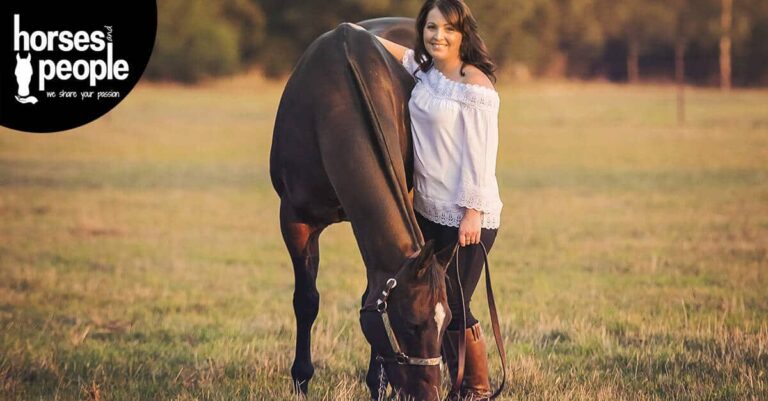
On our November 2018 issue cover, a photo by Louise Sedgman of Angie Johnson and her Quarter Horse and sweetheart ‘RL Double Hunch’ (a.k.a. Hunch), a 17-year-old gelding who is a double cross to the stallion Hunch Bid.

Angie grew up immersed in the Western showing industry, mentored by her mother who showed successfully while Angie was a child. It didn’t take long before she was competing in leadline classes and junior showmanship.

After finishing school and her final youth year, Angie took time off riding altogether, retiring her older horse and selling the young horse she had been producing. But, it didn’t take long before Hunch found a way into Angie’s heart and brought her back to the world of Western showing.

“I had to take a break from horses, try to have a ‘normal’ life like my other friends. All through school, I was always showing and never went to parties, so I had a couple of years’ break” says Angie. “But when I came across Hunch, I realised I wanted to go back to the show pen. I’d had a long-enough break.”

Angie works at the small but busy Avonsleigh Vet Clinic near the Dandenong Ranges, combining dog washing duties with vet nursing. “It’s a mixed practice” she continues. “We do a bit of everything which is interesting and, for a smaller clinic that is available 24/7 it gets pretty hectic”.

Angie has always had a passion for Western disciplines and Quarter Horses; “I think I did one day of Pony Club and I hated it!” she laughs. “I appreciate the other sports like dressage and eventing, but there’s always been something about Western that grabs me.

“The Quarter Horse itself is a big attraction. Their temperament I find so much nicer and, as I’m not a very tall person, they are more to my size as well.”

But it’s not just the horses and showiness that keep Angie in the saddle. The finer details of training that produce a polished performance are the challenges that drive Angie’s passion.

“I like the degree of difficulty involved in making it look easy” she says. “I am quite excited about training Hunch for Western Riding because it’s an event I have not competed in before.

“In Western Riding classes you have to lope a set pattern that the judge picks from the rule book” explains Angie. “The patterns vary for each age group but they include a series of serpentines between cones and changes of direction, and I am enjoying working with my trainer, David Norbury, on perfecting Hunch’s flying lead changes.

“Western Riding can be quite difficult. Being an older horse, Hunch has to be ridden one-handed, which adds a degree of difficulty. While I wouldn’t say that it ‘looks’ easy, it doesn’t look that hard, but I think it’s one of those events that are more challenging than they appear” she continues.

“I quite like the degree of difficulty in making riding a relaxed horse on a loose rein look easy and, when you get a horse that moves correctly, it’s so comfortable and you can sit back and cruise along. When you have a good horse and you achieve that, I find that really rewarding.”

“And I couldn’t do it without help. My mum, my trainer David and his daughter Courtney and my friend Adele, who owns the property where I keep my two horses, are my support network. They are very patient with me and forthcoming with advice and help when I’m working late. They are always there and I wouldn’t be where I am without them.”

And as to why Hunch holds a special place in Angie’s heart…
“My previous horse was quite challenging and unpredictable, I think due to events that happened earlier in his life, so when I got Hunch and he was so calm, and easy to do things with… I fell in love with him straight away.

“Plus, he’s going strong for a 17-year-old. He’s quite a natural and very strong. He has strong movement and he’s a very honest horse, willing to try anything you ask him to do.
“And he loves a cuddle!” she laughs. “He’s quite happy to put his head in your arms and just stay there. He’s one of those horses that become a girl’s best friend. When you’re feeling down he’ll just stand there and make you feel better.

“He’s just a sweetheart.”

This article was published in Horses and People November 2018 magazine.

The Equicentral System: Practical examples

Grass Farmers: Land Management for Horses

The Equicentral System is Jane and Stuart Myers’ complete approach to property layout, and provides practical solutions for sustainable horse and land management on your property. 

It is a system that works by utilising your horses’ natural cycles of grazing and loafing as an advantage, and is an opportunity to enhance the health and wellbeing of the horses themselves, and the land they live on, as well as the environment at large. 

In previous articles, Jane and Stuart outlined the system, discussed the surfaced, central holding yard and the importance of rotational grazing. In this article, we ask Australian Equicentric Grass Farmers to share and explain their own property layouts, and their top tips to help you start planning what you are going to build.

Time spent in the planning stage will save time and money later on, but even before you start drawing, it is important you learn as much as possible about horse behaviour because your dream could well be your horse’s nightmare.

A good example of a common horse facility that can cause the horse stress if designed and used incorrectly is a stable. Many assume they and their horses need stables when, in reality, stables are built more for human convenience, than the horse’s mental and physical wellbeing. Stables can have uses on a horse property, but they are not essential.

Horses are healthier if they are outside as much as possible. To thrive, they need a stimulating environment, daily turnout and the opportunity to interact with other horses. They also need large amounts (preferably ‘ad-lib’) low energy, fibrous feed, as opposed to small, high energy meals.

When planning a horse property, it is also necessary to accept that, although we cannot provide a fully natural lifestyle for our domesticated horses, we can learn from nature and work with it, rather than against it.

Once we begin to do this, everything becomes easier, more productive and healthier. By learning what our horses actually need, we are better equipped to make informed choices, not only about what we build and how we manage our horses, but also about who we turn to for advice when needed.

The Equicentral System was developed as a practical solution for good horse and good land management because it makes the most of natural cycles and natural horse behaviours.

In the following pages, you will hear from some of the thousands of horse owners we have met along the way and who, armed with the principles and knowledge of the Equicentral System, are creating environments that promote healthier land which, in turn, grows healthier pastures to ensure we have healthier horses.

We have selected from a variety of examples, including smaller and larger properties, and we purposefully included a challenging property that required some compromises to show how the Equicentral System can be adapted and applied to most situations.

A lot more can be learned in our books, workshops and webinars, as well as by joining the ever-growing Facebook page.

Property #1: A low rainfall area

The Howards property (above) is near the Grampians in Victoria. It is just over nine acres, fairly flat, with a very slight slope down towards the bottom of the property, near the dam.

They get run-off from the road, down the left side of the property, then via two slight, natural drains into the dam.

This is a low rainfall area, where native grasses do not grow very high, but the Howards are encouraging more diversity by mulching and composting.

They manage four horses that normally live together as one herd.

The central holding yard wraps around the round yard slightly, and the Howards say before they knew about the Equicentral System, this was wasted space, so it has ended up working very well as a central holding yard.

The yard is approximately 16m x 32m (although the round yard takes up a bit of space) so, at its narrowest, it is 11m. This does not unclude the 3m x 3m and the new  12m x 3m shelters which, including the front overhang, is actually 12m x 4m. Both shelters are three-sided and are plumbed into water tanks.

The Howards say two of their horses will share the 3m x 3m shelter, but the 12m x 3m shelter works much better.

The Howards surfaced the holding yard with crushed concrete, as it was readily available and cheap. They spread a layer around 4cm thick in the yard and a bit less in the laneways, which may not be thick enough because, although it stays dry, it allows some grass to grow through.

The crushed concrete compacts down to look like a dirt road. It held up well in Winter, except where water runs off from the round yard, so they will be installing a drain over Summer to prevent this from happening next Winter.

The Howard’s top tips 

“Even if you can only do one part of the Equicentral System, it will improve your land, but put it all together, and the results will surprise you. And… Don’t be afraid to adapt the system slightly to suit your land, yourself and your horses.”

Property # 2: A small private setup

Samantha Creswell has a five-acre property west of Sydney in New South Wales, which she has set up as an Equicentral System, and where She manages a horse and a pony.

Samantha has divided the area into four paddocks, plus the holding yard and arena, which is at the back fo the property and also fenced off.

The holding yard is 12m x 17m and she plans to add an adjacent shelter, which she hopes will be 8m x 8m. The plan for the building is to make the interior set-up flexible, with moveable walls in case there is a need to make two 4m x 4m stables in future.

The holding yard is surfaced with eucalyptus bark, which she can source for free, but she hopes to one day replace it with crushed sandstone.

Samantha faces the challenge of restoring her land, which was mined for shale 30 years ago, and never compeletly restored and rehabilitated.

Samantha’s top tips

“Just start your journey, do something, even if it is just one small part of Equicentral or even a temporary set-up. I started feeding round bales and using the leftovers for mulch. From there, I used electric fencing to map out my paddocks and see if it was going to function properly. I did that for a year to make sure it worked in all weather conditions on the property. I have learnt to love weeks and stopped spraying poison.

“My passion for the Equicentral System is huge! It not only is a better way of managing my small five acres, but it has allowed me to set up the property, so any non-horsey people I have feeding the horses can feed up without setting foot in a paddock and also check one water trough, not multiple. It’s just so functional and practical.”

Property #3: A future agistment property

Andrew Curran is in the planning stages with his 58-acre property near Ballarat, in Victoria, where he wants to run an agistment business.

Andrew’s land is undulating and, as marked in blue, he has drawn the course of any run-off water to show how it flows through the property. The black lines mark the driveway and elevated, future house site.

Purple marks the site for the arena and round yard, and next to them, a large shed will be built.

While Andrew plans to encourage agistees to keep horses in pairs and larger groups, he also wants to allow for individual housing for those who choose that, as well as for biosecurity and quarantine periods for new arrivals.

The left side of the property (see orange fencing lines) will, therefore, have a more traditional, small paddock design with a laneway for access.

The right side of the property will be divided into three paddocks (see yellow fencing lines) that lead to a very large central holding yard (possibly 100m x 60m) and will have different surfaces for different purposes, such as sand areas for rolling and resting, and granite sand or plastic grid around water troughs and gates to prevent compaction.

Andrew’s top tips 

“It will be important to limit the numbers of horses on the property to make sure we can rotate and rest pastures, and to allow us to apply all the Equicentral System tools and methods to improve the soil and grass, and – hopefully – the horses’ physical and mental wellbeing.”

Property #4: A difficult compromise

Here, we have a compromise situation – a difficult site that has required a very thoughtful layout.

This 5.7-acre property in Tasmania is owned by Laurel Gordon (we featured Laurel’s impressive pasture improvements in the September issue of Horses and People Magazine).

The property presents difficulties because the dam and low-lying, swampy areas split the land right through the middle. As a result, setting up a ‘standard’ Equicentral System layout was not possible. However, when you look at the property carefully, the same land and horse management principles do apply.

Laurel now manages two horses who live together. The pasture areas have been divided into five paddocks to allow rotation and rest, but access to all areas has required fencing a laneway that surround the riparian areas – namely, the dam and swamp.

The Equicentral System recommends minimising laneways because they take up space that could otherwise be used for grazing. They also require extra fencing and they concentrate hoof activity so, unless they are properly surfaced, they create land degradation (i.e. mud, dust, soil erosion and weeds).

While the Gordon’s laneway is longer than ideal, it fulils the Equicentral principle of allowing the horses to move themselves between the pasture that is in use and the surfaced yard.

The surfaced holding yard is also smaller than ideal, but made bigger by incorporating part of the laneway – all the way to the top righthand corner of the dam, where there is a gate. This gate remains closed whenever paddocks one, two or three are in use.

The open horse shelter is 6m x 3m and there’s a separate, large shed for storing hay. Next on the list of improvements is laying down a good gravel surface along its entire length. This improvement will take place during Summer.

In Winter, the Gordon’s feed hay in a designated sacrifice paddock in order to improve the soil with mulch. This year, it has been paddock two. In Summer, they use any waste hay and manure from the shelter and yard to mulch trees.

Laurel’s top tips 

“I hope people understand that our set-up is a departure from the ideal. As Jane and Stuart say, it’s a compromise for a particular situation and not a ‘track system’ in the usual sense. It really is an access laneway.

“It is important to surface the laneway as currently, it allows the horses too much access to short, stressed grass (courtesy of the wallabies) but, hopefully, we can mitigate that by adding more gravel.”

Grass Farming in Australia: November

Wet and Warm Means Grass!

Provided your paddocks are not waterlogged, they should be growing plenty of grass! Protect very wet areas by fencing your horses out of them because heavy hoof prints will damage the grass roots and compact the soil, preventing the grass from thriving when the ground dries out.

In the same way, keep your horses off any areas that you made the effort to mulch, and give the seeds and soil the opportunity to do their jobs.

Make sure you remain flexible with your rotation plan as conditions tend to change from week to week. The general rule for paddock rotation decisions is fast growth – fast moves.

Winter Rainfall Areas

This is the time of year when you want to see warm season grasses springing into action. Make sure you allow them to establish and gain sufficient leaf length before grazing.

Use a simple ruler to check the average length is at least 15cm and there is good groundcover (aiming for at least 70%).

With more grass available, you may be able to subdivide your paddocks further using temporary electric fencing.

If your horses are sensitive to sugars, remember plant sugars tend to be lower in the leaves during the elongation period – when the plant is using energy to grow leaves. Later on, the plant will send sugars into the stem and store it in the seeds.

In practical terms, this means the best period to graze grass is when it is increasing its leaf area – meaning it is higher than the magic 15cm in height, but it hasn’t started seed production.

Under good growing conditions, it is possible to lengthen the plants’ elongation period, and delay seed setting by regularly slashing or topping the plants to a height of 15cm. This forces them to put their energy (sugars) into growing more leaves again.

On the other hand, cool season grasses should be the ones seeding and drying off now, so letting the seeds drop before slashing will ensure the seeds are viable and germinate next Winter.

With the dry Summer just around the corner, you may want to start planning any property improvements that will require earthworks, such as topping up your holding yard surface, adding drainage or diverting water run-off.

Summer Rainfall Areas

Early and substantial rainfall along most of the north-east coast of Australia has changed the landscape from golden to vibrant green in a matter of days!

Make sure your Summer active grasses have enough length before you let the horses out to graze, but as explained in the Winter rainfall areas section, if your horses are not keeping up with the grazing and the plants are looking like setting seed early, set your mower or slasher to a height no lower than 15cm, and top the plants as regularly as needed.

There’s still time to plant warm season species – provided you can rest the pastures as long as the plants need to become well-established and vigorous. You may want to use soil tests to see if they would benefit from fertilising.

Protect your native pastures, which are likely to be most sensitive to overgrazing by resting them and allowing them to set seed. You could keep them untouched and use them as standing hay pastures during the drier months.

Your surfaced, central holding yard comes into its own during the warmer, wetter months. Watch how it copes and take notes of any repairs or improvements you may need to make during the next dry.


Read more about Jane and Stuart Myers … Jane and Stuart Myers It starts with knowledge

Will You Watch The Cup?

0

I loved the Melbourne Cup until I hated it, and then, later, became ambivalent. My ambivalence was hard-earned. As a child I found there was much to love about the cup. I was a horse-mad girl and for one day the rest of the nation got my passion. The whole country stopped to watch horses. The whole country talked about horses.

I watched the grainy images of horses galloping on the small black and white television at school; we were allowed to watch it. The TV, usually reserved for educational programmes like Behind the News and We Play Recorder, was switched to horse racing on the first Tuesday in November.

I envied kids in Victoria, where Cup Day was a public holiday. But it was a school day in Western Australia, so the whole school – all three classrooms full of us – crammed into the one room and sat cross-legged on the floor, knee to knee, to watch the horses.

It was 1975 and Think Big won for a second time, becoming only the fourth horse to win two cups. A legend. After school I galloped home, my feet hitting the hard pavement, my TAA Airlines school bag thumping against my side.

Mum wasn’t home, so I galloped down the road to the local pub to find her. She was there with her friends, ‘the ladies’ she called them, drinking beer and eating sandwiches and hors d’oeuvres – horses’ doovies Grandma pronounced it, which seemed appropriate on Cup Day.

Mum was bubbly, giggling, and wrapped her arm around me when I was almost close enough, pulling me the last couple of steps.

“I won the hat competition,” she said, grinning at me.

I looked at the hat. We’d made it together the night before, because hats were part of the cup spectacle. It was fashioned as a top hat, made from cardboard and covered with Alfoil to make it shiny and silver.

The brim we had made to be a racetrack, with green tinsel from the box of Christmas decorations serving as turf. We’d put a white fence and horses around it, borrowed from my toy farm set. We’d stuck the horses in place with plasticine, but now, late in the Wheatbelt afternoon, they were drooping. One had fallen off but it no longer mattered. It was on the table next to Mum’s beer glass. I pulled a paper coaster from the centre of the table and put the horse on it.

“It’s got a paddock now,” I said.

Mum laughed. “Are you hungry? Do you want something to eat?”

I nodded and took a sandwich from the table. Egg and lettuce on white bread, cut in small triangles. There were things on sticks. I took three toothpicks each with a square of Kraft cheese and a piece of pineapple stuck on the end. I left the olives but took a piece of Krackerwurst.

“When will you come home?” I asked.

“Later. It’s Cup Day. Do you have any homework to do?”

“Just reading and spelling.”

“Well off you go and do it. Feed the chooks too, and get the eggs.”

I nodded and wandered home, dreaming of the cup. I longed to go to it; to be at Flemington and watch the magnificent horses parade, skittish before the crowd, everyone dressed in their finery.

And hats. Everyone in fancy hats. And fascinators. That was a word and a head-dress that went with the cup; tiny concoctions delicately balanced on perfectly coiffured hair, feathers and flowers part of the show. I wondered if I’d wear one, but perhaps I would be a participant in the cup rather than a spectator. Perhaps I could be a jockey.

There were no women jockeys racing in the cup at that time. That wouldn’t happen for several more decades; in 2007 Clare Lindop and Lisa Cropp would become the first women to ride in the cup. And finally, in 2015, a woman would ride the winner. In that year, Michelle Payne would become the darling of Australia, riding 100 to 1 chance Prince of Penzance across the line ahead the field at Flemington.

In accepting her prize, Payne would point out that there were still chauvinistic elements in the horseracing industry that would have bumped her off her mount and put a man there instead. Payne had a point. She was only the third woman to ride in the Melbourne Cup since the race began in 1861.

In the mid-seventies when I was flirting with the dream of being a jockey, it was a vain hope indeed. Women were not permitted to race against men in Australian horseracing at all until 1979.

“You could be a horse trainer,” Mum suggested back in the seventies, all too aware of the barriers facing a young girl dreaming of finding a place in a man’s world, but, being the mother she was, not wanting to shatter my dreams. “Or a vet. Or just own a racehorse.”

I nodded and dreamed, cut pictures from the paper and collected statistics and facts. The Melbourne Cup is the longest handicap race in the world. It was first run in 1861 and won that year, and the next, by Archer.
Remarkably, Archer was walked the 900 kilometres from the stud where he lived to the Flemington Racetrack to participate in the race.

That endurance feat was perhaps almost as great as his galloping the 3200 metres that make up the Melbourne Cup. In the early days, it was a two-mile race – near enough to the same distance, just a different measurement system.

In the 1980s I had a friend whose father was into horseracing. Two failed racehorses – Bluey and Larry – grazed in the front paddock of their farm. Mr P threw them hay and I patted their soft noses.

“He was a good horse, that Larry,” Mr P told me. “Won three races at Ascot before he retired. And some country races as well. Placed a few times too. I’d like another one like him.”

I went with Mr P to a Thoroughbred stud ahead of the yearling sales and watched the colts and fillies parade, all long legs and tossed heads. Later, Mr P bought a stunning grey colt. He paid a staggering amount of money for him but it was okay, he was going to be a champion.

The colt was sent to a trainer and months later we went to Bunbury to watch him trial. I envied the strapper who led him out. “He’s a fabulous horse,” she told me. Standing next to him he was intimidatingly big and boisterous.

“But he’s getting a bit big for his boots,” the trainer added. “We might need to geld him, get him focused on running instead of flirting with the fillies.”

I envied the strapper and the trainer, as much for their skill and knowledge as for their proximity to horses. (Perhaps I could be a strapper, then later progress to being a trainer, I thought, holding my secret dreams close.)

The colt won that trial and Mr P was ecstatic, jumping around red-faced in the members’ bar. We drove home with the certain knowledge that this horse was going to pave the road with gold.

I didn’t go to his next trial, and afterwards was glad. The colt was leading but broke down lame just before the finishing post. He’d broken a foreleg. He stood forlorn on the track, balancing on his three good legs. The injury was catastrophic. There was no way such an injury could be healed, even if time and money were no barriers. Even now, with advanced veterinary procedures, many such injuries are irrecoverable and necessitate instant euthanasia.

For Mr P’s young horse, this was the only option. The vet went out with the bolt gun and the colt’s carcase was taken away for dog meat.

Mr P was distraught. He’d genuinely liked the horse, and it wasn’t just about money for him, although undoubtedly the thrill of potential riches was part of it. I pitied the vet who’d had to put the colt down, and the strapper and trainer who’d worked with him. Perhaps I didn’t want to be involved in the racing industry.

Years later, I rode at a riding school where half of the horses were ex-racehorses, stunning animals given a second career as showjumpers and school horses. Big, powerful, and well-trained, they were a joy to ride.A big chestnut called Wizard was my favourite. On him I learnt basic dressage and confidence at the canter. He taught me to jump and we popped over small jumps in the arena together.

I thought perhaps I would buy an Off-Track Thoroughbred. They go cheap. There’s a surplus of them. Over 13,000 Thoroughbred foals are born in Australia every year. Of those, 74 per cent start training to be racehorses; of those 93 percent progress to trials and racing.1

A proportion of them enjoy success; a small minority become champions. Thoroughbred racing is a numbers game as much as anything. Despite all the breeding and training and science and folklore invested in trying to produce champions, it seems there is still an inordinate amount of luck.

Buying a yearling racehorse in Australia is likely to cost somewhere between $50,000 and a million dollars. The new owners of the 4932 yearlings sold in Australia in 2013-14 paid $342 million for them. The total paid for all horses sold at public auction, including broodmares, was $469 million.2  Of course, there are the legends about horses bought for a pittance that go on to become champions.

Once the racehorse has been bought, it needs to be kept and trained. This will cost around $40-50,000 a year depending on where it is located, perhaps more if it goes to a high-end trainer, and that’s without unexpected vet bills or setbacks. But the lure of prize money draws people in.

The total annual prize pool up for grabs in Australia is $308 million at an average of $14,535 per race.3 The Thoroughbred owners’ association suggests that winning one Saturday city race a year is enough to pay for a racehorse’s annual keep.4

But 63 per cent of horses that race will earn less than $10,000 each year, and fewer than three per cent will make $100,000 a year.5

Some of those that don’t make it end up like Mr P’s colt, destroyed after a catastrophic accident; some end up like Bluey and Larry, living lives of leisure in large paddocks, doted upon as pets and asked to do nothing more. Some end up like Wizard, given second chances as riding horses.

And this is perhaps an undervalued side of the Thoroughbred racing industry; all those failed racehorses that give leisure riders and weekend equestrians a chance to own fabulous horses, fast and athletic, at a fraction of the cost that it really takes to breed them.

But not all find their way to loving homes and second careers. It is estimated that 6.3 per cent end up at the knackery.6

It was my realisation of this harsh reality, the reality of magnificent beasts slaughtered for pet meat, that first raised doubts in my mind about horseracing.

I became a horse-owner in mid-life and found myself drawn to people and trainers seeking an approach to horsemanship loosely referred to as natural; an approach that, simplistically explained, seeks to enable horses to express their natural behaviours.

Most people taking this approach ride horses and many compete in different horse sports. But it was in these circles that I first came across people vehemently opposed to horseracing. Thoroughbred horseracing is a favoured target among animal rights activists and the ‘wastage’ – that euphemistic term used to describe the Thoroughbreds killed when they don’t make the grade – is a rallying point.

The efforts of the industry to clean up its act often fall on deaf ears and the Melbourne Cup is a prime target, with its emphasis on fashion and festivities, with images of drunken women tottering on high heels, skimpy dresses and hats askew, fascinators no longer fascinating; of men in suit jackets and board shorts sculling beer; all this as much a part of the scene as magnificent horses galloping. The murk that lurks behind the glamour.

So I came to hate the cup. I saw only this dark side. The ‘wastage’, the drunkenness, the corruption, the chauvinism, the sexism, the cruelty. I didn’t want any part of it. I denied I’d ever been held in the cup’s thrall. And yet.

And yet there is still a little girl inside of me that feels a sense of pride that a horse race can stop our nation and I want that to happen. I want that pause, that unification. It has long been part of the Melbourne Cup. As early as the 1880s, the American writer Mark Twain noticed it. He wrote: “Nowhere in my travels have I encountered a festival of the people that has such a magnetic appeal to a whole nation.”7

I walked down the street with friends after dinner in late October. In the lead up to the cup, all the restaurants were advertising their cup luncheons. “Book now,” the billboards screamed as we searched for after-dinner coffee and cake.

“We don’t have a cup luncheon at work anymore,” my friend D said. “One of our team is vegan and she’s anti-horseracing. She finds the whole thing too upsetting.”

“Bloody wowser,” D’s husband said. “Why should one person destroy everyone else’s fun?”

“Well, she doesn’t say we can’t have a luncheon, just that she wouldn’t go,” D said. “But she gets very stressed and upset when anyone mentions anything about it, so we find it easier to just say nothing. She says it’s bad for the horses. She says they don’t want to race. Maybe she’s got a point.”

Her husband shrugged. “What do you think?” he asked me. “You have horses. What do you think of the cup?”

I ran his question through my head: What do I think? I honestly don’t know. “Some horses like to race,” I said, hedging my bets. And I told them a story about my little old Quarter Horse-Arab mare Floss. She’s not a racehorse, never was, doesn’t have the breeding or the athleticism. But like many horses, she loves to run.

Out riding with H once we came to a long gentle hill. We were cantering up it. Floss tossed her head, wanting to run. I let her. I didn’t do anything to make her. I don’t carry a whip. I don’t wear spurs. I don’t even kick her. I just shifted my body so she knew she was allowed to run. She galloped. Her hooves pounded as they ate up the ground. She stretched out and put everything she had into it. We flew up the hill. H, galloping along just behind us on her bigger, younger, stronger, fitter horse, laughed.

“Flossie is really going for it,” she called out. “Come on Cruiser, you’re not going to let that old girl beat you, are you?” H stood up in her stirrups, freeing Cruiser’s back from her weight and allowing him to move more easily. Cruiser took the cue and cranked up his speed. He drew level with Floss.

I was up out of my saddle, leaning forward, my hands at the side of Floss’s neck, her mane whipping back at my face. I was allowing her to run but not demanding it. She was entirely self-motivated. I could feel every muscle in her body straining to keep her nose in front of Cruiser’s, but she didn’t have it. The second Cruiser’s head got in front of Floss’s, she slowed down. She gave up the race.

All the fight and determination went out of her. We slowed to a canter and came back to a walk. I got off and loosened Floss’s girth, let her blow. She was drenched in sweat, her sides heaving. I led her for a while letting her cool down and catch her breath.

“You didn’t have to run that fast,” I told her. “I wasn’t making you.”

“If she was a racehorse, she’d either come first or last,” we decided later when I told my daughter about it.

“Once Cruiser put his nose in front, she just gave up,” I told her. “She wanted to win, but when she couldn’t, she lost all interest.”

I wonder if some racehorses are like that. A friend had a failed racehorse – an Off-The-Track Thoroughbred – who never made it past trials because she would just suck in behind another horse and run second at best, or further down the field if the horse she chose to flank was running slower. Unlike my Floss, she had no desire at all to put her nose in front.

“So will you watch the cup?” D asked me, as we pulled up chairs and ordered coffee.

“I’ll probably put the TV on,” I said. “I take a passing interest, but I don’t bet on it. I used to crave to go, to be there to watch the spectacle, but I’m not so sure now. There’s something I love about it and something I hate.”

And on Cup Day that’s what I do. I put the flat-screen TV on and watch the full-colour spectacle of Flemington on the second Tuesday in November.

I don’t go out to a cup lunch, I don’t place a bet, but I do watch. I bear witness to this race that captures the heart of a nation. I cringe when I watch the whips, padded though they are, whacking the horses as they pour their hearts out on the home straight.

I like it when the winning horse’s connections seem to genuinely care about the horse. I feel ill when there is a track-side tragedy and a horse is euthanised.

I love it when there is a rags-to-riches story of horse, trainer, owner or jockey. I surged with feminist pride when I listened to Michelle Payne’s winning speech.

I feel annoyed on behalf of the women who totter across the train tracks in their high heels because the train is blocked by protesters lying on the track.

Yet, like the protesters lying on the track I too am saddened by the too-many horses that don’t make it, by those almost-magnificent Thoroughbred foals born each year that end up as dog meat. Unlike the protesters, I don’t think the answer is in stopping horseracing entirely.

All in all, I suppose I can only be described as a fence-sitter in this complicated, multi-factored discussion. It’s taken a long time and a lot of soul-searching, but I guess have become ambivalent.

References

  1. Figures from Racing Victoria. https://rv.racing.com/welfare
  2. https://www.aushorse.com.au/becoming-an-owner/#getstarted
  3. https://www.magicmillions.com.au/buying-first-horse/
  4. https://www.aushorse.com.au/becoming-an-owner/#budget
  5.  https://sydney.edu.au/news-opinion/news/2016/10/31/3-horse-racing-myths-busted-for-the-melbourne-cup.html
  6. https://sydney.edu.au/news-opinion/news/2016/10/31/3-horse-racing-myths-busted-for-the-melbourne-cup.html
  7. Quoted in The Great Book of Australian Horses, 1976, Rigby Australia.
  8. Author’s note: Names (including of most horses) have been changed to protect identities.