fbpx
Home Blog Page 21

When the Drought Breaks… Hold Your Horses!

Horse pastures drought recovery

After yet another dry and hot year in Australia, most horse owners and farmers are longing for some steady rain to kick-start the growing season and seeing some green and standing grass. And, while nature does seem to restore things in a short time when temperature rises and water becomes more abundant, there are some aspects that you should be aware of before letting your horses out on these green emerging pastures.

Article highlights:

  • When the rain comes it’s a relief, but the problems don’t end there.
  • Pastures that have undergone drought stress need enough time to fully recover.
  • After the drought breaks, make sure you observe the new growth and manage your horses’ grazing time accordingly as it may put both plants and horses at risk!
  • While it’s tempting to keep horses longer in paddocks or turn them on to green emerging pastures, you have to delay and utilise where possible designated sacrifice areas or dry lots.
  • You may even have to stable or contain your horses in yards to reduce pressure during the first stages of pasture recovery and growth.
  • Make sure you have a post-drought plan in place for you pastures and horse management.
  • Identify paddocks that most likely need to be restored and graze only those paddocks that have sufficient density and leaf area.
  • When pastures are back in full production, make sure you rotate your paddock to allow for recovery and avoid overgrazing new growth.
  • If you have the possibility to harvest fodder, make sure you start planning your haymaking or alternatively build into your long-range ‘fodder conservation’ strategy to reduce the effects of the next drought.

Hold your horses!

Pastures are under a great deal of pressure when the drought breaks. Roughage and supplementary feeding is less available and more expensive during droughts, so it’s tempting to let horses continue grazing paddocks in the hope that the growth will improve dramatically and gradually meet animal needs. However, it pays not to, as this is very damaging to your pasture.

The effects of drought on pastures are extremely variable and subject to a large number of factors. Often, pastures that have experienced drought have limited ground cover and can even be bare. This affects the soils’ fertility. Compaction due to set stock grazing often contributes to other pasture/soil problems such as erosion, water logging and weeds!

After the drought breaks, weeds commonly accumulate in large quantities, as pastures are weakened and less able to compete with vigorous weeds, especially annual species. If these weeds accumulate secondary compounds that can cause toxic effects, horses and livestock are at risk of getting sick.

Therefore, it’s important as a horse owner to be aware of these challenges after the drought breaks, and develop appropriate management strategies that will allow you to establish sufficient and healthier pasture to safeguard your horses.

Drought is tough for pasture plants

It is not a surprise that drought is tough for pasture plants. Without water they cannot survive or grow. One of the most obvious effects of drought is thinning out of large areas of perennial pastures. The level of thinning out largely depends on:

Grazing pressure by animals: Research has shown that where grass stubble has been retained, the survival of perennial grasses was significantly greater than where feed was grazed out completely.

The species involved and soil fertility: It has also been shown that on good-fertility soils shallow-rooted pasture species such as ryegrass and cocksfoot were lost in significant numbers, whereas phalaris, fescue and native grasses such as wallaby grass and weeping rice grass survived.

The severity of the drought: Studies have demonstrated that losses of pasture were greater following prolonged dry conditions (where some green feed may still be available) than losses from severe drought. This is because in long-term drought plants stop growing, whereas in dry spells plants continue to grow and are grazed off, which depletes their energy reserves, resulting in death of the plants or very weakened plants that don’t recover well.

Management matters

Our management significantly affects pastures in drought.  During drought times and because grass is not growing, horse owners usually keep their horses longer in paddocks. This, however, results in continued grazing and compaction of your soils.

Following the break, this will often create further problems, such as erosion, waterlogging and/or weeds.

As highlighted above, keeping some stubble is the key to the future survival of grasses after drought. It is therefore important that you still rotate your pastures during winter and drought.

However, if rotation is not an option, then it’s important that you lock up some paddocks and designate only certain areas as a sacrifice area or a dry lot. Alternatively, you may have to consider keeping your horses for parts of the day in stables or yards to reduce grazing/trampling of drought-affected pastures.

Each drought is different, with the current drought being exceptionally severe in many areas. Understanding the effects of drought on plants is important, because it guides the management of both, your pasture and horses.

Assess your pastures: What has survived?

When the drought breaks, it is essential that you monitor your pastures and assess what plants have survived and what may be growing that is less favourable – such as specific weeds.

There will be many factors that influence the survival of your grasses and legumes such as, total and frequency of rainfall, pasture composition, soil condition, type, slope and aspect, grazing pressure, management strategy and the pasture’s health before the drought.

Check your horse paddocks after growth has recommenced, determine what is left, but also establish what the potential of the remaining pasture is, given a reasonable chance of recovery and reasonable seasonal conditions.

For some grass types such as annuals and tropical grasses, you may have to wait till later in spring/summer (warm-season grasses) or autumn (for cool season grasses). If you need some help with identifying plant species seek advice from your local landcare or catchment organisations or ask a pasture consultant.

There are also many free online grass species guides and database programs that you could access on the Internet.

After checking the potential for survival and for future regeneration of your pastures, rank them according to their potential value after the drought.

You can rank your pastures as follows:

  1. The paddocks that have moderate to good density of desirable species but have been under severe stress from drought and grazing pressure will be Group 1.
  2. The paddocks that have moderate to good density of desirable species but have not been under severe stress from drought and/or heavy grazing will make up Group 2. These paddocks offer the possibility of some grazing as conditions improve but will need management to allow full recovery in the short term. Consider only short term grazing or alternate with locking up horses in stables or yards for parts of the day.
  3. The paddocks where the pasture density is too thin in order for it to become worthwhile pasture after a return to more normal conditions are Group 3. This last group can be considered for immediate grazing (sacrifice paddocks), cropping, re-sowing or pasture renovation treatment.

Once you have identified the pasture species that have returned and you have ranked your pastures as per the above, you will have to develop strategies where:

  • Paddocks and pastures identified as ‘1’ (high-potential) are given priority for rest and recovery.
  • Pastures and paddocks that are classed as ‘2’, should be scheduled for rest as soon as practicable.
  • Paddocks and pastures in the last group ‘3’ can be used as sacrifice paddocks where drought feeding can continue until growth on better paddocks improves. These paddocks are suitable for re-sowing, renovation or being sown down to grow forage/fodder crops.

Managing what is left

Horse owners rarely consider post-drought management and often, pasture management is compromised by resting pastures less (if at all) or grazing pastures harder and for longer periods, and grazing to a height that is shorter than recommended. This causes energy reserves to depleted and the plant is weakened, often to the point of death.

Where pastures are compromised in this way, they need to be compensated.

A good fall of rain in itself does not overcome drought stress. The plant has to be allowed a period of recovery to build up the energy reserves that will allow it to reach its full potential.

You often need to help your pastures with additional input such as mulching, composting and/or spreading (bio) fertilisers to optimise the environment for soil organisms and nutrient exchanges with the plants.

Check our previous series on ‘All About Soil’

Rest is recovery

Rest is the key to preventing overgrazing. The length of time that a plant needs to recover following grazing depends on several factors including the type of forage species, plant vigour, and the level of utilisation.

Recovery time also depends on the season or time of year, which determines conditions such as day length and temperature. Soil condition, fertility and moisture also impact plant growth rates.

If we want to rest paddocks and allow recovery, we must manage the grazing time of our horses.

So, when can we graze pastures again? 

To answer this question we need to look at the pasture growth stages.

The efficiency with which plants convert the sun’s energy into green leaves and the ability of animals to harvest and use energy from those leaves depends on the phase of growth of the plants.
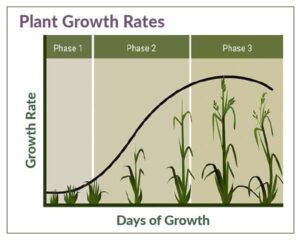
Table of Plant growth phases
Grazing pastures that are in phase 1 should be avoided, not only to protect the plant, but also to protect your horses, especially those with weight or metabolic problems. Aim for the mid to end stage 2 or the beginning of stage 3 (before flowering). This is when production of sugars slows down and when the sugars are fully utilised by the plant.

Plants go through three phases of growth that form an “S” shaped curve. The timing of the growth curve for each forage species is unique and these growth characteristics are an important factor when determining proper season of use for grazing.

For example, cool-season grasses start growing in spring and again in autumn, whereas warm-season grasses peak later, when it’s closer to summer.

The growth stage will dictate when plants are most vulnerable or when the plants have created enough biomass to survive grazing attacks! Therefore, avoid grazing pastures when plants are in phase 1.

In this first growth stage, the plants are weak and have insufficient leaf area to produce biomass quickly. After such a long, severe stress period of drought, pastures should be allowed to reach phase 3 and reach flowering.

At this stage, the plant’s energy reserves have been replenished, assuming flowering has not been premature (i.e. forced by dry conditions). If this is difficult to manage for all paddocks, at the very least, after drought, delay grazing some paddocks until pastures are into phase 2, at which stage they are growing actively and have sufficient leaf area to produce feed efficiently.

Where you are forced to graze paddocks early, plan to rest them (and preferably allow perennial grasses to seed down) as soon as conditions permit.

During the growing season, rotate your horses more frequently. The golden rule is fast growth = fast moves (shorter recovery) whereas slow growth = slow moves (longer resting). The height of pasture at these growth stages will vary considerably, depending on species, density, growing conditions etc., but as a guide, a typical healthy dense perennial grass/legume pasture would be in phase 2 between 5 cm and 15 cm high. It may take a few weeks to reach this stage depending on the vigour.


Weeds

It is also important that you keep track of the type of weeds that may be growing after the drought breaks. You might find that you get weeds you have never seen before or the quantities are much higher than usual.

The weeds that you can find after the drought breaks will vary depending on seed bank, location and soil condition. Often, weeds grow first as they have deep-tap roots and establish more vigorously when water becomes available, outcompeting shallow-rooted grasses.

Weeds can accumulate sugar, starch, or fructan under drought stress. This makes weeds a lot more appealing to your horse, especially when pasture is not abundant.

Dandelion, thistle and chicory are common weeds that often are relished by horses even under normal conditions.

However, there are some weeds that are more of a concern such as capeweed, flat weed, marshmallow weed, Paterson’s curse, St John’s wort, common heliotrope, mintweed, pigweed, fireweed, wireweed, and caltrops.

Many plant toxins concentrate under drought conditions. Weeds can accumulate nitrates, oxalates, alkaloids, prussic acid, and cyanogenic glycosides, which can cause a wide variety of equine health problems including staggers, digestive upset, laminitis, mineral imbalances, photosensitivity, and liver, kidney, and neurological damage.

For more information see the guide on toxic plants for horses published by RIRDC.

It is important that you remove horses from pastures where you have identified weeds that may put your horses at risk, especially if they are in large quantities.

These paddocks will need to be restored and managed to ensure that weeds are removed and no new weeds emerge. Don’t forget your sacrifice or dry lot areas as well!

Your horse’s health

The most common fear horse owners have in spring or when drought breaks is the quick growth of lush, green pasture and accumulation of non-structural carbohydrates. This can put horses at risk of developing digestive problems and/or trigging metabolic conditions, such as laminitis and EMS.

As we explained above, when conditions are favourable – a rise in temperature, sunlight hours and water availability – plants will start using their energy reserves (fructan or starch) to create more leaves, to increase their surface area, and accumulate more simple carbohydrates for new growth and seed production. Re-watering stimulates production of enzymes that break storage carbohydrates into shorter chains, and ultimately to the sugar components.

Those first new green shoots can therefore, be very high in sugar. The type of sugar produced after the drought breaks can vary depending on the species of grass.

Typically, improved pastures are more adapted to grow rapidly and allocate sugars for more growth, whereas native pasture species can survive well during drought conditions, but typically accumulate biomass slower (hence why native pastures are more susceptible to overgrazing pressure).

Grazing pastures that are in phase 1 should be avoided where possible, not only to protect the plant, but also to protect your horses, especially those with weight or metabolic problems.

Aim for the mid to end stage 2 or the beginning of stage 3 (before flowering). This is when production of sugars slows down and when the sugars are fully utilised by the plant.

As mentioned earlier, allowing pasture to set seed is important to add to your seed bank and diversity.

Nevertheless, research has shown that, if you slash pastures just before seeding, you can increase leaf production whilst avoiding the sugar increase from the seed heads. It is therefore advised that you check the ranking of you pasture and decide which pastures you allow to set seed and which ones you prep for grazing.

During the times when grazing should be avoided, manage your horses in sacrifice areas/ dry lots and yards or stable them as required. It does mean, however, that you have to continue feeding conserved forages and alternative fibre sources!

Regeneration of pastures

Where you have the ability to rest your paddocks (group 1 or 2), it’s important that you check your soil’s condition and organisms. Soil analysis is recommended to provide you with a point of reference as to what you may have to do to improve your soil and pasture condition to reach its full potential.

Often, topsoil is lost during drought periods due to thinning out of plants which creates bare patches that turn to dust and are exposed to wind erosion.

Increasing your organic matter (mulching), adding compost and fertiliser should be considered to increase fertility and support soil organisms. But make sure that you plan this when water is available.

If you are dealing with moderate to very degraded pastures (group 3) or experience problems such as erosion, water logging or weeds, you often will need to tackle the underlying problem – compaction.

See our previous articles on how to de-compact your soils and manage weeds.

If the pasture has significantly deteriorated, re-sowing may be necessary. Your options include a full seed-bed preparation for a forage crop, or direct drilling to re-establish a permanent pasture. Some annuals can be surface-applied in higher-rainfall areas.

Fast-growing forage crops fit in well to a pasture regeneration program after drought. Once established, they can take the pressure off the high-potential pastures, allowing them to recover.

Fast-growing forage crops are also useful for cleaning paddocks of weeds prior to re-sowing pasture and for replenishing hay and fodder reserves quickly.

Pasture re-sowing is expensive, however, and should be used only when the pasture is unlikely to improve through other techniques.

The bare ground situation, reduced sward density and lowered stock numbers (in some grazing areas) can provide an ideal opportunity for you to sow improved and/or native pasture species or to thicken up a sward where plant numbers have been reduced by drought.

Please note that after drought, the availability of locally produced pasture seed may be limited but there should be adequate seed available from other states. Of course, the price of seed is likely to rise and supply/demand generally will keep prices higher for some time after the drought.

The takeaway…

  • When the rain comes it’s a relief, but as this article has highlighted, the problems don’t end there.
  • Pastures that have undergone drought stress need enough time to fully recover.
  • After the drought breaks, make sure you observe the new growth and manage your horses’ grazing time accordingly as it may put both plants and horses at risk!
  • While it’s tempting to keep horses longer in paddocks or turn them on to green emerging pastures, you have to delay and utilise where possible designated sacrifice areas or dry lots.
  • You may even have to stable or contain your horses in yards to reduce pressure during the first stages of pasture recovery and growth.
  • Make sure you have a post-drought plan in place for you pastures and horse management.
  • Identify paddocks that most likely need to be restored and graze only those paddocks that have sufficient density and leaf area.
  • When pastures are back in full production, make sure you rotate your paddock to allow for recovery and avoid overgrazing new growth.
  • If you have the possibility to harvest fodder, make sure you start planning your haymaking or alternatively build into your long-range ‘fodder conservation’ strategy to reduce the effects of the next drought.

This article was published in Horses and People September-October 2019 magazine.
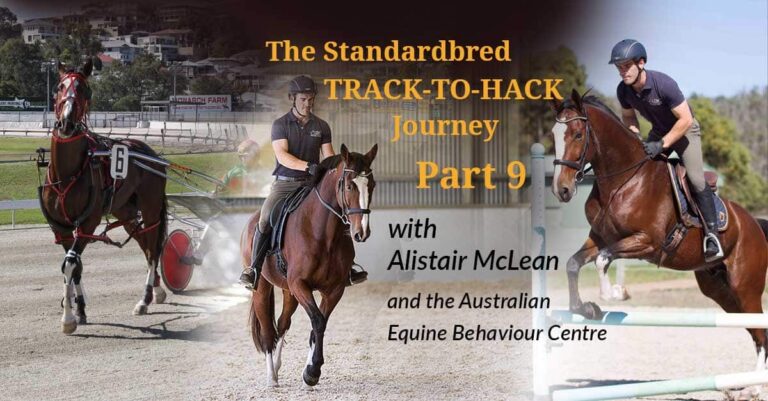
The Standardbred’s Track-to-Hack Journey Part 9: Andy’s Equitana Experience

Welcome to Part 9 of the Unharnessed Potential project, an education and awareness campaign to promote the re-training and re-homing of Standardbreds when they retire from a racing career.

The previous article marked the completion of Andy’s re-training, according to the shaping scale he reached ‘proof level’  which is testing the responses you have trained at home in more challenging (unfamiliar) environments.

In this article, Alistair recounts their Equitana experience.

Leading up to Equitana 

An important part of the preparation for Equitana was to take Andy to a new environment without the added pressure of a competition or performance. For this, and as explained in an earlier article, we took Andy to a dressage day, just for a casual look around and to test his training.

Training your horse in a new and unfamiliar environment, without the pressure of competing, is an opportunity to test all the responses you have trained at home and correct any issues. It is the training in these different environments that shows us where we are on the training scale.

This is the time where you can focus on fine-tuning all that you have taught your horse at home. Anything that is not quite consolidated at home will only be worse in an unfamiliar place, so it’s important to stop teaching him new things and focus on improving the responses he has already learnt.

Andy’s first outing, which took place about six weeks before Equitana, gave me some idea of how he would respond in a pressure situation and helped me identify the areas I needed to work on at home, as well as any groundwork and under saddle techniques I could use to get him to relax at Equitana.

To read more about Andy’s first outing click here.

Armed with the knowledge gained at this first low-key outing, we decided the weeks leading up to Andy’s demonstration, we would focus more on refining his gaits. We practiced riding the movements in a small 20m by 20m arena so we could see how well he coped in the smaller space. As expected, he found this quite hard in the beginning as his movement covers a lot of ground. 

It was also very important to keep him interested in his work and not get caught up in training too often. Andy has never been a horse I worked in the arena six days a week, so it was important that this didn’t just change in the lead-up.

We still went out on rides into the bush through the week – mixing the rides between riding on a loose rein and on a contact. I think this is where a lot of Andy’s improvement came from. Being able to keep him focused, riding some transitions and lateral work gave a more realistic training simulation to Equitana than the closed environment of the arena. His home environment is a great place to train as there aren’t many distractions, however, it does not train ‘proof’.

‘Proof’, the highest level on the training scale, is not something that magically happens, it comes from making the aids you have trained in a familiar environment work in challenging situations. In essence, it is when you can overshadow the environment with your aids. This is something I was well aware of leading up to Equitana, so we did a lot of ‘proof’ training under-saddle, testing all the responses in all sorts of situations. 

Arriving at Equitana 

Andy arrived on Thursday morning and joined the other lovely horses that were representing the Standardbred’s unharnessed potential at the breed village.

Andy was rarely stabled at the AEBC, so it took a while for him to settle in. Although we practiced staying overnight at our first outing a few weeks earlier, the environment of Equitana was much more challenging and the windy weather that morning did not help him settle.

We made sure that he had enough water and roughage to keep him chewing throughout the day and we were pleased to see that, despite his obvious anxiety, he began eating and drinking from the start.

We were hoping that he could have been walked more regularly but, because of the public access and the crowds visiting the breed village, he had to stay in his stable all day and was only allowed out between 6pm and 8am. This was not ideal for a horse like Andy, but a necessary safety aspect of attending an event like Equitana. Andy did, however, manage to settle down and happily posed for photos and scratches from the many fans that visited throughout the event.

A test ride 

Our next task was finding a permitted time to have a test ride. It was the day before his demo, so I really needed to see how he felt. However, the organisers could not let me out of the breed village to ride until after 6:30pm when the exhibition areas were closed to the public. Then, the car park had to be cleared to get to the warm-up arena, which was likely to be at least another hour and this was getting near dark.

Luckily, I know that Andy has well trained responses, so I could be flexible on where we train. So, in the end, we managed to squeeze a ride on a 10m x 20m area of bitumen the night before his demo. It was not ideal, but it was better than nothing.

The small space and bitumen footing of the exercise area meant I could only walk, but I was still able to get a feel for him in this new environment. There were cars nearby manoeuvring out of the car park and a lot of activity everywhere, so it was good enough to test our responses.

Andy felt a little tense in the beginning, but I just focused on getting him relaxed through some turns and lateral work, and got him obedient through transitions. After 10 minutes, he was relaxed and responsive, so we called it a day and hoped for the best tomorrow!

The big day 

The morning of the demonstration day (Friday) was exciting. We had a great team of helpers getting Andy ready. One of Andy’s sponsors, the NRG Team, had provided all of the show-prep products we needed to make Andy look like a star. It is safe to say that Andy had never had so much grooming in his life! This is where our ‘park’ training came in very handy – Andy stood patiently while our helpers turned him into a sparkling dressage horse.

We were lucky enough to get a short warm-up ride in a proper arena on our way to the demo arena. Again, I focused on the same things as the night before, but this time I introduced a little trot and canter.

Andy actually felt very nice at this point and was listening carefully to my aids. I knew this was a huge ask for him and I really didn’t know what to expect.

The walk over to the main pavilion was filled with nerves and excitement. Andy was still feeling great. Before getting into the arena, we had to walk through the crowd and past the booths. He was nervous, but still very responsive at this point and walked through like he had done it all before.

The demonstration 

The demo was a huge success for Andy. It was by no means a perfect demonstration, but it really showed how far this horse had come in only eight months.

The in-hand work was probably the trickiest part. Andy became quite nervous and wanted to move around a lot. It was difficult to show the things we needed to show for the demo and we didn’t have much time to spend on groundwork, so we didn’t spend a lot of time doing the in-hand training.

Because Andy was first started under-saddle at the Australian Equine Behaviour Centre, his ridden work has been clear and consistent from day one. His in-hand work, however, has a history of inconsistency between being handled by different people as a foal, in training, at the races, during transport, etc.

This means that his in-hand training has been a lot more inconsistent than his ridden work, which is a good reason as to why he was instantly so much calmer from the moment I got on.

His basic responses under-saddle really stood a huge test in that small and high pressure environment, but he responded well, showing really clean transitions.

His lateral work was also nice, however, it was difficult to really show the crowd what he can really do in such a small arena. He did occasionally get his legs in a knot!

A canter 

Towards the end of the demo, Andy was getting very tired and I could feel he really needed a stretch. Andrew wanted to show the crowd a canter but we were running low on time. I was a little worried his tiredness was going to be a problem. I asked for canter from the walk as he generally stays together a bit better, especially in a small arena, and I was so pleased that he gave me a very good effort and very clean walk to canter transition.

He cantered a nice circle and returned to walk with another lovely transition. It’s quite amazing that a pacer could do that in a tiny arena, in front of a crowd, after just eight months under-saddle. It’s a testament to the breed and specifically to Andy.

All in all, Equitana was a very successful outing for Andy. He was better than I ever expected him to be in such a radiant atmosphere. He is a great example of what can be done in a small space of time with such a trainable breed.

It is unfortunate that the statistics of re-homing Standardbreds are so much lower than their Thoroughbred counterparts, as they generally have very good temperaments and make ideal pleasure horses.

From a re-training perspective, the fact that harness racehorses do not have any (bad) experience under-saddle gives re-trainers an opportunity to start them just like any young horse. As we have seen with Andy, despite their lateral gait being very well-practiced and ingrained, Standardbred pacers can be re-trained to trot and canter, and some have excellent movement by any standard.

With human injury rates in horse-human interactions so high, I hope that this project will continue to provide incentive to use this breed more outside the track.

Although Andy’s basic re-training is now well-established, I am looking forward to continuing to ride him in 2015, but that will be after he enjoys a well-earned rest in his paddock.

As well as continuing to develop and consolidate Andy’s training, the next goal in the project is to compile a Guide to Re-training the Standardbred Racehorse to help others re-home and re-train more of these wonderful horses when they finish racing.

The Unharnessed Potential Project was possible thanks to the following sponsors – Australian Equine Behaviour Centre | Greg Grant Saddlery | NRG Team | Harness Racing Australia | Southern Cross Horse Transport | Advanced Equine Dentistry | The Barefoot Blacksmith | Raising the Standards | Kilmore Equine Clinic | Manuka Haylage | Horses and People Magazine | Strong Step Hoof Care | Kompeet to Win


Australian Bushfires – How Can I Help?

0

Help for Australian Bushfires.

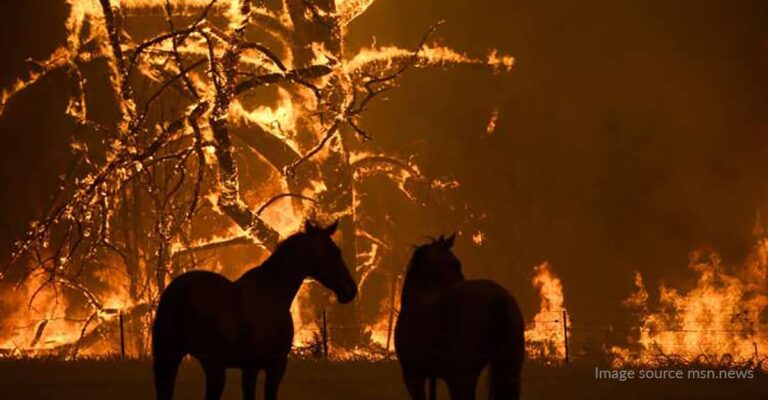
As part of the horse industry and farming communities, many of us are wanting to help those affected by the Australian bushfires.

Reports of rain during last week have been welcome but the falls were patchy and most areas face ongoing fire threats and evacuations, while many people are not being allowed back into some areas.

Details are sketchy but one thing is certain, even when the fire situation improves, the recovery is going to take many years. If you have not been directly affected, you may be wanting to help. Here are some ways you can.

The main way to help at this time, is to donate money but we urge you to be careful choosing how to donate, as there have been many fake charity and donation sites springing up. Here are links to ‘fair dinkum’ donation points making a difference in affected areas today:

TO HELP THE FIRIES:

The Rural Fire Brigades Association Queensland Inc.

New South Wales Rural Fire Service

Victoria Country Fire Authority

South Australia Country Fire Service

TO PEOPLE AFFECTED:

The Australian Red Cross is on the ground and accepting donations for all bushfire affected areas.

The Salvation Army (The Salvos) or phone 13 72 58

St Vincent de Paul – Funds raised will be directed to bushfire relief in ACT, NSW, QLD, SA, and VIC.

Blaze Aid – Blaze Aid organise volunteers of all skill levels to head into affected areas when safe to rebuild fences. You can make donations and/or buy merchandise to help raise more.

Gippsland Emergency Relief Fund – Specifically set up for Gippsland Residents.

Bendigo Bank Victorian Bushfire Appeal

TO HELP HORSES (and livestock) AFFECTED:

Australian Veterinary Association – The Veterinary Benevolent Fund – veterinarians who are being called upon to assist and provide essential services, many pro-bono in nature.  (Watch the video to understand where the funds are going)

Farmhub – They have a list of different ways we can help, with links.

Buy a Bale – This is the best way to donate feed for horses and livestock, which is connected to Rural Aid’s $25M Disaster Recovery Appeal. You can make a donation or buy merchandise to help raise funds.

Pony Club Victoria (Go Fund Me page to rebuild affected Victorian Pony Clubs)

TO HELP WILDLIFE AFFECTED:

Wildlife Rescue (WIRES)

World Wildlife Fund (WWF) – Whilst their fund is focused on saving koalas from extinction, they have launched a global Australian Wildlife and Nature Recovery Fund to supply urgent care to wildlife organisations.

TO HELP LOCAL BUSINESSES IN AFFECTED AREAS:

Once the fires have passed and businesses are re-opening, visit the fire ravaged townships. Shop and spend with them. “Go with Empty Eskys” campaign.


Check out our article – 6 ways to improve your horses natural disaster resilience.


How do Horses Sleep?

Whether you ride horses or just admire them from afar, at some point you might have wondered how they sleep. Maybe you saw a pony lying in a field and wondered if they sleep lying down or standing up. If you have pets, you probably already know that the sleep habits of dogs and cats differ quite a bit from that of humans. Just like other animals, horses have their own unique sleep requirements and patterns that differ from ours.

This article put together by tuck.com, focuses on everything you might want to know about how horses sleep. Do they really sleep standing up or must they lie down? Can they dream like humans do? How many hours of sleep do they need on a daily basis? How are horses’ sleeping habits the same or different compared to those of other large animals?

(Spoiler alert… One thing we do now know is that, contrary to popular belief, while equines can rest standing up, they need to lie down to achieve the REM phase of the sleep cycle.)

Read the article here and find the answers to your questions. (Re-directs to Tuck.com)


Read the results of a scientific study into sleep deprivation in horses.  

Architects Offer Free Aid to Bushfire Victims

Architects offer free aid to bushfire victims

Heartbreakingly, thousands of homes and farms in Australia have been destroyed or damaged by this summer’s devastating bushfires and in response, architects across the nation have put up their hands to help. Over 400 local architectural practices have signed up to Architects Assist to offer free design and planning services to help bushfire victims rebuild their homes and their lives – and the number is rising.

Architects Assist was established on 4 January 2020 by architectural graduate Jiri Lev, principal of Atelier Jiri Lev, a developer turned architect who is using his skills to connect architects with individuals and communities in need.

Architects Assist (AA) aims to help rebuild lives and livelihoods by connecting those in need with qualified professionals able to offer assistance. It provides a centralised platform where registered architects can sign up to help victims of the Australian bushfires replace the structures they have lost, free of charge.

The initiative is now jointly managed by the Australian Institute of Architects.

AA acts as a simple referral service between clients and registered architects, but the website also contains information resources for building and re-building in fire risk areas that everyone will find very valuable.

AA currently represents about 500 practices from across Australia, willing to dedicate some of their resources to pro-bono work and 1000 students and graduates of architecture prepared to help if any opportunity becomes available to involve them in the AA program.

On the website you will find information about how to get assistance and give assistance, as well as valuable resources to trades services and supplies for bushfire affected communities and guides to sustainable building for resilience in natural disasters – affordably.

The aim is to enable those affected by the present and future disasters to rebuild their lives, either by themselves or with help from the community, at once or in stages, with minimum amount of money.

And homeowners aren’t the only ones who will be offered a helping hand under the scheme. Small businesses and communities affected by the disaster that have lost shops, halls, churches and theatres can apply for pro-bono assistance too.

Visit the website for more.

The Standardbred’s Track-to-Hack Journey Part 8: The First Outing

The First Outing.

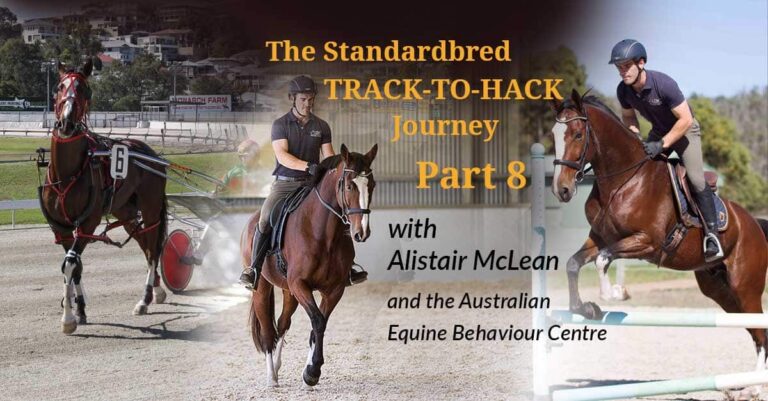
Welcome to Part 8 of the Unharnessed Potential project, an education and awareness campaign to promote the re-training and re-homing of Standardbreds when they retire from a racing career. In the previous training article, Alistair explained introducing and training the lateral movements.

This month, Andy is ready for his first outing! It’s time to start preparing him for his Equitana experience. As Alistair explains, because Andy knows well his in-hand and under-saddle responses, he will have that consistency and predictability to relate to when he is in a new and more challenging environment.

Preparing Andy for is big outing at Equitana

Andy is now in his final stages of training before our demonstrations at Equitana. This is the time where I focus on fine-tuning all that I have taught him over his time at the Australian Equine Behaviour Centre (AEBC). Anything that is not quite consolidated at home will only be worse in an unfamiliar place, so in preparation, it’s important to stop teaching him new things and focus on improving the responses he has already learnt.

One of the most important things to do before a horse’s first big outing like this is to take him to new environments without the pressure of competing to test out our responses and correct any issues. It is the training in these different environments that shows us where we are on the training scale.

These smaller outings will show how Andy responds in a pressure situation and will then give me an idea of what I need to work on at home, as well as any groundwork and under saddle techniques I may have to use to get him to relax at Equitana. All of this preparation will help make Andy’s experience at Equitana less stressful.

The first outing, taking Andy to a new environment

We took Andy to his first outing, a dressage day, just for a casual look around and to test his training. Andy will be at Equitana for all four days and kept in a stable, which will be quite a stressful experience, so we decided to arrive at the competition the day before to see what he was like in a small space and how he was to ride after a night in a yard as opposed to a large paddock.

Settling him into his yard

Staying in a yard can be a very foreign experience for a horse if he is not used to it. You need to make sure they have constant access to hay and water just like they would in their paddock. We often use a slow-feeding hay net when having a horse in a yard as it encourages them to forage rather than gorge themselves, which is better for their gut. However, for a horse that is stressed and unlikely to eat, you may want a regular hay bag to remove the difficulty from eating.

At his first outing, Andy was yarded in between two of our other horses who are experienced competitors and calm in a yard to encourage him to relax. Having been to so many race outings as a youngster, Andy settled in well without much encouragement. To ensure his legs didn’t swell up and to keep his mind active, we took Andy out of his yard for regular walks to stretch his legs, as well as to check his basic groundwork.

If you are intending to tie your horse to the float or the yard, you need to ensure your groundwork is consolidated and you have practiced at home. To stay tied, the horse needs to understand how he should respond to pressure from where he is tied, which is the same pressure he would feel from a handler.

Consolidating your horse’s response to a light forward lead aid, teaching him ‘head down’ and ‘park’ is essential. If the horse spooks and pulls back, this is where understanding to step forward from poll pressure will help. Rather than fight against the pressure, he should know that moving forward and/or lowering the head will make the pressure go away. Teaching and enforcing ‘park’ will help with immobility while tied.

Groundwork tools for relaxation

I have expressed on every occasion how important it is that we check our horse’s groundwork regularly. This is even more so the case with a re-trainer. Although I wouldn’t necessarily consider Andy a re-trainer at home any more, his old habits are much more likely to reoccur when he is in a new environment.

Practicing ground work at home does not need to be an extra session of training each day, it is just something that we tune up whilst leading from the paddock, grooming and saddling up. We can easily incorporate it in to our daily interactions with the horse without making a big deal of a groundwork session.

The importance of having clear rules at home means that I have a process to run through which he can easily follow in a new environment.

Horses seek consistency and predictability so, in a foreign place, such as his first outing, the horse will try to attach himself to something he knows and, if there is nothing, he may become anxious. Our training is the one consistency we can use to help him feel secure, so it needs to be predictable and clear every time we ride (See the previous articles of this series).

This comes down to the groundwork and ridden work that I have set up at home. Teaching things like ‘park’ and basic responses at home may seem useless to some because their horse seems to be calm and obedient at home. However, the reason we check and train these responses is because the training needs to be firmly in place in order for it to work when they are no longer in a familiar environment.

It is too much pressure for the horse to be expected to learn new responses when out at a competition or stressful environment, but if you have well consolidated responses at home, it won’t take much to have him focusing on you, rather than his environment when you’re out.

Andy is generally a very light and sensitive horse. His legs may be long and uncoordinated, but they are responsive so it’s easy to get them under stimulus control. This is the first stage of achieving relaxation. Once the horse is responsive to the rein aids, we can add in head control. A high head position is connected with the flight response, so gaining control of the head position is a huge help in promoting relaxation. Many trainers and handlers around the world have seen the calming effect of having the horse’s head down, but it’s important that this is not prioritised before the other responses are tested.

If your horse’s responses to the rein aids are not consolidated, ‘head down’ will not be as effective. I taught Andy to put his ‘head down’ from pressure on his pole in the very first weeks of his training once he had learned the basics to Obedience level. It has been trained regularly, which again makes it likely that it will work at a competition.

When you have established light ‘stop’, ‘go’ and ‘park’, and head control separately, we can begin to use them in combination. By adding another requirement to his basic responses, we can achieve ultimate relaxation. I now work through our basic responses in-hand and ask that he horse keeps his head low whilst doing them. In doing this, we have complete control of his body. Before getting on at a competition for the first time, I do a quick test of the basics with the head in a lowered position.

The first ride when out

After achieving relaxation on the ground, I started to work under-saddle. As I rode Andy to the warm up arena, I practiced some transitions and worked on straightness. It’s easy to lose track of what our horse is doing on the way to the warm up. We may be distracted by trying to remember our test or just generally unfocused on the horse, but never forget that each time you are on your horse he is learning something. Make the walk to the arena count.

You can still be relaxed, but just ask for basic straightness and responsiveness. This will help you when you reach the arena. On the way there, there were various ‘scary’ objects that he spooked at so I encouraged him to walk up to them and have a good look and a sniff. If he stalls or veers off your line, it is important that you don’t release the pressure until he gives you the correct response (steps towards the object).

For example, I walked Andy up to a trailer filled with piping and other unfamiliar shapes. At first, he stopped and started walking backwards, so I needed to make sure that I keep him facing the scary object and keep nudging him with my leg until he took at least one step toward the object, then softened and repeated. This must be repeated until you get all the way up to the scary object so that the horse learns that our ‘go’ aid always means ‘go’ no matter what is in front of him.

These challenging moments are what creates a reliable and safe horse. If your horse’s stress levels are high or you are nervous to make him approach the object, stop (facing the object) and wait for around 13 seconds until he seems less focused on the object, and then ask for another step forwards, then repeat. Research shows that it takes on average 13 seconds for a horse to show a significant positive change in behaviour after being startled, so you can use this knowledge to keep his stress levels down without giving in.

We then had the opportunity to ride him in the indoor arena, which was a great way to see how he coped in a different indoor arena to the one we have at AEBC. It was a much bigger area than what I have to work in at Equitana, but Andy responded well and did not put a foot wrong. I started by walking him around the area, testing my responses firstly with transitions, and then turn and yield.

We then went out to do some work in the outdoor arena. I tested his responses again and was pleased that he was almost as consistent as he is at home. His main issues were a tendency to run and pull against the bit, which I corrected with a downward transition, and the occasional drift off my line, which I corrected with turns. I was so pleased that he didn’t revert to pace which was my biggest concern with a new environment.

Whilst Andy is responsive to my aids to quite a good standard, he still has a slightly anxious temperament. He tends to show his anxiety with some occasional lower lip twitching. All horses are different, so don’t be worried if your horse has a unique character trait to show you how he’s feeling, but do question what areas may be causing this. If you continue to train clearly and consistently, these behaviours will subside but, for now, think of them as ‘tells’ – don’t cover them up with a tighter noseband or stronger bit. Instead, check his training and find the flaws.

In time, when his responses become clear and consistent, his ‘tells’ will dissipate. For Andy, it’s been difficult for him to learn to move his body in a new way. This caused some confusion for him for a period of time, but he is gradually starting to understand and consistently respond in the correct way.

Between now and his next outing at Equitana, I will continue to train Andy at home and test him in a smaller arena to mimic the Mitavite Arena (20 x 20m). I will also habituate him to crowd noises and clapping to help make his experience at Equitana less stressful.

You can find out more about habituation techniques here.

The Unharnessed Potential Project is possible thanks to the following sponsors – Australian Equine Behaviour Centre | Greg Grant Saddlery | NRG Team | Harness Racing Australia | Southern Cross Horse Transport | Advanced Equine Dentistry | The Barefoot Blacksmith | Raising the Standards | Kilmore Equine Clinic | Manuka Haylage | Horses and People Magazine | Strong Step Hoof Care | Kompeet to Win


How do we Measure a Horse’s Quality of Life?

Astute horse owners realise that their horse’s welfare is about more than having food, water and appropriate shelter. The horse’s emotional well-being, also known as their quality of life, is an important piece of the welfare puzzle. However, it is unclear what measurements are accurate and reliable enough to help objectively assess this area of a horse’s welfare. A group of researchers from the United Kingdom, New Zealand and Australia have teamed up to address this.

The researchers completed two systematic reviews of studies in horses.

One review focused on identifying equine behaviours that could reflect the horse’s mood and general well-being, i.e. how they feel.

The other review focused on physical measures of equine emotion (like heart rate and cortisol).

The initial results of these reviews were presented at the 15th International Equitation Science Conference held at the University of Guelph in August 2019.

Natalie Waran, from the Eastern Institute of Technology, NZ, presented on the findings of a review which included 75 publications related to equine behaviour.

Some of the behaviours they looked at included: feeding behaviour, types of interactions with humans and other horses (e.g. were they friendly or agonistic), and interest in the environment. The review found that these types of everyday behaviours, and responses to training, were the clearest indicators of a horse’s emotional state.

Waran adds: “Examples of behaviours that indicated a positive emotional state were increased feeding behaviour, friendly social interactions (between horses and with humans) and interest in the environment.

“Examples of behaviours that indicated a negative emotional state were decreased feeding behaviour, negative social interactions, reduced interest in the environment and increased repetitive non-functional movement patterns”.

Waran concludes that “these behaviours should help form the basis of assessment criteria so that horse owners and carers can assess and improve the quality of life of the animals under their care”.

Hayley Randle, from Charles Sturt University, AU, presented on the results from the physical measures related to a horse’s emotion.  Randle explains “Heart rate (HR), heart rate variability (HRV) and cortisol are the most commonly measured physiological indicators of equine emotion. Other suggested indicators include eye temperature, respiratory rate and salivary alpha amylase but many of these lack validation in relation to association with emotional state. There were methodological problems with all of the measures we looked at, such as the lack of standardisation of reporting and interpretation.”

She concludes “The physical measures of equine emotion looked at in this review revealed that these may have limited use when assessing horse welfare. A comprehensive set of measures that takes into account the horse’s experiences at any one time is needed to assess equine welfare and his/her overall quality of life.”.

Kate Fenner, a member of the Council of the International Society for Equitation Science (ISES) expanded on the importance of this presentation. “This research is an important step forward in equine welfare assessment”, she says, “We need studies like this that can help us identify consistent indicators of quality of life in order to build reliable welfare assessment tools that evaluate every domain of equine welfare.”

The findings were presented at the 15th International Equitation Science Conference held at the University of Guelph in August 2019 and the conference proceedings can be downloaded from this link.

The 16th International Society for Equitation Science Conference will take place from August 11th to 14th 2020 at Hartpury University, United Kingdom under the theme: “Succeed with science: performance, practice and positive wellbeing”. To find out more click here.

Click here to read about the 5 Domains Model of Horse Welfare Assessment and to download your FREE Horse Welfare Assessment Guide.

Yes, Horses ‘Figure Out’ Tasks from Watching Humans but Rarely Mimic Them

Do horses learn by watching people? Sort of, say the scientists… they definitely get a hint

You put your right hand on, You take your right hand off, You put your right hand on… the handle, And you turn it to the right…. You do the hokey pokey and you turn yourself around. That’s what (getting out of your barn) is all about!

Welcome to the social learning version of the Hokey Pokey. As many owners already know, horses can learn by watching what we do—especially when it comes to things we don’t want them to do, like opening doors…

Science, meanwhile, has recently confirmed it: yes, horses are capable of ‘interspecies social learning’ – learning how to perform tasks by watching people do them.

There’s at least one remaining question, though. How exactly are these animals learning from watching us? What’s the process, and what’s going through their minds? Is it all essentially one big Hokey Pokey, where they mimic what we do as best they can, with their non-human body parts?

According to German researchers, no, that’s not really it.

Most horses don’t really seem to be trying to recreate the same maneouvers that we’re doing. Instead, observing us achieving a task—like opening a door latch—helps them realise that it’s possible to do it and it has something to do with the mechanisms we touched. The rest, they say, is up to their own problem-solving.

“The horses in our study mainly appeared to benefit from what we call ‘enhancement,’ said Konstanze Krueger.

“Enhancement is sort of like giving hints,” she explained. “You hint about where to find the clues, or what parts need to be manipulated, without step-by-step instructions. Essentially these horses were learning from the humans that a certain button needed to be pushed somehow, and they took it from there through trial and error.”

In other words, horses won’t necessarily copy a human’s exact movements or use equivalent parts of the body, Krueger said.

To test how horses learn from humans, Krueger and her fellow researchers designed social learning tests for horses at their own farms.

The horses were given access to a closed food box and, one meter apart, a button on a box on the ground that triggered an electric opening of the food box. About a fifth of the horses were left to try to figure out how to open the box on their own. The others were given the chance to watch a human push the button, activating the opening of the box.

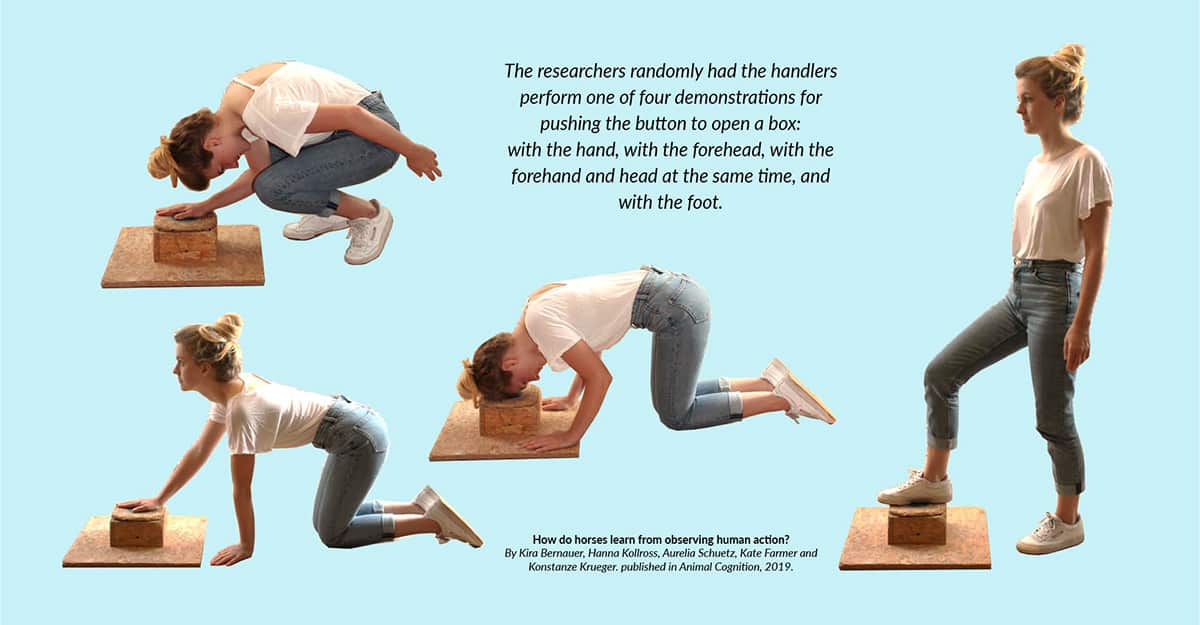
Each horse’s own regular handler acted as a demonstrator, because horses are more likely to learn from individuals who are familiar to them, according to Krueger. The researchers randomly had the handlers perform one of four demonstrations for pushing the button: with the hand, with the forehead, with the forehand and head at the same time, and with the foot.

handlers perform one of four demonstrations for pushing the button: with the hand, with the forehead, with the forehand and head at the same time, and with the foot

Altogether, 75% of the horses who watched a demonstrator ended up learning to open the box. (The researchers were sure the horses had “learned” when they were able to open it 20 times in a row.) That was more than double the success rate of the small group of horses that didn’t have a demonstrator, in which 31% eventually figured out how to open the box, Krueger said.

However, regardless of the kind of demonstration, the horses generally used their mouths—through nibbling, biting, licking, and pushing with the lip—to push the button, according to Krueger.

Some people might argue that this shows a reduced level of intelligence for the horse, since the horse didn’t ‘understand’ that he needed to copy the exact movements, Krueger said. However, it’s also possible that the very opposite is true—the horse understood what needed to be done and, through trial and error, adapted the situation to his own abilities or even preferences.

“You could certainly argue that it’s cleverer to observe a person and then make up your mind how you would do it yourself, and come up with your own technique,” she said.

Still, there was individual variation, she added, explaining that some horses did attempt the same technique as their demonstrators. That was especially true, she said, for the use of the foot.

“About half the horses seeing the foot demonstration used their hoof to push the button,” Krueger said. “Most of those used the hoof consistently, every time, but a couple of them alternated between the hoof and the head (mouth).” The horses in the foot demonstration group used their hooves significantly more than the horses in the head and hand demonstration groups, she added.

Whether this means horses assimilate human feet to their own feet is yet to be determined, according to Krueger. “Of course I cannot look into the horse’s head, but yes, some appear to observe closely and reason that they have to use a hoof when humans use their foot,” she said.

Professor Konstanze Krueger from the equine economics department of University of Nürtingen Geislingen, was lead author in an earlier study on the ability of horses to open door and gate mechanisms.

The full research team also comprised Kira Bernauer and Hanna Kollross from Nürtingen-Geislingen University, Auriela Schuetz from Georg-August-University Goettingen, and Kate Farmer from St Andrews University in Scotland.

The study How do horses (Equus caballus) learn from observing human action? by Bernauer K, Kollross H, Schuetz A, Farmer K, Krueger K (2019) is published in the journal Animal Cognition and can be found here.

A New Year… A New You?

0

New Year Resolutions.

Another year has finished and the new one has started already. Who’s been playing funny games with the clocks?

We don’t get any younger but hopefully, we are getting a little bit wiser.

For most of us, the new year comes with new plans, new goals and another attempt of the never-before-achieved New Year’s resolutions,

  • get fit…
  • stop drinking wine…
  • lose the extra 10 kilos…
  • ride the horse more often…
  • procrastinate less…

We all have hang-ups that haunt us. The stuff that always seems like a great idea but somehow never happens. So, another year another chance right…? Wrong!

I hate to break the bad news, so I will let someone else who is much smarter than I am, do it instead:

“Insanity is doing the same things over and over, expecting a different outcome.”

Whether Albert Einstein said the words or someone else, I think you get my drift?

So, instead of following the same old footsteps from last year, let’s create a whole new path!

The first thing is to be honest to yourself.

What has stopped you in the past from achieving your New Years Resolutions?

  • was it that you didn’t really want it bad enough?
  • was it that you couldn’t see yourself achieving it?
  • or was the old habit just too familiar, too comfortable and too much YOU to give it up?

You have to address the issues that come up when you ask yourself those questions before you can go to the next step and you start making plans on how to go about making changes.

Unless you become really comfortable with the actual change and all its consequences, you will not achieve it.

We are often too connected to the old to change to the new. There is a degree of letting go that has to happen.

Think about it,

  • how would you feel if you were fit and how would others respond to that?
  • how would your days/weekends be different if you would stop drinking wine?
  • who would you become if you lost the 10 kilos and how would others respond to that?
  • what would have to happen to make it possible to ride more often and what would others say to that?
  • what serves (rewards) your procrastination? What are you covering up by doing it?

These are important questions you need to answer before you start setting goals.

We are creatures of comfort, so we tend to do the same things because they are familiar to us. But that is exactly what we try to avoid when we plan on making changes. We don’t want to be comfortable and able to predict the outcomes.

The whole purpose of change is to get OUT of your comfort zone to experience new things that CAN’T be predicted. From the firs list of resolutions above,

  • getting fit, losing weight is all about becoming a new person. Recreating yourself by becoming a better version of the old. That is the aim.
  • drinking less is good if the old lifestyle brought you harm.
  • riding more and,
  • procrastinating less will lead to more success and better outcomes.

The key however, lies in LETTING GO. You first have to be prepared to let go of the old in order to create the new.

So, this year, instead of making yet another New Year’s Resolutions list, take time out to get to know your patterns and behaviours. The better you get to know yourself, the easier it is to see where you have struggled in the past.

Become aware of those old thoughts and habits you tend to fall back into, start to make changes there and you will find it so much easier to set new goals and achieve them.

Happy 2020 riding everyone!

This article was published in Horses and People Magazine January-February 2020 issue.

Welfare Standards for the Racehorse Sector

The International Federation of Horseracing Authorities (IFHA) has published standards for the care and welfare of racehorses at different times of their life. They integrate the Five Domains Model now recognised as the gold standard for animal welfare assessment and monitoring.

The IFHA expects all racing jurisdictions to refer to this guidance to establish accepted horse welfare practices in their jurisdiction, and to set minimum standards of participant behaviour, including behavioural change where necessary.

Titled “IFHA Minimum Horse Welfare Standards”, this paper complements recent reforms which will ensure the traceability of horses from their foal stage through into retirement and beyond.

In conjunction with the publication of the IFHA Minimum Horse Welfare Standards, a short video and podcast have been produced, featuring IFHA Horse Welfare Committee Chairman Jamie Stier, who is also the Executive General Manager, Integrity Services, Racing Victoria; Professor Emeritus David Mellor, the architect of the Five Domains Model for Welfare Assessment and a Foundation Director of the Animal Welfare Science and Bioethics Centre at Massey University, New Zealand; and Dr Lynn Hillyer, Chief Veterinary Officer and Head of Anti-Doping for the Irish Horseracing Regulatory Board. The panel is moderated by esteemed British racing presenter Rishi Persad.

Watch the video presentation below to find out what this means to the Horseracing sector all around the world.

Principles of Good Practice in Horseracing

To promote best practice, harmonisation and information exchange across Racing nations, the IFHA Horse Welfare Committee has also produced documents on the ‘Principles of Good Practice’. These serve as guidance on standards for the care and safety of horses in key areas as they relate to welfare.

This guidance is to raise awareness amongst participants and third parties of appropriate standards of horse welfare in racing and breeding in areas that are vital to ensure the ongoing success of racing.

These documents provide a practical means to racing authorities to ensure that welfare is properly taken into account by all people in charge of horses at the different times of their life.

They are a basis on which horse welfare can be introduced into the educational courses for jockeys and trainers, and in liaison owners and breeders, and with the Veterinary profession.

Monitoring of Racing Injuries and Fatalities

Activities to Minimise Injury and Optimise Horse Welfare

Veterinary Emergency Care Procedures

Emergency Euthanasia on a Racecourse

Aftercare of Racehorses

Use of the Whip

Who I the International Federation of Horseracing Authorities?

The International Federation of Horseracing Authorities (IFHA) is the world peak body for the international sport of Thoroughbred racing. Its members are the national racing authorities across the globe which stage Thoroughbred races.
Major areas of the IFHA’s activities include:
  • Making and amending the International Agreement on Breeding, Racing and Wagering (the IABRW)
  • Policy development relating to welfare and safety of horses and riders
  • International Race Planning and Grading (“black type”)
  • World Rankings
  • The fight against Equine Prohibited Substances and Practices
  • Harmonization of Racing Rules
  • Certification of IFHA Reference Labs
  • Fostering commercial development of the racing industry globally
The IFHA is a foundation member with Fédération Equestre Internationale (FEI) of the International Horse Sports Confederation and is affiliated to the World Organisation for Animal Health (OIE).