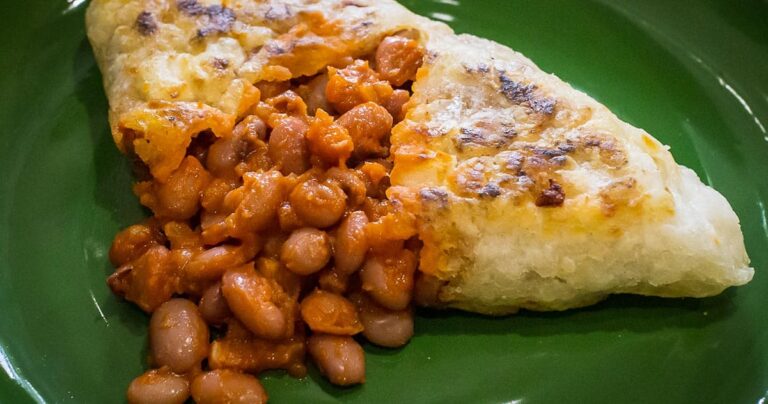
We have it on good authority, that Peter’s Breakfast Bean Pasties recipe below is one of the Australian Trail Horse riders’ favourite breakfasts.
Not only are they delicious, they are high in protein and they keep the riders energised until lunch time. They also travel well and make a good lunch, cold or hot.
This recipe is great for camping as all ingredients require little to no refrigeration.
Ingredients:
Breakfast Beans
200g dried kidney beans (soak overnight to speed up cooking) 2 tablespoons tomato paste 50g speck 1 tablespoon onion flakes 1 teaspoon brown sugar Salt and pepper Chilli or garlic
Tip: Buy tomato paste in sachets. Fountain and Leggo’s have handy sachets that conveniently contain 2 Tablespoons of tomato paste, so you don’t need to worry about wasting the left overs and it will store without refrigeration. Only take what you need!
Alternative: Speck is smoked salted bacon that will keep without refrigeration except in the most extreme heat. As an alternative, you can use a good quality oil and bacon flakes.
Pasties
1 cup Self Raising Flour 1/2 cup water 1 teaspoon oil
Methods:
Breakfast Beans Method:
Boil the beans in unsalted water until tender then drain. Melt speck over a low heat then add onion and brown sugar. Cook while stirring for 2 minutes then add tomato paste and cook one more minute. Add beans and stir in until coated then add enough water to just cover. Stirring occasionally to prevent burning, cook until a thick sauce is made. Add more water if it becomes too reduced. Season with salt and pepper and add chilli or garlic to taste and enjoy!
Tip: It is important to cook the beans thoroughly in unsalted water as salt will make them tough.
Pasties Method:
Combine the self-raising flour, water and oil. Mix until a smooth dough is formed. Let rest for 5 minutes then make into 4 even sized balls. Roll out or stretch with your hands until you have a 15cm disk.
To cook as a flat bread, cook the disk in a dry pan and top with the beans.
To make the pan pastie fill the centre of the disk with beans, fold in half to form a pastie shape and crimp on edges to hold together. Fry at a low temperature in a little oil. These travel well and make a good lunch cold or hot.
This article focuses on what the end-of-life options are for horses, and the advantages and disadvantages of these options. It further discusses some of the welfare problems associated with slaughter and how some of these could be addressed.
Article Highlights
There is an array of welfare issues associated with unwanted horses, including neglect, mistreatment and inhumane deaths
A large number of horses are killed in abattoirs and knackeries and may suffer extreme fear +/- pain prior to their death
Euthanasia (a ‘good death’) comes with some unique challenges in horses
Methods of euthanasia include lethal injection, shooting with a firearm, and shooting with a captive bolt – all methods have advantages and disadvantages
Slaughter in abattoirs or knackeries presents a range of risks to horse welfare
More research is required to identify what horses end up being slaughtered and why, and where the knowledge gaps and hurdles lie in ensuring good welfare at the end of horses lives
Improvement in slaughter standards and regulation is also required
The shocking numbers of unwanted horses
Most horse lovers shudder at the thought of horses being slaughtered, and the recent ABC 7.30 report will have confirmed their worst fears. Horses arriving at an abattoir terrified and often injured after long distance journeys, being verbally and physically abused prior to death by captive bolt. While a captive bolt should lead to instant unconsciousness, if it is not accurately placed, it leads to excruciating pain, until a repeated and accurate firing of the captive bolt is performed. The ABC footage captured some of the worst deaths that a horse could possibly endure.
The other shocking aspect was the sheer numbers of horses that are being killed in this way. Whilst the documentary focused on ex-racehorses, many horses from many different backgrounds are having their lives ended in this way. In a study in 2008, of around 9000 horses slaughtered in Australian abattoirs each year, around 50% were ex-racehorses, and the remaining 50% were a range of other horses and ponies including about 10% of them being brumbies straight from the wild 1.
Approximately 60% of all of these horses were less than 8 years old. It is likely that these proportions are different today, but unfortunately, we do not have any more recent studies to accurately update this information.
The number of horses being slaughtered in knackeries across Australia is unknown but could be as many as 22-32,000 per year 2. Little is known about the age and breed of these horses, where they have originated from and the reason that they have ended up there 1. One study surveyed 20 Australian knackeries, reporting that horses were either old, sick and injured, or ex-racehorses and young horses from drought affected properties 2.
This clearly highlights an array of welfare issues; from the number of unwanted horses having their lives ended at such facilities, to the terrifying experiences they may endure leading up to their death, culminating in the way in which they are killed frequently being associated with intense fear and pain.
There are many reasons why horses may become unwanted, including overbreeding, inadequate sport performance, dangerous behaviour, poor training, injury or health problems, or for practical or financial reasons when an owner can no longer care for them 3, 4, 5.
More needs to be done to address each of these issues if we are to minimise the number of horses that are being killed.
Nevertheless, all horses will at some point, reach the end of their life whether that is because they are unwell, injured or can no longer be appropriately cared for. Further, whilst most of Australia continues to experience one of the worst droughts in history, the issue of unwanted horses and horses that are unable to be cared for, is certain to continue for the foreseeable future.
Euthanasia in these circumstances is preferable to horses being left alive but neglected.
This 25-year-old TB was rescued after a period of neglect. He costs approximately $8,000 per year just in feed. He underwent approximately $3,000 of veterinary dental care in the last 12 months, requiring several tooth extractions. It is unrealistic for most owners to be able to afford to provide appropriate care for these older horses, and euthanasia in this situation is preferable to neglect, selling through sale yards, or being transported and slaughtered.
This article will focus on what the end of life options are for horses, and the advantages and disadvantages of these options. It further discusses some of the welfare problems associated with slaughter, and how some of these could be addressed.
It should also be noted that many owners find it understandably challenging to make a definitive decision about the end of their horse’s life and instead may opt to send their horse to a dealer or saleyard (public auction) in the hope that they find a good next home. However, horse owners must be aware that, at public auctions there is no way to assess the purchasers, and their horses could end up in another unsuitable home, an abattoir or knackery. It is therefore, far preferable to make the decision for a humane euthanasia rather than risk subjecting them to a worse fate.
Euthanasia: what’s special about horses?
Euthanasia means a ‘good death’, in other words instant unconsciousness without prior fear or pain 6.
Horses represent some unique challenges in achieving a good death alongside balancing practical issues, such as geographical proximity to veterinary care, the financial considerations associated with the euthanasia itself, and also with the carcass removal and disposal.
Having to balance these other factors likely plays a major role in why many horses end up at abattoirs or knackeries, which may not result in a ‘good death’, for reasons explained below.
The characteristics of horses that contribute to the challenge in achieving a ‘good death’ within practical and financial constraints include; their unique behavioural characteristics, that they are a flight animal, and are sensitive to changes in their surroundings.
They also have a wide range of differences in their previous life experiences and training which strongly influences how they react in different situations, and whether they can be effectively handled or not without causing them distress.
Their large body size contributes to transport challenges, and challenges with carcass disposal.
Combined, this all means that different methods may be better suited to different individuals. Choice of method should include safety, ability to appropriately restrain the animal and skill of the person performing the procedure, in addition to welfare considerations.
Methods of euthanasia (end-of-life options)
There are three main methods of euthanasing horses; chemical euthanasia (lethal injection), shooting with a firearm (rifle) or shooting with a penetrating captive bolt, followed by exsanguination (bleeding out by severing a major blood vessel) or pithing (placing a metal rod into the bullet hole to destroy the brain tissue).
The horse is also preferably sedated or anaesthetised prior to any of these methods, to further reduce risks of pain or fear prior to death, in addition to improving safety for personnel involved.
Chemical euthanasia/lethal injection
This end-of-life option must be performed by a veterinarian and involves the intravenous injection of a barbiturate. Sedation should be administered prior, to reduce anxiety, and increase safety of the procedure. The horse will collapse gradually, and will lose consciousness, followed shortly by cardiovascular arrest.
In unhandled or poorly handled horses, anxiety prior to sedation is likely.
The main disadvantages of lethal injection is the need to be carried out by a veterinarian, more limited options for carcass disposal, and consequently higher cost.
Burial or cremation is required following lethal injection, due to the drug residues. There are specific requirements for burial including depth and location of burial site, and burial in some locations (e.g. water catchments) is prohibited.
Therefore, discussion with the local council is required beforehand to ensure that this is a feasible option.
Obviously, the location where euthanasia is performed should be as close as possible to the burial site. If the carcass is collected for cremation, or an excavator is required for creating a burial site, these can both be costly options.
Gunshot
Although many owners may not like the thought of euthanasia via gunshot, when performed properly, this actually results in a very rapid and painless death, due to rapid, widespread brain destruction.
It does not require close contact with the animal and so, is the most appropriate method for horses that are anxious and/or not used to being handled.
In handled horses, particularly those that are anxious, sedation (or anaesthesia) prior to gunshot is ideal to reduce any anxiety and assist in keeping the horse very still. Sedation would however require a veterinarian and is not essential.
Euthanasia by gunshot can be performed by trained and experienced operators with a gun license. This is often a practical, more accessible and cost-effective end-of-life option, and enables more options for carcass disposal, including use of the carcass as pet food or composting material, or disposal at a licensed landfill.
It is a method commonly used by knackeries, and some knackers will visit private properties to perform the euthanasia at the horse’s home, and remove the carcass afterwards. The main disadvantages with firearms use are the safety issues associated with potential penetration and/or ricochet. As a result, it is not suitable for use in all environments.
Penetrating captive bolt
The major difference between shooting with a firearm and a captive bolt is that a captive bolt causes localised brain trauma and concussion, and to achieve this effectively, very accurate placement and positioning of the captive bolt gun is absolutely critical, and the gun needs to be held firmly over the intended site.
If there is any error in placement when the gun is fired the results are disastrous as the bolt may cause extreme pain without inducing unconsciousness, and a further shot is immediately required.
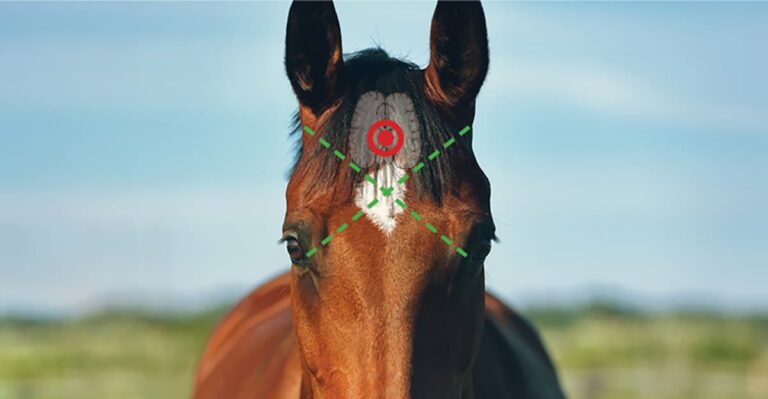
The brain of the horse is surprisingly small (about the size of a grapefruit), within a large skull, which makes it challenging to achieve accurate placement, especially if there is any movement of the head. Figures 1 and 2 illustrate the position and angle of the captive bolt required to make an accurate shot.
When fully conscious, most horses will have a tendency to raise their head if they are anxious or an unfamiliar object is advanced towards their head, and this makes correct height and angling of the captive bolt even more challenging (Figure 3).
Therefore, to aid accurate placement, either appropriate head restraint is required, or prior sedation (Figure 4) or anaesthesia. Sedation requires a veterinarian.
(Please note all the images have been specifically taken for illustration purposes with horses that were undergoing veterinary procedures. No horses were euthanised.)
Heavy sedation or anaesthesia followed by a penetrating captive bolt shot is a very good option for euthanasia by veterinarians and allows more options for carcass disposal than euthanasia by lethal injection.
The brain trauma caused by destruction of brain tissue is often sufficient to cause death if placement is very accurate. However, sometimes, it may only result in unconsciousness with the possibility that the horse could regain consciousness.
For this reason, it is always advisable that, once the horse is unconscious following a captive bolt shot, this is immediately followed up by exsanguination (‘bleeding out’ by severing a major blood vessel) or pithing (inserting metal rod into the bolt hole to extensively destroy the brain tissue).
Captive bolts are much safer for personnel and a firearms license is not required. They should, however, only be used by trained experienced operators due to the requirement for such accurate placement.
Figure 1: Recommended guidelines for placement of the captive bolt can be difficult to interpret and, if placement is slightly low, it may result in the bolt entering the frontal sinus cavity and missing the brain. The author recommends placing the captive bolt slightly higher on the skull. The surface of the skull begins to curve at this level, so it is slightly harder to position the captive bolt firmly against the skull.
Figure 2: The red line indicates the position for the captive bolt according to most published guidelines, but as this diagram shows, the captive bolt fired at this location will only penetrate the front part of the brain. There is therefore a high chance of missing the brain if positioning is even very slightly lower on the head, which could commonly occur especially on larger horses. For this reason, the author recommends placing the captive bolt slightly higher on the skull, as indicated by the green line on the diagram. The surface of the skull begins to curve at this level, so it is slightly harder to position the captive bolt firmly against the skull.
Slaughter at an abattoir or knackery
Whilst many horse owners shudder at the thought of killing horses for food, this can also theoretically be a ‘good death’ if the horse is not experiencing fear or pain and the firearm or captive bolt is appropriately placed resulting in immediate unconsciousness.
However, the practical reality is that it is very difficult to achieve this with horses within an abattoir or knackery environment, resulting frequently in a death at best associated with fear, and at worst associated with intense fear and pain. This is why I have classed this end-of-life option separately to euthanasia.
Let’s explain why a ‘good death’ in horses may be difficult to achieve in these environments, and what changes would be required to increase the prospect of a ‘good death’.
What is the difference between an abattoir and a knackery?
Abattoirs are licensed to slaughter animals for human consumption, whilst knackeries slaughter animals for pet food, and other by-products such as hides and bone meal.
Since the market for horsemeat for human consumption is small and based overseas, all horses slaughtered for human consumption are processed at abattoirs licensed for exporting meat, of which there are two in Australia (Queensland and South Australia).
In 2004 there were thought to be 33 knackeries across Australia that were licensed to slaughter horses 2, but the current number is unknown and has likely reduced.
The differences between abattoirs and knackeries is important because of the way in which they are regulated.
Export abattoirs operate under both, federal legislation and the requirements of the importing country, which includes European Union legislation that incorporates some animal welfare regulations.
There are specific requirements for export abattoirs under EU legislation such as requiring a veterinarian to be on site and a designated animal welfare officer to be present when animals are unloaded on arrival.
Conversely, knackeries are regulated by the states, there are no requirements for a veterinarian or animal welfare officer, are audited much less frequently (if at all), and have no requirements for specific animal welfare audits. 7,8,9
What is the difference in welfare standards between an abattoir and knackery, and what are the potential welfare issues throughout the slaughter process?
Due to the different legislation they operate under, theoretically, it would be expected that there would be a greater potential for animal welfare standards to be higher in the export abattoirs. However, there are several reasons why this may not be the case and several steps in the process where things can go wrong for the horses.
Longer distance travel
Since there are only two export abattoirs Australia wide, transport to the abattoir usually involves very long distances, with some horses travelling up to 3,000km 10.
Typically, a large number of horses that are often unfamiliar with each other, will be travelling together and a range of potential stressors have been reported, including isolation from herds, and/or exposure to new and possibly aggressive horses, temperature extremes, food and water deprivation, and novel surroundings 11.
Some transporters may have little experience handling and transporting horses, and injuries during transport may be common.
In a Texan study of over 1,000 horses being transported to slaughter, between 11 and 45 horses were transported in each truck, and 7.7% had severe welfare problems both, from prior to transport (e.g. neglect, laminitis, bowed tendons, weakness), and during transport, predominantly related to injuries from fighting with other horses 12. Conversely, much shorter distance travel is likely for horses going to knackeries.
Potential 6-month ‘holding period’
For horses being slaughtered for human consumption, a medication history is required for the six-month period prior to ensure no drug residues will be present in the meat. This means that if horses are not coming directly from the person who has owned the horse for that time, they need to be ‘held’ for six months prior to slaughter. This may be in a paddock near the abattoir or with a dealer that regularly supplies horses to the abattoir.
This is a period of time where there is more potential for welfare issues related to inadequate care. There is very little knowledge or research available on the welfare of horses arriving in abattoirs, but one study that assessed hoof condition of horses arriving at an abattoir found that 80% of horses had hoof issues related to being overgrown, suggesting at least some neglect in husbandry prior to slaughter 1. Horses going to a knackery will be slaughtered soon after arrival, so care prior to slaughter is the sole responsibility of the most recent owner.
Higher numbers of horses being processed at the same time
An export abattoir may be processing up to 300 to 400 horses in one day, which is inherently more likely to lead to extreme fear and subsequent mistreatment. Knackeries on the other hand might only process a handful of horses in any one day, which is more conducive to a less stressful environment.
Captive bolt stunning followed by hanging and exsanguination is routine in abattoirs
Captive bolt stunning the conscious horse is the method used in abattoirs; use of a firearm for so many horses in such a big facility would be unsafe.
Sedation cannot be given to horses destined for human consumption. As explained earlier, it can be very difficult to accurately position the captive bolt in a fully conscious horse, particularly one that is anxious and/or head shy and is moving its head.
Attempting to restrain a horse’s head results in more anxiety and fear, and their long neck makes complete head restraint almost impossible to do safely.
This is further hindered by slipping and falling within the stunning box as the horse panics.
Combined, this leads to a high risk of inaccurate placement of the captive bolt when it is fired resulting in intense pain prior to an accurate repeat shot. In some cases, there is a risk that the horse may be hoisted and the neck severed before it is fully unconscious.
Extreme fear and the high risk of inaccurate placement would most likely be worse for unhandled horses not used to human proximity or confinement, such as brumbies.
One review of 150 horses killed at an abattoir in Quebec found that 40% of horses were not rendered unconscious with the first captive bolt shot 13.
Some knackeries also use captive bolt stunning with the risk of similar welfare issues. Others may use a firearm, shooting the horse within a paddock, and this is more likely to result in immediate loss of consciousness without pain and less fear.
Figure 3: Too low. Attempting to accurately place a captive bolt in a conscious horse is very challenging, as when their emotional level is high horses move and raise their head. Consequently, the captive bolt in this image is being placed too low and would miss the brain. (Note: Photo for demonstration purposes. This horse was not euthanised).
Figure 4: Under sedation, horses are calmer and less likely to move, their head drops enabling much more accurate placement of the captive bolt. (Note: Photo taken for demonstration purposes using a horse that was sedated for a veterinary castration).
Abattoir facilities are designed for cattle
Horses are behaviourally very different to cattle and require different handling and different environments to minimise distress. However, abattoir facilities in Australia are not specifically designed for horses (e.g. Meramist abattoir in QLD is designed for cattle), and abattoir staff may not have appropriate training in horse handling.
Horses also vary significantly in size as well as in their previous experiences with humans and other horses. For example, some horses are used to being led and may become distressed at being driven from behind within a group, whilst other horses may be completely unhandled and distressed if separated from their group.
One review of horses in an abattoir found that about 20% of horses were terrified and shaking with fear and making attempts to escape wherever possible. The majority of horses were at best anxious, with the noise of the abattoir environment contributing to this. 13
Regulation challenges 7,8,9
The difference in legislation between abattoirs and knackeries were highlighted above. Problematically, there are no horses-specific welfare standards for the slaughter of horses.
Horses are included under the Australian Standard for the Slaughter of Livestock but the standards are dated and have very minimal animal welfare requirements.
Despite a requirement for one veterinarian to be at the facility during processing of animals at export abattoirs, these facilities are large, process multiple species, and the abattoir veterinarian’s role is largely focused on animal health and meat safety.
Auditing of animal welfare practices is performed monthly, but it is challenging to enforce animal welfare when detailed and specific standards are not in place.
Should horse slaughter in abattoirs and knackeries be banned?
Despite all the current welfare issues with the slaughter of horses that have been highlighted in this article, simply banning horse slaughter without feasible, more humane alternatives, would be likely to lead to even more detrimental impacts on horse welfare 14.
The numbers of horses being killed at abattoirs and knackeries demonstrates the number of unwanted horses, where for whatever reason, a more humane method of euthanasia may not have been accessible to their owners.
Until the number of unwanted horses is reduced and more humane methods of euthanasia are more practically, and financially accessible then, without the option of slaughter, many of these horses would face serious neglect or be illegally killed, which is likely to be associated with even worse welfare outcomes.
For example, since horse slaughter was banned in the US, it is widely known that horses are trucked long distances to Canada and Mexico for slaughter, where animal welfare standards may be much lower with less regulation, than they had been in the US. There is also an argument for utilizing carcasses of deceased horses rather than them going to waste.
What could be done to reduce the numbers and help ensure that all horses experience a ‘good death’?
Solutions to these problems require a multi-faceted approach and may include the following:
Implementation of a national horse register to increase traceability which would also enable further research into what horses are ending up at slaughter, and why. This information could direct further research into how to reduce the numbers of unwanted horses. Further, this would enable different owners of the horse throughout its life to register to ‘opt out’ of slaughter.
Improvement in existing abattoir facilities such as suggested in Box 1 15
Improvement in horses-specific welfare standards, regulation and welfare auditing within both, abattoirs and knackeries.
Improved access to alternative euthanasia methods such as home slaughter (after shooting with a firearm), easier to access network of licensed knackers that may perform home slaughter, subsidized euthanasia, and horse euthanasia centres.
If slaughter of horses within abattoirs or knackeries is to continue into the future, further research into optimal facilities for horse slaughter with the aim to develop state-of-the-art horse-specific slaughter facilities is required, as ultimately, this would be the only way of achieving and ensuring humane slaughter of horses within abattoirs and knackeries.
Detailed monitoring and record keeping regarding horses entering abattoirs and knackeries is also required, with transparency in access to records, to more accurately identify issues so that they can be subsequently addressed. Many of the studies cited in this article are dated because there simply hasn’t been more recent studies to provide more up to date information and this needs to be urgently addressed.
A list of design and management requirements for humane horse slaughter, as proposed by Temple Grandin 15
The management of the abattoir must care about having high standards of animal welfare.
There should be measurement, recording and auditing of welfare indicators, such as:
Percentage of horses rendered unconscious with one shot from either a captive bolt or a firearm. Minimum score should be 95%, aim is 99 to 100%.
100% rendered unconscious before hoisting.
Falling score 1% or less body touches the ground during handling.
No electric prods should be used.
There should be no acts of abuse, such as beating, slamming gates on horses, or poking sensitive areas.
Video monitoring over the Internet by a third-party auditing company.
Non slip floor in the stunning box.
A level or almost level floor in the stunning box.
Solid sides of the stunning box to prevent the horse from seeing activity on the slaughter floor.
A well-lit stunning box will facilitate entry.
Eliminate distractions such as reflections on a wet floor or shiny metal, air hissing or banging metal.
One person should move the horse into the stun box and a second person should shoot it, to enable shooting to be performed immediately on entry of the stun box.
Do not use mechanical head restraint devices.
Handlers should be observant to determine which horses should be led instead of being driven.
Only one horse at a time should be put in the stun box.
An adjustable side on the stun box is recommended to ensure that it is not wide enough for horses to attempt to turn around
Handlers should be trained in the principles of flight zone and point of balance. The installation of solid sides on races is recommended.
Article References
A Doughty (2008) An epidemiological survey of the dentition and foot condition of slaughtered horses in Australia Report for Master of Animal Studies, The University of Queensland
Hayek AR (2004) Epidemiology of horses leaving the racing and breeding industries. Bachelor of Science (Veterinary Science) thesis, University of Sydney.
DP Leadon (2012) Unwanted and slaughter horses. A European and Irish Perspective. Animal Frontiers 2 (3); 72-75
DP Leaden, D O’Toole, VE Duggan (2012). A demographic survey of unwanted horses in Ireland 2005-2010. Irish Veterinary Journal 65, 3:
TR Lenz (2009) The unwanted horses in the United States: An overview of the issue. Journal of Equine Veterinary Science 29 (5); 253-258
Shearer JK, Nicoletti P. Humane euthanasia of sick, injured and/or debilitated livestock. University of Florida IFAS Extension
Australian Government Department of Agriculture and Water Resources. Quick Reference Card. Animal Welfare Regulatory Management, 2018
Model Code of Practice for the Welfare of Animals: Livestock at Slaughtering Establishments, 2001. CSIRO Publishing
A Wright (2001) Injury, stress and dehydration – research and regulation in the commercial transport of slaughter horses. In. (University of Sydney)
TH Friend (2001) A review of recent research on the transportation of horses. Anim Sci. 79, E32-40.
T Grandin, K McGee, BS Lainer (1999) Prevalence of severe welfare problems in horses that arrive at slaughter plants. Journal of American Veterinary Medical Association 214, 1531-1533.
N Dodman (2011) A review of horse slaughter footage from Quebec
Sox came to me as a very sweet, very talented, yet very immature rising four-year-old in October 2014. I was excited about her bright future but I was prepared to give her time.
I am very much against rushing the training of young horses. I am an advocate for building them up slow and steady and I really took my time with her education. Yet despite my best efforts, things quickly fell apart. And just four years after she arrived, I found myself reading her autopsy report.
My name is Katrin Kuenstler. I live in the Perth Hills of Western Australia, and I am a dressage rider, equestrian coach, trainer and pilates instructor.
Overall, in the three years I had Soxy under saddle, she only advanced very slowly and I kept feeling I was treading water, rather than moving forward.
I also kept wondering why she didn’t seem to develop more musculature in the topline, her back and neck, especially given that I did all the things every vet or physio recommended: hill work, pole work, in-hand training, lots of long and low stretching, etc.
I put it down to her being young (mind you, she was a 7-year-old by then), and her being a Warmblood, and thus, taking longer to mature than others.
By 2017, her once very nice athletic movement appeared to have gradually deteriorated, rather than improved! And alongside it, her behaviour got worse.
The stress signs whilst tacking up and under saddle increased slowly but surely, the jaw clenching, ear pinning, tail swishing, etc., became more pronounced.
She was very grumpy in the paddock and although she never actually did bite or kick, she threatened to do so whilst being caught and rugged, brushed and saddled.
She was very reluctant to go forward and dragged her hind legs over the ground either with or without a rider on.
All this despite arranging regular saddle fits, therapeutic massages and feeding her all the right supplements. Soxy was always very sore over her whole back and down her glutes. But despite this, she was never lame and so, in the eyes of many vets and body workers, she was passed as fine – just weak.
But despite the lack of a diagnosis, I could not rid myself of the feeling deep down in my gut that something was not right with my mare, I just couldn’t pin it down.
One of the many things, I have learnt as a result of this trying process, is that we have to give our horses the benefit of the doubt. We have to listen when they try to tell us they are unhappy, in discomfort or pain.
I had her ‘looked at’ by many different experts in different fields – vets, physiotherapists, chiropractors, energy workers… no one seemed able to pick the problem. I became progressively more frustrated, and since there didn’t seem to be a physical cause for her behaviour, I decided Soxy was just being ‘difficult’ and didn’t want to ‘play’ or ‘perform’.
I drew upon the ‘problem horse’ expertise of my good friend and horse trainer Shelley Appleton. Shelley loves a good challenge when it comes to unpicking a horse’s mind and emotions, and got right into working with Sox.
After about four weeks of training, which progressed at a snail’s pace, Shelley’s verdict was that Sox actually did try, but was somehow limited, probably due to an underlying physical cause.
After much research, Shelley suggested that Soxy might be suffering from Wobbler’s Syndrome, a condition where the spinal cord becomes compressed because of a narrowing or instability affecting one or more vertebrae.
With that in mind, I took Sox to the vet and asked for a thorough assessment with neck x-rays, and discovered an irregularity in the two lowest cervical (neck) vertebrae – C6 and C7.
This area of the neck is difficult to x-ray in the horse, so an ultrasound was performed which detected a mild deformation of the C6 vertebra and inflammation in the C6/C7 joint.
The C6/C7 joint was injected with steroids typically used in the treatment of orthopaedic disease such as osteoarthritis, in the hope that this would reduce the inflammation.
After her treatment and a bit of rest, things looked quite promising. Sox seemed pain free, ‘happier in her own skin’ and overall more contented than she had been for a long time.
When I started to work her again, a week or so after she had been injected, she seemed much more willing to give things a go and her movement had reverted to her natural athletic, floating gaits.
I spent a few weeks working her from the ground, doing a lot of lungeing and in-hand work, and progressed to light work under saddle which also seemed to go much better – at first…
Because after just a few months, things started to fall apart again.
Sox started to show strong signs of discomfort again and although it still seemed as if she was doing well physically, she could just not cope with being ridden. Her anxiety levels rose and she just shut down.
This had been going on for too long. Sox was telling me loud and clear that she just could not cope. The pain in her neck started to re-appear and to top it off, possibly as a result of pain and stress, she developed gastric ulcers.
I had hoped that I would be able to work through the issue and build up her musculature correctly to support the damaged joint, however, I could not help her feel well. So, I made the very difficult decision to let Sox go and put her to sleep.
I had learned that Sharon May-Davies would to be in WA for one of her very sought after Whole Horse Dissection courses and I made Sox available to use for the autopsy.
Sadly, in the two months leading to the dissection, Soxy’s physical and mental state deteriorated in front of my eyes. I could not ride her anymore; in fact, on the last bush ride I took her on, she was so unstable and unbalanced on her feet that I felt very unsafe! She hardly moved around in the paddock, lied down a lot and was very anxious to be touched, groomed or rugged.
The extent and significance of Sharon’s dissection findings are incomprehensible.
It turned out that Sox’s C6/C7 malformation, a condition now known as Equine Complex Vertebral Malformation (ECVM) was only the tip of the iceberg. I decided I would not attend the dissection myself, but received descriptions and a comprehensive written report.
While some of the issues that Sox suffered from would have been subsequent conditions or possibly caused by trauma, most of them had to be hereditary.
Sharon has dissected hundreds of horses and to that date had not come across anything of Soxy’s scope yet.
She told me that, had Sox not been euthanised, she would have most likely suffered a very painful death from organ failure caused by dysfunction – she found her spleen and kidneys underdeveloped in size. She said she was glad I had not suffered a catastrophic accident. Horses with this type of cervical malformation are very likely to feel very unsteady on their feet at all times, so they will try to rebalance their body constantly and this might lead to them falling over.
This, in turn, might lead to strains in the soft tissues or more serious damage can be caused if the horse collapses from losing balance.
In addition to the ECVM, Sharon identified kissing spines, orteochondritis (OCD) lesions, bone spurs, muscle tears and nerve impingements, to only mention a few.
All of those fancy medical terms simply mean that this beautiful, well-bred mare would have been in chronic pain from the moment of birth, she never had a chance.
The reason why I share Sox’s story is to raise awareness of ECVM – a condition that is affecting many more horses than we think!
Not only is it painful for the horse, but the neurological dysfunction makes it very dangerous for the rider!
So my message is that, when in doubt of your horse’s behaviour, always assume a physical component, and I would go further and suggest to investigate the cervical spine – even if as an exercise that rules out that your beautiful horse is suffering form this condition.
Furtunately, ECVM awareness has been rising thanks to Sharon and other researchers investigating and publishing scientific studies around the world, showing that the occurrence of cervical malformation is on the rise.
As a result, radiographing the neck is now suggested as part of the pre-purchase vet check. Since this condition is congenital (with evidence shown on both maternal and paternal sides), horses with this condition should be identified and not be bred from.
One of the many things I have learnt as a result of this trying process is that we have to give our horses the benefit of the doubt. We have to listen when they try to tell us they are unhappy, in discomfort or pain.
We are all too quick to label them ‘stubborn’, ‘lazy’, ‘arrogant’; I myself have called my horse every name under the sun. But a horse can only express distress by displaying bevaviour which we consider disobedient or ‘naughty’.
They simply have no other way to communicate their plight to us… they don’t speak human!
So, please trust your intuition. No one knows your horse as well as you do. You live with them; they are part of your family. Learn to listen and observe, and even if it takes some time and, provided you don’t stop asking questions, you will find the answers. We owe it to these extraordinary creatures!
I miss Soxy a lot. The only source of comfort left for me is that I kept questioning and searching. That I did listen to Sox and that she is now in a better place and finally free of pain.
Soxy’s case will be included in Sharon’s future lectures and I am glad that she is able to educate people around the world.
The participants of Sharon’s dissection put together a lovely book with words of thanks and empathy and I would like to quote one of the messages:
“May the ripple of her legacy continue forever.”
Sharon May-Davis BAppSc (Equine), MAppSc, has published a study on The Occurrence of a Congenital Malformation in the Sixth and Seventh Cervical Vertebrae Predominantly Obseverd in Thoroughbred Horses. You can read the abstract here.
Equine Complex Vertebral Malformation (also known as C6/C7 Malformation or ECVM)
The C6/C7 Malformation is a skeletal malformation and cannot be corrected. It is congenital, i.e., inherited, as it has been noted in utero and so is present from birth.
The horse’s skeleton is designed to build a steady framework on which muscles, tendons and ligaments can attach to and hence provide the utmost stability yet wide range of motion. This is what enables the horse to not only carry a rider on his back, but also to perform in various Equestrian sports.
Horses that suffer from a malformation in their cervical spine will be limited in the flexion of their neck and develop muscles very slowly and irregularly. They are lacking stability as well as flexibility and will therefore, be limited in their performance as well as their every day life. Furthermore, they might suffer from chronic pain.
In severe cases, horses can display symptoms associated with Wobbler’s syndrome due to the deformity of the spinal canal which might cause pinching of the nerves that form the spinal cord.
This can result in problems with the horse’s proprioception, meaning they can find it difficult to be aware of where they place their feet – comparable to a person who is drunk. These horses might become very unsteady on their feet; stagger; stumble; sometimes even fall.
You can see how dangerous that would be for you when you are on their back!
For a horse that suffers from ECVM, their body is in a constant state of imbalance trying to adjust to likely spinal compression.
Straining some soft tissue in the legs is common or tearing muscles when the horse is falling over.
Some symptoms which Soxy displayed and which are commonly known to be related to Wobbler disease are: flicking her front feet; dragging her hind legs; swaying when walking; she was feeling very insecure on her feet under saddle; she had difficulties going down hill; backing up and scrambled while floating. She was also not able to bend her neck laterally and had trouble picking up her hind feet.
A new scientific study suggests owners often miss signs of stress. Even experienced horse owners risk missing signs that their horses are experiencing stress or fear.
The team of researchers from the Equine Behaviour and Training Association warn that when people fail to recognise the behavioural signs of pain and fear, the horse’s distress remains unresolved, reducing the horse’s welfare and having potential safety implications for the handler.
To investigate the public’s ability to recognise such signs of equine distress, members of equestrian Facebook groups were asked to view and comment on six videos; these videos were selected by the study authors on account of their portrayal of horses behaving in a manner suggestive of negative affect.
For comparison, responses were also obtained from six equine behaviourists, who identified behaviours suggestive of varying degrees of distress.
While respondents successfully recognised behaviour consistent with negative affect in some instances, videos featuring natural horsemanship and bridle-less riding were often wrongly interpreted to be positive experiences for the horses.
Despite recognising behaviours indicative of distress in some videos, a minority of respondents nevertheless said they would have been happy for their own horse to be treated similarly.
Participant age and experience had little effect on the results; however, responses by people who had selected “clicker training” as their preferred equestrian activity were more closely aligned with those of the equine behaviourists than other members of the equestrian community.
This study can be used to inform the outreach activity of education and welfare organisations, through improved recognition, and subsequent reduction, of equine distress.
“We were interested to find that signs of stress and fear in horses being used for natural horsemanship and bridleless riding were not recognised as readily as stress signs shown by, for instance, a dressage or western reining horse”, said Dr. Catherine Bell, one of the authors of the study. “It seems there is something about these more novel types of training that lulls us into thinking the horse is fine.”
Another outcome of the study was that the experience and self reported ability of participants had no effect on how capable they were at identifying signs of fear and stress signs shown by horses.
“Even long-term owners and some professionals were no better at recognising this subtle body language than more novice owners”, said Dr. Bell. “And many of us also overestimate our abilities, regardless of our equestrian experience.”
The researchers believe their findings to be relevant for both equine welfare and human safety. Instead of waiting until a horse exhibits dangerous signs of fear such as rearing or bolting and then pushing through that behaviour with increased pressure, owners could learn to recognise subtler signs of stress to prevent accidents from happening.
“It is important not to underestimate the welfare impact of what we do to our horses in even just ‘normal’ handling”, said Dr. Bell. If we miss these early signs of fear and stress then horses tend to escalate their behaviour into something more dangerous. When we respond sympathetically to early signals we are not “letting him get away with it” but reducing the chances of these dangerous behaviours, keeping ourselves and our horses safer.”
The study is titled: Improving the Recognition of Equine Affective States by Catherine Bell, Suzanne Rogers, Julie Taylor and Debbie Busby and can be read in full here.
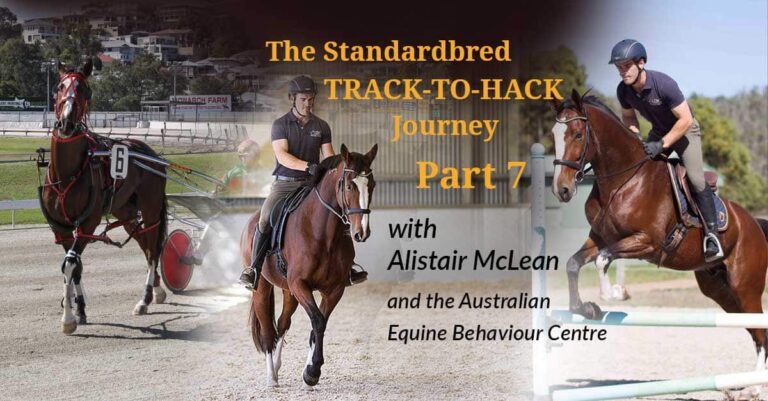
Welcome to Part 7 of the Unharnessed Potential project, an education and awareness campaign to promote the re-training and re-homing of Standardbreds when they retire from a racing career.
In the previous training article, Alistair explained some exercises to refine the canter response and the introduction to jumping and cross-country training, which all help prepare for Andy’s future all-round career.
This month, the focus is on lateral movements.
Lateral work
Now that Andy has consolidated all of his basic responses under-saddle, we can begin training the basic lateral movements, including turns on the forehand, leg yielding, shoulder-in and travers.
Lateral movements are great straightening and suppling tools as they improve the flexibility and coordination of your horse. Improving coordination is important for Standardbreds, and Andy in particular, because most of their prior training was working in bilateral paces.
Andy has long and slender musculature, which makes it easy to get him into the positions I want. However, he finds it difficult to maintain his gait as he is still learning to coordinate his legs. By training and practicing lateral movements, Andy will gain the coordination and strength required to maintain his gait within these body positions and movements, and it will positively impact his overall physical condition and way of going.
Training the lateral movements will also improve Andy’s canter work because, as a pacer, he still struggles to hold the position required for canter, whilst keeping his legs in a coordinated three beat rhythm.
The gymnastic advantage
The lateral movements additionally will stretch and supple different parts of the horse’s body, preventing soreness that may otherwise require equine massage. How our horses respond to the aids we give is always a good indication of what responses require further work, and this can be enhanced through training and exercising the lateral movements.
If the 10 basic responses are consolidated under-saddle and they are regularly checked (testing for self-carriage), then any resistance to your rein or leg aids could be a result of sore/stiff muscles. Take, for example, a horse that resists the right rein. Normally, we would say that the horse has a poor right turn response. However, it may be that the left side of his body is just sore and inflexible. In this case, riding shoulder-in both ways may be beneficial.
In another example, the horse may pull on the right side of the bit because he is stretching the right side of his body in order to protect the left side. In this case, we don’t need to necessarily think about softening him to the right rein but, instead, we could make him put more weight on the left side of the bit, which will make the right side eventually light.
Shoulder-in with bend away from the right rein is great for this, however this can also be accomplished by using a simple indirect turn from the right rein.
The benefit of the lateral movements over just simple indirect turns, however, is that it stretches more of the horse’s body as we are able to independently control and place the hindquarters and shoulders in different positions from what the horse is normally used to – just like gymnastics for people.
Training the basic lateral movements
Before training the lateral movements under-saddle, it is important that you can move the hindquarters and forequarters of the horse independently from each other in-hand (See the May issue of Horses and People Magazine).
Since we already have control over the shoulders using indirect turns under-saddle (See the June issue of Horses and People Magazine), it is now important to train yield of the hindquarters.
Yielding the hindquarters should be trained using a whip on the side of the rump of the horse. This area of the horse should always be an area associated with moving the hindquarters.
When tapping the hindquarters, it is important to release the pressure (stop tapping) for the correct response, which is stepping the hindlegs to the side (laterally).
If the horse tries to step forward, you can prevent this by using your stop/step-back rein aids.
Standardbreds can be quite whip-shy and, therefore, it is important not to tap hard. Soft taps will produce a more relaxed response (See page opposite).
The aim of this is to be able to classically condition (associate) the known tap cue with the desired under-saddle cue of putting our leg back. Once we can do turns on the forehand from our leg back cue and turns on the haunches from our direct and indirect reins under-saddle, we can begin training the lateral movements.
The lateral movements should always be taught in walk. This is the simplest way to train obedience to the aids, due to the fact that there will be less resistance as the horse is moving slower and will naturally find it easier to balance.
The lateral movements:
Leg yield
Leg yield is always the first lateral movement I train as the requirements for leg yield are simple. The horse must be able to turn on the forehand (yield the hindquarters) under-saddle and respond to an indirect turn (which place the shoulders in the correct position).
Because we spend a lot of time riding on the outside track of an arena, horses tend to fall back towards the outside track if ridden on the inside track. This creates a good place to begin training leg yield. Horses generally also yield better off the left leg, so we start on the inside track on the left rein.
To begin leg yielding, the first thing to do is to slide your leg back to the yield hindquarters position. At this point, your horse may trial a variety of responses.
If he does not move sideways and goes faster then you need to, immediately slow the horse and repeat the question, and maybe help with a small indirect turn from the left rein.
If the hindquarters lead too far or too quickly, you may correct this by using an indirect turn from the left rein; releasing once the shoulders have caught up.
If the shoulders lead too much, then you can slow them down using an indirect turn from the right rein followed by a little nudge of your left leg until the shoulders and hindquarters are even and then release.
When you can yield the horse’s body evenly from the inside track to the outside track with no major corrections, you can begin yielding from further out, and from the right rein and leg.
You will notice that your corrections are big initially. However, as you practice, the corrections will diminish until you no longer need to make any corrections and your horse can maintain the yield in walk with rhythm.
You now may aim to achieve this in trot.
Shoulder-in
Shoulder-in is the first lateral movement we train that involves bend. It is a three track exercise that is great for suppling and stretching, and for strengthening the horse’s hindquarters – as the bend of the horse pushes the inside leg further underneath the horse.
In the shoulder-in, the horse should bend around the rider’s leg, however, and contrary to popular belief, the bend is not necessarily created by the inside leg. It is actually the inside direct rein and the outside indirect rein that bring the shoulders in, creating the ‘bend around the inside leg’. The role of the inside leg is to tell the body of the horse – with a little nudge – to keep that position whilst moving along the track.
Without the inside leg, the shoulder-in would just be a simple turn off the track across the diagonal, for example. It is the initial hugging of the inside leg that eventually tells the horse that we want him to travel along the track with his shoulders-in.
The way I begin training shoulder-in is out of the corner of the arena. Imagine you are turning across the diagonal, but your inside leg comes on as soon as the inside front leg comes off the outside track.
Rhythm is more important than angle when training shoulder-in. Try to keep the natural rhythm of the walk. If rhythm is an issue, then the angle may be too steep.
Remember that the bend is created around your leg by the reins and, in particular, the inside direct rein. The outside indirect rein creates the angle of the shoulder. The inside leg stays in contact in the normal leg position and is still used as a ‘Go’ aid. The outside leg remains in its correct, neutral position.
One of the most common mistakes made when training shoulder-in is letting the horse come off the wall. In this case, you need to prevent the hindlegs from leaving the track by stopping the frontlegs from moving more forward and immediately applying more inside leg pressure.
The moment he begins moving along the wall, you should release the pressure and return to riding straight. To start the shoulder-in again, you can do a 10m circle and repeat the process out of the circle.
It is important not to ask for too many steps in the beginning. Gradually build up the amount of steps and then also the amount of angle. It’s helpful to have a mirror at the end of the long side of the arena to be able to see the angle as shoulder-in can sometimes feel different than it looks. It’s important at the end of the long side to ride straight before the turn, so that you maintain a clear turn response.
Travers
The travers movement is the first time in our horse’s training where we control both the shoulders and hindquarters independently from one another. Prior to this, the hindquarters would generally follow the shoulders of the horse. Now, we are asking the shoulders to remain on the wall through an indirect inside rein, whilst asking the hindquarters of the horse to walk along the inside track through an outside leg yield aid. This is confusing to the horse in the beginning as they generally think that the yield aid involves the whole body of the horse, but now we are preventing the shoulders going with the hindquarters. The horse should be flexed along the wall facing the direction of travel and the legs should be stepping on four tracks.
As I mentioned earlier, the outside track has a natural pulling effect on the horse’s body. This can sometimes make it difficult to get the horse’s hindquarters off the wall and, when you finally do, you might lose the rhythm (especially in trot).
A good way to prevent this is to walk towards the long side on a very slight angle. It doesn’t need to be an angle that will give you four tracks to start with, but just an angle to have from the beginning, so that the hindquarters never make it to the wall. This way we only have to focus on keeping the hindquarters where they are, instead of moving them off the track, and still having to keep the horse’s forward momentum. This exercise is particularly useful in trot, as horses tend to become quite short and choppy in Travers if the rhythm isn’t kept from the beginning.
Wrap up
When these lateral movements are consolidated, we will have a whole new set of tools to position Andy in the way he needs to continue his education into canter and also the further lateral movements, such as renvers, half-pass and pirouettes. These are ,after all, just further refinements and combinations of the above lateral movements we have just trained.
Next article…
In the next part we focus on preparing Andy for his first outing as we prepare him to appear at Equitana, so we need to prepare Andy for new environments beyond the AEBC fences.
I will talk about ground work tips to encourage relaxation on arrival at the new venue and how to expose him to the new environment under-saddle. Naturally, any problems he has at home will show up at the competition, so we need to prepare for this and use many techniques to help.
Therapeutic riding is a well-established and highly regarded equine-assisted activity for helping people with physical disabilities. Horses are also becoming increasingly recognised for their beneficial role in interventions designed to improve mental health and wellbeing, especially in relation to PTSD and other forms of trauma.
But horses don’t have to be put in the role of therapist for us to benefit. Being around horses can help all of us become better human beings – even horse people who mostly take their routine interactions with horses for granted.
In this article, I discuss how horses can provide the motivation and the means for us to improve ourselves in everyday ways – no therapist required. Horses can motivate us to get active, go outdoors and be more aware of ourselves and the impact we have on humans and horses.
Getting active
Anyone who has ridden a horse will know that horse riding is a sport. One way to measure the intensity of different physical activities is using a MET score. MET stands for Metabolic Equivalent Task and one MET is equal to the rate you burn calories while you are sitting.
According to a 2011 activity compendium, horse-riding has been calculated at an average of 5.5 METs. That means that horse riding burns 5.5 times more calories than sitting, which puts horse-riding in the category of moderate intensity physical activity (a range of 3 to 6 METs).
However, the effort required for horse-riding depends on what pace you are riding. Riding the walk is 3.8 METs, trotting is 5.8, cantering and galloping are 7.8 (this score above 6 METs is considered a vigorous intensity activity), whilst jumping is a score of 9. In other words, riding a horse over jumps burns nine times more calories than sitting. That is a higher MET than has been calculated for football, handball, lacrosse, mountain climbing, singles tennis, and volleyball which all have a MET of 8. And at 1.8, driving a horse carriage burns almost twice as many calories as sitting.
Like any scoring system, the MET scores should only be seen as indications. But one thing is clear; horse riders are not just sitting in the saddle making the horse do all the work. Riding requires – and therefore helps you to improve – physical fitness, but you don’t even have to ride to get physical benefits from horses.
Looking after horses entails physical activities like grooming, saddling, cleaning stables and yards, carrying bags of feed and walking horses to and from their paddocks. These activities have a MET score of 4.3 which is the same as archery or walking around a golf course carrying clubs. Lincoln Park Horse and Human Rehabilitation Centre in South Australia advertise ‘trail walks’ where people can lead their horses together.
This concept is a great for so many reasons – leading beginners, rehabilitating injured horses and giving young horses new experiences. You might think that taking a horse for a walk is an odd thing to do, but if walking a dog has a MET score of 3, then you can imagine the MET of walking a horse (and who said you had to ride to be a horse person?).
Being around horses can help all of us become better human beings – even horse people who mostly take their routine interactions with horses for granted.
Being outdoors
Despite horse sports and horse-related activities clearly being physical activities, their public perception as not-mainstream means that they can have particular appeal for children and adults who do not identify as ‘sporty’ or ‘outdoorsy’. In that regard, horses can be a gateway to increased physical and outdoor activity. In fact, one of the often-overlooked reasons behind the success of equine-assisted interventions is the practical fact that being around horses usually means getting outdoors.
There are lots of benefits to getting outside. The main one is getting some Vitamin D from sunshine, but daylight helps our bodies regulate our circadian rhythm – the internal body clock that makes us feel sleepy at night and wakeful during the day.
Being outdoors has particular benefits to children, as exposure to sunlight has also been found to reduce their occurrence of myopia (near-sightedness). Horses can be a great motivator for those who might not otherwise have any need or desire to go outdoors or get active.
Overall, being outdoors is associated with increased happiness and reduced stress. Some of these effects are chemical but they may also be explained by something called the biophilia hypothesis. This is a theory stating that humans have a biological drive to connect with nature and animals.
This is where equine-assisted interventions can differ from programs involving other animals such as dogs. You have to go out into nature to connect with horses (even a city stable is a little piece of nature) and horses can take you much deeper into natural places like forests, beaches, parks and scrublands than you may have been able to go in a car, on a motorbike or even on foot.
Being mindful – or just being
Being around horses is a great way to become mindful of our thoughts, bodies and the present. However, being around horses is also a great way to become complacent about what being around horses even requires.
Regular equestrians have to put effort into really noticing the horses with whom they are familiar, considering how they experience their environment, how they relate with us and what this looks like at any given moment of any particular day.
How many of us watch our horse’s expression and body language before we have even opened the gate to their paddock? Do we routinely check to see what distance they are most comfortable maintaining from us and if that changes if we wait, step back or move forwards? How long does it take for them to react, how do they react and what are they communicating? And throughout this period of observation and noticing, what do we notice in our bodies, our breath and our emotions?
I recently attended EQUUSOMA® training with Sarah Schlote. Sarah introduced me to a way of seeing humans and horses that has provided a whole new way of thinking about being with horses. She encouraged us to see one another – and our horses – for the mammalian nervous systems that each of us share.
The activity of nervous systems changes, rises and falls in response to internal and external stimuli as well as other nervous systems. It is hard – if not impossible – to not be mindful and in the present moment whilst paying your nervous system some attention.
What is my nervous system doing? What about my horse’s nervous system? This is more than just assessing a horse as being quiet, sleepy, grumpy, inattentive or ‘on its toes’. It is about taking a dynamic view of nervous systems as rising, falling and going through different stages in relation to others and the world around them.
If I was to graph the nervous system, is it tracking up or down? What happened just beforehand? What happens if I just stay aware? If I think of the nervous system as continually cycling, has the cycle even ended and how do I know?
The answer to each of these questions has implications for what we are capable of thinking, feeling, learning, doing or responding to at any given moment.
Being around horses can help people to learn self-control of their behaviour and self-regulation of their emotions
There are certain extremes in the cycling of nervous system activity during which it is futile to ask or expect a horse or a human to do anything.
In extreme states of hyperarousal or hypoarousal – when we might describe a horse or a human as being in flight, fight or ‘flooded’ (or crazy, stubborn, or ‘checked out’) – the best we can do is to create a feeling of safety. We can help each other out by providing a safe nervous system to provide a touchstone for co-regulation.
Co-regulation is essential for a nervous system to learn how to self-regulate. For example, human infants are unable to self-regulate their internal emotions and reactions to external stimuli. However, when they are soothed by a caregiver’s voice, hold or touch they are being co-regulated by another, which helps them learn to self-regulate.
Whilst it is true that one nervous system may trigger another into an increased state of dysregulation, anxiety or excitement, the assumption is that nervous systems are attracted to more regulated nervous systems and the feelings of increased safety, confidence and mastery they can provide.
Thinking through human-human and human-horse relationships through this framework of nervous systems helps to explain why some humans seem to have a calming effect on other humans and/or horses, or why some rides feel better than others.
Think about your last ride. Was it a good one or a bad one? Can you recall what state your nervous system was in before you mounted (or even when we were haltering our horse, or way before that when we were approaching the gate).
Now, can you remember what state your horse’s nervous system was in, how you knew and whether or not you allowed the time and space for both nervous systems to return to a state of regulation?
If you felt nervous, impatient or frustrated, did you get on anyway, or did you wait to see if that feeling gave way to something else? This level of awareness might provide new insight into that ride.
If you can’t remember those details from your last ride, don’t worry – you are in good company. Sadly, it is hard enough for so many of us to fit horses into our lives that we simply don’t take the time to notice, or prioritise the need to do so.
Starting to look at other living creatures as a room full of nervous systems has been particularly impactful. It feels like I have Superman’s x-ray vision, allowing me to see humans and horses in new ways, and better understand my interactions with them.
For example, when I perceive a sales assistant or a horse as being in a state of dysregulation – not just being rude or difficult, I can respond in a proactive rather than a reactive way. Instead of taking their behaviour personally (which would impact my nervous system as much as theirs), I can think about the role I play in co-regulation and how I can provide time and/or space for their nervous system to move in a direction of self-regulation. Sometimes all it takes is a step back and a deep, slow breath.
Taking a nervous system view of relationships is not only useful and insightful – it challenges some of our long-held beliefs.
For example, removing pressure from a horse (or a human) isn’t always about backing off and ‘letting them win’ or reinforcing their undesirable behaviour. Instead, it can be about recognising their window of tolerance (which can change at any moment in time), allowing their nervous system to reach a point where they can cope with our request and maybe even building greater tolerance over time.
That is when we are really setting one another up for success and ultimately, for self-regulation and the confidence that it comes with.
Thinking about nervous systems, self-regulation and co-regulation whilst you are hanging out with your horse can have wide-ranging benefits. When undertaken with polite observation, free of judgement, this framework can motivate mindfulness, being present, noticing your surroundings, be aware of self, other and the two of you together.
Whilst you are attending to these thoughts, you are giving your mind a break from worrying about other things in life that your horse will never care about (such as homework, exams, arguments with friends, what you look like, what time it is, how late you are for whatever, what notifications are on your phone, what your boss is waiting for, or what other people think about you, etc.). And that freedom gives yourself a chance to self-regulate and your nervous system a chance to reset and rebalance.
These are just a few ways in which being around horses can help all of us become better human beings. But there are no guarantees. Horses are not a magical panacea to human ills. They do, however, provide us with opportunities to be better versions of ourselves.
More importantly, perhaps the ultimate way in which horses can help us become better humans is for us to care more about making sure that our interactions with others (human and animal) benefits all and contributes to feelings of safety.
Most of us have been on, or at least seen, a horse spooking (some call it shying), and many of us have experience with horses that can have massive spooks, spin around and run away. Others, whose behaviour may not be as exaggerated, can seem to shy at almost anything or even nothing.
It would be unrealistic to think that we could stop the horse from ever spooking. After all, we all get surprised from time-to-time, right?
However, we can help the spooky horse (and ourselves!) by being mindful of why the horse spooks in the first place; we can learn what to do once the behaviour has become habitual, and how we can avoid this spooking behaviour from developing into a habit in the first place.
It’s about confidence
The spooky horse is not in a good place, he is not relaxed or under the stimulus control of the rider/handler.
Spooking is a sign of a horse that is lacking in confidence – ‘non-human social’ and ‘novel object confidence’ in particular.
In this article, we will discover the seven main reasons horses spook, the seven best ways of addressing this behaviour if it has already been established, and seven ways to help you prevent creating a spooky horse in the first place.
Reasons why your horse spooks
Before you think about the reasons your horse spooks, observe him or her at home, in the field.
1. Naturally high emotional level
Is your horse naturally over-vigilant, reactive and spooky when they are with their fellow herd members? If so, your horse is likely to have a naturally higher emotional level than the horse that is, most of the time, grazing quietly with his or her friends. Maybe your horse is usually relaxed and comfortable at home (and we aren’t talking about when a deer or kangaroo bounds through the field, he’s entitled to jump at that) but something changes when he or she is handled or ridden. In this case there are things you can do to find out why that might be.
2. Too emotional
A horse that one would describe as ‘spooky’ is usually overly emotional. This horse’s emotional level is so high that they are unable to focus on you, the rider or handler.
3. Not emotional enough
Your horse may also spook when he or she is not emotional enough when being trained, ridden or handled on the ground. Such a horse is not engaged with the rider and is likely to be suddenly surprised by things in the surroundings due to this lack of focus.
4. Confused
Horses can also spook when they become confused. Horses love predictability and a new rider, environment or new signals and cues, can be confusing for the horse, making him less confident and more likely to spook.
5. Bad experiences
A horse’s history plays a big role in how likely they are to spook. Horses that have had unpredictable and inconsistent training are more likely to be expecting the unexpected and thus, more likely to spook. While those that have gained confidence with the consistent use of well-timed combined reinforcement are less likely to do so.
6. A spooked rider
It is not always the horse that spooks! Some riders can spot the ‘scary’ thing and alert their horse to it. When we expect the horse to be afraid of something, we tend to get tense ourselves and this will be transmitted to the horse by an increase in pressure, on the rein or lead rope if we are on the ground and via our seat, leg and hands when we are riding.
7. Unfair expectations
Horses that are left to ‘work it out themselves’ in difficult situations such as a new environment will often spook more than those that have been actively engaged with the rider.
A good example of this is when you take your horse to a new arena for a ride. Do you walk your horse around the arena on the ground on a loose rein, allowing him/her to call out and jump away from each scary object? Or do you actively engage your horse with an activity on arrival and gently remind him/her to bring their attention back to you when it strays?
The former will most probably have a horse that spends the next hour making sure all the scary things are where they should be, whereas the latter, will enjoy an engaged horse and a good and productive training session.
Let’s find out how you and your horse can be the latter.
How to help your horse once spooking has become habitual
1. Emotional level
Help your horse relax by being conscious of its emotional level. Head elevation will usually tell you how emotional the horse is. I like to judge it out of 100, with 50 being a relaxed horse grazing in the field and 95 being a horse spooking and bolting away. For training, we’re aiming for a 60/100, and you can learn more about how you can manage your horse’s emotional level by reading The Engagement Zone article, and this webinar: https://www.kandooequine.com/blog/webinar-ez
You are aiming to build ‘a bubble of communication’. I like to think about it as a bubble because a bubble is fragile.
Imagine a bubble around you and your horse. Inside that bubble you can communicate, with subtle pressure-release-reward cues and your horse responds, remains engaged and relaxed. Then a car speeds past, he raises his head and bursts the bubble – you can almost see his pricked ears breaking the bubble. This is great, because you have identified the exact moment at which he left the bubble, and now you can simply re-engage him with your lesson and get back to strengthening your bubble.
I find the most useful lesson for helping the horse relax and focus on me, is the give to the bit lesson (which can be done with a bitted or bitless bridle in precisely the same way).
As trainers, we are always altering the horse’s emotional level. We need to increase it to engage the horse with the lesson and encourage the horse to relax during lessons. In order to engage the horse with learning, we do not need to increase the emotional level a lot but we must increase it a little, I find about ten to fifteen percent is perfect – much less than that and the horse is not focused on the exercise.
6. Patterns
Using combined reinforcement, pressure-release-reward, sets up good patterns for your horse to learn.
Remember we need movement to train, and a spooky horse will usually want to move. Good choices of lessons would be those that require movement from the horse, such as give to the bit and shoulder control from the ground or from the saddle.
Poor choices would be attempting to teach the horse to stand still. Save this lesson for a time when your horse is relaxed because you will be much less likely to have to correct/punish your horse at that time.
Energy is your most precious commodity and if you have a horse that wants to move take advantage of that by teaching him or her a lesson that will be useful both on the ground and under saddle, give to the bit and shoulder control are my favourite for this.
7. Set up a plan
You are now being very proactive, asking your horse to engage with you, rather than react to its environment and it is time to make a plan and take this good strong bubble of communication that you have built on the ground to the saddle.
The saddle is never the place to start! If a behaviour is not established or it is dangerous on the ground, it will be worse under saddle. Even for those of you that feel ‘safer’ in the saddle, it is considerably more difficult for the horse to learn while you are riding than it is while you are on the ground.
When I am re-training a spooky horse, I use the following plan:
How to avoid ‘creating’ a spooky horse in the first place
1. Have a lesson plan, even when you are on the trail.
This may seem like a bit of a kill-joy idea if you just wanted to go on a relaxing ride with your friends, but your spooky horse is not yet confident enough to do that. That should not necessarily prevent you from going, rather it will give you the perfect opportunity to be proactive and train your horse on the trail (plan for more training and less gossip for a few rides perhaps).
2. Start with relaxation whenever you are with your horse.
If your horse is not relaxed, address that first by engaging him or her with a simple lesson of pressure-release-reward. This could be any lesson such as head down, walk forward and back, give to the bit and so on.
5. Each lesson you teach adds to your horse’s confidence
And conversely, the longer the spooking behaviour is left unaddressed, the harder it will be to overcome. Even simple, easy lessons will greatly assist in this area. If you have good use of combined reinforcement (pressure-release-reward), your horse will engage with you more and more, and grow in confidence hugely because he/she will understand that they are ‘getting it right’, and being rewarded for doing so.
Our job, as riders and handlers, is to engage the horse with us and to do that we have to make it interesting, challenging and fun! If we can do this, we build a strong bubble of communication and those elements in the environment that the horse had been reacting to are no longer of importance to the horse. Once built, we can take our horse, in this safe and relaxed bubble, wherever we would like to go.
7. Always be proactive
The hardest thing for a horse to do, is to be in a new environment alone, even if you are with him, holding or riding. Have you ever seen a horse resembling a kite on the end of a string while being led? It is a terrifying place for a horse to be. This is the reactive mode for both, the handler and the horse.
The easiest way to get your horse to relax and engage with you, is with a simple lesson using combined reinforcement. This is what it means to be a proactive rider or handler.
Both situations described above can apply to the same horse, they are simply different approaches, so be proactive.
Tracking your horse’s progress
It can be sometimes hard to remember how your horse used to behave and this often makes us doubt our progress.
This is why the Equine Behavior Assessment and Research Questionnaire (E-BARQ) is such a useful tool.
E-BARQ is a longitudinal study designed to investigate how training and management effect behaviour. The study is open to all horse owners and you can check it out at www.e-barq.com.
When you complete your E-BARQ you will receive your horse’s results, showing how they scored on a number of different categories, from Trainability to Confidence. (The image on the opposite page shows an example E-BARQ graph.)
If you have a spooky horse, I encourage you to fill out an E-BARQ now and get your results.
You’ll be invited back in six months’ time to retake the questionnaire and you will be able to see how your horse has improved in that time (because I am sure you will implement all of the ideas in this article). Pay particular attention to Non-Human Social Confidence and Novel Object Confidence – I think you’ll see some big changes.
The practice of cross or mixed grazing is often suggested as a useful strategy to manage intestinal parasite infestation, but until recently, evidence of its efficacy was limited. A French team has provided the first evidence of the benefits of mixed grazing with cattle as an alternative to control strongyle infection in horses.
Cross or ‘mixed’ grazing means having different types of animals, as opposed to just horses, graze an area of land. Proponents of the practice explain that, in a natural setting, many different species of animals occupy the same areas of land and, therefore, by using cross grazing, you can get closer to replicating a more natural management system, benefiting your animals and the wider environment in a number of ways.
For example, cross grazing results in more ‘even grazing’ of a pasture – that is, it reduces the establishment of ‘roughs’ and ‘lawns’. Different animal species tend to complement each other in their grazing behaviours by eating different plants and eating parts of the pasture the horses tend to ignore.
But importantly it has always been assumed that cross grazing reduces parasitic worms on the area grazed because different animal species will eat around the dung of other species, but not that of their own.
This is thought to be a parasitic prevention strategy because most parasitic worms are ‘host-specific’ – they can only complete their life cycle in one species of animal. If a parasite is picked up by a different species of animal, it dies in their digestive system without reproducing.
The study by Forteau and colleagues compared the management and worm control of 44 horse breeding farms in two different regions – the more productive grasslands of Normandy, that generally specialise in sport horse breeding, and the less productive northern Massif Central, where leisure horses are bred. Of the 44 farms, 21 specialised in breeding horses and 23 bred cattle as well as horses.
Using field surveys and face-to-face interviews they aimed to quantify breeders’ awareness of the benefits of cross grazing horses and cattle, to establish whether farms that used cross grazing used different strongyle worm control management strategies and to test whether strongyle egg excretion was lower in horses grazed with cattle.
The results show that all breeders were relying on systematic calendar treatments and only 8 out of the 23 farms that breeds both, horses and cattle were aware that cross grazing both species could be used as part of their strongyle control strategy. There was also a high reliance on macrocyclic lactones (ivermecting and moxidectin) despite the well-recognised problem of resistance to these drugs.
Faecal egg counts measured in horses from Massif Central were significantly reduced when horses were grazed with cattle. The researchers also report that out of all the horses that were treated only with macrocyclic lactones, the young horses grazed with cattle had 50% fewer strongyle eggs excreted in their faeces than horses grazed in equine-only pastures.
This study provides the first evidence of the benefits of mixed grazing with cattle as an alternative to control strongyle infection in horses, but shows that the benefits of cross grazing are not widely known amongst French horse breeders.
The study is published by Cambridge University Press: Horses grazing with cattle have reduced strongyle egg count due to the dilution effect and increased reliance on macrocyclic lactones in mixed farms by L. Forteau, B. Dumont, G. Salle and G. Bigot. The abstract can be found here.
Humans Should Control Their Emotions Around Horses
You show up at the barn in a bad mood, grumpy, short-tempered. You snap at the other riders and you raise your voice at a significant other over your mobile phone. Then there’s your horse, wide-eyed and a little nervous, like he’s wondering what’s in it for him.
If you’ve ever had the impression your horse picks up on your emotions, you’re definitely right, according to scientific studies. And one French team has just taken that science a step further: they’ve confirmed that horses can match the emotions of our facial expressions with those of our vocal expressions—which is better than what most humans could do with horses.
“Can we ourselves associate a horse’s precise facial expression with the corresponding vocalization? I’m not so sure!” said Léa Lansade, PhD, of the French Horse and Riding Institute and the National Institute for Agricultural Research’s behaviour science department, in Tours.
Horses, however, are sensitive enough and in tune enough with humans that they can read us pretty well when it comes to emotional expressions, according to Lansade, speaking on the recent work led by her student Miléna Trösch, PhD candidate.
In their study, Lansade, Trösch, and their fellow researchers projected short silent videos of a woman making different facial expressions: one video of joy and one of anger. They projected one video to the left of each horse and the other to the right. Meanwhile, they played short audio clips of a different woman expressing either anger or joy (with voice but no words).
Consistently, the 34 study horses (Welsh pony mares) would stare at the “wrong” face—the one that didn’t match the vocal expression, Lansade said. Although some species tend to look at the “right” image that matches a particular sound, horses usually do the opposite.
For example, horses often stare for long periods of time at things they don’t recognize or don’t seem to understand, like flowers under a jump, a tractor in an otherwise empty lot, or a fallen tree in their pasture. “The horse is certainly very perturbed by this ‘violation of his expectations,’ to use the technical term,” said Lansade.
The horses in Lansade’s team’s study also had more relaxed behaviour and lower heart rates when they heard the joyful vocal expressions, she added. Whether the horses thought these expressions of emotion were directed towards them or not hardly mattered, she said—“they were affected all the same.”
It was particularly surprising how quickly the horses reacted, Lansade explained. Although the mares had had very little interaction with humans (just daily management but no training), they were “highly sensitive” to expressions of human emotions, even though the video and audio clips only lasted a couple of seconds each.
“It was incredible to see how a simple groan of discontentment made their cardiac rhythm shoot up!” said Lansade. “And also, to see how a smile could appease them.”
Lansade’s conclusion? “Manage your emotions around your horses!” she said. “They’re a lot more sensitive than many of us give them credit for, and they’re paying more attention than we might think.”
Knowing how sensitive they are can also help us better communicate with our horses for improved relationships and more ethical training, concluded Lansade.
Horses categorize human emotions cross-modally based on facial expression and non-verbal vocalizations by Milena Trosch, Florent Cuzol, Celine Parias, Ludovic Calandreau, Raymond Nowak and Lea Lansade was published in Animals in October 2019.
Welcome to Part Seven of the Unharnessed Potential project, an education and awareness campaign to promote the re-training and re-homing of Standardbreds that retire from racing.
In this article series, Alistair McLean from the Australian Equine Behaviour Centre (AEBC) is documenting the re-training of ‘Ideal Guy’ (a.k.a Andy), a five-year-old Standardbred pacer that is making the journey from track-to-hack.
Last month, we saw Andy consolidating the basic responses under-saddle and beginning to learn to canter under-saddle. This month is about refining the canter response, jumping and cross-country training, which all help prepare for Andy’s future all-round career.
Refining Andy’s canter Refining the Canter and Jumping
Andy’s response to the canter aid is now consolidated and, although he starts the canter well, he is not yet able to maintain rhythm and straightness for too many strides, largely because he is still unbalanced.
I found that Andy’s balance issue stemmed from his inability to keep his shoulders straight when cantering, so teaching him to straighten his shoulders through indirect turns is helping. Maintaining straightness involves using the hindquarters to create upwards energy, which, in turn, keeps the horse ‘off the forehand’, and less likely to break and fall into a pace.
For the indirect turns to work in the canter, they must be very obedient in the walk and trot. Any learned response can deteriorate as the gait increases, so we always use the shaping scale until all the responses are consolidated in all the gaits. In many cases, to teach the horse to respond correctly in the new gait, you have to take a step or two back within the Shaping Scale.
In Andy’s case, when we moved into canter, straightness, which he found very difficult, so he had to be trained again from a ‘Basic Attempt’ level, especially on the right rein. It didn’t take long to remind him though, as the response had been trained in the lower gaits so ‘it was in there’, he just needed to find it!
Breaking pace
Horses that break in the canter usually do so because they ‘fall out’ through the shoulder, and this causes them to become unbalanced and ‘flatten out’. The indirect turn can bring the shoulders back in line, but before it will have a chance of working in the canter, first ensure your indirect turns are well established in the trot. A good exercise for this straightness in canter is to canter down the long side of the arena and move the shoulders towards the centre line a bit at a time.
The straightness exercise in canter has helped Andy maintain balance and rhythm, and he is now cantering the length of the arena in a rhythm. Sharp turns tend to tip him off balance, as he hasn’t developed the musculature necessary to push off from his hindquarters through the turn. The more repetitions of canter he can experience, the more his coordination will develop in all areas.
Our next mission is to maintain straightness and rhythm through turns in the canter, ensuring the shoulders don’t drift in or out. Gradual turns in a large area in a hexagon shape (See the illustration on Page 36) will help him maintain straightness and balance.
A well-rounded training
Irrespective of whether you want your Standardbred to be an all-rounder or not, there is a lot to gain by teaching your horse to jump. Andy, for example, is very sensitive to his surroundings and is not naturally a very confident horse. In other words, his responses tend to deteriorate when he is out of the confines of a closed indoor arena with little distraction.
The best way to make a nervous horse confident is by repeating the learned responses in gradually more challenging situations.
When the horse is being controlled by the environment instead of our aids, we need the aids to be more motivating to him than the external environment. Once this occurs, the scary environment is overshadowed by our aids, producing a more confident horse. You might always have a horse with a tendency to be nervous, but having well-trained responses will help manage his anxiety. His reactions to the environment will reduce as he becomes focused on you – you become a predictable, safe and easy to understand guide for your horse!
At first I would suggest just doing some ordinary dressage training around the jumps before actually jumping. You want to minimise the chance of him becoming tense in that environment. I had already trained Andy over trot poles so I was happy to start teaching him over small cross rails. If you haven’t trained over poles then I would suggest doing this first at walk, then trot so the challenge isn’t too great in the beginning.
Teaching Andy to jump Refining the Canter and Jumping
The aim when teaching a horse to jump is to achieve rhythm and straightness. We don’t want our horse to surge towards the fence or draw back – we want him to stay at the same pace we set.
Our horses need to be in self-carriage, awaiting any aid we may give – that way, if we need to shorten or lengthen the stride to meet the requirements of the jump, we can do so with ease.
A horse that rushes or speeds up during the approach to a jump is often mistakenly labelled as one who ‘loves to jump’, but often the case is that they are scared and running away, which is dangerous for both the horse and rider.
A horse that maintains rhythm and straightness is a better example of a horse that is comfortable with jumping. If we notice that our horse is accelerating towards the fence, we need to correct the loss of rhythm and do it at a jump height that is safe, before increasing the challenge to a higher jump.
Low and slow
Problems, such as rushing, only become more difficult to manage when the jumps become higher. This is the reason why we train the horse to maintain rhythm and straightness over poles and small fences before increasing the challenge.
Training the horse in walk or trot first will give you a better chance of correcting any speed and/or line variations. Horses need to be able to land and exit the jump at the same speed we approached. If we can adjust our horses before and after the jump, we will know they are not scared, because our aids are motivating them to respond more than the jump in front of them is.
Correcting mistakes
We start small to minimise mistakes.
If your horse refuses at the jump, it is important not to turn them away from the jump. It is the sight of the jump that has caused them to refuse, so do not reinforce their behaviour by allowing them to turn away. At this early stage, the jumps are small enough for the horse to step over from a stand still or, if you prefer, you can rein back a step or two and give yourself more room. If you feel the jump is too big, ask the person on the ground to lower the jump down to a safe height, before asking the horse to step over it.
If your horse runs out to the right, it is important to immediately turn left, as this is the aid the horse pushed through (vice-versa if he runs out to the left). Once you have turned left, then you can face the horse up to the base of the jump and get him or her over it. Again, working from a slow pace will help you correct the run out before he goes past the jump.
If the horse manages to get past the jump, rein back and bring him back to the base of the fence where he made the mistake.
The next important part is to consolidate – repeat the jump over and over again until the horse can do it with no loss of straightness or rhythm.
A horse who has never been allowed to refuse or run out is much safer in the long run. The less options they have in front of the jump, the better they will be, as this will make the response predictable in future, which is why I never allow refusals. Repetition is a key part of training, as this is what creates habits for your horse.
Jumping for Andy isn’t a problem. His technique needs improving but, at this point in time, I am happy that he can trot into a jump maintaining rhythm and straightness. I am gradually adding in more fences until he is comfortably trotting a basic jump course at 50 cms.
Training cross-country fences Refining the Canter and Jumping
Now that Andy has good idea of what to do in a show jumping arena, his confidence and skill will improve as he learns to jump a variety of obstacles in various places. Like in show jumping, I want Andy to be relaxed, which is why the first cross-country session is always done at the walk. We do not want to associate cross-country with speed.
Everything is easier to correct in walk and, for now, there is actually no need to trot, as I will only be doing the basic cross-country obstacles, such as water, ditches, banks and small logs, and tyre jumps.
The weather at the time of writing this article iss making the ground very slippery, and I don’t want Andy to slide and lose confidence.
I start by walking Andy over all the small jumps, so he learns they are solid fences and they don’t fall over. Once I have walked him over these jumps, it is time to train some of the unique obstacles that he hasn’t seen before, such as the water jump, the bank and the ditch. These are the foundations found in nearly all cross-country courses and should be trained thoroughly before going out to compete. Again, this is all done in walk first and then, once the horse is comfortable, we can begin to trot.
We can only adjust a horse when its feet are on the ground, which is much more often in the trot and walk, and, therefore, preferable in the initial stages of training. In the same way as we have taught Andy to jump obstacles in the show jumping arena, we do so on the cross-country course.
Begin with the smallest option and correct any variations in rhythm and straightness. Repeat each jump often until the horse is comfortable. When your horse can walk over each small challenge without a problem, you can trot. To reduce the chances of injury and confidence loss, jumping from a canter should first be schooled over show jumps, just in case we have too long or short a take-off point, as the jump will fall down.
Natural obstacles
Andy was a little nervous in the water at the beginning, so I maintained leg pressure and increased it until he made an attempt to step forward and into the water. We then repeated this until there was no hesitation. The same process was followed for the bank and the ditch. The horse will often attempt to quicken as he steps over the ditch or down the bank, so we correct this by using the reins as we do for a downward transition, releasing when he reacts correctly. You can use reins aids before or after the jump, but never during. If you cannot get a slowing reaction until after the jump, use a downward transition immediately after the jump and repeat until he no longer rushes.
Later, when your horse is comfortable with both, the approach and the get away, you can test his straightness by jumping narrow fences or test his rhythm by practicing stride control between related lines. Just ensure that you set him up for success by only introducing these questions when he is consolidated over the basics.
Andy is now on his way to becoming an all-rounder and, although he is not entirely competent at all three disciplines yet, the next few months will be all about refining each of them.
In his dressage or flat work training, we have begun introducing some lateral work in trot, whilst still developing his canter. Show jumping and cross-country work will continue to be schooled once a week, refining his technique and introducing new challenges.
The next article in the re-training series will talk about training the lateral movements.