fbpx
Home Blog Page 2

Are You Brave Enough to be Kind to Your Horse, Yourself and Others?

Are you brave enough to be kind to your horse, yourself and others?

An article has been published titled ‘An Ethnographic Account of the British Equestrian Virtue of Bravery, and Its Implications for Equine Welfare’, which is available open access1. 

Author Rosalie Jones McVey based the article on data she collected over 14 months whilst conducting ethnographic research. This is the hallmark method of cultural anthropology2 research, and involves a skilled version of cultural immersion or ‘hanging out’ with people ‘in the field’. 

How do we study people?

The field is everything the laboratory is not. The laboratory is a highly controlled environment where variables can be pulled apart and studied independent from other influences, so that causal relationships can be determined. The scientists go to great lengths not to take part, influence or feature in the experiment at all. They are effectively written out of the research account. 

On the other hand, the field is a place where things can be studied naturalistically on their own terms, in the full complex and indivisible messiness of life. The aim of anthropology is to try to make sense of the world through the eyes of a particular group of humans, using ethnography. 

For a horse-related comparison of these two approaches, read my 2019 article Like Apples and Oranges: There are Different Ways to Research Horses and People.

Jones McVey wanted to understand the world through the eyes of equestrians in the United Kingdom. She spent 14 months in a large livery yard hanging out with horse riders, watching, helping, joining in, talking, and recording those conversations for analysis. She knew over 200 people in her research field by first name, of which 35 were ‘long-term participants’.

Anthropologists are trained to identify the ways in which people make sense of and judge their world, as well as how they identify as belonging to this group and not that. These ways are expressed by researchers as themes or narratives. 

For example, in an article titled ‘The Horse’s Tale: Narratives of Caring for/about Horses’, the authors document a theme of ‘life stories’ and a narrative of ‘rescue’ in the way that horse owners talk about their horse’s care and wellbeing. You may already be aware of a theme of dominance or hierarchy in the ways in which some people talk about their relations with horses, whilst other people might emphasise concepts of partnership and equality. 

In this instance, Jones McVey identified a common theme which she expresses in terms of a virtue; the British Equestrian virtue of bravery. 

A bravery virtue

Virtues are particularly revealing about cultures because they represent aspirations and judgments.

To say that there is a virtue of bravery is to suggest that horse riders within that culture should be brave and can be judged as good or bad depending on how brave they act or are perceived by others. 

In her article, Jones McVey describes how good riders were spoken about as brave, authoritative, unyielding, tough, adventurous, committed, resilient, stoic. They had grit. They didn’t shy away from a difficult or defiant horse, and they won those battles.

Jones McVey found ways in which she saw the virtue of bravery having real-world implications for horse welfare because; 

First, the virtue of bravery could deter riders from seeking veterinary advice or alternative explanations for ‘naughty’ horses. Riders who did so were described as ‘wimping out’, ‘going soft’, or being fearful, etc. 

Second, the virtue of bravery deterred riders from adopting more stress-free riding approaches or training techniques for their horses. Jones McVey recorded instances where people seemed to be deliberately explaining their horse’s behaviour by describing it as wilful, defiant, unruly, naughty, disobedient, etc., which legitimated the rider’s use of force and excessive pressure.

Jones McVey’s documentation of the real ways in which the virtue of bravery can have poor welfare outcomes is a warning to all of us, despite the fact that her findings may not be generalisable. 

The virtue of bravery that Jones McVey identified in her fieldsite in the UK could be much stronger in other equestrian circles, places, barns, states, countries or cultures. It could also be weaker. 

Certainly, my own research with eventers5 suggests that Australian riders do not consider that bravery is incompatible with fear. Whatever the ‘strength’ of bravery across various equestrian cultures, I think anyone who has ridden horses probably knows that a virtue of bravery applies to some degree in most if not all equestrian pursuits.

In fact, how could any Australian not be proud of Gillian Rolton’s Olympic ride with a broken collar bone and ribs at Atlanta in 1996, or Bill Roycroft completing his cross-country round at Rome in 1960 with a broken shoulder, a dislocated collarbone, and concussion? Under the current rules, those riders would never have been allowed to remount, but they did what they had to for their team. 

Their actions appeal to some of our strongest Australian virtues – mateship, hard work, having guts, defying the odds and being a battler. These virtues, together with bravery, do some great things for humans. 

Being brave, whatever that means to someone, can have important outcomes for personal development, professional gain, self-esteem, confidence, innovation and progress. After all, how many self-help messages tell us daily how life begins outside of our comfort zone and that fortune favours the brave? 

For some of us, bravery is riding up to a 5-foot oxer on a cross country course with total commitment. For others, it is simply getting on. In both examples, bravery does us an enormous favour but in extreme, any virtue can be problematic. Bravery is no exception. 

Jones McVey clearly describes how horse welfare is compromised when the virtue of bravery discourages riders from seeking veterinary attention, or encourages them to engage in a battle of wills with their horse. 

In Australia, we can consider some other behaviours that could similarly be explained through a virtue of bravery. These include riders not wearing helmets, complaints that people are ‘soft’ if they follow a hot weather policy or suggest that track riders’ working hours should be made later in the day. 

The question to be asked is, if we didn’t judge riders as brave or not-brave (where we consider bravery to be virtuous and ‘good’), would they be more likely to wear a helmet, retire from competition on a hot day, reinvent working conditions or even evacuate early on a catastrophic bushfire day? Would the Facebook group ‘shiteventersunite’ be so popular? 

The answer is maybe. My personal opinion is that the likelihood of these changes occurring relies on more than a challenge to the virtue of bravery; it relies on the gender politics which have underpinned ideas of bravery for as long as humans have been riding horses.

This is where I think gender can help us make more sense of Jones McVey’s findings. Her research occurred in the United Kingdom, where equestrianism has a much longer history than in Australia. Equestrianism, especially the Olympic disciplines, comes from military riding, which has historically been the domain of men. Thirty-three out of 35 of her research participants were women. 

Bravery is traditionally a masculine attribute and the list of adjectives that I included above about being brave, are also things that have been traditionally applied to men and the male virtue of masculinity (unyielding, tough, stoic, etc.).

Wearing a helmet, withdrawing from a competition due to heat, seeking a veterinary explanation for a horse’s undesirable behaviour, ‘letting the horse win’, giving up a battle of the rope, bit or spur, etc., have all, at one time or another, been judged as ‘soft’ of ‘cop outs’. 

In fact, seeking peace and acquiescing to others, have traditionally been applied to women and the female virtue of femininity. In this way, we can see that the same actions that are unacceptable for horse riders within an equestrian virtue of bravery are the same that have traditionally been unacceptable for women. That is, a virtue of bravery makes it most appropriate for horse riders (of both sexes) to adopt a masculine virtue of bravery in the role they take in their interactions with horses. 

At the same time, the horses who are thought to require a masculine stance of being ‘shown who’s boss’ or being ‘put in their place’, are described in similar terms to women who have been accused of challenging feminine virtues (wilful, disobedient, etc). 

What I am describing here is a simplistic generalisation, but it does serve as a reminder that virtues are not free of gender politics.

In most so-called western equestrian cultures, women are amongst the majority of participants. This is considered a great thing for female participation, at least at the amateur levels6. But has women’s overwhelmingly successful participation in what has traditionally been a male sport, relied on women adopting male gender norms? Have women had to assume more masculine ways of thinking about, interacting with and explaining problems, like ‘naughty’ horses? 

The implications of these questions for women in horse sport – and the welfare of their horses – are profound. But there are implications for men as well, who may feel the weight of the masculine virtue of bravery in all areas of their lives and be even less likely than women, to seek veterinary advice, or more likely to turn to force when dealing with a ‘naughty’ or difficult horse. 

At this point, I do not believe improving horse welfare and wellbeing depends on feminising horse riding, challenging bravery or creating a feminine form of bravery. All of those are short-sighted suggestions that ignore the incredible complexity of human society and culture. I certainly am not an advocate of throwing out the proverbial baby with the bathwater. 

Horse riding gives women the opportunity to experience and demonstrate things which they had historically been denied – freedom, independence, autonomy, speed, strength and competing against men – and bravery is absolutely one of those things. 

But to return to a framework of gender and draw from the concept of toxic masculinity, at what point does a virtue of bravery become a culture of toxic bravery? How many women and men have not taken up horse riding, or have given it up, because they have more or less intentionally been made to question their own bravery and whether they belong in this weird and wonderful world of horse riding? 

Avoiding bad consequences

It is not bravery that is essentially good or bad. It is the effects of how we employ the virtue of bravery in everyday life that can have good or bad consequences. We need to change how we talk about ourselves and how we talk about others. 

This can be as simple as refusing to engage in the casual shaming of yourself by saying things like “I’m only riding at novice’, ‘thanks but I was the only one in the class’, ‘I only jump 60cm’, etc. 

We also need to stop the casual shaming of others with statements like “she’s wearing a vest so she can’t be much of a rider”, “I don’t’ know why he doesn’t just show that horse who’s boss”, “she’s letting that horse pull one over her” or “he’s probably just looking for an excuse not to get on”.

We all practice casual shaming in one way or another, more or less consciously, but we don’t need to. We can be brave by championing ourselves and others. 

We can also be disruptive by noticing how brave it was for someone to pull their horse out of an event when competing was so important to them, for getting a veterinary investigation done when it might confirm a dreaded prognosis, or for being the only person on the agistment property who evacuated prior to a catastrophic day. You never know who may be listening or who may follow your lead.

I invite you to be your own anthropologist and do some ‘auto-ethnography’. How do you describe yourself and others, and how does that change (if at all) when you feel good or bad about yourself and others? What words do you use? What kinds of virtues can you see in the stories you tell about yourself and others? Importantly, what kinds of things do those virtues make easy/hard, possible/impossible, right/wrong or good/bad? 

This kind self-reflection will take some bravery on your part. 

References: 

  1. An Ethnographic Account of the British Equestrian Virtue of Bravery, and Its Implications for Equine Welfare: https://www.mdpi.com/2076-2615/11/1/188
  2. https://theconversation.com/what-does-an-anthropologist-actually-do-55321 
  3. https://wpold.horsesandpeople.com.au/like-apples-and-oranges-there-are-different-ways-to-research-horses-and-people/ 
  4. https://brill.com/view/journals/soan/18/4/article-p331_1.xml 
  5. https://journals.sagepub.com/doi/abs/10.1177/1012690213513266 or available upon request
  6. https://theconversation.com/equal-but-not-the-same-equestrian-sports-unisex-approach-hides-inequity-64054 
Report Recommends Racehorse Welfare Overhaul

1

The long-awaited report on the welfare of thoroughbreds in Australia includes 46 recommendations. Ensuring they become a reality will require commitment to a major welfare overhaul.

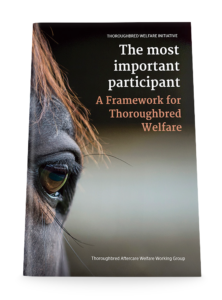
The 140-page “Framework for Thoroughbred Welfare” is comprehensive and highlights significant legal, structural, logistical and strategic weaknesses that the racing industry must address to maintain a social licence to operate and adequately protect their most important participants – the horses.

In March 2020, a wide cross-section of the horse racing industry came together to appoint an independent Thoroughbred Aftercare Welfare Working Group (TAWWG), charging them with making recommendations for how to improve the welfare of thoroughbred horses leaving the racing and breeding industries.

The TAWWG report’s findings and recommendations are built on the ideas received in more than 180 written submissions as well as consultations with more than 50 organisations and individuals from across Australia and around the world.

A few months earlier, the Australian Broadcasting Corporation (ABC) had aired a shocking documentary, showing that hundreds of registered racehorses are being discarded at slaughterhouses in Australia, contravening racing rules, rehoming policies and animal welfare guarantees.

The result is a report which has built on more than 180 written submissions and consultations with more than 50 organisations and individuals from across Australia and around the world.

As the report highlights, the welfare challenges facing the racing industry are “complex and evolving” and they cannot be solved by the racing industry alone. There are a number of impediments that will require a “strategic, national and collaborative approach”.

These impediments include:

  • the lack of legally enforceable minimum welfare standards that cover all horses at all ages, in all contexts and all jurisdictions.
  • the lack of minimum welfare standards across all areas of the thoroughbred industry and, indeed, the broader horse community.
  • the lack of specific, enforceable welfare standards for racing industry participants.
  • the need for quality assurance schemes to drive welfare improvements across the industry to achieve a level of care above that mandated.
  • the need for science-based standards for the care of all thoroughbreds at different stages in life, which should be based on the Five Domains Model for Welfare Assessment.
  • the lack of lifetime traceability through a national database. Without one, the authors say, “it is almost impossible to have an effective welfare regime” and the racing industry cannot “provide the community with robust data on the outcomes of horses that transition out of the industry”.
  • the lack of a national strategic plan for sustainability that considers the future size of the industry and numbers of thoroughbreds bred, which currently result in 8,500 horses needing re-homing every year.

The solution, they say, is the urgent establishment of a single body that is solely dedicated to the development, and implementation, of a national welfare strategy.

“It is clear that Racing Australia cannot not fulfil this role. Its constitution does not support this, nor does it have the remit from its shareholders and members, the state racing authorities, to carry out such a role” state the authors.

The independent body, which they suggest be called “Thoroughbred Welfare Authority” (TWA) would,

  • have a leadership role in shaping welfare policy, working with racing regulators and thoroughbred industry participants, state and federal governments
  • build a state-of-the-art national welfare regime and,
  • fund key functions that produce better outcomes for thoroughbreds across the country.

“To be successful, it would need to build on – and interact effectively with – existing PRA [principal racing authorities] welfare commitments. The role of the TWA is not to replace, duplicate or in any way undermine the welfare efforts going on at state and territory level, but to augment and support this work” say the authors.

Another important issue raised is transparency and public access to information. “The new organisation would also provide a national thoroughbred welfare information service to ensure the public debate about thoroughbred welfare is properly informed.”

The TAWWG report has created a comprehensive framework that is based on Responsibility, National Standards, Industry Standards, Traceability, Transition, Safety Net, and National Body, and lists 46 specific recommendations.

To read the full report, click here. 

Thoroughbred Aftercare Working Group Recommendations

  1.  The thoroughbred industry, which breeds horses for the purpose of racing, has a social and moral responsibility to take all reasonable steps to ensure thoroughbreds have a good life, including after racing or breeding, and a humane death.
  2. The thoroughbred industry should coordinate the development of Thoroughbred Welfare Australia (TWA), whose mission would be to focus on the whole-of-life welfare of thoroughbreds. The industry should convene key groups, including Racing Australia, PRAs, Thoroughbred Breeders Australia, RSPCA Australia and the Australian Veterinary Association, to nominate a steering committee responsible for establishing TWA, developing its constitution and appointing an independent skills-based board.
  3. The steering committee should be an expert rather than a representative group to ensure that the single objective of establishing TWA is to create an organisation wholly focused on thoroughbred welfare. Its constitution and leadership should support delivery of positive life-long welfare outcomes.
  4. The science-based, world’s best practice model of animal welfare, Five Domains, should be used as the foundation for all welfare considerations for thoroughbred horses, and all sectors of the thoroughbred racing and breeding industries should commit to its application.
  5. The Australian Animal Welfare Standards and Guidelines for horses should adopt the Five Domains model as the foundation for welfare assessment and be science-based, auditable and enforceable.
  6. Thoroughbred Welfare Australia (TWA), working with other stakeholders, should advocate to state, territory and Commonwealth agriculture ministers to expedite the development and regulation of Australian Animal Welfare Standards and Guidelines for all horses. This may require an alternative process, such as engaging an independent panel, to allow the standards and guidelines to be developed in parallel with current national animal welfare priorities.
  7. The thoroughbred racing and breeding industries should fully support and engage to expedite the review and implementation of the Australian Animal Welfare Standards and Guidelines – Land Transport of Livestock in relation to horses, to ensure the particular needs of thoroughbred horses are fully considered in this process.
  8. Each principal racing authority (PRA) should develop a memorandum of understanding with animal welfare enforcement agencies in its jurisdiction to ensure consistency of enforcement, access and resourcing of animal welfare standards for thoroughbreds during and after their racing or breeding careers.
  9. TWA should work with the breeding and racing industries, Racing Australia and the principal racing authorities (PRAs) to urgently develop and implement national thoroughbred welfare standards, based on the Five Domains model and covering the care and welfare needs of thoroughbreds across all stages of their lives.
  10. Racing Australia and the principal racing authorities (PRAs) should work with TWA to develop and implement an effective and transparent compliance and enforcement regime, with significant penalties for non-compliance, to ensure the national thoroughbred welfare standards are fully and appropriately enforced.
  11. Racing Australia, through the Australian Stud Book (ASB), should require all owners and breeders to meet the national thoroughbred welfare standards and be subject to its rigorous compliance regime.
  12. TWA should work with the breeding industry to develop and implement a welfare quality assurance (QA) scheme for breeders
  13. Any person with a criminal conviction for an animal cruelty offence should be presumed unsuitable to be a racing or breeding industry participant. Such individuals should be barred from becoming a licensed participant, a registered owner, or having their horses registered in the Australian Stud Book (ASB).
  14. A national horse register and traceability system should be established with utmost priority. The system must allow for all horses to be individually identified and traced to their current owner.
  15. The thoroughbred industry should actively lobby state and federal governments on the urgent need for a national horse traceability register.
  16. The federal, state and territory governments should commit to funding the establishment of a national horse register and traceability system.
  17. Racing Australia should encourage the national traceability of thoroughbreds for life by developing the capacity to update ownership and other details at any stage of career and life and providing incentives for owners to do so.
  18. Racing Australia should adopt and implement a policy of open and transparent publication and access to data relating to thoroughbred racing and breeding.
  19. Racing Australia should review its data collection system to ensure it:
    • delivers a comprehensive statistical profile of all horses in the thoroughbred racing and breeding industries from birth to retirement
    • captures all the data required by different industry sectors
    • promotes compliance with reporting requirements across the industry
    • informs all industry participants about the purpose and benefits of the data they provide
    • provides for the validation of data to ensure it is robust
    • underpins a transparent and accountable welfare regime
    • encourages and incentivises participation by industry.
  20. Racing Australia should use its data capabilities to:
    • inform policy development across the Australian thoroughbred racing and breeding industries
    • benchmark the welfare performance of the industry
    • inform the development of a community thoroughbred welfare information campaign.
  21. TWA in conjunction with Racing Australia should publish annually a report that provides industry information on the number of racehorses, broodmares, stallions and unraced thoroughbreds that have left the racing and breeding industry that year, and their destination.
  22. Racing Australia, together with TWA, should seek opportunities to work with the broader horse and equestrian sectors to share registration and traceability information, especially for thoroughbred horses that have left the racing and breeding industries.
  23. Racing Australia should expedite the introduction of existing and emerging technologies such as database linkage, real time geolocation and mobile phone apps. These should be used wherever possible to improve user experience and extend functionality of traceability systems.
  24. As a priority, Racing Australia should work with industry stakeholders to develop a well-researched, medium- to long-term sustainable national thoroughbred breeding and racing plan. This should aim to align the size of the foal crop with the current and future requirements of the racing industry, and of the export and non-racing thoroughbred markets, while providing appropriately for the aftercare needs of all horses the industry produces.
  25. Racing Australia should create a separate category in the Australian Stud Book (ASB) for thoroughbred horses that are not bred for racing purposes and would not be eligible to race.
  26. Principal racing authorities (PRAs) should consider adjusting their racing programs, particularly in country areas and at community picnic races, to provide more opportunities for older horses.
  27. Racing Australia should work with industry stakeholders to commission scientific studies to determine how the thoroughbred breeding industry can better understand and use genetics and the heritability of desired attributes such as speed, staying ability, soundness and racing longevity to improve the quality of thoroughbred horses.
  28. TWA should work with the industry to develop a national framework for the assessment, retraining and rehoming of thoroughbreds exiting the racing and breeding industries.
  29. TWA, working with Racing Australia, the principal racing authorities (PRAs) and the broader industry, should develop and implement a comprehensive coordinated national plan to significantly increase the number and diversity of opportunities for all thoroughbred horses leaving the breeding and racing industries.
  30. TWA should implement programs to improve the sharing of knowledge and experiences across Australia and internationally, with respect to retraining and rehoming of thoroughbreds. This should include the development of best practice guidelines for the retraining of retired thoroughbreds.
  31. All retired racehorses should have an appropriate period of rest and recuperation, followed by an appropriate health and welfare assessment, before entering a retraining and rehoming program.
  32. TWA should develop an advisory service to provide information on pathways to successfully transition horses out of the thoroughbred racing or breeding industry.
  33. TWA, working with relevant stakeholders, should develop and implement welfare quality assurance (QA) schemes for key thoroughbred industry participants, including trainers, foundation trainers and retrainers.
  34. TWA should develop and implement a national safety net that develops and oversees a thoroughbred welfare hotline to advise on welfare options for at-risk horses. It would include a service to assess at-risk thoroughbreds and provide advice on options including rehoming, retraining and on-site humane killing. The national safety net would report annually on all its activities.
  35. TWA, in consultation with the thoroughbred industry, the Australian Veterinary Association and RSPCA, should develop a national decision-making framework to provide guidance on end-of-life decisions for thoroughbreds, that protects the welfare of horses, is consistent with the ethical obligations of veterinarians and includes relevant activity and time-based thresholds.
  36. TWA, in consultation with the thoroughbred industry, the Australian Veterinary Association and RSPCA, should develop national protocols with respect to the humane killing of thoroughbred horses based on the following principles:
    • From an animal welfare perspective, the least stressful and most humane option is for a horse to be humanely killed in familiar surroundings by a registered veterinarian.
    • Where attendance by a veterinarian is not feasible, shooting with an appropriate calibre firearm, carried out according to best practice by a trained and competent operator, is also a humane option.
    • Where on-farm humane killing is not an option, appropriate transport to a nearby knackery where shooting is carried out according to best practice by a trained and competent operator can also be acceptable.
  37. The industry should develop and support measures to improve national access to on-farm humane killing where a decision has been made to end a horse’s life, including by providing access to veterinarians and other persons trained in the above protocols to conduct humane killing.
  38. TWA should develop an industry accreditation program to recognise trained and competent firearm operators that meets best practice standards for on-farm humane killing.
  39. The racing and breeding industries should engage with state and territory governments to expedite the development and implementation of the Australian Animal Welfare Standards and Guidelines – Livestock at Processing Establishments and ensure these standards include species-specific requirements for the handling, management and humane killing of horses.
  40. Racing Australia should implement national rules to prevent thoroughbred horses being sold or transported for the purpose of slaughter at an abattoir. These should remain in place unless and until mandatory national species-specific standards are developed and implemented that guarantee thoroughbred welfare during transport to and at abattoirs.
  41. State and territory regulators should act to increase the level of oversight and auditing of animal welfare at knackeries where horses are killed. This should include requirements for animal welfare training of auditors and knackery staff, increased audit frequency and direct auditing of the handling and killing of horses.
  42. TWA should develop a quality assurance framework for knackeries that handle live thoroughbreds to ensure these horses are managed in accordance with best practice welfare standards, particularly at their end of life.
  43. TWA, Racing Australia, the principal racing authorities (PRAs), and the breeding and racing industries should work with AgriFutures to develop and implement a nationally agreed thoroughbred horse welfare research program.
  44. TWA should work with Racing Australia, the principal racing authorities (PRAs) and the breeding and racing industries to facilitate and encourage all workers involved in handling thoroughbred horses to undertake appropriate skills training and education. This should include workers involved in early foal management, yearling preparation, foundation training and training for the racetrack.
  45. TWA should work with Skills Australia, the national body that sets the curriculum/course content for VET courses, to ensure that all national VET courses for students undertaking equine studies – such as Certificate III in equine studies, Certificate III in horse breeding, Certificate III in performance horse – include in their curriculum up-to-date modules or course content on horse welfare.
  46. TWA should establish a publicly available national thoroughbred welfare information portal that is regularly updated with key data to ensure the public is fully informed with accurate information on the welfare of thoroughbred horses in Australia.

The TAWWG report authors say they believe strongly that the findings and recommendations outlined in the report have the potential to improve welfare outcomes for all thoroughbreds but ensuring they become reality will require new commitments from the industry.

To download the report, click here.


Manuka Honey: The science behind the magic

Ever considered adding Manuka honey to your equine first aid box? Here’s the scientific background that supports Manuka honey use in horse wounds.

Honey – the liquid gold. It’s sweet, tasty, and healthy. Most of us love honey – be it as a delicious bread spread or natural sweetener. But there is more to honey than just its irresistible taste.

Honey has long been praised for its medicinal properties and ancient civilisations, such as the Greek and Romans, already knew about honey’s beneficial effects on human health. Although honey plays a key role in apitherapy, a branch of alternative medicine, it is slowly finding its way into mainstream medical practice due to its exceptional medicinal properties.

From a total of several hundred honey types existing today, one stands out: Manuka honey. But why exactly is this dark honey so special? It is the chemical composition that makes it a potent tool in treating wounds and supporting the wound healing process, for instance – and it can also be used as a safe alternative to (some) common antibiotics.

What exactly is honey and what chemical substances does it contain, that gives it its omnipotent properties?

Bees make honey collecting flowering plants’ (including trees’) nectar with their long tongue. They then keep and transport the collected nectar in their extra stomach – also referred to as crop – before storing it in their beehives. The crop contains specific enzymes that change the nectars’ chemical composition and pH-value. Upon arrival at the beehive, bees regurgitate the nectar and enzyme mixture, which is still rather liquid. Once placed in a honeycomb, other bees help evaporate excess water before sealing the comb, using a secretion that later turns into beeswax.

Honey’s chemical composition depends on numerous factors

Honey differs in colour, texture, taste, and flavour – depending on the flower types visited by the bees. The high sugar (between 65 and 73 %) and relatively low water content (approximately 20-30 %) is a characteristic that most types of honey share. But honey is not just made up of sugar and water. Its chemical components are vast and varied and a total of about 180 different compounds can be found.

Honey contains various minerals and trace minerals such as Calcium, Magnesium, Iron and Kalium, important amino acids, and several Vitamins such as C, B2.

Honey’s properties (chemical compositions) also depend on its origin (plant type), environment, and the way it’s being processed (e.g., sterilised).

Darker honeys contain higher concentrations of phenols (flavonoids), i.e., strong antioxidants which can positively impact cardiovascular health, for instance.

One honey type stands out: Manuka honey

Manuka honey originates from New Zealand and a small proportion can be found in south-eastern Australia as well. As the name reveals, bees collect nectar from the Manuka plant – a type of myrrh. The aetheric oils of the Manuka plant have been found to show very potent antibacterial and anti-inflammatory properties.

In addition, Manuka contains hydroperoxide in small concentrations and methylglyoxal (MGO) which both are very efficient substances when combatting bacterial, viral, and mycotic infections. MGO is also termed unique Manuka factor (UMF), and the antibacterial effectiveness of Manuka honey increases with its MGO content. However, MGO can only reach its full potential in combination with the other components found in Manuka honey.

Honey’s antibacterial action is influenced by different factors that can impact wound healing such as the pH level of the wound itself, hydroxy peroxide concentration (anti-bacterial), pH level of the honey itself, its phenolic compounds.

The relatively low pH level of Manuka honey (around 4; slightly acid) not only inhibits bacterial growth but also stimulates fibroblast activity (wound healing). Bee-defensin-1 (a type of protein), complex sugars, and honey’s other phenolic compounds further contribute to its antimicrobial properties. 

How does it work?

Antioxidant and antibacterial properties of honey help maintain moisture and the texture provides a natural protective layer and barrier to the environment, keeping harmful bacteria away and reducing chances of developing infections.

Honey reduces the wound healing time due to its ability to decrease the production of inflammatory cells at the wound site and helps with the proliferation of cells that aid in wound healing (e.g., fibroblasts).

What can it be used for?

Manuka honey is predominantly used in the treatment of topical wounds, infected or necrotic wounds, wounds that heal slowly or have developed proud flesh, stitched wounds/after operations, and it also works wonders against mud fever (although there are more cost-effective alternatives to treating mud fever or scratches).

Therefore, in some instances, the topical application of Manuka honey on wounds could become a sound alternative to (some) mainstream antibiotics.

In times where multi-resistant germs threaten to inhibit the proper functioning of antibiotics, Manuka honey, in combination with some antibiotics, can also become a powerful tool in treating wounds infected by multidrug resistant bacterium types (Alvarez 2014).

Remember, the higher the MGO or UMF content, the better Manuka honey will be in fighting off microbial infections and supporting wound healing.

See for yourself: Manuka honey and wound healing

The following photos contain graphic content (open wounds).

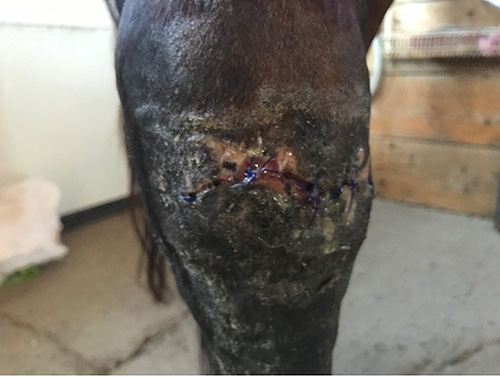
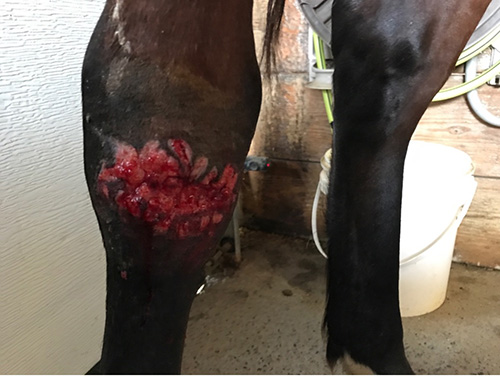
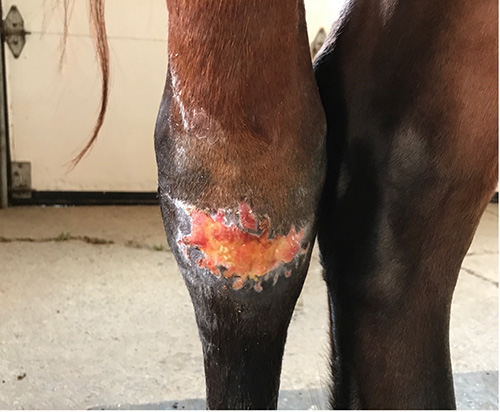
Short background: A horse caught his leg in a fence wire that led to a large wound in front if the hock joint (the joint capsule was still intact). Manuka honey has been applied from the beginning.

Photo 1 depicts the wound two weeks after the injury occurred – the tissue is still held together by the sutures.

Photo 2 shows the wound just minutes after the sutures were removed.

Photo 3 was taken only two days after photo 2 (note the progress in wound healing). The leg was dressed and bandaged continuously, and the wound dressing was replaced every other day (Manuka honey was applied on the wound every second day when the wound dressing was replaced).

No infection occurred, nor did proud flesh or necrotic tissue develop.

Manuka honey… It really is a kind of magic.

References:

  • Hossen MS, Ali MY, Jahurul MHA, Abdel-Daim MM, Gan SH, Khalil MI. Beneficial roles of honey polyphenols against some human degenerative diseases: A review. Pharmacol Rep. 2017 Dec;69(6):1194-1205. doi: 10.1016/j.pharep.2017.07.002. Epub 2017 Jul 4. PMID: 29128800.
  • Khalil MI, Sulaiman SA. The potential role of honey and its polyphenols in preventing heart diseases: a review. Afr J Tradit Complement Altern Med. 2010;7(4):315-21. doi: 10.4314/ajtcam.v7i4.56693. Epub 2010 Jul 3. PMID: 21731163; PMCID: PMC3005390.
  • Mavric, E.; Wittmann, S.; Barth, G.; Henle, T. Identification and quantification of methylglyoxal as the dominant antibacterial constituent of manuka (Leptospermum scoparium) honeys from New Zealand. Mol. Nutr. Food Res. 2008, 52, 483–489
  • Lu, J.; Turnbull, L.; Burke, C.M.; Liu, M.; Carter, D.A.; Schlothauer, R.C.; Whitchurch, C.B.; Harry, E.J. Manuka-type honeys can eradicate biofilms produced by Staphylococcus aureus strains with different biofilm-forming abilities. Peer J. 2014, 25, e326, doi:10.7717/peerj.326
  • Alvarez-Suarez, J.M.; Tulipani, S.; Romandini, S.; Bertoli, E.; Battino, M. Contribution of honey in nutrition and human health: A review. Mediterr. J. Nutr. Metab. 2010, 3, 15–23
  • Gethin, G.T.; Cowman, S.; Conroy, R.M. The impact of Manuka honey dressings on the surface pH of chronic wounds. Int. Wound J. 2008, 5, 185–194
  • Visavadia, B.G.; Honeysett, J.; Danford, M.H. Manuka honey dressing: An effective treatment for chronic wound infections. Br. J. Oral Maxillofac. Surg. 2008, 46, 55–56

No Research is Perfect, That’s the Point!

Part 1 of the Science Critique 101 series.

We live in an era of information saturation. In my own time, I have gone from Encyclopedia Britannica in the family library, specialty veterinary books on my friend’s shelf, university lectures and information nights, through to specialist CD ROMs and DVDs, then the internet and now podcasts and webinars. 

If someone criticises you for feeding your horse garlic, you can just ask Siri to find articles about ‘benefits of feeding horses garlic’. They can do the same with the search term ‘garlic poisonous for horses’. Siri is always there to tell people what they want to hear (). This is why evidence-based, scientific knowledge is more valuable than ever. 

It’s why we no longer ride horses on empty stomachs, why Pony Club Australia revised their 2019 Syllabus of Instruction around Equitation Science and probably why you have chosen to read Horses and People. 

Science is about continuous improvement – getting closer to confidence and certainty by continually testing, revisiting, reviewing and sometimes replacing or outright rejecting that of which we were confident yesterday.

That is, science is not perfect. Science is as critical of itself as are its consumers. Researchers as well as the general public should be critical of the scientific evidence with which they are provided, especially regarding how knowledge is produced.

Most people know some form of what I call science critique 101, covering the following big four: sample size, research bias, peer-review and funding. They want to know ‘how many people or things were in the study?’, ‘who did the research?’, ‘who vouched for it?’ and ‘who funded it?’ 

However, those critiques are sometimes based on unhelpful assumptions like ‘the bigger the better’, ‘they always push that barrow’, ‘peer-review is a mate’s club’ and ‘they were paid to find that answer’ – especially when people dislike or disagree with the research findings (see my article ‘Make Hay, Not Straw Men!’).

Whilst these critiques are legitimate, knee-jerk deferrals to these kinds of criticisms for the purpose of dismissing research findings are usually short-sighted projections that reveal more about the anxieties and personal politics of the critic than the implications of the research.

In future articles, I will provide more context for these critiques so that science consumers can be more nuanced when interpreting and engaging with scientific research. To borrow from metaphor, I want to make sure we aren’t throwing out the baby with the bathwater or missing opportunities to gain something beneficial even from flawed research. In the present article, I want to simply make the point that no piece of research is perfect.

Research is a decision-making process. When a researcher designs a study, they are faced with many decisions. Whether they are answering a research question or testing a hypothesis, researchers need to decide what approach they will use, what method they will use, who they will do the research with, who the researchers will be, if and what they will measure, what is included, what is excluded, when and where the research will be done, for how long and for how many repetitions.

The answers to all these questions should depend principally on what is going to be most useful to answer the research question or test the hypothesis. They may also depend on how well researched the area already is. For example, new areas of research tend to be more open-ended and exploratory whilst well developed areas of research can have more specific studies, often extending or testing the findings of previous research. 

The best way to answer any research question is not the same as the perfect way. Every decision in research design is a trade-off. 

I can survey hundreds or thousands of people quickly online, but it is very hard to consider their answers unless they are restricted to units of information that can be easily and quickly analyse. If I want that kind of large sample size, I defer to closed-ended questions (yes/no, how many?) or a Likert scale (always, sometimes, rarely, never, etc). 

The trade-off is that I miss all the highly nuanced responses that might more accurately reflect how people actually make decisions. 

You know when you do a closed-ended online survey and are faced with yes/no options or a Likert scale, but the first thing that comes to mind is ‘umm, it depends’? 

Well, that’s the kind of real-life (‘ecologically valid’) thought process of humans that a simple survey of thousands just can’t capture. I might end up finding out how many people think horse-racing is cruel, and I might have collected enough demographics to consider the age and gender of people who do and don’t think horse-racing is cruel, but I will know nothing about where they draw the line between what is and what is not cruel, under what circumstances and dependent on what? 

For example, if you asked me if I find rodeo riding more or less cruel than dressage, my answer would depend on many things. Rodeo horses are ridden for a few minutes every so often. Dressage horses might be ridden for an hour a day. In the same way that we know that the ‘goodness’ or ‘badness’ of your average dressage bit and bridle depends on the rider, are there also kind and unkind rodeo riders? Is the dressage horse kept in a stable or housed with company where he or she has room to move? 

It all depends. Faced with only two possible responses in the survey, I might end up ticking the box ‘more cruel’. Still, I would have an immediate snapshot of public perception and findings that could be easily communicated.

I could do a stated preferencing study where I can add these other variables about time spent being ridden and living conditions, but that would be a fairly artificial creation of a fixed number of options. Still, I could weight the variables and determine statistically what people attributed more or less value to and how that impacted their relative ranking of welfare outcomes.

A 30-60 minute face-to-face interview, however, might capture convey all of that ‘it depends’ complexity and more. But it would be very hard for the researcher to analyse more than 40 or 50 of those interviews in a way that preserves that complexity and makes it easy to present in a scientific paper. 

And 20 or 30 interviews might be the ‘sweet spot’ before the person analysing the interviews stops looking for (i.e., just can’t handle) new insights. And how would I handle the diversity of responses and multiple combinations, even if some of them only occurred once during an interview. And how much does what someone say during an interview reflect how they thought before or after?

Then, what if the nineteenth person you interview brings up something incredibly relevant to the research question, but you never anticipated it, so you never asked participants 1 through 18? How will you handle that information, if at all? You might never have found that out if you did a close-ended online survey, but if you had done an online survey, you would have had more people to be able to identify trends that might be common in the general population. 

This is the breadth versus depth trade-off that is often lent on to distinguish  between quantitative and qualitative research. All of the aforementioned approaches have advantages and limitations. It just means that the decision to use a survey-based design or a face-to-face interview design needs to be made in direct relation to the aims of the research. (It makes little sense, for example, to answer a research question about ‘how many people think rodeo is cruel’ with a research design of 20 face-to-face interviews). 

But how often does our imperfect world provide the conditions for the best research design to occur?

In deciding on the best way to answer their research question, researchers face many practical restraints, mostly related to the resources available. This includes the people available to do the research, the necessary equipment, ethical considerations and the time available to get the work done (at the right time of year, in the right time frame and at the right pace). Time may possibly be the easiest thing to plan but it is the hardest thing to manage. 

In-depth, face-to-face interviewing takes time to conduct and analyse. Someone might answer ‘question six’ in their response to ‘question two’, or not at all. It takes time to organise the findings of that interview against the others. How well could this have been predicted and put into a timeline?

An online survey of 100 people might be free to host and take three hours to analyse the data which is delivered in a spreadsheet. Each interview with 20 people might take one hour to conduct, three hours to transcribe and three hours to analyse. That means 180 hours of work, at least. 

Such practical limitations of time and money are rarely spoken about in the published methods sections of academic articles. I believe this is largely a reflection of the legacy of the monastic history of universities. 

There was a magical time that academics dream of fondly, when they could produce knowledge for knowledge’s sake, in the time necessary to do it well, without justification of importance and with full support of their institution and the community. 

During that period, there was no need to make it acceptable for a researcher to say something like ‘we studied six horses because the two others we had hoped to include were taken back by their owners’, or ‘we only analysed the effects of the medication for six months because our research assistant took a position elsewhere and we couldn’t find anyone else who wanted to work with us for prestige instead of pay’.

With the corporatisation of university research, academics have to either justify their research in relation to the official list of national research priorities, fund their day-to-day existence by doing research demanded by industry or partner with like-minded organisations. 

Few, if any universities or industries, will cover the costs of research that cannot be translated into intellectual property that can be sold. That is, there will be more support for academics to research the treatment of laminitis, than research the reasons why horse owners and carers struggle to objectively score their horse’s body condition. And that’s just the system in which most researchers currently find themselves. 

This is why other kinds of research are largely a labour of love, done by researchers at night, on weekends, during their holidays without any assistance or put up as a project for Honours, Masters or PhD students to work on. 

Indeed, that is how most of my research on human-horse relations was completed, whilst my salary was directed towards more important/topical/fundable/profitable issues like domestic food waste, train driver fatigue or passenger crowding. They may not have been done perfectly – being subject to the same or even more practical limitations as my ‘bread and butter’ projects – but they were done. 

This is not to say that some research should be subject to less scrutiny that other forms of research. Rather, the question becomes, how can we use popular forms of science critique to contextualise research findings and ensure that they are neither over nor under interpreted, nor over or under stated?

Over ten years of being a university researcher, teacher, supervisor, project manager, article reviewer and writer, I was continually reminded that no piece of research is perfect. But that’s the point. That’s exactly why research is necessary and that is exactly why we should question the findings of research. 

However, whilst critique is necessary for progress and improvement, it is important to know that even basic concerns over the big 4 (sample size, research bias, peer-review and funding) are not free of moral values, politics, agendas and biases. But these can be used in much more useful ways than disregarding a study.

Over the coming issues of Horses and People, I will explore science critique 101. There are three reasons for this: 

  • First, to make sure that research findings are not being dismissed unfairly. 
  • Second, to make sure that critiques of science are themselves subject to critique and, 
  • Third, to make sure that we don’t deny ourselves the opportunity to be better horse people, and we do better by and for our horses, because we rejected something for being imperfect.

This article was first published in the May-June Horses and People Magazine. 

Balking at Bucking

Research into the welfare of rodeo animals

When thinking of the American west, images of cowboys riding the open range moving large herds of cattle come to mind. With the cowboy was born the rodeo, where stockmen could practice and show off skills necessary for ranching life. Soon crowds were entertained watching a rider pit his expertise against a bucking horse in an effort to stay on for the 8-second ride. But with the thrill and excitement of rodeo events also comes concern over the welfare of the animals.

In spite of the rough and ready performances provided by rodeo events, multiple studies have shown an injury rate of less than one animal in 2000. This is far below the average in race horses of one injury and almost two fatalities per 1000, or eventing horses with a wastage rate of 28-45%.

Still, animal rights groups have campaigned ban rodeos to prevent the suffering of cattle and horses used for entertainment purposes.

Under this pressure, the Professional Rodeo Cowboys Association (PRCA) has responded by working together with the American Humane Association to implement stringent regulations including mandatory veterinary inspections, padded flank straps to encourage bucking, and only allowing dulled, free-spinning roweled spurs.

While the rodeo remains under close scrutiny, a group of researchers in western Canada were prompted to evaluate the behavioural stress responses of bucking horses.

They hypothesized that horses who were more experienced would be less reactive before their performance, and that reactive behaviours would be related to the environment or the anticipation of performance rather than from stress.

Bucking horses are not wild terrified animals put on display. Today’s bucking horses are carefully bred specifically for their bucking capacity, and a good bucking horse can be worth over $10,000.

Most bucking horses grow up in a natural environment until about four or five years of age when they are introduced to bucking work.

Those who are not predisposed to bucking are directed to ranch work.

Consignors provide strings of bucking horses for rodeo events, and while the horses do travel extensively from rodeo to rodeo, they might spend less than two minutes per year actually performing in the arena.

During a performance, a horse is scored by two judges on how well it bucks, and this is added to the score for the rider’s style.

Thus, it is important to have a healthy and sound horse to earn a good score.

Over three consecutive years, the researchers observed 116 horses entered in either the saddle bronc or bareback bronc competitions at a large sanctioned rodeo. Information on individual horse performance scores and how many times each horse was used was collected.

Behaviours of the horses were noted using video footage as they were herded from holding pens to loading chutes to bucking chutes prior to their performance. Movements of handlers were also examined in relation to the horses’ activities.

On average, horses spent at least an hour in the holding pen prior to a performance.

It took almost one minute to herd a selected horse to the loading chute, and the horse would spend almost 30min here before entering the bucking chute. Another 30min would be spent in the bucking chute where the horse would be tacked (for the saddle bronc competition) and the flank strap loosely applied.

At the last minute, the rider mounted and the flank strap was tightened as the horse was released into the arena for its performance. After eight seconds elapsed, or the rider was bucked off – whichever came first – the flank strap was released by outriders and the horse was herded out of the arena.

From the video footage the researchers found that over 71% of the horses balked at being herded into the loading chute, often balking more than once. Horses also balked while in the loading chute, most often when they had to make a 90 degree corner and where the chute narrowed.

Balking generally occurred when a handler was in front of the horse. Other than balking,  few stress-induced behaviours were noted here.

While in the bucking chute, horses mostly displayed lip licking (>82%), moving to and fro (>69%), head tossing (>52%) and kicking (>51%). Kicking occurred most often while the horse was being tacked.

Horses who had performed at least three times previously were less likely to display stress-induced behaviours.

Behaviours were not correlated to the horse’s performance scores.

The researchers concluded that horses become habituated to their job since those with more experience displayed fewer stress-induced behaviours. This has been shown in horses working in other disciplines as well as in bucking bulls.

While the researchers were aware of the dangers of learned helplessness, they did not believe this was the case in the bucking horses since the horses were not apathetic to their environment.

The researchers did suggest simple adjustments to handling and facility design that would easily improve the horses’ experience. Removing the 90 degree corner would greatly reduce balking, as would keeping handlers out of the horse’s path. The number of handlers around any one horse ranged from 1-7, and having fewer handlers would also improve the ease of herding the horse through the chutes.

The act of tacking the horse appeared to be when the horse displayed the most stress-induced behaviours. The researchers suggested this could interpreted by the horse as a signal of imminent performance.

This study provides a baseline of horse behaviour prior to bucking events, however it did not measure outcomes from the performance itself.

While rodeo events may still be viewed by some as inappropriate use of animals, research results such as these can help rodeo organizations like the PRCA to improve the animals’ experience.

This article was sourced from The International Society for Equitation Science

Click here to read the original research article by Goldhawk C, Grandin T, Pajor E. 2021. Effect of animal’s experience and rodeo procedures on behaviour of bucking horses at a large commercial rodeo in Canada. Applied Animal Behaviour Science 234:105199.

Bernard Rollin ‘father of veterinary ethics’ died on 19th November

0

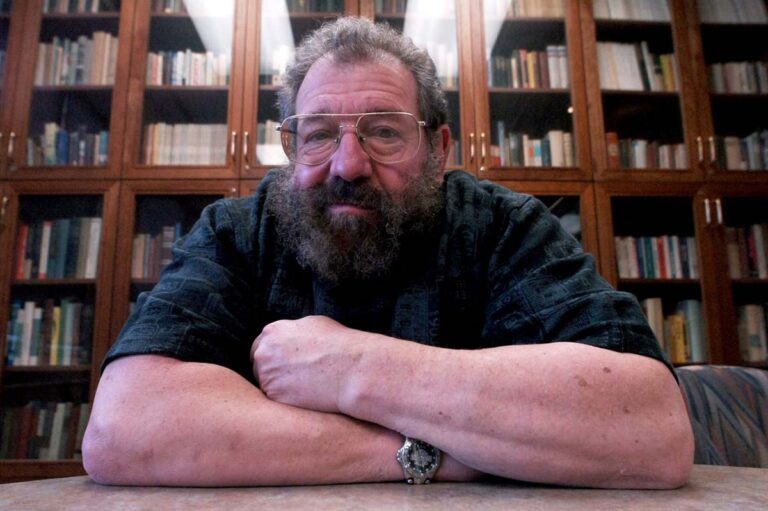
Bernie Rollin, one of the leading scholars in animal rights and animal consciousness, a longtime Colorado State University professor and “father of veterinary medical ethics,” died Friday, November 19. He was 78 years old.

Rollin leaves behind his wife of 57 years, Linda; their son, Dr. Michael Rollin; two grandchildren; and a legacy at CSU stretching back more than half a century.

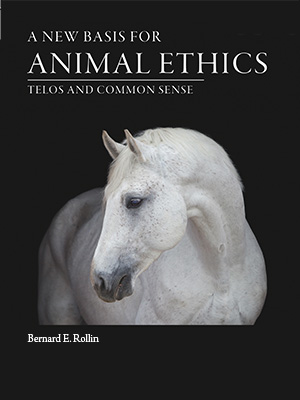
Cover of the Book 'A New Era for Animal Ethics, Telos and Common Sense

His scholarly interests included both traditional philosophy and applied philosophy. In addition to numerous articles in the history of philosophy, philosophy of language, ethics and bioethics, he was the author of Natural and Conventional Meaning (1976), Animal Rights and Human Morality (1981, 1993 & 2006), The Unheeded Cry: Animal Consciousness, Animal Pain and Scientific Change (1988 &1998), Farm Animal Welfare (1995), The Frankenstein Syndrome (1995), Science and Ethics (2006), and Putting the Horse Before Descartes (2011).

He was also a great storyteller, a weight-lifter, horseman, and Harley-Davidson enthusiast.

I never met Rollin but I was pointed in the direction of his work when a colleague introduced me to the concept of telos which Rollin coined to refer to an animal’s essential nature – what he called the ‘dogness’ of the dog and the ‘pigness’ of the pig – those things that make an animal what it is, and which, when applied in the context of animal husbandry, we must allow them to do because they have evolved to do them.

In that sense, Rollin argued that keeping animals well fed, healthy and safe was not enough. That if we are going to use animals, then we should respect their nature and allow them to fulfil it. That when we talk about welfare and giving animals a good life, we must take their nature into consideration.

Applying this concept within the Five Domains Model for Welfare Assessment helped me when I designed the Horse Welfare Assessment Guide, because it makes clear the difference between care and welfare. You can download the guide here – in English. And you can download it in Spanish here.

I think the three Fs – friends, forage and freedom – are some of those things that reveal the telos or nature of horses, and that we must facilitate if we really want to give them a life worth living.

In the video below from 2014, Prof. Rollin discusses philosophical theories and how they apply to arguments about the moral status of animals. He shares stories about applying these theories to the realities of an animal care system at Colorado State University.

Another great lecture by Prof. Rollin can be viewed here.

In a tribute published in Psychology Today, his colleagues Dr Andrew Fenton and Dr Marc Bekoff tell of their relationship with Prof. Rollin and the impact he had:

“Bernie was someone with deep compassion for animals and even those who use animals in agriculture or scientific research; he also had strong views that were forcefully stated but often reasonable. Even when disagreeing with him, Bernie had a way of lifting one up. Conversations with Bernie were a mix of good humor, repartee on philosophy or ethics, and our experiences chatting with folks who use animals. I treasure those conversations with Bernie.

“When thinking about Bernie’s approach to animal research ethics, three pivotal considerations come to mind. First, Bernie was a fierce defender of the view that most of the animals commonly used in scientific activities (e.g., mice, rats) are sentient. Second, Bernie was unwavering in his view that all sentient animals were due compassionate treatment that respected their “natures” (what he called their teloi). Third, Bernie challenged the regrettably common view that humans enjoy a privileged or exalted moral status (or moral importance that constrains the choices we make) that permitted treating animals in a way we would not treat human members of our communities.

“Those even with a passing familiarity of Bernie’s work will know that he bemoaned the impact of the view that science is value-free (a sort of “ethics-free zone”) as well as a narrow understanding of scientific confirmation through experience. For Bernie, because science was thought to be an ethics-free zone, it came with the unfortunate consequence whereby ethical considerations brought inappropriate constraints on scientific pursuits. It also meant that scientists tended to shallowly engage various publics when defending animal use: benefits arising from animal use were taken to be sufficient justification; those who opposed it were misanthropes or labeled anti-science. A narrow understanding of what could be scientifically confirmed allowed scientists to dismiss ethics as nothing other than the expressions of emotion or feelings, and also dismiss talk of mental states in other animals (like fear, joy, love, pain, and suffering) as anthropomorphic.

Read the rest of their tribute here. 

Read this article by Prof. Bernard Rollin on the ethics of pet euthanasia

When Decisions Matter

0

How to make decisions when they matter

We are often faced with having to make decisions that affect our lives. Some of the decisions we make are of little consequence and therefore, if we get them wrong, it doesn’t matter. 

But what about the ones that do matter?

The bigger the decisions the harder it can be to make them.

We generally base our decision making on external factors:

  • What do other people think?
  • Does the decision come with security and safety?
  • What are the long term effects?
  • Is it sensible?

All these things and probably more go through our head, and it is the head that often runs the decision-making process. 

And here lies the problem.

The head is our rational part, the part of us that contains our memories, our past experiences, our conditioning, and our fears and doubts.

The decisions made in our head are more focused on others rather than ourselves.

We all know what it is like to make decisions for the wrong reasons and how bitter regret can be.

To avoid making wrong decisions you need to connect to your heart, your gut, or your intuition, whatever you want to call it. Connecting to yourself will help you determine your own truth.

To make big and potential lifechanging decisions you need to make sure that whatever decide you make, it is the right one – for you.

How do we connect to our heart?

We must become quiet and we must pay attention.

The first step is to separate your head from your heart. To do that, you must become conscious of your thoughts, identify the reasoning behind your thoughts. Are there doubts or fears that drive these thoughts and therefore effect your decision making? Or is there guilt?

It is easy to talk yourself into your head, find reasons and excuses why you should be making a decision that feels wrong.

We often consult others and if they also agree with our head, it makes it even stronger. But what happens in those quiet moments when you can’t escape? This is when your heart becomes louder again. When it tells you “I shouldn’t be doing this.”

You need to listen!

So before making big decisions, ask yourself what it will be like, feel like and look like when you have made the decision. 

Will it be right? Will you feel happy? Will there be a feeling of ease and calm that comes when you have chosen wisely? 

If you are not sure, then think again. This time think with your heart not with your head. Put your head aside, just for a moment and ask yourself: “If I had nothing to lose, if there would be no consequences to anyone else, would I choose the same?” 

If your answer is YES, then you know your decision comes from your heart. 

If the answer is NO, you know that you have made the decision with your head because there are roadblocks and you cannot see your way ahead.

When you focus on problems, the head can easily talk you around. We give up on our dreams, we take the short cut, we start pleasing others and we are guided by our fears.

This is no way to live a life. This is living a life of hiding from yourself, kidding yourself in the hope that one day you might succeed in convincing yourself. This day however, will never come.  Instead, the regrets will mount until such time that you are paying attention again.

So, save yourself the heartache and pay attention. Remember that it’s often easy to make the wrong decisions and harder to make the right ones. 

However, decisions that are right for you are always easier to live with.

This article appeared in the September-October Horses and People Magazine.

Tomorrow’s Horse World

0

What is your vision of tomorrow’s horse world?

When I was growing up, the TV program ‘Tomorrow’s World’ was a huge family deal. Presented by the national icon and MENSA member, Carol Vorderman, it was a glimpse into how our world might look in 30, 40, or even 100 years’ time. 

A weekly special event, my family and I would gather with our dinners on laps (ham salad followed by jelly and tinned fruit with evaporated milk poured on top – always!) We would sit, excited, in front of the TV, ready to be wowed by…. 

‘THE FUTURE!’ 

The science, the inventions, the tech, the drama… “The lights came on when she clapped, Dad!” my brother would squeal. “Oooh…” the studio audience would exhale. “Well, you just can’t fathom it,” my Dad might add in his broad Yorkshire accent, shaking his head in disbelief. 

Thirty years on and so much of what they predicted has come true! Although instead of clapping to turn on the lights I shout at Alexa (when will she learn that I meant the big light, not the hall light?)… 

I am writing this in the aftermath of the Tokyo Olympics. What did you think of Tokyo? 

I am a rider, horse sport lover, equitation scientist and eternal optimist. I watched with you all, heart in mouth, through the highs and lows of the Olympics. I celebrated with joy seeing barefoot show jumping horses win medals, felt compassion when other horses were withdrawn early to “save them for another day” and felt jolted to my core watching the equestrian section of the Modern Pentathlon. 

I followed the explosion of media coverage and joined some of the hard conversations about the future of our sport. And even though we have been shocked, saddened and, at times, deeply angry, can I say, I’m actually excited? 

These hard conversations are our collective ‘doing the work’, it is the honest discourse that tips the scales, that gives us an opportunity to think about what we want our sport – and our love of horses – to look like in the next decades.  

Tonight, I want to go ‘back to the future’ and sit, open mouthed, jelly wobbling on spoon, and watch what I hope tomorrow will bring for equestrianism. 

I want us – you and I – to smile and shake our heads in happy disbelief at what is coming. Because change is real, it’s happening, so in visualising what the future could look like, I hope to inspire others to help shape the changes to ensure future generations can also enjoy a life full of horses.   

Can I tell you what I see? 

The theme tune of the Horse of the Year Show starts playing (it never gets old). The black screen fades into drone footage of an equestrian property and slowly locks on to a 30-something year old woman riding a grey horse. The pair stops and Pippa smiles at the camera and scratches the horse affectionately. 

“My name’s Pippa, and I’ve been riding and competing for around 20 years now. This is Tidy (I don’t know why we called her that because it doesn’t suit her at all!)” she laughs as she combs the hay out of the horse’s mane with her fingers. I can already tell that horse riding has had quite an overhaul over the past 20 years. 

“It’s pretty awesome really” says Pippa. “I think at one stage it was very touch and go whether we would see horses at the Olympics, especially with public opinion. You know how it is… when it turns, it really turns. 

“We were worried that horse sports might be banned altogether and then, you know, where does it stop? We’re banned from riding altogether? But we were lucky, we realised we had to face the truth and luckily, the regulators stepped in. Of course it took time, change had to work its way throughout the whole equestrian community. But I think it’s positive now, for riders and horses – a bit like the lights have been turned on for everyone” says Pippa.

The screen fades to video of Pippa riding Tidy in an arena and her voice over continues: “So, yes, this is Tidy, she’s a ten-year-old Connemara x warmblood mare. I got her as a 2-year-old, after she had been weaned naturally. She was hand-picked even before she was born. I wanted a great all-round horse and with the advances in breeding, there’s been a huge increase in interest in the native breeds and crosses. There was a ton of work done on genetic testing for temperament, so the experts have been able to pin-point what makes a horse a suitable ‘all-rounder’” continues Pippa.  

“That, and the clamp down on backyard breeding has really improved the quality of the general horse population – good, sound horses seem easier to find. Breeders are committed to producing confident youngsters so they invest in their early training and handling. And of course, there are tests for matching horses and riders – those are pretty cool!” says Pippa.  

“All this means that we hardly see horses being discarded for behavioural issues. That was another issue that the regulators were really concerned about – the huge number of horses wasted just because they were confused enough to be difficult or dangerous.”

The interviewer then asks questions about changes to the ways horses are kept and managed, to which Pippa replies: “The biggest change I’ve noticed has been turnout and stabling – I guess it was already happening in some places, but the government regulations made a big difference”. At that point, the camera pans to a group of horses, grazing in a paddock and the interviewer notes that the few stables are empty. 

“Yes!” Pippa replies. “The regs set a minimum daily turnout and social time. There was so much science backing up the decision that they were super easy for them to pass, apparently. Even the competition yards found clever ways to adapt. Gosh, most of the horses I know hardly go in stables at all now, at least not here where we don’t get the huge highs and lows in temperature. 

“I remember you used to see horses coping by weaving or cribbing, but I can’t remember the last time we had anything like that here – horses are just less stressed – they live most of their life outside with their friends so they cope with life much better.” 

The interviewer then asks how they manage in the cold weather, to which Pippa responds laughing: “Do you know, they’re made to be out here, they’ve got different temperature sensors to us sensitive souls! We used to wrap horses up with massive rugs when it dropped below 10 degrees and they were literally cooking. Then they brought in smart textile rugs and it’s crystal clear; there are a couple of older horses who feel the cold but the others are much better without rugs unless they’re clipped.” 

She continues explaining that the rugs contain sensors that measure the skin temperature and a panel that lights up; green when the horse is within a healthy thermoneutral zone and red when the horse is getting too hot. 

“My friend, it’s funny, she’s got her horse’s rug linked to her phone and we both get notifications to ‘get his rug off!” says Pippa. Then the interviewer remarks on the irony, that it has taken advances in science for us to let horses live more natural lives, and asks if the same has happened with riding, at which point Pippa’s eyes light up: “Wow, yes, where do I start, lots of changes!” 

“Take here as an example, they have five school horses but complete beginners can’t ride them. They learn some basics from the ground but have lessons on the simulator before they’re allowed to get on a real horse! 

“It sounds expensive but after the simulator lessons they’re balanced and they know when to let go. They’re not hanging on to the horse’s mouth when they ask for trot. I love the line my instructor uses: ‘If we don’t do this, the horses pay for the tuition.’ It’s true, I can’t even think about what I put horses through when I was learning.

The interviewer seems puzzled, he has an image of those rodeo simulators they hire for parties… “Ha, yes, that’s the advanced setting!” laughs Pippa. “No, seriously, the riding simulators have gotten so good you can close your eyes and feel like you are riding a real horse. So much so that the good riders use them too.” 

“Today’s simulators can tell you if you’re sitting evenly, they give you data on how you use your hands, your legs, your weight… They are super useful. They are covered with pressure pads and sensors so you can see exactly what you’re doing” says Pippa. 

The topic moves on to what’s new in competitions. The screen flashes images of horses performing in different disciplines as Pippa goes on: “Well, the huge difference is that we finally understood exactly how to train horses and make them feel good about it at the same time – and we have the data to prove it. We use that to assess the riders’ skill in competitions” she continues.  

“It’s a long story but a couple of decades ago, when horse sports were on the brink of losing their social licence to operate, it wasn’t so much about the quality of the training. People were beginning to understand how to use learning theory, but they weren’t really prioritising the horse’s emotions, and they were asking horses to do things they clearly should not be doing.  

“There was no way to measure the impact on the horse’s mental state, so people were going overboard, even cheating, all the while telling the world their horses were happy athletes. Maybe they even believed their own stories, who knows” says Pippa, now in a much more sombre tone of voice. 

“Horse welfare really was going backwards… There was a time when riders were even cheating and short-cutting training by coercing their horses with horrible equipment, harsh bits, spurs, gadgets and drugs, all to mask the fact their horses weren’t happy at all. 

“But you can see why it was happening” she continues. “Back then, there was no way to objectively measure what the horse was going through – mentally. But now we can, and when the data says your horse is really doing well – both mentally and physically, everyone can feel good and proud to be an equestrian.   

“It’s really impacted all sports here. Judges understand how horses learn and at all levels they have tests to assess how both, horse and rider feel during and after the competition. The positive measures count towards a win – it’s amazing!

“Of course you lose points when any sign of tension or coercion is detected, like a forced outline or elevated stress hormones. The reins are made with inbuilt tension gauges and the rider’s boots have inbuilt pressure sensors, so if riders use too much pressure or don’t release the pressure in time when the horse responds correctly, you lose marks. Only riders who can demonstrate their horse is trained for self-carriage can win.” 

The screen moves to images that zoom into horses and riders performing in an Olympic dressage event, most horses are ridden in snaffle bridles without nosebands, some are bitless and some, going for maximum points, are competing without bridles at all.  

“The great thing about measuring emotional state is that you can’t fake a good score anymore” says Pippa. “You can’t fabricate it on the day, you have to build it at home, over time. That’s why nobody has bothered trying to cheat or abuse a horse for a long time!”

The interviewer then asks why it took so long to get to this stage and Pippa replies: 

“Well, I think there are so many layers to change. Many horse people really struggled with the change of mindset because they were reluctant to accept they had blind spots, so they didn’t listen when someone from the outside pointed them out. That’s quite scary. We wanted to believe that our horses enjoyed competing just as much as we did, that we were both working towards the same goal. Accepting that horses’ brains simply don’t think like that was too much. No-one really wanted to acknowledge that we weren’t doing the right thing. 

“But after the disasters at the 2024 Olympics, the public demanded that we change or lose horse sports. It made many of us take a deep dive into really finding out how our horses feel and learn. 

“And it was hard, you know, to realise that we hadn’t always been doing the best that we could. Pretty heartbreaking. But how can we demonstrate welfare if we don’t ask the horse how they feel?” says Pippa. 

“We had been riding around with our fingers in our ears, humming a tune so we didn’t hear the horses’ complaints – and they were definitely making them. It took almost losing equestrian sports to force us to start again, look at how we were training, get over our own egos, arguments, fashions and fads and stop doing things just because that’s the way we’ve always done it. 

“And it was all worth it. Now, I really think Tidy is living her best life and I know that it’s better because I’m with her. That this is a good place to be, a good life to live. And I am also all the better for having her in my life.

Horses are amazing and it just wouldn’t be a good life without them” concludes Pippa as the show’s theme tune plays, the screen fades to the credits and I switch the TV off.

That’s what I want to see

That is some of what I want to see, a little glimpse of my vision of the future. I’d love to go on writing, describing a whole world of hopeful changes, dreaming about what could be and how good we could feel to call ourselves equestrians. 

Change happens, so let’s bend it towards the ideal. And do you know? It is possible to influence change. If we all keep learning about our horses, we have the hard conversations and identify where change is needed – I am sure we can all make it real. We can start writing a better equestrian future.  

What would your ‘Tomorrow’s World’ look like?

How to get more out of your next horse transport purchase

We all want to save money on horse and transportation – equestrian, racing, and other horse related activities can add up to a lot! With the current international shipping delays, some horse goosenecks, trucks, and trailers may be delayed – and be quite expensive compared to a couple of years ago.

So, what should you do? Here are some tips to get more out of your next horse transport purchase.

Should you buy new or used?

Buying used can be cheaper – but cheaper doesn’t always necessarily mean a good investment. If you are buying used, you need to do your homework. You’ll need to check if there is any money owing on the float or truck using the Personal Property Securities Register. When inspecting the float – and any seller that is dicey about it should be ignored – you need to check for rust, especially on the floor and underbody. There should also be a separate door on the side for access without opening the tailgate.

You also need to consider your horse’s freedom of movement, weight, and your own vehicle’s towing capacity, too.

Consider Delays – On All Fronts

With the global semiconductor shortage causing massive delays on all products needing chips, you may have to wait for your horse float, gooseneck, or truck to become available. New vehicles have wait lists of eight months or more – and this can affect second-hand models coming on to the market too. Bottom line is it all adds up to higher prices. You could wait – but waiting could make things worse. Even so, there’s something you can do about it.

Saving On the Back End – Good Finance Deals

You can save on the back end in the current climate by getting a cheaper personal loan. “Finding a competitive personal loan through a trusted broker, preferably one who has some understanding of horse transport, can save you in interest which is a long-term saving,” says Savvy Managing Director Bill Tsouvalas. “With interest rates as low as they can go right now, locking in a good rate can reduce repayments and interest overall. So, you might be balking at prices, rest assured you’ve got a better handle on the overall cost.”

Finance Pre-Approval

You can improve your leverage over dealers and sellers by getting finance pre-approved. Tsouvalas says this works the same way as a loan, except you haven’t found a float or truck yet. But what you do get is a powerful bargaining chip – your price ceiling. “This is the conditionally approved amount,” Tsouvalas says. “Sellers know you’re ready to buy and so do dealers. They also have to match your price ceiling, or you walk away. It’s a great point of leverage, so use it to your advantage.”

Remember to consult a financial professional before making any decision about loans and big purchases.

Growing Trust

On the front cover of this, the last Horses and People magazine issue, a photo by Louise Sedgman of 9-year-old Zoe Tomlin with Blackie, the Waler-Quarter Horse schoolmaster who belongs to her mother, Trish Weickhardt, but is quickly becoming Zoe’s most trusted friend. 

Trish, who takes lessons most weeks with dressage rider and coach Rachelle Wilson, started letting Zoe ride Blackie at the end of her lessons, and this has grown gradually so that now Zoe takes the whole lesson. The pair have clicked, and things are progressing so well that they may soon graduate to going out on trail rides. 

“I love that I can trust her, and she listens to me a lot” says Zoe. She has ridden other horses in the past whom she describes as “a little bit cheeky” but Blackie is building her confidence. 

The mare is 21 this year and has been in the family since she was six years old. Previously, she belonged to Trish’s uncle Mick Smith, the only other horseman in the family who has a passion for Cutting and racehorses and has helped guide Trish throughout. 

Trish whose own parents were not horse people must have inherited the horse gene from a common ancestor, because at just 10 years of age, she was picking up manure for a local horsewoman, Gayle Joyce, in exchange for riding lessons on her Welsh ponies. 

“Later, when I was 15 and [the pony riding] stopped, I answered an ad for trackwork riders. I used to ride three horses early in the morning before school, but then stopped riding again when I went to university” says Trish. 

It was only much later when together with her husband she purchased 15 acres overlooking the Bunyip State Forest that Trish was able to get back into riding and with her uncle’s help, she bought her first horse, a grey and steady Percheron cross mare who had been pulling carriages in the city.

“Now I have quite a few horses” says Trish. “As well as Blackie and the Percheron, there’s a rescue called Ruby Tuesday who is in work, a pony, a horse off the track… Most of them are paddock ornaments just enjoying their life here.” 

Trish is a paramedic and at the time we spoke, was on the last day of leave. “We work four months on and take one month off. Although out here in Gippsland the COVID situation is not as intense as in the city, it’s starting to explode a bit, so I will be wearing a lot of plastic for the next few months” she says. 

Zoe has three siblings and somehow, Trish finds time to fit in riding. “I do two day-shifts, two night-shifts, and take four days off. But with COVID, my time has been very limited, because of work but also home schooling” she says. 

On the other hand, it is home schooling which prompted her to get Zoe riding more regularly – as a substitute for PE (physical education). Before getting on Blackie, Zoe had been attending monthly rallies at the Neerim District Pony Club with Ella, a Shetland pony they leased from Daina Custance. “She would be led around for a few minutes and then wanted to hop off. Now she wants to ride Blackie all day, but not on the lead, she just trusts her” says Trish. 

“I have a few friends [at Pony Club] who are my own age. I love seeing everyone riding their horses and having fun with them, and also riding my own horse” says Zoe who hopes that by next year she will be doing much more cantering on Blackie and maybe take part in some shows or gymkhanas. 

“I like riding because it feels nice and relaxing, and it makes you feel like you’ve achieved a lot of things. Every day – if you are riding – you get better and better. Say you started walking and then you start trotting, and then you move up to cantering. It’s great” she says proudly. 

But despite all the riding, she’s really looking forward to returning to school, maybe in as little as a few days, as restrictions are eased across the state. 

Victorians have been through so much in the last few years. It has been a privilege to feature some of them on the magazine’s cover, thanks to Louise Sedgman’s wonderful photography, and I am grateful for the opportunities I’ve had to speak with them, to share their stories and passion for horses.