
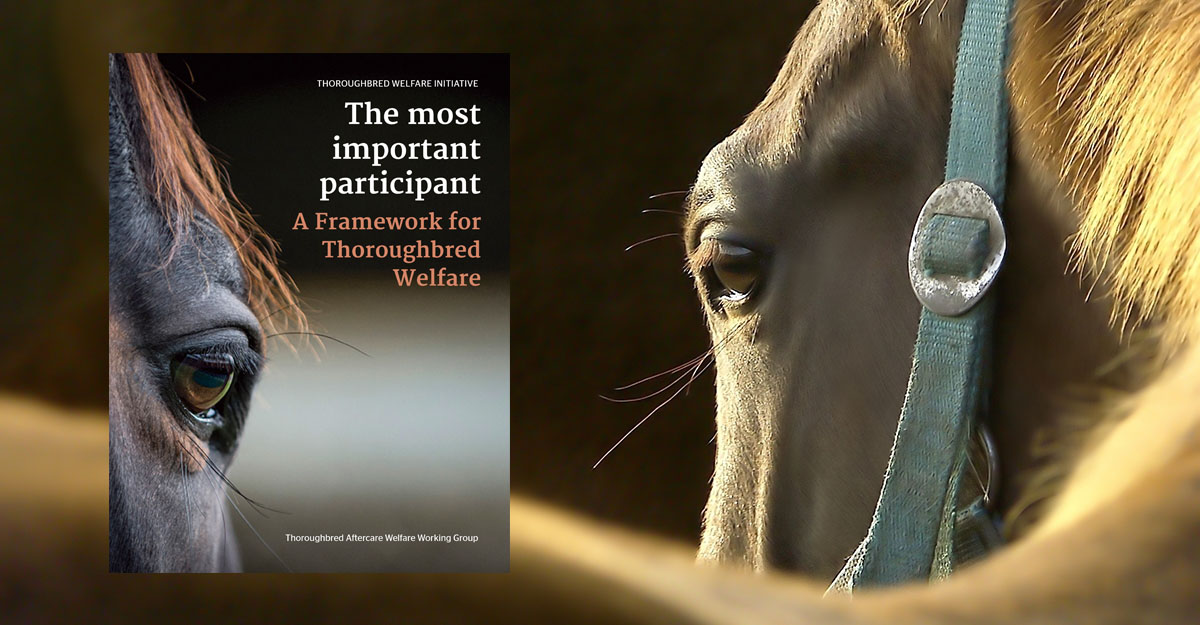
The long-awaited report on the welfare of thoroughbreds in Australia includes 46 recommendations. Ensuring they become a reality will require commitment to a major welfare overhaul.
The 140-page “Framework for Thoroughbred Welfare” is comprehensive and highlights significant legal, structural, logistical and strategic weaknesses that the racing industry must address to maintain a social licence to operate and adequately protect their most important participants – the horses.
In March 2020, a wide cross-section of the horse racing industry came together to appoint an independent Thoroughbred Aftercare Welfare Working Group (TAWWG), charging them with making recommendations for how to improve the welfare of thoroughbred horses leaving the racing and breeding industries.
A few months earlier, the Australian Broadcasting Corporation (ABC) had aired a shocking documentary, showing that hundreds of registered racehorses are being discarded at slaughterhouses in Australia, contravening racing rules, rehoming policies and animal welfare guarantees.
The result is a report which has built on more than 180 written submissions and consultations with more than 50 organisations and individuals from across Australia and around the world.
As the report highlights, the welfare challenges facing the racing industry are “complex and evolving” and they cannot be solved by the racing industry alone. There are a number of impediments that will require a “strategic, national and collaborative approach”.
These impediments include:
- the lack of legally enforceable minimum welfare standards that cover all horses at all ages, in all contexts and all jurisdictions.
- the lack of minimum welfare standards across all areas of the thoroughbred industry and, indeed, the broader horse community.
- the lack of specific, enforceable welfare standards for racing industry participants.
- the need for quality assurance schemes to drive welfare improvements across the industry to achieve a level of care above that mandated.
- the need for science-based standards for the care of all thoroughbreds at different stages in life, which should be based on the Five Domains Model for Welfare Assessment.
- the lack of lifetime traceability through a national database. Without one, the authors say, “it is almost impossible to have an effective welfare regime” and the racing industry cannot “provide the community with robust data on the outcomes of horses that transition out of the industry”.
- the lack of a national strategic plan for sustainability that considers the future size of the industry and numbers of thoroughbreds bred, which currently result in 8,500 horses needing re-homing every year.
The solution, they say, is the urgent establishment of a single body that is solely dedicated to the development, and implementation, of a national welfare strategy.
“It is clear that Racing Australia cannot not fulfil this role. Its constitution does not support this, nor does it have the remit from its shareholders and members, the state racing authorities, to carry out such a role” state the authors.
The independent body, which they suggest be called “Thoroughbred Welfare Authority” (TWA) would,
- have a leadership role in shaping welfare policy, working with racing regulators and thoroughbred industry participants, state and federal governments
- build a state-of-the-art national welfare regime and,
- fund key functions that produce better outcomes for thoroughbreds across the country.
“To be successful, it would need to build on – and interact effectively with – existing PRA [principal racing authorities] welfare commitments. The role of the TWA is not to replace, duplicate or in any way undermine the welfare efforts going on at state and territory level, but to augment and support this work” say the authors.
Another important issue raised is transparency and public access to information. “The new organisation would also provide a national thoroughbred welfare information service to ensure the public debate about thoroughbred welfare is properly informed.”
The TAWWG report has created a comprehensive framework that is based on Responsibility, National Standards, Industry Standards, Traceability, Transition, Safety Net, and National Body, and lists 46 specific recommendations.
To read the full report, click here.
Thoroughbred Aftercare Working Group Recommendations
- The thoroughbred industry, which breeds horses for the purpose of racing, has a social and moral responsibility to take all reasonable steps to ensure thoroughbreds have a good life, including after racing or breeding, and a humane death.
- The thoroughbred industry should coordinate the development of Thoroughbred Welfare Australia (TWA), whose mission would be to focus on the whole-of-life welfare of thoroughbreds. The industry should convene key groups, including Racing Australia, PRAs, Thoroughbred Breeders Australia, RSPCA Australia and the Australian Veterinary Association, to nominate a steering committee responsible for establishing TWA, developing its constitution and appointing an independent skills-based board.
- The steering committee should be an expert rather than a representative group to ensure that the single objective of establishing TWA is to create an organisation wholly focused on thoroughbred welfare. Its constitution and leadership should support delivery of positive life-long welfare outcomes.
- The science-based, world’s best practice model of animal welfare, Five Domains, should be used as the foundation for all welfare considerations for thoroughbred horses, and all sectors of the thoroughbred racing and breeding industries should commit to its application.
- The Australian Animal Welfare Standards and Guidelines for horses should adopt the Five Domains model as the foundation for welfare assessment and be science-based, auditable and enforceable.
- Thoroughbred Welfare Australia (TWA), working with other stakeholders, should advocate to state, territory and Commonwealth agriculture ministers to expedite the development and regulation of Australian Animal Welfare Standards and Guidelines for all horses. This may require an alternative process, such as engaging an independent panel, to allow the standards and guidelines to be developed in parallel with current national animal welfare priorities.
- The thoroughbred racing and breeding industries should fully support and engage to expedite the review and implementation of the Australian Animal Welfare Standards and Guidelines – Land Transport of Livestock in relation to horses, to ensure the particular needs of thoroughbred horses are fully considered in this process.
- Each principal racing authority (PRA) should develop a memorandum of understanding with animal welfare enforcement agencies in its jurisdiction to ensure consistency of enforcement, access and resourcing of animal welfare standards for thoroughbreds during and after their racing or breeding careers.
- TWA should work with the breeding and racing industries, Racing Australia and the principal racing authorities (PRAs) to urgently develop and implement national thoroughbred welfare standards, based on the Five Domains model and covering the care and welfare needs of thoroughbreds across all stages of their lives.
- Racing Australia and the principal racing authorities (PRAs) should work with TWA to develop and implement an effective and transparent compliance and enforcement regime, with significant penalties for non-compliance, to ensure the national thoroughbred welfare standards are fully and appropriately enforced.
- Racing Australia, through the Australian Stud Book (ASB), should require all owners and breeders to meet the national thoroughbred welfare standards and be subject to its rigorous compliance regime.
- TWA should work with the breeding industry to develop and implement a welfare quality assurance (QA) scheme for breeders
- Any person with a criminal conviction for an animal cruelty offence should be presumed unsuitable to be a racing or breeding industry participant. Such individuals should be barred from becoming a licensed participant, a registered owner, or having their horses registered in the Australian Stud Book (ASB).
- A national horse register and traceability system should be established with utmost priority. The system must allow for all horses to be individually identified and traced to their current owner.
- The thoroughbred industry should actively lobby state and federal governments on the urgent need for a national horse traceability register.
- The federal, state and territory governments should commit to funding the establishment of a national horse register and traceability system.
- Racing Australia should encourage the national traceability of thoroughbreds for life by developing the capacity to update ownership and other details at any stage of career and life and providing incentives for owners to do so.
- Racing Australia should adopt and implement a policy of open and transparent publication and access to data relating to thoroughbred racing and breeding.
- Racing Australia should review its data collection system to ensure it:
- delivers a comprehensive statistical profile of all horses in the thoroughbred racing and breeding industries from birth to retirement
- captures all the data required by different industry sectors
- promotes compliance with reporting requirements across the industry
- informs all industry participants about the purpose and benefits of the data they provide
- provides for the validation of data to ensure it is robust
- underpins a transparent and accountable welfare regime
- encourages and incentivises participation by industry.
- Racing Australia should use its data capabilities to:
- inform policy development across the Australian thoroughbred racing and breeding industries
- benchmark the welfare performance of the industry
- inform the development of a community thoroughbred welfare information campaign.
- TWA in conjunction with Racing Australia should publish annually a report that provides industry information on the number of racehorses, broodmares, stallions and unraced thoroughbreds that have left the racing and breeding industry that year, and their destination.
- Racing Australia, together with TWA, should seek opportunities to work with the broader horse and equestrian sectors to share registration and traceability information, especially for thoroughbred horses that have left the racing and breeding industries.
- Racing Australia should expedite the introduction of existing and emerging technologies such as database linkage, real time geolocation and mobile phone apps. These should be used wherever possible to improve user experience and extend functionality of traceability systems.
- As a priority, Racing Australia should work with industry stakeholders to develop a well-researched, medium- to long-term sustainable national thoroughbred breeding and racing plan. This should aim to align the size of the foal crop with the current and future requirements of the racing industry, and of the export and non-racing thoroughbred markets, while providing appropriately for the aftercare needs of all horses the industry produces.
- Racing Australia should create a separate category in the Australian Stud Book (ASB) for thoroughbred horses that are not bred for racing purposes and would not be eligible to race.
- Principal racing authorities (PRAs) should consider adjusting their racing programs, particularly in country areas and at community picnic races, to provide more opportunities for older horses.
- Racing Australia should work with industry stakeholders to commission scientific studies to determine how the thoroughbred breeding industry can better understand and use genetics and the heritability of desired attributes such as speed, staying ability, soundness and racing longevity to improve the quality of thoroughbred horses.
- TWA should work with the industry to develop a national framework for the assessment, retraining and rehoming of thoroughbreds exiting the racing and breeding industries.
- TWA, working with Racing Australia, the principal racing authorities (PRAs) and the broader industry, should develop and implement a comprehensive coordinated national plan to significantly increase the number and diversity of opportunities for all thoroughbred horses leaving the breeding and racing industries.
- TWA should implement programs to improve the sharing of knowledge and experiences across Australia and internationally, with respect to retraining and rehoming of thoroughbreds. This should include the development of best practice guidelines for the retraining of retired thoroughbreds.
- All retired racehorses should have an appropriate period of rest and recuperation, followed by an appropriate health and welfare assessment, before entering a retraining and rehoming program.
- TWA should develop an advisory service to provide information on pathways to successfully transition horses out of the thoroughbred racing or breeding industry.
- TWA, working with relevant stakeholders, should develop and implement welfare quality assurance (QA) schemes for key thoroughbred industry participants, including trainers, foundation trainers and retrainers.
- TWA should develop and implement a national safety net that develops and oversees a thoroughbred welfare hotline to advise on welfare options for at-risk horses. It would include a service to assess at-risk thoroughbreds and provide advice on options including rehoming, retraining and on-site humane killing. The national safety net would report annually on all its activities.
- TWA, in consultation with the thoroughbred industry, the Australian Veterinary Association and RSPCA, should develop a national decision-making framework to provide guidance on end-of-life decisions for thoroughbreds, that protects the welfare of horses, is consistent with the ethical obligations of veterinarians and includes relevant activity and time-based thresholds.
- TWA, in consultation with the thoroughbred industry, the Australian Veterinary Association and RSPCA, should develop national protocols with respect to the humane killing of thoroughbred horses based on the following principles:
- From an animal welfare perspective, the least stressful and most humane option is for a horse to be humanely killed in familiar surroundings by a registered veterinarian.
- Where attendance by a veterinarian is not feasible, shooting with an appropriate calibre firearm, carried out according to best practice by a trained and competent operator, is also a humane option.
- Where on-farm humane killing is not an option, appropriate transport to a nearby knackery where shooting is carried out according to best practice by a trained and competent operator can also be acceptable.
- The industry should develop and support measures to improve national access to on-farm humane killing where a decision has been made to end a horse’s life, including by providing access to veterinarians and other persons trained in the above protocols to conduct humane killing.
- TWA should develop an industry accreditation program to recognise trained and competent firearm operators that meets best practice standards for on-farm humane killing.
- The racing and breeding industries should engage with state and territory governments to expedite the development and implementation of the Australian Animal Welfare Standards and Guidelines – Livestock at Processing Establishments and ensure these standards include species-specific requirements for the handling, management and humane killing of horses.
- Racing Australia should implement national rules to prevent thoroughbred horses being sold or transported for the purpose of slaughter at an abattoir. These should remain in place unless and until mandatory national species-specific standards are developed and implemented that guarantee thoroughbred welfare during transport to and at abattoirs.
- State and territory regulators should act to increase the level of oversight and auditing of animal welfare at knackeries where horses are killed. This should include requirements for animal welfare training of auditors and knackery staff, increased audit frequency and direct auditing of the handling and killing of horses.
- TWA should develop a quality assurance framework for knackeries that handle live thoroughbreds to ensure these horses are managed in accordance with best practice welfare standards, particularly at their end of life.
- TWA, Racing Australia, the principal racing authorities (PRAs), and the breeding and racing industries should work with AgriFutures to develop and implement a nationally agreed thoroughbred horse welfare research program.
- TWA should work with Racing Australia, the principal racing authorities (PRAs) and the breeding and racing industries to facilitate and encourage all workers involved in handling thoroughbred horses to undertake appropriate skills training and education. This should include workers involved in early foal management, yearling preparation, foundation training and training for the racetrack.
- TWA should work with Skills Australia, the national body that sets the curriculum/course content for VET courses, to ensure that all national VET courses for students undertaking equine studies – such as Certificate III in equine studies, Certificate III in horse breeding, Certificate III in performance horse – include in their curriculum up-to-date modules or course content on horse welfare.
- TWA should establish a publicly available national thoroughbred welfare information portal that is regularly updated with key data to ensure the public is fully informed with accurate information on the welfare of thoroughbred horses in Australia.
The TAWWG report authors say they believe strongly that the findings and recommendations outlined in the report have the potential to improve welfare outcomes for all thoroughbreds but ensuring they become reality will require new commitments from the industry.
To download the report, click here.
So good to see this in writing, thank you for sharing Cristina. Now putting it into daily life…