fbpx
Home Blog Page 19

(Online) Horse Shows Go On During COVID-19 Pandemic Lockdown

2

Did you know you can also show from home? Many equestrian communities can organise online horse shows, allowing riders to upload video of their performances to be judged remotely.

**Editor’s note: We will be updating this post as news of new online competitions emerge!

Social distancing measures are disrupting everyone’s lives, horse shows, from large to small are being cancelled all around the world. But today’s technology gives unique opportunities to stay connected and people everywhere are responding with innovative ideas to help us keep doing what they love most. 

Italians may be singing from their balconies, but especially in Australia, most horse riders can still get outside and ride their horses. Those of us lucky enough to be in good health and have our horses at home, can enjoy them even during self-isolation. We know that horses provide so many benefits! They will help us through this difficult time, motivating us to stay active, healthy and connected.

If horse shows are one of the big motivators in your life, check out this handful of groups that are rising to the challenges ahead by moving their shows to an online platform. Even if this short list is not relevant to your preferred discipline, it may inspire your own equestrian community to follow a similar line!

** Horse Competitions Online are based in Australia and offer Dressage (Equestrian Australia rules and tests), Western Dressage (rules and tests of the Western Dressage Association of America) as well as Trail events. Check their website and follow on Facebook Horse Competitions Online.

** North American Western Dressage have been offering virtual shows since 2015 and have a very open and inclusive policy, as well as progressive rules that align with the latest knowledge in horse welfare. Read this article to find out more.

** Bitless Inc. Australia’s Only National Equestrian Association representing riders, drivers and groundwork handlers who want to train and compete bitless, bridle-less or at liberty is also running online horse shows, so check them out and join!

** HayGrazer E-Rider is a UK-based small business and Facebook community who is rising to the challenge – seeking to help as many horse businesses, groups and clubs affected by the cancellation of events. They offer dressage competitions and a wide range of classes from bareback to veterans and everything more ‘normal’ in between! Go to their website.

** The Standardbred Association of Queensland (SAQ) just announced they will be running their first qualifying event toward the 2020 Queensland Standardbred Track To Hack Series as an online horse show, following the cancellation of the Warwick Agricultural Show, and plan to do the same with other events that have to be cancelled. Check their Facebook Page for more information.

** The SAFE 2020 Online Arabian Show – as their name suggests – is another Australian virtual option, it has a great range of classes – check out their Facebook group.

Racing Australia and Equestrian Victoria Collaborate to Improve Horse Traceability

0

In a show of inter-discipline collaboration, Equestrian Victoria and Racing Australia have agreed to share horse traceability data and augment the numerous equine welfare initiatives implemented by the Australian Racing Industry.

This data share agreement supports Equestrian Victoria’s Strategic Plan 2018-2022 pillar around Industry Leadership in Equine Welfare and will allow for more accurate tracing of Thoroughbred horses moving between the industries enabling greater care provision for them upon transfer. Data to be shared will be limited to horse specific information such as microchip number, registered name and location and will be readily available for both parties to access.

Just last week, at the Horse Welfare Forum, guest speaker Dr Roly Owers, CEO of Horse World Welfare presented on a social licence for equestrian sport and encouraged all the different sectors to work collectively on the various welfare initiatives being considered and implemented, as a way to re-affirm equestrian sports’ social licence. The event had been organised by Equestrian Victoria and the Australian Horse Industry Council. Dr Owers’ presentation can be watched here.

Equestrian Victoria Chairman Carl Parkin said, “This arrangement between Equestrian Victoria and Racing Australia is incredibly important in the industry’s work towards improving horse traceability and continues Equestrian Victoria’s commitment to equine welfare.

“By sharing data between our parties and working together, we are confident that we will achieve our common goals of equine welfare and show the way forward for the rest of the industry.”

Racing Australia Operations CEO & Acting CEO Myles Foreman agreed, saying “Racing Australia is pleased to have come to this arrangement with Equestrian Victoria in what is an important step forward for equine welfare in the industry.

“The overall wellbeing of Thoroughbred horses during their careers and following retirement is and always has been a top priority of ours at Racing Australia.”

The two organisations also aim to explore the expanding of this data sharing nationally and hope that this is the first step in greater collaboration between racing bodies throughout Australia in working towards greater equine welfare outcomes.

The data sharing agreement has an initial term of two years and can be extended by another two years subject to the parties’ agreement.

Whip-free race finishes in UKs £1.8M Racing League

1

Jockeys will race under ‘hands and heels’ rules at this summer’s Racing League if organisers have their way. Whips may be carried but not used for ‘encouragement’.

The Racing League, a new initiative of Championship Horse Racing, will be televised and take place across six consecutive Thursday evenings in July and August. There will be six races per meeting and each team will have one runner in each race. Points will be awarded depending on where teams finish in each race, and added to a league table.

In the series, 12 teams will compete for a share in £1.8M in prize money.

Hands and heels racing rules have been regular fixtures in Britain thanks to the Racing Excellence series, part of the British Horseracing Authority’s accreditation program for apprentice jockeys.

In the Hands and Heels races, which include flat and jump races alike, a whip may be carried and used for safety reasons, but whip use for correction and encouragement is not allowed.

The Hands and Heel’s series are recognised by racehorse trainers and owners as an important element of a young jockey’s race riding career development. If they are applied by the Racing League, this will be the first time senior jockeys are restricted by the same whip rules.

Whip use continues to be a contentious issue for racing throughout the world. Around this time last year and in an attempt to improve public perception of racehorse welfare, the Californian Horse Racing Board (CHRB) announced they would limit whip use in the same way announced by the Racing League’s organisers. But despite being passed, such whip-use restrictions have never been implemented.

Whip rule breaches and inadequate penalties are a constant source of news, debate and discussion. And, while industry claims that the approved padded whips don’t hurt horses when used within the rules, the welts on last year’s Melbourne Cup winner, Vow And Declare, showed otherwise.

A growing number of racing insiders are calling for the sport to align all races with the Hands and Heels whip restrictions, arguing that at the very least, whipping is eroding the sport’s already tenuous social licence to operate.

Three quarters of Australians quizzed in a poll said they do not support the whipping of horses in racing. And research has shown whipping does not make horses run faster as they near the finish line.

The proactive move by Racing League organisers to align whip use to public expectations, is in line with a need to re-affirm the status of the sport of horse racing and refresh the audience.

However, although the British Horseracing Authority has sanctioned series, it is less clear that they will eventually allow the races to run under Hands and Heels rules. Read more in this article from the UK’s BBC and this article from The Guardian…

Warnings that punters will shy away from horse racing if whip use is restricted have never been tested. This British experience could provide some solid evidence of the impact.


Horses Get Asthma Too!

We all know that asthma is a common respiratory disorder in people but, did you know that horses get asthma too? 

“Equine asthma” is a broad term that has recently been used to describe a spectrum of non-infectious respiratory diseases in horses, previously known as broken wind, heaves, chronic obstructive pulmonary disease (COPD), recurrent airway obstruction (RAO), inflammatory airway disease (IAD) or bronchiolitis, amongst others.

Whilst the condition is well-recognised in the northern hemisphere, little is known about how commonly Australian horses are affected and what the potential risk factors might be.

This is why the University of Adelaide is asking you to participate in a study that will determine how common equine asthma is within the general Australian horse population.

If you are an Australian horse owner, . 

What causes Equine Asthma?

It is understood that environmental factors play a key role in the development of equine asthma. Exposure to airborne dust, moulds, fungal spores and pollens have all been found to cause an inflammatory effect in the horse’s lungs. In the northern hemisphere, the stable environment and feeding of dusty hay have been found to be key triggers whilst in parts of the southern hemisphere pasture-associated disease appears to be more common. However, the situation in Australia has received little study.

What are the signs of Equine Asthma?

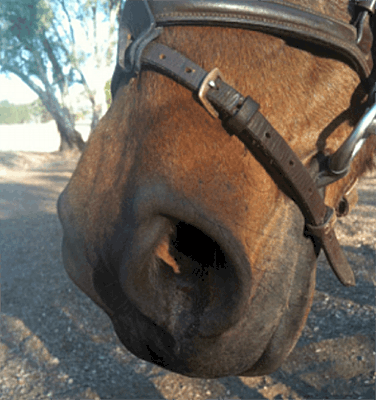
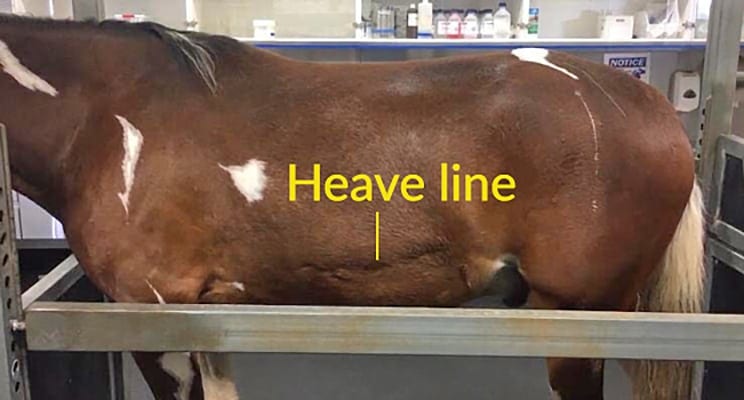
Equine asthma can affect horses of all ages and may vary in severity considerably. Mild cases may show few outward signs of respiratory disease and can be easily overlooked. Such horses may show decreased performance or a reduced willingness to work without overt signs of respiratory disease. Other horses may have a clear or white nasal discharge and /or coughing. In the most severe cases affected horses will show signs of breathing difficulty whilst at rest. This can be seen as flaring of the nostrils (figure 1) and increased abdominal effort, which may ultimately result in the formation of a “heave-line” (figure 2).

A horse showing signs of nostril flaring
Figure 1: A horse showing signs of nostril flaring
A heave line can be a sign of equine asthma
Figure 2: A horse with a “heave-line”

How is Equine Asthma diagnosed?

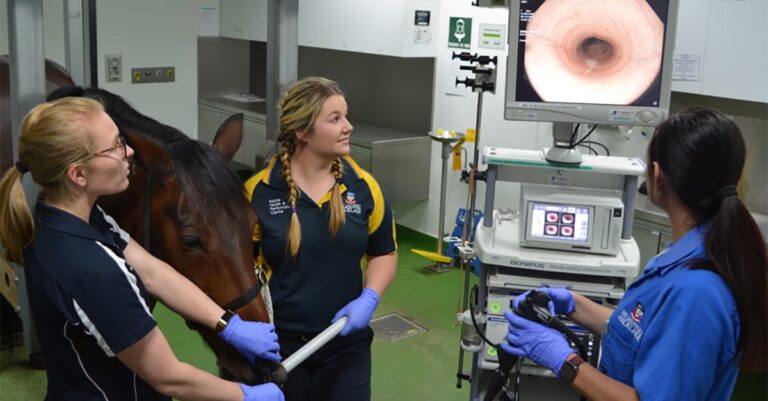
We can get a good idea about whether a horse has equine asthma from the clinical signs that are reported by the owner. However, it is important to rule out other breathing problems (such as respiratory infections or upper airway obstructions) that may be mistaken for equine asthma. In people, a diagnosis of asthma is based on lung function testing. This is more challenging to perform in horses and so instead we look for evidence of mucus and inflammation in the lungs by performing an endoscopic examination (figure 3) and lung washes.

An endoscopic examination of a horse's airway
Figure 3: An endoscopic examination of a horse

How is Equine Asthma treated?

The cornerstone treatment for equine asthma involves environmental management to reduce the exposure to airborne dust and allergens. For stabled horses this can involve changing the type of bedding that is used, reducing respirable particles in hay by soaking or steaming, using alternative forage sources or moving the horse to pasture. If the pasture is the key trigger, then it may be necessary to move the horse to a different environment or to stable it. However, it should be noted that horses with pasture-associated disease are also likely to react to the stable environment and so it is important to minimise the environmental dust that they are exposed to within the stable as well.

For the majority of horses affected with equine asthma it is also necessary to treat medically in order to reduce the airway inflammation and restore normal lung function. As in humans, medical management of equine asthma includes corticosteroid therapy (indicated for its potent anti-inflammatory effects) and bronchodilators to help open up the airways. These drugs can be administered via inhalation just like in humans (figure 4).

Treating a horse with inhaled medication
Figure 4: Treating a horse with inhaled medication

Help us find out more about Equine Asthma in Australian horses!

At the University of Adelaide, we are currently conducting a study to determine how common equine asthma is within the general Australian horse population. In addition, we hope to identify the most important risk factors for the development of the disease in this country.

To help more Australian horses, help us with this study! The survey will take just 15 minutes to complete.

Your contribution to this study will help us to improve the welfare of Australian horses. Participants will have the option to remain anonymous unless they would like to enter the prize draw for completing the short survey!

The study is for Australian horse owners and open until the end of April 2020.

This study is being conducted by Miss Jewel Azaria Tan (Animal Science Honours student, The University of Adelaide), Dr Surita du Preez (Equine Internal Medicine, The University of Adelaide), Dr Samantha Franklin (Equine Sports Medicine, The University of Adelaide) and Dr Jackie Cardwell (Epidemiology, The Royal Veterinary College, UK).

Rising to the Challenge; Australian Bushfire Relief

Throughout spring and summer, Australia has been burning. Although every state has a bushfire season, the scale of devastation and areas impacted during the 2019-2020 fire season have been unprecedented.

Nearly 12 million hectares land have burnt, killing 33 people and an estimated 1.5 billion native animals, destroying thousands of homes.

And alongside nature’s destruction we’ve witnessed amazing feats. Communities banding together, people helping other people and helping animals.

With emergency services completely overstretched, grass roots organisations have formed, and individuals have pulled out all the stops to help those in need.

One such example is the Gippsland Horse and Stock Safe – Bushfire Assistance. Established around five years ago by a local equestrian business owner Kelly van den Berg to help horse people help each other during a disaster, this Facebook page became a centre point in terms of bushfire relief for the horse community during the Bunyip and Yinnar fires in March last year and became a force for good to be reckoned with during this summer’s catastrophe.  

An Equestrian Australia coach with a journalism background, I spoke to Kelly about the organisation, their achievements and what the future might hold for the Gippsland communities.

“The Bunyip and Yinara fires were pretty horrific but compared with what we are experiencing now, it was just a drop in the ocean” says Kelly.

“It’s hard to gauge the scale of the impact of what’s happening [in Gippsland] unless you see it for yourself. It’s one case in which the media sensationalism isn’t depicting the scale and real state of what’s going on, the long-term effects.”

The group quickly responded to the escalating needs of their community by expanding their efforts from supporting just horse owners to all stock owners.

“We recognised we needed to help any farmer with stock” she continues. “Many of the farms in East Gippsland have been in a three-year drought, they were already on the bones of their backsides, farms were already struggling for feed” says Kelly.

In a tragic chain of events, while many areas of Gippsland had received their share of winter rain last year and had a good hay production, the vast majority of the stockpiles of feed and forage that would see farmers through until next winter have gone up in flames.

“In a lot of cases, farmers have lost property, equipment, tractors, they’ve lost parts of their herd, some have lost all their herd, and they’ve lost their hay sheds, their feed, so our group is addressing their immediate emergency. “But the real emergency is the ongoing months ahead. I’m not really confident that a lot of farmers are going to actually recover from this” says Kelly.

The team’s efforts have highlighted a huge a needs gap between the response of emergency services and the recovery support efforts from government departments and charity organisations.

Kelly says that while it is understandable that the priority is given to protecting people and assets (in that order), the importance of animals and livestock deserves to be reviewed – not least because fires impact on rural communities that are farming based, and therefore, impact directly on farmers whose lifestyle, livelihoods and lives are intrinsically tied around their livestock.

“Our main focus is supporting farmers, horse owners and animal owners, and supporting them in the days of them being impacted, because that’s when they most need the support.

“A lot of these guys, their cattle would be dead if they were waiting for the official organisations to set up. And they do a great job, especially for the long-term effort, but there doesn’t seem to be any kind of organisation, other than ourselves and other groups like us, that were really there in the first week, when farmers are saying, we have no feed and water, our cattle are starving, standing on dirt ground” says Kelly.

Strong community connections have allowed this grass roots organisation to move fast to set up an impressive operation and build a strong team of capable volunteers. “It’s definitely not just me” says Kelly.

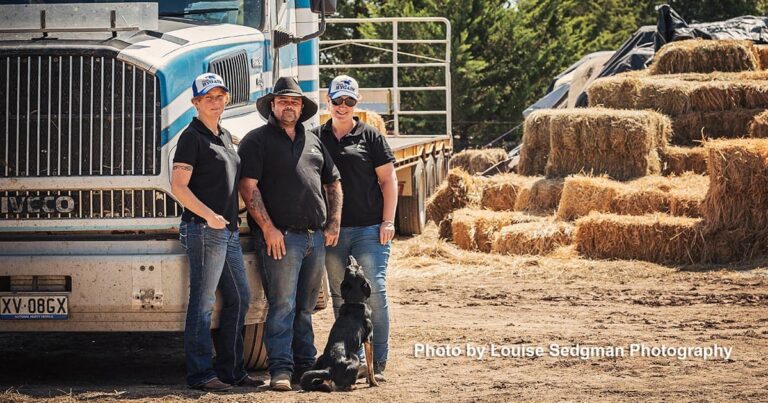
“I am the founder and oversee everything, then we have Tegan Hector, on who’s property we set up the depot. She’s fantastic at overseeing the site office. She has a professional logistics manager (who happened to be between jobs), working with her full time, in the office. We’re all volunteers.

While it is understandable that the priority is given to protecting people and assets (in that order), the importance of animals and livestock deserves to be reviewed – not least because fires impact on rural communities that are farming based, and therefore impact directly on farmers whose lifestyle, livelihoods and lives are intrinsically tied around their livestock.

“In the depot where we store hay and feed we’ve had donated sea crates for storing feed. We’ve set up a turnaround for B-double trucks, with  gravel, there’s showers for our volunteers, it’s really taken off. The original home owners are on board fully, we all have designated jobs, and we all take a chip out of it. We have all the truck drivers that drive for us, a site manager that runs the truck yard. And we have other people helping us more remotely, like our IT manager that’s based in Melbourne.”

And, according to Kelly, being a grass roots organisation has its benefits. The strong personal connections with the locals throughout these areas has allowed them to move quickly and stay focused on the tasks at hand. Making personal contact with individuals in the Department of Environment, Land, Water and Planning (DELWP) and the Victorian police force has facilitated access, in some cases escorts to access directly into farmers properties before roads were officially open to the public.

“Our trucks drive directly through the farm gate” says Kelly. “We ask the individual person directly, how many head are you feeding, what do you need, do you need lick blocks, mineral replacers, milk replacers, etc. In a lot of cases these people haven’t seen fresh food or meat for three or four weeks, so we bring that too.”

“Water has been a big aspect on top of the feed runs, it has slowed down a bit now with access becoming more available and also the Country Fire Authority have done a wonderful job diverting their trucks to properties that were really in need, at the least filling up house tanks but also helping the stock.

“At one point we had four water tankers with drivers that were donated to us, which is amazing. We had two smaller domestic tankers for filling up house tanks running five days a week, potable water we could take from road access sites, and we had two large tankers, a 20,000 L semi water designated tanker and a 40,000 L milk tanker that we used to cart water for livestock.

One of the group’s most remarkable feed drops was made for Mallacoota, the tiny coastal town that, having been completely cut off, saw thousands of holiday makers sheltering on the beach under apocalyptic red skies, and were relocated by the Royal Navy.

Kelly says it was a massive effort that involved a large number of local people and businesses pulling together their resources and contacts.

“When Mallacoota was cut off, the Australian Defence Force were there but they were, understandably, focused on human life. There was very limited access for horse owners in terms of feed and vet care, so the idea was to hire a commercial tuna boat and, as well as other supplies, take about 50 pallet loads of fencing and horse specific feed and medical supplies!

“It was a big logistical project. We had to find a boat, or an owner that would allow us to use a boat, and we had to find a willing skipper. Local business owner Wayne Cribbs made himself available, but the boat was all the way in South Australia. So, with the help of the fishing co-ops, we flew him to the boat and he steamed it to Victoria.

“Thanks to everyone’s contacts, through port authorities and fishing co-ops, we were able to get the boat docked at Welshpool and loaded, and then we were able to get it to Mallacoota, through the domestic channels. We had to use the abalone boats in Mallacoota but luckily, they all had wives or daughters who had horses, so we rallied the community together to help. It was a real humanitarian mission. Mallacoota is my second home, I am very connected to the place and I have a lot of friends there so it was a personal mission for me as well.”

Moving forward, Kelly would like to see another push to increase people’s awareness of prevention and being prepared ahead of time. She says the awareness has improved since the 2009 Black Saturday fires but needs to be continually reinforced.

And, for those who want to help out in some way she suggests putting some research into the areas they direct their donations to, whether that’s financial, in time or hay.

“What we’ve seen is that very well-meaning people who are overwhelmed by the devastation and want to do something, have been flooding the towns with relief in terms of clothes and food. The horse gear is driving us insane. We’re saying to people there aren’t enough horses in Gippsland to wear that many halters or rugs – it’s overwhelming.

“And the feedback I’m getting (and I have friends who’ve lost everything), is that when the time comes to rebuild, they want to be able to choose their own toaster and the colour of their own bed sheets. It’s really important to them precisely because they’ve lost everything.

“If people really want to make a difference and donate, then I would suggest donating into funds that are going to assist with either the long-term relief effort or for immediate emergency relief. I would encourage them to find those organisations that are grass roots or part of the communities (and there’s quite a few of them), or to support the organisations that are going to do the long-term relief, like Blaze Aid.

“I guess the message is do your research and put some thought into the direction of your donations.”

In terms of how intrinsically connected the community is to their farming families, Kelly would like to see animals and their needs become a bigger consideration when disasters like this happen in future, and she plans to develop other support programs that can help, farmers and local businesses who will be suffering for long time.

“In six months time, these farmers will not have had enough time to grow enough feed to cut some hay. Hay is running out and we’re already in a drought. Victorian hay has been going up to Queensland and NSW, because they’ve been in drought, so six months down the track there will be significant problems. This is a long-term disaster and these farmers are going to need a lot of help for a long time. Raising this awareness is really important.”

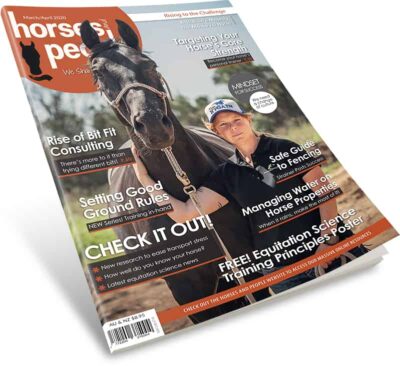
This article was published in Horses and People March-April 2020 Magazine.

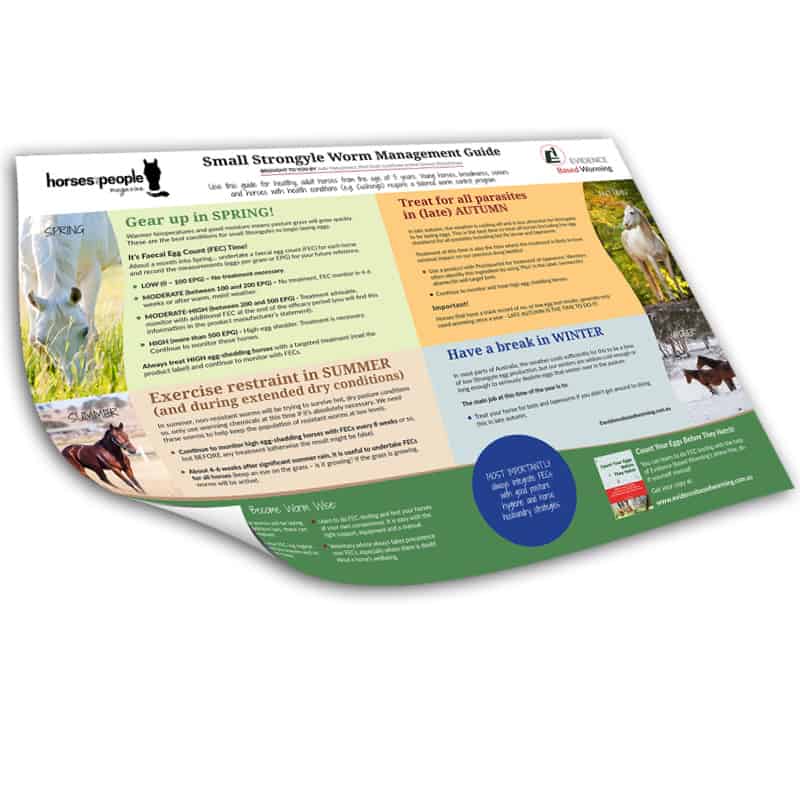
Small Strongyle Worm Management – Seasonal Guide

Use this year-round guide for managing worms, particularly small strongyles, in healthy, adult horses from the age of 3 years.

Young horses, broodmares, seniors and horses with health conditions (e.g. Cushings) require a tailored worm control program.

MOST IMPORTANTLY always integrate FECs with good pasture hygiene and horse husbandry strategies.

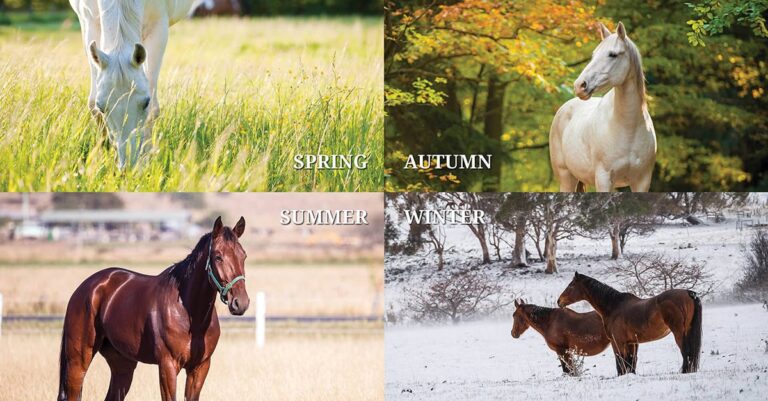
Gear up in SPRING!

Spring is Faecal Egg Count (FEC) Time!

Warmer temperatures and good moisture means pasture grass will grow quickly. These are the best conditions for small Strongyles to begin laying eggs.

So, about a month into Spring… undertake a faecal egg count (FEC) for each horse and record the measurements (eggs per gram or EPG), for your future reference.

  • LOW (0 – 100 EPG) – No treatment necessary.
  • MODERATE (between 100 and 200 EPG) – No treatment, FEC monitor in 4-6 weeks or after warm, moist weather.
  • MODERATE-HIGH (between 200 and 500 EPG) – Treatment advisable, monitor with additional FEC at the end of the efficacy period (you will find this information in the product manufacturer’s statement).
  • HIGH (more than 500 EPG) – High-egg shedder. Treatment is necessary. Continue to monitor these horses.

Always treat HIGH egg-shedding horses with a targeted treatment (read the product label) and continue to monitor with FECs.

Exercise restraint in SUMMER (and during extended dry conditions)

In summer, non-resistant worms will be trying to survive hot, dry pasture conditions so, only use worming chemicals at this time if it’s absolutely necessary. We need these worms to help keep the population of resistant worms at low levels.

  • Continue to monitor high egg-shedding horses with FECs every 8 weeks or so, but BEFORE any treatment (otherwise the result might be false).
  • About 4-6 weeks after significant summer rain, it is useful to undertake FECs for all horses (keep an eye on the grass – is it growing? If the grass is growing, worms will be active).

Treat for all parasites in (late) AUTUMN

In late autumn, the weather is cooling off and is less attractive for Strongyles to be laying eggs. This is the best time to treat all horses (including low-egg shedders) for all parasites including bot fly larvae and tapeworm.

Treatment at this time is also the time where the treatment is likely to have minimal impact on our precious dung beetles!

  • Use a product with Praziquantel for treatment of tapeworm. Wormers often identify this ingredient by using ‘Plus’ in the label. Ivermectin/abamectin will target bots.
  • Continue to monitor and treat high egg-shedding horses.

Important! Horses that have a track record of no, or low egg test results, generally only need worming once a year – LATE AUTUMN IS THE TIME TO DO IT!

Scroll down to download this guide as a poster!

Have a break in WINTER

In most parts of Australia, the weather cools sufficiently for this to be a time of low Strongyle egg production, but our winters are seldom cold enough or long enough to seriously deplete eggs that winter-over in the pasture.

The main job at this time of the year is to:

  • Treat your horse for bots and tapeworm if you didn’t get around to doing this in late autumn.

Become Worm Wise

  • When the grass is growing, the worms will be laying eggs so, after warm, moist conditions (yes, these can even occur in winter) be FEC-vigilant!
  • This means that in the tropics your FEC-ing regime will be governed by the wet and dry seasons and on irrigated pastures it will be year-round.
  • Veterinary advice always takes precedence over FECs, especially where there is doubt about a horse’s wellbeing.
  • Learn to do FEC-testing yourself (it really is not that hard!) and test your horses at your own convenience. It is easy with the right support, equipment and a manual.
  • For more about worm management, read The Ultimate Guide to Worming Your Horse.

Why not do it yourself? Count Your Eggs Before They Hatch!

You can learn more about managing worms in horses and do FEC testing with the help of Evidence Based Worming’s stress-free, do-it-yourself manual!

Get your copy and get in control of your horse’s worming program! Click here to learn more about managing worms in horses…

National Horse Register a Step Closer

1

The Agriculture Ministers’ Forum (AGMIN) met in Launceston last Friday to progress priority issues affecting the agriculture sector, with horse welfare and the development of a national horse register taking centre stage.

The meeting was chaired by the Australian Government Minister for Agriculture, Drought and Emergency Management, the Hon. David Littleproud MP.

Ministers discussed key issues impacting the agricultural sector, and what governments can do together to build the Agriculture portfolio into a $100 billion industry by 2030.

Horses were centre stage at the meeting, with Ministers agreeing that Queensland will lead the development of Australian Animal Welfare Standards and Guidelines for Livestock at Processing Establishments.

Queensland will also lead a review of the suitability for horses of the existing Australian Animal Welfare Standards and Guidelines for the Land Transport of Livestock subsequent to completion of coordinated action on horse welfare during transport, as agreed by agriculture senior officials on 19 December 2019.

Ministers also agreed that a working group, co-led by Queensland and Victoria, will develop a proposal for a national horse register, a project that has received strong support from all corners of the horse industry.

Currently, there is no accurate figure for the total horse population in Australia. Estimates range between 900,000 and 1.8 million, which includes domesticated horses and brumbies. A 2001 study suggested that the total horse population was 1.2 million,6 and a more recent but limited 2016 survey found that there were one million or more domesticated horses, with Thoroughbreds representing approximately 10% of the domesticated horse population.

A national register would provide a much clearer picture of Australia’s horse population and its benefits were highlighted in a Senate Inquiry chaired by Greens Senator Mehreen Faruqi.

Animal welfare, biosecurity safety (including the prevention and management of Emergency Animal Diseases, such as equine influenza and African horse sickness), backyard breeding and the integrity of trade in horses were some of the aspects that would benefit from a single database covering the whole country.

The importance of a database that covers horses from birth to death was magnified in the documentary by the national Australian broadcaster into the treatment of retired racehorses.

The report exposed the gaps in accountability and information that occur when horses move out of a racing environment and lose the protection of any registry. The idea of a national horse register gained the support of all racing bodies, veterinary groups and many other horse welfare advocates.

Federal support for the development of the horse registry is a crucial step forward to ensuring a coordinated approach. The working group will be able to contrast the variety of overseas models of national horse tracking systems, as well as funding and enforcement models.

A Campaign to Give Hazel a Fair Go for Tokyo 2020

Give Hazel a fair go to Tokyo 2020. Hazel Shannon and her Off the Track Thoroughbred, Willinga Park Clifford have won the Adelaide 3 Day Event an historic three times. It’s never been done at any other 5* event in the world. For eventers, it’s like winning the Melbourne Cup three times.

But despite making eventing history, the pair was not listed on the Equestrian Australia Gold High Performance Squad and is not being considered for this year’s Tokyo Olympic Games. 

The oversight has sparked the interest of passionate volunteer, author and eventing advocate Maggie Dawkins, who launched a campaign calling for more transparency in the Olympic selection process and asking selectors for a #FairGoForHazel.

“The people who know me well understand that I am motivated by a sense of fairness” says Maggie. “Hazel Shannon is the only rider in the world to win at 5* level on the same horse, at the same event, three times. They have earned a place on the Australian eventing team and, furthermore, the stated purpose of the Adelaide International as an Olympic qualifier must be upheld.

“The integrity of this International event’s financing model is on the line here. South Australian taxpayers have funded the Adelaide 3 day event for years with the expectation that the winner will gain selection for the Olympics. Hazel and Clifford have won it three times! How can anyone say they haven’t earned the right to represent us at Tokyo?”

Maggie says the campaign will hopefully avoid the necessity of going to the Court of Arbitration for young event rider Hazel Shannon and Clifford. Equestrian Australia’s selection of riders for past Olympics and World Equestrian Games has been shrouded in controversy due to selection decisions that do not relate to performances at official qualifying events. The Federation Equestre Internationale (FEI) the world governing body for the sport lists the first and most difficult criteria for qualification to ride at Tokyo, a completion at 5* and Hazel has more than met the FEI selection criteria.

Hazel’s third Adelaide victory in 2019, was evidence of that elusive ‘fairy dust’ required for Olympic success, the partnership between rider and horse that sets the sport of eventing apart from other equestrian pursuits. It is clear that Hazel and Clifford have built a trust in each other. Hazel smashed her goal of finishing below 40, like dual German Olympic champion Michael Jung and his horse Sam (La Biosthetique-Sam FBW).

The Adelaide 5* three-day event is the only 5* Olympic qualifier in the Southern Hemisphere and only one of five in the world. South Australian eventing enthusiasts proudly host the Olympic qualifying event, which heavily relies on State Government funding.

“It is unthinkable that selectors continue to overlook this combination” says Maggie. “After two wins at Adelaide in 2016 and 2018. A delegation of event riders were invited to the test event at Tokyo in August 2019, and Hazel was excluded. This a clear indicator that Hazel and Clifford have already been written off, despite consistent performances.

“The #FairGoForHazel is my idea, I am funding it and I am running it,” Maggie Dawkins says.

“Let’s rip back the curtain on the subjective shenanigans that appear to be behind Olympic selection and disclose what is going on to the general public. After all, taxpayers pay for High Performance through the Federal Government and sports rorts are a hot topic.”

“I have contacted businessman Terry Snow, the owner of Willinga Park Clifford and he understands my motives. As the horse’s owner, it is not appropriate for him get too involved as he clearly has skin in the game,”  Maggie says.

Terry Snow said of Hazel, “She’s a little Aussie battler from the back-blocks of Far North Queensland, and right from the first time I met her, she said her number one aim in life was to get to the Olympics.”

Hazel and Clifford will follow Olympic Gold medallists Gillian Rolton and Peppermint Grove and Wendy Schaeffer and Sunburst.

Hazel has earnt her place on the team to represent Australia at Tokyo and deserves to go. They are the stuff of dreams, that will inspire the next generation of Pony Club and Interschool kids to reach for the stars as well as fly the flag for retired racehorses.

Join us to give Hazel a fair go to Tokyo 2020 by following the campaign on Facebook @FairGoForHazel and learn more about Hazel’s story at www.fairgoforhazel.com.au

Pre-purchase Veterinary Exam

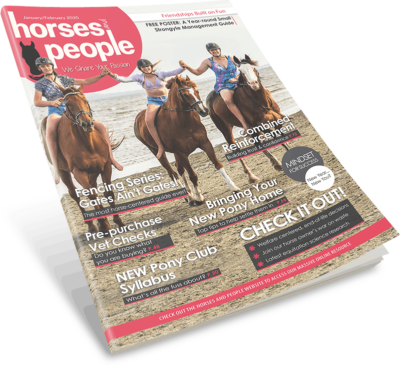
Pre-purchase veterinary exams: Hindsight is a wonderful thing and buying horses is a risky business. While there is no such thing as a perfect horse, a pre-purchase exam can answer many questions about the likely significance of an abnormality and likely long-term prognosis to protect you, the purchaser, from buying a problem that may be expensive, risky or even impossible to fix or treat.

So, what does a pre-purchase veterinary exam entail? Dr Olivia James from Australian Veterinary Equine Dentistry and The Veterinary Dental Company explains.

Horses are a risky business, right? The horse that is perfectly fine one day, can be rolling around on the ground with colic the next day, bandaged from hoof to hock the week after or scratched from a competition the folllowing month due to lameness.

We all know that some horses are just out to get injured, no matter how hard we try to protect them from themselves. It often seems that the more we pay for a horse, the more they seem to invent things to get us dialling our vet’s phone number… again.

In today’s litigious society where having insurance on everything from your car, your house, your job and even your life is becoming the norm, horse owners are becoming more aware of just how risky buying and owning a horse can be.

While many common problems are obvious to an experienced horse person, there are many things that are not obvious without specific veterinary training, specialised equipment and experience in equine veterinary practice.

Some common scenarios

Consider this scenario: Your 12-year-old daughter is riding independently and has been having riding lessons for the past two years. She has just outgrown her first pony and is looking to move up to something a little bigger and a little more forward. You find what you think is the perfect mount; he is a 14-year-old quarter horse cross gelding for a reasonable price of $2,500.

After a little financial juggling and a few delighted squeals you are heading back home with the newest member of your family. A pre-purchase veterinary examination (PPE) of this horse was too expensive and too hard to organise.

After a few weeks you notice that this horse is slower to eat his feed compared with the others, and he is a ‘hard keeper’, not gaining weight despite the extra feed he is getting. After noticing the spilled feed around the feed bin you ask your local vet to come and take a look at him.

At the end of this visit you are feeling dismayed, your daughter’s precious pony has a fractured tooth that requires treatment. Your vet has taken you through the treatment options, your mind boggles with all this talk of x-rays, extractions and infection.

Suddenly, the price and effort of a pre-purchase veterinary examination is dwarfed by the potential cost of treatment of this horse’s health problem.

Now let’s look at a different scenario: The same horse has been shying more than usual and last week your daughter fell off and fractured her collarbone when he shied at the last minute at something he has cantered past a million times before.

You get your local vet out, and after a physical exam, which includes examining the back of the eye with an ophthalmoscope, your vet declares that your horse is slowly going blind due to a degenerative eye condition whose name you can’t even pronounce.

There is no treatment and there is no cure. You are now left with a horse that doesn’t suit his intended purpose, you won’t be able to sell (ethics aside) and one that you will probably have to look after (and pay for) for the foreseeable future. Hindsight is a wonderful thing.

So, what does a pre-purchase veterinary exam entail?

A pre-purchase veterinary exam is likely to be the most detailed veterinary examination a horse will receive in its lifetime, and it will be tailored for an individual horse (and client) depending on many factors.

A PPE on a grand prix showjumper will be entirely different to one that is performed for a cutting horse, or a child’s first pony.

They will, however, share many similarities, such as an examination of the integumentary system (skin and mucous membranes), respiratory system (lungs, windpipe and throat), gastrointestinal system, conformation and an assessment of gait and soundness, just to name a few.

A vendor is asked to reveal any vices (e.g. windsucking) they are aware of, or if the horse has received any medications in the last 45 days.

Clients can elect to request specific diagnostics before the examination even starts, such as an endoscopic exam to assess the upper airway, or a reproductive exam to assess the likelihood of a broodmare being able to carry a foal.

The process

The clinician usually starts looking at the horse from a distance, evaluating the general demeanour of the animal, type and conformation.

In the absence of the purchaser, they need to make sure that they are actually examining a 16hh eventing prospect rather than a 11hh miniature pony. Don’t laugh, it has happened before!

The markings, brands, scars etc. are all noted, and the horse scanned for a microchip. While every vet will have their own way of proceeding, the vet will then have the horse trotted out in hand as a cursory evaluation of soundness (or lack of soundness).

Some of the more common problems found are conformational faults (pigeon toed, fetlock varus), oral pathology such as periodontal disease, splints and joint effusion (from arthritis or wear and tear on joints), skin lesions and scars.

An often-overlooked aspect of a pre-purchase veterinary exam is a complete oral examination. Periodontal disease is the most common disease of horses, and with over 60% of horses aged over 15 years affected, it makes complete sense to have a thorough exam carried out. In order to perform a complete examination, the horse requires a mild sedation and an examination with a speculum to keep the mouth open, a bright, focal light and a mirror or oroscope (endoscope designed for use in the mouth).

It is not acceptable for a cursory examination just by feel, approximately 75% of pathology is missed if this occurs (just as in when an oral exam and routine floating is performed).

The veterinarian should check the teeth to determine that the stated age correlates with the estimated age of the horse. They should also check for the presence or absence of dental disease and any malocclusions (such as wave mouth, hooks, ramps displaced teeth etc), and for the presence or absence of disease such as periodontal pockets, pulp exposures, fractures and more.

What can’t be seen can’t be diagnosed, and what can’t be diagnosed can’t be treated. It is important to note that the majority of dental diseases do not have clinical signs, but signs such as dropping feed, pulling faces when eating or slow eating can also occur in some cases.

The author routinely performs this part of the PPE at the end of the clinical and ambulatory examination as the horse can then be left alone while the sedation wears off.

Pass or fail?

Much discussion has taken place on a horse ‘passing’ or ‘failing’ a PPE. This is where good communication between the potential purchaser and vet is crucial.

While evidence of a tendon injury has a high significance in a showjumper, this becomes less so for a brood mare.

There is no such thing as a perfect horse; all horses have some imperfections that will be major or minor in magnitude.

The author assigns a risk level for any abnormality found depending on factors such as the age of the horse (e.g. a weanling versus a 17-year-old schoolmaster), and level of anticipated performance in the intended discipline and the horse’s breed.

The veterinarian performing the pre-purchase exam is not the buyer’s insurance policy for the horse staying sound. They are however, providing an examination at a point in time with consideration given to the intended purpose of the horse, the level of work it is currently in and with the history that has been provided.

The final decision

The final decision as to whether to continue with the purchase of a horse will always lie with the purchaser, and a good vet can help guide by answering specific questions as best they can about the likely significance of an abnormality and likely long-term prognosis.

Who owns the information?

The information gained from a PPE strictly belongs only to the potential purchaser, and it is entirely up to them whether or not they choose to share this information with the vendor.

A vendor may be unhappy if the purchaser decides not to proceed with a purchase after the completion of a PPE.

This can be a very awkward situation where the vendor feels hard done by and is worried there might be something wrong with their horse. Or they may feel that a problem that has been found by the veterinarian, in their opinion, is not as significant as the level of risk that it has been assigned.

Any conflicts of interest must be declared before the start of the examination. And, while it is preferable not to have that horse’s regular veterinarian perform the PPE, in reality this is often difficult, for example in small country towns where there may only be one veterinary clinic.

The pre-purchase veterinary exam report

Finally, a written report should be given to the purchaser and the opportunity given to explain any abnormalities found during the examination.

Often the practitioner requires that if the purchaser is not present at the time, they must be contactable by phone so any major issues can be discussed immediately and if any ancillary diagnostics are required (e.g. the recommendation of taking radiographs of feet or a specific area) these can be performed at the time.

The Equine Veterinarians Association (a special interest group of the Australian Veterinary Association) provides forms to its members to use for the purpose of providing a written report.

In summary, it is always advisable to have a pre-purchase veterinary exam performed on a horse you are considering, in order to protect yourself from buying a problem that may be expensive, risky or even impossible to fix or treat.

An experienced equine veterinarian will be able to tailor a pre-purchase exam depending on the individual horse and their client’s needs.

This article was published in Horses and People January-February 2020 magazine.

Little Riders and Cute Ponies: The World of Horse Book Illustration

Today we’re exploring pony stories and humorous cartoons. Pony stories feed our obsessions and provide insight into the skills and ethics of horsemanship and horse care. Beautifully illustrated pony stories also stimulate an appreciation of art and an interest in drawing.

Some pony books, the ones we are looking at here, such as the Billy & Blaze series, Misty of Chincoteague, and of course, the Thelwell books, are timeless, and as such their continuing readerships demand they remain in print.

My brief selection of personal favourites is based around a preference for a finished pencil and charcoal drawings with lots of detail. As a child I obsessively drew horses on every surface (and sold the drawings at school for twenty cents a pop!) so what I needed from illustrated pony stories was information on equine bone structure and how to render light and shade on shining coats.

My three favourite illustrators were able to show me many technical solutions. Their horses spring off the page, and you can feel their biomechanics.  Their horse drawings aren’t flawless; only Stubbs’s drawings of dissected horses are scientifically accurate, but they were well able to express the horse at liberty, the horse under saddle, the horse in relationship with its rider and feeling its own emotions.

Wesley Dennis, who collaborated with author Marguerite Henry on ‘Misty of Chincoteague’ and C.W Anderson, of ‘Billy and Blaze’ fame, were both horsemen as well as artists and it was the love of horses that led them to illustration. Thelwell, the ‘odd man out’ here, wasn’t horsey, yet he was a superb observer of their expressions, and those of their riders!

Wesley Dennis’ Misty of Chincoteague

Misty of Chincoteague has been a perennial best seller in the pony book category, and has been recently re-printed by Simon & Schuster. Misty herself was a real Chincoteague pony belonging to the story’s author. Misty was very pretty; “Oh the beauty of her! She was neither silver nor gold, she was both … Like her mother she, too, wore a white map of the United States on her withers.”

In the photograph of her with Henry (overleaf), we can see the ‘map’ on the patriotic little wither. She is surely one of the cutest foals in the pony book canon.

Misty’s story is set in the close seafaring community of Chincoteague, off the eastern shore of Virginia where the swimming of the wild ponies from one island to another for sale is an annual tradition. Misty’s dam, the ‘Phantom’ is called back to Assateague Island, where the wild ponies live by the stallion Pied Piper. Meantime, after a series of dramas and against the odds, the two orphan children Paul and Maureen Beebe, manage to keep her little filly foal Misty.

The structure of Misty, finding her, losing her, finding again and then winning the island race on Phantom, is a common structure that unites most illustrated pony stories, which tend to follow the arc of “rescue, rehabilitation and recognition”. Through this structure, the intertwined qualities of patience, determination and horse sense are key to eventual success.

“Based on abiding principles of patience and humour, these examples of pony stories and pony humour are a good introduction to the world of horses for children.”

Wes Dennis’s brilliant illustrations really bring Misty to life – her sweetness, ‘wonderment’ and ‘surprise’. A true post war pony book classic, ‘Misty’ enjoyed many sequels and reprints, and the original Misty herself is on view in taxidermied glory at the Beebe Ranch Museum to this day.

C.W. Anderson’s Billy and Blaze

Reaching and inspiring generations of new young readers, and staying in print for the last eighty years C.W. Anderson’s adventures of ‘Billy and Blaze’ came out in the midst of the Great Depression in the US. Between 1936 and 1969 Anderson wrote and illustrated eleven different stories in this series, each entailed boy and pony working together, with an underlying message about the importance of the proper care of horses, and of being responsible, kind, community-minded and hopeful. All qualities that were much needed in these tough years.

The story starts with “Billy, a little boy who loved horses more than anything else in the world.” For his birthday he finds Blaze in the garden, with a card on his halter from his father. Blaze becomes Billy’s “best friend” and together they roam the bridle paths and forests of Central Virginia, embarking on many adventures, some of which are frightening like Blaze and the Forest Fire of 1938.

The Billy and Blaze books became instant classics. What is notable about them is how the human-animal bond is depicted here with sweet simplicity, allowing the theme to develop in ways meaningful and relevant; caring for animals, having a work ethic, being tolerant; and learning about the natural world.

Such is the following for the books that Welkin Studios in Virginia, where the books were originally set, have brought them to the cinema. Billy and Blaze: The Movie stars a cute Welsh hunter pony, Banbury Cross Abu.

Taking the part of Billy is young rider Henry Lesko, while two-time US eventing gold medal winner Tad Coffin plays Billy’s grandfather. This fifteen year-long passion project is finally in post-production and its debut is much awaited.

Along with well-illustrated ponies stories, what we budding equestrians also need is humour. As equine journalist Rebecca Didier recently put it ‘we are bound together not only by our love for horses, but by recognition of our shared insanity’.  Somehow chuckling over the latest horse-meme on social media and clicking ‘share’ helps bring us that little bit closer.

Norman Thelwell

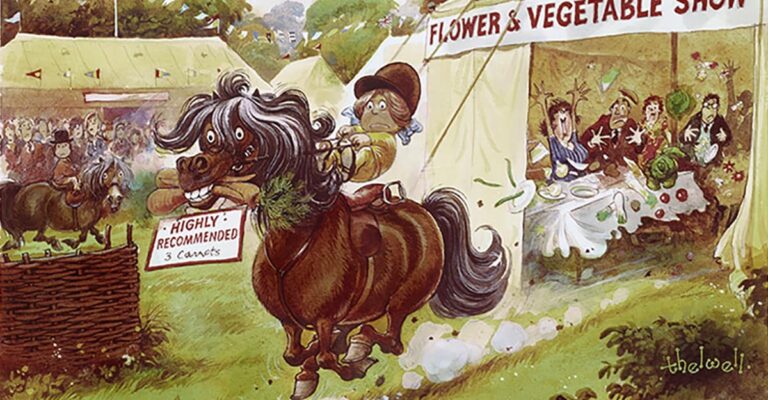
Ironically the master of pony humour, whose books are still amusing generations of horsey kids, Norman Thelwell, was terrified of horses, after having been bolted with in India.

One of the most popular cartoonists in Britain since the Second World War, Norman Thelwell is loved the world over for his ‘little girls and fat, hairy ponies’. His first book of pony humour Angels on Horseback, came out in 1957. This was followed by A Leg at Each Corner; then Thelwell’s Riding Academy and many more popular titles.

Those of us are now re-reading his books to children, and grandchildren will be pleased to know Trafalgar Square Books have recently released an anthology of the first three books, titled Pony Cavalcade. A line of merchandise thrives, including everything from mugs to curtains to a collection of Beswick china ponies. I believe our Dear Editor, a huge Thelwell fan, slept nightly as a child under a Thelwell print doona and matching pillow cases. And in England – apparently to this day – fat hairy little ponies are called ‘Thelwells’ and local shows often feature classes for ‘most Thelwellian pony’.

What is it about Thelwell’s genius that keeps the young, and young at heart, coming back for more? Maybe it’s because they are endlessly re-readable, and that is something children love. Kids are really good at looking at energetic, funny, lively, brightly coloured images again and again and finding the same enjoyment, even noticing new small details. The compositions are balanced and dynamic, and even the backgrounds are full of the wellie-boot sucking mud, wildlife, and buildings, of rural Engand. Thelwell’s quintessentially verdant and English settings – full of glades, copses, and ancient beech trees with winter are an added wonder for Australian children, more used to the whites, olives and baked ochres of the bush.

Thelwell was not from a rural, horsey family, in fact he was born by the sea, in Birkenhead on Merseyside in the north west of England, where the main business was shipbuilding. He started sketching as a little boy and had dreams of being an artist, but the Second World War intervened and he signed up in 1941. One of his jobs though was editing Army magazines, which provided valuable experience. Posted to India later, it was here that he had his one and only horse-riding experience – an army remount who bolted with him; leading to his opinion that horses are “great windy things that’ll grab your coat off your back as soon as look at you”.

“As equine journalist Rebecca Didier recently put it ‘we are bound together not only by our love for horses, but by recognition of our shared insanity’.”

Evening art classes, marriage and children followed, and eventually he won a spot drawing for Punch magazine, which put him in the public eye as a humourist. But it was the experience of moving to the country, in Hampshire, and seeing from his studio window the antics of the two little girls next door trying to catch their Shetland ponies that led to worldwide success, and thirty-two books on ponies, dogs, and country life, drawn with his usual dry but gentle wit.

Thelwell recalled “They [the fat little ponies] were owned by two little girls about three feet high who could have done with losing a few pounds themselves. They would arrive to collect their mounts in yellow pullovers, tiny jodhpurs and velvet safety helmets”, he remembered. The little girls calmly dodged every well aimed kick and bite. “As the ponies were led meekly away, he imagined “they were planning vengeance – you could tell by their eyes”.

Says Thelwell’s son David, “Most of his pony books were researched from real books on horsemanship. They are the normal methods, given a comic twist.”  Thelwell was a keen observer of Shetland pony behaviour, especially their stubbornness! These little vertically challenged hairy haystacks are depicted doing endless wayward things, shattering the visions of competence and skill of their tiny riders. Some of the funniest Thelwells are the ones where the diminutive partnership is out in public, aghast onlookers at the local gymkhana; supercilious other children on better behaved ponies at riding school; so the ponies’ antics are guaranteed to be particularly mortifying.

The books are both comical and endearing and inspired many later horse cartoonists all over the world. Jean Abernethy, creator of ‘Fergus’ says the reason for Thelwell’s timeless popularity is that … “Ponies still behave like ponies. And we still behave like humans …”

Norman Thelwell’s comedy continues to remind us to throw out expectations and take things lightly. Fergus (and his herd of friends) and Thelwell’s pony characters all reserve the right to remain fundamentally equine.”  She says of her own creation, ‘Fergus’, “I don’t try to make Fergus do human things. I let him be a horse.”   And as a horse, Fergus has the knack of saying what we often suspect our horses are secretly thinking, about everything from flying changes to his role as therapist to his human, Shelby!

Based on abiding principles of patience and humour, these examples of pony stories and pony humour are all a good introduction to the world of horses for children.

What’s interesting about all of these books is that though they were published in the thirties, forties and fifties respectively, they still easily available; and now being rendered into new media. Readers enjoy them because they do say something profound and enduring about the soul and spirit of horses. The reality of horse care and riding is mixed or lightened with humour and insight, and we are left, as the last page is turned, with the feeling that though as species we are poles apart, we can sometimes bring out the best in each other.

Further Information:

  • https://www.billyandblazemovie.com/
  • http://www.thelwell.org.uk/
  • http://wesleydennis.com/

References

  1. https://www.cartoons.ac.uk/cartoonist-biographies/s-t/NormanThelwell.html
  2. Quote from Rebecca M. Didier’s article in Horse Illustrated ‘Little Girls and Fat, Hairy Ponies
  3. August 14, 2017. https://www.horseillustrated.com/horse-community-little-girls-and-fat-hairy-ponies
  4. Ibid.
  5. https://toplinemediateam.com/fergus-the-horse/

This article was published in Horses and People January-February 2020 magazine.