fbpx
Home Blog Page 18

Humans domesticated horses – new tech could help archaeologists figure out where and when

In the increasingly urbanized world, few people still ride horses for reasons beyond sport or leisure. However, on horseback, people, goods and ideas moved across vast distances, shaping the power structures and social systems of the premechanized era. From the trade routes of the Silk Road or the great Mongol Empire to the equestrian nations of the American Great Plains, horses were the engines of the ancient world.

Where, when and how did humans first domesticate horses?

Tracing the origins of horse domestication in the prehistoric era has proven to be an exceedingly difficult task. Horses – and the people who care for them – tend to live in remote, dry or cold grassland regions, moving often and leaving only ephemeral marks in the archaeological record. In the steppes, pampas and plains of the world, historic records are often ambiguous or absent, archaeological sites are poorly investigated and research is published in a variety languages.

At the heart of the issue is a more basic struggle: How can you distinguish a “domestic” animal from its wild cousin? What does it even mean to be “domesticated”? And can scientists trace this process in archaeological sites that are thousands of years old and often consist of nothing more than piles of discarded bones?

As an archaeozoologist, I work in a field that seeks to develop ways to do just this – and with the aid of new technologies, recent research is turning up some surprising answers.

Looking for traces of domestication

Analyzing horse bones from archaeological sites across Eurasia, 20th-century scholars argued over whether changes in the size and shape of horse bones might reflect the impacts of human control. They debated whether management of a domestic herd would leave recognizable patterns in the ages and sex of horses in the archaeological record.

Without agreed-upon criteria for how to recognize horse domestication in the archaeological record, a staggering range of different ideas emerged.

In nearly every corner of the world with grassland ecosystems and wild horses, various researchers hypothesized domestication began in Anatolia, Iberia, China and even North America. Some more outlandish models suggested an origin for horse domestication as far back as the last Ice Age, about 20,000 years ago.

Toward the end of the 20th century, a key breakthrough in the debate came when researchers recognized that the use of bridle mouthpieces, known as a “bit,” can cause unique damage to the teeth of a horse, known as “bit wear.”
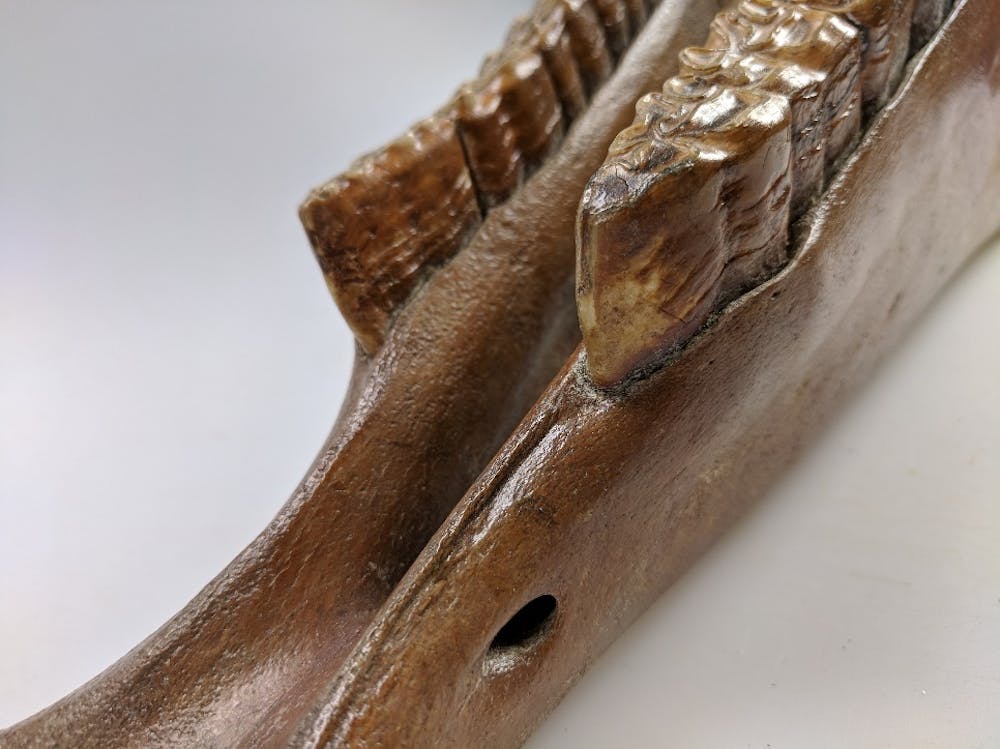
Horse teeth exhibiting damage to the front of the second premolar, caused by a metal mouthpiece – known as ‘bit wear.’
William Taylor, CC BY-ND

Still the complicated nature of archaeological data has made the search for horse domestication a process of trial and error. For example, one famous horse with bit wear, from the site of Derievka in Ukraine, seemed to place horse domestication in Eastern Europe as early as around 4000 B.C. – until scientific dating showed that this animal lived around 600 B.C.

Evidence from Kazakhstan

In the late 2000s, a proliferation of scientific research seemed to narrow the field to a single, compelling answer for the first domestication of the horse.

Researchers zeroed in on a site called Botai, in northern Kazakhstan, dating back to around 5,500 years ago. Nearly 100% of the animal bones they identified there were from horses. These animals were butchered and eaten, and their bones were used to make a variety of tools. Some were buried in ritual pits.

Initially, skeptics argued that the age and sex patterns of Botai horses were inconsistent with a domestic herd. Pastoral management involves culling young, mostly male animals, and far too many of these remains were from adults and females.

However, individual teeth found at Botai showed apparent bit wear. And, in a dramatic discovery made in 2009, a new technique that analyzes ancient fat residues suggested that the ceramic vessels recovered at Botai once contained horse milk products. If true, that finding would indicate humans had raised and cared for the horses that produced it.

This new biomolecular evidence appeared to place horse domestication deep into the past, around 3500 B.C. To some, if people were eating and milking horses, logic dictated that they must have also ridden them.

Many researchers took this thinking a step further, using this early timeline to argue that horse domestication kicked off the continent-wide dispersal of Indo-European peoples and language groups around five or six thousand years ago.

Newer techniques cast doubt on Botai

As the 2020s begin, the pace of technological innovation in archaeology continues to accelerate. And new archaeological data have begun to trickle in from understudied areas.

With improving methods, new information has triggered serious doubts about the Botai/Indo-European model about domestication.

In a shocking 2018 study, a French research team revealed that the horses of Botai were in fact not the domestic horse (Equus caballus) at all, but instead Equus przewalskii – the Przewalski’s horse, a wild animal with no documented evidence of management by human societies.
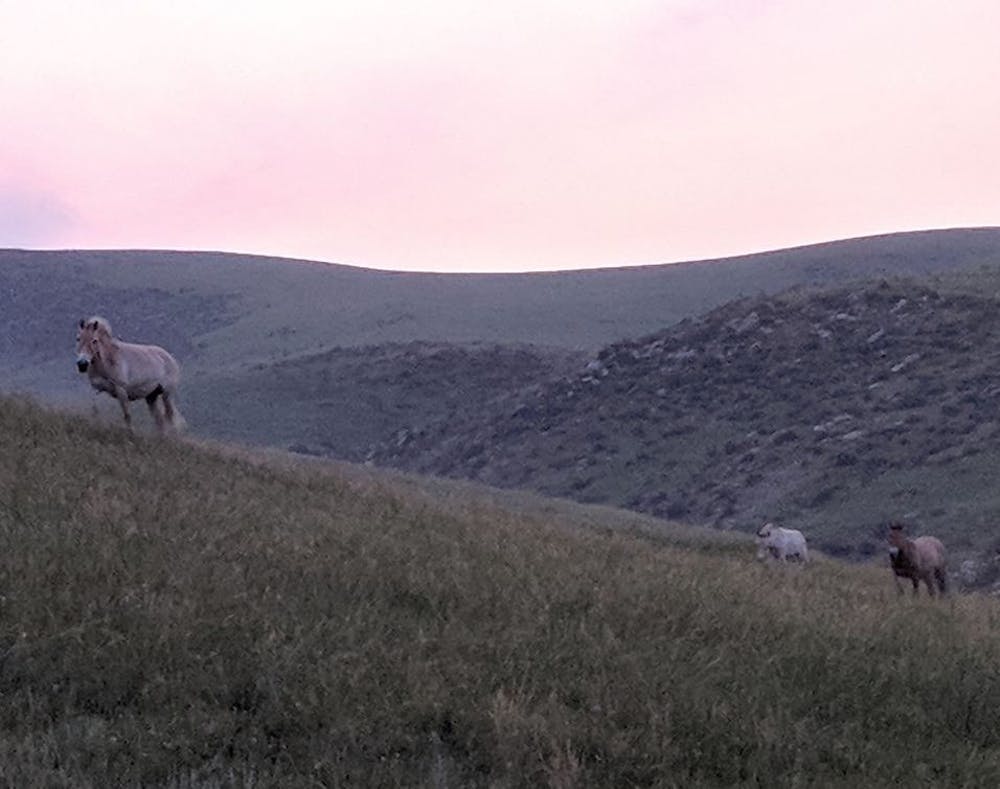
A family of wild Przewalski’s horses at sunset in Khustai National Park, Mongolia, where they have been reintroduced following their near-extinction. William Taylor, CC BY-ND

Another project using ancient DNA analysis of human remains from Botai showed no genetic links between the area’s ancient residents and Indo-European groups, undermining the idea that horse domestication at Botai stimulated a continental dispersal on horseback.

In the ensuing chaos, researchers must now find a way to piece together the horse’s story, and find an explanation that fits these new facts.

Some, including the equine DNA researchers who published the new discoveries, now suggest that Botai represents a separate, failed domestication event of Przewalski’s horse.

Other scholars now seek to reevaluate the archaeological and historical records around the horse’s initial domestication with a more skeptical eye.

As of the writing of this story, the oldest clearly identified remains of the modern domestic horse, Equus caballus, date back only as far as about 2000 B.C. – to the chariot burials of Russia and Central Asia. From here, researchers are scrambling backwards in time, seeking to find the “big bang” of the human-horse relationship.

Pastoral herding is still a key way of life in Mongolia, and horses are important as both livestock and transportation.
Orsoo Bayarsaikhan Photography, CC BY-ND

No clear answers, but a path forward

New data from places typically left out of the conversation, such as Mongolia, may help fill the holes in the story of horse domestication.

My colleagues and I, led by Shevan Wilkin, recently recovered ancient proteins from the teeth of Mongolia’s ancient herders that suggest these pastoralists who lived around 3000 B.C. drank the milk of cattle or sheep or goats – with no evidence they drank milk from horses.

In fact, much of Central Asia may not have had domestic horses at all until well after 2000 B.C. Another recent study suggests the late second millennium B.C. saw a spike in the frequency of domestic horses across the continent – perhaps because the innovation of horseback riding occurred much later than researchers had commonly assumed.

The urgent question now becomes: Where did the first ancestors of the modern domestic horse first find themselves under human care? And what does this tell researchers about the rest of human history that followed?

In the decades to come, the story of humans and horses is likely to be dramatically rewritten – maybe more than once.
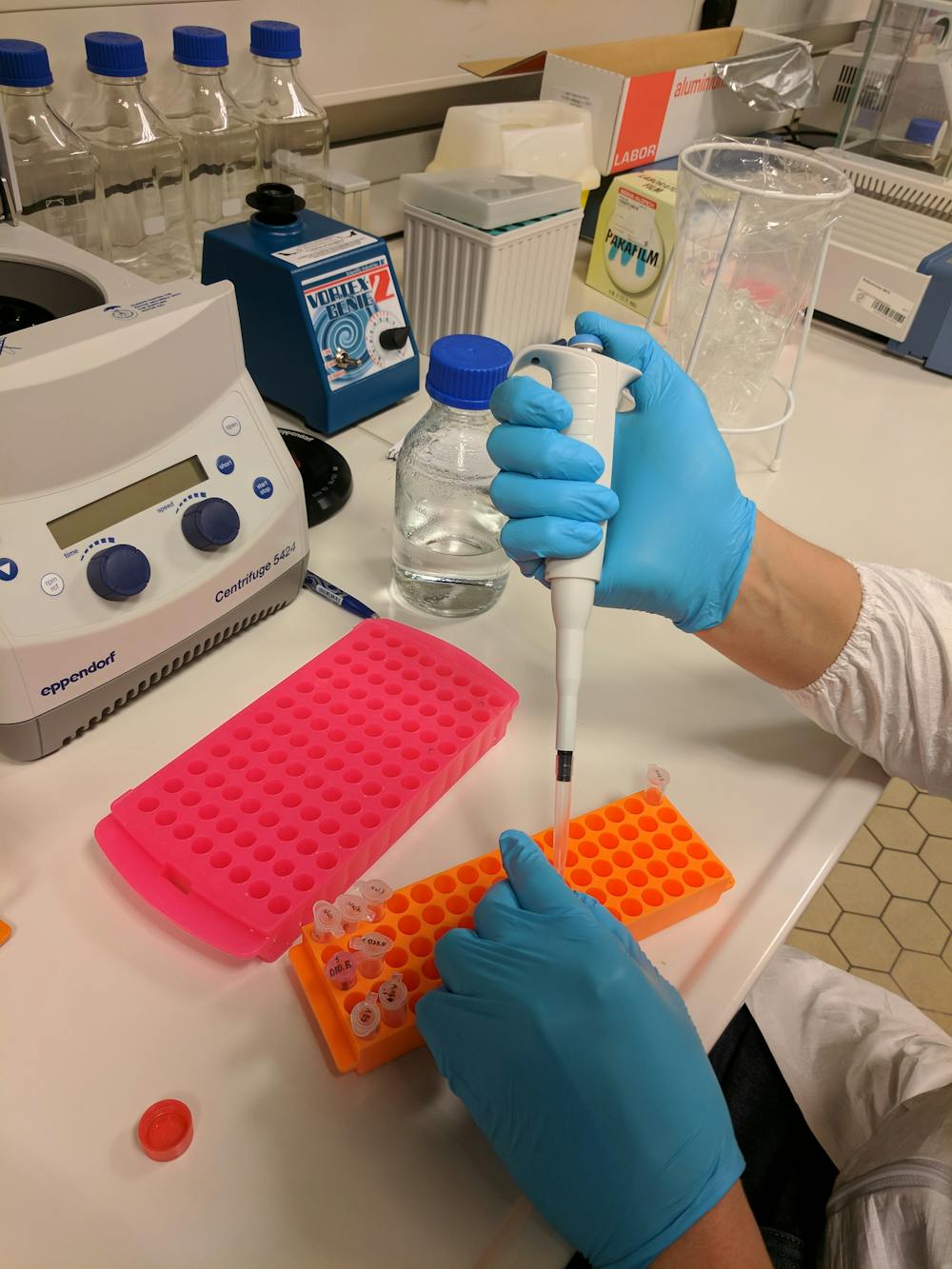
Scientists work to extract collagen at the Max Planck Institute for the Science of Human History in Jena, Germany, to identify ancient horse bones from Central Asia for DNA analysis. William Taylor, CC BY-ND

Archaeologists must continue to use cutting-edge technology, constantly reevaluating old conclusions developed with earlier techniques. DNA and biomolecular data must be paired with other kinds of information, such as skeletal clues, that can tell us how horses were bridled, exerted or cared for. That can help to distinguish wild horses from early domestic horses managed by humans.

Species identifications from archaeological sites must be made using DNA rather than assumed (as at Botai) – and each specimen must be directly radiocarbon dated to determine its age, rather than lumped in with other similar objects and dated through guesswork (as at Derievka).

Most importantly, archaeologists must continue to dive deeper into the archaeological record of the desert and grassland regions of the Old World – Eastern Europe, Russia, Central Asia, Mongolia and elsewhere – where the secrets of the past have not yet all been brought to light.

William Taylor, Assistant Professor and Curator of Archaeology, University of Colorado Boulder

This article is republished from The Conversation under a Creative Commons license. Read the original article.

Royal Windsor Show Pivots to a Virtual Platform to Beat the Pandemic

Faced with a pandemic, the Royal Windsor Horse Show 2020 has pivoted to a virtual platform.

In doing so quickly and with a beautifully designed platform, the organisers have set the bar high for all other equestrian events going online to continue supporting retailers, sponsors, participants and engaging the public despite the enforced shutdown. 

On Tuesday 1st April, the organisers launched VIRTUAL WINDSOR 2020, a new online hub, which is free to the equestrian community. This enterprising initiative aims to help fill the gap left by the cancellation of Royal Windsor Horse Show 2020 due to Covid-19.

VIRTUAL WINDSOR 2020 will host exciting features, the Show’s 200 shops, virtual Showing competitions, training videos, social media feeds and the best of online content from previous Royal Windsor Horse Shows and from the equestrian world at the moment.

The shops that would normally have a physical presence at the Show will be displayed on the hub, giving users the opportunity to access some of equestrian’s best brands, including the latest technical equipment, country and lifestyle collections and clothing. One of the key drivers of the “Virtual RWHS Shopping Experience” are the deals some of which will be available exclusively on the platform.

Those visiting VIRTUAL WINDSOR 2020 can also enter online equestrian competitions, including a variety of Showing classes adhering closely to the original Royal Windsor Horse Show schedule.

Those wishing to compete will upload their entry in the form of a photo to put them in the running, with applicants able to enter via email or social media. A Royal Windsor Horse Show judge will then select 10 finalists, before announcing the winner. The winners of each class will then progress to the Championships being judged on Sunday 17 May 2020.

To further help fill the void, VIRTUAL WINDSOR 2020 will give users access to features from the official Royal Windsor Horse Show programme. For the nostalgic, there is fabulous content from the archives (check this out) going back to the 1960s. There are guest bloggers, live Q&A sessions, and insights into Royal Windsor Horse Show 2021, which is already well into its planning stage.

Giving equestrian fans a central hub to find training videos, light-hearted posts, the latest updates from top competitors, and tips from other riders, VIRTUAL WINDSOR 2020 will support trainers, coaches, physios and riders who may be struggling during this time.

Show Director Simon Brooks-Ward said:

“This online platform is a way for the equestrian community to come together, it aims to support and entertain, keeping the spirit of Royal Windsor Horse Show alive during this difficult time.

“The platform involves everyone, from fans to riders, shops, competitors and officials.

“We wanted to find a way that we could support the shops at the show and engage with our competitors and customers and I’m genuinely excited to see what we can accomplish. Our hope is that it will go part of the way towards recreating the magic in Windsor Castle’s iconic private grounds that we all expected to see in May.”

Ben Buxton, Events Manager of Fairfax and Favor said: “Virtual Windsor is an exciting real and online opportunity for Fairfax and Favor to have a presence at one of the leading horse shows of the year. Whilst we may not see customers (both new and existing) in person, we relish the opportunity to connect with anyone who would have seen us, and let them see our range, including the launch of our Spring Summer 2020 collection”

The Show plans to return next year from 12-16 May 2021. Over 55,000 visitors are expected to attend the annual Royal Windsor Horse Show, which offers its audience an extensive programme of first-class equestrian competition and performances in five arenas.

The displays in the main Castle Arena are set to include The Musical Ride of The Household Calvary Mounted Regiment, The Musical Drive of The King’s Troop Royal Horse Artillery, The DAKS Pony Club Mounted Games and The Shetland Pony Grand National.

As well as the equestrian competitions and activities, there are over 220 shops in the Shopping Village, with a wide range of goods for sale, from jewellery and fashion, to food and drink. Her Majesty The Queen has attended every year the Show has run since 1943 and it is the only time of the year that the private grounds of Windsor Castle are open to the public. Royal Windsor Horse Show is organised by Windsor Equestrian Promotions Ltd, as part of HPower Group, also organisers of Olympia, The London International Horse Show

Seven tips to manage your horse’s weight

These challenging times are affecting every aspect of our lives, including, for many of us, how we manage our horses. If you are turning your horse out daily or 24/7, check out these 7 tips to help you manage your horse’s weight.

Rates of obesity are considered to be as high as 70% in some populations of ponies. Quite simply horses usually get fat because they receive more calories/energy in their diet than they burn through activities such as exercise, keeping warm and just the daily energy required to keep them alive (basal metabolic rate). Excess weight increases the risk of laminitis so it’s crucial to try and keep grass intake under control.

Importantly, the latest research shows that strip grazing could be a useful tool for restricting weight gain.

Annette Longland in collaboration with Spillers via the WALTHAM Equine Studies Group compared three restricted grazing practices for equine bodyweight management during the UK grass-growing season.

Three groups of four ponies, that had been equally matched for weight, height and secondarily, body condition score, were placed in paddocks with a herbage yield equivalent to 1.5% (dry weight) of the ponies’ bodyweight per day for 28 days.

The groups were assigned to one of three grazing practices:

  1. no other restriction;
  2. a lead fence placed across the width of the paddock to allow fresh grass to be accessed each day by moving it 1/28th of the paddock length daily;
  3. strip grazed with both a lead and a back fence with the back fence being moved the same distance as the lead fence daily.

The ponies were weighed and body condition scored weekly. Bodyweight gains were significantly higher for the ponies without any grazing restriction but there was no significant difference in weight gain for those with the lead fence and those with the lead fence and back fence.

“The ponies with gradual access to pasture via strip grazing had significantly lower bodyweight gains than their counterparts who were allowed free access to the entire 28-day herbage allocation,” said Clare Barfoot RNutr, Marketing and Research and Development Director at SPILLERS.

“If you are planning on turning your horse out to grass during this current situation or at any other time it’s certainly worth considering installing a strip grazing fence and moving it once a day.”

The next stage of research includes looking at a number of other aspects of strip grazing such as pasture wear and tear and activity levels in order to be able to give further advice as to the choice of strip grazing method.

To help horse owners get through these testing times safely, Clare has put together 7 tips to help you manage your horse’s weight:

1. Install a strip grazing system: smaller paddocks are best to limit grass availability, but the fence should be moved daily.

2. Turn out at night: Overnight typically grass will contain less sugar and fructan (Water Soluble Carbohydrate).

3. Beware of restricting time at grass: Ponies in particular learn quickly that they need to maximise their time eating and can consume 40% of their daily intake in just 3 hours!

4. Use fewer rugs: Fewer rugs or no rugs at all will encourage a horse to burn off a few extra pounds keeping warm!

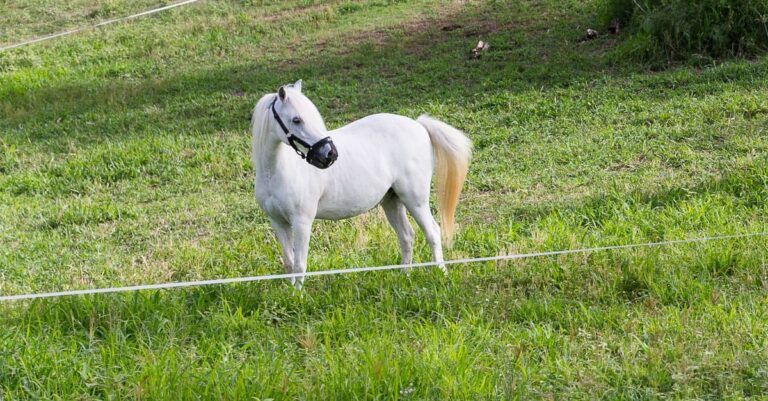
5. Try a grazing muzzle: A grazing muzzle can reduce intake by up to 80% but it must be properly fitted, allow for drinking and you must let the horse or pony get used to it before leaving it on for long periods although they should never be left on for 24 hours a day. Continue to monitor body weight as some horses and ponies can still gain weight while wearing a grazing muzzle.

6. Feed an alternative safe source of forage: For horses and ponies at very high risk consider removing them from pasture altogether and feeding them a suitable forage/ short chopped fibre, preferably one that has been approved by the Laminitis Trust and/or is guaranteed low in starch and sugar.

7. Up the exercise: Regular exercise will help keep a horse’s waistline in check and support a healthy metabolism.

Harris P & Longland A (2020) Comparison of three restricted grazing practices for equine bodyweight management during the UK grass growing season is in the Proceedings of the 4th Global Equine Endocrine Symposium p64.

Learn more about grazing management with Equiculture.

Read about the Equicentral System.

The Equestrian Coach Challenge

The coronavirus crisis is creating huge problems, but it’s also opening opportunities for us to focus on connecting with what really matters and embracing the opportunity to lead.

A leader who believes in turning a crisis into an opportunity for meaningful change is the EquiCoach, Lisa Ashton.  An equitation science coach and mindset coach based in the United Kingdom, Lisa has been, for the last two years, building a connected community that thrives on curiosity and encourages us to “be the change our horses need”. Now she is coming up with new initiatives to expand the connection and support professionals and horse lovers need to ride this through and come out stronger.

Scroll down for the video interview.

It is not surprising to see Lisa quickly pivot to turn this current crisis into an opportunity to expand her connections and support more people, by offering a new range of initiatives that will help these changes we are making become a better future for ourselves, our communities, our horses and the horse sports we love.

Already ahead of her time, Lisa’s landscape is all about connecting people on- and off-line. While she coaches in the field, she also embraces technology, using Zoom for coaching, webinars, interviews and meetings, and running two separate Facebook communities – the free access Coffee With Horse Lovers and her mastermind subscription group, Espresso With Equicoach.

Throughout April and starting on Monday April 6th, Lisa is launching the Equestrian Coach Challenge, a four-week (20 x 1 hr sessions) program designed specifically for coaches but made accessible to anyone who wants to come out from the COVID-19 crisis stronger.

The challenge is using this time of restriction and uncertainty to get close and personal with the framework of horse sports’ social licence to operate and learn to navigate the social media landscape with more confidence. The comprehensive program is packed with information, tools and resources to help you become an influencing and socially responsible equestrian coach.

In just one hour a day (weekdays) on Zoom over four weeks, Lisa will provide you the resources you need to feel comfortable in a social media landscape and show ways to improve your legitimacy, transparency, communication and public trust.

From helping you assess lightness to turning mistakes into wins, from how to show up on social media to the how-to of running digital training for your clients.

By the end of the challenge you will be ready mentally and practically to work online and give your clients exactly what they need right now, YOU.

You can also join the challenge if you are not a coach! Just say on joining. We are all in this together and this challenge is inclusive of everyone.

The course will run over 4 weeks (20 x 1 hr sessions in a small group) and costs just £50.

However, there’s a special offer for those who know they need this challenge and are struggling to make this contribution, please email lisa@equicoach.life to discuss and look at other options. Thank you for your support.

All you need to do right now is click here to join.

Watch my interview with Lisa Ashton, where we discuss the coronavirus situation, the challenges and her ideas for improving our connection and coming out stronger.

Pony Club Australia Launches Plan B

Pony Club Plan B. Even though your local Pony Club is not running competitions or rallies right now, there is still plenty to do.

Pony Club Australia has launched the #ponyclubplanB to help you BE ACTIVE – BE LEARNING – BE CONNECTED

BE ACTIVE:

Have an Active April!

Get a team together from your club, zone or riding centre and add up your daily activity. Visit the 10,000 steps website.

More details on page 4 of the April PCA newsletter. We have lots of prizes to thank you for taking part. Every participant gets a 50% discount code for the online courses at ‘The Horse Riders Mechanic’ and the full Equiculture course at Equiculture, as well as a 10% discount code to spend at Shezam Equestrian. Many other prizes for individual and team top score, highest average, most improved, most innovative and most enthusiastic.

Improve your own health and wellbeing with The Riders Pod

Support your health, nutrition and fitness goals with The Riders Pod. Plenty of at-home workouts for all fitness levels.

PCA Members save 20% on monthly subscriptions and 30% off annual subscriptions https://theriderspod.com.au

Enter an on-line horse competition

Video yourself and submit it to the event organiser. The Horseland digital dressage competition is free to enter . More details here. Closes April 13th

Many Pony Clubs are also running virtual competitions so check out your local calendar. There are lots more to come and some examples here.

Set up a record for your horse care regime on Hopoti

The Hopoti horsecare module lets you keep all of the information in one place

Get crafty

Make something cool from a huge list of DIY horse projects on YouTube here.

BE LEARNING

New Pony Club certificate manuals

Get started on your next certificate. Everything is in the new manuals. Order via the member store. Here’s how…

Your club might set up a Facebook group for your friends doing the same certificate so you can work through it together.

We will soon have some on line assessment tools for your certificates too.

Learn about Equitation Science

This is a new part of the PCA syllabus and there is a lot of free video content to help you learn and practice it with your horse.

Videos from Equitation Science International and Equitation Science Coaching are on You Tube.

The videos from Sustainable Equitation closely follow the PCA syllabus.

Dressage training TV

PCA have negotiated a special arrangement with Dressage Training TV just for members. The Pony Club Australia package is approximately $14 per month (6.90 British Pounds Stirling). The Pony Club Australia package gives PCA Members full access to four courses: The How of Riding (10 x 1hr video lessons), Improve Your Dressage Scores (6 x 1hr video lessons), Equine Back Rub (4 x 1hr video Lessons, a pdf download of the book ‘Master Dressage, The Basics’ by Peter Dove and most importantly, the Groundwork Certification Programme. The Groundwork Certification Programme has five levels of certification from beginners through to lateral work. Dressage Training TV provide feedback on videos that you send through for assessment.

Click here to find out more.

Free courses

Equiculture has free videos on Youtube and a discount on their comprehensive courses. The free videos will help you improve your riding and learn how to manage your horse paddocks. More information and a free ebook here

Erica Posely has free videos on improving the use of your aids.

Listen to a horse podcast

Horse Chats is available on iTunes. It is up to episode 659 so plenty to choose from.

BE CONNECTED

Join the PCA National Quiz on Thursdays in April

Have some fun with the Pony Club community from across Australia. We will be running the Quiz on Kahoot. Make sure to keep watch on the PCA Facebook page for entry details each week.

Watch a horse movie with your friends

There are plenty to choose from. Here is a list to get you started

More fun with your friends so set up a watch party on Facebook

Reflect

COVID19 is an unimagined global pandemic. We are living through history in the making. It will be talked about by generations to come. Why not make a journal with your thoughts, pictures and videos to share with your children and grandchildren?

Be mindful

Get the right mindset to see out this period. This article is written for equestrians.

Smiling Mind is a free app with meditation and mindfulness tracks

Talk about it

Sane.org has a helpline 1800 187263 and forums to connect with others

Lifeline 13 11 14 for 24 hour crisis support

eHeadspace is on line help for 12-25 year olds

Kids Helpline 1800 55 1800, email and webchat

#ponyclubplanB

Kandoo Community and Connection

Online horse training. With the current global crisis, what we, as horse lovers and riders need today more than ever before, is community and connection.

The Kandoo Community is a group of like-minded, supportive horse owners and riders who would love to welcome you to their tribe. Founder, Kate Fenner, is a regular contributor for Horses and People Magazine, and writes regularly about horse training that is evidence-based and ethical.

Above all else, Kate will make you feel confident about becoming your horse’s trainer! 

There are lots of ways to get involved and, as a member, I highly recommend all of them!

1) FREE (ONLINE HORSE TRAINING) MEETINGS

Kandoo holds two free online training meetings each Wednesday. They run at 8am and 5pm (Brisbane time) on Wednesdays.

At these, you can meet other horse owners, discuss your horse and training with Kate, learn from others’ experiences and get the support you need. If you want to take a peek and see a meeting example, click here. There is also a series of meetings where Kate invited the legendary Josh Lyons to help the Kandoo Community, click here.

To enter the meeting, click here (the address is always the same – my Zoom room: 845 829 8338).

2) FREE 30-DAY VIDEO SERIES

Get 30 days of training videos delivered directly to your inbox. Simply click here for the free subscription.

3) FREE 100-DAY EMAIL SERIES

Let’s face it, we’re likely to be house-bound for the next 100 days, so why not discuss a horse training question each day? Click here to get the series delivered to your inbox.

4) 50% OFF KANDOO GOLD

Extraordinary times call for extraordinary measures! Enter the coupon code COVID19 to receive 50% of your lifetime ownership of the most comprehensive online training available today. Follow the roadmap to

To learn more, click here.

5) 50% OFF EAT, RIDE, LOVE

It’s vital that, during this time of global crisis, we look after ourselves. For this reason Kandoo is also offering 50% off the Eat, Ride, Love Course – a holistic approach to rider health and fitness and horse training.

This course includes horse training, diet, an exercise app, emotional health, virtual meetings and access to a private Facebook group.

Enter the coupon code COVID19 on checkout to receive 50% off this 8 week course.

To learn more about the course, click here.

All prices on the website are shown in full, simply click your payment option, enter the code COVID19, and the price will reduce by 50% (also applicable to payment plans).

So go on, join the Kandoo community, learn about the latest in ethical, evidence-based and sustainable training and find the support you and your horse need on this extraordinary journey.

Barmah Brumbies: Admired or Despised

A decision by Parks Victoria to eradicate all brumbies from the Barmah National Park within the next three years has intensified the clash between conservation agencies and brumby advocates.

One side considers free-roaming horses to be destructive, invasive pests that don’t belong in the Australian landscape. The other believes that having lived there for over 200 years, these animals, descendants of the working horses that contributed to European settlement, are now an integral part of the forest and Australia’s cultural heritage.

The passionate and polarised views are stifling discussions but, according to Renee Neubauer, former President of Project Hope Horse Victoria and a member of the Barmah Brumbies Hay Angels, a group that formed to help horses and other wildlife through the 2018-2018 drought, there are factors and options that need to be seriously considered before the imminent eradication program begins.

In this article, Renee describes the situation these horses find themselves in and some of the initiatives that could allow their sustainable presence in the Barmah National Park.

The Barmah Forest

The Barmah National Park is a wetland that lies adjacent to the Murray River near the town of Barmah, approximately 225 kms north of Melbourne. European settlers arrived in the area during the mid 1800s and soon, the township now known as Barmah became a river outlet for transporting wool along Australia’s longest river, which flows westwards from the Alps all the way to Adelaide, in South Australia.

Timber, cattle and wool were the mainstay economy and the Barmah Muster Yards still stand today as a reminder of the vast pastoral activity. Dating back to the 1880s, these Muster Yards are Heritage listed and used each April for the well-attended Barmah Muster.

Back in the mid 1850’s before mechanisation, draft horses were a farmer’s tractor and when the workhorses were done for the season, they were turned out into what was called the Barmah ‘common’ – a paradise of green serenity for the horses to rest and recover until they were mustered-up for the next season’s work. Of course, not all were recovered every season and some remained roaming free in Barmah.

The start of World War I in 1914 saw many local lads enlist in the war efforts, so they too turned out their horses. Tragically, many never made it back from war so their horses remained free. These are the founding stock of the Barmah brumbies.

Much later, in the 1950’s, a local trainer of Standardbreds fell on hard times and released some of his herd into the Barmah.
Barmah State Park was established in 1987 but became the Barmah National Park in 2010, and it was this name change that spelled trouble on the horses. Suddenly, brumbies found themselves bearing the brunt of the blame for the destruction of the forest’s Moira grasses which predominate in the wetland.

The Moira Grasses

Moira grass conservation is the reason Parks Victoria want the brumbies eradicated. This native species is listed as a ‘critical wetland type’ of international importance under the Ramsar Convention, which aims to halt the worldwide loss of wetlands and to conserve, “through wise use and management”, those that remain.

The grasses have suffered a 90 percent decline in extent since 1930 and provide a hunting and nesting ground for birds including several species protected by bilateral agreements between Australia, Japan and China.

Principal factors like artificially controlled flooding regimes, invasive weeds and the ever-choking saplings that are encroaching the Moira Grass plains en-masse are now considered the biggest threat to Moira grass conservation (Bren 1992, CSIRO Publishing -Ecosystem Sciences), yet the brumbies continue to be blamed for most of the degradation. Keep in mind that, prior to the regulation of watering conditions, in the 1930s, Moira grass extent was estimated at 4,000 hectares and this was a time when 4,000 head of cattle and brumbies roamed the forest.

Since river regulation, reductions in the frequency, depth and length of inundation mean that Moira Grass does not have the same opportunities as it once did to complete its lifecycle. These changed conditions have allowed river red gum and giant rush to encroach on the Moira Grass plain” said Mr Childs from the Victorian Department of Agriculture, Water and Environment.

Despite all this, and the presence of some 150 to 200 free-roaming horses, the seasons of 2018 and 2019 recorded exceptional growth and flowering of Moira grass. It was observed to grow in parts of its former range where it has not been recorded for many years as described by the Victorian Environmental Water Holder.

A war of numbers

There is controversy surrounding the number of brumbies in the Barmah National Park. To base their estimates, conservation agencies have used the FLIR imaging system, whereby areas that are frequented by the horses are surveyed.  The results of these surveys conducted in June 2018 and 2019 suggested 540 horses, but choosing sites of highest brumby density could provide artificially high readings. Other surveys conducted during October and September 2019 record numbers nearer 280.

While Parks Victoria state that that the 280 count ‘under-represents’ the numbers, but will not acknowledge the possibility that 540 ‘over-represents’. As well as false readings due to the location bias, the Barmah Brumby Hay Angels (BBHA) have questioned whether deer could be mixed up in the counts.

The BBHA was formed during the drought of 2017/2018 when the Murray Darling Basement Authority released great amounts of water into the river to increase flows for growers in South Australia. The extreme flooding starved the parks animals (not just brumbies), as they were either cut off due to flood waters or their grazing areas were destroyed.

Kaye and Gerry Moor drew attention to the fate of the animals. A third generation resident of the Barmah, Gerry has an intimate understanding of the life of the Barmah brumby.

The Moor’s started the BBHA to provide fodder to the horses as well as many of the native species, which include kangaroos and wallabies. I became involved at this time, when we were granted access to private properties that bordered the park from where we maintained feeding stations to see the animals through the tough times.

Through generous donations, BBHA was able to purchase hay and feed around 120 brumbies and countless other native animals. Other private individual groups and locals joined the cause.

From drought to eradication

Under the Strategic Action Plan Protection of Floodplain Marshes Barmah National Park and Barmah RAMSAR site, 2020 – 2023, Parks Victoria plan to remove 100 brumbies each year over a period of four years.

The BBHA are opposing the plan because, based on their estimated numbers, which are almost half of those published by Parks Victoria, the brumbies would be eradicated from the area in less than two years.

Horse trapping practices, however they are done, have their share of welfare impacts that deserve to be considered. In Australia, horses may be trapped into pens by chasing or luring with salt licks. Mares and foals can easily become separated and family bands broken up. Stallions lose their mares, whilst feeding mixed bands in confined areas leads to fights and injuries.

Parks Victoria have listened to community pleas for the welfare of the horses and, for the first time, they have established a re-homing program. While on paper this is a much better alternative to culling, under the current terms and timeline set, it is not feasible. The department first called for expressions of interest on Feb 24th, and closing date for applicants is March 30th (Editor’s note: The dates refer to the year this article was posted, 2020).

In practice, this short time frame means that prospective re-homers are given one, maybe two weeks notice once Brumbies are trapped, making it difficult to find suitable homes for many horses, and those that remain unclaimed are then shot or sent to slaughter, placing their welfare at even further risk.

A hung jury

The Consultation Summary of the Strategic Plan notes that 67% of respondents said they rarely or never visit Barmah, and of those, 50% don’t support the shooting Brumbies. The heritage and cultural value of the brumbies was listed as the principal response when questioned whether the horses should be allowed to remain.

The local Bangerang Aboriginal Corporation stated that evidence-based decisions on the health of the forest should be made in consultation with their community. Whilst they acknowledge there are differing opinions in relation to the Barmah brumbies, they mention that the horses are now part of the history of the forest.

Is balance possible?

Is it so wrong to consider that, after two hundred years living in this environment the brumbies might be allowed to stay? As a main tourist attraction, keeping brumbies in the National Park provide a great benefit local rural towns who are already struggling through ongoing droughts and fires.

Australian Brumbies are included in the World Wild Horse database undertaken by the university of Texas’ team led by Dr Gus Cothran. To date, DNA sampling has established a genetic line that is individual to the Barmah Horses and Barmah National Park.

An approach that BBHA argue is not being explored deeply enough by Parks Victoria is whether a balance could be struck by allowing a sustainable number of brumbies could remain in the forest and still allow Moira grass regeneration.

Perhaps a controlled number of horses could be contained within certain parts of the forest, setting aside some form of sanctuary.
After all, many other countries maintain free-roaming horses and have been reporting benefits from re-wilding herds of horses and cattle as a means to maintaining and regenerating natural ecosystems.

More research could be undertaken to provide an evidence-based assessment of the welfare of the current population.

In the United States, Mustangs are used in inmate rehabilitation programs and other equine therapy interventions.

At the very least, Parks Victoria should consider much longer time frames for the removal of horses, such as implementing more sustainable and feasible rehoming programs and conducting immunocontraception trials to reduce numbers more gradually. These are more humane and sensible options than eradication through trapping and culling.

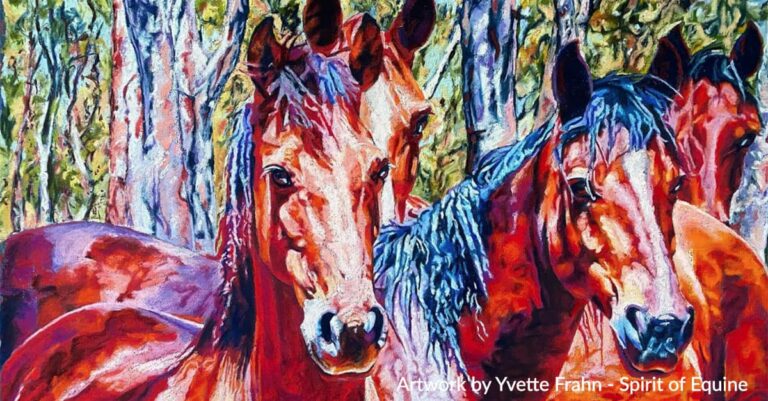
The world is watching Australia’s handling of its brumby population. Many influential photographers and artists are shining a spotlight on their iconic status and remarkable resilience. A photo by Lyn Collins is being turned into an artwork by South Australian Yvette Frahn, Spirit of Equine, and will be the showcase piece of an upcoming exhibition.

With almost a quarter of a century of forest living, the brumbies’ strong form of mutualism should be given immense consideration before eradication. Too rapid and great a shift in the balance could see the Park’s ecology going into shock. As coexistence becomes possible, any introduced species must eventually become ‘native’ as it should in the case of the Barmah brumbies.

For more information, and to stay up to date, follow the Barmah Brumby Hay Angels Facebook Page.

To support the Barmah Brumbies petition on change.org, please click here.

To support the Barmah Brumbies parliamentary e-petition, please click here.

Mounting and Dismounting Causes Stress in Therapy Horses

Therapy horses.

It can be a tough, but noble job.

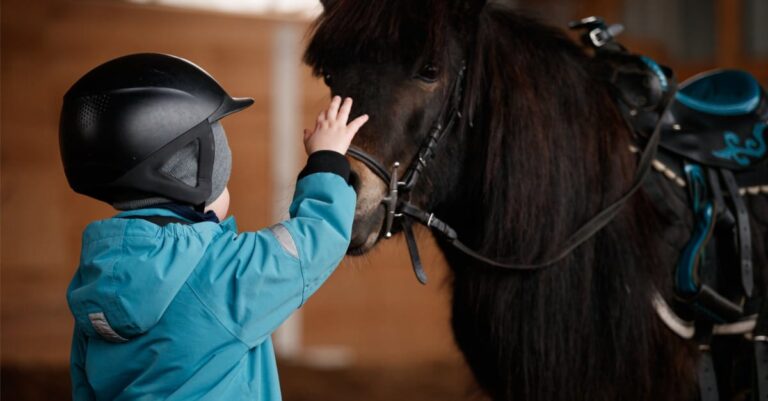
The equine assisted therapy horse might experience stress during his work—but that doesn’t mean he shouldn’t be doing the work, according to Canadian scientists. Still, a few tweaks in therapy programs—in particular in the mounting sessions—could make the lives of therapy horses a bit easier, they said.

“The stress experienced by therapeutic riding horses in our study isn’t a ‘problem’ exactly, as stress is technically a normal physiological response and a certain level of stress is healthy and normal,” said Larissa Carr, BSc Hons., veterinary student at the Atlantic Veterinary College in Canada.

“However, our research indicated activities which were linked to these changes in stress—namely, mounting and dismounting—and if these activities were modified, the welfare of these therapeutic riding horses could be improved,” Carr said.

In their study, Carr and her fellow researchers tested four horses used in an eight-week equine assisted therapy session with disabled riders (having diagnosed developmental, physical, cognitive, and/or psychosocial disabilities).

They monitored physiological stress responses in the horses, like heart rate variability and salivary cortisol, and they observed behavioural signs of stress before, during, and after the riding sessions.

The researchers also tested the horses undergoing similar sessions while ridden by an experienced, able-bodied rider.

Carr presented her results during the 15th Conference for the International Society for Equitation Science (ISES), held August 19-21 in Guelph, Ontario, Canada.

The researchers found that, compared to baseline (standing in the stall), the horses showed considerable increases in stress responses during the mounting session, Carr said. And that was true whether the horse was being ridden by an able-bodied or a disabled rider.

“There was a slight increase in stress during the therapy sessions, but the differences weren’t significant,” she told Horses and People.

The increased stress during mounting and dismounting might be related to the system used for mounting and dismounting in that therapy program, Carr explained. “The rider is elevated above the horse, and the horse is confined to a small area surrounded by four to five side walkers along with a leader who holds the lead rope,” she said.

“The horse is also surrounded by blocks used to direct their legs and keep them from walking away from the ramp, in order to maintain the safety of the rider. This setup could have led to the changes in heart rate variability and salivary cortisol, as well as the higher number of behavioural indicators of stress displayed by the horses during mounting and dismounting.”

In fact, the horses seemed to get stressed “from the moment they knew they had to approach the ramp,” said Carr. “Program leaders could possibly revisit other options instead of using a mounting ramp, or decrease the number of people restraining the horse, while still ensuring the safety of the rider.”

Even so, Carr cautioned that her study population was small—only four horses—and that it’s possible that other therapy horses might react to therapy work differently. “Our results can’t be generalized to all therapeutic riding horses,” she said.

what3words App Improves Horse Riding Safety

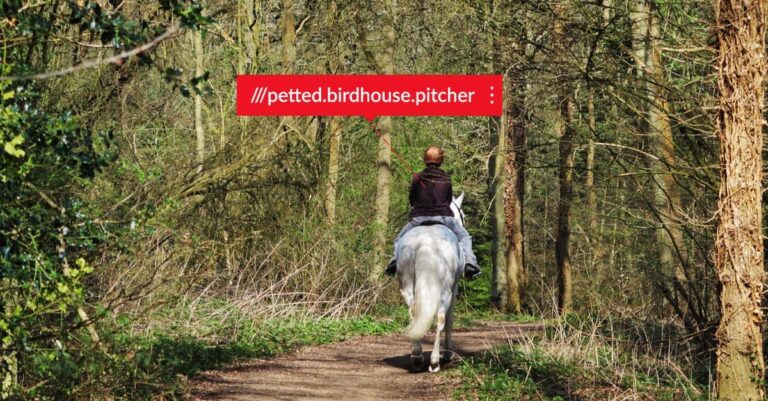
what3words is a new app that makes horse riding safer. It has divided the globe into 3m x 3m squares and given each one a unique 3 word address. You can share the 3 word address with anyone to help them find you, wherever you are in the world.

The accurate and easy to remember format is already proving valuable to horse owners and riders, helping others pinpoint their exact location, whether it is to meet at a horse show or in the case of an accident.

The 3 word address format covers the entire world, never needs updating, and works offline. For example, ///petted.birdhouse.pitcher will take you to the middle of the Sydney International Equestrian Centre’s indoor arena.

Emergency services around the world are adopting and recommending what3words, and have specifically identified the benefits of this free app to the equestrian community.

The 3 words generated by the app gives everyone and everywhere a simple, accurate and reliable address. 3 word addresses are easier to remember than a postal address and can be shared more accurately than any other location reference system. Downloading what3words app to your smart phone makes horse riding safer. This is why it is being recommended by fire and rescue teams across everywhere.

In the UK, a horse who got stuck in a five feet ditch was found and rescued very quickly thanks to what3words. He slipped into the ditch while out on a hack and could not get out. After struggling to explain their location to the emergency services operator, his rider remembered she had the app on her smart phone, and sent them the 3 word address. The rescue team arrived within 15 minutes and safely extricated the horse, who despite suffering some injuries, has made a full recovery.

The developers have also entirely optimised what3words for voice, allowing for the easiest and most human-friendly possible input. 3 word addresses are currently available in 40 languages, allowing more than half of the world’s countries to use them in at least one of their official languages.

A what3words address is a human-friendly way to share very precise locations with other people, or to input them into platforms and machines such as autonomous cars or e-commerce checkouts. It is optimised for voice input and contains built-in error prevention to immediately identify and correct input mistakes.

The company’s partners include Mercedes-Benz, who recently launched the world’s first car with built-in what3words voice navigation. Mercedes-Benz, Ford and TomTom drivers can now navigate anywhere in the world by saying three words to their car. Meanwhile, Domino’s Pizza is delivering food hotter and faster to 3 word addresses around the world, whilst travellers are navigating with ease with the help of Lonely Planet’s and Airbnb’s 3 word address listings. And numerous humanitarian partners are using the technology to help people in need: The United Nations has adopted the technology for disaster response and relief, in addition to the Philippine Red Cross. Many emergency services can also accept 3 word addresses to locate people in need.

Individuals are using the what3words app to navigate the world more easily and to meet friends in places without addresses such as parks, beaches or at crowded festivals.

3 word addresses are being used by running clubs to set meeting points, by off-roading fans in the deserts of the Middle East, and by hotels to guide guests to their entrance without complicated written directions.

The free what3words app, available for iOS and Android, and the online map enable people to find, share and navigate to what3words addresses in 40 languages to date. A 3 word address in one language can be switched instantly into any other supported language, and even looked up in one language and shared in another.

Other useful apps that use location services are integrating what3words address format. For example, the Huufe app a ride-tracking app that includes a SafeRide feature that detects when a rider has fallen from their horse.

You can find your 3 word address here.

COVID-19 Pandemic: Things You Can Do To Help

The Coronavirus COVID-19 pandemic hails a looming disaster for horses, livestock and pets (especially small numbers that are personally owned), as unemployed or underemployed people will begin to run out of money and resources, and may not have banked enough hay, feed, supplies and care arrangements for their animals.

This will be more so as people get sick and may not be able to physically get up and go out to do those chores for weeks at a time.

In the Northern Hemisphere, we are coming into Spring and many people are reaching the end of their hay quantities. In Australia, they are coming out of an excruciatingly long drought topped by apocalyptic fires that have depleted hay stock and pushed people’s bank accounts to the limit.

All this just as the COVID-19 ever increasing containment measures are forcing small businesses and venues to close, events and clinics cancelled, and employed people to stay home with their children, many with less cash in hand.

This is a time that could push many over the edge, but there are many things you can do to help – yourself, your loved ones and the community at large. 

Things you can do to help

1. If you have the opportunity, reach out to those that may be less fortunate or infirm and ensure they have planned for their animals (hay, feed, etc.) into the coming months. If you know people that are always just barely able to get by with caring for their animals – this might push them past the brink.

2. Reach out to someone you trust ahead of any sickness to coordinate for animal care in case you get sick (flu, injury, COVID-19 etc.) so that they know how to provide seamless care for the animals (where your supplies are, etc) just as you would for a hired pet-sitter. In my opinion – hired (paid) assistance is usually more reliable. Read this article.

3. Remind people in your communities that animals are part of our community and may need to consider pet or large animal sheltering on a small scale for people that are sick and can’t care for their animals. For large animals – this may be shelter in place care where teams go to their home locations and check on the animals regularly. Check with your animal response teams and animal control shelters to see if this is being coordinated for.

4. Keep your eyes open for animals that are not being cared for, loss of weight and neglect – call your Animal control or welfare officers first, to get involved with education and correction of the problem. A good relationship with your local Animal Control / Welfare officers can often mean that they call trusted members of the community for assistance with specific issues – i.e. someone loses their income and can’t afford to take care of their animals properly. In some areas – like Alberta Canada – there is a welfare (800) number at AFAC to call if you have a concern – then a livestock or industry professional colleague goes out to check on the situation before law enforcement gets involved.

5. If you board (agist) at a facility with your horses, look around to make sure that others (and your management) are doing smart things to prevent illness spread (biosecurity for animals and people), proactively mitigating challenges, and planning for back ups in case of limited supplies and resources. Don’t be afraid to speak up and ask.

6. If you are starting to see unusual lack of hay, feed and other resources in your communities, reach out to your local and state agricultural animal response teams and emergency managers and grass roots relief groups – this would be at your state’s Emergeny Operations Centers and let them know this is happening. They should be on top of this now and planning for hay banks, pet food and animal resources to help people get thru this coming situation.

While I prefer that all animals get the very best of care, which I am sure all of you are working to provide – I remind all of you that pasture, hay and water are what large animals need – and they will survive on less hard feed if you provide more turnout and hay.

If you don’t have the cash for that bag of horse feed and can’t get out to muck stalls because you feel awful, get bales of hay instead and turn them out in pastures and paddocks. This makes it easier to ensure they stay healthy – even if they look muddy, hairy and get a few bites and kicks from their pasture friends.

Get the word out, start planning and preparing for taking care of animals in your communities, and share this information as a reminder throughout your networks. Resilience in our communities is something that all of us should be working towards – and that includes the animals that are part of our families and livelihoods.

Disaster impacted areas always have these types of problems after the initial wave of impacts – and since the COVID-19 pandemic is a global situation – we can expect to see it in many places.

While animal care is an owner responsibility, many people will not have the resources or be physically capable for short periods of even longer periods if they get ill.

Meanwhile – wash your hands, use a lot of toilet paper (just kidding!), and enjoy your chance to stay home and catch up on whatever you have always wanted to do with your family and animals! Now you have the time!


For COVID-19 updates…

World Health Organisation (WHO) updates

Australian Government Coronavirus (COVID-19) current situation and case numbers