To instantly estimate the weight of your horse, scroll down to use our Horse Weight Calculator
There are two ways to calculate the body weight of your horse. The first and most accurate way is to weigh your horse on an equine specific weighbridge, however, many of us don’t have easy access to one.
The second most accurate method is using a regular measuring tape and formula, as Dr Mariette van den Berg from MB Equine Services explains:
The Carroll & Huntington (1988) formula we use in this horse weight calculator has proved to be the most reliable for estimating the weight of adult horses. (Please note that formulas should not be relied on for young and miniature horses, pregnant mares and foals. With these horses, scales are the only reliable option).
Why do I need to know how much my horse weighs?
To calculate your horse’s feed ration.
To accurately identify weight loss and weight gain. Allowing you to keep your horse or pony at a healthy weight by adjusting feed and grazing accordingly.
To identify any sudden weight loss which may indicate a health problem.
To enable the correct dosage and administration of medication, supplements and wormers.
Determining the maximum weight a horse can carry in a specific moment (preventing musculoskeletal problems sum of rider and gear should not exceed 15-20% of the live weight).
How to measure your horse:
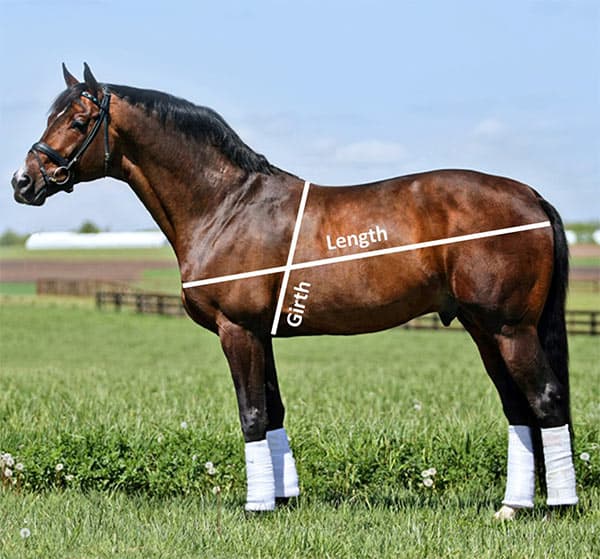
Make sure that your horse is standing square and is relaxed. Use a measuring tape that is long enough to measure the length of the horse. It is also advised to have another person or helper present that can assist with holding the horse and tape.
HEART GIRTH:
The heart girth is measured around the front part of the body immediately behind the elbow and at the base of the withers. Record the measurement after the horse has breathed out.
BODY LENGTH:
The body length is measured from the point of the shoulder to the point of the buttock. Make sure the horse is standing square and still while you take the measurement.
Bit fit. Trained bit fitting consultants now offer horse owners holistic and welfare-centric solutions.
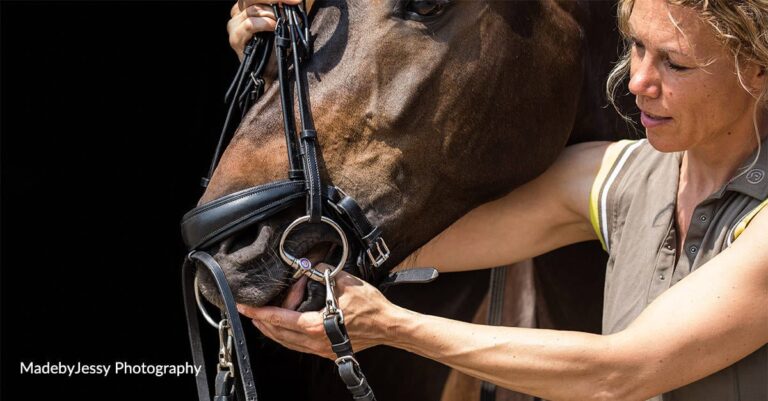
Choosing the correct bit for your horse is more challenging than most people might think and, particularly so when your horse is coping with ‘contact issues’ or other training problems you would like to resolve. It is, of course ideal, when you can engage a professional to turn up at your yard stocked-up with a wide selection of different bits to help you make the right choice.
This is how bit fitting services started in the Netherlands. But with certain bit brands behind the beginnings of this new service, these professionals soon became salesmen skilled in promoting a particular brand of bits.
A bit of a good story
The stories told to horse owners were good but not exactly accurate. One of the main ‘theories’ that caught on was that since horses don’t have that much space in the mouth, they all need bits with thinner mouthpieces.
A quick check inside the mouth makes this storyline quite convincing, since horses do have thick tongues indeed, and not much space for any bit. But let’s be honest, the mouth cavity is filled with the tongue for a reason and that reason is not accommodating a bit! There are other aspects to take into account before you can say the horse will better off with a thin mouthpiece.
There’s a bit more to the story!
In the Netherlands but also in other countries, not every rider is as soft with their hands as we would like… Thin mouthpieces slide more readily from left to right and they also apply a higher (peak) pressure because of their smaller surface area and, in the wrong hands, they cause rubbing and wounds.
As a horse owner and especially if your horse didn’t have mouth injuries previously, you would be very unhappy if you ended up causing a wound after the bit fitting. Especially since you were relying on the advice of someone you thought was a professional.
The explanations given about the action of certain bits may sound quite simple and convincing, but hands-on practice shows that correctly fitting a bit to the horse, is nuanced and requires a horse-centred and holistic approach.
So, how do you know if a so-called bit fitter is properly educated and ready to place your horse’s welfare ahead of their bit sales commissions?
As a pioneer in the profession of bit fitting, I admit I’ve made mistakes (like the one of the thin mouthpieces that I just told you about). I was the first person in the Netherlands to become a full-time bit fit consultant and fortunately, I was able to combine my knowledge of bits with a long background in equine anatomy, body therapy, riding and coaching.
This knowledge has allowed me to recognise whether tension in the horse is a result of poor bit fit more quickly. I began working with all kinds of brands, trusting what the horses where showing me. I did my own research, diving into osteopathy and combining knowledge from different fields.
I often combine a change of bit with a manipulation or mobilisation of the cervical spine (if needed), as well as educating the riders on achieving a better communication with their horses. I will always remember the time I did a ‘psoas stretch’ (a stretch of one of the major core muscles) for a horse while the rider was on and he began foaming on both sides of the mouth, instead of just one, and the contact issue of being more heavy on one side was gone.
Since that time, I have fitted more than a thousand horses, mostly dressage horses, and helped riders resolve many contact issues. One of my first was Donnerfee of former Olympic rider Claudia Fasseart, and many more did follow.
A bit more horse-centred
There is much more to making a proper bit choice than just trying different bits or looking in a horse’s mouth. On the other hand, a thorough look inside the mouth is the starting point. While thin bits seem to fit in any mouth, if a tongue is soft and ‘squishy’ or the palate is very hollow, a thicker bit can be a better choice. Also, the width of the tongue makes a horse sometimes prefer a single jointed over a double jointed, or the other way around.
And it’s only when the horse starts moving that we can see the biomechanics at work. Certain conformation traits and ways of moving will create a different position of the tongue which will affect the way a bit rests in the mouth.
Then we factor in the rider. What is the rider doing with the bit? How are the rider’s biomechanics, their balance and seat? Is there something he or she can improve on with instruction or is it a more difficult issue (like a physical asymmetry) or a rider problem that will take a long time to resolve? Should I pick a bit that compensates for the rider’s unsteady hand? What will make the horse more comfortable?
And then there’s the rest of the bridle. How does that fit around the horse’s head? Are the straps creating undue pressure, pinching or adjusted too tightly?
Like saddle fitting, bridle fitting has also become a part of the bit fit consulting process.
Filling the bit fit education gap
As the years went by and more horses had their contact issues improved, the demand for bit fitters has increased. The existing gap in the education of bit fitters was quickly filled with short courses that resulted in ill-prepared people making mistakes, because they lacked sufficient background, or they believed, without questioning, that what they learned in a two-day course was all they needed to know. Some promoted themselves as elite experts in the field of bit fitting with enviable confidence!
But allowing people to make mistakes in bit fitting eventually hurts the horse and there’s no point doing that when it is possible to educate bit fitters well from a correct start.
Such an education has to be built from a foundation that does not rely on the promotion of a particular bit brand but will consider all the pros of the different models as well as acknowledge what can go wrong depending on the horse’s mouth anatomy and biomechanics, the rider and their riding style. It should also include a thorough understanding of the muscle connections, biomechanical influences and more.
And this has been the aim the International College for Professional Bitfit Consultants (ICPBC) since its inception in 2016. The first year’s graduates are already out in the Netherlands combining the knowledge learned at the ICPBC with their own professional expertise.
In 2019, the ICPBC welcomed the first international students thanks to the development of an online support. It currently has students from Sweden, Denmark, Finland, Latvia, Singapore, South Africa, America, Alaska and already two from Australia. And, being such an excellent horse country, in 2020 we will bring the education course to Australia as well.
For whom is the course?
The ICPBC training is not open to everyone. It is limited to horse professionals with a very broad knowledge of horses. Preference is given to professionals with a solid background in equine bodywork and anatomy.
The study program is very intensive, requiring the completion of case studies of various bit fitting problems and relies on students having a professional background. The course duration (one year) does not allow sufficient time for students to develop the additional knowledge, so at this time, we accept students who are veterinarians, physiotherapists, osteopaths, equine dentists, body-workers, FEI riders and high level judges.
ICPBC has three missions:
Providing proper, all-round education and accreditation so horse owners can find registered bit fit consultants, knowing these graduates will not likely make beginner mistakes and they will know how to truly assess contact issues from a whole-of-body perspective.
Improving the connection and understanding between horse and rider in any discipline.
The last but most important mission, is to improve horse welfare.
What does the course entail?
To become officially registered and be able to use the name of the ICPBC, the students need to pass three exams.
Theory exam: The ICPBC is evidence-based, so in the online part of the course we share published research on bit and bitless riding. We want our students to learn the latest knowledge, the welfare issues such as over-tight nosebands, the way the bit affects biomechanics, how bridles interfere with proprioception, and so on. After a study period, students need to pass the theory examination.
Practical exam: There is no registration without a practical exam where students are assessed on performing a proper mouth check while working safely with the horse, making logical bit choices, checking trigger points in the horse’s body, informing the client about what to expect with every bit and showing the client how to check that the bit is working well for their horse.
A case study: Every student has to write a case study about a bit related problem. Some of the cases studies submitted by students to date, are on topics like drooling, tongue problems and oral injuries. Students are expected to dive deeply into their cases and establish the connections and solutions by themselves.
Once exams have been passed and the case study is assessed successfully, graduates become registered with the ICPBC as qualified.
An intensive learning program favours the most committed practitioners and this, in turn, helps reassure horse owners that registered ICPBC bit fitters have invested heavily in their profession and are not relying on bit sales for their income.
Graduates also understand biomechanics and will not look for short cuts that could negatively affect the horse’s welfare (like tighten a noseband! A great subject I will discuss in a future article).
I am looking forward to welcoming more Australian students and, hopefully this year, register the first Aussie graduates so all horse owners can eventually find help with improving their communication and horse’s comfort and wellbeing.
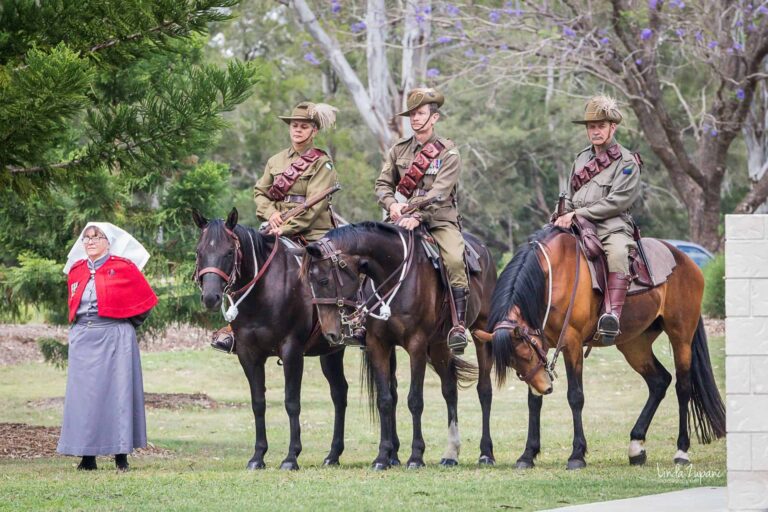
With ANZAC day commemorative events cancelled, Horse SA has invited horse owners and their steeds to stand at the end of their driveway, to commemorate the sacrifices of humans and animals in war.
The idea of standing at the end of driveways will be the way to recognise this year’s ANZAC day, along with watching services online and lighting candles.
COVID-19 has resulted in the cancellation of ANZAC day commemoration events around the country, including the memorial service for horses, traditionally held each year in Adelaide. The ceremony, at the horse trough memorial, on the corner of North and East Terraces, Adelaide, is believed to be the only one of its type in the world.
The service, traditionally attended by The Barossa Light Horse Historical Association, is followed by the horses attending the traditional ANZAC day parade.
Martin Hilton, Barossa Light Horse Secretary, said: “While this year we will not be able to ride together as a troop, individually we will be on parade at our driveways to keep the memory of the Light Horse alive through this difficult time”.
This year, Horse SA is inviting all horse owners and their steeds to stand at the end of their driveway, perhaps mounted, led, or in a carriage. Equids including donkeys and mules also are recognised for their services in war, none more famous than ‘Simpson’s Donkey’ portrayed in a statue located in the Adelaide Parklands, opposite the entrance to the Adelaide Oval.
“We are inviting people to take a photo as a tribute to the ANZACS’ said Horse SA Chair, Dr Lisa McDonald, “to share this on social media and to tag Horse SA on Facebook or Twitter. It’s one way we can all recognise the services that animals, including horses, gave to our nation, and will provide horse owners and riders with an opportunity to pay their respects and feel connected to one another during this time of social restriction.”
It’s not like you can buckle their seat belts. You can’t exactly give them those fuzzy little neck pillows for the long, overnight trip, either.
Yet horses regularly take long trips, especially in Australia. So how can you make their travel more comfortable and less stressful for them?
For starters, give them more space, researchers say. A new study has just revealed, for the first time, that larger bays provide better balance and welfare benefits compared to ‘standard,’ narrow bays, according to Barbara Padalino, PhD, researcher at the University Alma Mater Studiorum of Bologna Department of Agricultural and Food Sciences, Division of Animal Sciences, in Bologna, Italy, and her research partner Sharanne Raidal, PhD, of the School of Animal and Veterinary Sciences at Charles Sturt University in Wagga Wagga, NSW.
Transporting horses backwards – meaning they’re rear-facing – might also help, she said. However, their study was less conclusive on this point.
What was conclusive, though, was that horses had better balance when they travelled in larger bays and/or when they were rear-facing, Padalino and Raidal said. And furthermore, the group’s study showed a clear correlation between loss of balance and gastric squamous ulcer development.
“We can definitely see that space is really important,” Padalino said. “When horses have more space, they can balance better (by, for example, having more room for spreading out their legs to brace themselves). Position (rear- versus forward-facing) seems to have some effect, but it’s not as important as space.”
In their study, Padalino and Raidal tested a group of research mares during a 12-hour road trip and during a 12-hour stationary holding period in transport-sized stocks. They looked at behaviour, blood samples, physical (bodily) reactions, and stomach testing.
During the transport phase of the study, the horses travelled in two groups in the same truck in varying formats: large bays, narrow bays, forward-facing, and backwards-facing.
They found that horses in larger bays (190 cm length compared to the standard 1.2 m2—the required minimum in Australia) showed fewer balancing behaviours such as leaning against the partitions. This kind of leaning can lead to bruising, even severe, as detected in horses arriving at slaughter. (“You can’t see a bruise on a horse because of the coat, but bruises are easy to detect on carcasses,” said Padalino.)
They also had fewer stress-related and balance-related behaviours, such as touching their lead rope or licking the surface in front of them, she said. The licking could essentially be considered a stereotypical behaviour since it serves no purpose but is repetitive, and the rope-touching could be a way for the horse to redirect his stress.
What’s more, these horses had lower levels of cortisol (the “stress hormone”), neutrophils, and white blood cells compared to horses in “single stall” compartments, Padalino explained. “These results suggest an effect on horse health and welfare,” she said.
“So many people continue to believe that horses travel better when they’re in narrow compartments, often because they think the padded partitions help them maintain their balance, but this just isn’t true,” said Padalino. “Ours is finally the first study to confirm this. But if you think about it, it seems obvious that horses need to be able to spread their legs out to deal with the balancing challenges they face during transport. It’s just basic physics, really.”
While Australia has the above-mentioned space requirement of 1.2 m2 per horse, specific space regulations on equine transportation worldwide are rare and aren’t based on scientific findings, Padalino said. In Europe, the requirement is greater—1.75 m2 per horse. Still, that’s less than the 1.9 m2 used in this study.
Globally, the World Organisation for Animal Health (OIE) imposes a “vague” space requirement for any animal: “They say that animals should have sufficient space to adopt a balanced position as appropriate to the climate and species transported,” she said. “Our findings could be useful for updating OIE and national requirements.”
As for rear-facing travel, their results suggested that traveling backwards was a better position for horses due to more favourable physiological and laboratory data, she said. However, the behaviour data was less conclusive. In particular, although the horses showed less ‘balancing’ behaviour when rear-facing, these study horses actually ended up losing their balance more than horses in the forward position.
While this might seem contradictory, it’s also possible that the results had something to do with the design of their study truck itself, according to Padalino. “The compartments located just behind the cab, at the front of the truck over the axle, were rear-facing,” she said. “So the behaviour we’re seeing might actually be related to that position more than or in addition to the position of the horse itself. This also means that our findings may be overestimated, suggesting that if we had not had this logistical situation, rear-facing positions would have given much lower balance behaviours in comparison with facing forward.”
Furthermore, the researchers found that the horses who showed more stress-related and balance-related behaviours during transit (as viewed by video surveillance) tended to have higher rectal temperatures and heart rates after arrival, according to Padalino.
Since these signs also correlated with a higher risk of stomach ulcer development in their study population, it could be a way to screen for horses that are more likely to develop transportation-related health issues, she said.
Unlike when the horses were confined in stocks for 12 hours, they didn’t fall asleep during transit—and this is another important conclusion from the study, Padalino said.
“This is a novel finding, and it suggests that horses can’t rest at all while traveling,” she explained. “It’s possible that they’re facing sleep deprivation when traveling overnight (which happens frequently to avoid daytime heat).”
As a side note, the researchers observed that horses seemed to travel better when “paired with a buddy” compared to a horse they didn’t know or didn’t like, Padalino added. While this wasn’t part of the study, it was certainly something the scientists noticed anecdotally.
“When they’re buddies they interact a lot in a positive way rather than an aggressive way,” she said. “That’s especially important after about seven or eight hours of travel when they’re getting tired. Horses are like people in that they start to get ‘grumpy’ when they get tired, and if they’re traveling next to a neighbour who’s not their friend, they start to get upset.”
The authors were keen to acknowledge the funding they received and which made this research possible, from Virbac, Goldeners and World Horse Welfare.
The paper by Barbara Padalino and Sharanne Raidal was published in Animals in January 2020. It is titled: Effects of Transport Conditions on Behavioural and Physiological Responses of Horses.
An African Horse Sickness outbreak has ferociously killed hundreds of Thai horses in less than three weeks. How at risk is Australia?
In some languages, it’s called “The Equine Plague.” And given its rapid transmission, fierce symptoms, and haunting mortality rates, the “plague” might be a more apt description for the viral equine disease that’s currently sweeping across parts of Thailand.
African Horse Sickness (AHS), as it’s known in English, has ferociously killed hundreds of Thai horses in less than three weeks in an outbreak that purportedly started after zebras were imported from Africa. If not contained, it could spread southward to Australia, according to experts.
“There is a possibility of infection spreading as far as Australia if inadequately controlled, at least in theory, said Evan Sergeant, PhD, BVSc, MANZCVSc, veterinary epidemiologist at AusVet Animal Health Services in Canberry.
However, such a spread would take one or more years and a combination of “bad luck” and high numbers of midges—the biting insects that transmit the virus from equid to equid—transported by wind currents, Sergeant said.
Data provided by the World Organisation for Animal Health (OIE) indicate that these insect vectors could travel in the air distances of 700 km over water or 150 km over land, according to Sergeant. However, these figures are “probably extreme,” and spread over such distances “would be uncommon,” he said.
“Vector spread would obviously also depend on prevailing winds and/or monsoon activity,” he added.
AHS infects all equids but primarily creates serious disease in horses, which have a mortality rate ranging from 70 to 90% or more. The disease, which causes facial swelling, frothy nasal discharge, and internal edema and hemorrhaging, only kills 10% of donkeys and rarely leads to clinical signs in zebras. The current outbreak in Thailand is the first appearance of AHS in Asia (outside the Middle East) since 1961. While possible imports of zebras from Africa are widely suspected as the source of the outbreak, Thai officials have yet to report on zebra testing results or on any records of imports into the country.
Endemic in sub-Saharan Africa, AHS is a constant threat to South Africa, where scientists lead ongoing control measures including vaccination protocols and vector management. “The general rule is having horses indoors behind (efficient) screens from two hours before sunset until two hours after sunset,” said Camilla Weyer, BVSc, MSc, PhD, of South African Equine Health and Protocols, in Capetown. During times of outbreak, scientists recommend a four-hour margin around sunset and sunrise, or even full-time indoor management including walking the horses inside tightly protected enclosures, she explained.
The main vector species in AHS spread in Africa, the Culicoides imicola midge, is “not present in Australia,” according to Mark Schipp, Australia’s Chief Veterinary Officer and President of the OIE Assembly. However, other Culicoides species present in Australia could possibly act as vectors for AHS.
For Schipp, the risk, however small, is not to be ignored.
“Wind movement of infected insect vectors has the potential to spread AHS behind the current outbreak area (in Thailand),” Schipp said. “AHS is exotic to Australia. There would be devastating consequences to the Australian equine industry if it were to establish here due to the high morbidity and mortality in some strains.”
Australia’s current biosecurity requirements for imported horses already manage the risk of AHS, Schipp explained. “These include only permitting imports from countries that have been free from AHS for two years prior to export and which do not allow vaccination,” he said. Thailand is not approved to export horses directly to Australia.
While it might seem paradoxical, AHS vaccination itself presents a risk, according to Weyer. The live attenuated virus used in vaccines has been known to replicate and create its own, albeit less severe, form of outbreak.
With strong biosecurity measures in place and unfavorable conditions for natural spread via the wind, the risk is “still pretty low,” according to Sergeant. “Spread would probably take years, as infection would have to establish in equid populations along the way,” he said. “So, the spread would also depend on the presence of equid populations sufficient to support infection, in countries and/or islands along the way as well as in northern Australia.”
“Australia continues to monitor the outbreak of AHS in Thailand as part of our routine animal disease surveillance and is engaging with other countries to develop a regional response to this outbreak,” Schipp said.
African horse sickness (AHS) is a highly infectious and deadly disease caused by African horse sickness virus. It commonly affects horses, mules, and donkeys.
It is caused by a virus of the genus Orbivirus belonging to the family Reoviridae.
This disease can be caused by any of the nine serotypes of this virus. AHS is not directly contagious, but is known to be spread by insect vectors.
AHS virus was first recorded south of the Sahara Desert in the mid-1600s, with the introduction of horses to southern Africa. The virus is considered endemic to the equatorial, eastern, and southern regions of Africa. Several outbreaks have occurred in the Equidae throughout Africa and elsewhere.
AHS is known to be endemic in sub-Saharan Africa, and has spread to Morocco, the Middle East, India, and Pakistan.
More recently, outbreaks have been reported in the Iberian Peninsula (1987-1990) and Thailand (2020).
AHS has never been reported in the Americas, eastern Asia, or Australasia. Epidemiology is dependent on host-vector interaction, where cyclic disease outbreaks coincide with high numbers of competent vectors.
The most important vector for AHS in endemic areas is the biting midge Culicoides imicola, which prefers warm, humid conditions. Larvae do not carry the virus, and long, cold winters are sufficient to break epidemics in nonendemic areas.
The common hosts of this disease are horses, mules, donkeys, and zebras. However, elephants, camels, and dogs can be infected, as well, but often show no signs of the disease. Dogs usually contract the disease by eating infected horse meat, a recent report has been made of the disease occurring in dogs with no known horse-meat ingestion.
This disease is spread by mosquitoes, midges and possibly biting flies, particularly by Culicoides spp. According to the World Organisation for Animal Health (OIE) The disease has both a seasonal (late summer/autumn) and an epizootic cyclical incidence, with disease associated with drought followed by heavy rain.
Clinical signs of AHS
Horses are the most susceptible host with a mortality rate of 50% to 95% of those affected, followed by mules (50%) and donkeys (5-10%). In African donkeys and zebras mortality is rare. They very rarely display clinical symptoms, despite high virus titres in blood and are thought to be the natural reservoir of the virus.
AHS manifests itself in four different forms:
Mild or horse sickness fever form
Fever (40–40.5°C/104°F–105°F)
Mild form; general malaise for 1–2 days
Very rarely results in death
Mild to subclinical disease is seen in zebras and African donkeys. Infected animals may have a low-grade fever and congested mucous membrane. The survival rate is 100%.
Subacute or cardiac form
Fever (39–41°C/102–106°F)
Swelling of the supraorbital fossa, eyelids, facial tissues, neck, thorax, brisket and shoulders
Mortality usually 50% or higher; death usually within 1 week
This subacute form of the disease has an incubation period longer than that of the pulmonary form. Signs of disease start at day 7–12 after infection. High fever is a common symptom. The disease also manifests as conjunctivitis, with abdominal pain and progressive dyspnea. Additionally, edema is presented under the skin of the head and neck, most notably in swelling of the supraorbital fossae, palpebral conjunctiva, and intermandibular space. Mortality rate is between 50 and 70%, and survivors recover in 7 days.
Acute respiratory or pulmonary form
Fever (40–41°C/104–106°F)
Dyspnoea, spasmodic coughing, dilated nostrils with frothy fluid oozing out
Redness of conjunctivae
Nearly always fatal; death from anoxia within 1 week
The peracute form of the disease is characterized by high fever, depression, and respiratory symptoms. The clinically affected animal has trouble breathing, starts coughing frothy fluid from nostril and mouth, and shows signs of pulmonary edema within four days. Serious lung congestion causes respiratory failure and results in death in under 24 hours. This form of the disease has the highest mortality rate.
Mixed form
Occurs frequently
Pulmonary signs of a mild nature that do not progress, oedematous swellings and effusions
Mortality: about 70–80% or greater
Diagnosis is made at necropsy. Affected horses show signs of both the pulmonary and cardiac forms of AHS.
Presumptive diagnosis is made by characteristic clinical signs, post mortem lesions, and presence of competent vectors. Laboratory confirmation is by viral isolation, with such techniques as quantitative PCR for detecting viral RNA, antigen capture (ELISA), and immunofluorescence of infected tissues. Serological tests are only useful for detecting recovered animals, as sick animals die before they are able to mount effective immune responses.
Treatment & control of AHS
No treatment for AHS is known. Control of an outbreak in an endemic region involves:
identifying the virus and serotype,
establish quarantine and movement controls,
consideration of euthanasia of exposed equines,
establish vector (insect) control, e.g. stabling of horses from dusk to dawn, when culicoides are most active, destroy culicoides breeding areas, use insect repellents, insecticides and/or larvicides.
Uninfected horses are vaccinated against the virus.
According to the OIE, at present, only the live attenuated AHS vaccines currently exist – a polyvalent vaccine, a monovalent vaccine. There was a monovalent inactivated vaccine, but it is no longer available. A serotype specific subunit vaccine is currently in development.
References:
Brown C. & Torres A. Eds. (2008). – USAHA Foreign Animal Diseases, Seventh Edition. Committee of Foreign and Emerging Diseases of the US Animal Health Association. Boca Publications Group, Inc.
Coetzer J.A.W., & Tustin R.C., Eds. (2004). – Infectious Diseases of Livestock, 2nd Edition. Cape Town, South Africa: Oxford University Press Southern Africa.
Fauquet, C., Fauquet, M., & Mayo M.A. Eds. (2005). – Virus Taxonomy: VIIIth Report of the International Committee On Taxonomy Of Viruses. London: Elsevier/Academic Press.
World Organisation for Animal Health (2012). – Manual of Diagnostic Tests and Vaccines for Terrestrial Animals. OIE, Paris.
World Organisation for Animal Health (2009). – Online World Animal Health Information Database (WAHID). Website accessed in 2009. http://www.oie.int/wahis/public.php?page=home
World Organisation for Animal Health (2012). – Terrestrial Animal Health Code. OIE, Paris.
I want to comment on a recent article in Eurodressage by Adriane Alvord, “The Pain that Lives Behind the Barn Door” referring to the tragic death of Teresa Butta in the US.
We have lost three professional riders to suicide in the last three months and there are many more I know who were contemplating taking the same action. We can’t ignore this anymore and something needs to change.
There are so many people who struggle with life. Most struggle in silence and put on a mask that hides the way they feel. A beaming smile, a chatty conversation and a false assurance, “I am doing fine”, is all it takes to hide the way you feel. Not many people have the courage to ask for help and not many friends notice the subtle warning signs.
I am a mindset coach in the equestrian industry and, having worked with riders for over 15 years now, I know how many riders out there are suffering.
We often talk about the financial struggles and the pressure that riders are facing, but that is not all. I have met riders from wealthy backgrounds who have that special horse in their stable and still struggle with the pressure they put on themselves.
The constant striving to be better, living up to expectations (mainly their own), wanting to prove their worth and to earn the recognition of judges, trainers and colleagues often proves too much.
Our competition environment is a no-win situation. No matter what you do, it will never be good enough. There are always scores that need to improve, expectations from owners, coaches and parents that need to be met, and there is that constant drive to earn recognition – to gain the confidence that confirms, “I do belong.”
Every rider is only as good as the horses they have in their stable. A horse can be exceptional one day and create opportunities to be on ‘that team’, get selected into ‘that squad’ and reach ‘that dream’. It all seems just a grasp away and can disappear again in an instant, when the horse goes lame. Who can sustain that pressure over long periods of time?
To top it off, the general view is that riders are tough. There is an expectation that beautiful and skillful riders are confident and happy. After all, they are role models and others out there are looking up to them. So, riders just suck it up, put their heads down, work even harder and ignore the pain. They put the stress and worries aside and just keep on going, hoping that it will all turn out ok. Until one day it doesn’t and they break.
This has to stop and I am calling for a big review of how we can include more emotional support for all the participants in our equestrian sport.
We can’t just focus on our horse training we also have to focus on life training. It is possible to get mindset coaches involved in junior squads and pony clubs to help young riders develop life skills in how to deal with stress and pressure, but more importantly, creating a culture in our sport that allows them to reach out for help. With people around them they can trust and open up to. Let’s teach our young riders that asking for help shows strength and courage, not weakness.
For our older riders and professional trainers. Please hear me when I ask you to make time for yourself. We become so good at putting everyone else before ourselves – you are important, please make time in your day for you!
Get a coach who is there for your own wellbeing not only for your horses.
Speak openly about your problems and the pressures you encounter. Don’t bottle it up and hope it will disappear, it won’t! Instead, it will grow inside you and gradually consume you.
To the friends out there, take note. If someone doesn’t look like they are okay, that means they are not. Don’t let them shake you off. Keep an eye on each other and offer your support. That’s what friends are for. Picking up the phone when you feel like checking-in with someone can make a world of difference.
To the parents, encourage your kids. Teach them that achievements are measured from within not from the outside. Tell them that validating yourself is far more important than looking for validation from other people. Ask them what they want and make them understand that loving their pony and simply enjoying a ride is more important than winning ribbons.
To all the riders out there who ride for pleasure, take the pressure off! I see so many riders striving for this illusive goal of ‘success’ only to find that they keep shifting the goal post and whatever they do is never enough.
You are not wrecking your horse if you make a mistake!
Your horse is not better off with someone who takes it out competing and brings out the best in him/her. Your horse is better off with the one who loves and cares for him/her!
If you try to please others you will never reach happiness!
If you wait for someone else to tell you that you are good enough you will never be good enough!
Look inward rather than outward and find your joy, your love for riding, within you. That will make you better at what you do.
If you struggle, ask for help. Speak up and be open. It is time we made our equestrian sport a more supportive environment for everyone.
The Eurodressage article ‘The Pain that Lives Behind the Barn Door’ can be read here:
It’s a mild summer evening after work and you are swinging along in the arena practicing your dressage test for next weekend. Rhythm is good and your horse seems to be taking weight evenly on all four legs. It feels like the perfect time to head up the centre line.
You halt at X, take the reins in one hand, then find yourself clutching at some mane as the stable cat leaps up onto the post at E and your horse spins about her forelegs to fixate on what just happened.
As she snorts loudly at the cat, you regain your seat. “For goodness sakes, it’s just the cat” you say.
You draw your right rein outwards, keen to get back to the centreline and pick up where you left off, but nothing happens.
Now you get frustrated. Not only has your horse seen the cat a million times before, but she is now ignoring your turning aid.
You add some leg into the mix. A squeeze. A nudge. A tap. A few kicks. You ask harder and faster and still nothing. It’s like the light is on but no one is home. “Listen!” you say before turning your toes out for full spur effect.
Before you know it, you’re bolting back towards the arena gate picking up reins that didn’t seem nearly so long before. What on earth just happened?
One explanation is that the cat scared the horse. Others could be that your horse gave more attention to the cat than the rider. Your horse was deaf to the aids. Your horse should have known better. Your horse was being difficult.
With these interpretations in mind, you might decide you need to desensitise your horse to the cat and/or repeat stop and go transitions until you are satisfied that she has remembered what your rein and leg aids mean.
But that’s only going to fix one side of the picture – the external side where things happen to the horse. What about what’s going on internally, regarding your horse’s capacity to respond to and process the external world?
Neuroception
Horses, like humans, are mammals. We both have a mammalian nervous system and, one way to think through your horse’s unusual behaviour is to consider what we know about how human nervous systems perceive threats, danger and safety – a process known as neuroception.
When humans perceive danger, they often go into a state of hyperarousal such as screaming, crying, running, etc., or a state of hypoarousal which includes fainting, freezing or acute depression.
Our nervous system is hardwired to enter these states to help us survive. When we are in these states, we can’t control our behaviours and, depending on our prior experiences and present state of health, we may be more likely to go into or stay ‘stuck’ in them.
To return to our cat example, it is easy to become frustrated because your horse already knows your cat, but it is much more useful to think about our horse’s ‘window of tolerance’, a term coined by Dr Daniel Siegel.
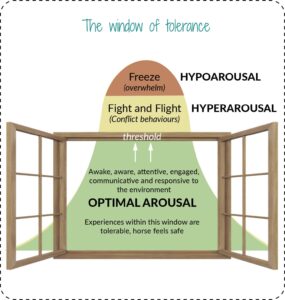
The window of tolerance is a term coined by Dr Dan Siegel that is now widely used in all areas of mental health. When an individual is pushed out of their window of tolerance their ‘thinking’ brain stops functioning and their limbic system takes over. Before they can make sense of the situation, they need to find their way back into their window of tolerance. Illustration by Cristina Wilkins, adapted from Equusoma’s Polyvagal Defense Hierarchy.
The window of tolerance
If we think of your horse grazing happily with a few other horses nearby, we can say that she is in her window of tolerance.
If something happens, she might take notice but then return to grazing, resting and digesting. This is a calm state of arousal. Arousal is not a bad thing. It is what keeps horses (and us) awake, aware, attentive, engaged, communicative and responsive to the environment.
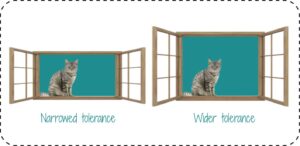
Some horses have a wide window of tolerance. They seem able to absorb lots of external stimuli into their window.
Other horses seem to have a narrower window of tolerance. They don’t seem to be able to accommodate many external stimuli at all. Depending on what the stimulus is, even the slightest thing might make them spook, buck, bite, rear, kick bolt or freeze.
We tend to label horses with a wide window of tolerance ‘quiet’ and those with a narrow window of tolerance as ‘spooky’, but in reality, their window is never fixed. It is dynamic.
The window of tolerance changes in relation to other factors (such as different riders or even different times of day). It also changes over time and occasion.
The threshold
At the edge of the window is the horse’s threshold. That’s where we find the behaviours we know as fight, freeze and flight and it is in that exact order that the horse in our example reacted. Turning to face the cat was a fight (hyperarousal) response to the sudden jump that took the horse over threshold.
The rider’s additional stimulus of reins and legs pushed the horse even further into freeze (hypoarousal) which was then followed by flight (hyperarousal).
In both states of hypo and hyperarousal, mammals are incapable of communicating and responding (or learning). The rider’s aids thus became another stimulus that push the horse even more over threshold.
So, the cat in our example put our horse over threshold. That’s fairly clear. But why did the cat put our horse over threshold today when it doesn’t normally?
The window of tolerance is never fixed, it’s dynamic. The narrower the window, the more ‘space’ the cat takes up when it appears, and the more chances the horse will be pushed over the threshold.
One way to think about this is to use the idea of a window of tolerance (and other mixed metaphors) where the horse’s nervous system is calmly aroused. If there is lots of free space in the window, the cat doesn’t take up much space.
The nervous system might be aroused momentarily (perhaps manifesting as a slight wobble off the centreline) but – assuming the stimulus is not too big or novel – the nervous system can respond to the shock of the cat’s jump, discharge that energy and fairly quickly return to a calm state of arousal.
If the horse came into the arena with a wide window of tolerance, the stimulus of the cat’s jump may not have put the horse even close to threshold. If the horse came into the arena already with a narrowed window of tolerance, the cat was literally the final straw that took the horse over threshold.
A different perspective
Now, this gives us a very different perspective on the horse that appeared to make a big and unnecessary deal over the stable cat. The horse’s uncharacteristic reaction tells us that she was not coping as well as we had thought. It tells us that she was either close to threshold and/or her window of tolerance was narrowed.
Worse still, your horse may have been in a ‘faux’ window of tolerance where to human eyes, she was coping well but really she was only managing her behavioural reactions.
Your horse’s non-response to the aids tells us, not only that the nervous system was activated, but that she was physically incapable of interpreting your signals (being either hyper or hypo-aroused).
You can say that your horse’s ‘social engagement system was offline’ in the same way that you would not expect to have a thoughtful conversation with an arachnophobe in the presence of a huntsman spider. If you just kept talking louder and louder to get their attention, you shouldn’t be surprised if they ignored you, walked off or became aggressive towards you.
In short, the horse was not being stupid, ignorant, willful or difficult. The horse was having a difficult time. If she did indeed “know better”, she was physiologically incapable of doing any better due to being over threshold and in a hypo-/hyper-aroused nervous system state.
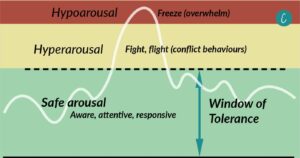
A different way to visualise the window of tolerance is like ripples. Provided the ripples stay within the tolerance band, the horse can manage his or her reactions to stimuli.
More options
This knowledge widens our options from simply desensitising the horse to the cat whilst sensitising her to the aids (remembering that, in our example, she is normally responsive to them).
Instead of focusing all our attention on what made your horse go over threshold, we can think about what may have compromised, narrowed or otherwise taken up space in her window of tolerance.
Stimulus stacking
There are some obvious things that horse people are typically good at noticing such as the weather (a windy day), a horse leaving or entering the property, a change of routine, feed or a digestive upset.
Sometimes it’s all of the above and, when the nervous system doesn’t have a chance to reset back into a calm state of arousal between stimuli, we can have a case of ‘stimulus stacking’. Each stimulus brings the horse cumulatively closer and closer to threshold until the slightest thing tips them into hyper- (fight, flight) or hypo-arousal (freeze).
We also experience times where hyper or hypo arousal seem to occur for no apparent reason. The days when your horse does something completely “out of the blue”. However, these may have been days when you weren’t noticing everything you could have.
Maybe there are signs you routinely ignore and narrow your horse’s window of tolerance over time (girthiness is a common example).
Sometimes, we humans are just too busy or preoccupied to notice some of the equine body language that reveals our horses’ nervous states and how close they may be tracking to threshold.
You might want to think back to the mounting block when your horse braced her back as you got on, and then back to the way she moved sideways as you put the saddle on her back, and back further, to the tie-up rail when you had to force the bit in her mouth, or even further back to the paddock where you blocked her from walking away so you could get the halter on quickly…
That’s when you might realise that you never allowed time for you horse’s nervous system to recover before you proceeded with what you wanted to do.
You just kept on despite your horse’s attempts at communicating that she was not feeling OK. Whilst your horse didn’t seem to go over threshold at each of those points, you were effectively stimulus stacking.
You might even realise it wasn’t just the halter, the bridle, or the saddle but you too who was a stimulus that together made the cat in the arena too much to bear on that one ‘freak’ occasion.
It doesn’t matter if the horse has seen the cat, been caught, haltered, bridled, saddled and mounted a million times before. Everything that happens creates a ripple that impacts the horse’s nervous system and influences their window of tolerance. If you don’t let the ripple settle and deactivate, you will end up (sooner or later) creating waves.
The more I engage with the science of the mammalian nervous system and think through metaphors of windows and thresholds (and ripples), the more I realise that, no matter how quiet or how slow we are, we are probably being louder and faster than our horses would wish.
It really doesn’t take long to stop, breathe, go slow, take a step back or wait until we sense a deactivation in the nervous system. In fact, that is precisely how we can help our horses to widen their window of tolerance, be less likely to go over threshold and if they do – more likely to deactivate and return to a state of calm arousal.
If you practice these exercises on a regular basis you will get to know your horse’s body better, improve his/her core strength and spinal health, and help keep your four legged friend happy.
And, to safely teach your horse to stretch, Hayley Chambers from Outback Equines is going to show you in detail how to gradually shape each stretch using targeting, and we’ll discuss what to look out for in the process. To read the entire article with pictures see the download link below.
For each stretch I include a short section explaining which muscle groups are being activated and what the stretch will help with.Make sure you always warm your horse up before stretching. Walking for 5-10 min is enough to warm the muscles up.
To ensure the stretches are beneficial, your horse needs to stretch from a square halt. You may want to spend a bit of time training that part correctly – check out Hayley’s handy training hints over the next pages.
Hayley’s Hints: Why target training?
Some people like to do these stretches by bribing the horse with a carrot – but ‘carrot stretches’ go against the golden rule of clicker training using food, which is to take the treat to the horse’ not let the horse’s mouth come to the treat.
With target training, you can achieve and practice the same beneficial stretches whilst teaching your horse great manners around treats.
Target training is simply teaching any animal to touch an object with his/her nose or a body part repetitively to a signal or cue. In dog training, zoos and marine parks, targeting is a very common skill to teach to all different kinds of animals. When teaching horses to target, I make a point of teaching them to use their nose only – to simply ‘touch’ the item on cue without biting, licking or chewing it.
Whether you use a food treat or a scratch to reward your horse will depend on what he or she finds motivating. Most horses are very motivated and, therefore, easily trained using food treats but some horses are just as motivated by a scratch on a favourite spot!
To begin Target Training you need to first ensure your horse is correctly conditioned to a marker word or a clicker (so he knows that ‘click’ = ‘treat’). This is called ‘pairing’ the clicker.
A clicker is ideal because it gives a clear and audible sound that is consistent and never changes, but you can also use a distinct voice signal. The aim is to associate the clicker/sound to your horse’s chosen reward – either a food treat or a scratch on a favourite spot – using this sequence: click, treat, repeat.
In a very short period of time (as little as 5-15 mins) the horse will start to understand that the click sound equals something awesome!
Introduce the target (put it near his nose) and click-treat when he touches it. Repeat and soon he’ll understand that touching the target with his nose gets the reward. You can then start moving the target around. Make it easier if he loses interest or becomes confused.
Neck stretch #1
Head at wither height, stretched forward for a duration from a couple of seconds to 20 seconds, with practice.
Improves: Flexibility in the poll, jaw and hyoid (tongue bone), anterior-posterior stability and core strength.
Muscle groups that benefit: jaw, poll, neck, core muscles, top line and abdominal muscles.
Repetitions: 5x before work or 1x day.
Dos: Make sure your horse is warmed up. Make sure your horse is standing square before starting the stretch, always be mindful of your horse’s strength and weakness. Only increase duration as the horse gets stronger.
Be sure to prioritise (reward) a square stance and straightness (keeping the ears level, without a head tilt), and increase the stretch gradually over time.
Don’ts: Not for horses in the first three months after any surgery! Make sure the head does not twist as he stretches (check the ears are level).
Don’t push your horse past it’s comfort zone, Don’t stretch when the horses muscles are not warmed up.
Hayley’s Hints: The target
The target can be any object that is distinctive and your horse can learn to recognise easily. After trialling several devices, from home made to store bought, we found an extendable flag pole, removed the flag and fitted a tennis ball to the end. Having an extendable pole proves super handy, allowing you to gradually shape the stretch further and further without having to change your position.
Training pre-requisites: Teach your horse to ‘park’ square, so he follows the target by stretching the head and neck, rather than stepping forward. You might need to refresh ‘park’ before you stretch.
Variation: Using a stool or a long target stick aim to stretch the neck upwards as if the horse was eating leaves of a high branch. Remember to prioritise straightness (level ears) above the amount of stretch achieved.
This variation will stretch the muscles in the lower neck as well as help with your horse’s core strength.
Hayley’s Hints: Teaching ‘park’ using combined reinforcement
The term ‘park’ refers to teaching the horse to ‘stay’ or ‘plant his feet’. First, your horse should know how to ‘Back up’ – using either halter pressure or chest pressure, but preferably from a verbal or hand signal, or a light whip-tap/cue on the front legs/chest or on the ground in front of them. (Backing up helps you to correct the horse if they try to walk forwards during the park exercise.)
I use a dressage/driving whip so I can extend my signals when I’m ready to get further away from the horse.
With your horse in a halter and lead, and initially staying close to him, use your clicker/marker whenever his feet are still. Repeat at a close distance several times at a very short duration of ‘park’ i.e., 1-2 seconds. At this stage we are looking for duration rather than HOW the horse is standing. We can change our park criteria once the horse understands.
If your horse tries to move the feet forward, back them up using one of the signals he knows, and then wait for a very short moment (for his feet to stand still again) and then reward your horse with a release of pressure AND your marker (click-treat) immediately.
Remember when releasing the pressure that your timing is VERY important – use the lowest pressure needed (the LIMA approach of Least Invasive Minimally Aversive) and release that pressure AND click the very moment the horse adheres to that signal. This is combination reinforcement. We then start SHAPING the behaviour in small increments i.e., park still for one second – click–treat. Park still for 1-2 seconds – click–treat. Park still for 2-3 seconds – click–treat.
Once the duration of the park has been established, we can look at changing the criteria to the quality of the park, e.g., standing the front and back feet square then park for 1 second, 2 seconds, etc. The horse will already understand duration and the foundations of the ‘park’ but can then extend the information to the HOW he is standing in the park. Clever pony!
Neck stretch #2
Stretch the head and neck between the knees (carpal joints) – the horse’s muzzle at knee height.
Improves: neck flexion, upper thoracic stability and flexibility, shoulder strength and flexibility of the shoulder blade.
Muscle groups that benefit: neck muscles, poll, shoulders, withers.
Repetitions: 5x, before work or 1x day.
Dos: Make sure your horse is warmed up. Make sure your horse is standing square before starting the stretch, make sure the neck is straight with ears level, always be mindful of your horse’s strength and weakness and shape the degree of stretch gradually.
Don’ts: Not for horses in the first three month after any surgery. Don’t stretch beyond the knees or higher up towards elbows or chest as this puts too much pressure on the upper cervical vertebrae and the lumbar sacral transition. Don’t push your horse past its comfort zone, Don’t stretch when the horses muscles are not warmed up.
Neck stretch #3
Stretch head and neck towards the girth area at elbow height, making sure the ears stay level.
This is a difficult stretch for the horse to do with level ears and they will try and tilt their head to make things easier, so make sure you shape it gradually, that is, increasing the reach over time and rewarding for maintaining the square halt and bending with level ears, gradually increasing the degree of bend.
If your horse can only go to 90 degrees or less without a head tilt that’s fine! Take things slow as many horses are stiff in the upper cervicals.
Improves: lateral neck flexion, especially the upper neck, thoracic stability and flexibility, shoulder strength and flexibility of the shoulder blade, core strength.
Muscle groups that benefit: neck muscles, poll, shoulders, withers and back muscles.
Repetitions: 5x, before work or 1x day.
Dos: make sure your horse is standing square before starting the stretch. Always be mindful of your horses strength and weakness, and keep training positive by noticing when he has stretched enough, or done enough repetitions.
Don’ts: Not for horses in the first three months after any surgery. Never push your horse past it’s comfort zone, don’t stretch when the horse’s muscles are not warmed up.
Hayley’s Hints: It’s all about shaping!
Shaping means we gradually encourage the horse to engage further and further with the target until they are touching it repetitively over and over. For example, you may have to start rewarding your horse for simply looking towards the target item – click and treat.Many horses will, at least, sniff the item out of curiosity. When they realise that engaging with it earns a click-treat, they will very quickly repeat the behaviour.
Targeting is something I often teach in a very short period of time at clinics, lessons and demonstrations. Within 5 to 15 minutes, most horses will be offering a ‘touch’ to the item with much enthusiasm and positivity.
If your horse tries to mouth, lick or bite the item don’t click and treat – remember we are teaching touch – not pick up! (We can always teach them ‘tricky stuff’ later, if we want to go down that path.)Once your horse is reliably touching the item over and over (about 98% reliability), we can add in a voice cue or physical signal. I generally use the word ‘touch’ or ‘target’. In a short period of time, your horse will pair the verbal signal to the actual action.Soon you will have your horse reliably ‘touching’ the target item on cue.
Now we need to test the targeting by moving the target item to different spots. Don’t go too far to begin with. Try just slightly to the left. Slightly to the right. Slightly up. Slightly down.Doing this will test if your horse really understands the ‘touch the item to earn a reward’ lesson correctly. If he gets stuck – go back a step. If he continues to follow the target item, start shaping one of the stretches described in this article. Choose the one you think will be easiest for your own horse.
Always start from a square halt and prioritise the correct posture over the amount of stretch your horse achieves. Focus on maintaining the square halt and level ears, for example.Be very slow to increase the degree of stretch, and then also shape the duration of the stretch by delaying the click-treat a little bit, over time. If he moves or starts to tilt the head you will know you are asking too much. Go back a step or two and make it easier for him to get it right.
Shaping is all about timing, so keep practicing and don’t worry if you make a mistake every now and then, such as click the wrong behaviour! Just notice and try to be more accurate next time.
Next time…
Next time we will introduce more beneficial stretches you can incorporate into your horse’s daily routine.
Disclaimer… This content is not intended to be a substitute for veterinary advice, diagnosis, or treatment. Always seek professional advice with any questions you may have regarding the health condition of your horse. Never disregard professional advice or delay in seeking it because of something you have read in this magazine!
As we learn more and more about the horse’s body and how things are connected, we try and find better ways of keeping our fur-kids safe, healthy and most importantly, happy.
There are lots of new fads that promise quick cures for imbalances, whether they are found in the feet or the upper body, but to find a long-term solution, we need to realise that, unfortunately, these imbalances have an underlying cause.
Usually, the underlying cause is either pain, bad training, ill-fitting gear, an unbalanced rider or husbandry issues.
This means that if the problem is a badly fitting saddle, a change in training is not going to help much. If the horse has grown unbalanced feet due to compensating for shoulder pain, feeding minerals for hoof growth is not the solution. And a horse that is kept isolated and develops behaviour issue as a result, will not become calm and happy with a chiropractic treatment.
To have a healthy and happy horse, we need a team of professionals to support us on the horse-keeping journey and our horse needs friends, exercise and healthy nutrition. Nevertheless, there are things you can do effectively and on an everyday basis to help your horse stay happy and healthy.
In this series I will explain some beneficial and simple core strengthening exercises and I will team up with trainer and coach Hayley Chambers, from Outback Equines, who will describe how to train the horse to stretch. But first, let’s lay the knowledge foundations.
Becoming your horse’s personal trainer for core strength
Horses, like any other animal or human, need movement, stability and mobility to stay healthy. Yes, they move while they are in the paddock with their friends and they are moving while being trained, but we can add more specific movements to their day – to help them stay healthy and to help us notice issues before they become big problems. Let’s have a closer look at this.
A joint needs to be able to move in a certain way for the whole body to stay healthy. If we get restrictions in a joint or a joint is too loose, we change not only that one joint, but through compensation patterns, we change the whole horse.
And the change doesn’t just affect the musculo-skeletal part of the horse but everything from breathing to blood flow, digestion to hoof balance and even the nervous system will be affected.
The nervous system
The nervous system is responsible for all functions in the horse’s body and it is made up of two parts. The central nervous system (CNS) is the brain and the spinal cord. The peripheral nervous system (PNS) refers to all other nerves in the body.
The skull and the spine protect the CNS. If we look at the horse’s spine, we know that it runs from the back of the head to the tip of the tail. The spine stabilizes the horse’s body and protects the spinal cord. The spinal cord is a thick bundle of nerves that send information from the brain to the rest of the body and receives signals from the body and sends them on to the brain.
If a joint in the spine lacks movement, the nerves coming in and out of the spinal cord will be compromised. This means that the signals to and from the brain will be disrupted.
You can think of this like a road with a traffic jam. The road is the nerve and the cars are the signals. The worse the traffic jam, the slower the signals get to their destination. A horse with only a few minor ‘traffic jams’ will not show many signs, but a horse with major road blocks will have a whole lot of issues.
The cause of these traffic jams can be pain related, of a metabolic nature or can be caused by a disease of the nervous system. But pain related issues are the most common.
Signs of pain-related issues in the horse can vary, from a behaviour problem to lameness, colic, changes in hoof health and hoof balance but also ataxia which means loss of coordination.
Without a healthy spine, a horse cannot perform. Many behaviour and lameness issues are due to back or neck pain.
The issues we find in the horse can be caused by bone lesions (like kissing spines for example), or tissue damage like sacroiliac strains, longissimus dorsi lesions or damage to ligaments around the spine.
Throughout the length of the spine, there are also a number of stabilizer muscles. These are small but important for providing stability, flexibility and mobility. One of these muscles is called the multifidus.
The multifidus
The multifidus is a deep muscle that helps maintain posture, giving support and stability to the spine. If there is a back injury, the multifidus muscle atrophies and long-term, the muscle fibres can be replaced by fatty tissue. Unless we reactivate it through specific exercises this muscle does not recover well.
The multifidus muscle is important for stability and is a major cause for back pain. So if it does not work correctly we can have problems like a lack of top line, lameness, behaviour problems like rearing, bucking, bolting, jaw and teeth problems, inability to maintain contact, rhythm and self-carriage, reoccurring colic, saddle fit issues, the list goes on.
Multifidus atrophy is also the key to some of the common problems and complaints I see on an everyday basis. “He was lame all of a sudden”, “she started to buck out of nowhere”, “I can’t keep weight on her” or “he was the perfect kid’s pony until a week ago”.
These comments are common and sadly, nine times out of ten, these horses have been putting up with pain and discomfort for a very long time before they displayed such clear signs.
Horses are so good at compensating and hiding pain that it can be hard to notice when things are starting to go wrong. But there are clues in the horse’s body that we can use. And, if we are able to notice changes in our horse’s body before they become a real problem, we might avoid having to rest our horse for long periods of time or unknowingly cause damage beyond repair.
So how can you, as a horse owner help your own horse and catch little issues before they become major problems?
A simple way is by adding a few stretches and core strength exercises to your horse’s everyday routine. They don’t take long and the better you know what your horse is capable of, the sooner you will notice when things are ‘not right’.
By practicing stretches with your horse on a regular basis (5 to 7 days a week), you also get to know your horse’s body.
If suddenly he is not as flexible as he was yesterday or a week ago, you have the opportunity to get these problems addressed before the rest of the body has to compensate too much.
With increased flexibility we also increase joint stability and overall mobility and decrease the risk of injury.
Knowing where our horses are weaker and where they are stronger also helps us put together a better training plan. Regardless of whether you compete at the highest level or you take your horse on a trail ride once every few weeks, the stronger the core the healthier your horse. Because let’s face it, nobody is perfect, but we can aim to improve ourselves and our horses so they can stay healthy and happy for as long as possible.
In future parts of this series I will show you some stretches and core strength exercises, you can use on a regular basis to get to know your horse’s body better, improve core strength and spinal health and to keep your four legged friend happy.