fbpx
Home Blog Page 45

Weaning Strategy: Let the mare decide!

Weaning strategy.

Whilst some will argue over the best timing or weaning method, the question horse owners are asking is why wean at all? 

Is it really necessary to intervene in what is a normally occurring and natural process? And, what might happen if you didn’t wean that foal? 

Horses and People’s Editor, Cristina Wilkins, talks with breeder and equitation science researcher Dr Amanda Warren-Smith about her experience allowing broodmares and foals to stay together in their family group, and the reasons she chooses not to wean. 

It is always difficult to question traditional practices, especially ones that are as well established as weaning. The act of forcibly separating foals from their mothers when they are between four, six or sometimes eight months of age is believed by many to be a necessary part of the growing up process for a foal. Nevertheless, in this age where horse owners are becoming better informed about horse psychology and behaviour, more and more people are beginning to question the practice.

We know that placing horses under stress compromises their physical and emotional health. Gastric ulcers, sudden changes in growth rate and crib biting are all serious conditions that we know can happen as a result of a stressful weaning period, and have the potential of affecting the horse for life. The health risks added to the thought (and guilt) of seeing a young foal running up and down the fence calling out to his disappearing mother drives most diligent horse owners to seek the best method and timing for weaning – one that will cause the treasured youngster the minimum of stress. But, how many have considered the possibility of not weaning the foal at all?

Dr Amanda Warren-Smith is one of such horse owners going against the tide. A small breeder and equitation science researcher with a PhD that focused on training horses, Amanda owns and cares for her seven horses on her 20 acre property near Orange, New South Wales.

Amanda’s horses include three mares of breeding age, an older retired broodmare, a Warmblood stallion, plus three of their progeny – one of whom is away being campaigned by a professional rider. Amanda doesn’t wean the foals from their mothers and argues that weaning is not usually necessary and should, in fact, only be done in exceptional circumstances.

“Large scale breeding facilities and other professional studs,” says Amanda, “have economic reasons for weaning. Their aim is largely to sell their entire foal crop as soon as possible and certainly within their first year of life. In large-scale racehorse studs, weaning early increases the efficiency of their yearling sales preparation and pre-training processes.

“The priorities of these establishments are, clearly, very different to mine. I try not to breed too many foals as I do not want to add to the already problematic wastage and I see each foal as a long-term responsibility. For me, not weaning is so much easier.”

“When mare owners visit to breed to my stallion, they often ask when – at what age – they should wean the foal,” says Amanda. “They are always surprised when I explain that I don’t wean at all, nor see any reason to wean. Initially, it may be hard to fathom the concept but, when you think about it, why would you? It is going to happen anyway, so why make it hard?

“Even when they are empty, my mares tend to stop the foal from suckling at around yearling age. They do this progressively and the scientist in me has always thought this would make an excellent long-term observation study!

“From my own anecdotal observation, as the foal grows, the mare starts preventing him or her from suckling at will, starting a gradual and natural weaning process. The foal may approach and nuzzle the flank and, with the flick of a tail and her ears laid back, the mare will say no, not this time. Other times, she will stand quietly and allow him to drink. By this time, the foal has already learnt what those behaviours mean, so there is no need for actual kicking and the foal has soon learn that, sometimes, they have to wait for a drink.

“It would be very interesting to actually count and record how this process happens – how many times they drink, at what age, how it decreases over time and the occurrence of injury (which I have never experienced). My estimate is that, at around six months of age, my foals only get to drink one in four times they approach their mothers. It seems to decrease even further as they age to a very occasional drink. I don’t believe there is any need to completley prevent them from the occasional drink by putting fences between them. It just doesn’t make sense to me.”

A common reason for weaning is the risk of injury when foals become boisterous and owners feel they are harassing the mare. How do you manage the risk of injuries caused by boisterous, playful behaviour?

“Yes, it is true the foals really seem to harass their mothers, but we’ve never had injuries. The colts tend to do it more, they are quite playful, but none of our foals or mares have been hurt. They rear and fight, charge into their mothers, bite them and all that. The mares don’t even seem to mind and they don’t do much disciplining either, they put up with it without too much worry.

“Our foals seem to know when a kick threat from mum is meaningful and they know they should stay a safe distance away. This relates to the round yard study we conducted a few years ago, where we put pairs of horses in the round yard to see how they would interact and watched for any behaviours that may be similar to those reported by trainers during round pen work (join up). In that study, the pairs that were related (dam and foal) seemed to keep more distance between them. They were less aggressive and, when they displayed threats, there was greater distance between them which, therefore, means less likelihood of injury because they had more room to escape.

“On a similar line, some research in hens has shown that, in small groups, they do well but, in large-scale free-range situations where they interact with hundreds or thousands of other chickens, they can be quite stressed. It is sad because it means that in cages, where they are with the same chickens all the time, they have less social conflict. Of course, in nature, flocks and herds are mostly made of smaller family groups. This is the case with horses in nature – their group composition is quite stable, so they learn to relate and socialise with the other group members; they know who’s who and they know how to behave around each other.

“Our group is small and stable and, of course, we keep them in reasonably big, clean paddocks, so they have room to move and to move away from each other. The property is divided into four main paddocks, which are 5-8 acres each, with shelters and trees around the perimeter and good pasture cover. The stocking rate is low, the area big and we watch them all the time.”

Do you keep all the horses together all the time?

“Keeping the group together allows me to rest and rotate the pastures as needed, but my stallion, Dom, is kept separate, although he is only a fence apart from the others. I don’t keep him in with the mares because I don’t want them pregnant all the time – we disagree on that point! So, my attempt to keep his situation as natural as possible is to keep him next to everybody, but not in with everybody.

“Another time when I may separate a horse from the group is at foaling time. For example, last year I separated the younger mare three weeks before her foaling due date and for six months after the foal was born. This mare is a daughter of one of the older mothers, both of whom are very protective of their own foals and have been known to become aggressive, so I was a bit worried about foal pinching and general herd dynamics. Once the foal was about six months old, I put them all in together again without any problems.”

Do you find your non-weaning strategy makes it more likely for the horses to show separation anxiety?

“Separation anxiety happens anyway, whether they were weaned as foals or not. It is more to do with having friends and not necessarily to do with having been weaned or not. The mare Annabelle whom I have bred and compete on has always been in with her ‘mothers’ (one is her real mum and the other is mum’s best friend). She is six years old now and, when I take her out for a ride or to competitions, both her and her dam are fine about it. Occasionally, they call out and show separation anxiety, but they do it for reasons that no doubt make sense in their own minds and not in mine, and I don’t think it’s anything to do with weaning as such.

“We also have another homebred gelding, Monster, who is leased to a professional rider, but comes home for spells a couple of times a year and, when he does, he goes in with his family and, when he has to go back into training, he goes back to the rider’s property. There doesn’t seem to be a problem, everyone comes and goes, and they seem to know that it is what happens and it is okay.

“So, basically, apart from the first few months after foaling, they are always in the group. When I need to do some training or handling, I just get the foal, do the training and put him back.”

What is your approach to handling and training the foals?

“I work progressively with the foals. I certainly don’t wait until the foal is six months old and expect him to be happy to leave the group. I start early just putting on and taking off the halter, brushing them all over and picking their feet, then progress to leading responses. I will lead the foal away and back, going further and further as he gets better at it. I work a couple of minutes and that’s it, then the halter comes off. The mare gets to learn the foal invariably comes back and he learns the same. Going away to a competition for the weekend when he is five or six years old is really just a progression from those initial lessons.

“The mare is just there and I also use her as a reference point. Obviously, the mare should be calm and settled during the training sessions. When I first start leading, if it is not easy for the foal to get the idea, I position him a few steps away from his mother and lead towards her so she becomes the drawing aspect. Later on, you can do the opposite – test that his leading responses work by challenging the foal to move away from the mare. This consolidates the pressure release training and leading responses.

“I put the gear on them as yearlings. They may wear a saddle blanket, or a saddle and a bridle, but it is just habituating them to the equipment. I don’t do any mouthing of any kind at this stage. They wear the bit, but I don’t attach any leads or reins to it. I also don’t leave it in the mouth very long.

“I wait to start them under saddle when they are four years old. I progress slowly and really, to me, the riding part is a very natural progression and extension of all the other handling I have done with them. It may seem like a slower process if you compare it with someone that throws a stock saddle on them and gets on in six weeks, but it represents only a few minutes of work 3-4 times a week, slowly building towards the end result and I think it is much fairer on the horses. I usually back them myself and I am happy with a few good walk steps on the first sessions under saddle and reward them by getting off, rather than pushing forward to achieve more in less time.

“Some people don’t agree with waiting until they are four to start them under saddle, but our horses are quite big, they are half Thoroughbred, half Warmblood and they mature very late. They grow to around 17 hh, so I don’t want them doing too much work too early. They get plenty of natural exercise in the paddock, but I am not making it happen.”

What about keeping condition on the mares during the long lactation time?

“Quite the opposite, actually. One of the good reasons I leave the foals on the mares is to keep the mares’ weight under control! Mine are all good doers and I have no issues keeping condition on them. If a mare was poor and losing weight, I may do things differently. But, the mares we have are all huge. I have a 25-year-old retired broodmare, and the three breeders are 15, nine and six, and they are all in great condition. I feed them very little, just for convenience really, to give them a routine and to check them every day and, because they are so well, I think having the foals on longer is good for them.

“While I agree that poor condition in the mare may be a reason to wean a foal, before weaning I would go through everything else… Is she getting enough feed, pasture and roughage? What are the health issues behind her lack of condition? Why isn’t she doing well?

“Under a domestic situation, it is not normal for a horse not to hold its condition and, with broodmares, there are many more factors to consider than just removing the foal. You also need to look at the foal’s growth rate – is he growing too fast? All those sorts of things. I have not had that experience, in fact, mine is that the less you do the better they seem to be!”

What advice do you have for other small-scale mare owners?

“It is rewarding to breed a horse but, if you don’t have enough room for them and time to look after the foal long-term, you really should re-consider.

“Anyone breeding should also only breed the number of foals they can handle – and I mean it literally! The foals need to have gradual training from a young age, progressing through the following four years until they are ready to be ridden. For a young horse, being sent to a trainer for ‘breaking in’ is always going to be traumatic – whatever his age. Even if the trainer is good, the change of setting, the unfamiliar people, other horses and environment, added to having to learning so many things in a short space of time, is never going to be the best for the horse. The more you can train at home, the better, and the more you can break down the whole process into very small steps and build on them very gradually, the better.

“Ask yourself if you really have to wean, and, more importantly, what could possibly happen if you don’t. To me, not weaning is so easy; I don’t have to do anything. It is natural for horses to live in a family group and it is also good for my property management. Keeping the horses this way means I can rest and rotate the pastures as needed.”

[wpdm_package id=66640 template=”link-template-button.php”]


For further reading about weaning strategies:

Managing Horses in Family Groups: Part 2

Managing Horses in Family Groups: Part 2

Breeding and weaning.

Horses and People Editor Cristina Wilkins talks with veterinarian and pony breeder Tom Davis about his experiences managing a breeding herd as a single family group and his reasons for not weaning. 

A passionate advocate of welfare for both horses and people, Tom explains the all-round benefits of allowing horses to express their social nature and social habits, and details his approach to solving any logistical challenges. In Part 1, Tom spoke about general husbandry, feed and pasture management, in this final part he covers breeding and weaning.

How do you introduce new horses into the group? 

As long as there are no health issues, especially any possibility of a transmissible infection or, for the new member, a need to become accustomed to new food, I just put them together and let them all work out the new hierarchic order.

Sometimes, my neighbour turns his horses out into my pastures with the ponies. No orientation, no trial periods, just watching them a little while at first to make sure none are unusually aggressive. The ponies – at all ages – do fine in the presence of these strangers.

When we mix whole groups together all at once, we only do it in a pasture so they have enough room to get away from each other if they want to. If the getting-acquainted arguments become heated, the animals should have plenty of room to separate if they need to cool off for a while or to show submission.

The animals argue and push each other around for a while, but quickly work out the hierarchy and let peace reign. Mental, not physical, power is the key in these encounters. My original, now 10-year-old pony mare always turns out to be the boss, however large the other horses are.

If I get a new pony who will be a permanent addition to the group, it must first be acclimated to the food the group is receiving. Once that is done, I just turn it out with the rest of them, but always into a large space. If you turn a new pony into a confined area with an established group, some injury could result because the ponies don’t have room to yield and separate from one another.

Always remember that horses are social animals. They must live in groups to be safe, so their behaviour is designed for group compatibility. Certainly, there is competition, but it’s not allowed to disrupt the group; it’s designed only to decide the leader.

Deciding on a leader actually lessens the amount of conflict within the group. If the group does not know who the leader is, the members argue over every little thing. They may also become skittish because, when they sense danger, they do not have a known leader who will give direction. What so many people call dangerous fighting is just discussion between horses. Leave them alone. They know how to settle things without getting hurt.

Do you manage the group’s breeding? 

I currently have four mares of breeding age and one stallion. I use the stallion, but also breed to outside stallions by natural or artificial insemination methods. This requires some management of the group in the Spring months, because I’m unwilling to keep my stallion alone and segregated from all the others.

In early Spring, before the mares begin cycling, I split the group into two parts – separating the stallion from the mares that I don’t want him to breed that year. I have always left him with at least one mare, plus some young ponies. The mares that are to be bred to other stallions, plus some young ponies, make up the second group. The groups go into separate pastures.

Fortunately, I have enough land to set the pastures at sufficient distance from one another, so the two groups are not always trying to get through the fences and back together. I try to breed mares in mid May to early June, so that the foals are not born before the weather begins to moderate the next April.

As the mares are confirmed to be pregnant, they can go back into the main group. Usually by early to mid July, the entire group is back together. I have not had any problem with the stallion attacking or trying to breed re-introduced mares that have already been impregnated by another stallion.

As my group continues to grow in number, I will face the problem of too many males and too much potential for close in-breeding. I will geld some of the colts to lessen those problems and I may also establish a bachelor group where several males, gelded or intact, can run together. The one thing I have decided not to do is keep any pony – male or female – alone and isolated from companionship.

Do you wean your foals? 

I do not wean young animals – that is their mother’s task. Weaning by human intervention is commonly practiced for almost all domestic species. The usual reasons are phrased as biologic necessities, but if you ever stop to think about it seriously, none of those reasons stand scrutiny.

There are a few thousand mammalian species, but only about 15 of them are domesticated and subject to weaning by humans. How is it that the mothers and young of the non-domesticated mammals manage to survive the birth and nursing process without human help with weaning?

The question answers itself: human intervention is unnecessary. The real reason for weaning is human convenience.

Why do you think most horse breeders insist on weaning? 

In my experience, people accept weaning as necessary for one of three reasons:

1. Weaning is one of those things that is generally taught to be necessary. This doctrine is so pervasive that most horse owners do not question it.

2. The mare must be put back to work, requiring she must be free to come and go as necessary without worrying about the nutritional needs of the foal. I agree work is good for the mare, but owners should try to manage this transition so the psychological and educational needs of the foal are also satisfied. Temporary separation without weaning, such as for daily rides or work-outs around the farm, can easily be tolerated by an unweaned foal, especially if it lives in a group, or the foal can be allowed to tag along.

Prolonged separation, such as extensive and regular training sessions or attendance at shows where the foal cannot go along, may require weaning, but weaning should not also involve separation of the foal from other adult and young horses, because interaction with a diverse group of other horses is necessary to the social education of foals.

3. There is a strong commercial advantage to weaning. Biologically, a young horse should not be separated from its parent group until the age of two. However, economics often requires breeders to have the flexibility to sell young horses at a much younger age. Of course, no one wants to admit he drags the little foals from their mothers at four or six months only to make a profit. So, over the din of dams and foals calling for each other, we hear explanations why weaning is good for the horses.

If a mare is bred back and is pregnant shortly after the birth of a foal, she will wean that foal by about nine to 10 months of age. This gives her enough time to prepare for the birth of the next foal. She weans gradually and there is very little drama involved.

I have observed mares who are left open after giving birth to allow their foals to nurse for two years or more. For the first four to six months of the foal’s life, the mare is at the foal’s beck and call. By about six months of age, the foal is eating plenty of other food, and the mare is looking bored and impatient with the nursing ritual, but she still has a feeling of duty.

As time goes on, the duty is performed more and more reluctantly. By the second Summer, the foal uses the teat as a security blanket, but what little milk it gets has no nutritional significance. The mare is completely disinterested. At some point, the mare says “enough”, the foal gets a good kick or bite to tell it to “grow up”, and the nursing process ends for that pair. The final weaning was a long time coming, so the end is no surprise, or particular trauma, to the foal when it occurs.

When a foal is weaned naturally by its mother, they both remain as members of the same horse group. This should apply also to foals that are forcibly weaned. There is no need to permanently separate foal and dam after weaning. (Separation may later become appropriate for other reasons, particularly for colts who are left as stallions).

If a foal is left on the mare for a year or two, it is advisable to check the mare’s udder periodically for signs of possible infection (mastitis). And, if the mare has some health problem that does not allow her to maintain good condition while still producing milk, the foal should be weaned and the problem addressed. Otherwise, I’m not aware of any biological or health reason why humans should interfere in the nursing and weaning process.

Why do you think two years should be the earliest age to sell young horses? 

In natural, free range groups, the age of two years is the time when young horses are separated from their parent families.

The colts will begin to challenge their sires and the sire will drive them off. The colts will then get together with others of similar age and run for a year or two in bachelor groups until each decides to pair up with a mare. The two-year-old fillies will be driven from their parental group when they begin to have oestrus cycles, and they will be incorporated into the family of an established stallion or will be picked up by a bachelor to start a new family group.

So, two years of age is the most natural time for young horses to separate from their parental group. By this time they have been fully socialised. In contrast, if a foal is separated from other horses when it is very young, it is deprived of the opportunity to be properly educated by its parents, siblings, aunts and uncles.

Transfer into another horse group can substitute for the parental group if the new group is diversified by age and sex, and if the horses in the new group truly live together. Living in separate stalls is not the same as running freely with a group, no matter how many horses live in that barn. Horses can be considered to be living in a group only if they can freely interact with one another – whether that interaction be just standing around together, playing with one another or fighting with one another.

Proper education and socialisation by other horses is an important step toward proper socialisation with humans. Allowing a young horse to grow up as part of a group of horses will pay great dividends when the time comes to train that horse for its life with humans.

Does free living make them harder to handle or a little ‘wild’? 

No, I think it does the opposite. The freedom my ponies have does not make them difficult to catch or handle. I think it makes such things easier. When I appear in the pasture, they all come without being called. One or two require a little catching, but the effort is minimal. The others just stand while I put the halter on them. The stallion is the easiest to catch and halter. I do not recall ever having to “train” him to be that way.

My ponies are meant to be mounts for children. As such, they must be safe to handle (as should all horses). I believe the manner in which they live – free and in a close social equine group – helps make them and keep them safe animals for anyone, including children, to be around. For instance, though my stallion requires a little extra control when around strange horses, he otherwise acts like, and is treated like, just another one of the ponies. Young children can handle him with ease.

Proper behaviour is a simple lesson for these animals because, in their ordinary daily interactions with each other, they have learned to behave within reasonable limits. However, safe and respectful behaviour toward humans will not necessarily follow automatically. The ponies must be also taught that aggressive or unsafe actions toward humans will not be tolerated.

Horse owners who wish to keep horses or ponies in free running groups must learn the skills necessary to teach and enforce this rule. Those skills are not difficult to understand or acquire, but safety requires some attention be paid to them. The same rules apply to horses kept under all conditions, including stalls. In the case of ponies that will be handled by children, some adult attention is usually necessary; not because ponies are more difficult than horses, but because children may be unwilling or unable to adequately enforce the rules without some help.

Do you find the ponies easier or more difficult to train as a result of living in a family group? 

I think group living helps with some aspects of training, especially early and basic topics, such as leading and desensitising. In my opinion, ponies kept in groups are more mentally balanced and, therefore, less likely to have a major issue with training. However, overall, I think the attitude and approach of the trainer and rider are stronger influences than the way the ponies are kept.

Separating the importance of human versus environmental factors can be difficult. A trainer who does not understand or care about a horse’s social needs is likely to exert his will by force, rather than understanding, and end up fighting with his horse over everything. On the other hand, someone who sees the benefits of free group living is likely to also be a good leader and communicator with horses and, therefore, a good trainer or rider. But, that is only my biased opinion.

I also believe that successfully keeping horses in group living forces you to know and understand them better, and forces the horses to know and respect you better. The result is an improved relationship between you and your horse, which translates to greater success in training and performance. Which horse do you think will be better to train: the one that freely comes to you when called from a 10 acre pasture or the one that will bolt out of the stall and run away if you don’t fasten the lock?

Do your ponies experience separation anxiety problems when the are removed from the herd? For example, to take to a show or when you want to do some training?

That depends on the age and stage of training. When I take very young ponies from the group for a walk around the farm or neighbourhood, or into the round pen for some work, they often worry and call for the others. I think that is natural because the young pony still looks to its mother or the other ponies for security. I don’t object to an animal relying on its mother for support when it is young; that is how it should be.

I have not found ‘separation anxiety’ to be a problem with mature ponies. They look to me for security and, if they don’t, it’s just a signal that I must work to strengthen our relationship.

I see confirmation of this when I take a pony away from home without any companions to some busy event like a show. When we get there, everything and everybody is a stranger to my pony, except me. I have found that, in those circumstances, the pony tries to get closer to me and more compliant with my directions and wishes. The very strangeness of the circumstances makes the pony focus on me for relief of any anxiety.

I actually don’t ever worry about separation anxiety (or about problems called some kind of ‘sour’ – buddy sour, barn sour, etc.). I view these issues as a sign that the relationship between me and the pony has not been solidified and matured. The solution to the problem lies in correcting the relationship and firmly establishing my hierarchic position. If I concentrate on that task, the anxiety or sourness disappears of their own accord.

On the subject of separation anxiety, I recommend the videos of Warwick Schiller, particularly for you fellow Australians. He has many videos on YouTube. He makes the point very well – that the anxiety is not about separation, it is about leadership (more exactly, lack of leadership). When you become the true leader, the horse’s anxieties disappear.

[wpdm_package id=66622 template=”link-template-button.php”]

If you would like to discuss this topic further you can contact Tom by email by clicking here.

Flip the Lip: Bits and Bitting Demystified

Flip the Lip: Bits and Bitting Demystified

If you want a topic to spark a conversation, generate some controversy or perhaps motivate someone to produce the collection of bits they’ve bought and tried over the years, then this is certainly it… 

Whilst I make no claims to be an expert on the subject, as a specialist equine dental veterinarian, I know horses’ mouths well and, over the years, I have identified some simple and common mistakes and problems that affect many horses and riders. 

I’ve also discovered that sharing this information with horse riders has invariably had a positive response. As a result, I’ve helped many horses and riders solve bitting issues and move on from the frustration, the expense and the headaches, allowing them to get on with what they really want to do – go riding!

One of the issues that really becomes apparent the more time you spend talking with riders, is the lack of understanding of the basic principles behind bitting – how bits work and how horses’ mouths change with age.

Many of you will have wandered in to a saddlery and seen large displays of bits of varied shapes and sizes, but how many of you understand that there is little basic difference in many of the bits on display?

Many choices, one signal

To understand the basics of bitting, you need to first understand that all the equipment used to communicate with the horse via reins and ropes works through the application of pressure signals. Pressure is the signal that motivates the horse to yield, bend or alter its course or pace.

Whether they are in the mouth or outside the mouth, bridles and halters work as training aids through the application and release of pressure. The basic principle is you apply a pressure signal and, when the horse responds correctly, you release the pressure. That’s how horses learn to respond to the rider’s signals.

What changes, depending on the type of bit or bridle used, is the location of that pressure and how much pressure is created from the same amount of pressure applied by the rider.

It is important to understand this because, provided your horse is comfortable, their bit and bridle fits well, and you as a rider are safe and can communicate with your horse using deliberate signals and releasing the pressure at the right time, the type of bit or bridle you use is often less important than how you use it.

Simple physics 

Let’s look at some examples of why this is important.

Let’s say we take the fairly common example of an off-the-track Thoroughbred about 6 to 7 years old.

This same horse, wearing the same bit and bridle, and ridden by the same rider will experience a different action of the bit when they shift from a gallop to say a trot or a canter in a round frame.

This is because, at the gallop, the horse’s head and neck are extended and the rider’s hands will work back on the reins towards the horse’s shoulder, the action of the bit will be back across the lip corners (the commissures).

Whereas, with the horse in a round frame, with their head on the vertical, the areas of pressure of the bit will be across the bars of the mouth and the tongue.

The movement of the bit will also have changed, as the different gaits and speeds affects the bit moving inside the horse’s mouth.

So you see, without changing the rider, the horse or the tack, we can get two very different actions of the bit in the same horse, just based on the type of work he’s doing.

What’s going on inside?

The next thing to talk about is the age of the horse.

Horses are different to people in that they have what are called hypsodont teeth. This is very relevant to bitting of horses because a hypsodont tooth continues to erupt (it does not grow) over the horse’s life. The effect of this is that at different ages, there will be more or less space in the diastema (the space between the front teeth and the cheek teeth where the bit sits) and this will have an impact on the thickness of bit that will fit comfortably in the horse’s mouth.

This means that you are likely to have more flexibility of bit choice in your horse when he is 10 than when he is 3 and, as that same horse becomes older, the bit that fit him when he was a 10-year-old may not fit as a 20-year-old.

At the moment, we have been discussing the same horse, but if we now start to compare different horses, we see that each is different not only at different ages, but also from each other.

We could take three thoroughbred geldings as an example – all the same age and size, and all bred by the same stallion. Whilst their head shapes might be similar, the length of their bars, the width of their bars, and the height between the bars and the palate will all be different, as will the thickness of their tongues. None of these things can be seen from just looking at the outside of the horse’s head. Only by flipping the horse’s lip can we begin to check and measure these distances.

This means that trying to set the position of the bit on the cheek pieces of the bridle simply by looking at the outside of the horses head, and the number of wrinkles in the lip, is NOT an accurate indicator of where the bit is sitting in relation to these important and sensitive structures inside the mouth. So, again, it’s very important where it can be done safely that riders flip the lip and look inside.

Simple tips for bits and bitting

So… What are some commonsense, simple tips all horse owners can take from this article that may help them comfortably fit a bit to their horse?

  1. Generally speaking, when the bit is correctly fitted, there should be approximately 1/2 to 1 inch either side of the lip commissures. This is not always the case, but you certainly don’t want the bit any wider than this as you risk it sliding through the horse’s mouth.
  2. Check the thickness of the cannons (the mouthpieces either side of the joint/s) either by fitting the bit, flipping the lip and looking at the amount of pressure on the tongue and palate without rein contact, or by carefully sliding your finger through the diastema over the tongue and using it as a guide to how much space exists between the tongue and the roof of the mouth.
  3. Flip the lip and ensure the bit is not sitting too low, i.e in contact with canine teeth in males or too high (your horse has a permanent smile).
  4. For most bridle designs, start at the top of the cheek pieces and ensure the bit is adjusted to have an equal number of holes from the top on both sides.
  5. Examine the corners of the lips (the commissures) before and after every ride (e.g. when you put on the bridle and when you take off the bridle) for signs of cutting, bruising or chafing.

Moving on from these simple tips, what else should you do to ensure your horse is comfortable?

First and foremost, be attentive… How many times have I asked an owner during a consult if the horse is having any issues and the answer is either “No, not at all” or “Oh sure, but that’s because of an issue with the horse’s back, etc.”

Don’t be afraid to talk to your vet about your horse, information is what we, as vets, work with. So, if you don’t talk to us about your horse it can be difficult to identify the cause of a problem. Remember, as owners and riders, you spend far more time with your horse than we do, so things you notice might be important. Talk to your vet and don’t discount anything without looking into it first.

Signs that your horse may have a bitting problem 

Does your horse lug? Do they chew the bit? Do they have more resistance one way? Do they tip their head? Do they try to get above or below the contact?

This is not an extensive list, but gives you an idea of some things to think about.

As we discussed at the beginning of the article, bits, bridles, hackamores, bosals and halters all work through providing signals (or pressure) to the horse, so if your horse is not comfortable in the mouth, then they will experience pain – no matter how well-fitted the bit and bridle are. So, it’s an important part of bitting that all horses receive regular, competent dental exams and treatment from an equine dental veterinarian.

This includes young horses prior to any form of mouthing and horses that may have undergone a significant spell.

When getting to terms with a problem, remember that all horses’ teeth contain nerves, so if you have contact between a tooth and the bit there is often pain, especially in smaller crowned teeth, such as canines and wolf teeth.

Bit design

We talked earlier about the wide array of shiny bits on display in the saddlery. Whilst it is far too large a topic to cover in detail here, let’s look at some of the simple principles of bit design.

Firstly, to the rudimentary parts of most bits…

The mouthpiece is a general term to describe the section of the bit that sits inside the horse’s mouth. There are many different styles and designs. However, breaking it down into simple categories, we have solid mouthpieces (no articulation or joins).

Then come jointed mouthpieces, which can be further divided into single and double jointed.

We have not yet discussed ring design, bit thickness, bit material, leverage, bits used with a double bridle, etc., yet, already we have three bit broad bit designs that each differ significantly in their design and how (where) they apply pressure (signal) to the horse.

Many variations and additions to these three basic designs exist – the use of rollers, spoons, ports and other modifications have been tried during the evolution of bit design.

Fundamentally, a solid mouthpiece (sometimes with a gentle curve across it’s surface) can supply a more evenly distributed pressure across the horse’s tongue and bars. However, it can also provide (as can all bits) significant stopping power (read: pressure).

Mouthpieces like this are often used in ponies because of the size of a pony’s mouth (some horses and ponies strongly resent palatal pressure) and because ponies are usually ridden by very young riders who are unable to apply strong pressures. 

Moving to bits with a joint – most of you will be familiar with a single jointed versus a double jointed mouthpiece. A single jointed mouthpiece has only one central point around which it can pivot. As a result, as rein pressure is increased, more pressure is applied to the roof of the mouth (palate) and over the edges of the tongue and bars – the so called ‘nut cracker’ effect. This is not in itself a problem nor poor design, many many horses have been educated in and compete in simple, single jointed bits – again it comes back to understanding how a bit works, where it applies pressure, how it is correctly fitted and how it should be used. Bit makers have also designed alternatives to the traditional joint in a single jointed mouthpiece to limit or prevent the nutcracker effect and reduce palatal pressure.

Moving to double jointed mouthpiece designs, such as the ‘French Snaffle’, the two cannons (each half of the mouth piece) are connected by a third ‘lozenge’-like centre. This creates two pivot points, so the pressure from this mouthpiece is across the tongue, the bars and the lips as the mouthpiece rounds across the tongue. One point on this – many of these designs are loose ring, so the cannons slide loose on the rings to which the reins attach. This means that in the horse’s mouth, the cannons of the bit will naturally ‘fall’ to the most dependant point unless the horse is grabbing the bit. This concept is important because this affects the position of the cannons in the horse’s diastema. Try it for yourself – pick up a thick cannoned, double jointed loose ring bit and try to get it to sit in any position other than the most dependant point.

Direct action or leverage?

Now, because we are running out of time, let’s look at the next main type of bit design. The direct action bits (like the ones we have just been discussing) versus leverage bits. The key difference between the two is that, with the direct action bits, the amount of pressure on the horse’s mouth is equal to the amount of pressure applied to the reins by the rider. Whereas leverage bits, such as gag bits, pelhams, curbs, etc., work by increasing the pressure on the horse’s mouth, this is because there is a lever (shank) between the rider’s hands and the mouthpiece, which acts to multiply the pressure. The amount of increase is determined by the length of the lever or shank. 

There is no inherent problem with this type of bit design and, again, many people successfully compete in them across many disciplines. The key is understanding that the real aim of this type of bit design is to apply the same amount of pressure in the horse’s mouth as with other designs, i.e. to reduce the amount of pressure applied by the rider. These bits will also be used because they apply pressure to the horse’s poll and, therefore, encourage the horse to lower its head. It is when these bits are used incorrectly, or as an attempt at compensation for ‘poor hands’ or incorrect training that we run into trouble.

Here is another great quote from Benjamin Latchford on the subject of bitting that’s as true today as it was in 1871:

“On no account punish the horse; on no account hurt his mouth. When my friends have come to me concerning their un-manageable horses, I invariably find the poor animal has been over bitted, or wrongly bitted, and recommend the easiest kind of bit, which, in nine cases out of ten, succeed. But there are exceptions to this rule; occasionally I have met with a good bred horse, the skin of whose mouth is very thick, thereby requiring a sharper mouthpiece to accommodate the sense of feeling; but certainly never over-bit the horse.”

We’ve skipped over many aspects of bit and bridle design, we haven’t talked about ring design, bit material, bit weight, bridles, hackamores, etc.

But, as you can hopefully see, although it’s a bigger topic than we could ever hope to cover in just one article, by adopting some commonsense principles to bits and bitting, and by remembering to ‘flip the lip’ before and after every ride, hopefully bitting will be less of a mystery to you.

[wpdm_package id=60717 template=”link-template-button.php”]


Further reading about bits and bitting:

How to Fit a Bit and Bridle Correctly

A Bit More Choice: The Rise of Bit Fit Consulting

How to Fit a Bit and Bridle Correctly

Science answers: Do whips hurt horses?

The racing industry insist that padded whips don’t hurt horses. But two humans who volunteered to be struck by a padded whip on camera said it hurts bad – so, is there any anatomical reason to believe that horses don’t feel pain in the same way we do? As part of an ABC Catalyst investigation into horse whipping, a forensic veterinary pathologist, Dr Lydia Tong, helped get to the bottom of the question and reported her findings.

Large animals like horses are commonly said to have ‘thick skin’ – and thick skin is associated with stoicism and insensitivity. But is this assumption fair on horses? Has anyone actually ever looked at this scientifically?

Whilst there is some information out there about horse skin thickness it appears that, as far as we can tell, no one has ever looked specifically at the pain sensing fibres in the skin of horses.

We decided to see if horse skin thickness and nerves were really that different to human. To do this, I took a piece of horse skin from the flank area (the area where the horse is usually whipped), as well as a piece of skin from the equivalent area on a human. Using both routine and special techniques, I was able to look at both the structure of the skin, but also the precise location and amounts of nerve tissue.

No one has ever used this technique in horse skin before, nor have they specifically compared human skin to horse skin in this way.

I looked at the skin to answer two questions–

  1. What was the difference in the thickness of horse and human skin?
  2. How many nerves does the horse have in its skin in comparison to humans.

Examination of the horse and human skin under the microscope revealed a few surprising things:

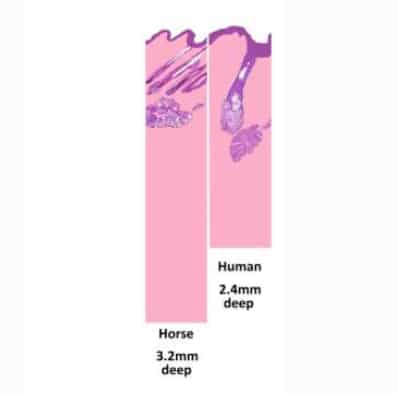
  1. The horse skin was thicker, but by less than 1mm! And this was primarily just the deep collagen tissue (which sits below the superficial pain sensing fibres).
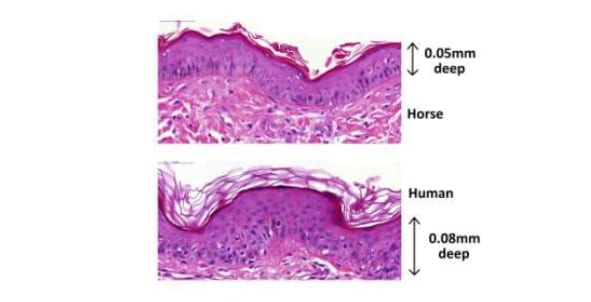
  2. The horse epidermis (the very top most layer of skin where the pain sensing nerves are found) was actually thinner than the human epidermis. This means that the horse has fewer skin cells lying between the source of the pain (e.g. a whip), and its sensitive nerve endings. 
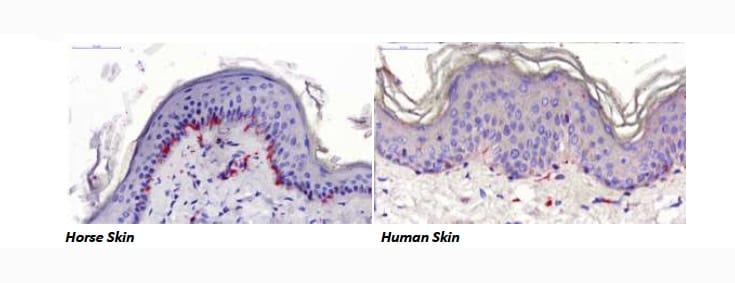
  3. Finally – a special stain that only stains nerve tissue revealed that the horse appears to have considerably more nerve endings in its skin than the human skin, including the nerves in the epidermis (superficial cells) where the pain sensation primarily occurs.

In some ways you could therefore argue that when it comes to pain, the horse’s skin is thinner.

There are more nerve endings in the horse skin than the human skin, including in the epidermis (the layer on top with all the blue circles). These represent sensory fibres, including those which feel pain. We were astounded by these simple findings.

This small pilot study suggests that horse skin really doesn’t have all the supposed ‘padding’ from pain that we often assume larger animals have. And even more revealing than that, the skin of the body – where we whip horses – may have even more sensation than ours.

To really get to the bottom of exactly how human and horse skin differs in thickness and sensation, we need to look at skin from more people and horses. For that reason, I will be extending this work to a full sized research project. I believe that the best way to make a decision about horse whipping is by establishing the facts through science. Are we using pain to make horses run faster?

So far, it certainly looks like it.

Figure 1. A piece of horse and human skin side by side, showing a comparison of depth. The pink area shows the collagen (dermis), and the thin purple area at the top is the epidermis, where most of the painsensing nerve fibres are found.
Figure 2. A close up of the very top layer of the skin (epidermis) where the sensitive pain sensing nerve fibres end. The human epidermis is thicker than the horse epidermis, so there are more cells lying on top of the nerve endings.
Figure 3. A special staining technique called “immunohistochemistry” allows us to specifically stain up only nerve endings, in this case they have been stained a bold red.
Figure 3. A special staining technique called “immunohistochemistry” allows us to specifically stain up only nerve endings, in this case they have been stained a bold red.

Read the transcript of the Catalyst story here.

Managing Horses in Family Groups: Part 1

Managing horses in family groups. Horses and People Editor Cristina Wilkins talks with veterinarian and pony breeder Tom Davis about his experiences managing a breeding herd as a single family group. 

A passionate advocate of welfare for both horses and people, Tom explains the all-round benefits of allowing horses to express their social nature and social habits, and explains his approach to solving any logistical challenges. Feeding, pasture management, breeding and weaning will be covered in this new series.

Why do you manage your horses as a single family group? 

I keep horses (in my case, ponies) only in groups and they run free outdoors together whenever they wish. I have known for a long time that horses do just fine outside, as long as they can get out of the wind and wet weather when necessary. But, it wasn’t until I began breeding and raising ponies that I appreciated the social structure of horse groups, and the tremendous disadvantages of single and stall-centered housing for the horses, and for their owners and handlers.

My group currently consists of eight Section A Welsh ponies: four mares of breeding age, one stallion of breeding age and three youngstock aged between one and two. I expect three foals this Spring.

Can you describe how your property is set up and the climate in your area? 

The total property is 75 hectares (185 acres), but most is used for growing field crops – corn, soybeans and hay. The pastures now total about 8 hectares (20 acres), split into two plots of 9 and 11 acres. I have no stable barn – only sheds that provide enough space for them all when they want to be out of the wind or rain (but which they rarely actually use). The Summer pasture has a shed, but it is almost never used. There are plenty of shade trees, including a small patch of woods.

My farm is in the north-east of the United States (New York State) about 100 km (60 miles) north of New York City, near the south-eastern edge of the Catskill Mountains. Summer (June to August) temperatures can range up to ~38oC (100o F), but daytime highs are usually 29oC (85o F) or less. Rainfall allows for green pasture growth throughout the Summer provided the ratio of animal days per acre is reduced beginning some time in August to prevent overgrazing. Winter weather sets in by early December and begins to break up in early March. Winter temperatures vary. Some nights can reach -30oC ( -20o F), but the usual range is nights in the -10oC and days at 0-10oC. The heaviest snowfall usually occurs in January and February, and often reaches 60 cm (2 feet), occasionally much more, but the variations in temperature cause enough melting to keep the typical snow cover to 30 cm (1 foot) or so. The ponies have no problem dealing with these conditions.

Do you supplement the group’s pasture intake? 

During the months they are on fully grown grass pastures they get only grass, water and a salt block.

Our main Winter food is hay. I prefer the least coarse varieties I can get and have nothing against mixes that contain clover, alfalfa, etc. that some say are too rich for horses. and

The food for our ponies changes gradually over the seasons (See the discussion directly below about grass pasture), so they never have trouble digesting good hay during the times of the year when they are principally on it.

The most important characteristic of our Winter feeding regime is that food is available to the ponies constantly. I cannot emphasise this too much. They have access to hay 24/7.

We feed little or no grain to our ponies at any time of year. We judge their body condition but, for the most part, hay alone has kept them with good fat reserves in the Winter. So far, we only had to supplement with feed a pregnant mare that is low in the group’s social hierarchy and a couple of young ponies in their first Winter. This points up the need to pay attention to group dynamics in the Winter feeding process. Available food must be dispersed widely enough so that every animal can get its share without being pushed out by those higher in the social hierarchy. We had problems with ponies getting thin through the Winter when we made the hay available in racks on the inner walls of the sheds. There was not enough space for all to get to the hay freely, so the high pony got fat and the low ponies got thin. The problem decreased when we fed the hay in the box that is large enough for all the ponies to easily fit around.

A less apparent, but very important, aspect of this 24/7, everyone-has-access feeding process is the social benefit. Because they live so closely together, my little herd of ponies has to learn to get along and the young ones have to learn how to be polite around the older, stronger ponies. And I have to keep these important aspects of equine life in mind. If I forget about the pony’s social needs, and don’t design the sheds and feeding areas in a way that allows them to interact, but still have room to all get to food and shelter, then problems arise for which I am responsible.

Do you ever need to restrict your ponies’ diet? 

Many horsemen have told me that ponies should be restricted from grass pasture because of the risk of laminitis and colic. I agree that these diseases afflict horses and particularly ponies on pasture, but my experience tells me a year-round pasture-centered system of dietary management controls these problems without requiring restriction. On the contrary, I believe optimal management of ponies and horses requires access to pasture.

We are advised to keep away from grass an animal that evolved to live on open grassland and whose digestive tract is designed to handle grass. Those who advocate this restriction claim the horse’s evolutionary history is not relevant because domestic pasture grass is much richer in nutrients, particularly carbohydrates, than is grass in natural, wild environments.

All herbivores depend on bacteria (and some fungi and protozoa) to digest the fibrous material they eat. The cow’s rumen is the best known example. It is a fermentation vat, where bacteria break down the cellulose and complex carbohydrates of the grass, hay and other fibres the cow eats into simpler and absorbable carbohydrates.

In equines, the food is fermented primarily in the cecum, which is at the junction of the small and large intestine, and lays along the lower part of the belly toward the animal’s right side. Its location is not obvious from the outside. The fermentation that occurs in the cecum depends on bacteria. The mix of species of bacteria that most efficiently ferments the food in the cecum changes according to the type of food the horse eats. Some species of bacteria are best at digesting very coarse fibers of late grass or of hay, some are best at digesting early, lush grass, some are best at digesting grain, etc.

When the food changes, the mix of the bacterial species must change if digestion is to be efficient. But, this cannot happen in an instant. It takes time and, until the bacterial populations have time to adjust and reach the proper mix, undigested food will accumulate in the horse‘s intestinal tract causing diaorrhea, increased gas formation, fluid accumulation, and possibly, if severe enough, colic. Accumulation of undigested carbohydrates is also one possible cause of laminitis.

My experience tells me the solution to the problem is to make the transition to good grass very gradual and the best way to do that is to keep the horse out on the pasture during the pasture’s entire growth cycle. In the Spring, the grass doesn’t grow overnight from the short brown stubs of the Winter to the tall green of early Summer. The awakening of grass in the Spring is gradual and, therefore, gradual also is the change in the pastured horse’s diet from the hay and other stored forage of Winter, through the short stubs of early Spring grass, eventually to full pasture, then later in the year to hay. This gives the horse’s intestinal tract time to adjust to the changes in food.

Under this system, none of my ponies has had laminitis. The absence of grain supplements from their diet, and the constant exercise from being outside and free to roam may also help in keeping them free of that condition.

Some owners are concerned about injuries caused during play or fighting when horses are kept in groups. Have you experienced any situations like this with your group?

I experience this situation almost every day (the kicking part, not the injury part), and I am happy to see it. If a dam never kicks or bites her foal, she is not doing her job as a mother. And if you, as owner or caretaker, keep horses apart because they quarrel, you are increasing the chances of having an unruly horse who is impolite and doesn’t know how to interact with other horses or with humans.

Horses are social animals. Many people do not understand how important and fundamental this fact is. In my opinion, it is the single most important fact to know and to live by if you handle horses. Their social nature and their social habits are the most important factors in determining how horses get along with other horses and with humans.

How does a horse become properly socialised?

If you watch horses, the answer is as clear as it could possibly be – it is not ‘by being properly trained by people’. The answer is ‘by being properly socialised by other horses’. The most important horse in that process is the mother.

The first thing a foal learns is to move when his mother tells him to move. She spends its first hour making it stand up and, when she swings her head, move. She spends the first several days teaching him to walk at her shoulder when she walks, run at her shoulder when she runs and stop at her shoulder when she stops. These lessons are partly about physical skills, but they are more importantly about dominance and submission. She is telling the foal “I am your mother. My job is to keep you from danger, your job is to follow me. If I ask it, you do it. Period.”

Some time during the second week of life, the aunts and uncles and father and cousins and older brothers and sisters begin to enter the picture. They put up with the young foal to a degree, but at some point they all draw a line and make certain the little one knows how to act and knows his/her place; and that place is not at the top of the heap.

And so, the struggle goes as foals grow. The young ones constantly seek more privileges, other horses in the group seek to maintain their access to resources. But, because safety is to be found in numbers and within the group, disruptive fights that would fracture the group are avoided. 

Watch any group of horses that has been together for a long time and has a well-established hierarchy. They still push each other around, lay back their ears to one another and even kick one another. Once in a while, they may rear up and strike at one another. All this is a routine part of equine life. I call it discussion, not fighting.

This constant social interaction with other horses, particularly older horses, teaches a young horse how to behave, how to accept the directions of a higher ranked member, how to seek higher status or be resigned to a lower social position.

Membership in a group reduces anxiety and builds confidence. Because my ponies live, eat and sleep in an established, extended group, I don’t have to teach any of these lessons. The ponies teach themselves and each other, and do it better than we humans could.

A word about the kicking and possibility of injury: Observe a group of horses from afar and watch the kicking carefully. When you see a horse kick out, at first it looks like a violent and hostile unrestricted act meant to deliver harm. But, on closer observation, you can begin to understand how controlled and well directed these kicks are. They are usually aimed and very accurately placed. More importantly, the force of the kick is carefully and effectively calibrated to the intent; and the intent is rarely, if ever, to cause true harm. The intent is to speak in a shout rather than a whisper: GET AWAY FROM ME!

In their day to day interactions, I have seen my ponies kick one another hundreds of times. I have never yet observed the occurrence of an injury more serious than the temporary loss of a little hair. On two occasions a pony has been observed in the morning to be limping a bit and have a spot on a leg where the hair is lost. These may have resulted from kicks or from some other cause – I can’t be certain which. In any case, no real harm was done.

That is not to say accidents can’t happen. Horse hooves are hard and they can be delivered with great force. Not all strikes necessarily hit the target as intended. But, in my view, the mental damage caused by not allowing horses to have a normal social life that satisfies their needs and mentally prepares them to safely interact with humans must be weighed against the small chance of significant physical injury.

Are there human safety concerns when moving among a free-living group of ponies? 

Absolutely. Risk of mishap or human injury, possibly serious, is inherent to association with horses under any circumstances. For instance, horses can be startled or frightened by something totally out of their control, and, if you happen to be moving among them, they can hurt you without meaning to.

You can also be injured through the carelessness of a horse or yourself. You must always be alert to possible untoward circumstances when you are around a group of horses.

If you know something new or strange is about to happen – for instance, hunters are about to fire guns, dogs are about to be let loose, whatever – let it happen, but don’t be standing in the middle of the horses when it does. If you see some horses are arguing, let them argue and step a safe distance away. If you approach the group and see they are nervous for some reason, let them calm down before get too close. You shouldn’t need major safety precautions, just alertness and a little common sense.

However, the biggest danger if you want to keep your horses running free as a group, is that you will be at great and constant physical risk if the horses have not learned to give you space – that is learned to move away when you ask them to do so.

This is where ‘leadership’ and ‘dominance’ are usually mentioned but in this context, it just means that horses should learn that you can control access to resources; that you can confidently move them around without asking permission and can go wherever you wish.

Horses understand and establish this type of social order between them and part of our responsibility is to set some rules to make sure young foals and horses don’t learn they can push you around, invade your space or ignore your requests.

Horses are rough but they are not mean and unruly, they are just playing by horse rules. And, the hierarchy is never set in stone. You can change their behavior by changing your own behavior. Educating young horses to move when you ask whilst staying calm is the most important skill in horsemanship and too large a topic to be dealt with in this article, but before you handle horses as a group you need to check this.

Take a simple test. When your group of horses is out together and in a relaxed state, go out and walk among them. No ropes, no halters, no treats. Just wander about between them, greeting each quietly, walking in front or behind them, running your hand over them or through their mane and tail, or maybe doing nothing but standing there.

What is your reaction to that idea? If it is “Yes, it is always a pleasure to do that”, then keeping your horses under group conditions is generally safe for you. But if your reaction is “No way! That is too risky”, then you should not keep your horses in a free-running group until you have the skills necessary to feel and be safe around them. 

Some of the signs that indicate you are not safe, more or less in increasing seriousness:

  • When you go to the pasture or corral, the horses either ignore you or they run away.
  • When you bring food, they push you away so they can just take the food. 
  • If you walk among the group, they bump into you and step on your feet. 
  • If you are walking near them they block your path or otherwise obstruct your movement. 
  • They pin their ears back in your presence. 
  • They turn their hind quarters toward you. 
  • They bite or kick. 

These behaviors can be exhibited by one, more than one or all of the group. One is enough to make you concerned. The situation must be corrected.

But it should be corrected anyway. Bad behavior indicates bad horse-human interactions, not a bad housing scheme. Keeping your horses individually in stalls is not the solution to bad behavior – it just makes that behavior less obvious.

It is better to establish the proper relationship with your horses, enjoy them for what they really are and let them enjoy the 23 hours of the day they are not with you.

Once you try, I promise you will never want to go back.

In Part 2, Tom Davis talks more about his group’s behaviour, including introducing new members to the herd, how he manages the breeding aspects and the reasons why he maintains the family group intact and does not wean his foals.

[wpdm_package id=66618 template=”link-template-button.php”]

Boost your Dressage Scores Part 1: The Equitation Science Training Scale

The Equitation Science Training Scale.

“If dressage is the highest expression of horse training, dressage judging should be a transparent and systematic system for de-constructing that training”. Horses and People Editor, Cristina Wilkins, speaks with Andrew McLean about his proposal to align the dressage judging system with evidence-based horse training (learning theory) as a means to making results more objective and transparent.

Throughout this exclusive series, Dr Andrew and Manuela McLean, founders of the Australian Equine Behaviour Centre (AEBC) and Directors of Equitation Science International, will explain dressage judging against the backdrop of learning theory and the equitation science training scale. Just like step-by-step horse training, breaking down the dresssage judging criteria into chunks (training deficits) will help you identify and rectify specific training deficits, so you can design clear training strategies to enhance your next competition performance. 

Dressage is training, and training is learning

Dressage derives from the French word ‘dresser’ (meaning ‘training’) and, in its ultimate form, is considered the highest expression of horse training. At a national level, official competitions are governed by each country’s equestrian federation (e.g. Equestrian Australia). Their rules are based on those set by the International Equestrian Federation (FEI).

The FEI rules state that “the object of Dressage is the development of the horse through harmonious education,” and should ultimately result in “achieving perfect understanding with the rider.”  There is a clear premise that a horse’s education or training progresses in a series of ‘steps’ and this is reflected by each of the different levels of competition, from preliminary to Grand Prix, whereby horses have to demonstrate they can perform at one level before moving on to the next.

The FEI concepts of ‘harmonious education’ and ‘perfect understanding’ imply that the horse has learned how to behave (respond) to the rider’s aids, whereas ‘development’ refers to the physical changes to the horse’s body that allows the horse to carry a rider in balance with increased strength and power. This ‘education’, therefore, has two components; one is mental/cognitive (the psychological process of learning new skills) and the other physical (the gymnastic development and strengthening of the muscles).

In the past, most of the schools and systems of riding have focused mostly on how the rider communicates with the horse; that is, if you ride well enough, your horse will perform well. However, by focusing on the rider’s ability to deliver the signals/aids, they do not promote a clear understanding of how the horse learns to respond correctly and fluently to the rider’s aids in the first place.

A good seat and accurate application of the aids are obviously important – they allow the rider to be very clear and consistent – but the horse first has to mentally absorb, process and retain the meaning of each of the rider’s cues (the correct response for each aid).

The cognitive process of learning has been studied extensively in behavioural psychology and is known as learning theory.

How the horse learns 

Dr Andrew McLean was the first to describe how to explain dressage training using learning theory. Working in collaboration with Prof Paul McGreevy , a specialist in veterinary behavioural medicine and animal welfare science who has assisted Andrew to disseminate this knowledge to the scientific world, the pair have refined many aspects of learning theory in horse training. Together with his wife Manuela, Andrew has developed a complete and practical training system that aligns with learning theory and respects the horse’s mental abilities, instinctive tendencies and biomechanical potential. This system is described in detail in the book ‘Academic Horse Training’.

In great demand as a trainer, coach and speaker, Andrew travels the world explaining to both lay and academic audiences how training works at all levels in a refreshingly simple, logical and illuminating way.

Shaping scale in learning theory

Andrew and Manuela developed the shaping scale of horse training (To view the shaping scale history review and explanatory tables we recommend you download the pdf version of this article). Known as the Equitation Science Training Scale, it is a systematic progression that identifies six stages of learning to perfect each response, from a basic attempt (an approximation of the correct response) to proof (where the horse immediately responds correctly every time and in any environment).

The scale is based on the principle of shaping: reinforcing successive improvements that are approximations of the final response. Effective trainers have always known how to ‘shape’ behaviours – they analyse the components of the behaviour, and break them down into small chunks the horse can understand and store. Like steps on a ladder, each chunk leads on to the next and, over time, the behaviour is perfected.

By rewarding the horse often at the right time, great trainers capitalise on each tiny improvement and move quickly towards the final response.

In fact, Dressage Master Gustav Steinbrecht says in his book ‘Gymnasium of the Horse’: “[The training exercises] should all follow one another in such a way that the preceding exercise always constitutes a secure basis for the next one. Violations of this rule will always exert payment later on…”

Dressage training versus judging 

Recently, Andrew has turned his attention from training to dressage judging. Speaking at several 2014 international forums, including the International Equitation Science Conference and the Global Dressage Forum, Andrew put forward a proposal to make dressage judging more objective and clear by applying learning theory.

“If dressage is about training,” says Andrew, “and training animals is about using learning theory to shape the criteria of responses, then dressage judging is about de-constructing training; de-constructing what the trainers are trying to do.”

Judging in any sport should be about objectivity – facts that are probably true – rather than subjectivity, which are opinions, personal interpretations, unsubstantiated assumptions and inherent biases – but many people believe dressage is rife with subjectivity and prone to inherent biases.

Dressage professionals have highlighted problems, such as discrepancies of 30-40% between individual judges and inherent bias. In an article published by eurodressage.com, CEO of the International Riders Club and FEI competitor Wayne Channon called for judging to move into the 21st Century and nominated four levels of judging bias:

  • Conformity Bias – judges feeling that they have to fit in with their colleagues.
  • National Bias – scoring one’s own nation higher than the other judges. 
  • Order Bias – the later a rider starts the better chance they have of a higher mark. 
  • Memory Bias – remembering the previous marks awarded to the same horse/rider combination and awarding marks based on that performance, rather than what was actually seen on the day.

Channon points out that judging needs to be simple so judges get it; transparent so riders, coaches and the audience get it; objective so riders can trust it and; reliable so that what we value is not too complex.

Importantly, Channon declares himself “a proponent of separating the judging tasks into manageable chunks” – a statement which Andrew points out sounds just like shaping.

Far from attacking the judges, Andrew believes judges judge what they see at the time, based on the FEI training scale. His review proposal centres around enhancing the FEI training scale by making it truly scalar and aligning the elements with learning theory. In this way, the scale could be applied to every dressage movement and used as the marking criteria.

Establishing training priorities 

Equitation science emphasises that horse training should prioritise, for the sake of safety, obtaining clear control of the horse’s mobility, which should be achieved from light aids to protect the horse from strong or constant pressures. This, as Andrew reminds, is old classical training and ideology – legs first, then frame; in other words, the head and neck posture is a consequence of training the legs to respond to our aids. Problematic head carriages almost always reflect major training holes in lightness to either leg or rein aids or both.

“All dressage movements are based on just four mobility responses,” says Andrew. “These basic responses, which have to be trained in all gaits, are the basic responses that horses learn and are reflected in the lower level dressage tests.”

Scroll down to download the pdf version of this article and see all the text boxes and images that were shared in the original print article.

Andrew explains that, in training, the rider first achieves a basic attempt of these four responses. By applying learning theory correctly, the horse then learns to respond immediately and from a light aid every time. This is what behaviourists call stimulus control, which in equitation may be better understood as ‘obedience’ – an immediate response to a single light aid.

Once these basic responses are installed and once the horse develops the physical strength required, the responses can be chained together one after the other (not at the same time preferably as it could confuse the horse) in cascades of responses to produce the more advanced and complex movements.

For example, half pass is a composite movement consisting of a turn response and a yielding the hindlegs response. Shoulder-in is a turn of the forelegs off the line, while travers is an indirect turn on the line followed by a yielding the hindlegs response. The quality of these higher composite responses depends on the quality of the basic responses.

Andrew insists that the first steps of basic attempt and stimulus control need to be added to the FEI training scale before rhythm.

“There is no slot in the FEI scale for basic attempt and stimulus control,” says Andrew. “It is assumed, probably because in the early days when dressage was first introduced as a sport, the horses, which were mostly military mounts, were trained and had already achieved rhythm level for the required movements. We can’t assume that anymore today. Horses may perform at competitions when they are only beginning to learn shoulder-in or piaffe and we need to be able to assess this and mark them accordingly.”

Stimulus control, which Andrew terms ‘obedience’, should be assessed as happening immediately from a single light aid. It is easy to see if the rider is constantly spurring or holding the horse, or if the response is delayed, and this ties in with the element of ‘rhythm’.

Andrew insists it is critical to define rhythm according to the oldest and most useful definition – that the horse keeps doing what was asked. Judges often differ in their interpretation of the term and some believe it is the regularity of the gaits. “While regularity is an important aspect of rhythm,” says Andrew, “it is secondary from the training perspective of continuing to respond to the single aid.” When seen from this perspective, rhythm can be directly observable and assessed with tests of self-carriage (momentarily softening the rein and/or leg contact). Self-maintenance of the response is what training is all about and, in Andrew’s view, it is essential to ensure good welfare.

Straightness is shaped after rhythm and can also be assessed with self-carriage tests. “Straightness,” says Andrew, “is not about the straightness of the body, but rather a function of laterality, and to a smaller extent, asymmetry. The effect of laterality is that one diagonal pair of legs tends to provide more propulsive thrust than the other. The other diagonal pair tends to provide slightly more reverse thrust and the difference between them skews the horse.” Biomechanically, ‘crookednes’ is normal for quadrupeds as it allows them to place the hindlegs deeper so that one leg goes in between the forelegs, as happens in jumping or galloping. “When training lightness and rhythm,” he continues, “if the trainer focusses on making the diagonal pairs as even as possible, the horse will maintain perfect rhythm and straightness.”

The ‘contact’ or connection level in the scale includes other subtleties, not just the horse-rider contact, but the further physical development of the horse’s impulsion, engagement, ‘durchlaessigkeit’ (throughness) and collection. Rather than being actual learned responses, these elements occur as the horse becomes physically stronger.

‘Durchlaessigkeit’, a German word that is as hard to translate as it is to pronounce is known as ‘throughness’, but has been better described as ‘letting go-ness’ or ‘when the rein aids flow through to the hind legs’. This, says Andrew, is a very important part of training a horse: “it is not good enough when you pull on the reins and the horse just slows his front legs. His hindlegs must also dig-in to some extent and this occurs by lowering the hindquarters.”

“When seen from this perspective, the degree of throughness also corresponds with the degree of collection because, as the horse improves and develops physical strength, the hind foot prints begin to step closer to the front foot prints. So, impulsion, engagement, throughness and collection should be seen as on a continuum at the same scalar level but varying only for the training stage.”

The last step of the equitation science training scale is ‘proof’ – an element that Andrew says he ‘borrowed’ from American dog trainers. “It is important to show that what you have trained at home in your indoor arena will still work when you go elsewhere,” he states. “Horses are very contextualised in their learning (they make associations between the behaviour and the place where they are doing it), so it is normal for the wheels to fall off to some extent when you move to a different environment. It is important to gradually shape that as well – taking them to slightly more challenging places over time.”

Merging dressage training and judging for better transparency

If the equitation scale was universally accepted to describe the training process, the judge’s marks would reflect the actual training error. This way, trainers would have a better idea of where the training had gone wrong and what elements need to be re-trained, improved or refined for each response or movement. By emphasising the importance of lightness and self-carriage in all movements, a scale like this would also align good judging with good welfare.

For example, instead of the current criteria for a mark of 5 being ‘sufficient’, the benchmark would become ‘basic attempt’ – the required movement was visible and happened at the correct place. Marks below 4 would indicate a failure at basic attempt and the severity would reflect the gravity of the training problem. Marks from 5 to 10 would align with the training scale to show the level of development towards harmony between horse and rider.

The scale could also be used to set ‘firewalls’ or ceilings for marks, so that if any step is not present, the mark is frozen at the step below. According to Andrew, rhythm should be firewalled, so that no horse, regardless how expressive his movement, can be marked higher than a 6 if he is not showing self-carriage. Straightness is another level that should be firewalled, not just because crookedness thwarts the horse’s ongoing progress, but also because the lack of it may mean the horse is subject to ongoing pressures on one side or the other. This would mean that a horse that is not straight could not receive marks higher than 7.

Andrew is a firm believer that judging and welfare should be synonymous. “Judges are the housekeepers of welfare and the system should be transparent for all. If we want to see dressage go into the future, it must be sustainable, it must move away from its cultural shadow and become more objective. Importantly though, a more objective system would give judges more confidence and credibility.”

Scroll down to download the pdf version of this article to see how the Shaping Scale could be applied to judging specific movements such as, the halt, lengthened strides and piaffe.

Next month 

While the dressage world is entrenched in its own history and traditions, and changes such as Andrew proposes will take time to be accepted, the truth is that, with a good understanding of learning theory and the shaping process, it is still possible to make some sense of the current judging system against the equitation science shaping scale in a way that can inform your training.

In the next part, which will be available soon, Manuela McLean will begin to list the most common comments that judges make when scoring dressage movements and explain how they fit in with a learning theory approach to horse training, and describe strategies for rectifying problems. Comments such as ‘not shown’, ‘resistance’, ‘not forward’, ‘needs to be more uphill’, etc., will be grouped and placed into the appropriate level of the equitation science training scale. Clear training strategies to improve each response will be broken down and explained.

Check out this article by Manuela McLean about teaching learning theory to young riders.

To find out more about Equitation Science International and the work of Dr Andrew McLean and Manuela McLean, visit the ESI website.

Download the complete Boost Your Dressage Scores series as an e-book, complete with diagrams and illustrations.

The Caspian

The Caspian Horse: From a time millennia past, when a kingdom’s strength was often measured by its ability to master the art of horsemanship, comes a small horse of legend. A legend that reached forward into the later part of the 20th Century and gripped the heart of an American woman named Louise Firouz. A legend that she spent much of her life defending, sometimes at the risk of her own. 

Louise Firouz 

After studying at Cornell University, Louise married an Iranian aristocrat, Narcy Firouz and, upon their return to Iran, they established an equestrian centre. Sparked by rumours of the existence of a small, fine type of pony in the remote Alborz Mountains, Louise and her Bermudan friend, Joan Taplin, set off on a journey of discovery. After failing for many days and about to abandon their search, they chanced upon an exquisite small bay stallion near the Amol Bazaar on the southern shores of the Caspian Sea. Covered with lice and hitched to a heavily laden cart, his fine conformation and elegance still took their breath away.

Louise purchased the stallion, later named Ostad, along with another stallion, Aseman, and a mare, Alamara. Upon their return to the riding school, the horses soon became mounts for even the youngest children. “Standing 11 hands high, Ostad was narrow, fast, intelligent and spirited, but manageable and amenable, with incredible jumping ability,” Brenda Dalton recalls in her book ‘The Caspian Horse’.

Over the next two years, Louise continued her search. “We are still searching for Caspian Ponies… Arab-looking creatures with bold eyes, prominent jaws and high-set tails, which so distinguish their larger cousins,” Louise wrote in PONY (1968). “It has been a losing battle as the already pitifully small numbers are further decimated each year by famine, disease and lack of care. Until now, we must accept the sad fact that the survivors must number no more than 30.”

Scroll down to the end for an option to download this article as an illustrated pdf (ebook).

Darius the Great’s trilingual seal, which now resides in the British Museum, tells of his esteem for these small horses in choosing them to pull his chariot whilst lion hunting. Louise was determined to research the origins of the Caspian. The stone reliefs at Persepolis, the ancient palace of King Darius the Great (522-586 BC), depicted many breeds that she could recognise, including the Nisean, Thracian, Armenian, Cappadocian, Scythian, Chorasmian and a small horse possessing fine limbs, small ears and a slightly bulging forehead, which she now knew to be unmistakably Caspian. However, she found no evidence of the Arabian horse among them. Could it be, she wondered, that the Caspian predated the Arab? 

Prior to Louise’s discovery of living Caspians, they were only known to villagers in the remote mountains of Northern Iran. The small horses depicted on reliefs in the ancient palace were thought to have been extinct for 1,000 years and ancient horse bones that were unearthed from time to time were mistakenly attributed to a form of ass.

Genetic research into the Caspian Horse 

Historians now agree the discovery of the Caspian is as fundamental to the study of equine evolution as that of the Asiatic Wild Horse and the Tarpan. Among the many experts that carried out research programs was zoologist Sandor Bokonyi of Hungary who studied bones found at Hamadan and Shahir-e-Kumnis. Sandor concluded, “Three separate breeds were present at the same place, suggesting the Persians were [possibly] the first people to breed ‘consciously’ at the beginning of the first millennium BC.”

The Caspian fits the original Horse Type 4 as outlined by Anthony Dent in ‘The Horse Through Fifty Centuries of Civilisation’. Horse Type 4 played a part in the development of the Turkoman and Akhal-Teke breeds. 

In 1990, genetic studies began. Blood samples from 94 Caspians were collected, plus those from several other breeds. Findings from the phylogenetic reconstruction of the Oriental horse group concluded: “Therefore, we are able to state without a doubt that a tiny form of horse existed in ancient Persia [and] that this horse is the same as the modern Caspian and is ancestral to all forms of Oriental horse.”

The characteristic vaulted development of the forehead, the dense fine bone, narrow hard hooves and high-set tail not present in other Indo-European imports to the Middle East in 2,000 BC has led to the proposal that the Caspian horse was the wild stock from which the Arabian horse was bred. (Brenda Dalton, The Caspian Horse)

Their struggle for survival 

From 1965-1974, Louise acquired 27 Caspians, mostly from peasant farmers. From these, a further 32 more were bred. H.R.H. Prince Philip became involved in 1971 when he was invited to Iran by the Shah to celebrate the anniversary of the Peacock Throne. Being interested in the preservation of rare breeds, Prince Philip expressed his concern at their low numbers and singular location. Soon after, he was given a mare, Khorshid Kola, and stallion, Rostam. It took another two years for them to reach England after quarantine in Hungary.

The first Caspian exports were one stallion to the United States (1966) and two in-foal mares to Joan Taplin in Bermuda (1970). In 1972, Joan’s horses and those belonging to Prince Philip formed the basis of the first Caspian stud in England, the Hopstone Stud. 

By 1973, Louise had sold five Caspians to private Iranian owners and three to the School of Veterinary Medicine at Pahlavi University. In 1974, a second stallion was sold to the United States and a mare to Venezuela. That same year, a Caspian stallion named Ruba II won the Supreme Pony Championship at Salon du Cheval in Paris. Prince Caspian, a black stallion, was also sold and trained as one of Iran’s dancing horses – usually reserved for choice Arabian stallions. In 1977, he performed with the Sadlers Wells Ballet in ‘La Fille Mal Gardee’.

Also in 1973, the Crown Prince H.I.H. Prince Reza Pahlavi set up The Royal Horse Society to help preserve native horses. Shortly after, he purchased Louise’s herd of 23 Caspians with the agreement she would continue to care for them. However, the next year, Louise was forced to sell her equestrian centre to the Society due to financial hardship. The society’s support for the Caspian soon waned and they began to neglect the expenses for their care.

In October 1974, Louise and Narcy were abruptly forced to leave the centre. They were able to take their horses, except the 23 originally purchased.

A very difficult year followed, worsened by the grip of Winter and the threat of wolf attacks. When all seemed lost, they were able to purchase 15 hectares at Ghara Tepe Sheikh on the Turkoman Steppes. In 1976, their herd suffered two wolf attacks, killing a foal, two mares and one of Louise’s riding horses. This prompted Louise to ask Hopstone Stud to take in as many horses as possible. She later accompanied seven mares and a stallion to England.

Scroll down to the end for an option to download this article as an illustrated pdf (ebook).

Louise returned to a hostile situation in Iran as The Royal Horse Society was furious over the poor publicity they had received in England. They seized Louise’s Caspians and moved them to the Royal Stables at Gonbad-e-Ghabus, where they were severely neglected. After the Shah was forced to leave in 1979 due to the rise of the revolution, the surviving Caspians were sold off for such low prices that the majority were probably eaten by the nomadic tribe who purchased them.

Believing that horses were ‘playthings of the rich’ an almost 10-year ban was placed on keeping more than one horse. Consequently, not a single Caspian was bred during this time, which was simply devastating to the preservation of the breed.

While Louise managed to keep one stallion, Zeeland, during this time, the majority of her precious bloodlines, so meticulously gathered and bred, were lost except for those exported to England, and from there to Australia and New Zealand. During the revolution, both Louise and Narcy would also spend time in prison.

In 1989, Louise started to breed again with a small stock of eight mares and three stallions. However, ill-health sent her to England for several months and, with Narcy’s unexpected death in 1994, the horses risked being sold as part of the estate. Thankfully, the Ministry of Jehad stepped in and purchased 37 Caspians and their foals at full market price. This being most of the known Caspian stock left in Iran.

Due to Louise’s untiring efforts, Iran officially declared the breed a national treasure. Sadly, Louise died on 25th May 2008. Today in Iran, a team of dedicated people, aided by Louise’s daughter Ateshe Firouz-Larsson, have started surveying and registering the stock that is being bred by new and established breeders. They have the full support of the Equestrian Federation of Iran.

2015 marks the 50th Anniversary of the re-discovery of this extremely important horse breed, which the Federation hopes to commemorate with a conference in Iran in September.

A horse, not a pony 

Though small in stature, the Caspian is a horse, not a pony. The height range is generally from 10.2-12.2 hh. The foals grow very rapidly, almost reaching an adult height in the first 18 months. They come in solid colours only, including bay, chestnut, grey, black, brown and various duns. Being a horse, not a pony, a Caspian should give the overall impression of a well-bred elegant horse in miniature.

Over the years, there have been numerous discussions regarding the different ‘types’ within the breed. “Within the breed, there is a natural gradation from a larger stronger type to a dainty fairy-like type,” says E. Alderson in the International Caspian Stud Book. “This variety is a strength, not a weakness.” Louise felt that by breeding Caspian type to Caspian type breeders would eventually come back to the original Caspian in type and size, which is the smaller animal.

Temperament 

On the whole, if treated well, Caspians are kind natured and affectionate, visibly enjoying pats, attention and kind words. They readily learn their names and will usually come when called. They like to be with the people they trust and can form strong attachments to certain individuals. Being naturally curious, you will often find a Caspian looking over your shoulder and you need to be careful where you leave new objects if you don’t want them investigated.

Like all breeds, every Caspian is an individual and good owners will allow for this and learn how to relate to each horse in order to bring the best out in them. Caspians are generally sensitive horses and do not cope well with harsh treatment. Coupled with their sensitivity is also a good dose of sensibility. If something startles a Caspian they may jump or take a few steps, but then they will tend to stop and analyse the situation, rather than overreact. Their intelligence, coupled with their kind nature, makes Caspians highly trainable and generally fast learners. Comments such as “He never put a foot wrong” or “Never have I had a horse so easy to train” are not uncommon. 

Communication is also one of their strong points and Caspians will often neigh or perform a physical action in order to convey a message to you. I personally know of two herds of Australian Caspians who deliberately sought out human help and then led the way to a fellow horse in need of help. To read heart-warming Caspian stories like these visit the Horses and People website in March.

Scroll down to the end for an option to download this article as an illustrated pdf (ebook).

Uses 

The average Caspian nature, which combines affection, curiosity, spirit and kindness, makes them wonderful mounts for children. Compared to ponies of similar size, Caspians are more slender in the barrel, making it much easier for children to wrap their legs around them and their smooth gaits are easy to ride. In Australia, Caspians have been regular winners of pony trots and carriage driving classes. In Sweden, Caspians compete in pony racing, being able to keep up with larger horses in all gaits, except at the full gallop.

For their size, Caspians have an exceptional jumping ability. The Caspian’s speed and great agility make them highly desirable for gymkhanas and barrel racing. They also exhibit a long low action in the show ring and have smooth gaits for dressage. Their stamina also makes them suitable for endurance riding.

Peculiarities of the Caspian Horse 

Owing to their mountain origin, Caspians have more angled hocks than lowland breeds and, from the beginning, breeders have taken steps to correct excessive cow hocks. Other than this, Caspians have no breed-specific faults. Caspians have a number of unique features compared to other breeds, including unique haemoglobin in their blood, a different parietal bone structure in the forehead, a shoulder blade which is narrow at the top and wider at the base, their first six vertebrae are longer, an extra molar tooth in the place of the ‘wolf teeth’, long slender cannon bones, and a generous length between their hip and hock which likely contributes to their jumping ability. Caspian foals also have very distinctive, bulging foreheads when born.

The Caspian Horse in Australia 

In 1975, Margot Schabort convinced the Shah of Iran to allow her to export to Australia the stallion Ruba II, but sadly and despite paying a princely sum, she never bred from him. In 1981, the Caspian Preservation Society of Western Australia was established by Betty Giles and her husband Tony of Heroden Stud, Western Australia.

The first Caspian breed classes were held in Perth at the Royal Showground in 1982. The first two Heroden part-bred Caspians collected 44 rosettes at their first four shows as three-year-olds. The purebred stallions, Hopstone Kaftar and Hopstone Tochal, later became part of a celebrated Caspian demonstration team. Hopstone Kaftar won many driving classes and remained a much-loved edition to the Gyles family for his entire life, only dying in 2005. Sadly, the Heroden Stud only ever bred one purebred foal.

Tandara Stud was the second stud to be formed in Western Australia when Sue and Ray Eiffler saw the photograph of Hopstone Tochal that would begin their love affair with the breed. From 1981 until 1985, they acquired eight Caspians from the Marida (SA) and Cheleken (NZ) studs. Sadly, one of their first died from a snakebite within the first six weeks.

They also leased Ruba II for a time and ran him with a number of mares, but sadly no pregnancies resulted. Tandara Stud also exported seven mares to ProtoArabians and Texana Farms in the United States and a number of horses to New South Wales.

Though other studs were formed in Western Australia, sadly Tandara Stud is the only remaining one and has 15 Caspians in total. Due to age, Sue and Ray now only breed to order. Since it began, a total of 57 purebred and 59 part-bred Caspians have been registered with the Caspian Preservation Society of Western Australia.

Ida Graham of South Australia formed The Australasian Caspian Society (Inc), with the first meeting taking place in 1976. That same year she, together with Marshall Steer, created the Marida Stud when they purchased from England the stallion Amu Daria and three mares: Susiana, Gulpar and Aloucheh. In 1983, they purchased Cheleken Avval Pesar from New Zealand. They also bred two fillies from Ruba II. After Ida’s death, the trust fund she set up for the ongoing promotion of the Caspians imported Cheleken Grischa. Other studs soon formed in South Australia using the Marida progeny.

Ida had unfailing enthusiasm for the Caspian horse, she loved them all and would often say in fun “They are all my Caspians” no matter who they belonged to. She was an extremely persuasive lady and no one ever said no to her. Ida always attended the shows along with her butler/chauffeur who brought along a fabulous picnic basket to be shared amongst all the Caspian breeders.

Interestingly, in 1988, Mandy Pascoe instigated the first and only known Caspian embryo transfer with a two-year-old Clydesdale mare, Matilda, to be the surrogate mother. Marida Tarikh, the resulting filly, later placed first in the Royal Adelaide Show filly class.

Ida died in 1991 and later when Marshal moved properties, the Marida horses were transferred to Ningana Park, owned by Mandy Pascoe and her husband Scott. Mandy had been heavily involved with the Marida stud from her childhood and promised Ida the Marida would continue as long as she had a say in the matter. In 1999, local Caspian breeders and owners gathered at Ningana Park for the filming of the Burks Backyard segment and, when aired in September, it was remarkably well received. Mandy’s daughters promoted the Caspians in the pony trots, and Mandy’s skills in breeding and horse presentation resulted in many ribbons in the show ring.

Marshal Steer has always taken his custodianship of the Caspian Horse very seriously and although in his 80’s, he is still very supportive and interested in what is happening. When managing Marida, he held constantly to his goal of breeding good quality Caspians and would only keep a colt if he was an improvement on his sire.

In 1990, Shauna Mills-Swarts and her husband Gerard became the managers of Chippendale Stud, where they continued for five years. As purebred Caspian mares were very hard to come by, they purchased a 7/8th Caspian named Tori Park Neshatarave in 1991 and started their own Astara Stud. They intended to use her to breed up to purebreds. However, the rule allowing upgrading was soon overturned by the ICS and only purebreds could be used to breed purebreds.

Over the years, Shauna and Gerard have acquired and bred many purebred Caspians, and have been dedicated to showing and promoting the breed and helping others become involved. Sadly, although they still have 21 horses, the Astara stud has now stopped breeding due to age and Gerard’s ill health.

Three Studs were set up in New South Wales, all have since closed. Among them, Maureen Byrne of the Markazi Stud was responsible for updating the Constitution for the International Caspian Society. Two currently unregistered studs in Victoria own a number of purebred Caspians.

Fiona Morland of Zarin Stud emigrated to Australia in 2004 from England, bringing her beloved Caspians with her: the gelding Henden Balut, the yearling colt Zarin Taze Majara and the three mares Spark Zarrin Tara, Sirhowy Arziz and Spark Persia. This injection of new bloodlines in Australia was both vital and timely. Now owned by Jasenna Stud, the filly Zarin Shaphiyr was the last foal to be bred by Fiona before her retirement and is the only foal born in Australia to exclusively contain the bloodlines she imported.

Finally, Jasenna Stud was established in 2006 by Jenne and Andrew Timbs. It is the first and only registered Caspian stud in Queensland. Jasenna Stud is responsible for the Caspians’ presence at the Horse Breeds Expo display at Queensland Royal Show for the five years from 2009 to 2013. Being avid photographers, Jenne and Andrew have turned 17 of their photos into a series of posters with the hope of raising awareness of the breed in the younger generation. Jenne has done many public presentations, two radio interviews and continues to write articles to help promote the breed. Since the beginning, Jasenna Stud has faced many obstacles, including equine influenza, the loss of their first two foals and economic downturn. High feed prices and the ongoing drought/flood cycle continue to challenge their dedicated efforts to maintain their precious herd.

Scroll down to the end for an option to download this article as an illustrated pdf (ebook).

The Future of the Caspian Horse 

Currently, breed societies exist in the United Kingdom, Iran, Australia, New Zealand, the United States of America, Norway and Sweden. Sadly, the economic downturn has seen a fairly rapid decline in the number of Caspians worldwide. In many places, including Australia, breeding has drastically slowed or been put on hold. In Australia, there are only four registered studs left in operation, including Marida/Ningana Studs (SA), Astara Stud (SA) and Jasenna Stud (QLD) under The Australasian Caspian Society, and the Tandara Stud (WA) under the Caspian Preservation Society of Western Australia.

Membership and registration with either of the Australian Societies are open to pure and part-bred Caspians. Horse registration and transfer requirements are quite straightforward and all fees have been kept low to encourage breeding. Both societies pay a yearly subscription to the International Caspian Society (ICS), so all Caspians can be registered on the international register. ICS has a website and studbook available online.

A total of 2,040 Caspians are registered in the International Caspian Studbook. Of those, approximately 1,500 have been bred within the last 20 years. Brenda Dalton estimates there cannot be more than 1,000 in existence today. Of these, half will be geldings or not used for breeding, which leaves between 500 and 600 breeding Caspians worldwide. Though so influential in the early days, New Zealand has seen its Caspian herd dwindle to the point where, without the importation of new mares, no purebreds can now be bred.

The ongoing preservation of the Caspian in Australia is in desperate need of new breeders, sponsors and patrons. Both the societies and individual breeders are looking for volunteers in website design, promotion and marketing, as well as reliable and competent riders who are light enough to start young Caspians under saddle.

Though the early part-breds in both Western Australia and New Zealand were so successful in a number of disciplines, the cross-breeding potential of the Caspian has remained largely untapped.

Finally, as 2015 marks the 50th Anniversary of the Caspian’s re-discovery, the ICS intends to produce a commemorative calendar. Australian breeders are also considering producing a limited edition book on the Caspian in Australia. To find out more, contact Jenne Timbs of Jasenna Stud on (07) 5547 0224.

Further Stories about the Caspian Horse

Though the history surrounding the Caspian is fascinating, it is the horses themselves that capture the hearts of many who come into contact with them. I have often been captivated by the personal stories people have shared with me and, as a breeder, I am steadily collecting my own.

Like all breeds, every Caspian is an individual and good owners will allow for this and learn how to relate to each horse in order to bring the best out in them. On the whole, if treated well, Caspians are kind natured and affectionate, visibly enjoying pats, attention and kind words. They readily learn their names and will usually come when called. In fact, I’m amazed at the number of times I can say something to my horses and they actually go and do it!

Caspians like to be with the people they trust and, if you want to muck out a yard or stable unimpeded, then you need to either turn them out or give them some food that they prefer more than your company.

These horses are also highly curious. If you are using a power tool to fix the fence in their paddock, don’t be surprised to find a head or two looking over your shoulder. I have on numerous occasions reminded vets to be careful where they put their equipment. Two years ago, Saraph, then a foal, had the vets’ attention as he was rummaging through the supplies in the back of their vehicle. “There’s not much he can hurt in there,” they chuckled. Just to be sure, I shooed him away and closed the door.

One night, when coming home on dusk, having left a mare and foal in the house yard, I was bringing groceries into the house when I heard little hoof falls on the hard floor behind me. I turned around to find the young filly, Shenayim, standing in the middle of the lounge room looking intently around. I made it back to the door just in time to stop her mother from coming in also. Sometime later, the same filly used to follow me into our hay container, which was often piled high with hay, leaving only enough room for me to squeeze down the centre aisle. She would unhesitatingly follow me in and then have to back out, and take the final step down a foot or so onto the ground. She never missed a beat. On the whole, our Caspians have few qualms about ‘squeeze situations’.

Shauna and Gerrard Swarts tell of a filly, Chippendale Keshvar, who used to demand that they take her out of her stable at the Royal Adelaide show so she could watch the fireworks.

This ancient breed can form special bonds with their carers and two long-term breeders, Brenda Dalton in England and Sue Eiffler in Western Australia, have commented to me that Caspians can be somewhat dog-like; in that, they can form a particular attachment to certain people.

We were given a mare that, though well treated, had a personality clash with her last owner. She used to be hard to catch and impossible to worm. We employed our usual calm persistence and she is now easy to catch, which we rarely need to do because she usually comes when called and leads well with just an arm over her neck. I now worm her without ever having to put a halter on. In fact, she is one of our favourites and has formed a special attachment to me, giving me both of her foals on my birthday exactly two years apart.

The first a colt was the first foal I had ever seen born from start to finish – the whole process taking just 7 minutes. Coming up to the second foal, I would rub Arziz’s tummy and say “Do you think you can wait til my birthday ZeeZee?” Much to the protest of my eight-year-old daughter who said it would not be fair for me to have two foals born on my birthday. Well, Zeez didn’t listen to her and, on the morning of my birthday, she had drops of milk on her udder. I had to dash out for an hour and I told her not to have the foal until I came back. When I got back home, I immediately called her name and she called back; she was still in one piece. Her little filly was born around 3 in the afternoon. We got to photograph and video the whole event and, soon after, I stroked her neck and welcomed her into the world. She and her Mum were tucked up in their stable before dark and I got to sleep the entire night in my bed – what a birthday present!

Caspians can also show a concern for others.  Betty Gyles told Liz Webster of a time when Kaftar was at the Albany Show and stabled beside a horse that was on a diet. During the show, Kaftar’s generosity and kindness were displayed when someone caught him passing mouthfuls of hay to the dieting horse through the rails that separated them.

Marshall Steer of Marida Stud, a partner in the first South Australian stud, tells of a herd of Caspians who kept running down to a man who was fencing in their paddock, they would circle him a few times and then run back up the hill. The horses repeated this until he decided he should follow them up to a large hole he had been digging for a strainer post. There, he found a small foal who had fallen into the hole. He promptly rescued the foal, who was thankfully no worse for wear.

Shauna Mills-Swart of South Australia recounted to me a time when Omar, one of her purebred geldings, kept running up to the house calling out and then running back over the hill into the back paddock. Strange behaviour for a horse that is extremely shy and does not readily seek out human company – unlike the average Caspian. After the third time, they thought they should follow him and did so in their ute. They found the entire Caspian herd of approximately 18 individuals had surrounded a Thoroughbred mare who had become entangled in the plain wire fence. They were packed around her so tightly that she had been unable to move and, therefore, had done no damage to herself.  Shauna and Gerard were amazed. They immediately got wire cutters out of the back of the ute and cut her free. There was not even a scratch on her.

In 2012, Jasenna Hadar, then a 10-month-old colt, decided when he was at Queensland Royal Show that our eight-year-old daughter was his special responsibility. It was his first time away from home and I think it gave him a new perspective on the world. When he returned home, he took to being her singular protector and, if when she was mucking out her part of the yards she got too close to the railing where one of the older colts was housed, he would dash in between her and the railing so he would be the target of any bites and not her. Of course, the other colt had most likely come over to pick a play fight with him and our daughter was in little danger, but Hadar didn’t know that.

Caspians, tend to be great communicators. One year, when we had Jasenna Meshek in the Horse Breeds Expo at the Queensland Royal Show, he came to his window that looked into our display booth and whinnied, he then picked up the corner of his hanging hay feeder and shook it at me and, just in case I hadn’t got the message, he pawed the stable wall once only. Needless to say, I rewarded his polite efforts to tell me that he had run out of hay with another biscuit.

Finally, Shauna Mills-Swart of South Australia tells of a mare who called her when she was about to foal and waited for her to make it down to the stable at 3:15 am on a freezing Spring night. Throughout the pregnancy, Shauna, who was also pregnant, had repeatedly rubbed the mare’s belly and whispered into her ear “Molly, call me when you have your baby” and she did! The resulting chocolate brown filly nicknamed ‘Koko’ (Chippendale Balkis) became Shauna’s little shadow and, when Shauna sat on the edge of her veranda, the filly would sit her rump down into Shauna’s lap. This continued up until the filly was sold to the USA at the age of two – and somewhat heavy to be sitting in a human lap, I think you’d agree. In 1999, Shauna went to the international conference in the US and was able to see Koko again at her new home at MCC farms.  Koko was in the mare’s paddock with approximately 100 companions. Shauna called her name and she immediately called back and walked over to Shauna and stayed with her for hours.

Their intelligence, coupled with their kind nature, makes Caspians highly trainable and, generally, fast learners. I, with little effort, have taught several of mine to smile (curl up their top lip) when asked. A click followed by a food reward – indicating when they had done what I was looking for. Shenayim will also voluntarily hold up each leg when asked and kick a ball, which is a great crowd-pleaser.

Trainers who have worked with two of our colts have made comments like:

  • “He hasn’t put a foot wrong.”
  • “Nothing seems to worry him.”
  • “He hasn’t got a mean bone in his body.”
  • “He hasn’t got a bit of dirt in him and he would make the perfect kid’s pony even though he is a stallion.”
  • “He hasn’t forgotten a thing since his last lesson. Usually, they drop back a little.”

When Shauna and Gerard met Dick Kearly from the US, he thanked them for doing such a great job training KoKo. When they asked him what he meant, he proceeded to tell them how great she was as both a ridden and driven pony. When they explained that she had been well handled, but had left Australia as an unbroken two-year-old, he was amazed because, from the beginning, she behaved as if she had been well trained in both of these disciplines.

Dick Kearly from DiMar Caspians in the US recalls a story…

“I love the Caspian [horses] because they are ‘sensitive but sensible’.

Thursday was the last chance to drive with my friend and trainer Bob Giles before he left for Maine for the Summer. Bob always likes excitement and challenges, so I tried to provide that for him for this special ride.

I chose to hitch the four-in-hand because that is Bob’s favourite hitch. I put Triumph back on the lead and he hadn’t been hitched for several months. The other leader was Onyx who always leaps, plunges and bounces around. On the wheel, I put Agatha who kicks a little if you touch her with the whip and, on the other side, Ava who kicks and throws a fit at the start of every drive. So, there was plenty of potential for excitement in the hitch!

We hitched in my new barn, which is full of stuff due to all the rain. We had to move all the carriages and other equipment into that barn just to get it out of the wet. This meant we were hitching some excited horses in close quarters. We got that done and spun out of the barn with Onyx and Ava jumping and plunging, but not kicking.

With Bob on the lines, we immediately drove across a flooded area and the ground gave way under the horses due to some excavation we had done a few weeks earlier. Plenty of excuses for them to go nuts, but they just buckled down and pulled through it. The excitement level was high coming out of there, so I was looking for safe routes so they could settle. Not Bob though. He turned them right into our big water hazard, which had 18 inches of water in it. He said, “Got to keep their minds busy.”

About 300 yards from our starting point, he stopped and handed me the lines. Off we went again through the narrow trails through the woods. The horses settled nicely and we jogged along chatting about this and that. After about 15 minutes, I decide to go into the 50 acres I had just finished fencing up. This wooded area has cows and eight other full-sized horses in it.

The free horses immediately ran over and started trouble with the horses in harness. I told the Caspians to step up and they pushed right through the big, aggressive horses. As we went down the trails, we had eight big horses following us like a parade then, when the trail widened, they charged past us. A perfect excuse for my team to try to run off with them, but it didn’t happen!

Then, the big horses stopped and again tried to start trouble with us. This time, Onyx got his bit ring tangled in Triumph’s rein and I couldn’t turn the team left. They went off trail into the bushes with the big Hanoverian mare trying to mess with Triumph. I called “Whoa” and all stopped. Bob popped the big mare with the whip and got her out of the way. Then, he untangled Onyx’s rein and I backed the four out of the bushes and we were off again.

Soon, we came to a small stream which Onyx and Triumph elected to jump rather than wade through. This jerked the leader bar up into the wheelers’ faces and the leader bar snap caught Ava’s bit ring. Now, we had a horse who is not crazy about driving anyway with her bit tied down, again I called “Whoa” and Bob got down and unsnapped her bit.  No muss, no fuss – and we were off to complete our drive and return safely to the barn.

We packed more potential disasters into a one hour drive than most drivers would be exposed to in a year. The Caspians never tried to run off, and they never lost their minds and tried to break out of the harness. Every time they stopped and stood quietly while we sorted it out. Sensible!”

Dick Kearly from DiMar Caspians in the US recalls another story…

“The stallion’s name is spelt ‘Kiyan’. I know I haven’t said much about him, but he illustrates much of the good things about Caspians. He is beautiful and athletic. He has been ridden a little by my daughter and driven a lot. He is probably her first choice to drive whenever she does drive because he is very easy, yet she takes a certain pride in saying “I drive the stallion.”  

He has a very playful personality, which has led me to use him in an act called ‘The Do It Yourself, Driver’. In this act, I play a drunken hick who is sure he can train a driving horse without professional assistance. The act consists of doing everything possible wrong – starting with the idea that you could use a stallion for your first driving pony. Kiyan is trained to pull back violently if he is led incorrectly, so the act begins with some difficulty in even getting him into the ring. I then proceed to put all sorts of junk harness on him – mostly backwards, inside out and upside down. While doing this, I drink beer steadily and become more stupid by the moment. Kiyan is also trained to pull my hat off and throw it away every time I kneel down to tighten his girth – the crowds love that. The act culminates with me putting him to the cart backwards, so he pushes it around. I ride backwards a few feet like that and then pull a lever that causes a wheel to fall off the cart. The end!

Kiyan puts up with all this stupid stuff with no problem. He is also trained to jump in and out of the bed of a full-size pick-up truck on command. I’m sure I could train him to ride around back there like a dog with only a little more work.”

Bruce Perrott from South Australia recalls a story…

“In the early 1990’s, my combined driving scores were suffering pretty badly as the dressage was the worst component of my harness driving, so I opted to have private dressage lessons as I considered dressage as a bit poofy – little did I realise this was the most important phase of horsemanship!

On one trip back from a class, we stopped for fuel at Truro, and a young girl came up to my wife Susie and ask about our pony in the float. While Sue was talking to the kid, her father approached and mentioned they had a pony at home that was a good match and they were interested in selling. As we had been in the market for another pony to drive as a pair, before we knew it we were following the guy out to his place to look at the pony.

As Casper appeared out of a ravine trotting up to us with a beautiful gait and look-at-me attitude, we were sold. We paid the guy $200 as he wanted, plus bought two old sulky’s that were lying in the creek for a six pack of beer and a cask of wine. We loaded up and headed off for home. Casper was put into a yard next to our harness pony, Louey, who was the calming influence in our stables.

That night, we went through our horse books looking for information on Caspians and didn’t find much at all. As the weeks went by, we thought we would geld him and start to break him into harness – as it turned out he was a bit smaller than the pony that we wanted to pair up with. At the farm, during the Winter months, we used to sit around the fire and hand sew our harness and also build our own carriages, so it was time to start on the gear for Casper.

About that time, we went to a Mount Crawford Harness Club meeting, after the dinner Gerard and Shauna were introduced as new members and it was mentioned that they breed Caspians. We introduced ourselves and told them about our little bloke. We exchanged phone numbers and promised to phone his brand number the next morning.  Shauna mentioned that a few ponies had been lost on the register and we left it at that.

The following day, we phoned through his brand number and thought that would be it. Much to our surprise, Shauna rang back several hours later with the news that Casper was breed from Prince Philip’s stallion, Rostrum. We were ecstatic! The thought of gelding the little bugger rapidly faded as he was part of a line that had ended. Shauna suggested that we load Casper in the float and bring him over to their place and we could chase up his papers.

On inspection, they were happy with Casper. However, the rot set in as we tried to obtain his papers. While the breeder who was happy to sell him for a miserable $60 in the pet meat market, they then wanted an extra $1,000 for his papers.

We resigned ourselves to the fact that we would not get his papers and decided to geld him and break him into harness. All the trouble with horse registrations over the years has left me cold as a bit of paper and made no difference to a horse’s ability in competition.

By this stage, Casper’s harness and sulky were finished, so we put him in the round yard and started to put the mouthing tackle on him, the bit and bridle went on him. When the roller, crupper under his tail, side reins, driving reins – everything we did to him – never caused him to get upset. Instead, he gave us the impression that he had been mouthed before. On went the rest of the harness and then I started to drive him on the long reins. After about an hour, he handled everything as though he had been there and done that before.

We had not finished his breaking in cart but had finished his show vehicle, so the decision was made to put him in. Casper just stood as we harnessed him into the sulky and then stepped up. We gave him a bit of time, slowly we moved him off and he walked around the yard, getting used to the weight behind him. After about 20 minutes, I asked Sue to open the gate. He moved along gently as I drove through the eight kilometres of tracks on the property, then out onto the main highway for a few more kilometres and back home. Casper was driven every day for two months and never put a foot wrong. Never before had I broken a horse to harness so easily.

We phoned Tony White, the man we bought Casper from and asked if he had been broken into harness before and the answer was “No”, as they had bought him when he was 12 months old. In fact, they had rarely handled him, as they knew very little about horses and their only reason for having horses were they like to feed them. Sadly, he didn’t take up my offer to send over half our show team to be fed!

Never before in all the time that I spent with horses had one pony made such an impression on me. His calm, gentle and tractable nature made him a joy to work with.

Casper covered 16 mares in the time that we owned him – from an 11 hh Australian pony to a 14.3 hh part-bred Morgan. All of his progeny went on to be good harness horses; all with the same kind, warm nature. We sold him to a couple in Tasmania who put him over a few Warmblood mares. Sadly, we have never followed up on his progress.

The day Casper left the farm, there were tears and a very eerie quiet fell over our stable area.

To learn more visit the Caspian Conservation Society here and The International Caspian Society here.

Download the illustrated article as an e-Book (pdf) by clicking here.

Planning For Emergencies

Planning for Emergencies: Cyclones, floods and fires are an unfortunate part of Summer in Australia. Take some time to develop a safety plan and prepare a safety kit in case of emergency. 

Here are some tips to help: 

Safety plan

Think about where to go and how to get there. If you need to evacuate horses, how many float trips will it take? How much time will you need? Who is available to help you? Plan to leave feed in storage nearby long before the emergency arises.

If you elect to leave the horses at home, identify a suitable refuge paddock such as a very green or bare paddock in the middle of your property (for fires) or a high point (for floods) with good laneway and water access, have a clear plan about how and when animals will be moved.

Safety kit

In addition to the normal human emergency kits, set aside some fence cutters, animal first aid supplies, a torch, radio and spare batteries.

Be fire prepared

Control and remove weeds and debris, including slashing and spraying or ploughing along fences to create a bare soil fire break. Clear rubbish and debris regularly from around your property. Invest in and regularly maintain a petrol or diesel firefighter pump.

Make contact easy 

If you have to release or abandon animals, attach your contact details to your animals for quick recovery. Plait a luggage tag in their mane or, better still, paint your name and phone number on the horse itself or its hooves using livestock grease crayons (like the ones used to number horses in endurance rides). Ensure your contact details are updated with microchip registers. Keep a contact list in a safe place recording phone numbers of all the people you may need during an emergency – vets, doctors, insurance companies, family, friends, local authorities.

Be alert

Regularly check fire warnings, storm warnings and flood information during high-risk weather.

Stay safe

Protect the lives of yourself and your family, plan well ahead, be prepared and follow expert advice.

More resources

Check out Kirrilly Thompson’s  6 Ways to Improve Your Horse’s Natural Disaster Resilience.

My Horse Disaster Plan: Horse SA have collated planning and recovery tips and information onto one site titled ‘My Horse Disaster Plan’

Read about the life-cycle of disaster resilience.

Exercise-induced Pulmonary Haemorrhage (Bleeding)

History and presenting complaint 

Exercise-induced Pulmonary Hemorrhage: Poor athletic performance or expistaxis (bleeding from the nose) are the most common presenting complaints for horses with exercise-induced pulmonary haemorrhage or EIPH.

Epistaxis (bleeding from the nose) generally occurs during or shortly after exercise and is first noticed at the end of a race/ performance, especially when the horse is returned to the stall, paddock or winner’s circle and is allowed to lower its head.

EIPH is commonly attributed to racehorses who perform below their expected standard. Many horses with poor performance have cytologic evidence of EIPH on microscopic examination of tracheobronchial aspirates (cells extracted from the lower respiratory tract) or bronchoalveolar lavage fluid (fluid collected from the lung), or have blood evident on endoscopic examination of the tracheobronchial tree (the lower respiratory tract) performed 30 to 90 minutes after strenuous exercise or racing.

Severe EIPH undoubtedly results in poor performance and, on rare occasions, death of performance horses or racehorses.

Cause of Exercise-induced Pulmonary Haemorrhage 

The cause of EIPH is rupture of alveolar capillary membranes with subsequent leakage of blood into interstitial and alveolar spaces. Rupture of the alveolar capillaries occurs secondary to an exercise-induced increase in transmural pressure (pressure difference between the inside of the capillary and the alveolar lumen). If the transmural stress exceeds the tensile strength of the capillary wall, the capillary wall ruptures.

Bleeding into the airways and interstitium leads to inflammation of both airways and interstitium (the small spaces between tissues) with the subsequent development of fibrosis (thickening and scarring of connective tissue) and tissue damage. 

Read a related article on the impact of bits on respiratory performance

Diagnosis of Exercise-induced Pulmonary Haemorrhage

Endoscopic examination of the tracheo-bronchial tract: This is the most appropriate diagnostic tool to use if the horse is examined within 1-2 hours of exercise. An endoscope is passed through the nostrils, into the nasopharynx and into the trachea. In most cases, the bronchial bifurcation (where the trachea bifurcates into the right and left lung sides) can be visualised.

Bronchio-alveolar lavage (BAL) fluid examination: This is a saline wash of the airways (bronchio) and air sacs (alveolar) for recovery of inflammatory cells/blood cells. A BAL tube or endoscope is passed through the nostril into the nasopharynx. The BAL tube is then advanced into the trachea, quickly, but gently, to the point where slight resistance and bending of the tube is felt. The cuff on the BAL tube is then inflated and then approximately 250ml of sterile saline is infused into the BAL tube as rapidly as possible and is aspirated straight back, slowly. This sample of fluid that is aspirated back is then sent to the laboratory for further microscopic evaluation. Often horses who experience EIPH have quite milky red aspirate fluid.

Trans-tracheal wash (TTW) fluid examination: Usually performed under sedation, a catheter is placed through the skin, between the tracheal rings and into the tracheal lumen. A 10cm2 area of the upper trachea is clipped and aseptically prepared, after a small bleb of local anaesthetic anaesthetises the area where the catheter will be passed through the skin and then between the tracheal rings. A catheter is passed to about the bronchial bifurcation and 30-60ml of sterile saline is infused through the catheter and then rapidly aspirated back. This sample is then aseptically handled and sent to the laboratory for further cytological, culture and sensitivity testing. Airway washes (TTW, BAL) are the most appropriate if the examination is days to a week after strenuous exercise. 

Radiography, pulmonary scintigraphy and lung function tests: These are useful in eliminating other respiratory diseases as a cause of poor performance, but are minimally useful in confirming a diagnosis of EIPH or in determining the severity of haemorrhage.

The use of these diagnostic tests varies and the choice of examination technique depends on the time between the horse performing/racing and the examination, and the desired sensitivity of the test.

Observation of blood in the trachea or large bronchi of horses 30-120 minutes after racing or strenuous exercise provides a definitive diagnosis of EIPH. The amount of blood in the airways varies from a few small specks on the airway walls to abundant blood covering the tracheal surface. Blood may also be present in the larynx and nasopharynx.

A grading system is used to estimate the severity of EIPH following bronchoscopic examination. A commonly used grading system has four levels from 0 (no haemorrhage visible) to 3 (streak of blood >5mm wide). 

Read a related article on the impact of bits on respiratory performance

Treatment recommendations 

Therapy is controversial in that many treatments are used, but none are backed by conclusive scientific evidence of efficacy in horses under field conditions, such as racing.

Furosemide (better known as Lasix, Salix): administration as prophylaxis of EIPH is permitted in a number of racing jurisdictions worldwide. The efficacy of furosemide in treatment of EIPH is uncertain. Studies have shown that whilst it may not actually reduce the prevalence of EIPH, it has been demonstrated to reduce the severity of it.

Nitric Oxide: This is a potent vasodilator in many vascular beds. It reduces pulmonary artery pressure of standing horses, but does not affect pulmonary artery pressure of horses during intense exercise.

Increasing alveolar inspiratory pressure (Flair strips, Nares): application of nasal dilator bands (flair strips, nares) to reduce the nasal resistance by dilating the nasal valve. 
  • Bronchodilators (Clenbuterol, Albuterol): have not been shown to alter the haemodynamic relationships in the airways. Studies are still be undertaken to determine their efficacy in treating EIPH.
  • Reduce airway inflammation: haemorrhage into interstitial tissues induces inflammation with subsequent development of fibrosis (hardening and scarring of the tissues) and bronchial artery angiogenesis (the formation of new blood vessels). Treatments to reduce inflammation and promote healing with minimal fibrosis have been proposed. Rest is an obvious recommendation and many racing jurisdictions have rules regarding enforced rest for horses with epistaxis.
  • Corticosteroids: These are administered either by inhalation, enterally or parenterally, in an attempt to reduce pulmonary inflammation and minimise fibrosis. 

The currently favoured treatment for EIPH is the administration of furosemide before intense exercise. Rest is an obvious recommendation for horses with EIPH, but haemorrhage (bleeding) is likely to recur when the horse is next strenuously exercised. The duration of rest and the optimal exercise program to return horses to exercise after EIPH is unknown.

Prognosis 

The prognosis for EIPH is guarded because of the progressive nature of the disease. Horses that have experienced severe EIPH on one occasion are likely to do so again, regardless of treatment. However, the risk of horses experiencing a repeated bout of severe haemorrhage and the effect of EIPH on career longevity are unknown.

Read a related article on the impact of bits on respiratory performance

About the Author: Jane graduated in 2008 from the University of Queensland and commenced an internship at the Randwick Equine Centre, Sydney. After wrestling racehorses, she moved back to her roots of Western Queensland to St George, where she predominantly treated horses, but was otherwise a Mixed Practice Veterinarian. In 2010, she commenced work at the University of Melbourne Equine Centre, Werribee, as a surgical resident. She later accepted a job at the University of Queensland Equine Centre in 2011. Jane’s experience in veterinary medicine is extensive. She has attended to daily stud work, ambulatory equine practice, as well as small animal medicine and surgery. While her passion lies with horse surgery, Jane joins the team at WestVETS as a Mixed Animal Veterinarian at the new Marburg Hospital. In her spare time she enjoys riding and breeding Australian Stock Horses.


Making Sense of Taste and Smell: Part 2

Equine flavour preferences.

Ever wondered why horses have such big, long noses? How important are smell and taste when it comes to preferences and food choices? And, do you think horses use their senses of smell and taste in the same ways we do? 

In this two-part series, nutritionist Mariette van den Berg investigates the influence smell and taste have in a horse’s diet selection.

Last month, Mariette reviewed the science behind how these senses work, and examined the anatomy of the nasal and oral cavities in horses. This month, she looks at how animals learn to like or dislike certain foods and how this knowledge can help you when managing your horse’s diet.

Last month, we discussed the function of smell and taste in humans and other animals, and how this may affect dietary preferences. We learned that animals may express preferences for foods based on a change in liking of the flavour of the food (e.g. odour, taste and texture) or based on the anticipated consequences from eating that food (post-ingestive feedback). In this section, we continue by elaborating further about how animals acquire food preferences and aversions and in particular, equine flavour preferences. 

Preferences and aversions 

Much of the research concerning conditioned (‘learned’) food preferences has involved rats and ruminants such as, goats, sheep and cattle. We know, for example, that lambs acquire preferences for flavours paired with the nutrients in that food. When lambs were offered solutions of glucose flavoured with grape (group 1) or orange (group 2) on some days, and solutions of saccharin (an artificial sweetener) flavoured with grape (group 2) and orange (group 1) on alternate days, they subsequently preferred (96% to 4%) the flavours that were paired with the glucose (1).

Rats will also eat more of a food or flavour when these are paired with calories, even when they don’t like the flavour. For example, rats acquired strong preferences (over 95%) for bitter and sour tastes when its was paired with a positive nutritional consequences (2,3).

The research shows that food intake and preferences will also depend on the nutritional status of the animal, so that when animals have nutritional deficiencies, a positive post-ingestive feedback from foods (the feedback from the gut to the brain that allows animals to sense the nutritional effect of the food ingested) will be stronger and influence the preference for that food. In nutrition these are called the hedonic responses – ‘hedonic’ relating to the pleasant or unpleasant sensations an animal can experience.

Unpleasant experiences, such as nausea or colic, can result from the ingestion of excess toxins and nutrients, which stimulates the emetic system and causes a decrease in preferences (‘aversions’).

The emetic system (responsible for causing nausea and vomiting) is very sensitive to low doses of most toxins and involves complex interactions between several brain areas. Studies have shown that ruminants can learn to dislike foods when they experience imbalances in essential amino acids and energy (i.e. the food is too high or too low in these nutrients). They also have demonstrated that rats, ruminants and even horses will learn to avoid a food when this is followed directly by a nausea-causing toxin called Lithium Chloride (LiCl) (4).

These findings highlight that flavour-feedback associations are dynamic processes – preferences and aversions continually change – which reflects the fact that most animals are adapted to eating a varied diet (including ourselves!). This is most obvious in herbivores that are exposed to complex plant environments where nutrients and toxins change from day to day and from season to season, depending on the growing conditions.

Equine flavour preferences 

When it comes to equine research, only a few studies have been able to show that horses alter their food preferences based on flavour and post-ingestive feedback mechanisms.

In 2005, researchers at Southampton University’s Equine Behaviour Centre in the United Kingdom conducted a study to determine horse flavour preferences (6). The researchers started with 15 different flavours, but eliminated echinacea, coriander and nutmeg when some of the eight horses in the study refused to eat food flavoured with those spices.

Another four flavours were abolished later because, while the horses did eat them, they were not eaten as rapidly as the remaining eight flavours. The flavours that received this unenthusiastic reaction from the horses were ginger, garlic, turmeric and, most surprisingly, the beloved apple!

In the second part of the study, the remaining eight flavours were offered in pairs to determine which flavours horses preferred over the others. This was repeated until each horse had been offered every possible pairing of flavours. The final results, in order of preference were: fenugreek, banana, cherry, rosemary, cumin, carrot, peppermint and oregano.

In the third phase of the study, researchers added fenugreek and banana to unflavoured mineral pellets, which, on their own, horses found unpalatable. It took the horses an average of 195 seconds to eat the pellets, and, in some cases, they did not finish them.

The banana and fenugreek flavoured pellets were consumed in an average of 52 and 66 seconds, respectively. These results suggest that flavours can be used in horse feeds to increase intake of foods or help with the change over to other food types. However, if feedback mechanisms work in a similar way in horses, long-term exposure to preferred flavours may actually reduce intake after a while – due to the sensory satiety of that flavour! As the old proverb says, variety is the spice of life!

Recognition of foods based on nutrient profile 

But what about flavour paired with nutrients? Can horses discriminate foods based on their nutritional content in the same way ruminants and rats can?

A study by Cairns et al. (7) showed that horses are able to select a higher energy concentrate over a lower energy one, regardless of the preferred flavour (in this case, mint or garlic), and they can form associations between a food and its nutritional composition. This was done by presenting a higher energy feed paired with one flavour, and a lower energy of another flavour and then, later in the study, swapping the flavours and energy levels. The results showed that, although initially the horses continued to prefer the flavour that was associated with the increased energy intake, once they realised it was not paying-off in energy, they switched to the higher energy diet with the other flavour.

Whereas cattle and sheep get a very direct response from the rumen, the fact that horses are hindgut fermenters and have very long gut transition times, means they may have some limitations when it comes to post-ingestive feedback from nutrients. They do, however, respond very well to toxins as they are directly taken up in the foregut system.

Another, more recent study, investigated the effect of long-term exposure of a single nutritional forage that was rich in either protein, lipids (fats) or hydrolysable carbohydrates (starches that can be digested in the small intestine). They wanted to know if in a future multiple choice session the horses would recognise and select the forages higher in nutrients (8).

The results indicated that the dietary experience (i.e., having been previously exposed to those macro-nutrients) did alter the horses’ foraging behaviour, showing a greater preference for the forages rich in protein or hydrolysable carbohydrates, whereas lipids remained constant throughout the testing period.

The authors suggest that the horses responded to the macro-nutrients in the diet and the dietary experience (single exposure to each macro-nutrient) facilitated feedback mechanisms, and hence affected their dietary preferences. This means that horses are, indeed, able to recognise foods based on their nutritional content.

There are, however, lots of other questions that remain unanswered. For example, would horses respond in the same way to minerals? And, how important is smell and taste in the actual selection process of foods, especially when dealing with a variety of plants in pasture environments?

Some researchers have suggested that because horses (being single stomached, hindgut fermenters) have a slower post-ingestive feedback, they have a higher risk of ingesting too many toxic plants before feeling the poisonous effect and, therefore, they must have adapted to rely much more on the smell (and taste) of foods, as it allows them to make the decision to eat a plant or not before it is too late (the so called pre-ingestive feedback!).

Our questions 

Let’s go back to our questions. Do you think horses use their senses of smell and taste in the same way we do? And how important is smell and taste for the selection of their diet?

We can answer with certainty that, to a large degree, the senses of smell and taste in horses work in a similar way as seen in other mammals (i.e. via olfactory and gustatory receptors that provide messages to the brain). However, the actual smell and taste sensations and abilities vary amongst species. By simply looking at the animal’s design, horses seem to beat humans when it comes to smell!

What about the second question? How important are smell and taste? It seems that this remains largely unclear – yes, horses may exhibit preferences for flavours and nutrients, but these are already established with familiar concentrates and forages. What about novel tastes and smells?

At the University of New England, we are currently conducting new research that will, hopefully, shed some more light on how smell and taste work when horses are dealing with a variety of choices and plants. The research is in its early stages, but if you would like to receive more information on this subject and research, you are welcome to contact me directly by email.

Practical applications 

Can we apply this information about equine flavour preferences to our feeding management?

Adding flavours to horse feeds can be helpful when you are dealing with foods that may be very unpalatable. Traditionally, molasses has been used extensively, but we now know that adding more sugar content to a diet is not always a wise choice. Some horse owners, for example, are dealing with horses that are sugar-sensitive and need to be fed high-fibre, low-calorie foods, such as soybean hulls or beet pulp.

A solution could be to try flavouring the feed with non-nutritive (sugar-free) flavours. One example could be lucerne juice, which you can make in your kitchen by blending and sieving some fresh lucerne plants. Success, however, will depend on the individual’s preferences, and some trial and error will be required! Non-nutritive flavours will also allow you to provide variety without changing the actual diet (this may be especially important when trying to add variety to cereal-based diets without having to change the actual feed).

These flavours can also be used when a new food is introduced or when horses are moved/transported to unfamiliar places – competition or new facilities.

Learning more about post-ingestive feedback mechanisms in horses will be very useful when dealing with pasture planning and rotation. Horses can be very selective grazers, over-grazing certain preferred plants and under-grazing others that may be good to eat, but not preferred. It may, therefore, be useful to introduce them to the idea of sampling the less palatable or unfamiliar species – for example, by spraying a familiar and well-liked flavour. This would allow the animals to try these plants and may will lead to better utilisation of the pasture and a more even pattern of grazing which, in turn, will encourage biodiversity.

It goes without saying that we should never force animals to eat a particular plant species – for example, by providing only that choice – as this may cause excessive ingestion of one particular toxin. The idea of encouraging them to try new plants is only meant to facilitate learning about other food options, so they can gain experience in mixing and matching nutrients, as well as detoxifying from their system toxins from different plant species.

The role of toxins in plants is generally misunderstood and many people think that many plants are poisonous and can’t be eaten by horses at all. We are learning more and more that relationships between plants and herbivores is much richer and more complex so, in a future series, we will explain more about toxins in plants (grasses and browse) and about how this may affect horses’ foraging behaviour.

References:

  1. Burritt, E.A., Provenza, F.D., 1992. Lambs form preferences for nonnutritive flavors paired with glucose. Journal of animal science 70, 1133-1136. 
  2. Mehile, R., 1991. Hedonic-shift consitioning with calories, in: Bolles, R.C. (Ed.), The Hedonics of Taste, Lawerence Erlbaum Associates, Hillsdale, N.J.
  3. Sclafani, A., 1991. Conditioned food preferences. Bull. Psychon. Soc. 29, 256-260.
  4. Provenza, F.D., 1995. Postingestive feedback as an elementary determinant of food preference and intake in ruminants. Journal of Range Management 48, 2-17.
  5. Pfister, J.A., Stegelmeier, B.L., Cheney, C.D., Ralphs, M.H., Gardner, D.R., 2002. Conditioning taste aversions to locoweed (Oxytropis sericea) in horses. Journal of animal science 80, 79-83.
  6. Goodwin, D., Davidson, H.P.B., Harris, P., 2005. Selection and acceptance of flavours in concentrate diets for stabled horses. Applied Animal Behaviour Science 95, 223-232.
  7. Cairns, M.C., Cooper, J.J., Davidson, H.P.B., Mills, D.S., 2002. Association in horses of orosensory characteristics of foods with their post-ingestive consequences. Animal Science 75, 257-265.
  8. Redgate, S.E., Cooper, J.J., Hall, S., Eady, P., Harris, P.A., 2014. Dietary experience modifies horses’ feeding behavior and selection patterns of three macronutrient rich diets. Journal of Animal Science 92, 1524-1530.

View this article “Making Sense of Taste and Smell: Part 2″ about equine flavour preferences by clicking here [wpdm_package id=52961 template=”link-template-button.php”]