fbpx
Home Blog Page 39

20 (More) Reasons to Wear a Helmet

Reasons to wear a helmet. Horse riding is dangerous. I’m not going to go into the statistics on horse-related injury and fatality because they are far from straightforward. Do you calculate injury rates per ride, per hour spent in the saddle or per jump attempt? 

Suffice to say that all accidents range from annoying to tragic, and the statistics for any sport as a whole are not going to matter when an accident happens to you or someone you know. 

Very few horse riders would deny the fact that a helmet will mitigate the severity of a contact injury to their head, but for many riders, this is not reason enough. Not every horse rider wears a helmet every time they ride for various reasons that might even make seem to sense (e.g. “I wouldn’t get on a horse if I thought I was going to fall off”), but which just don’t pass muster. Rather than focus on the excuses for not wearing a helmet, let’s consider at least 20 other reasons to embrace the skid lid.

1. Even your horse is dangerous

My research has found that many riders consider horse riding dangerous, but they don’t think they are taking risks with their own horse. Sadly, this is just not the case (See point 9 below: Manure happens), but this doesn’t mean your relationship with your horse or decision-making is any less reliable. In fact, a helmet is not a replacement for a whole host of safety-related decisions that horse riders routinely make. So, if you are going to make those, why not just add a little sugar on top?

2. Helmets work

No – helmets will not stop your neck or back getting broken, but that’s not what they are designed to do. Whilst wearing a stack hat is no guarantee you won’t suffer a head injury, wearing one sure will reduce the severity of an injury and reduce your recovery time.

3. Helmets are easy to use 

Your confidence might be dented each time you try to find which string to pull on your bag of chaff, but you will always be a champion at putting a helmet on your head and doing up the strap. The ground is hard, wearing a helmet is easy.

4. Helmets are affordable

We all know you could spend close to a thousand dollars on a helmet if you wanted to, but you can buy an approved helmet for around the cost of a riding lesson. Maybe even less. You don’t even need a separate helmet for competitions. Helmet covers are a great way to keep show helmets clean and unmarked during training (see point 15 below: Helmets can be cool!).

Many companies celebrate International Helmet Awareness Day each year on September 17 with special discounts. Follow www.riders4helmets.com for more information.

5. There is a helmet to fit you

Even the biggest egos can be accommodated by trying enough brands and styles.

6. Ain’t nobody got time for a head injury

You would rather be riding. Riders suffering serious concussions or bone fractures may need to stay off their horse for six months to reduce further injury. Trust me on this one.

7. Protect your investment

How much time and money have you spent learning the knowledge and skills that you bring to the saddle every time you ride? Most, if not all of that, is stored in your head. Do you really want to put that at risk? I didn’t think so. Put on your brain bucket.

8. Your horse is worth it

If you get sidelined in hospital, or worse, who will look after your horse, and can they do it as well as you do and for as long as you might need? You can even pledge to wear a helmet for the good of your horse at the Facebook group ‘Who are you staying safe for?’ Visit: https://www.facebook.com/groups/1409019799389433/

9. Manure happens 

Helmets aren’t just for falls. A helmet will protect your head if your horse slips, if you are hit by a car, if a magpie swoops you, if you misjudge an overhanging branch or if a eucalypt drops one as you pass below.

10. Helmets protect your reputation

They look professional. Professionals attract students, sponsors, goodwill, good fortune and other opportunities.

11. Experience is good, but not that good to justify no helmet

Experience is not nearly as good at protecting your noggin’ as a helmet. Novice riders might lack the experience to prevent an accident, but then they might be quite cautious. They may also spend fewer time around horses. In risk management terms, this means they have a relatively low exposure to risk.

Professional riders, on the other hand have a high exposure to risk. That is, odds are the more time they spend around horses, they more likely they are to get injured – even if they know how to avoid them. Experienced riders might have less exposure than professional riders, but anyone can become complacent around horses and accidents can happen (See point 9 above: Manure happens).

12. You might not blame someone else for an accident, but your insurers might

You could be putting your friends, family, clients or others you know at risk by not wearing basic personal protective equipment, like a helmet, when you ride or handle their horse.

13. Riding requires taking responsibility

You have a duty of care to people who ride or handle your horses, especially but not only when you pay them. Protect yourself from legal action and personal regret by requiring others wear a helmet when riding, or when handling your young or difficult horses.

Yes, you can request your vet/farrier/trimmer/coach/rider/transporter/trainer wears a helmet. How seriously they take you will depend on many things, including how seriously you take safety. Culture change starts with individuals. Wear a helmet every time you ride and compliment others who do too – especially the role models and professionals in our sport.

14. You can be a leader 

If you take safety seriously, and you choose to support other people who take safety seriously, you can be a leader for the greater good for your sport. Does it matter that your idols don’t wear helmets? Have you noticed all the champions who do? Have I already mentioned culture change starts with individuals, like you?

15. Helmets can be cool!

You don’t have to wear a golden helmet like Isabell Werth, but you can still personalise your helmet. Try googling ‘horse helmet decal’ or ‘horse helmet sticker’. You can order a bespoke monogram or silhouette to reflect your style, your horse, your club or a business. Add some bling if that’s your thing.

Where altering the physical surface of your helmet may void a warranty or compromise the effectiveness, you can consider a helmet cover. Helmet covers can be purchased in a variety of materials – from velvet to lycra, in plains or patterns. They can be further enhanced with diamantes, personalised designs or ribbon bows. Covers can be a great way to change your helmet look for different purposes – personal and professional.

16. You are an athlete

At some stage, you have probably argued with your non-horsey friends and family about whether or not horse riding really is a sport. Of course horse riding is a sport! How do you prove it? Your sweaty helmet head is a sure sign that you, my friend, are an athlete. Congratulations. Case closed.

17. Hat hair is your friend

Every hair dresser will tell you a little bit of nature’s own grease is the secret ingredient to a winning up-style. Plus, the ‘helmullet’ is, like, so cool right now.

18. Your actions affect the horse industry

We may live in a society where we think we are free to make our own decisions, but you cannot avoid the reality that your decisions impact other people. Even if you don’t make money from horse riding, you are part of the greater horse industry and you rely on it.

For example, hospital admissions are used to calculate the risk of horse riding. These statistics inform insurance premiums (for you and riding clubs), but they also impact decisions made by riders or their guardians about participating in horse riding. The equestrian industry relies heavily on participants.

19. You are part of a greater community

You could even prefer the company of animals to humans and you might be the only human inhabitant on horse island, but you can’t avoid being a part of society. Every time you are treated for a preventable head injury, you are diverting medical treatment and services (including the ambulance) away from other people – including your friends and family.

20. The times, they are a changing

There was a time when helmets became mandatory for other sports and other occupations, such as working on construction sites. Unsurprisingly, there was resistance to wearing helmets and there were excuses. This was the case with the Australian mining industry over a decade ago.

But, some of the most macho groups have made a transition from a culture where helmets were oddities, to one where they are just part of the uniform or, in the case of motorcyclists, part of their style and identity. So, get on board – no one likes a late transition.

Wearing a helmet isn’t just about protecting your head from a fall. It is about the reality that manure happens – even to good riders, quiet horses and perfect partnerships.

If you don’t want to wear a helmet to save yourself, do it for the good of your horse and the benefit of other riders. With 20 reasons to put a lid on it, the excuses are looking more and more like, well, excuses. But, if you’re still resisting the chrome dome, then at least register to be an organ donor. The process is almost as easy as putting on a helmet.

List of references:

[wpdm_package id=65544 template=”link-template-button.php”]

This article was published in Horses and People June 2018 magazine.
Embryo Transfer in Horses: A Research and Ethics Review

Is the equine science of embryo transfer ethical? The practice of equine embryo transfer is becoming more and more accessible to breeders as a way of obtaining offspring from mares who might be compromised through age, fertility problems or injury in their ability to produce a healthy foal, or from those who still have an active competition career and can’t afford the ‘time off’ for active pregnancy. It is also becoming an important ‘life raft’ in the preservation of rare breeds but is it playing God or employing good science?

With advanced assisted reproductive techniques (ART’s), it is now possible to produce a foal from the union of a deceased stallion and a top level competition mare who continues to compete throughout. Indeed, it is possible to produce several foals from this union in a single year!

Of course, these practices raise a number of moral and ethical questions, which must be closely scrutinised if we are to go forward with a clear conscience. We must consider the ethics and wellbeing of all involved, including both the donor and recipient mares, and the resulting offspring. But, does that consideration extend to the embryonic stage? Does the embryo itself deserve the same rights and ethical concern as the resulting horse that it will become?

In a recent feature, the Equine Veterinary Journal (EVJ) presented four papers looking at various aspects of embryo transfer. As an introduction, Madeleine Campbell, European Diplomate in both Equine Reproduction and Animal Welfare Science, Ethics and Law, presented a discussion of the ethical concerns that might arise concerning equine embryos (defined as being less than 42 days of gestational age).

The introduction explores the questions of whether we ought to be worried about the use of embryos in equine research and, in particular, the damage or destruction of them for research purposes, or during the embryo transfer process itself.

Campbell explains any damage to embryos which causes the future pain, suffering, stress or discomfort of the postnatal foal should be cause for ethical concerns on the grounds of welfare, but asks whether the damage or death of equine embryos in and of themselves should be a matter of ethical concern.

In the United Kingdom, legislation dictates that animals are only protected by regulations governing experimental design and clinical procedures in the third trimester of pregnancy onwards, with no provision for the younger neonate.

The notion of ‘embryo suffering’ is explored. Can embryos feel pain? To date, there is no suggestion, based on scientific evidence, that embryos are capable of suffering and, therefore, there is no evidence-based rationale to suggest a welfare concern about damage or death of embryos themselves, unless they are allowed to continue their development through to the third trimester.

But, is it morally right to use embryos experimentally; to use them in embryo transfer with variable success, or to ‘squeeze’ them – as the process is called – if there happens to be more than one occupying the same uterus?

If our moral concern is based on the animals’ ability to suffer, then clearly, there is no concern where embryos are concerned, right?

When we consider human embryos (with no evidence to suggest they can suffer or feel pain), which are still considered worthy of respect simply because they represent potential people, should we then consider equine embryos, with the same respect as potential horses? Should horses have the same moral rights as humans, including the right to life?

Campbell suggests, if we are comfortable with the notion of equine euthanasia, even for non-welfare-based reasons, and taking the life of a horse is morally acceptable, as long as it is done humanely,  then we should concede we do not believe horses have the same right to life as humans. And, with this argument in mind, it makes no sense to consider the rights of the embryo as any greater than the rights of the resulting horse that it might become. Campbell argues there is no coherent argument the treatment of embryos should be considered as an ethical dilemma.

What about all the positive outcomes from embryo transfer? The use of this improving technology in the preservation of rare breeds, such as the Suffolk Punch from the United Kingdom and the ancient Przewalski horses of Mongolia, is proving a valuable tool that might make all the difference in the survival efforts for these breeds, amongst others.

The Suffolk Punch is a much loved and iconic draft breed in the United Kingdom, which has difficulties with fertility, possibly due to closely connected bloodlines. Semen for artificial insemination (AI) is difficult to obtain and mares often have trouble maintaining a pregnancy once successfully inseminated. The situation for the critically endangered breed is so dire experts have recently predicted we have less than 10 years to act before the breed disappears entirely.

There remain just 80 viable breeding females in the United Kingdom, meaning the Suffolk Punch is now in the top three breeds of farm animals facing extinction. In a bid to save the iconic breed, genetic samples are being taken and stored cryogenically with the aim that future technologies will allow a resurrection from this material, should the current preservation activities in place prove unsuccessful in the long-term.

In the meantime, embryo transfer is providing a way to increase the number of pregnancies by using large draft breed surrogates to carry the valuable offspring to term. In Australia, between 2016 and 2017, five Suffolk Punch foals were born – four of which were embryo transfers. But, the process is expensive and prohibitively so in some cases. Fundraising by breed societies is helping to increase the viability of embryo transfers for some breeders, but the breed is still in grave danger of disappearing if assisted reproductive techniques are not more widely available.

In Mongolia, the battle to save the critically endangered Przewalski horse has been a long and arduous one. As the last remaining breed of truly wild horse, the issues surrounding their dwindling numbers include a diminishing habitat, as well as an ever decreasing gene pool. The Przewalski is one of the oldest surviving breeds of horse and is familiar as a breed depicted in cave paintings by our early ancestors. Due to habitat loss, and increasing difficulty of finding food and water, their numbers have been dwindling for many years.

Early attempts at capturing and breeding in captivity proved challenging, with many young horses not surviving the ordeal. The small numbers of stallions meant a very small gene pool from which to breed the captive animals. Genetic weaknesses ensued, hampering future efforts to increase numbers. The main purpose of the Species Survival Plan (SSP) is to maintain a healthy and genetically diverse wild population of horses. To this end, horses and genetic material are now transferred between zoos all over the world, to ensure as large a gene pool as possible.

Out of 80 zoos worldwide hosting the Przewalski horse, 20 to 30 will produce foals each year. Many horses will be successfully re-introduced to the wild, thus increasing the population and genetic diversity of the wild herds. Recently, embryo transfer has entered the toolbox, which breed conservationists have used to help maintain the breed. Nine pure Przewalski embryos were successfully transferred surgically and two non-surgically to domestic mares. Seven of the embryos became viable pregnancies and four foals were, ultimately, born.

Embryo transfer allows the combination of very specific genetics from the mare and stallion, and a far larger number of foals born to that coupling than would be possible naturally. The technology means far less chance of genetic disease, as well as overcoming the geographic limitations of breeding a certain mare with a certain stallion. The use of embryo transfer, along with other technologies, may just be the difference between survival and extinction for this important horse breed.

Whilst ‘messing with nature’ will always raise a healthy amount of debate, and questions of ethics and morality, if we can make a positive difference to the lives and, indeed, the very survival of horses by employing it in a thoughtful and clearly planned programme, then surely the ends must justify the means?

Whether we should be using the technology to breed the next fastest racehorse or the best eventer from a mare still competing actively, or whether fears of ‘designer foals’ with genetic traits picked from a list and meddled together in the laboratory are warranted, the technology as it stands today is not to be feared in and of itself.

So long as we continue to ask the pertinent questions, and be truthful about the potential risks and ethical considerations, can we agree the benefits outweigh the concerns with the technology we have available?

The Equine Veterinary Journal (EVJ) special focus section appeared in the May 2018 issue, including four research papers examining some of the latest methods, protocols and success factors involving embryo transfer.

The special focus is available free online here.

Read more about the equine science of embryo transfer here.

All about Soil. Part 4, Lab soil tests

Laboratory soil tests.

In this exclusive Equine Permaculture series, we have been ‘digging deeper into soils’ and explored what soils are, how soil is formed, the different types of soil and how they sustain life through the soil-food-web. 

In Part Three (Horses and People April 2018 issue), we described soil sampling and started to investigate some important parameters of soil health using DIY techniques. In this Part Four, we will continue with soil laboratory tests and how to interpret these results. 

You can use laboratory soil tests as a diagnostic tool or to identify trends through time, which can help you in your decision-making process on how to improve your soils and, ultimately, enhance your pasture health. 

Laboratory soil tests

The primary goal of soil testing is to inform efficient and effective resource management on your property. Laboratory soil tests are the most accurate way to determine the current state of your soils, its composition, what nutrients it may need (or that are in excess) and other characteristics, such as pH and salinity. Soil testing is also useful for identifying contaminated sites (e.g. elevated levels of heavy metals, pesticides, etc.).

Once you have collected your soil samples (see Part Three in Horses and People April 2018 issue), you will have to send these to a soil-testing laboratory to have them accurately analysed.

It is important to recognise the values obtained when a soil sample is analysed are of little use as raw analytical data. In order to make use of the values in predicting nutrient needs, the test must be calibrated.

These calibrations are based on nutrient response research with representative soils (and conditions) – ranging from deficient to adequate for each nutrient of concern. These calibrations are also plant/crop or soil-specific. The sufficiency/optimal range (or typical range, in some cases) is usually provided in the column to the right of your results (for quick comparison).

Laboratory soil testing methods vary, which may influence results and sufficiency ranges. This means if you send the same soil sample to two or three different labs, you may see some variation in the results, as this is largely determined by the analysis techniques and calibrations used at that lab, and may be specific to a region (i.e. state).

Therefore, it is important to check lab techniques/methods used and if the lab is accredited by an authority, such as NATA (National Association of Testing Authorities) or ASPAC (Australian Soil and Plant Analysis Council).

There are other national and international accreditation systems. By visiting the lab’s website, you can find most of this information, as well as their pricing!

Interpreting results

You finally received the report of your laboratory soil tests, but what does it tell you and how should you interpret these results to make an informed decision?

As mentioned earlier, there are different parameters we can measure in soil and the selection of these listed parameters is determined by the soil analysis packages that you chose when you submitted your samples. Some of these parameters are reasonably simple, such as identifying soil type, which you may already have done yourself by following the instructions outlined in Part Three in the last issue.

When it comes to the nutrients, it is important to note soil tests measure nutrients that are expected to become plant-available, rather than the total amounts of nutrients in soil. Measurements of total nutrient content are not useful indicators of sufficiency for plant growth, because only a small portion of the nutrients in the soil are plant-available.

Roots take up plant-available nutrients as positively (cations) or negatively (anions) charged ions from the soil (see Image B) with the help of structural elements, such as carbon (C), hydrogen (H) and oxygen (O). So, when you see your soil tests results, keep in mind nutrients are expressed as plant-available or extractable/exchangeable (using various test methods, such as Merlich, Morgan, Bray, Olsen, DTPA, etc.). These testing methods will typically be listed in your results as reference.

It is also important to recognise soil test results can be viewed in three categories:

  • Low or yes, a fertiliser addition will likely increase growth and productivity;
  • High or no, a fertiliser addition will not likely increase growth or yield;
  • Intermediate or maybe, a fertiliser addition may increase growth or productivity.

This categorisation is based on the sufficiency/optimal level range, and is often displayed per soil types or can be presented in a bar figure for selected soil type (see Image D on the next page).

Categorisation of soil test results into ‘yes (low), ‘no’ (high) and ‘maybe’ (medium) assists us in understanding the limits and benefits of using soil test results for making nutrient and soil management recommendations. This will be discussed in more detail in the last part of this series in a future issue!

Let’s now look at the different nutrients and other soil characteristics that are listed on your report, and discuss what they tell you. Please note, your results may be expressed in different measuring units, such as parts per million (ppm) or m/kg (which is the same 1:1 for soil).

Soil type

Soil type is reported as the colour and texture of the soil. Both colour and texture are indicators of properties of the soil, and are taken into account when interpreting other soil chemical results, such as Cation Exchange Capacity (CEC).

Soil colour

Soil colour has little direct influence on its chemical, physical or biological attributes, but when considered with other observations, can be very useful.

Often, soils of darker colour are higher in organic matter than lighter coloured soils. Red colour can be related to un-hydrated iron oxides present in well drained soils; yellow or mottled coloured soils may be related to hydrated iron oxides, which may occur where soils are saturated for long periods and/or poorly drained.

The Munsell Soil Colour Charts are internationally accepted as being the standard guide to discern soil colour classification. You can view it online at: https://bit.ly/2HPfNNu.

Soil texture

The texture of a soil is an indication of soil type and its properties. It is always taken into account when interpreting the other results and preparing fertiliser recommendations due to leakage issues. Soil texture is measured separately for Mineral Soils and for Organic Soils; for example, peat.

Soil texture can be measured in two ways, including:

  • Field method: Where a small handful of moistened soil is squeezed between the thumb and forefinger to produce a ribbon. The length of the ribbon before breaking and the ‘feel’ of the soil (sandy, silky, etc.) provide an indication of the texture. To improve consistency of results, this test is usually done by experienced laboratory technicians. However, the method remains subjective and the results may differ slightly between assessors. Slight variations are of no real concern to the final fertiliser recommendations.
  • Mechanical method: A mechanical sieving process is used to separate and quantify the percentages of sand, silt and clay in a soil. This method is more time-consuming and expensive than the field method, so it is used where greater accuracy is required (e.g. for research).

Organic carbon

Soil organic matter (OM) is a surrogate for soil carbon and is measured as a reflection of overall soil health. Organic matter results from partly decayed plant and animal residues in various degrees of decomposition in the soil.

Soil organic matter assists in maintaining soil structure, and the supply and retention of nutrients, air and water. When monitored for several years, it gives an indication whether soil quality is improving or degrading.

Soil OM is important to a wide variety of soil chemical, physical and biological properties. As soil OM increases, so does CEC, total nitrogen (N) content and other soil properties, such as water-holding capacity and microbiological activity. If a soil is low in organic matter, the soil test will result in a low organic carbon level. Preferred levels are above 2%.

Soil pH

Soil pH is a measure of the alkalinity or acidity of the soil. A pH value of 7 is neutral. Values below 7 are defined as acidic and those above are alkaline. The soil pH can influence the availability of nutrients to plants, and potential toxicity of aluminium and hydrogen.

In most Australian soil tests, the pH of the soil is measured in water (pH(water)) or calcium chloride (pH CaCl2). Soil pH CaCl2 values are usually between 0.5 to 1.1 units lower than pH(water). The pH(water) value readily reflects current soil conditions, but is subject to seasonal variations. The CaCl2 test is useful for long-term monitoring of pH and is less subject to seasonal variations. Aim to keep the pH level above 5.3 (water) or 4.5 (CaCl2).

Plant-available nitrogen

It is difficult to measure the amount of nitrogen (N) available for plant growth in soils, because the form and availability of nitrogen in the soil can change quickly, particularly in improved pastures. Therefore, by the time the soil samples are received and analysed by the laboratory, the amount of mineral N in the sample may have changed.

Even if the amount of mineral N is correctly analysed by the laboratory, by the time the soil test results are returned to the farmer, changes may have already occurred in the N content of the soil.

The plant-available forms of nitrogen are ammonium-N (NH4-N) and nitrate-N (NO3-N). The abbreviation NH4-N means nitrogen in the ammonium form and the abbreviation NO3-N means nitrogen in the nitrate form.

Soil concentrations of NO3-N and NH4-N depend on biological activity and, therefore, fluctuate with changes in conditions, such as temperature and moisture. Nitrate is easily leached from the soil following high rainfall or excessive irrigation.

Laboratory soil tests can determine NO3-N and NH4-N concentrations at the time of sampling, but do not necessarily reflect future conditions.

Available phosphorus

Phosphorus (P) is essential for plant growth and is vital for early root formation. Soil minerals can react strongly with applied phosphorus and only a small proportion may be available for plant uptake.

Plant-available phosphorus can be tested using different methods, such Olsen, Bray or Colwell (depending on the region), and results are presented in milligrams per kilogram (or mg/kg) or parts per million (or ppm).

Available potassium

Potassium (K) is needed for a wide range of important processes within the plant, including cell wall development, flowering and seed set. Available potassium can be measured by different methods, such as Exchangeable K soil tests. Because the holding and supply capacity of potassium in soils can differ, the appropriate target for available potassium depends on soil type. When potassium levels are high, potassium inputs can be reduced from the fertiliser regime until levels fall.

Available sulphur

Sulphur is essential for nitrogen (N) fixation by legumes, such as lucerne or clovers. It is usually measured by the potassium chloride (KCl 40) test and is reported as mg/kg. This test takes into account some of the sulphur that will become available during the growing season from the breakdown of organic forms of sulphur.

Sulphur is considered adequate when the levels are > 4 mg/kg using the CPC test. Sulphur is considered adequate when the levels are > 8 mg/kg using the Blair (KCl 40) test. Plant analysis, especially a nitrogen-sulphur (N:S) ratio, is useful for diagnosing a sulphur deficiency.

Nutrients calcium, magnesium, sodium, aluminium and hydrogen are also typically recorded as plant-available values in the report, in addition to the extractable/exchangeable values.

Cation exchange capacity

The cation exchange capacity (CEC) of a soil is the measure of the soil’s capacity to hold important cations (positively charged ions), such as calcium, magnesium, sodium and potassium. Some laboratories also include aluminium.

The CEC measure provides an indication of the types and amount of calcium, potassium and magnesium available, and associated ratios, while exchangeable sodium is useful for determining potential soil structural problems. The CEC of the soil is largely dependent on the amount and type of clay and organic matter that is present (which results in greater CEC values than sandy soil).

The exchangeable cations are usually reported in unit of milli-equivalents per 100 grams (meq/100g) soil and also as a percentage of total cations.

Exchangeable calcium

Calcium is a necessary plant nutrient that plays a key role in maintaining soil structure and is generally present in high concentrations in the soil solution, even at low pH. Calcium deficiencies usually are found only on very acidic soils.

Exchangeable calcium should be > 5 meq/100g and in the range of 65-80% of the total cations present.

Exchangeable magnesium

Magnesium is also a necessary plant nutrient and is usually present in sufficient quantities to satisfy plant requirements. Exchangeable magnesium should be > 1.6 meq/100g and in the range of 10-20% of the total cations present. If exchangeable magnesium is more than 20% of the sum of cations present, it may result in potassium deficiency in plants and animals.

Calcium to magnesium ratio

Well-structured soils generally have twice the amount of exchangeable calcium to exchangeable magnesium. If the calcium to magnesium ratio is less than 2:1, this may indicate reduced soil stability.

In contrast, a calcium to magnesium ratio of more than 10:1 indicates a potential magnesium deficiency in plants and animals, including horses.

Exchangeable potassium

Potassium is an essential plant nutrient and is required in larger amounts. Exchangeable potassium should be > 0.5 meq/100g and in the range of 3-8% of the total cations present. If the exchangeable potassium level is more than 10% of the sum of cations, it may cause magnesium deficiency in plants and animals.

Magnesium to potassium ratio

The amount of magnesium should be one and a half times greater than the amount of potassium. If the ratio of magnesium to potassium is less than 1.5:1, this indicates an increased likelihood of magnesium deficiency in plants and potential grass tetany in classes of grazing animals.

Exchangeable sodium

Ideally, exchangeable sodium should be < 0.1 meq/100g and less than 1% of the total cations present.

If sodium makes up 6% or more of the total cations present, then the soil may be sodic and susceptible to dispersion – where a soil may lose structural integrity, compact and form surface crusts. The application of gypsum (CaSO4) can help alleviate excess sodium in the short term.

Exchangeable aluminium

High exchangeable aluminium concentrations can be common in very low pH soils and may be toxic to plants. High aluminium levels can be reduced by applying lime. Aluminium levels generally fall to harmless levels once the pH (water) exceeds 5.6-5.8. The exchangeable aluminium level should be less than 1% of the CEC.

Salinity (conductivity)

Soil salinity is a measure of the total soluble salts present. High levels of soluble salts in the root zone may affect water and nutrient uptake, and adversely affect plant growth. Plants are more susceptible to salinity in their germination and seedling stage than in later stages of growth.

Soil salinity is generally determined by measuring the electrical conductivity (EC) of the soil sample, with results decisiemens per metre (dS/m). Ideal levels are less than 0.2 dS/m.

Different pasture species have varying tolerance to soil salinity. Salt tolerance of plants is usually based on a different test – the electrical conductivity of a saturated extract method, ECe, which is also measured in dS/m. Salinity levels are satisfactory for all pasture species if the ECe is under 1 dS/m.

Summary

This article is meant to provide a basic understanding of how to read your laboratory soil tests and what some of these parameters tell you. Some soil reports may be more extensive and will report more values, such as trace minerals or heavy metals. This also depends on your chosen analysis package.

Additionally, the lab may record different measuring units. If this seems like too much information to digest at once, keep this article as a useful reference because I’ve aimed to bring the points that are more relevant to Australia and a horse property setting in particular.

Be sure to check the lab’s website, as they may provide additional information (or even services) than can help you with the interpretation of your results. You can always opt to get your laboratory soil tests done and reported by a soil service or agronomist that, at the same time, may assist you with soil and pasture recommendations.

In the next part, we will discuss how you can use soil test results and what the best practice is to improve your soil values to support better soil, pasture and, ultimately, your horses’ health!

[wpdm_package id=49059 template=”link-template-button”]

This article was published in Horses and People June 2018 magazine.

Starting Romeo Part 4: Shoulder Control

In this exclusive training series, Kate Fenner from Kandoo Equine is taking  you deep into the essential foundation lessons for any horse. This article is focusing on shoulder control.

So far, Romeo has learned basic handling, including haltering, grooming, picking up feet, tying up and ‘give to the bit’, both at a standstill and at the walk. 

Join us and watch the un-started, five-year-old Friesian gelding, Romeo, gradually work through each of the lessons – and why not follow along with your own horse? Whether your horse is un-started or already going under saddle, but you feel these are areas that need a little work, you’re in the right place.

Watch the accompanying video of Romeo’s first attempts at reverse-arc

Shoulder control 

Rather than pushing the horse around – often with a strong leg cue – to move their feet where we want them to go, teaching ‘shoulder control’ is all about building a dance partner.

Now Romeo has an idea about ‘give to the bit’ – or pressure-release – and can travel around us, while remaining relaxed and in a soft frame, it’s time to start moving the feet in the direction we want them to go.

It’s important to start with the ‘give to the bit’ work because relaxation should always be our priority and starting point. If we don’t have this relaxation and softness, Romeo may become anxious when we pick up pressure to indicate a turn and brace against the rein.

1. Why teach this lesson from the reins?

I teach both shoulder and hindquarter control off the reins, which surprises a lot of people. By doing this, I am able to save leg cues for ‘go forward’ initially and, later, the application of a single leg to indicate a lateral movement. I have found horses prefer a rein cue over the use of leg, as indicated by the frequent tail swishing and ear pinning you see with some horses when leg is applied.

Rein cues are more readily accepted than leg cues:

I first noticed this when working in the United Kingdom as I was so often in an indoor school. At clinics, when teaching hindquarter control, I would get the participants to teach the horses to disengage their hindquarters using the reins. This was a silent 5-10 minutes of work.

Later, I’d ask them to get the horse to do the same disengaging exercise (stepping one hind foot away in front of the other hind), but this time by placing their hand on the horse’s barrel, where their leg would be if they were riding. The arena was suddenly filled with the sound of swishing tails – it was amazing. This was the result of simply placing their hand on the horses’ side – no pushing, poking or prodding.

2. Where are the feet moving?

In last month’s lesson, we had Romeo walking around us, while maintaining relaxation and a soft frame, but we didn’t have much control of where he was going. This next lesson is all about directional control.

Have a look at the clock under the horse’s chest on the opposite page. The aim of this lesson is to be able to move the horse from 10 o’clock to 2 o’clock with both front feet from both sides of the horse, while maintaining a slight lateral bend of the neck – reverse-arc.

Reverse-arc is useful for teaching the horse to carry himself on a circle and not fall in.

Ultimately, when we are riding the horse, we want to be able to move the inside rein towards the neck and have the horse elevate their forehand and step out, maintaining the inside bend of the circle.

This rein movement may only be a matter of the rider moving their hand an inch or less, but we have to exaggerate this while the horse is learning.

By teaching this from the ground, we also help the horse, as we can use our body language after the initial rein cue and before the pressure cue to further assist them.

Let’s break it down:

a) Standing on the lefthand side of the horse, with a slight bend in the neck to the left, when walking forward, the horse is stepping their left front to about 12 o’clock on the clock.

b) If we make a small circle around us, the horse will step to 10 or 11 o’clock with their left front foot.

c) When we make the circle bigger, maintaining that slight bend in the neck to the left, the horse will step to 1 or 2 o’clock with their left front foot. Here, the horse needs to step their left front across, in front of, their right front, giving us that lateral movement of reverse-arc.

d) The steps are repeated on the other side of the horse to achieve reverse-arc from the right. In doing so, the horse steps from 2 o’clock initially, all the way around to 10 o’clock as we progress through the lesson.

3. Where do you stand? 

Last month, when Romeo was walking forward, I was standing at his shoulder, walking forward with him. That’s the perfect position for same-rein-same-foot (SRSF), where the horse simply follows their nose.

When we want the horse to reverse-arc, we can help them by adjusting our position during training.

By moving ourselves forward and stepping into the horse’s ‘space’, we encourage the horse to reverse-arc without having to put any additional pressure on the bit.

Of course, not all horses will respond to this cue immediately, so consistent repetition is important.

The pattern of rein movement, changing your body position and, finally, rein tension allows the horse to respond before pressure is applied – so, slow yourself down to speed up your training. We want the horse to process the information and learn the pattern. By giving them a second between each step, you allow for this to occur.

4. Where do I start?

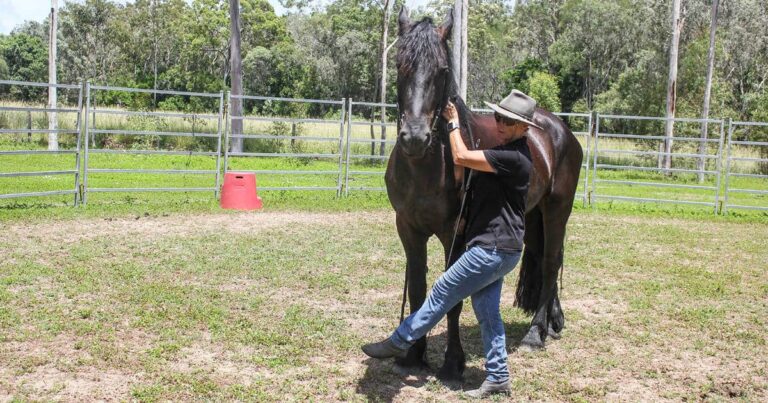
Before asking for reverse-arc, it’s important to have the horse walking forward in SRSF (see Image A). This establishes the good forward movement needed so the horse isn’t tempted to back up (step one front foot behind the other in reverse-arc).

To begin the lesson, stand on the left side of the horse, with the left rein in your left hand, your right hand carrying the whip and resting on the wither, ready to administer a rewarding scratch (see Image A). This is the same position as we discussed last month, but this time, I want you to concentrate on that left front foot (see Image C).

Imagine the clock under your horse’s chest. When you are walking forward, they will be stepping to about 11 or 12 o’clock. If you open the rein a little and step away from the horse, they should follow their nose and step to 10 o’clock.

Once you’ve established 10 and 11 o’clock (SRSF), begin the reverse-arc work by lifting the rein, so it touches the horse’s neck, and by stepping forward and towards the horse’s neck as shown in Image D.

To begin, just ask for one reverse-arc step, return to your SRSF position and continue with the horse walking around you. Be aware of where that left front is stepping. I often talk to myself: “10 o’clock, 11 o’clock, 12 o’clock, 11 o’clock” and so on, just to make sure I am being really conscious of moving their feet where I want them to go.

The other thing to remember is to always start with SRSF, having the horse walk around you following their nose, before asking for one or more steps of reverse-arc. It will be considerably easier for your horse if they are already moving forward, to make that reverse-arc step.

5. Shaping the behaviour

We all know the old saying ‘start with your goal and end in a wreak’ and it’s just as true when we are teaching reverse-arc. Ultimately, we want the horse to step to 2 o’clock with their left front foot, while remaining relaxed and soft in the bridle, bent to the left and with us standing on their left side.

However, to get there, we need to shape this response by rewarding a try or a step in the right (also being the correct) direction. By releasing and praising on 12 o’clock, we can build on that.

Remember to have forward movement first, with the horse walking around you, and then ask for the step of reverse-arc. Release and reward any step that is better than the SRSF step. So, if your horse is stepping to 11 o’clock with SRSF and then steps to 11:30 or 12 o’clock, reward that. Next time, ask for another step and you might get a 12 o’clock step followed by a 12:30 step, so release and reward that, and go back to SRSF before asking again.

Top Tip:

Remember this sequence when you are teaching your horse something new:

  1. Get the feet to move (walking around you with give to the bit).
  2. Get the feet to move in the direction you want them to go (SRSF and reverse-arc).
  3. Make it pretty (minimise all cues, especially reducing the required pressure).

6. Where does this lead?

As you progress with this lesson, notice how your horse is moving their hindquarter less and less. In the beginning, when you cue reverse-arc, the whole horse is likely to move laterally. Once the horse discovers you are releasing on one front foot only, they will stop moving the hindquarters so much and, eventually, you’ll get a pivot on the hindquarters. This will give you independent shoulder control; that is, control of the shoulders that doesn’t involve moving the rest of the horse.

Once established, independent shoulder control will allow you to address the hindquarters in a similar way – something that cannot be done until you are able to control the direction of the shoulders.

And, yes, if you’re thinking this is the basis of teaching pirouettes for dressage or spins in reining, you’re absolutely right!

7. What about 9 and 3 o’clock?

When we’re on the ground, it’s difficult to get the horse to step to 3 o’clock (on the right) and 9 o’clock (on the left) because we are standing in the way.

Once you’re riding this exercise, it’s much easier. Begin by really opening the rein, imagining the horse to be a puppet and releasing the rein when the foot steps under your hand.

Full details on how to teach this lesson under saddle can be found in the Shoulder Control Module in the online training course at https://www.kandooequine.com/.

Remember:

You’re teaching a pattern, so your first cue should be the one you ultimately want the horse to respond to – a movement of the rein. In the beginning, we can help the horse by exaggerating this cue and using our body language on the ground to initiate movement in the desired direction.When you ask for reverse-arc, use the following sequence of cues to establish the pattern for your horse:

  1. Lift the rein and place it on the horse’s neck, half way up the mane.
  2. Step forward so you are also halfway between the shoulder and head.
  3. Turn to face the horse’s neck.
  4. Step towards the horse.
  5. Apply pressure to the rein.
  6. Release pressure when the horse makes a reverse-arc step.

Watch the accompanying video of Romeo’s first attempts at reverse-arc

Next time…

Next month, Romeo starts to look like a ‘proper riding horse’ with his first girth. Don’t miss this lesson, showing you how to introduce the girth without the stress and bucking that so often accompanies the experience.

Check out Dr Kate Fenner’s podcast for more step-by-step, ethical and sustainable horse training courses.

This article was published in Horses and People June 2018 magazine or buy the whole series as an e-book.


Does Soaking Hay Really Reduce Carbohydrate Content?

Hay is the primary component of the equine diet. In recent years, with the increased incidence of metabolic disorders, such as laminitis and insulin resistance, the carbohydrate content of hay has come into question. 

Pasture-associated laminitis is currently thought to be a sequel to over-consumption of certain carbohydrate fractions in forages, potentially associated with the development of chronic metabolic disorders, such as insulin resistance, especially in overweight animals. 

Water soluble carbohydrates (WSC), in particular, are the predominant culprits in most grass forages.

Understanding fibrous carbohydrates

Carbohydrates in the equine diet can be divided into two types: structural and non-structural. The determination of non-structural carbohydrates is currently accepted as WSC + Starch. 

WSC are carbohydrates solubilised and extracted in hot water, including monosaccharaides, disaccharides (simple sugars) and some polysaccharides (which are mainly fructan). 

A recommendation for horses and ponies suffering from these metabolic disorders is to reduce the WSC content of the diet. The current recommended upper threshold for WSC contents of diets for equine predisposed to laminitis is 10 g WSC/kg of the dry matter (DM) content of forage DM. 

In doing this, a great emphasis has been placed on understanding the carbohydrate content of forages and ways in which to reduce this content. In an attempt to reduce the intake of WSCs, owners of horses and ponies predisposed to laminitis often soak the hay intended to be fed to such animals in water. 

It has been shown that nutrients, including soluble carbohydrates, may be leached from hay during this soaking process. The current recommendation commonly used is to soak hay for 30 minutes in warm water or 60 minutes in cold water. 

Latest research findings

Recent research may, however, alter this current recommendation of soaking hay as there is some evidence that soaking hay may not be decreasing the WSC content of hay adequately and consistently across all species of forage.

A study in the United Kingdom evaluated the amounts of total WSC, WSC constituents and crude protein (CP) leached from a range of different grass hays, either shaken free of the flake or left compacted in the flake when soaked in just sufficient water to allow total submersion for various time periods throughout the study.

Nine different hays of mixed grass species were tested during the study. Hays were soaked for 20 minutes, 40 minutes, 3 hours and 16 hours before water soluble carbohydrate content and crude protein content were tested. 

Findings

There was no overall significant difference in the WSC contents of loose or dense hays after soaking. This suggests that water is capable of penetrating the hay quickly when it has been baled. 

Soaking for 16 hours resulted in only two of the hays containing less than 100g WSC/kg DM, and two of the hays still contained an excess of 160g WSC/kg DM.

This study illustrated that, although soaking hay results in reductions of WSC content, the extent of the losses was highly variable between hays and not related to their initial WSC content. 

No significant effects were shown for soaking time on CP content of the hays. 

Conclusion

The authors concluded that, when formulating diets that include soaked hays for horses and ponies predisposed to laminitis, hays with an initially low WSC content should be chosen and re-analysed after soaking. 

As there was no apparent benefit of shaking hay loose from the flake on the decrease of WSC, it was recommend that hays should be soaked in compacted flakes to reduce the potential negative impact of increased airborne particles on human and equine respiratory health.

Recommendation

Ultimately, it is still critically important to test forages being fed to those horses sensitive to WSC. It may be beneficial to acquire a laboratory analysis of the hay after it is soaked according to the practices of your facility. 

The researchers in the United Kingdom tried to emulate current soaking practices, but each facility is slightly different and obviously, depending on the grass species in your hay, the outcome could vary greatly.

Other options include incorporating super fibres or a commercial forage product, such as haylage or hay pellets into your horse’s ration. Unmolassed micronised sugar beet flakes are high in well-fermentable fibre and low in sugar. Commercial feeds formulated with a high fibre (35%), low-carb, low-GI formula with less than 1.5% starch, less than 5.5% non-structural carbohydrates and a WSC of 4% are ideal choice for horses sensitive to WSC. 

The good thing about commercial products is they offer consistency and should have little variation in their WSC content from bag to bag.

Study Reference: 

Longland A. C., Barfoot C., Harris P. A. (2011)  Effects of soaking on the water-soluble carbohydrate and crude protein content of hay. Veterinary Record. 168: 618

Starting Romeo Part 3: Learning to Give in Walk

Learning to give in walk. In the first articles, Romeo learned basic handling, including haltering, grooming, picking up feet and tying up. This month he continues by learning to give to the bit at the walk. 

In this exclusive training series, Kate Fenner from Kandoo Equine explains the essential foundation lessons for any horse using her un-started, five-year-old Friesian gelding, Romeo. Why not follow along with your own horse?

Whether your horse is un-started or already going under saddle, but you feel these are areas that need a little work, you’re in the right place. 

Let’s get moving! 

Last month, we taught Romeo two different pressure-release exercises – to put his head down from poll pressure and ‘Give to the Bit’ from rein tension. These were simple exercises that taught the horse to look for answers in movement and engaged him with the lesson.

If you missed the earlier articles, catch up by clicking Part 1 and Part 2

And make sure you also watch the accompanying free video of this lesson #3 on the Kandoo Equine Blog.

We need movement to train. Last time, we moved the tip of the ear, which lowered the head, and the tip on the nose, which moved the head laterally. Now, it’s time to get the horse’s feet moving forward.

Overview 

The purpose of this lesson is to get the horse to walk around you, in self-carriage, maintaining relaxation and a soft, round frame at all times.

Step 1:

Beginning on the lefthand side of the horse: Position yourself at your horse’s shoulder, facing forward, with your left hand on the left rein. You can simply leave the right rein over the neck, just make sure it doesn’t get too long, enabling the horse to step into it.

You should face forward and your left arm will be across your body. In this way, you can walk forward with the horse. Your right hand is holding the dressage whip and should rest on your horse’s wither. From here, you can reach the hip with the whip to encourage forward movement, and also apply positive reinforcement in the form of a scratch when you see your horse relax and give to bit pressure.

Step 2:

Practice your ‘Give to the Bit’ work from last month, just one or two gives, and then ask your horse to walk forward.

Give them a verbal cue first. I use a single ‘cluck’ for walk and raise the whip to the hip if the horse does not move forward. Your third ‘Go Forward’ cue is to tap the horse on the hip with the whip and this should get you both moving.

Step 3:

Now you have your horse moving around you, it’s time to really establish that pattern. As we haven’t yet taken directional control of the feet, don’t worry too much about where your horse goes in these early stages, but try to make your circle as big as you can – a 10 metre circle is ideal.

If your horse is stepping in to you and making the circle too small, establish more forward movement (see the section on Establishing Forward below) – the more forward movement you get, the bigger your circle should be.

Don’t forget to move forward with your horse (See Image E and the accompanying video at: https://www.kandooequine.com/blog/starting-romeo-3).

The pattern you are establishing looks like this:

  1. The horse walks a circle around you.
  2. They feel bit pressure.
  3. They relax and give to bit pressure.
  4. They feel a complete release of pressure and receive verbal praise, together with a scratch on the wither.
  5. If they lift their head or become tense, go back to Step 2.

Important tip:

The horse is learning about self-carriage; that is, maintaining relaxation, gait and frame (at this early stage) until signalled to do something differently.

Don’t be tempted to ‘hold’ your horse in frame as this will only desensitise them to bit pressure.

By allowing the horse to make the mistake of coming out of frame (or leaving your bubble of communication), you are giving yourself another opportunity to train by picking up some rein tension to cue that give again.

You shouldn’t have any rein tension when the horse is relaxed and walking around in a soft frame. The horse will soon learn that staying there avoids any bit pressure.

Step 4:

It may sound counter-productive to slow yourself down to speed up your training, but that’s exactly what you should do.

Your horse is learning a pattern and you need to give them time to respond before picking up pressure on the bit.

Most horses learn this very quickly and can see your hand slowly moving, so they respond before the pressure is applied. This is perfect. The pressure is a form of negative reinforcement – something the horse wants removed and it’s not the important element of the training, the important part is the release.

If your horse finds a solution that completely avoids the application of pressure, then give them a big scratch – clever horse!

Whenever we are training, we’re always looking to minimise the pressure required to get the same response. By slowing yourself down, you give the horse the opportunity to respond to the lightest of touches – making for a more pleasurable ride for both of you in the future.

Step 5:

I usually start this exercise on the left because most horses have had more handling on that side and will, therefore, find it easier to relax.

However, in some cases (and this especially applies to horse that have been systematically desensitised to pressure, such as off the track racehorses), you might find it easier to start from the right side where the horse can be considered a bit more of a ‘blank canvas’. The horse may be more responsive to a lighter pressure from the right side, depending on their history, previous ground work and handling experiences.

Whichever side you do decide to begin with, it’s important you train both sides equally the course of your training.

I try to change sides every few minutes, so the horse doesn’t get a tired neck from bending in one direction for too long. This also gives you the opportunity to stop and praise the horse while you change sides, teaching the horse they can simply stand and relax when nothing else is being asked.

Step 6:

If your horse is already started under saddle, practice this lesson before you ride. It’s the perfect way to engage your horse. I suggest doing just 3-5 minutes each side, and mounting once you see your horse is relaxed and in your bubble of communication (see the Engagement Zone lesson by clicking here)

I’ve dedicated a month to this lesson because it is the most important of all the foundation lessons. It is here the horse learns to connect a light touch of the rein with relaxation and travelling forward in a soft frame.

Now go and watch the accompanying free video of this lesson #3 on the Kandoo Equine Blog.

Next lesson…

In the next lesson, we’ll look at shoulder control and moving to more areas of the clock under the horse’s chest and, when we do that, you should expect to lose some of your softness. Don’t worry, it won’t be gone forever, in fact, just the opposite will occur.

This is because, as the horse learns new movements, they concentrate on that one new thing and seem to ‘forget’ everything else (remember, horses can only think of one thing at a time and, even though we hate to admit it, so can we). You’ll find, once the new behaviour (reverse arc) is established, your ‘Give to the Bit’ will come back even better than it was before you began the shoulder control lesson, because each lesson builds on the one before.

Check out Dr Kate Fenner’s podcast for more step-by-step, ethical and sustainable horse training courses.

This article was published in Horses and People May 2018 magazine or buy the whole series as an e-book.

In the Company of Trailblazers: Julie Fiedler and Horse SA

It is a chilly Summer evening in an Adelaide Hills community hall, but the subject of horses is running red-hot. Gatherings such as this might have once taken place informally at the local agricultural show or blacksmith’s shop. Modern times, however, call for a modern approach. Tonight’s meeting is an interactive ‘horse industry briefing’, a first-of-its-kind held by South Australia’s proactive horse council, Horse SA.

The ‘panel’ comprises state government agency representatives and industry experts who are presenting horse-relevant information and predictions. Topics include biosecurity, trade and export, animals in emergencies, and land planning and development. It seems all very grown-up, but horse owners are becoming increasingly aware of a need to become involved with bureaucratic matters and legislation.

The coordinator of this inaugural industry briefing is Julie Fiedler, Horse SA’s Executive Officer. Her first memory of horses was ‘patting a few over the kindergarten fence’, something unlikely to be allowed anymore in modern childcare.

Nevertheless, it was the start of a long involvement with horses and the horse industry. After leaving school, Julie worked as a jillaroo and later taught riding lessons at Sheoak Hill Riding School. This was followed by a decade at Riding for the Disabled and a few more years at TAFE working in its Horse Industry program.

It is a professional background that fitted in perfectly with Horse SA, created in 1999 to provide a collective voice when a group of trail riders started feeling the pinch of urban sprawl. With riding trails and agistment areas under threat, a collective voice was required to speak for horse owners at a local and state government level.

Julie has been holding the reins at Horse SA for 18 years and, when asked what their biggest achievement has been to date, she replies that Horse SA “is still recognised today as having a voice within government and connects across all parts of the horse industry and community”.

Horse SA has developed a solid reputation as a bridge between industry and government. Julie and other members of the Horse SA board have involvement with countless committees and advisory boards.

“As an advocacy organisation, you have a vision and collaborate for community outcomes,” Julie says. “Some projects are short-term… Sometimes, it takes many years, even election cycles.”

Horse ownership has changed considerably in modern times, according to Julie. “There is much more agistment,” she says. “Also, a lot of people are first-generation horse owners. These societal shifts make organisations like Horse SA even more important.”

Horse SA promotes the statement: Advocate, Communicate, Educate. These guiding principles flow through everything they do – from giving phone referrals to developing information webcasts and delivering hands-on seminars (the next to follow was the industry briefing about worm resistance and using microscopes to test worm count in faeces).

In addition, Julie and the Horse SA members are asked to attend and speak at national and international equine conferences, often self-funded. Despite its important foundation work to benefit all horses and horse owners, Horse SA operates on a shoestring budget. Its core funding is from the SA Office for Recreation and Sport, supplemented by membership fees and sponsorship.

In turn, Horse SA provides essential two-way networks for sport, industry and government agencies to communicate directly with horse owners. One of these, the Country Fire Service, has been working closely with Horse SA for several years to promote bushfire safety within the horse community.

According to Penny Kazla, a Community Engagement Officer for the CFS, the relationship has proven to be highly successful for CFS objectives. “I really appreciate that Horse SA has been working so diligently with CFS over the last few years,” Penny said. “With their hard work, we have increased horse safety in SA by encouraging families to prepare for bushfires well in advance and to include their horses in their Bushfire Survival Plans”.

The volunteer managing board of Horse SA and its Life Members read like an honour roll of industry horse community leaders, united by the wellbeing of the ‘state herd’ and a passion to keep horses relevant in the community.

Current chair of Horse SA is Associate Professor Kirrilly Thompson, an anthropologist known and respected for her research into horses and the horse-human relationship, who is also a regular contributor to Horses and People.

Vice-chair Denis Edmonds is a former member of the mounted police cadre and currently registrar for the racing appeals tribunal. He is also involved with incident management planning of the Australian International Three Day Event.

Secretary Denzil O’Brien is a retired researcher with a special interest in horse-related injury and safety issues, and former Executive Officer of Equestrian Australia.

Treasurer Peter Oborn is the former chair of Eventing SA with life-long experience in sporting club administration, while board members Ashley Kramer is manager of SA Harness Racing club and Melanie Scott is involved at the top level of endurance riding sports administration.

As Julie explains: “Horse SA works hard on being an ‘outwardly-focused’ organisation; that is, to seek out partnerships, collaborations or just expert advice to problem solve an issue or work on a new solution.”

There over 200 general individual and group members of Horse SA – ranging from sports and recreational groups, to businesses and horse industry bodies.

Long-time horse owner and rider Sarah Harris, who also co-owned a tourism carriage business, says Horse SA “is there for us, to watch our back. They’ve also introduced me to so many advanced learnings. I feel that if I don’t know something, I can just call, especially about land management,” she says.

The passion behind Horse SA is not surprising when you consider the State’s history of innovation and commitment to equestrian pursuits.

Horses have always been an integral part of the South Australian social scene, with the Adelaide Hunt Club and Adelaide Polo Club two of the country’s oldest continuous sporting groups.

Both forming in the 1800’s, not long after colonial settlement, members of these clubs also had strong links to the 140-year-old Oakbank Easter Racing Carnival, still the largest picnic race meeting in the southern hemisphere.

Some of the country’s biggest horse-related pastoralists, trainers and equine trailblazers can also be traced back to South Australia, a legacy recognised by Horse SA wherever possible.

‘The Cattle King’, Sidney Kidman, founder of the S. Kidman & Co pastoral empire, started out his journey as a wet-behind-the-ears 13-year-old who rode a one-eyed horse from Adelaide to the mid-north in search of his ‘fortune’.

One of Horse SA’s biggest projects over time has been joint development and maintenance of the Kidman Trail, a 269km riding, cycling and walking trail on public land. It runs from Willunga, south of Adelaide, to Kapunda in the mid-north and includes several purpose-built horse yards along the way.

Then, there is legendary Reginald ‘RM’ Williams from Percy Street, Prospect, a saddler who was dissatisfied with riding boots on offer, he designed a more suitable pair, now so popular they are sold the world over.

RM’s commitment to the horse world continued long after this, helping to create the Equestrian Federation of Australia (now Equestrian Australia) in the 1950’s in time to get a team together for the Stockholm Olympics. He also sponsored Franz Mairinger from the Spanish Riding School in Vienna to come to Australia to be head coach.

Another big figure to influence the Australian horse world was Colin Hayes, a racehorse trainer with 5,000 winners who gained global attention from the 1960’s onwards with his large-scale Barossa Valley Thoroughbred training and breeding facility, Lindsay Park (now Cornerstone Stud, and still run by the Hayes family).

Someone who probably had the most practical influence on horse-keeping and horsemanship, however, was horse educator, Tom Roberts. His yellow-jacketed ‘how to’ book series were bookshelf mainstays for anybody learning to ride or train horses, or just pony-mad kids who loved horse books.

In honour of Tom’s extraordinary contribution, Horse SA turned the tables last year and published a book about Tom Roberts himself, titled ‘Go Forward, Dear’. Written by Dr Andrew McLean and Nicki Stuart, the project was almost entirely funded by donations from Horse SA members throughout the state.

South Australia is also the place where the teenage dream of riding for the Olympics has come true, several times. Teenager Wendy Schaeffer took an ex-racehorse she rode at Mountain Pony Club, Mt Barker, all the way to Atlanta Olympics in 1996 to win team gold in eventing. This achievement was almost matched a few years later by fellow Adelaide Hills Hahndorf resident Megan Jones, who won silver at Beijing in 2008 on a horse she bred and trained herself.

A role model for these young equestriennes, Gillian Rolton, lived a few towns away in Clarendon. Not only did the former school teacher win two consecutive team gold Olympic medals in eventing, she was also instrumental in creating the four-star Australian International Horse Trials hosted in Adelaide each year.

But, although there is much to celebrate in SA about successes of the past, pressing issues, such as land squeeze and government regulations, are the new hurdles facing horse-owners and business operators.

Keeping horses relevant and involved in the community will require continued innovation, but this is where the good work of Horse SA promises a bright future for horses and those who share their lives with them.

One of the strengths is undoubtedly the knowledge and skill acquired by Julie in her working career with horses and long tenure at Horse SA. Her energy and commitment has not waivered; if anything it has gained momentum.

Horse stakeholders are becoming more engaged than ever before, due, in part, to the advent of social media, but also as a result of Julie’s diligence and tenacity.

Privately, the committed EO is also completing her Masters in Communication (by research) on the subject of sports horse welfare and social licence to operate – something which connects directly back to her work at Horse SA.

Julie says a current focus for Horse SA is the state’s ‘reforming’ economy, which is moving away from old style manufacturing to the new and growing industries of IT, defence, green industries and advanced manufacturing.

What does this mean for horses? “In a relatively short period of time, our state workforce is starting to refresh, and many of these ‘new workers’ are in a position to afford to ride and own horses. These new industries also bring new networks and international relations.”

One recent example is a French trade mission visit to Adelaide late last year, which included a representative from the Normandy Horse Council. As well as having strong ties with South Australia through the submarine project, France is the only country in the world to have ‘Equitation in the French Tradition’ inscribed by the United Nations on the Representative List of Intangible Cultural Heritage of Humanity.

“Horses are integral within our culture and society, and all of its evolutions. Through recognising these shifts, Horse SA can make sure we stay relevant in a modern society,” Julie says.

The role of advocacy has been helped enormously in recent years with the rise of social media. “It’s easier to keep in touch with local people and local issues and, where possible, to support moving any particular issue ‘up the line’ to the right level within local or state government for attention,” she says. “Any horse owner can advocate for issues in their local area by contacting government representatives and clubs can also build relationships that often will be called-on if an issue arises in the future.

“Advocacy is continuous, taking place on multiple levels and in many formats,” continues Julie. “From Members of Parliament receiving a regular e-news, through to meetings, participating on committees with government representatives or in public consultations, reviewing documents, coordinating information and engaging in social media, all can have important input into areas such as policy planning.”

A new era may be dawning for horse-keeping and ownership, but the rich cultural heritage and long list of horse-related legends who have lead the way continues through the ground-breaking efforts and tireless service to the horse community by Horse SA and its long-time executive officer, Julie Fiedler.

To find out more about Horse SA, visit: https://www.horsesa.asn.au. You can also learn about Equitation in the French Tradition at: https://ich.unesco.org/en/RL/equitation-in-the-french-tradition-00440.

This article by Sally Harding was published in Horses and People April 2018 magazine.

Towing a Horse Float Safely

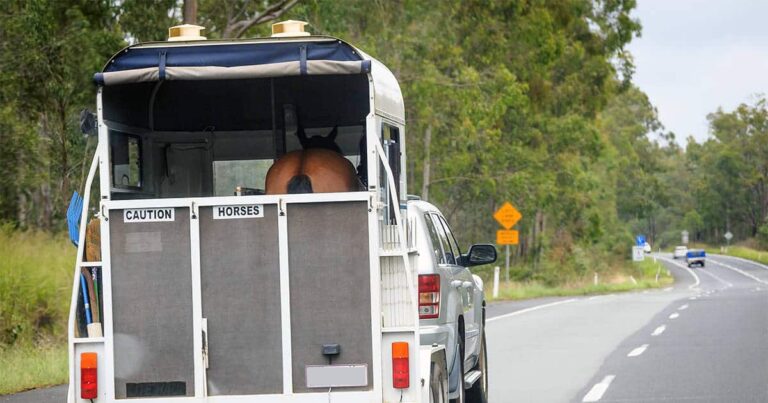
Towing a horse float requires additional knowledge and skill. All horse floats, trailers and caravans affect the performance of the towing vehicle, they affect fuel consumption, acceleration, braking ability, general control and manoeuvrability. And these effects worsen as the size and weight of the horse float increases relative to that of the towing vehicle.  The extra length and width can be hard to manage, with wind, road roughness and passing vehicles having a greater effect than on the vehicle alone. This puts additional responsibilities on a driver.

Here are some handy tips to remember for towing a horse float safely. (The information on this page applies to vehicles not exceeding 4.5 tonne gross vehicle mass).

Rules for towing

Towing more than one horse float at a time is not allowed. No person is allowed to ride in horse floats, trailers or caravans. When towing and driving on a road without street lights, drive at least 60 metres behind heavy vehicles or other vehicles towing trailers, unless overtaking. Learner drivers and learner and provisional motorcycle riders are not allowed to tow. P1 car license holders can tow small trailers with up to 250 kg of unloaded weight.

Towing vehicles must be properly equipped with:

  • Tow bars and couplings of a suitable type and capacity.
  • Electrical sockets for lighting.
  • Brake connections if the trailer is fitted with power or electric brakes.

Driving with a horse float takes practice.

Remember:

  • Allow for the horse floats tendency to ‘cut-in’ on corners and curves.
  • Allow longer distances for braking, overtaking and joining a traffic stream.
  • When reversing, it is advisable to have someone outside the vehicle giving directions.
  • Avoid sudden lane changes and changes of direction.
  • Look further ahead than normal so you can react to changes in traffic or road conditions.
  • Use the accelerator, brakes and steering smoothly and gently at all times.
  • Use a lower gear when travelling downhill to increase vehicle control and reduce strain on brakes.
  • Slow down well before entering corners and curves.

Horse floats tend to jerk the back of the vehicle around and can cause sway (snaking). If a horse float starts to sway, the vehicle’s brakes should not be applied, except as an absolute last resort. If the float’s brakes can be operated by themselves they should be applied gently, otherwise a steady speed or slight acceleration should be held if possible until the sway stops.

  1. Plan more rest stops and shorter travelling days as towing is stressful and tiring for both, horses and humans.
  2. There is no specific speed restriction while towing a horse float. Obviously, the posted speed limits must not be exceeded.
  3. Always drive to the road, traffic and weather conditions

The tow bar 

A properly designed and fitted tow bar is essential for towing. The rated capacity of the tow bar and coupling should not be exceeded. The tow bar should be clearly and permanently marked with its: Maximum rated capacity. Make and model of the vehicle it is intended for or the manufacturers part number, manufacturer’s name or trade mark. This is compulsory for vehicles built after 1 January 1992.

The horse float (trailer)

Horse Floats must be of a suitable size and type for their intended tasks. They must be built to meet the standards for registration. If a horse float is required to be registered it must be fitted with a rear number plate and a registration label holder and current registration label mounted as close as possible to the number plate.

Before each trip – Check:

  1. Vehicle and Horse Float are roadworthy.
  2. All tyres are properly inflated.
  3. Floats wheel-bearings, suspension and brakes work properly.
  4. All lights work and safety chains are properly connected.
  5. Oil, water, brake fluid, battery and other service checks on the vehicle.

At regular intervals during the trip, check:

  • Couplings, all doors, hatches, covers and any load or equipment are still properly secured.
  • Tyres are still properly inflated and not rubbing on suspension or body work.
  • If travelling to another State, check with the relevant roads authority whether there are different rules.

Towing ratio requirement

The loaded mass of the trailer must not exceed the lesser of: Rated capacity of the towbar and tow coupling. The maximum towing capacity of the vehicle. The maximum carrying capacity of the trailer.

If the vehicle manufacturer has not specified the maximum towing mass, the maximum towing mass is: One and a half times the unladen mass of the towing vehicle, provided that the trailer is fitted with brakes which are connected and in working order, or the unladen mass of the towing vehicle if the trailer does not require brakes.

Vehicles with a manufacturer’s gross combination mass (GCM) more than 4.5 tonne may tow in accordance with the above requirements. The GCM is the gross combination mass of the car and loaded Horse Float.

If you are in any doubt, contact the manufacturer or retailer of your horse float and discuss any concerns you may have.

Braking system

The minimum braking system for a float depends on the type of horse float, its weight and the weight of the vehicle:

  • 0 – 750 kg loaded weight – no brakes required.
  • 751 – 2000 kg loaded weight – braking on both wheels on at least one axle.
  • 2001- 4500 kg loaded weight – braking on all wheels, and an automatic breakaway system in case the trailer becomes detached from the vehicle.

Brakes must be operable from the driver’s seating position.

Towing coupling 

All couplings must be strong enough to take the weight of a fully loaded trailer. They should be marked with the manufacturer’s name or trade mark and rated capacity. They must be equipped with a positive locking mechanism which must be able to be released regardless of the angle of the trailer to the towing vehicle.

Safety chains 

Safety chains must comply with Australian Standards. Trailers less than 2500 kg when loaded must be fitted with at least one safety chain. Trailers over 2500 kg when loaded must be fitted with two safety chains.

To prevent the front end of the drawbar from hitting the ground if the coupling is disconnected, safety chains must be “As short as practicable and connected to the towing vehicle.”

 Loading the horse float

It is important that horse floats are not overloaded, and that the load is balanced. This is not only a safety issue, but you could also incur a hefty fine, so be sure to stop by a local weigh bridge to check the real weight of your horse float and vehicle when they are fully loaded.

Make sure that your horses and equipment are properly secured and or contained within the trailer. Your horse’s safety is of the utmost importance and therefore your float should be properly configured to ensure that you, your horse and all of your equipment have a safe and trouble free trip.

Find out more about towing in Australia in this handy article from RACQ

Did you know horses travel better when facing backwards? Find out more. 

Read about reducing the risk of transport-related health problems.

Train your horse to load in 10 easy steps

Starting Romeo: Part 2 Bridling and Learning to Give

In this exclusive training series, Kate Fenner from Kandoo Equine will take you deep into the essential foundation lessons for any horse. Last month, Romeo learned basic handling, including haltering, grooming, picking up feet and tying up. This month,  it’s bridling and learning to give. 

Join us for the whole of 2018 and watch the un-started, five-year-old Friesian gelding, Romeo, gradually work through each of the lessons and why not follow along with your own horse?

Whether your horse is un-started or already going under saddle, but you feel these are areas that need a little work, you’re in the right place. 

Before you start

In Part 1, I showed you how Romeo stood, without being restrained, for having his feet done and grooming. This pre-lesson work sets the stage for the lesson itself, helps get the horse into the Engagement Zone (see the March 2017 issue of Horses and People or click here) for learning and begins to build that bubble of communication we are going to need when riding. An important part of this is tacking up, especially bridling.

As you follow along with this series of articles, you may be starting your own horse, or perhaps re-starting one that lacks solid foundation training.

Whichever category your horse falls into, your choice of bit is very important when dealing with an educationally young horse. My personal preference is a full cheek jointed snaffle with a lozenge. This particular bit, when fitted correctly, has limited movement to prevent the nutcracker effect of some snaffles.

Have a look at this short video comparing snaffle bits.

Whether you’re working an un-started youngster or a more experienced horse, it’s a good idea to go through this important lesson step-by-step. It is here the horse often has their first introduction to negative reinforcement – pressure-release – and much of their future training will be based upon this type of reinforcement schedule.

Head down

The first thing to do is to teach the horse to lower their head for bridling.

Romeo stands at about 16hh (18.3hh when he’s nervous… Or so it seems!) And, personally, height is not one of my best features – being a mere 5’3” (shod). So, for this task, Romeo must come to me.

Last month, we discussed putting the head collar on the horse and I showed you a way to do that without necessarily teaching the ‘head down’ cue first. This is useful because it’s sometimes difficult to reach the horse’s poll, as Romeo taught me (see Image A).

You can use the head collar and lead rope to apply gentle pressure to the poll.

Simply hold even pressure on the rope until your horse drops their head – even a centimetre – and then release all pressure as soon as the horse lowers their head (Download the pdf version of this article to see Images B and C).

Here, you’re teaching the horse to respond to the ‘head down’ cue, which is a simple pressure cue to the poll.

While you’re teaching this, expect the horse to raise their head between attempts and re-apply pressure when they do. Your horse will soon learn the pattern – raise head, feel pressure; lower head, pressure is released.

Bridling

Now your horse has learned the ‘head down’ cue and is relaxed with a low head, they’re in a good position to be bridled. If this is the first time you’ve bridled the horse, then I suggest you do some habituation work without the bit attached to the bridle.

To do this, simply remove the bit from your bridle, and slip the bridle on and off the horse – paying careful attention when handling their ears. If you find your horse is not comfortable with this process, then I suggest you do some more habituation work before starting the bridling and ‘give to the bit’ lesson.

One of the advantages of webbing headcollars (the less expensive ones, that is) is the buckle on the nosepiece. Slip the bridle on over the headcollar (Download the pdf version of this article to see Image D) and then simply undo both buckles and slide the headcollar off the horse (Download the pdf version of this article to see Image E).

Once in place, adjust the bridle to fit your horse with a wrinkle in their lip, just above the bit. If you’re using a noseband, be sure you can insert at least two fingers underneath it – this needs to be done right in the middle of the horse’s nose, on the nasal plane, not at the soft area on the side of the face above the bit.

As you can see in Image F, Romeo is wearing my every day, work bridle – a simple leather strap over the head.

Give to the bit 

Whether your horse is un-started, off-the-track or a dressage schoolmaster, the ‘give to the bit’ lesson will be a useful addition to their education.

For the less-educated horse, it’s a gentle introduction to negative reinforcement, and teaches them to engage with you and look for answers in movement.

For the older and sometimes ‘hard-mouthed’ horse, it’s a simple way to re-sensitise them to rein cues and re-engage them with learning.

We begin the lesson at a stand-still, but have a dressage whip with you, because if your horse wants to move, it’s important they only move forward. We really don’t want the horse backing away from the pressure. If your horse does back up, simply lift your whip to the hip and encourage them forward again, then offer them another opportunity to stand still.

Romeo is wearing a pair of long split reins. I particularly like these reins for teaching this exercise, because I don’t have to worry about the off rein getting too long or looped – I simply leave it over the neck.

If you have a set, great; if not, just try to remember we’re only teaching this lesson from one side at a time – meaning you should never have any pressure on the rein on the opposite side of the horse.

We’ll begin by handling only the left rein from the left side. After that, we can go to the other side of the horse to teach the right rein; at which stage the left rein will be looped over the neck (Download the pdf version of this article to see Image A on the next page).

The first step is to pick up a little pressure on the left rein and wait for the horse to give to that pressure.

Your position is important here (Download the pdf version of this article to see Image B on the next page). Try to hold the rein at a similar angle, as it will be when you’re riding; this way there is one less step for the horse to learn a new rein angle when it’s time to ride this exercise.

In Image B, you’ll see I have the dressage whip in my right hand and that is resting on Romeo’s wither. With my hand here, I can easily lift the whip when needed and, more importantly, give Romeo a nice scratch as a reward (positive reinforcement) when he gives to the pressure (negative reinforcement).

You can also see I am standing at Romeo’s shoulder, about a foot away from him. In the next lesson, which will appear in the next issue, we’re going to start moving the horse’s shoulders and will need to change our body language to help the horse with that, so try to be aware of where you are standing at this stage.

Hold that gentle pressure (Download the pdf version of this article to see Image B) until the horse gives, or moves into the pressure by dropping their nose slightly and bending their neck a little to the left (Download the pdf version of this article to see Image C). Then, immediately release the pressure by making a loop in the rein, and give the horse verbal praise and a scratch on the wither as reward for finding the correct answer.

The pressure you apply should be steady and the horse needs to move into that pressure to ‘give’. This is one reason the full-cheek snaffle is such a good bit for this lesson – it puts some pressure on the other side of the horse’s face, encouraging movement in the direction we are wanting.

Remember, it’s the horse that makes the movement. We are not trying to pull the horse’s head around – your hand stays still and the horse’s head moves. Bending the horse’s head too far around to the side as shown in Image D (when you download the pdf version) is unproductive and will cause the horse discomfort if done repeatedly.

Release the rein and praise the horse when you get a small amount of lateral movement as shown in Image C.

Try hard not to ‘give and take’ or ‘play with the bit’, because each time you release pressure, you’re telling the horse they found the correct answer.

If the horse has not given when you release the pressure, even momentarily, then you are simply confusing the horse.

As riders, we’re often taught to wiggle the bit with the aim of softening the horse in the bridle, but this action is more likely to be confusing to the horse.

You’re teaching the horse a pattern, as always, and the pattern goes like this for the horse:

  1. I feel pressure on the bit.
  2. I relax, lower my nose and move my head to the side a little.
  3. All pressure instantly goes away and I get a nice scratch.

It’s a simple pattern and one the horse will learn quickly. In fact, if you’re quick and consistent with your release, after a few repetitions, you may even find your horse anticipating the pressure and ‘giving to the bit’, even before you’ve picked up the rein. This is exactly what we want the horse to do because they are now working off the lightest of pressure cues and responding before the pressure reaches the bit.

How much pressure? 

So, how much pressure should you apply? Pressure is your motivator, and you need to apply enough pressure to motivate your horse to change what they’re doing and move their head.

For the dressage schoolmaster that is accustomed to large amounts of unrelenting pressure, this may be a lot of pressure for the first few repetitions. Whereas the youngster that has never worn a bridle before and has not been desensitised to bit pressure, simply picking up the rein may invoke the movement you want.

The thing to always remember is we are working towards less and less pressure, having the horse become lighter and softer in the bridle. So, each time you pick up the rein, see if you can get the same result from a little less pressure.

This lesson, at a stand-still, should be taught from both sides of the horse, as shown in the pictures of Romeo.

In the next lesson, we’re going to get those feet moving! We’ll look at same-rein-same-foot and reverse-arc when we start to teach Romeo shoulder control.

Check out Dr Kate Fenner’s podcast for more step-by-step, ethical and sustainable horse training courses.

This article was published in Horses and People April 2018 magazine or buy the whole series as an e-book.

Transport-related Pneumonia: Can we reduce the risk?

Transport-related Pneumonia. It is well-known transporting horses carries a significant risk – not just of injury, but also disease, such as colic and respiratory problems. Studies have shown transport is stressful, but does the level of stress experienced by the individual horse predict the development of health-related diseases, like pneumonia?  

As an equine veterinarian, rider, driver and Standardbred breeder, Dr Barbara Padalino has first-hand experience and a special interest in transport-related problems. She began researching on this topic in 2011 and completed a PhD on horse transportation with the Faculty of Veterinary Science at the University of Sydney last year. Today, her work in this field is ongoing.

During the course of her research, Dr Padalino has been interested in understanding why, during the same journey, some horses develop respiratory illness, while others don’t. “If we could predict which horses are more likely to become affected,” Dr Padalino says, “we could provide timely, veterinary intervention to minimise the progression of the disease after the journey.”

(Check out Dr Padalino’s tips for safe transport at the end of this article)

Dr Padalino presented some of her latest findings to delegates attending the 13th International Equitation Science Conference, ISES Down Under 2017 at Charles Sturt University in Wagga Wagga, New South Wales.

In their study, Dr Padalino and colleagues examined the relationship beween behaviour during transport and the occurrence of respiratory inflammation.

Transport-related issues

To first understand the issues and practices related to transporting horses, Dr Padalino and colleagues previously designed a survey and analysed the responses of 797 Australian horse owners involving approximately 17,000 horses and 313,000 individual horse transport events.

The results, which were published in the Australian Veterinary Journal, confirmed there are significant health and welfare risks associated with horse transportation, particularly during long journeys and in Spring.

In the survey, 67% of respondents had experienced transport-related health problems during or after transportation.

Although respondents identifying as amateurs transported horses less frequently and over shorter distances, the incidence of transport-related problems was similar between amateurs and professionals.

The most common problems reported in this survey included:

  • Traumatic injuries (45%),
  • Diarrhoea (20%),
  • Muscular problems (13%),
  • Respiratory problems (12.3%),
  • Over-heating (10.5%), and
  • Colic (10.3%).

Importantly, in the two years reviewed in the survey, 9.4% of participants reported at least one case of transport-related pneumonia and 35 transported horses had died, most commonly from fractures, colic or pneumonia.

Transport-related pneumonia

Previous research had already identified transportation aggravates pre-existing respiratory disease; in other words, if you transport a sick horse, you will end up with a sicker horse at the other end.

Dr Padalino and colleagues, however, questioned whether a high level of stress during transport could play a role in the progression of disease and could, therefore, be used to identify those individuals who are at risk of developing respiratory illness post-travel.

To investigate this particular question, 12 horses – all experienced travelers – were transported on an eight-hour journey.

The horses were split into two groups, which travelled the same route, in the same horse truck on two separate days. They travelled side-on in a six-horse truck and were tied long enough to allow a low head-neck posture during the journey.

All horses received a series of health examinations before departure and straight after unloading, as well as one day and five days post-travel.

A tracheal wash was performed to collect mucous from the respiratory tract and to identify the presence of bacteria in the airways. Blood samples were also taken and analysed.

In addition, during the journey, each horse was video recorded, and their behaviour during the entire journey was later evaluated and documented.

Blood test results and examinations confirmed transportation is stressful. The journey caused an increase in blood glucose and cortisol – a hormone which is commonly used as an indicator of stress, as well as increased heart rate and respiratory rate. These parametres were restored after 24 hours post-travel.

Lactate and the enzyme creatine kinase (CK) was also increased post-journey, both of which indicate some level of muscular stress and fatigue. These levels were still high 24 hours after unloading, showing horses need at least (if not more than) 24 hours rest after an eight-hour trip to recover.

When it came to inflammation of the airways, Dr Padalino remarked she was surprised by the results of the tracheal washes. Neutrophils (pus) in the lungs were significantly increased following transportation for all horses, which indicates the journey activated an immune response in their bodies.

Despite the increase in mucous, some horses came back with a transparent tracheal wash and others came back with an opaque one. The researchers found a clear correlation between the quantity of bacteria and the colour of the wash.

“If you see yellowish, greenish nasal discharge in a horse after transportation,” Dr Padalino says, “you can predict that horse is full of bacteria and probably needs to be seen by a veterinarian as soon as possible.”

Six of the horses in the study were identified as having abnormal respiratory sounds during auscultation at the time of unloading, while the other six were normal. The six affected horses also had pre-travel inflammation of the trachea, so Dr Padalino recommends, particularly over long distances, owners should make sure there is no sub-clinical respiratory inflammation before moving them.

“Our research indicates that prior health status is a vital indicator of the horses’ ability to cope with periods of extended transportation, but it also suggests that there is great merit in examining horses prior to travel to ensure optimal health and prevent a higher risk of adverse effects following transport.”

Behaviour indicators

When it came to behavioural signs, Dr Padalino said the findings confirmed a high head position was a good indicator of tracheal inflammation post-journey.

She remarked, compared to a normal day at pasture when horses spend most of their time with their head around wither height or lower, during the eight-hour transport journey, the horses spent a great deal of their time with an elevated head position – already a known risk factor for pneumonia.

And, in this study, head position correlated with tracheal inflammation; horses who spent more time with their heads in an elevated position during the journey had increased mucous and bacteria in their tracheas.

In general, the behaviours observed during the eight-hour journey in this study were strongly influenced by the stage of the journey.

In the first hour, there was an increase in behaviours indicative of stress, which decreased as the journey progressed.

Behaviours related to balance (including leaning, stumbling or shifting the feet), which were high during the first hour, tended to decrease until around the fifth hour of travel when they increased to peak at the eighth hour of travel (as horses tired), with many losses of balance recorded towards the end of the journey.

“Next time you must travel for extended periods with your horse, pay attention to [their] behaviour,” Dr Padalino warns.

“The use of on-board cameras makes this task much easier. If you have noticed, during a journey, that your horse has spent an extended period of time with [their] head in the air or you feel that the horse has displayed behaviours which might indicate a high level of stress, it would be wise to follow-up over the following days with a full examination in order to catch any resulting illness early and treat any immunological challenge with timely intervention.”

“After a long journey,” Dr Padalino continues, “put your horses out on pasture, so they can have their heads down and are able to clear their tracheas by themselves.”

During question time, Dr Padalino also remarked horses need enough space inside the truck or float to lower their heads and, in many cases, the internal design of horse trucks is not always conducive to this, particularly for very large horses.

“The horses in this study all had the same space, but there was a correlation between bodyweight and time spent with their heads down – the smaller horses, who would have had more room inside the truck, spent more time with their heads lowered.

“It would be interesting to see if there are other ways we can motivate the horse to put [their] head down,” she concludes. “For example, by placing dampened hay on or near the floor.”

Transport-related illness can be multi-factorial, but this study showed a link between behaviour during the journey and later health outcomes.

As well as monitoring horses before and after the journey, watching and paying particular attention to behavioural indicators of stress during the journey might help to predict impending illness at the other end.

The abstract for Behavioural, Clinical and Respiratory Responses to 8-hour Transportation in Horses by B. Padalino, S. L. Raidal, P. Knight, P. Celi, L. Jeffcott and G. Muscatelo can be found on Page 39 of the Proceedings of the 13th International Equitation Science Conference.

The published version of the study is available in the open access journal Plos One if you click here. 

Assessing fitness to travel, and evaluating different training and management practices to reduce stress-related behaviour during travel will be the subject of Dr Padalino’s next presentation at ISES 2018 Rome, the 14th International Equitation Science Conference.

Dr Padalino’s tips for safe horse transport:

Prior to any travel

  • Train your horse to self-load and to stand quietly, so all journeys start with minimum stress and fatigue.
  • Ensure your float design allows your horse to balance and lower their head during every journey.
  • Check your horse’s vital signs regularly, so you know what is ‘normal’ for your horse.
  • Install a camera inside your float to monitor your horse during every journey.

Before a long journey 

  • Check your horse’s temperature. An elevated body temperature is one of the first symptoms of disease.
  • Check your horse’s capillary refill time. Press your index finger on the gum, above the third incisor and hold for 2-5 seconds then release. Count in seconds the time it takes for the capillaries to refill and the gum colour to return. The normal is less or equal to two seconds.
  • If you have any doubts about the health of your horse don’t travel and, instead, consult your vet. A sick horse will only get sicker during the journey.

During the journey 

  • Make sure your horse can lower their head comfortably during every journey. If possible and safe, motivate this head lowering by placing some dampened hay low down.
  • Monitor your horse during every journey, noting signs of stress. Pay particular attention to the amount of time spent with the head above and below wither height.

After the journey

  • Check your horse’s vital signs and record them.
  • Continue to monitor and check on your horse for the next 5-7 days after a long journey. Consult your vet immediately if you are in doubt.
  • Opaque, yellowish or greenish nasal discharge is a sign of bacterial infection. Consult your vet without delay.
  • If your horse spent much of the long journey with a high head position, or displayed signs of stress and fatigue, follow up with a full vet examination and continue to monitor for early signs of disease.
  • Allow at least 24 hours rest after a long journey. In addition, put your horse out on pasture for 24 hours, so they can clear their airways naturally.

This article was published in Horses and People April 2018 magazine.