The first ever Equitation Welfare Workshop took place on 1st & 2nd August and was attended by delegates from Australia, Ireland, Sweden, Canada, The Netherlands and Italy.
Owing to COVID-19, this technology-driven, collaborative workshop was a ‘pivot’ from the originally planned ‘Happy Athlete’ conference proposed to run at Reaseheath College, Cheshire, UK, and was the brainchild of Lisa Ashton, UK’s leading Equitation Science Consultant.
International behaviour and welfare consultant Dr Andrew McLean, Australia, delivered a presentation on Agency and the Sport Horse. Agency is the degree to which an individual is able to make free choices about its life and it is the most recent extension to our understanding of animal welfare.
Dr McLean delved into the question from all viewpoints affecting sport horses; how we might give horses a sense of agency through access to their natural drives (friends, forage and freedom) and how, together with optimal training, these enhance positive welfare.
Delegates were encouraged to gain insight into the complexity of the question of agency in terms of what we currently know about horses and its relativity to the FEI’s concept of the ‘Happy Athlete’.
Dr David Marlin placed the horse sport welfare spotlight on the barriers to retraining equestrians when new knowledge is available. From our tendency to seek out those who confirm our existing beliefs to the rise of the YouTube expert, Dr Marlin challenged delegates to foster collaboration, seek consensus, and communicate widely all evidence-based information that optimises horse welfare.
The educational presentations where immediately followed by virtual breakout rooms where participants engaged in lively collaborative discussions facilitated by Dr Portland Jones, Australia, author of Equitation Science book for children Horses Hate Surprise Parties, Lorna Cameron, Teaching Fellow at the University Centre Sparsholt, UK and Cristina Wilkins, Australia, Editor of the evidence-based resource, Horses and People.
Delegates shared on social media how the four hours flew by gaining knowledge, listening to varied experiences and creating solutions within the various virtual breakout rooms.
“I thoroughly enjoyed hearing from all the different delegates and feel refreshed and re-motivated to keep quietly pushing the change for horses forward. It was lovely to connect with others, who share the same frustrations and barriers as I do – it’s always good to know that you are not alone!” Said Dawn Joyce of the safe space Lisa had cultivated.
Welfare discussions and collaborations were captured for further explorative research that will be led by Lorna Cameron, University Centre Sparsholt. The Equitation Welfare Workshop team will now review the findings and feedback and start the planning process again to deliver more workshops for as long as COVID19 lives amongst us.
“What a great format. Fantastic group of likeminded people…” Donna Baker, Australia.
“A very thought-provoking weekend and as good as any conference I’ve attended save for physically seeing old friends and meeting new ones in person.” Moi Watson, UK “Feel so privilege to be part of this workshop with the most amazing group of people” Chris Brook, UK
“I feel so privileged to be part of this workshop with the most amazing group of people.”
Why you should invest in a pre-purchase vet exam when buying your next horse
Looking for a horse to buy? Whether you are buying your first horse or looking for another one to add to your collection, finding your ‘unicorn’ is the stuff dreams are made of – at least for most of us crazy horse lovers!
It all starts quite rationally. You tell yourself, quite firmly, that you won’t buy the first horse you see. After all, this horse is going to be better, faster, bigger, younger… exceptional.
And then it happens. The ‘perfect’ horse shows up as if he’s found you and steals you heart. He is the one and you just have to take him home…
Whoa! Hold your horses!
Buying a horse is a big investment and I am not just talking in financial terms. You will be pouring all your resources on this horse; your time, energy, care, training, dreams… your love. Does this horse even have the physical attributes and soundness to do what you want?
A pre-purchase veterinary exam (PPE) is always money well spent – whether you are buying your first ever horse on a very tight budget or you are searching for the next Olympic champion.
Not only will a PPE give you a snapshot of the horse’s health state, but having an expert opinion is also an opportunity to slow the process down and get advice from someone that is not emotionally or financially invested in the deal.
So, what does a PPE exam entail?
The most important aspect to make clear at the time of the PPE is what you want the horse to do for you, since the PPE will be tailored accordingly.
What is evaluated and in how much detail is a decision you should make with your vet, as it’s based on a number of factors.
The sport and level of performance that will be expected is very important. But also consider how important it is to protect yourself from buying a problem.
Some of the checks are standard, for example identifying the horse and confirming age, examining the skin and mucous membranes, checking the heart, lungs, windpipe and throat, gastrointestinal system, conformation and an assessment of gait and soundness, just to name a few.
In addition, you can request specific diagnostics. X-rays and ultrasounds and endoscopic exams of the airways are all valuable if you are buying a performance horse. A reproductive exam can help determining the likelihood of a broodmare carrying a foal.
The vet will highlight any conformation faults and check the limbs for abnormalities, like splints, joint effusion, skin lesions and scars, then have the horse trotted out to check the gait for soundness, and generally perform flexion tests of the joints.
Often-overlooked but very important is a thorough dental examination. It is not acceptable to just perform the dental exam by feel as it is easy to miss a whole range of pathologies unless the horse is under slight sedation. What can’t be seen can’t be diagnosed, and, in turn, can’t be treated.
Pass or fail?
Technically, the horse doesn’t ‘pass’ or ‘fail’ a PPE. Instead, most vets tend to assign a level of risk for any abnormality found, depending on a range of factors like age, breed, type and level of activity the horse will be required to perform.
For example, an old tendon injury has a high significance for an event horse, but less so for a broodmare.
What’s important to remember is that the veterinarian performing the PPE is not the buyer’s insurance policy for the horse staying sound.
They are providing an examination at a point in time with consideration given to the intended purpose of the horse, the level of work it is currently in and with the history that has been provided.
The final decision
The final decision as to whether to continue with the purchase of a horse will always lie with you, the purchaser.
A good vet can guide, answering specific questions as best they can, about the likely significance of an abnormality and likely long-term prognosis. The better your relationship with your vet, the easier it will be to discuss the findings and make a decision.
The report
Finally, a written report should be given to the purchaser and the opportunity given to explain any abnormalities found during the examination.
The Equine Veterinarians Association (EVA) provides members with standardised report forms.
In summary, it is always advisable to have a PPE performed on a horse you are considering, in order to protect yourself from buying a problem that may be expensive, risky or even impossible to fix or treat.
An experienced equine veterinarian will be able to tailor a pre-purchase exam depending on the individual horse and their client’s needs.
Thermography, a useful tool for saddle fit evaluation.
Saddle fitting isn’t just black and white.
While you’d always aim for a “Good” saddle fit and avoid a “Bad” saddle fit, there’s actually quite a bit of grey area in between those two extremes.
Or, according to one research team in the U.S., there’s actually quite a bit of colour.
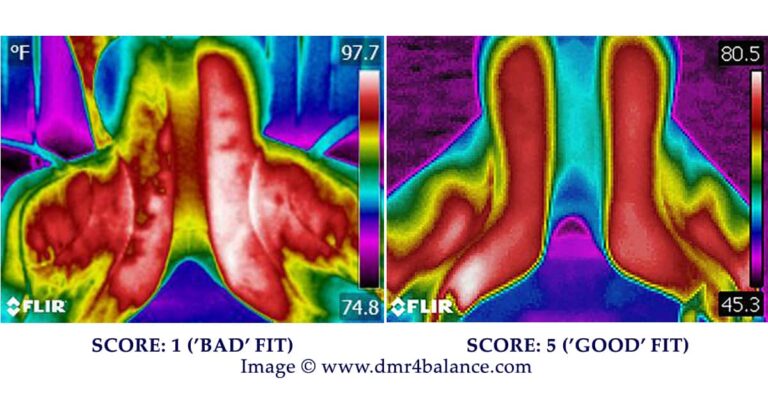
By analysing the colour patterns visible in thermographic images of just-used saddles, people can evaluate saddle fit and even give it a score from 1 to 5, said Michael Guerini, PhD, of DMR 4 Balance, a scientific riding consultancy service near San Jose, California.
Colour coding representing heat intensity levels creates heat maps from saddles that have just been removed from a ridden horse, according to Guerini. After initial thermography training, observers can associate heat maps with the forces and interactions between the saddle and the horse, thus determining how well the saddle fits the horse.
Critically, they can determine saddle fit on a pre-established five-point scale, rather than just saying the saddle fits, or it doesn’t, Guerini said. In doing so, they’re communicating in a “common language” that would allow riders, saddlers, veterinarians, and other care takers to have understandable exchanges about saddle fit.
In their study, Guerini and his fellow researchers analysed thermographic images of saddles taken off the backs of 95 ridden horses. The horses had warmed up for five minutes and then worked under saddle in 20-meter circles at walk and trot (both rising and sitting) in both directions before having their saddles removed.
The scientists took thermographic images of the saddles in a quiet stall with little airflow so as to avoid any environmental influence on the heat readings.
Working with thermography specialists, the researchers developed a scale of 1 to 5 with regard to saddle fit based on the resulting colour patterns in the images. The scientists then presented the images to five people (veterinarians, trainers and saddle fitters) trained in thermography and found that their evaluations yielded similar results, meaning agreement was high.
Although the researchers used high-end thermographic equipment, thermographic readings of saddles don’t need to be cost-prohibitive, according to Guerini. “I believe the information would be accessible with the purchase of a simple thermography camera or thermography camera cell phone attachment,” he said.
“At times the interpretation may still require assistance, but image capture is certainly accessible, and a 1 versus 5 can be discerned. The issues would be in comparing a 3 and a 4. But I would offer that we should always come out on the side of equine welfare and score lower.”
Incidentally, the scientists also noted that saddle fit in their study population was fairly evenly distributed among the five points of the scale, Guerini said. Considering 1 as the poorest rating and 5 as the highest, they found that 13% scored a 1, 19% scored a 2, 30% scored a 3, 21% scored a 4, and 17% scored a 5.
“Approximately one-third of all saddles were either a bad or poor fit based on the evaluation of thermography images,” he said, indicating that this would likely have a negative welfare effect on those horses.
Thermography also has potential in evaluating rider-saddle impact, Guerini added. “I have done some preliminary work on scanning the top of a saddle for rider-to-saddle seat interaction,” he said. “At this time, I can only say it is promising for sitting work but not so much for rising/posting trot.”
The findings of this research were presented at the 2019 International Equitation Science Conference in Guelph, Canada. To read the abstract, download the Conference’s proceedings.
A survey into noseband use asked riders why they choose nosebands and, one in five respondents reports complications related to their use.
They look nice.
They frame a horse’s head.
They’re part of the standard equipment used in my discipline.
They keep the tongue in the right place.
So many nosebands, so many reasons for using them. Yet still so little knowledge about how they affect horses and, in particular, how to be sure they’re not too tight.
That’s what Australian researchers have found recently in a wide-reaching online survey across racing and equestrian disciplines concerning the use of nosebands.
Gathering responses from more than 3000 riders worldwide, the scientists were able to get a useful overview of what’s happening with nosebands in horse sports. And what they’ve determined is that there are many ‘passive’ or ‘aesthetic’ reasons for using nosebands—as well as many complications. And meanwhile, there’s very little standard on evaluating tightness or comprehending its effects.
In particular, few riders use any kind of objective measuring gauge, like the taper gauge developed by members of the International Society for Equitation Science (ISES), according to Dominic Weller, MSc candidate at the Sydney School of Veterinary Science in the Faculty of Science of the University of Sydney, Australia.
That, combined with vague recommendations and rules from federations and clubs, can give riders unreliable feedback about how tightly they’re attaching their nosebands—and the importance of measuring that tightness.
“If we take the FEI (Fédération Equestre Internationale) for example, they still recommend a noseband be not fixed so tightly as to cause harm to the horse, and broadly recommend checking by sliding one finger under the strap on the side of the face” Weller said. “With respect to the FEI, this is unhelpful due to the variability in finger size from human to human. The only way to objectively test it is to use a standardised device (like the ISES’s taper gauge).
“We firmly stand behind the idea that this (the taper gauge) should be a compulsory piece of equipment for stewards to check for noseband tightness more frequently,” he said.
In their survey, fully completed by 3040 of the 3236 respondents from primarily Australia, New Zealand, Europe, and North America, Weller and his fellow researchers probed into the demographics of riders using nosebands, or not. They also looked at reasons for using nosebands, any recognized issues with noseband use on respondents’ horses, and how they assessed tightness.
Nearly 40% of the respondents always used nosebands, and nearly 19% usually used them, the scientists reported. Approximately 11% sometimes used them; 7% rarely used them; and 23% never did.
Nearly half the riders not using nosebands rode primarily for leisure, pleasure, and trail riding, they said.
About 10% declared their primary discipline as natural horsemanship. Interestingly, nearly 13% of non-noseband users said they rode dressage—the discipline most commonly associated with noseband use. (It’s worth noting, however, that dressage riders represented about a third of all respondents combined.)
For people using nosebands, the most common noseband—representing about 50% of all styles—was the plain cavesson.
About a fourth use a Hanoverian noseband, and 14% use a Micklem. Drop nosebands and figure-of-eight nosebands represented about 7% of the total styles each.
Nearly 30% of noseband users (28.9%) reported tightening with a crank tightening system, the scientists said. “Crank nosebands have grown contentious in the literature over the past decade due to their ability to be overtightened,” Weller said.
As for why people rode with nosebands, about a third of the reasons were “passive”—meaning the rider didn’t necessarily make a determined decision about the use of a noseband, according to the researchers. These reasons included going along with the tack rules for the discipline, other people in their sport using them, or even just because the bridle was sold with one.
Still, people also sometimes had what the scientists called “anatomical” reasons—meaning the noseband plays a specific physical function on the horse, they said. The two top anatomical reasons were preventing the horse’s tongue from going over the bit, and preventing the bit from sliding through the horse’s mouth.
Finally, there were the “consequential” reasons—what the effect of noseband use was. Topping this list were improving the horse’s acceptance of the bit/contact, and improving the appearance of the horse, the researchers stated.
“The prevalence of passive reasons for noseband use was interesting to see,” Weller said. “You would assume that each piece of equipment that a horse wears has a specific reason behind it, whether it’s for increased performance generally or to improve the appearance of the horse (as two examples). As nosebands can be used incorrectly to the detriment of the horse (inferred by 18.6% of noseband-using respondents reporting one or more complications), it’s concerning that more thought isn’t placed into their use.”
The complications reported by riders included primarily loss of hair under the noseband area. But riders also reported behavioral signs of anxiety or distress, lip injuries, soreness under the noseband, bleeding, and head shyness, among others, he said.
Generally, riders appeared to be aware that it’s necessary to check tightness, with about 96% of respondents stating that they always or usually check how tight their nosebands are, the researchers stated. However, there was a general difference in how they checked tightness: 60% checked along the bridge of the nose, 21% under the chin, 10% at the cheek, and 6% somewhere else.
Interestingly, only 4% of respondents recognized a picture of a taper gauge, they reported. “This is really a concerning issue,” Weller said, adding that objective measurements help ensure the safe use of nosebands.
“A noseband is a pretty unassuming piece of tack,” Weller told Horses and People. “However, the literature is very clear: if a noseband is applied incorrectly or too tight, it is likely to cause your horse to experience stress.”
That doesn’t necessarily mean nosebands shouldn’t be used at all, though. It just means riders need to be more aware of the risks of using them incorrectly, and understand how to ensure they are loose enough. It also means federations need to get more involved in monitoring.
“Simply put, riders need to be made aware of the risks of every piece of tack they use on their horse,” said Weller. “A noseband, if used incorrectly, can seriously impact the welfare of your horse. For industries and federations, the current guidelines aren’t consistent or clear enough. They should employ the use of a standardised gauge, and update their guidelines accordingly so that a minimum spacing between the noseband and the nasal midline is precisely set.”
At a grassroots level, regardless of discipline or competition or federation, riders themselves can learn to use nosebands more responsibly for their horses’ comfort and welfare, he explained.
“Ultimately,” said Weller, “everyone involved with horses needs to be more mindful and able to justify the reasons they choose the tack they use on their horses.”
A heavy horse galloping with swinging mane and flowing tail, in ceremonial barding or armour, is a magnificent sight and one that reminds many of us of the drama and romance of the ‘great’ horse of the Middle Ages (476 AD – 1453).
The ‘Medieval’ horse is a vision increasingly gracing our screens large and small, as our global entertainment media reflects an on-going fascination with the so-called Dark Ages, from horse-based epics from A Knight’s Tale, Lord of the Rings, Transformers, Game of Thrones, series on Norse and Viking cultures to a trove of similarly themed computer games.
At the visual centre of these productions is the knight on a horse, but, what were these horses really like and how different were they to those of today?
Studying the medieval horse has wider implications for our view of the era. While the genetics are lost or changed, art can tell us quite a bit about what horses looked like and how they were used in the Middle Ages. The horse in art in the Middle Ages was a lens through which ideas about gender, class, but above all, morals and knightly virtues were shaped and expressed.
“For people of the Middle Ages, horses were crucial; they were integral to war, agriculture and transport, and were even used as currency to pay debts and taxes”
For people of the Middle Ages horses were crucial; they were integral to war, agriculture and transport, and were even used as currency to pay debts and taxes. This closeness to daily human life was reflected in writings from song cycles, chronicles, tales and manuals asserting that horses could feel ‘human’ emotions, especially loyalty, sorrow, and eagerness for battle. Thus the horse-human connection differed considerably from our own time.
A typical battle horse in this time period would have stood at about 14-16 hands tall and weighed about 1,300- 1,500 pounds. They were not tall, but rather they were strong and powerful.
Scholars doubt whether there is direct ‘through line’ to modern draught breeds. Certainly, it’s hard to link modern to medieval breeds as horses then were named by the jobs they did, or their place of origin. Moreover, since only the aristocracy and the monastic orders could read and write, records of bloodlines and studbooks are rare.
The ‘destrier’ was the term for the type of knightly horse we think of as emblematic in the medieval period. ‘Destriers’ which were the most valuable type, were primarily widely used in war and jousting.
To convey a sense of what they looked like, imagine a modern day, exceptionally heavily-built Andalusian. They were highly trained, and could cost up to eighty pounds in the currency of the period; which was a fortune, considering labourers earned at most two pounds a year income.
Recent research undertaken at the Museum of London, using literary, pictorial and archaeological sources, suggests war horses (including destriers) averaged 14-15 hands, and were distinguished from a riding horse by their strength, musculature and training, rather than their size.
Stallions were preferred by most for battle for their strength and aggression. Additionally their rounded, muscled body type is indicated by their armour – with 12th century horse armour, or barding, typically being quite curved to allow for large neck crests.
The Knight
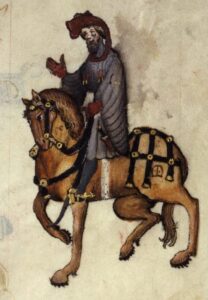
The illustration of the Knight, from the Ellesmere version of Chaucer’s Canterbury Tales, shows us a good example of a destrier. The Knight is the first character we meet on the ‘road’ before the night of group storytelling, and he is about the only one Chaucer presents as fully admirable.
From the illustration, we get the sense that both horse and rider are a well-seasoned pair of fighters. We are told that they have taken part in some fifteen crusades in many countries and also fought for one pagan leader against another. We see the Knight’s tunic is still stained from the marks of his armour. The horse has two brands, an ‘M’ for ‘military’ on his neck, and a possibly Italian breeder’s mark on his haunch.
This horse would have seen many strange lands; he would have been, in the parlance of today, literally ‘bomb-proof’. He would have undergone many sea journeys as well.
Warhorses like this one would have travelled with their knights on overseas campaigns and in fact had their own special ships or ‘dromonds’ that transported them to battle grounds separately from men and supplies. The Bayeux Tapestry [1070s] shows a dromond transporting the horses of William the Conqueror’s Norman army across the Channel to the Battle of Hastings, and scholars have pointed out the smiling mouths and pricked ears of the equines seem to suggest they were enjoying their journey.
The artist who illuminated this manuscript of Chaucer’s Tales moreover seems also to suggest that the partnership between horse and rider has been deeply forged by their overseas service; the knight sits easily in the saddle, riding one-handed, with the reins looped, yet the horse is collected underneath him, one ear swivelled back in well-mannered attentiveness. The Knight’s right hand is raised in greeting his fellow pilgrims. The sprezzatura or studied carelessness of his riding, was (as is always true in horsemanship), hard-won through continuous, consistent and structured training and practice. As Jürg Gassman tells us:
[Knights] had to be able to bring their mounts into collection, on the correct lead, on command; they then needed to maintain formation in a collected canter for an extended period until contact with the enemy, execute a turn on command while wielding their weapons, and do all that over broken ground, not in the manicured manège, and while under fire.
The Knight’s destrier has a keen, bright ‘let me at it’ expression in his eyes which is matched by the modest, alert expression on the Knight’s face. The illustrator here conveys Chaucer’s favourable presentation of the Knight as one of the few trustworthy characters in the Tale.
‘He was of sovereign value in all eyes.
And though so much distinguished, he was wise
And in his bearing modest as a maid.
… He was a true, a perfect gentle-knight.’
Pentheselia, Amazonian queen
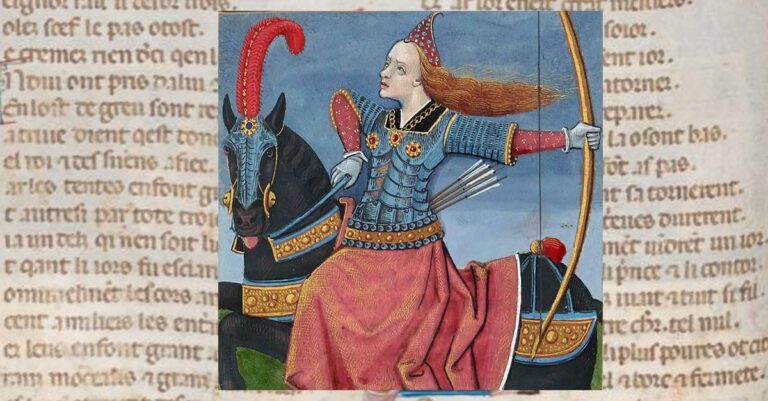
In the beautifully illustrated French translation of Boccaccio’s De Mulieribus Claris, or Book of Famous Women, we see the ancient Greek Amazon, Penthesilea, riding a magnificent black destrier in collected canter to the left (this article’s feature image). Her horse also appears to be poking out his tongue and whether this is a response to too much curb rein, or a challenge to the enemy remains a mystery!
Penthesilea was a legendary woman warrior who also was said to be responsible for the invention of the battle-axe. In mythology, she became queen of the Amazons upon the death of her sister Hippolyta.
She first appears in art in the eight century Cycle of Troy, by Arctinus of Miletus. The story goes that the Amazons led by Penthesilea and her sisters, fought Achilles in the defence of Troy. After a day of distinguishing herself on the battlefield, Penthesilea confronts Achilles. Achilles kills her, but after taking off her helmet, he falls in love with her.
Boccaccio’s fourteenth century compendium De Mulieribus Claris was the first collection of biographies in Western literature that was devoted to famous women.
Penthesilea’s story is told and readers are asked to admire her intelligence, skill in battle, and courage. She is somewhat of a role model for our times and appears still in popular culture. In fact, Star Wars’ ‘Princess Leia’ was a variation on her name.
More recently, Penthesilea appears as a minor supporting character and comrade-in-arms to Gal Gadot’s eponymous heroine in 2017’s Marvel film, Wonder Woman, and she was played by American cross-fit athlete Brooke Ence.
Thus, Penthesilea is a perennial example of how with the right upbringing, training and talent, women can easily be the soldierly equivalents or superiors to men.
The artist illustrating this copy of De Mulieribus Claris was careful to show us a contemporary fourteenth century Penthesilea, on a contemporary war-horse. Neither horse nor woman are heavily armoured; she wears an articulated plate mail over her chest, which is decorated with three huge jewels. Her armour has chain mail arms, and is worn with a heavy belt and skirt. Her horse wears an open metal chanfron over his face, with a magnificent red plume, and elaborate gold decorated reins, breast plate, and croupier.
She is shown getting into position to fire her arrows. According to legend, at the Battle of Troy she killed many Achaeans with her bow. Her end came though, when Achilles speared her through her armour. Penthesilea, as if with foreknowledge of her death, casts her eyes to the sky, while her destrier meets our gaze, in his own form of challenge.
Barbara of Celje as Venus
The other type of war-horse in the medieval period was the Courser or Charger. These were the slighter, lighter in build, swiftest and popular in combat. In the image from the German military engineer Konrad Kyeser’s 15th century book on military technology, Bellifortis, we see a good example of one.
Exiled to Bohemia in 1402 to 1403, Kyeser reportedly flagged down some passing German illustrators, commissioned the images from them, and sat to write this extraordinary work. Strangely to the modern reader, it combines discussion of new and experimental military technology as well as astrology and sorcery. Leonardo da Vinci was apparently conversant with it, and based some of his military machines on its designs.
In the illustration, we see Barbara of Celje on a courser. Barbara was born in 1392 and died 11 July 1451. She was the Holy Roman Empress and Queen of Hungary and Bohemia by marriage to Holy Roman Emperor Sigismund. Here in a flowing blue gown she represents the planet Venus.
Hailing from modern day Slovenia, Barbara was also known as the ‘Black Queen’, for her habit of wearing black, and of murdering townsfolk, and she is still both feared and revered in this area, especially around her castle in Medvedgrad, a tourist attraction today.
Here, Barbara is portrayed bearing a standard or war flag. Female standard-bearers were not unknown in her time, one of the periods most loyal and brave being ‘Big Margot’ bearer of the Flemish standard, who fell at the Battle of Westrozebeke in 1382. Of course we might also think, of Jeanne d’Arc, the archetypal medieval female warrior.
Barbara’s martial role here was quite appropriate since she was actively involved in politics and economy of her times, independently administering her large feudal fiefdoms and taxes, and was instrumental in creating the chivalric Order of the Dragon.
Barbara rides skilfully and in a balanced, upright position. She appears to be partly naked underneath a novel kind of petyral or equine chest armour, which attached together at the horse’s chest, extends on both side up her legs. Her heel, with a long spur, can be seen peeking out underneath it near the chest of the horse. Hers was not an unusual leg position for military riding – the “a la brida” style was the typical technique of heavy cavalry and was characterized by the use of long stirrups and a built-up padded cantle to provide support for the lower back in case of a lance blow to the front of the body. This unusual petyral would have also allowed a knight to wear more light mail rather than heavy plate armour.
Her grey courser is cantering uphill, and he looks keen. He’s being ridden from her seat only, as she has one hand on her hip and the other bearing the standard. He’s relatively long-legged and light-bodied, showing only a little feathering around his fetlocks, indicating he is a courser rather than a destrier. He has a gentle expression, which, when read with the happy, dreamy look on Barbara’s face, underscores the idea that this is indeed Venus the Goddess of Love rather than War. Yet this remains a curious image of medieval women’s agency and presence in a military context.
There is no doubt about the firm attachment between knight and horse. Though capable of great cruelty, medieval people formed sympathetic kinship with their animals. Bartholomew Anglicus, a thirteenth-century scholastic, noted that horses do indeed have feelings like humans. He proposed that man and steed are therefore bound together, or “medlied” [muddled] emotionally.
Correspondingly, it’s long been thought that knights rode ‘without any sophistication’ … but was this true? Surely shoulder-in, laterals, collection and the lower ‘airs above the ground’ would have all been required in mounted warfare, which was more like a ridden form of fencing than jousting.
Recent collaborations between scholars of the medieval period, and horse trainers such as that between the UK’s Jason Kingsley, and Holland’s Arne Koetz suggest that, far from being un-sophisticated, knights had to be very good riders. These two horsemen, and history graduates with an interest in dressage and mounted combat have tried riding some of the training exercises in mediaeval cavalry manuals. Doing these successfully required, in their view, extensive training, which suggests there was an elevated equitation culture in those times.
This indicates that the classical knowledge from the Ancient Greeks about dressage and haut école was not lost, but revived in pockets, even before Duarte of Portugal’s unfinished Livro do Cavalgar, (1430s), the first riding manual produced in Europe since Xenophon.
This makes sense if we consider the point of knightly riding in battle was to vanquish other mounted knights using a variety of weapons in partnership with a highly mobile, supple horse.
In another hundred years or so, the great riding masters and their theory manuals make their appearance; Grisone, Pluvinel, de la Guérinière etcetera. However it’s fascinating to think how so much of their later knowledge about horsemanship might have been put into practice many centuries beforehand.
References:
Bachrach, Bernard S. Caballus et Caballarius in Medieval Warfare. From: The Study of Chivalry: Resources and Approaches (1988) Web. 1988. The average height for a north-western European male in the 9th C was 173.4 cm (i.e. 5’8”). That declined to about 167 cm (5’5”) in the 17th and 18th C. Not until the early 20th century did height recover to 9th century levels. Armour in museums looks small, but it was close-fitting and lighter than is commonly assumed. The war horses of the period were slightly smaller than we’re used to today, but that was mainly due to the very practical problems of campaign logistics and the problem of feeding and watering extremely large horses, which were insurmountable considering armies had to carry all their horse feed and water. This job was done by ‘sumpter’ or pack horses.
Emma Herbert-Davies, The Cultural Representation of the Horse in Late Medieval England: Status and Gender, Undergraduate dissertation, BA Hons History, School of History University of Leeds 2009 p 25.
Other types included the Palfrey, [ridden by those of higher status, clerics and ladies]. These were finer boned, comfortable to ride. Then there was the all-rounder or ‘Rouncey’ typically used for daily riding, farm work and as pack horses. Rounceys would have been comparable, some say, to a Galloway-sized Welsh Cob; affordable for a poorer knight, good doers, sensible, hardy, and able to turn their hoof to a variety of jobs.
Big Margot was banner-bearer for merchant populist leader Philip van Artevelde, together they were trampled to death by their own army, fighting Charles VI and this particular battle was one of the inspirations for Game of Thrones.
Women in the Medieval period were significantly implicated in war, whether they themselves or the men around them liked it or not. Whether as protagonists in military engagement, fund-raisers or victims of sieges, captures and rapes. ‘Despite all the hostility displayed by contemporary male writers, women throughout England, France, and the Holy Land were frequently involved with military events in a range of different ways’. ‘An Entirely Masculine Activity’? Women and War in the High and Late Middle Ages Reconsidered By James Michael Illston Master of Arts in History Department of History University of Canterbury 2009
On another page of Bellifortis, Barbara’s husband King Sigismund is shown similarly galloping on a horse, holding a flag, and wearing the same strange scalloped leg armour. It looks to be an extended experimental design for a ‘peytral’, or horse chest armour, part of the ‘barding’ of which extends up the rider’s leg. It curves up around the rider’s lower abdomen, presumably leaving the leg free of armour to be better apply the aids.
In an earlier article, I wrote about the window of tolerance, which is kind of like the horse’s emotional comfort zone.
In this article, I discuss how you can grow your horse’s individual window of tolerance so they can become more resilient to the demands we impose. I also introduce the concepts of pendulation and titration whilst revisiting self-regulation.
When your horse is in their window of tolerance, they can fulfil all kinds of important physiological processes such as resting and digesting. They can also perform cognitive processes such as thinking, processing information and learning. Here, the horse is described as being in an aroused nervous system state.
The term ‘arousal’ does not refer to excessive energies or emotions – it just means the horse is not asleep. Arousal is associated with the parasympathetic nervous system.
When the horse is pushed over the threshold of their window of tolerance, their nervous system is described as activated, engaging the more primal sympathetic nervous system, typically seen in flight, flight or fawn (freeze) responses. See Draaisma’s Communication Ladder on ‘Fight or Flight’ linked at the end of this article.
The window of tolerance is clearly the best place for a horse to be – not just because they are happiest and healthiest there but because they are going to be the easiest and safest for us to interact with. They are also more likely to grow their window of tolerance and develop a calm nervous system.
For example, a positive state of relaxation will allow the back to swing and the mind to relax. The horse will develop mental and physical attributes that make them more capable of responding to the demands of interacting with humans.
This does not mean that a horse will not spook or startle whilst they are in the relaxed state of their window of tolerance. Everyone is entitled to be caught off guard. What it does mean, however, is that a horse in their window of tolerance can easily accommodate ‘surprises’. Most surprises will cause a reaction without pushing the horse out of its window of tolerance. They may push the horse towards its threshold but they can be easily accommodated because the horse was not already stressed, pressured or responding to other stimuli.
In moments of activation, the horse may react by quickening their steps, rushing forwards, raising their head and neck, hollowing the back, raising the tail, quickening or holding their breath or spinning to see something.
These responses may be followed by relaxation, head shaking, body shaking or a deep breath as the horse’s nervous system changes from an activated state (over threshold) back to an aroused state within their window of tolerance. .
Identifying visible signs of relaxation like the ones above is important because an absence of visible signs of tension does not necessarily indicate relaxation.
The window you met yesterday with your horse may not be the window you meet today. The cat that your horse could accommodate jumping into their window of tolerance yesterday may not be able to fit today, given that your horse’s window is already full of other stimuli; the weather, pain, a change in diet, unfamiliar sights, sounds or smells, hormonal changes or the removal of a paddock mate, for example.
You are unlikely to notice that your horse is already dealing with those things until the stimulus stack gets too great to bear and the cat becomes the last straw that pushes your horse over threshold.
That is how your horse’s behaviour might seem to be unwarranted, out of character, unnecessary, etc. In reality, they were doing such a good job of coping that you didn’t notice.
How to help your horse
Your horse’s nervous system is going through cycles of activation and relaxation/deactivation all the time. When these cycles and flows fit in the horse’s window of tolerance, you might not even notice all the work that is going on under the surface. So, when your horse ‘loses it’, you have the choice of being completely annoyed or congratulating them for having coped so well with all the stimuli that came before their ‘final straw’.
Riders find it easy to notice when a horse’s window of tolerance can’t accommodate the stimuli with which they are faced (when they just aren’t coping). But your response when your horse crosses their threshold, can either grow or shrink their baseline window of tolerance and its resilience – it’s ability to stretch and bounce back quickly. Yes, that means you can grow your horse’s window of tolerance!
There are three concepts to help you help your horse; pendulation, titration and self-regulation.
Pendulation
Pendulation is a general term for something which swings, like the weight hanging on a pendulum clock. You might experience your body pendulating slightly forwards and back as you breathe.
Peter Levine uses the term pendulation to refer to a full cycle of the nervous system going from arousal to activation and then back to arousal.
This can be imagined as wave formation tracking high and low on a heart monitor, but you can also think of it as a process of expansion and contraction.
Incorporating pendulation into your relations with horses means being patient. It is not good enough for the horse to ‘calm’ down somewhat or be close to a state of relaxation. It means allowing for a full and complete release, deactivation or expansion.
I have heard cowboys talking about how in times gone by, horse trainers would stop and have a cigarette whilst they let the horse “do some thinking”. The time it took to have a cigarette (maybe roll it too) probably provided some time for the horse’s nervous system to pendulate and reset to a calm state of arousal within the horse’s window of tolerance.
Every single time you allow for a full pendulation of the nervous system, you are growing the window of tolerance.
It is important that you avoid stimulus stacking (refer to the previous article). That means do not introduce another stimulus or request until the horse’s nervous system has reset to a state of arousal. Often, when we try to control our horse’s reactions, we are inadvertently adding more stimuli. Instead of helping them to move through different nervous system states, we can contribute to them getting stuck in extremes of hyperarousal (or hypoarousal expressed in learned helpless).
Now, this advice about pendulation should never be interpreted to mean that you should leave your horse to deal with disorder and fear for themselves.
For example, you should not leave a horse to run around a paddock in separation anxiety until they learn to live by themselves (if they do, then it will be by a process of learned helplessness, not confidence). Nor does this mean that you should let a horse gallop around on the lunge line until they are exhausted.
In fact, the better you become at reading your horse’s nervous system response, allowing for pendulation and avoiding stimulus stacking, the less likely your horse is to reach and get stuck in such extreme nervous system responses.
For example, you might notice that Horse A’s separation anxiety starts as soon as you lead their mate Horse B out of their paddock. Maybe they don’t appear to get anxious until you are 10 or 20 metres away from the paddock.
By asking Horse A to stand until Horse B’s anxious behaviour wanes and then ceases (a full pendulation), you are helping to grow Horse A’s window of tolerance, which is the same as saying that you are building Horse A’s resilience to being left behind.
With the example of lungeing, having noticed that your horse takes off as soon as you feed out a loop of the lunge rein, you might just stand and observe how the horse’s anticipation of lungeing stimulates their nervous system and triggers their body to adopt the flight posture associated with hyperarousal.
Without interfering or stimulus stacking, you may then witness a pendulation as the horse releases a breath, shakes their neck and relaxes the topline and tail. What you are properly witnessing is a moment of growth and learning as the window of tolerance grows and expands.
What next? This is where you will need to draw from another tool, titration.
Titration
Titration is a process used in chemistry to add the tiniest drop of one solution to another – one insignificant amount at a time.
Figuratively speaking, titration is the opposite of dropping horses in the deep end and expecting them to swim.
In behaviourism, that would be called ‘flooding’ and could result in the horse’s nervous system being so overwhelmed that they may enter a state of learned helplessness, which is neither healthy for horses nor safe for their humans.
In the case of Horse A who suffers separation anxiety, titration would entail thinking about the smallest, tiniest thing that starts an anxiety response and then very slowly titrating Horse B’s movement away from Horse A, one step at a time allowing for pendulation in between.
In the case of lungeing the horse that takes off as soon as they feel slack in the lunge rein, titration might start with letting out a single centimetre of rein. However, as you become more attuned to reading your horse’s nervous system from their body language, you might realise that you need to titrate the process of walking towards the round yard, allowing for pendulation to occur and making sure there is no stimulus stacking.
After continued practice, you may note that the slightest distraction which used to send your horse skidding off around you as you prepared to lunge now just becomes something that draws their attention for a few seconds before it is dismissed (ie. quick deactivation instead of escalation).
This is where pendulation and titration will have enabled the window of tolerance to grow and your horse to build resilience and self-confidence.
Self-regulation
Allowing for pendulation and enacting titration for your horse requires that we as riders and handlers are self-regulated.
As described in the previous magazine article, nervous systems respond to one another and they are safety-seeking. Always try to be the kind of nervous system that your horse can use for co-regulation to help them return to and grow their window of tolerance.
Seeing as horses and humans are both mammals, it is not surprising that pendulation and titration are important for us to practice ourselves.
If we are nervous about leading or lungeing an anxious horse, it will be hard for us to consistently create the conditions for pendulation and titration. More importantly, it will be hard for us to self-regulate our own emotions and nervous system state.
That being said, there is no reason why you can’t use a process of titration and allow your own nervous system to pendulate, grow and expand. You might choose to do so before you enter the paddock to catch Horse A, after you close the gate behind Horse B, before you feed out the slack of the lunge rein or even when you stand at the mounting block.
The more you become aware of and respect your own nervous system, the more you will be able to help your horse.
Six months old. That landmark age when your baby foal isn’t a baby anymore. Time to wean…
As in, time to take him away from his dam, lock her up so she doesn’t injure anyone trying to get to her baby. And time to make him try to get past the anxiety of losing the one living being he’s ever been truly connected with.
Maybe it seems sad. Maybe, for some, it seems worse than sad, even heartwrenching. Yet, it’s what everyone does. It’s the way it’s always been, so it must be right. Right?
If you’ve ever wondered where that six-month weaning tradition came from, you’re not alone. French researchers have recently decided to try a different approach. Instead of artificial (forced) weaning at the six-month mark, they looked at the effects of spontaneous, “natural” weaning on both horses in the “nursing couple.”
The results of their study, they said, could change the way we view weaning management in breeding farms.
“The mare-foal relationship isn’t just about food; the social aspects are important as well,” said Séverine Henry, PhD, lecturer of animal behavior at the University of Rennes, in France.
“It might seem impractical to some breeders to allow foals to naturally wean from their mothers, but the potential benefits could be worth considering.”
In their study, Henry and her fellow researchers observed 16 mare-foal couples in three groups of Icelandic horses in Iceland.
The horses belonged to a private breeder and a riding school, but they roamed freely at pasture as semi-feral herds. (It is customary for handlers to bring in the young stock at about three years old to start their training.)
They found that weaning age varied considerably from couple to couple, but on average it was at about nine months of age, according to Henry.
Surprisingly, the foal didn’t seem to gradually decrease his suckling before weaning. “They still had about the same frequency of nursing even up to two weeks before stopping,” she said. Meanwhile, the mare didn’t become more aggressive with the foal during this pre-weaning period.
“This combination really gives the impression that it’s the foal who just decides to stop nursing at some point, at least for some dyads,” said Henry.
In the weeks following weaning, the foals spent about as much time near their dams as before weaning, and stayed just about as close. “It appears that they still needed that social contact with their mothers, and some needed it more than others, staying closer for longer,” she said.
None of the mares lost any body condition throughout the study, despite being in foal and nursing at the same time, and despite very harsh winter conditions outdoors, Henry added. However, the hardy nature of the Icelandic breed could contribute to that, she added.
Very few observation studies have been carried out on horses left to wean on their own, according to Henry.
“It’s really necessary to have this data so that we can understand in detail what’s going on in the mare-foal relationship, especially from a social point of view, to help consider what we might be interfering with when we wean foals artificially at six months or even younger,” she said.
Did you know? Weaning time has been previously identified as a critical point in the development of oral stereotypies such as crib-biting and windsucking. Two thirds of horses affected by these coping behaviours start within one month of being artificially weaned. Read more…
The study didn’t involve a direct comparison between artificial and spontaneous weaning and can’t be used, at this time, to provide any concrete suggestions for breeders. However, it’s a first step in “opening doors” to considering the possibility of allowing mares and foals to choose their own timing for weaning.
“We now have a better scientific base of knowledge about weaning in horses, like an understanding (from previous studies) of some of the effects of artificial weaning such as high levels of stress and the introduction of coping mechanisms like stereotypies, and, in this new study, of the way natural weaning occurs,” Henry said. “Based on that knowledge, we can start to question ourselves about the pertinence of artificial and precocious weaning in equine breeding programs, more especially for breeders of one or two breeding mares.”
Read about breeders who don’t wean at allhere, and here.
Further reading:
1. The study by Séverine Henry, Hrefna Sigurjónsdóttir, Aziliz Klapper, Julie Joubert, Gabrielle Montier and Martine Hausberger is titled: Domestic Foal Weaning: Need for Re-Thinking Breeding Practices? is published in Animals and is open access. You can read the full paper here.
If people would just leave brumbies, mustangs, and other free-roaming horses alone, they’d be able to live peaceful, happy lives with good welfare. Right?
Maybe. Or maybe not.
Judging the welfare of wild, free-roaming animals actually isn’t something scientists have had the means to do, until now. Australian and New Zealand researchers have just developed a scientific protocol for assessing the quality of life of these animals, which—prior to their project—had been lacking. Without such a protocol, they said, people haven’t really been able to know whether those wild animals were actually living good, “happy” lives, or not.
“One of the challenges working in animal welfare is that many people have their own opinions on what good or bad welfare is, and many people often think that welfare is easy to assess,” said Andrea Harvey, animal welfare veterinarian and PhD candidate, in the Faculty of Science at the University of Technology Sydney, Australia.
“However, when we really think about what welfare is—how animals feel and what kinds of mental experiences they’re having—we realize that it is actually incredibly challenging to assess,” she said.
Accurate welfare assessment requires objectivity, scientific validity, and repeatability, according to Harvey. “We need a process that we can be confident will always lead us to make the same assessment, one that different people can use and also reach the same assessment,” she said.
To rise to that challenge, Harvey and her team developed a 10-step welfare assessment protocol for evaluating the physical and emotional status of free-roaming wild animals in general. The protocol consists of an emphasis on understanding the Five Domains Model for assessing animal welfare, and in particular within a conservation context, she said. It details which kind of information about individual species needs to be considered, how to determine aspects that can be accurately observed and measured, and how to identify individual animals.
The protocol then goes into scientific specifics about measuring and validating welfare indicators, scoring confidence levels, and creating grades for levels of welfare compromise, Harvey explained. The grades are relatable to other scientists and non-scientists, and they’re the aspect of the assessment which becomes useful in practical contexts such as evaluating the impacts of management actions.
Lack of such a protocol has led to many assumptions about wild animal welfare that might or might not be reflective of the animals’ real qualify of life, said Harvey.
“What many untrained people are doing when they are trying to assess an animal’s welfare is projecting their own feelings and emotions onto the animal—in other words, they’re anthropomorphising,” she said. “Whilst sometimes this might be quite accurate, other times it can be far from what the animal is actually feeling. So essentially, this is a very subjective way of assessing welfare, and different people can make different conclusions. It’s actually very open to interpretation.”
Even watching the horses in their environments doesn’t necessarily provide accurate information about their welfare, Harvey added. “You may only see tiny snippets of their life, unlike a pet that you may observe for many hours every single day,” she said.
Harvey’s specific field of research is Australian brumbies, but she created the protocol to be adaptable to multiple wild species because, prior to this research project, no such protocol existed, she said.
“In searching the literature for any studies scientifically and systematically assessing the welfare of any wild free-roaming animals, it became evident that there weren’t any,” said Harvey. “Whilst I was studying the welfare of free-roaming horses, I became aware of other researchers wanting to assess the welfare of a range of other wildlife, and so I realised that I could help with this by explaining the process that I was going through with horses.”
Harvey said she’s already applied the protocol in practice, in order to assess the welfare of brumbies—which have become the subject of intense political discussion. Her hope is that the work of her team will lead to clearer and more ethical decision-making with regard to the management of these free-roaming animals.
“Brumby management has become highly politicized, and I feel that people have lost sight of what the arguments are really about,” said Harvey. “Brumby management should be about the brumbies’ welfare—alongside the welfare of other species and the environment—and not about politics or personal opinions.”
Achieving that goal requires science-based information regarding the brumbies’ welfare and about how different management methods can impact their welfare, she said.
“This is what I am trying to achieve: bringing brumby welfare to the forefront of management decision-making,” said Harvey. “Until we can do this, and until we are doing it, brumby management will not be about their welfare.”
The Ten-Stage Protocol for Assessing the Welfare of Individual Non-Captive Wild Animals: Free-Roaming Horses (Equus Ferus Caballus) as an Example, by Andrea M. Harvey 1,*, Ngaio J. Beausoleil 2, Daniel Ramp 1 and David J. Mellor is open access and can be read here.
I recently had an opportunity to catch up with Mike Lawrence, founder of Equus Nexus, while he was starting a young racehorse of mine. Equus Nexus has several beautiful retired Thoroughbred racehorses and warmblood horses, in various stages of training. My interest was the retraining of Thoroughbred racehorse project that I know Mike is passionate about and is a current topic of considerable importance to horse lovers and racing enthusiasts.
The re-training of retired racehorses is a highly skilled process so I was eager to hear insights from someone who has spent a long riding lifetime successfully preparing racehorses for new careers in other equestrian endeavours.
Why is retraining ex-racehorses essential to the success of the racing industry?
As a result of some courageous and long overdue journalism, the racing industry has had its ‘social licence to operate’ seriously challenged in recent years due to an increasing concern for the welfare of racehorses when their racing careers are over. In my experience with the racing industry, I have concluded that trainers and owners love their horses, and create real bonds with them during the daily work they undertake. They often go to great trouble to properly rehome the horses under their care.
However, as an industry standard, the systems required for monitoring the welfare of horses after they have finished racing have been at best inadequate, and in reality non-existent.
It is my firm belief that the racing industry must take responsibly for the whole life experience of horses bred for racing including taking a significant role in the bigger picture solution, of ensuring less horses are bred. I believe that the future of racing will be predicated on the success of the actions being taken by racing authorities to monitor and proactively drive the transition of horses from racing to the equestrian world. For my part, I am committed to, and get great satisfaction from, facilitating the re-training aspect of this process.
Why is it advantageous for racehorse owners to plan their horses’ carrers with a long-term view?
In the perfect world, we would start equestrian training for all racehorses before racing.
The number of trainers doing this is small but increasing. When we do this, we seem to also have a better racehorse outcome. This needs further evidence-based research but, in my experience, this has been the case. I’m very encouraged by the acceptance of this training amongst progressive racehorse trainers.
What is your experience riding and training ex- racehorses?’
I grew up on my parent’s cattle property in Yarra Glen next to a racehorse trainer. I started riding as a track rider for him as well as preparing horses for re-homing o retirement when I was twelve years old (that’s 50 years ago! It doesn’t sound long if you say it fast). Those early experiences developed a great love of Thoroughbreds and ever since, I’ve had ex-racehorses in the mix of horses I am training.
Why do you love thoroughbreds?
They are wonderful athletes! Their willingness to go forward and their adaptability make them a favoured breed for any serious performance trainer. They also have a unique and valuable background training history.
I am currently working with a leading racehorse trainer who is investing in developing better educated racehorses which will enable them to have a more seamless transition into an equestrian life after racing. Working in a modern racing stable you see exactly what training experiences the young horse has. By the age of two, most racehorses have been ridden, shod, rugged, washed, clipped, swam, worked in groups and individually, floated, trucked, had their teeth floated, worked in crowds, etc. All are invaluable experiences which require considerable expertise, time and effort when training any horse. My job is to ensure all the horses I work with have a much broader basic training.
Describe some of the horses you have trained?
From 15hh polo or riding club types, to 17hh professional eventing or show jumping mounts. Some have come out of racing young, others with 70-plus starts under their girth. Every horse is unique in some way. Recognising this is the key to the re-training re-homing process.
What do you do to help ex-racehorses into their new careers as equestrian horses?
Racehorses gallop. They go forward, fast. Retraining starts with teaching the horse to ‘self-carry’ or ‘cruise control’ on a light rein contact. This is the longest and most exacting part of the training, but an important foundation.
Jockeys ride with very short stirrups, so racehorses rarely feel a rider’s legs against them, let alone understand leg cues, so training ex-racehorses to understand the leg aids is essential.
What are your essential training principles?
Always supporting the use of hands, legs and seat aids with positive reinforcement (feel-good rewards). Being conscious of the balance between pressure-release (negative reinforcement) and consolidating cues with positive reinforcement is very important.
The biggest mistake trainers of any discipline make is projecting human idiosyncrasies onto the animal. Lacking the complex language capacities we humans have, horses live in the moment. This is why punishment, for example, has no place in animal training. When we accept that we, as trainers, are largely responsible for the horse’s equestrian behaviours (by default or design), we can create very positive training relationships.
What are the best possible outcomes for a retrained racehorse?
My focus is in the equestrian codes I have trained and competed in personally, including dressage, show jumping, eventing, stock work and polo, but I see thoroughbreds as capable of succeeding in every discipline.
How do you find new homes and or equestrian riders for these ex-racehorses?
Awareness is the key. So often, people buy former racehorses and have little or no experience in what is required to retrain the horse as a safe equestrian horse. However, with patience and a good training strategy ex-racehorses, with their innate athleticism and trainability, can readily adapt into successful partnerships with their riders.
These successes need to be promoted and encouraged. The prize money racing authorities are putting into equestrian competitions is an excellent concept. The prize for a fourth placed Thoroughbred, for example, needs to be greater than the first placed code specific bred horse receives.
I understand Equus Nexus currently provide a free online course to thoroughbred racehorse owners?
Yes, it seemed to me that many racehorse owners had little information and confidence regarding re-homing of their horses and who might do this work successfully, so we created a free course, which is an overview of the course we provide to trainers. The feedback has been extremely encouraging and this only further improves the outcome for horses.”
The course is in 10 modules, the first being the assessment and career planning. The next 4 modules are concerned with the basic training all horses need as a foundation to code specific training, which is the focus of modules 6 to 10.
Mike Lawrence, and the Equus Nexus team care and are committed to promoting ethical and evidenced-based training and coaching services worldwide.
They further facilitate finding your perfect equine partner and understand the care and attention to detail required to successfully make this happen.
Mike can be contacted on 0428 446 717 or email: mike@equusnexus,com
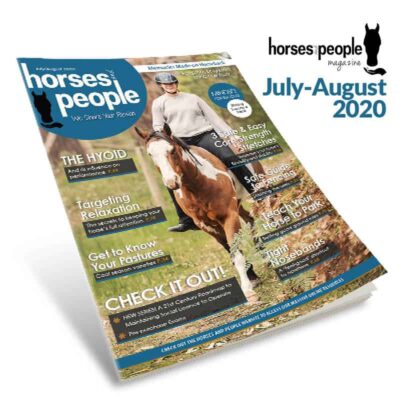
The July-August edition of Horses and People magazine’s front cover features up-and-coming youth Sara Leitch riding her mother’s Paint horse Duke (a.k.a. BPS I’m Obsessed), by the Quarter Horse An Obsession, and out of Ransoms First Priority.
The beautiful and serene scene captured by Louise Sedgman instantly caught my eye when I was searching for a candid image to portray that unique bond we develop with our horses. That Sara is confidently riding Duke bridleless through Hastings Pony Club grounds shows this pair have it.
“Mum bought Duke for herself and I stole him” laughs Sara after describing that six years ago, she had stopped riding after a bad fall. “I don’t know what it was… He spoke to me”.
Even before she was born, Sara’s family life revolved around horses. Mum Diane and dad Geoff are both New Zealanders but met here, in Australia, while working at a Thoroughbred breeding farm. Geoff’s professional involvement with rearing racehorses has taken them all around the world, from New Zealand and Australia to Dubai, Ireland and Kentucky.
Despite their shared love of horses, Diane stopped riding having Sara and Sara’s brother Jon, and it was only when Sara had her accident and lost interest that Diane decided it was time to get back in the saddle.
“I thought I would do something for myself again” says Diane. “And when I found Duke, all the stars aligned. He was only four but his cheeky and quiet character won me over”.
“We brought Duke home and I was enjoying trail riding him when Sara asked if she could have a ride. Next thing she was taking him to lessons, pony club and competitions! So I lost my horse for a bit” she continues.
The photoshoot took place a couple of years ago and now, Sara has a new horse, the 23 year-old off the track Thoroughbred Academy Dancer (a.k.a. Caddy), who was a Caulfield Stakes winner and retired to an eventing home, where he competed to one star level.
Sara says Duke prepared her well for the transition to a big, hot, racehorse. “Duke and I had our challenges, but most of his struggles have been mine more than his. He’s such a caretaker horse and has helped me overcome a lot.
“At the start, Caddy was quite laid back and placid but since we’ve had him, he seems to have become a much brighter personality” continues Sara. “I had a bit of trouble adjusting to a bigger canter, striding and height of horse, but we seemed to click. And mum still lets me ride Duke.
“I owe Duke so much” she continues. “Last year he took me to the Pony Club Australia’s State Championships, after coming back from an injury, and this year I want to do games on him.”
Diane says Duke is the perfect family horse and has allowed Sara to have fun and cement her confidence, and riding bareback and bridleless has become their favourite trick.
“We just did it” says Sara. “The first time I took the saddle and bridle off I was jumping cross rails. It is because I trust him so much and he’s just such an easy horse”.
“But he can be quite cheeky” adds Diane. “He can throw in a little pigroot and when Sara was younger, she used to fall off quite a bit. If they had been jumping he would sometimes finish the course without her!” she laughs.
Sara has managed to get in lots of riding during the COVID-19 lockdown. She’s had extra time to focus on improving Caddy’s flatwork but has missed the regular trips to other grounds either to exercise or compete in events.
Sara and Diane say they owe much gratitude to the Zerbe family who own Bittern Estate Winery, where their horses are agisted, as well as Sara’s sponsors Tuff Rock Australia, whose products have helped keep the horses sound and healthy.
Now, Sara is looking forward to taking part in Louise Sedgman’s fundraiser, ‘The Sweet Teen Project’ in support of Headspace Australia, an organisation that supports the mental health and wellbeing of our youth.
You can find more information about The Sweet Teen Project, pre-order the book or make a donation on Louise’s website: or on her Facebook Page.
This story featured in the July-August edition of Horses and People Magazine. Order a copy here.


 From the illustration, we get the sense that both horse and rider are a well-seasoned pair of fighters. We are told that they have taken part in some fifteen crusades in many countries and also fought for one pagan leader against another. We see the Knight’s tunic is still stained from the marks of his armour. The horse has two brands, an ‘M’ for ‘military’ on his neck, and a possibly Italian breeder’s mark on his haunch.
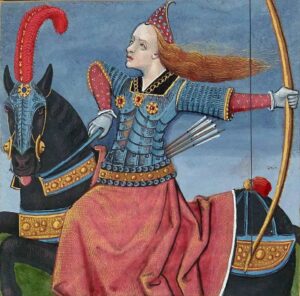 In the beautifully illustrated French translation of Boccaccio’s De Mulieribus Claris, or Book of Famous Women, we see the ancient Greek Amazon, Penthesilea, riding a magnificent black destrier in collected canter to the left (this article’s feature image). Her horse also appears to be poking out his tongue and whether this is a response to too much curb rein, or a challenge to the enemy remains a mystery!
 The other type of war-horse in the medieval period was the Courser or Charger. These were the slighter, lighter in build, swiftest and popular in combat. In the image from the German military engineer Konrad Kyeser’s 15th century book on military technology, Bellifortis, we see a good example of one.