
Ever considered adding Manuka honey to your equine first aid box? Here’s the scientific background that supports Manuka honey use in horse wounds.
Honey – the liquid gold. It’s sweet, tasty, and healthy. Most of us love honey – be it as a delicious bread spread or natural sweetener. But there is more to honey than just its irresistible taste.
Honey has long been praised for its medicinal properties and ancient civilisations, such as the Greek and Romans, already knew about honey’s beneficial effects on human health. Although honey plays a key role in apitherapy, a branch of alternative medicine, it is slowly finding its way into mainstream medical practice due to its exceptional medicinal properties.
From a total of several hundred honey types existing today, one stands out: Manuka honey. But why exactly is this dark honey so special? It is the chemical composition that makes it a potent tool in treating wounds and supporting the wound healing process, for instance – and it can also be used as a safe alternative to (some) common antibiotics.
What exactly is honey and what chemical substances does it contain, that gives it its omnipotent properties?
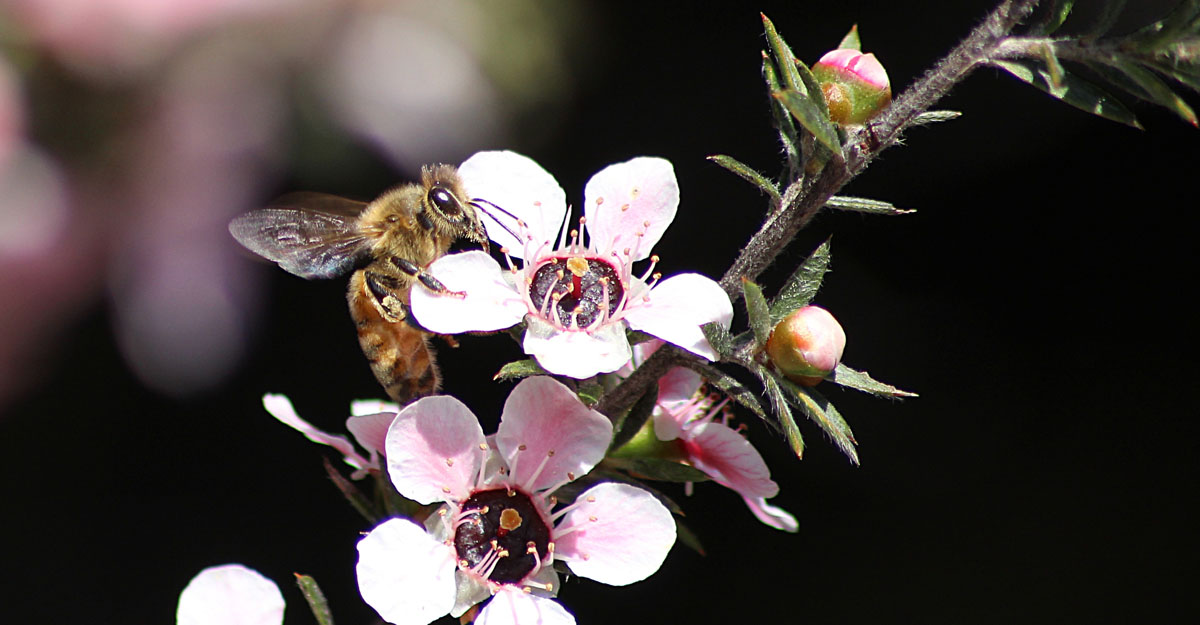
Bees make honey collecting flowering plants’ (including trees’) nectar with their long tongue. They then keep and transport the collected nectar in their extra stomach – also referred to as crop – before storing it in their beehives. The crop contains specific enzymes that change the nectars’ chemical composition and pH-value. Upon arrival at the beehive, bees regurgitate the nectar and enzyme mixture, which is still rather liquid. Once placed in a honeycomb, other bees help evaporate excess water before sealing the comb, using a secretion that later turns into beeswax.
Honey’s chemical composition depends on numerous factors
Honey differs in colour, texture, taste, and flavour – depending on the flower types visited by the bees. The high sugar (between 65 and 73 %) and relatively low water content (approximately 20-30 %) is a characteristic that most types of honey share. But honey is not just made up of sugar and water. Its chemical components are vast and varied and a total of about 180 different compounds can be found.
Honey contains various minerals and trace minerals such as Calcium, Magnesium, Iron and Kalium, important amino acids, and several Vitamins such as C, B2.
Honey’s properties (chemical compositions) also depend on its origin (plant type), environment, and the way it’s being processed (e.g., sterilised).
Darker honeys contain higher concentrations of phenols (flavonoids), i.e., strong antioxidants which can positively impact cardiovascular health, for instance.
One honey type stands out: Manuka honey
Manuka honey originates from New Zealand and a small proportion can be found in south-eastern Australia as well. As the name reveals, bees collect nectar from the Manuka plant – a type of myrrh. The aetheric oils of the Manuka plant have been found to show very potent antibacterial and anti-inflammatory properties.
In addition, Manuka contains hydroperoxide in small concentrations and methylglyoxal (MGO) which both are very efficient substances when combatting bacterial, viral, and mycotic infections. MGO is also termed unique Manuka factor (UMF), and the antibacterial effectiveness of Manuka honey increases with its MGO content. However, MGO can only reach its full potential in combination with the other components found in Manuka honey.
Honey’s antibacterial action is influenced by different factors that can impact wound healing such as the pH level of the wound itself, hydroxy peroxide concentration (anti-bacterial), pH level of the honey itself, its phenolic compounds.
The relatively low pH level of Manuka honey (around 4; slightly acid) not only inhibits bacterial growth but also stimulates fibroblast activity (wound healing). Bee-defensin-1 (a type of protein), complex sugars, and honey’s other phenolic compounds further contribute to its antimicrobial properties.
How does it work?
Antioxidant and antibacterial properties of honey help maintain moisture and the texture provides a natural protective layer and barrier to the environment, keeping harmful bacteria away and reducing chances of developing infections.
Honey reduces the wound healing time due to its ability to decrease the production of inflammatory cells at the wound site and helps with the proliferation of cells that aid in wound healing (e.g., fibroblasts).
What can it be used for?
Manuka honey is predominantly used in the treatment of topical wounds, infected or necrotic wounds, wounds that heal slowly or have developed proud flesh, stitched wounds/after operations, and it also works wonders against mud fever (although there are more cost-effective alternatives to treating mud fever or scratches).
Therefore, in some instances, the topical application of Manuka honey on wounds could become a sound alternative to (some) mainstream antibiotics.
In times where multi-resistant germs threaten to inhibit the proper functioning of antibiotics, Manuka honey, in combination with some antibiotics, can also become a powerful tool in treating wounds infected by multidrug resistant bacterium types (Alvarez 2014).
Remember, the higher the MGO or UMF content, the better Manuka honey will be in fighting off microbial infections and supporting wound healing.
See for yourself: Manuka honey and wound healing
The following photos contain graphic content (open wounds).
Short background: A horse caught his leg in a fence wire that led to a large wound in front if the hock joint (the joint capsule was still intact). Manuka honey has been applied from the beginning.
Photo 1 depicts the wound two weeks after the injury occurred – the tissue is still held together by the sutures.
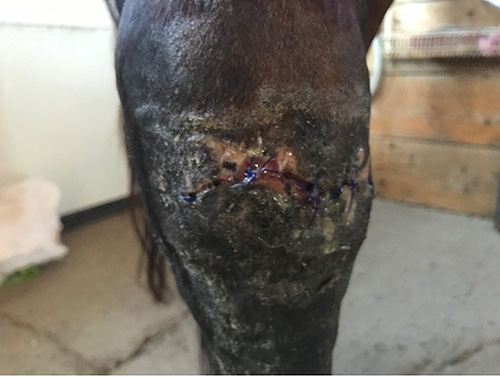
Photo 2 shows the wound just minutes after the sutures were removed.
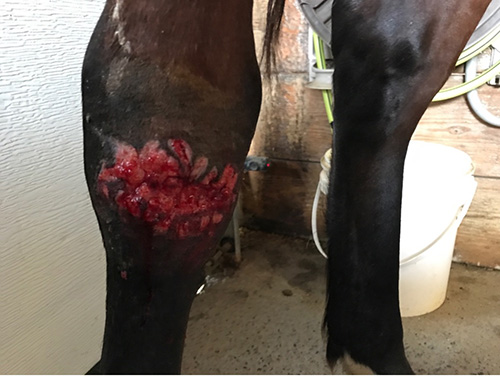
Photo 3 was taken only two days after photo 2 (note the progress in wound healing). The leg was dressed and bandaged continuously, and the wound dressing was replaced every other day (Manuka honey was applied on the wound every second day when the wound dressing was replaced).
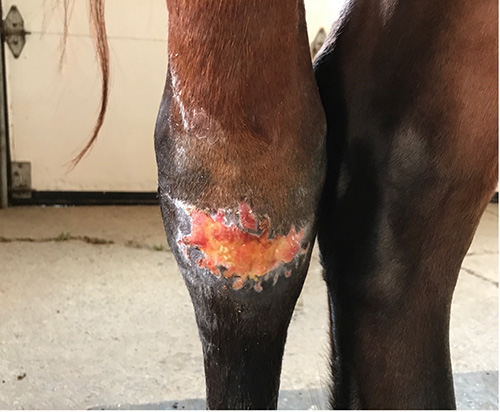
No infection occurred, nor did proud flesh or necrotic tissue develop.
Manuka honey… It really is a kind of magic.
References:
- Hossen MS, Ali MY, Jahurul MHA, Abdel-Daim MM, Gan SH, Khalil MI. Beneficial roles of honey polyphenols against some human degenerative diseases: A review. Pharmacol Rep. 2017 Dec;69(6):1194-1205. doi: 10.1016/j.pharep.2017.07.002. Epub 2017 Jul 4. PMID: 29128800.
- Khalil MI, Sulaiman SA. The potential role of honey and its polyphenols in preventing heart diseases: a review. Afr J Tradit Complement Altern Med. 2010;7(4):315-21. doi: 10.4314/ajtcam.v7i4.56693. Epub 2010 Jul 3. PMID: 21731163; PMCID: PMC3005390.
- Mavric, E.; Wittmann, S.; Barth, G.; Henle, T. Identification and quantification of methylglyoxal as the dominant antibacterial constituent of manuka (Leptospermum scoparium) honeys from New Zealand. Mol. Nutr. Food Res. 2008, 52, 483–489
- Lu, J.; Turnbull, L.; Burke, C.M.; Liu, M.; Carter, D.A.; Schlothauer, R.C.; Whitchurch, C.B.; Harry, E.J. Manuka-type honeys can eradicate biofilms produced by Staphylococcus aureus strains with different biofilm-forming abilities. Peer J. 2014, 25, e326, doi:10.7717/peerj.326
- Alvarez-Suarez, J.M.; Tulipani, S.; Romandini, S.; Bertoli, E.; Battino, M. Contribution of honey in nutrition and human health: A review. Mediterr. J. Nutr. Metab. 2010, 3, 15–23
- Gethin, G.T.; Cowman, S.; Conroy, R.M. The impact of Manuka honey dressings on the surface pH of chronic wounds. Int. Wound J. 2008, 5, 185–194
- Visavadia, B.G.; Honeysett, J.; Danford, M.H. Manuka honey dressing: An effective treatment for chronic wound infections. Br. J. Oral Maxillofac. Surg. 2008, 46, 55–56

Tanja Bornmann, BSc, MSc, MSc, Trainer B (FN)
Tanja is an equine scientist, qualified riding coach (dressage specialist), and writer. As a lifelong equestrian, she competed her own and clients' horses in dressage, showjumping, eventing, and at young horse shows, earning one national dressage championships title on her young mare. With a strong emphasis on horse welfare, Tanja’s training approach combines the principles of learning theory with classical dressage and up-to-date scientific findings - aiming to create ‘happy’ horses and well-informed riders.
Follow Tanja on twitter @academicequitat.
-
Tanja Bornmann, BSc, MSc, MSc, Trainer B (FN)#molongui-disabled-link

-
Tanja Bornmann, BSc, MSc, MSc, Trainer B (FN)#molongui-disabled-link
-
Tanja Bornmann, BSc, MSc, MSc, Trainer B (FN)#molongui-disabled-link