
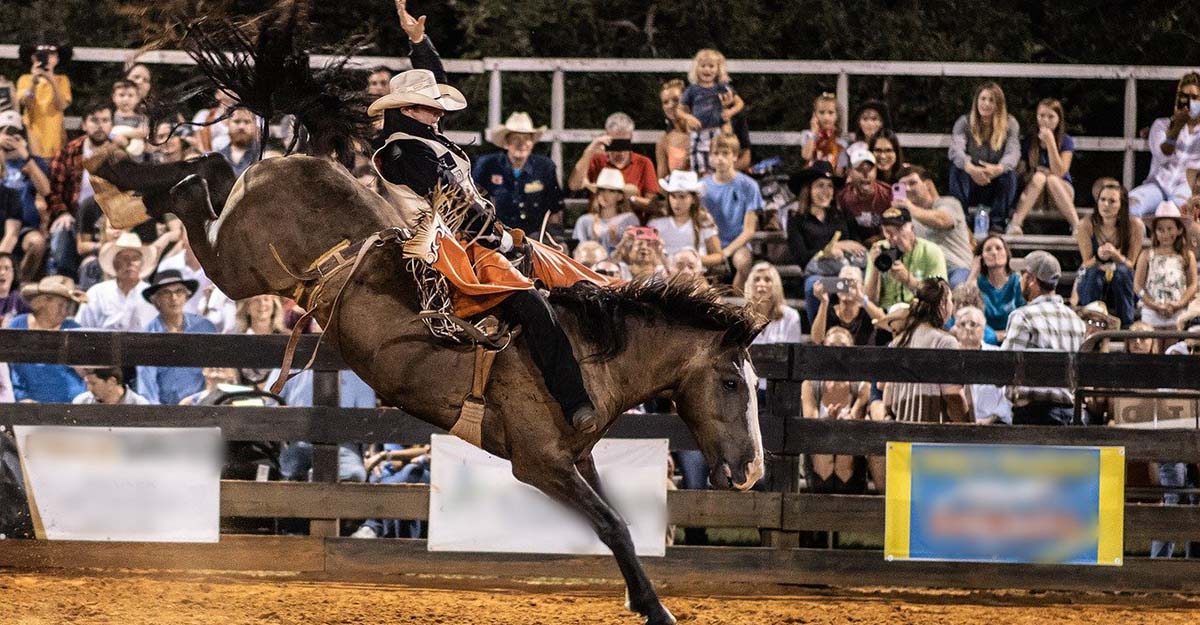
Research into the welfare of rodeo animals
When thinking of the American west, images of cowboys riding the open range moving large herds of cattle come to mind. With the cowboy was born the rodeo, where stockmen could practice and show off skills necessary for ranching life. Soon crowds were entertained watching a rider pit his expertise against a bucking horse in an effort to stay on for the 8-second ride. But with the thrill and excitement of rodeo events also comes concern over the welfare of the animals.
In spite of the rough and ready performances provided by rodeo events, multiple studies have shown an injury rate of less than one animal in 2000. This is far below the average in race horses of one injury and almost two fatalities per 1000, or eventing horses with a wastage rate of 28-45%.
Still, animal rights groups have campaigned ban rodeos to prevent the suffering of cattle and horses used for entertainment purposes.
Under this pressure, the Professional Rodeo Cowboys Association (PRCA) has responded by working together with the American Humane Association to implement stringent regulations including mandatory veterinary inspections, padded flank straps to encourage bucking, and only allowing dulled, free-spinning roweled spurs.
While the rodeo remains under close scrutiny, a group of researchers in western Canada were prompted to evaluate the behavioural stress responses of bucking horses.
They hypothesized that horses who were more experienced would be less reactive before their performance, and that reactive behaviours would be related to the environment or the anticipation of performance rather than from stress.
Bucking horses are not wild terrified animals put on display. Today’s bucking horses are carefully bred specifically for their bucking capacity, and a good bucking horse can be worth over $10,000.
Most bucking horses grow up in a natural environment until about four or five years of age when they are introduced to bucking work.
Those who are not predisposed to bucking are directed to ranch work.
Consignors provide strings of bucking horses for rodeo events, and while the horses do travel extensively from rodeo to rodeo, they might spend less than two minutes per year actually performing in the arena.
During a performance, a horse is scored by two judges on how well it bucks, and this is added to the score for the rider’s style.
Thus, it is important to have a healthy and sound horse to earn a good score.
Over three consecutive years, the researchers observed 116 horses entered in either the saddle bronc or bareback bronc competitions at a large sanctioned rodeo. Information on individual horse performance scores and how many times each horse was used was collected.
Behaviours of the horses were noted using video footage as they were herded from holding pens to loading chutes to bucking chutes prior to their performance. Movements of handlers were also examined in relation to the horses’ activities.
On average, horses spent at least an hour in the holding pen prior to a performance.
It took almost one minute to herd a selected horse to the loading chute, and the horse would spend almost 30min here before entering the bucking chute. Another 30min would be spent in the bucking chute where the horse would be tacked (for the saddle bronc competition) and the flank strap loosely applied.
At the last minute, the rider mounted and the flank strap was tightened as the horse was released into the arena for its performance. After eight seconds elapsed, or the rider was bucked off – whichever came first – the flank strap was released by outriders and the horse was herded out of the arena.
From the video footage the researchers found that over 71% of the horses balked at being herded into the loading chute, often balking more than once. Horses also balked while in the loading chute, most often when they had to make a 90 degree corner and where the chute narrowed.
Balking generally occurred when a handler was in front of the horse. Other than balking, few stress-induced behaviours were noted here.
While in the bucking chute, horses mostly displayed lip licking (>82%), moving to and fro (>69%), head tossing (>52%) and kicking (>51%). Kicking occurred most often while the horse was being tacked.
Horses who had performed at least three times previously were less likely to display stress-induced behaviours.
Behaviours were not correlated to the horse’s performance scores.
The researchers concluded that horses become habituated to their job since those with more experience displayed fewer stress-induced behaviours. This has been shown in horses working in other disciplines as well as in bucking bulls.
While the researchers were aware of the dangers of learned helplessness, they did not believe this was the case in the bucking horses since the horses were not apathetic to their environment.
The researchers did suggest simple adjustments to handling and facility design that would easily improve the horses’ experience. Removing the 90 degree corner would greatly reduce balking, as would keeping handlers out of the horse’s path. The number of handlers around any one horse ranged from 1-7, and having fewer handlers would also improve the ease of herding the horse through the chutes.
The act of tacking the horse appeared to be when the horse displayed the most stress-induced behaviours. The researchers suggested this could interpreted by the horse as a signal of imminent performance.
This study provides a baseline of horse behaviour prior to bucking events, however it did not measure outcomes from the performance itself.
While rodeo events may still be viewed by some as inappropriate use of animals, research results such as these can help rodeo organizations like the PRCA to improve the animals’ experience.
This article was sourced from The International Society for Equitation Science
Click here to read the original research article by Goldhawk C, Grandin T, Pajor E. 2021. Effect of animal’s experience and rodeo procedures on behaviour of bucking horses at a large commercial rodeo in Canada. Applied Animal Behaviour Science 234:105199.